Category Archives: USSR

African-Soviet Parallels before and after 1989

From The Fate of Africa: A History of Fifty Years of Independence, by Martin Meredith (PublicAffairs, 2005), pp. 378-379, 385-387:

By the end of the 1980s, not a single African head of state in three decades had allowed himself to be voted out of office. Of some 150 heads of state who had trodden the African stage, only six had voluntarily relinquished power. They included Senegal’s Léopold Senghor, after twenty years in office; Cameroon’s Ahmadu Ahidjo, after twenty-two years in office; and Tanzania’s Julius Nyerere, after twenty-three years in office….

Out of a list of fifty African countries in 1989, almost all were one-party states or military dictatorships. Opposition parties were illegal in thirty-two states. Elections, when held, served mainly to confirm the incumbent president and his party in power. In twenty-nine countries, over the course of 150 elections held between 1960 and 1989, opposition parties were never allowed to win a single seat. Only three countries – Senegal, the tiny state of Gambia and Botswana – sustained multi-party politics, holding elections on a regular basis that were considered reasonably free and fair. Botswana, in particular, stood out as an example of a liberal democracy, tolerant of opposition activity, where the rule of law was held in respect and where economic development proceeded apace.

Yet a new wind of change was stirring across Africa. It was driven in part by widespread discontent with the corruption, incompetence and stifling oppression of Big Man rule, in part by resentment over rising unemployment, falling living standards and austerity measures that African governments were forced to implement in return for international assistance. Students were at the forefront of a wave of protests that erupted in one country after another, but other urban groups – businessmen, professionals, churchmen, labour unions and civil servants – soon joined in, demanding not just redress of economic grievances but political reform.

Events abroad, in the Soviet Union and Eastern Europe, affected the clamour for change. From the mid-1980s, as a result of Mikhail Gorbachev’s ‘new thinking’, the Soviet Union began to retreat from Africa, no longer willing or able to sustain client states that had relied upon Soviet largesse for survival. With the demise of Marxism-Leninism in Europe came its demise in Africa. When Ethiopia’s Mengistu went to Moscow in 1988 to ask for more military hardware, Gorbachev turned him down, telling him he needed to reach a negotiated settlement to the wars in Eritrea and Tigray. Having lost Soviet sponsorship and confronted by rebel advances, Mengistu renounced Marxism-Leninism and embraced the idea of a multi-party system in the hope of avoiding defeat at the hands of the rebels. The outbreak of mass street demonstrations in Eastern Europe starting in the spring of 1989 and culminating in the fall of the Berlin Wall and the departure of European dictators like Ceausescu in Romania and Honecker in East Germany provided potent examples of what ‘people’s power’ could achieve. One-party regimes now looked outmoded, in Africa as much as in Europe. Even Julius Nyerere, the most articulate spokesman for one-party systems in Africa, felt obliged to modify his support. ‘To view a one-party system in almost religious terms is wrong; he said in February 1990 after visiting Leipzig in East Germany. ‘We Tanzanians have one party as a historical necessity. But this is not a kind of divine decree. It is not proper to treat a person who floats the idea of a multi-party system as someone who has committed treason.’

The end of the Cold War, moreover, changed the West’s attitudes towards Africa. Western governments no longer had strategic interests in propping up repressive regimes merely because they were friendly to the West. Along with the World Bank, they concluded that one-party regimes lacking popular participation constituted a serious hindrance to economic development and placed new emphasis on the need for democratic reform.

In June 1990 Britain declared that the distribution of its aid programme would henceforth favour countries ‘tending towards pluralism, public accountability, respect for the rule of law, human rights and market principles’. At a Franco-African summit at La Baule in June 1990, attended by thirty-three African delegations, twenty-two of which were led by heads of state, President Mitterrand stated that French aid would be dependent on efforts towards liberalisation. He warned: ‘French eagerness to offer development aid is bound to cool off in the case of authoritarian regimes which fail to heed the need for democratisation while regimes prepared to embark on the courageous path of democracy will continue to have our enthusiastic support.’

Previously, Franco-African summits had been known as lavish, back-slapping family gatherings, full of empty talk.

It seems clear in retrospect that Soviet models of governance and Soviet models of “development” were just as effective in strangling civil society and hollowing out the private sector in postcolonial Africa as they were in the ostensibly postimperial Soviet Union, leaving failed states awash in Kalashnikovs and ruled by gangsters to deal with the new expectations, dilapidated infrastructure, and diminished foreign subsidies of the 1990s, during which Africa experienced more than its share of Bosnias and Chechnyas (though with less artillery and more machetes than in their northern counterparts).

Leave a comment

Filed under Africa, Britain, democracy, Eastern Europe, France, USSR

Stalin Reinstates the Church, 1942-43

From Sacred Causes: The Clash of Religion and Politics, From the Great War to the War on Terror, by Michael Burleigh (HarperCollins, 2007), pp. 233-236:

Unlike Stalin, who suffered a mental collapse when the reality of Hitler’s invasion of the Soviet Union penetrated his state of denial, on the very day of the attack metropolitan Sergei sent a message to every Orthodox parish. It reminded the Russian faithful of the heroic deeds of their ancestors, and of the saints Alexander Nevsky and Dimitri Donskoi, who had rescued Holy Russia in past crises: ‘Our Orthodox Church has always shared the fate of the people. It has always borne their trials and cherished their successes. It will not desert the people now … The Church of Christ blesses all the Orthodox defending the sacred frontiers of our Motherland. The Lord will grant us victory.’ … When Stalin did finally address the nation on 3 July, he spoke in the uncharacteristic tones of ‘Brothers and sisters! My dear friends!’ whose religious accents were unmistakable. He may have mentioned Lenin, but the radio address was much more like a simple priest sounding the village tocsin. In October, patriarch Sergei wrote a further address, as the Germans came within sixty miles of the capital. He condemned clergy who had defected to the enemy, notably metropolitan Voskresensky who had been despatched to the Baltic States before the war as part of a wider attempt to exploit Orthodoxy to integrate the newly acquired states into the Red Empire. On 11 November, Stalin harangued troops on Red Square as German troops battled their way towards suburban Moscow, invoking Nevsky, Donskoi, Suvarov and Kutusov, realising that common or garden patriotism and religion had greater mobilising potential than Marxist-Leninism. Typically, patriarch Sergei had been dragged from his sickbed a few days before and deported to Ulyanovsk.

Of the other two remaining Orthodox hierarchs, metropolitan Nikolai was brought back from the Ukraine to Moscow, where he became the regime’s main clerical foreign policy propagandist, while metropolitan Alexei rallied the faithful during the terrible siege of Leningrad. The regime made a few cautious and parsimonious concessions to a Church that played a major role in maintaining wartime morale. It tolerated rather than encouraged religion. Overt anti-religious propaganda may have ceased for the duration, perhaps in rueful recognition of Pius XII’s leading role in persuading sceptical US Catholic bishops of the legitimacy of their government’s Lend-Lease aid to the Russian people despite his predecessor’s comprehensive damnation of Communism, a stance that militates against the notion that anti-Communism was the overriding obsession of his pontificate. Sunday was restored as a day of rest, and artists were allowed to repair damaged icons. In 1942 the presses of the almost defunct League of the Militant Godless were used to produce a tome called The Truth about Religion in Russia, in which the weary remnants of a Church the Soviets had tried to destroy were displayed for foreign consumption. Beyond this there were no concessions. At Easter 1942 churches in Moscow were allowed to hold candlelit processions as the curfew was raised for a night. This was a meagre gesture given the enormous role that the Churches had played in the war effort. Starting with Alexei in Leningrad, sermons became appeals to donate money to the war effort. By January 1943, over three million rubles had been raised in Leningrad alone. Another five hundred thousand rubles funded a tank column named after Dimitri Donskoi. By the end of the war, the Church had contributed 150 million rubles.

In November 1942 metropolitan Nikolai became the first cleric since 1917 to have an official function, when he joined a government commission to investigate Nazi war crimes on Soviet territory. That included putting his name to accusations that the Germans had carried out massacres at Katyn for which the NKVD had been responsible. In January 1943, patriarch Sergei sent a telegram to Stalin requesting permission to open a central bank account where the Church could deposit such monies. When Stalin assented, relaying the gratitude of the Red Army, the Church effectively received corporate legal recognition for the first time. It was a sign of the times that in the same month a senior party official in distant Krasnoyarsk formally received a bishop, who was also a brilliant surgeon, the man still being a prisoner at the time. In September, the exiled Sergei was surprised to find himself brought back to Moscow and installed in the former residence of the German ambassador. At 9 p.m. the following night, he and metropolitans Alexei and Nikolai, were driven to the Kremlin for a session with Molotov and Stalin. The former improbably asked what the Church might need. Recovering from the shock of this request, Sergei said the reopening of churches and seminaries, a Church council and the election of a patriarch. As if it had nothing to do with him, Stalin gently inquired: ‘And why don’t you have cadres? Where have they disappeared to?’ Rather than pointing out that most of these ‘cadres’ had died in camps, Sergei quickly joked: ‘One of the reasons is that we train a person for the priesthood, and he becomes the Marshal of the Soviet Union.’ This set Stalin off on a monologue about his days as a seminarian which went on until 3 a.m. Stalin helped the elderly Sergei down the stairs, saying, ‘Your Grace, this is all I can do for you at the present time,’ although he also appointed Georgi Karpov as the regime’s liaison with the Orthodox Church. Karpov was the NKVD official who had arrested and shot most of the clergy, though Stalin added, ‘I know Karpov, he is an obliging subordinate.’ At some point in the course of that night there was oral agreement regarding the future status of the Orthodox Church. Within four days nineteen bishops were found who elected Sergei patriarch, successor to patriarch Tikhon who had died in 1925. They issued a joint exhortation to Christians around the world to unite against Hitler.

1 Comment

Filed under religion, USSR, war

Baciu’s Early Exile Network

From Mira, by Ştefan Baciu (Honolulu: Editura Mele, 1979 [also Bucuresti: Editura Albatros, 1998], p. iii (my translation):

I dedicate this “Double Autobiography” to our Brazilian friends, departed but always present:

and to those in Hispanic America, just as present:

and to the memory of our friends:

    Grigore Cugler/“Apunake” (d. in Lima)
    Mircea Popescu (d. in Rome)
    Horia Tănăsescu (d. in San Francisco)
    Ion Oană-Potecaşu (d. in São Paulo)
    N. I. Herescu (d. in Zurich)
    Alexandru Busuioceanu (d. in Madrid)
    Aron Cotruş (d. in California)

It is perhaps not too surprising that the Romanian exiles are not well represented in Wikipedia. Baciu himself has a longer biography in Spanish Wikipedia than in either Romanian or English. Exiles tend to fall between the cracks. Who feels responsible for documenting their lives, people in their countries of exile or the ones they left behind? In the case of literary exiles, it depends who reads their work. I believe that Baciu devoted half of his own separate volume of memoirs (Praful de pe toba) to sketches of his old mentors and colleagues precisely in order to ensure that they would not be entirely forgotten.

Aleksandr Solzhenitsyn, who just passed away, spent time in both domestic internal and foreign exile. The English translations of his early classics like One Day in the Life of Ivan Denisovich, The First Circle, Cancer Ward, and August 1914 had a major influence on my understanding of what the Soviet system was all about, an understanding that was reinforced and enriched by my year in Romania in 1983-84. (I did not read The Gulag Archipelago, but have blogged passages of several books about Gulags more recently.) Solzhenitsyn is not regarded quite the same way in his country of exile as in his country of origin, and his obsessions also evolved differently at home and abroad. He lived more than two lives, perhaps even as many as nine.

Leave a comment

Filed under biography, Brazil, Latin America, literature, migration, North America, Romania, Russia, USSR

Ethiopia, 1978: One More Equal Than Others

From The Fate of Africa: A History of Fifty Years of Independence, by Martin Meredith (PublicAffairs, 2005), pp. 245-248:

In September 1976 the Ethiopian People’s Revolutionary Party (EPRP), drawing support from the labour unions, teachers and students, all vehemently opposed to military rule, embarked on a campaign of urban terrorism against the Derg and its civilian ally, the All-Ethiopian Socialist Movement, usually known by its Amharic acronym, Meison. An assassination attempt was made on Mengistu in the centre of Addis Ababa in September, the first of nine such attempts. Scores of officials and supporters of the Derg were murdered. The Derg in turn sent out its own murder squads…. By mid-1977 the EPRP was effectively destroyed. In the final phase of the red terror, to establish his own supremacy, Mengistu turned on his Meison allies, destroying them too. The young generation of intellectual activists, who had so avidly supported the revolution were all but wiped out.

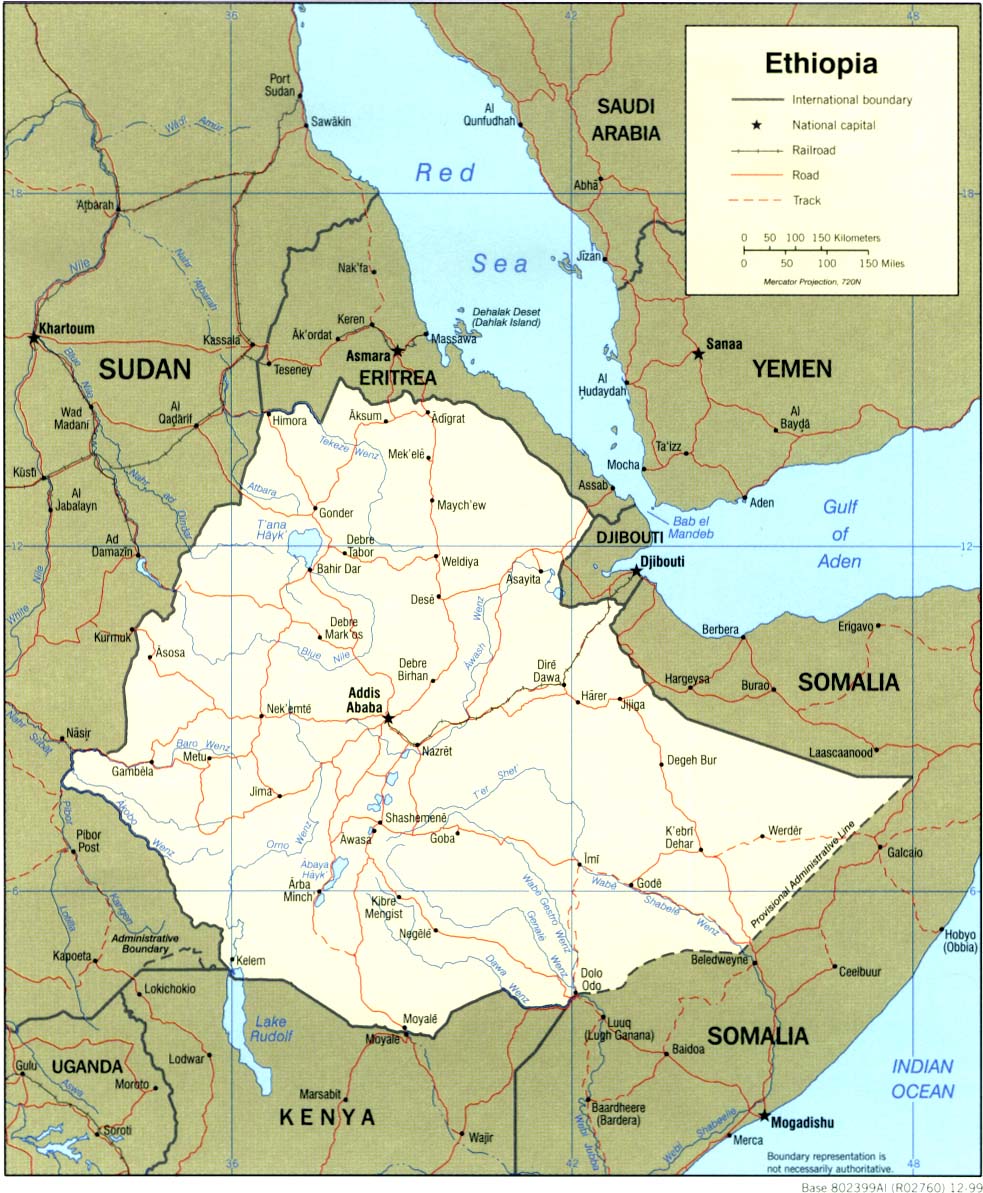
Mengistu’s hold over other parts of Ethiopia was nevertheless precarious. By mid-1977 the Ethiopian army in Eritrea had lost most major towns and controlled little more than Asmara and the ports of Massawa and Assab. In July 1977 Somalia, deciding the time was ripe to take advantage of the Derg’s preoccupation with Eritrea and other revolts, launched a full-scale invasion of the Ogaden. By August the Somalis controlled most of the Ogaden. In September they captured Jijiga, an Ethiopian tank base, and pressed on towards the town of Harar and the rail and industrial centre of Dire Dawa, the third largest city in Ethiopia.

What rescued Mengistu from military defeat was massive intervention by Soviet and Cuban forces, determined to prop up his Marxist regime. In November 1977 the Soviets mounted a huge airlift and sealift, ferrying tanks, fighter aircraft, artillery, armoured personnel carriers and hundreds of military advisers to Ethiopia. A Cuban combat force numbering 17,000 joined them. Led by Cuban armour, the Ethiopians launched their counter-offensive in the Ogaden in February 1978, inflicting a crushing defeat on the Somalis. The full force of the Ethiopian army, supported by the Soviet Union, was then turned on Eritrea.

At the fourth anniversary celebrations marking the overthrow of Haile Selassie in 1978, Mengistu sat alone in a gilded armchair covered with red velvet on a platform in Revolution Square in Addis Ababa watching a procession of army units and civilian groups pass before him. Then he returned to his headquarters at the Grand Palace. Having succeeded in holding the old empire together, he liked to portray himself as following a tradition of strong Ethiopian rulers. Indeed, Mengistu came to be compared with the Emperor Tewodros, a nineteenth-century ruler who started his career as a minor local chieftain, fought his way up to take the Crown and then strove to reunite the empire after a period of disintegration. At official functions at the Grand Palace, while members of the Derg stood respectfully to one side, Mengistu chose to preside from the same ornate chair that Haile Selassie had once favoured.

One of his ministers, Dawit Wolde Giorgis, once a fervent supporter of the revolution, recalled his growing sense of disillusionment.

At the beginning of the Revolution all of us had utterly rejected anything having to do with the past. We would no longer drive cars, or wear suits; neckties were considered criminal. Anything that made you look well-off or bourgeois, anything that smacked of affluence or sophistication, was scorned as part of the old order. Then, around 1978, all that began to change. Gradually materialism became accepted, then required. Designer clothes from the best European tailors were the uniform of all senior government officials and members of the Military Council. We had the best of everything: the best homes, the best cars, the best whisky, champagne, food. It was a compete reversal of the ideals of the Revolution.

He recalled, too, how Mengistu changed once he had gained complete control.

He grew more abrasive and arrogant. The real Mengistu emerged: vengeful, cruel and authoritarian. His conduct was not limited by any moral considerations. He began to openly mock God and religion. There was a frightening aura about him. Many of us who used to talk to him with our hands in our pockets, as if he were one of us, found ourselves standing stiffly at attention, cautiously respectful in his presence. In addressing him we had always used the familiar form of ‘you’, ante; now we found ourselves switching to the more formal ‘you’, ersiwo. He moved into a bigger, more lavish office in the Palace of Menelik. He got new, highly trained bodyguards – men who watched you nervously, ready to shoot at any time. We now were frisked whenever we entered his office. He began to use the Emperor’s cars and had new ones imported from abroad – bigger, fancier cars with special security provisions. Wherever he went he was escorted by these cars packed with guards, with more riding alongside on motorcycles.

He concluded: ‘We were supposed to have a revolution of equality; now he had become the new Emperor.’

You get the same result every single time a revolutionary thug promises equality—and begins to deliver it with the help of other revolutionary thugs. Every French Revolution yields a new Robespierre—and then a new Napoleon.

1 Comment

Filed under Cuba, Eritrea, Ethiopia, labor, language, military, USSR, war

The Gulag Economy’s Peace Dividend

From The Whisperers: Private Lives in Stalin’s Russia, by Orlando Figes (Metropolitan, 2007), pp. 467-468:

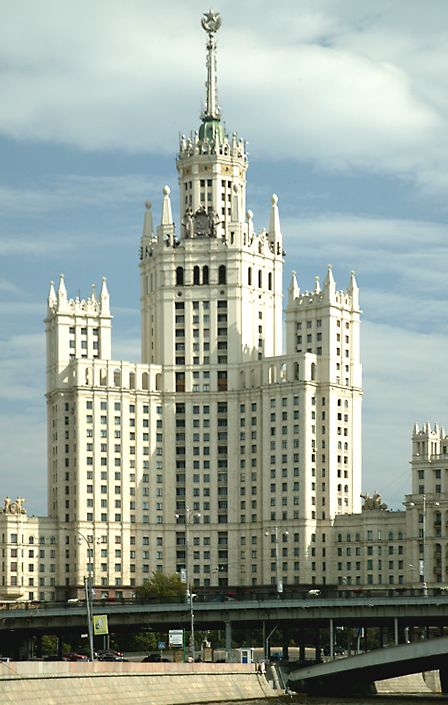
Forced labour played an increasingly important part in the post-war Soviet economy, according to a policy dictated by Stalin and his ‘kitchen cabinet’ of advisers. With the ending of the war the pool of unpaid labour available for exploitation by the state grew enormously. Apart from Gulag prisoners and labour army conscripts, there were 2 million German POWs, and about another million from other Axis nationalities, who were mostly used for timber-felling, mining and construction, although those with skills were employed occasionally in Soviet industry. In some factories German POWs were so integral to production that detention camps were built on the factory grounds and officials tried to block the prisoners’ repatriation to Germany. The Gulag population also grew, despite the release of many prisoners in the amnesty of 1945; the camps took in well over a million new prisoners between 1945 and 1950, largely as a result of the mass arrest of ‘nationalists’ (Ukrainians, Poles, Belorussians, Latvians, Lithuanians and Estonians) in territories captured or reoccupied by the Red Army but never really reconciled to Soviet power. The Gulag system expanded into a vast industrial empire, with 67 camp complexes, 10,000 individual camps and 1,700 colonies, employing a captive labour force of 2.4 million people by 1949 (compared with 1.7 million before the war). Overall, it is estimated that conscript labourers represented between 16 and 18 per cent of the Soviet industrial workforce between 1945 and 1948. They were especially important in the mining of precious metals in cold and remote regions where free labour was very expensive, if not impossible, to employ (hence their contribution to the Soviet economy was even more significant than the figures would suggest). Slave labour also made up the workforce in the big construction projects of the late 1940s which came to symbolize, officially at least, the post-war confidence and achievements of the Soviet system: the Volga–Don Canal; the Kuibyshev hydro-electric station; the Baikal-Amur and Arctic railways; the extensions to the Moscow Metro; and the Moscow University ensemble on the Lenin Hills, one of seven wedding-cake like structures (‘Stalin’s cathedrals’) in the ostentatious ‘Soviet Empire’ style which shot up around the capital in these years.

The post-war years saw a gradual merging between the Gulag and civilian economies. Every year about half a million Gulag labourers were contracted out to the civilian sector, mostly in construction, or wherever the civilian ministries complained of labour shortages; about the same number of free labourers, mostly specialists, were paid to work in Gulag industries. The Gulag system was increasingly compelled to resort to material incentives to motivate even its forced labourers. The population of the camps had become more unruly and difficult to control. With the amnesty of about a million prisoners in 1945, mainly criminals, who had their sentences either reduced or annulled, the camps were left with a high proportion of ‘politicals’ – not the intellectual types who filled the camps in the 1930s but strong young men who had fought as soldiers in the war, foreign POWs, Ukrainian and Baltic ‘nationalists’ – who were hostile to the Soviet regime and not afraid of violence. Without a system of rewards, these prisoners simply refused to meet the set targets. The cost of guarding the prisoners was also becoming astronomical. By 1953, the MVD was employing a quarter of a million guards within its camps, spending twice as much on the upkeep of the Gulag than it received in revenue from its output. Several senior MVD officials were seriously questioning the effectiveness of using forced labour at all. There were even mooted plans, supported by Beria and Malenkov, to dismantle sections of the Gulag and convert the prisoners into partially civilian workers, but since Stalin was a firm supporter of the Gulag system, none of these ideas was seriously proposed.

Leave a comment

Filed under economics, labor, nationalism, Russia, USSR, war

Soviet Wartime Disunity and Unity

From The Whisperers: Private Lives in Stalin’s Russia, by Orlando Figes (Metropolitan, 2007), pp. 419-421:

Contrary to the Soviet myth of wartime national unity, Soviet society was more fractured during the war than at any previous time since the Civil War. Ethnic divisions had been exacerbated by the Soviet state, which scapegoated certain national minorities, such as the Crimean Tatars, the Chechens and the Volga Germans, and exiled them to regions where they were not welcomed by the local populace. Anti-Semitism, which had been largely dormant in Soviet society before the war, now became widespread. It flourished especially in areas occupied by Hitler’s troops, where a large section of the Soviet population was directly influenced by the Nazis’ racist propaganda, but similar ideas were imported to places as remote as Kazakhstan, Central Asia and Siberia by Soviet soldiers and evacuees from the western regions near the front. Many people blamed the Jews for the excesses of the Stalinist regime, usually on the reasoning of Nazi propaganda that the Bolsheviks were Jews. According to David Ortenberg, the editor of Krasnaia zvezda, soldiers often said that the Jews were ‘shirking their military responsibilities by running away to the rear and occupying jobs in comfortable Soviet offices’. More generally, this gulf between the front-line servicemen and the ‘rats’ who remained in the rear became the focus of a widening divide between the common people and the Soviet elite, as the unfair distribution of the military burden became associated in the popular political consciousness with a more general inequality.

But if there was no genuine national unity, people did unite for the defence of their communities. By the autumn of 1941, 4 million people had volunteered for the citizens’ defence (narodnoe opolchenie), which dug trenches, guarded buildings, bridges and roads, and, when their city was attacked, carted food and medicine to the soldiers at the front, brought back the injured and joined in the fighting. In Moscow the citizens’ defence had 168,000 volunteers from over thirty nationalities, and another half a million people prepared for defence work; in Leningrad, there were 135,000 men and women organized in units of the citizens’ defence, and another 107,000 workers on a military footing, by September 1941. Fired up with civic patriotism, but without proper training in warfare, they fought courageously but died in shocking numbers in the first battles.

Comradeship was also crucial to military cohesion and effectiveness. Soldiers tend to give their best in battle if they feel some sort of loyalty to a small group of trusted comrades, or ‘buddies’, according to military theorists. In 1941–2, the rates of loss in the Red Army were so high that small groups seldom lasted long: the average period of front-line service for infantrymen was no more than a few weeks, before they were removed by death or injury. But in 1942–3, military units began to stabilize, and the comradeship that men found within them became a decisive factor in motivating them to fight. The closeness of these friendships naturally developed from the dangers the men faced. The mutual trust and support of the small collective group was the key to their survival. ‘Life at the front brings people closer very fast,’ wrote one soldier to the fiancée of a comrade, who had been killed in the fighting.

At the front it is enough to spend a day or two together with another man, and you will find out about all his qualities and feelings, which on Civvy Street you would not learn in a year. There is no stronger friendship than the friendship of the front, and nothing can break it, not even death.

Veterans recall the intimacy of these wartime friendships with idealism and nostalgia. They claim that people then had ‘bigger hearts’ and ‘acted from the soul’, and that they themselves were somehow ‘better human beings’, as if the comradeship of the small collective unit was a cleaner sphere of ethical relationships and principles than the Communist system, with all its compromises and contingencies. They often talk as if they found in the collectivism of these groups of fellow soldiers a type of ‘family’ that was missing from their lives before the war (and would be missing afterwards).

Leave a comment

Filed under USSR, war

Gulag Returnees Meet Their Accusers

From The Whisperers: Private Lives in Stalin’s Russia, by Orlando Figes (Metropolitan, 2007), pp. 583-587:

‘Now those who were arrested will return, and two Russias will look each other in the eye: the one that sent these people to the camps and the one that came back.’ With those words the poet Akhmatova anticipated the drama which unfolded as prisoners returned from the camps to confront colleagues, neighbours, friends who had informed on them….

Ibragim Izmail-Zade was a senior professor of medicine and a departmental head at the Institute of Medicine in Baku at the time of his arrest, in 1938, on charges of belonging to an ‘anti-Soviet group of Azerbaijani nationalists’. After his release from the Kolyma camps, he returned to Baku, where he took up a junior position in the same institute. Instead of the cutting-edge research he had done in the 1930s, he was now employed in routine clinical work. During the trial of M. D. Bagirov, the former Party boss of Azerbaijan, in 1955, Ibragim appeared as a witness for the prosecution, in which capacity he was allowed to look at his own file from 1938, when Bagirov had led the terror campaign in Baku. Ibragim discovered that he had been denounced by his favourite student, who had since gone on to become the head of his department at the institute. While Ibragim was in Kolyma, the former student had often visited his wife and daughter, who treated him as a member of the family. The old student was noticeably cooler in his behaviour after Ibragim’s return, rarely coming to the house, and never in the evening, when he would have been obliged to eat or drink with him. After his discovery of the denunciation, Ibragim and his family were forced to see the former student several times, and while they never spoke to him about his actions, it was clear that the Izmail-Zades now knew of the betrayal. One day the political director of the institute appeared at the Izmail-Zade house. He wanted Ibragim to sign a document stating that his family had no grievance against the former student, and that they would remain on friendly terms. Ibragim refused to sign. He had to be restrained from throwing the official out on the street. According to his daughter, Ibragim was crushed by the betrayal. He felt humiliated at being forced to work beneath someone who, he felt, was hardly qualified. Being asked to sign the document had been the final straw….

Many former prisoners were surprisingly forgiving towards the people who had informed on them. This inclination to forgive was seldom rooted in religious attitudes, … but it was often based on the understanding, which was shared by everyone who had experienced the prisons and the camps of the Gulag system, that virtually any citizen, no matter how good they might be in normal circumstances, could be turned into an informer by pressure from the NKVD.

Leave a comment

Filed under Russia, USSR

Gorky: ‘We need more camps like Solovetsky’

From The Whisperers: Private Lives in Stalin’s Russia, by Orlando Figes (Metropolitan, 2007), pp. 192-194:

In August 1933, a ‘brigade’ of 120 leading Soviet writers went on a boat tour of the White Sea Canal organized by Semyon Firin, the OGPU commander of the labour camps at the canal. The idea of the trip had its origins in a meeting that took place in Maksim Gorky‘s Moscow house in October 1932, at which a number of the country’s leading writers discussed the tasks of literature with several Politburo members, including Stalin, and other Party functionaries. In one of the earliest statements of the Socialist Realist doctrine, Gorky called for a heroic literature to match the ‘grand achievements’ of the Five Year Plans, and Stalin, who compared the Soviet writers to ‘engineers of the human soul’, proposed a tour of the canal to inspire them. Everything was organized by OGPU. ‘From the minute we became the guests of the Chekists, complete Communism began for us,’ the writer Aleksandr Avdeyenko later commented ironically. ‘We were given food and drink on demand. We paid nothing. Smoked sausage, cheeses, caviar, fruit, chocolate, wines and cognac – all was in plentiful supply. And this was a year of famine.’…

The writers had different reasons for colluding in this legitimation of the Gulag. No doubt there were some who believed in the Stalinist ideal of perekovka, the remoulding of the human soul through penal labour….

Gorky was also a believer. He never visited the White Sea Canal. But this was no obstacle to his glowing praise of it in the book commissioned by OGPU (just as ignorance was no obstacle to foreign socialists, like Sidney and Beatrice Webb, who also praised the canal as ‘a great engineering feat … a triumph in human regeneration’ in 1935). Having spent the 1920s in the West, Gorky had returned to the Soviet Union on the first of several summer trips in 1928 and had settled there for good in 1931. The ‘great Soviet writer’ was showered with honours; he was given as his residence the famous Riabushinsky mansion in Moscow; two large dachas; private servants (who turned out to be OGPU spies); and supplies of special foods from the same police department that catered for Stalin. So perhaps it is not surprising that Gorky failed to see the immense human suffering that lay behind the ‘grand achievements’ of the Five Year Plan. In the summer of 1929, Gorky had visited the Solovetsky labour camp. The writer was so impressed by what he was shown by his OGPU guides that he wrote an article in which he claimed that many of the prisoners had been reformed by their labour in the camp and loved their work so much that they wanted to remain on the island after the completion of their sentences. ‘The conclusion is obvious to me,’ Gorky wrote: ‘we need more camps like Solovetsky.’

Leave a comment

Filed under literature, religion, Russia, USSR

St Vladimir of the October Revolution

From: Sacred Causes: The Clash of Religion and Politics, From the Great War to the War on Terror, by Michael Burleigh (HarperCollins, 2007), pp. 53-54:

Krupskaya’s wish that her husband [V. I. Lenin] be interred with other old comrades was ignored in favour of mummifying his corpse, a step apparently inspired by worldwide fascination with he contemporary excavation of Luxor and discover of the tomb of the pharoah Tutankhamen, although the intention was to preserve for eternity what Robert Service has dubbed ‘Saint Vladimir of the October Revolution’. Lenin’s mummified corpse was displayed in a temporary timber mausoleum in the Wall of the Kremlin before this was replaced in 1930 by a permanent stone structure. The design reminded one Russian commentator of the tomb of King Cyrus near Murgaba in Persia, although the model was actually the mausoleum of Tamerlane. The prime movers in the preservation of Lenin’s body were Bonch-Bruevich, Leonid Krasin and Lunacharsky, ironically all erstwhile God-builders who had clashed with Lenin on this very issue. They formed an ‘Immortalisation Commission’. The reasons for Lenin’s mummification were several. His early death, probably brought about by chronic bureaucratic overwork that he had been unaccustomed to in the earlier decades of his life, was a metaphor for the years of revolutionary elan and enthusiasm that were ineluctably passing away. Mummification meant that the moment would exist in this curious symbolic form throughout time. His spirit would also endure in the Party: ‘Lenin lives in the heart of every member of our Party. Every member of our Party is a small part of Lenin. Our whole communist family is a collective embodiment of Lenin.’ The aura of this dead St Vladimir would spread to his lesser successors, who henceforth were in control of what he had or had not said or written during his lifetime. Significantly, Stalin managed to gain influence over the fledgling Lenin Institute at the Party’s Sverdlov university, and through The Foundations of Leninism, in which he explained Lenin’s ideology to the new Party intake, thereby establishing himself as guardian of the canonical texts.

And what was the net result of this vicious campaign against religion? The Party-state could certainly deploy more force, and did so against the Orthodox clergy. But the ranks of the militant godless waned as quickly as they had waxed, and they were usually filled with the intellectually low grade in the first place. Peasants, whether on the land or newly transplanted to the cities, found ways of resisting this assault on their beliefs, perhaps by sending grannies to obstruct four-eyed student atheists or using loopholes in the law to retain use of a church. Committed religious believers became more entrenched in their faith, while the more casually secure fell away, probably without turning to the dominant secular creed.

Leave a comment

Filed under religion, Russia, USSR

Stakhanovites as the New (Leisure) Class

From: Sacred Causes: The Clash of Religion and Politics, From the Great War to the War on Terror, by Michael Burleigh (HarperCollins, 2007), pp. 89-91 (reviewed here and here):

The Soviet Union was not immune to what was emerging as a global cult of celebrity, or notoriety, focused on athletes, aviators, boxers, film-stars, gangsters, mountaineers and, as we have seen, dictators. Already, the commissar for heavy industry, Sergo Ordzhonikidze, had launched the search for ‘new people’, saying, ‘In capitalist countries, nothing can compare with the popularity of gangsters like Al Capone. In our country, under socialism, heroes of labour, our Izotovites, must become the most famous,’ a reference to Nikita Izotov, a miner whom colleagues described rather sourly as ‘the human cutting machine’. But Izotov was destined to be eclipsed, along with the new hybrid Marx, Aristotle and Goethe.

In 1931 Pravda ran features under the slogan ‘The Country Needs to Know its Heroes’, consisting of photographs of aviators, collective farmers, shock-workers and the like. The concept of the exemplary elite was primarily associated with Aleksei Stakhanov, a thirty-year-old Donbass coalminer, who in August 1935 managed to cut 102 tons of coal (or fourteen times his norm) in a single shift—moreover, with the aid of a trusty Soviet-produced pneumatic pick. Stakhanov had migrated from a village in Orel, working his way up from pony-brakeman to manual pick operative, before getting his hands on the air-powered pick that brought him fame and fortune. Of course the work was done at night, enabling Stakhanov to maximise his labours as compressed air went to his pick alone, and his six-hour continuous stint was facilitated by a lengthy logistical chain beginning with the men installing timber props behind him. Nonetheless, the anonymous battalions of shock-workers were thenceforth superseded by a Soviet Hercules with a human face. ‘Recordmania’ spread like a feverish sickness, with managers and foremen sweating too lest they be denounced as ‘bigwigs’, ‘windbags’, ‘routiners’, ‘wreckers’, or ‘saboteurs’ for failing to make these ‘Stakhanovite’ feats feasible, rendering them liable to what the Kremlin’s own Al Capone sinisterly called ‘straightening out’ or ‘a tap on the jaw’. It mattered not that these epic episodes tended to deplete machinery and leave ‘Stakhanovites’ spent, or that some workers resented the diversion of resources, the subsequent lifting of their own norms, or the rich rewards such Promethean heroics brought. Schadenfreude best describes those who said of a young female Stakhanovite, who had been rewarded (one hopes she was grateful) with the selected works of Lenin: ‘That’s what the whore deserves!’ Resentment towards Stakhanovites bestriding the factory floors ‘like gods’ was compounded when they became fixtures of the factory ‘production courts’.

Much of the time of stellar Stakhanovites was increasingly spent on tour, whether visiting the Kremlin, addressing other workers or venturing confidently into places—such as the opera or theatre—where workers already did not comfortably go. Even society pages in the newspapers included such gems as ‘The brigadier-welder Vl. Baranov (28), the best Stakhanovite at Elektrozavod, glided across the floor in a slow tango with Shura Ovchinnovka (20), the best Stakhanovite at TsAGI. He was dressed in a black Boston suit that fully accentuated his solidly built figure; she was in a crepe de chine dress and black shoes with white trimming.’

In other words, although they talked incessantly about work, Stakhanovites did less and less of it, recalling it, like millionaire footballers or pop stars from humble origins, as something that took on roseate hues in memory of things past. Of course, Stakhanovites had a role to play within a wider myth-in-the-making. As an explicitly hierarchical society replaced one allegedly based on fraternity, they had to acknowledge the crucial guiding role of the nation’s father-figure, whose speeches had allegedly originally inspired them to break through artificial barriers while using technology almost as an extension of their own brain. Stakhanovites, who were often not members of the Party, were also model citizens in respects other than dutiful sons and daughters of the ultimate patriarch. Their lifestyle was supposed to exemplify the theme that ‘life is joyous, comrades’, and since they were showered with official munificence while simultaneously enjoying very high wages, the joyous life seemed like an idyllic shopping spree, for clothes, clocks, furniture, motorbikes, perfume, phonographs and so forth. Thus adorned and kitted out, Stakhanovites appeared having their leisurely breakfasts, reading the papers, lunching with friends, playing a little volleyball, tea and a game of checkers, while their wives undertook charitable work as ‘housewife-activists’ and their children were exhorted to their own heroics at school.

Leave a comment

Filed under economics, industry, Russia, USSR