
Category Archives: U.S.

Watershed Face-off: 1979 vs. 1989

While Europeans and Americans are remembering the major transformation of international relations in 1989, economic historian Niall Ferguson argues that 1979 marked a much greater watershed.

The real question about Russian policy today is not whether Russia will invade Ukraine, but whether Gazprom’s strategy of investing in new pipelines and gas fields will pay off. Should Gazprom focus on developing its dominant position in the European natural-gas market? Or should the vast gas fields of Russia east of the Urals (Yamal, Arctic, Far East) be given precedence with a view to capturing market share in China? Could Russia one day establish an Organization of Gas Exporting Countries, modeled on the Saudi-dominated oil cartel? Or is the simpler strategy simply to stoke trouble in the Middle East, covertly encouraging the Iranians’ nuclear ambitions until the Israelis finally unleash airstrikes, and then reaping the rewards of a new energy price spike?

These questions themselves indicate the limited long-term significance of the Soviet collapse of two decades ago. By comparison, the events of 10 years earlier—in 1979—surely have a better claim to being truly historic. Just think what was happening in the world 30 years ago. The Soviets began their policy of self-destruction by invading Afghanistan. The British started the revival of free-market economics in the West by electing Margaret Thatcher. Deng Xiaoping set China on a new economic course by visiting the United States and seeing for himself what the free market can achieve. And, of course, the Iranians ushered in the new era of clashing civilizations by overthrowing the shah and proclaiming an Islamic Republic.

Thirty years later, each of these four events has had far more profound consequences for the United States and the world than the events of 1989. Today it is the Americans who now find themselves in Afghanistan, fighting the sons of the people they once armed. It is the free-market model of Thatcher and Reagan that seems to lie in ruins, in the wake of the biggest financial crisis since the Depression. Meanwhile, Deng’s heirs are rapidly gaining on a sluggish American hyperpower, with Goldman Sachs forecasting that China’s GDP could be the biggest in the world by 2027. Finally, the most terrifying legacy of 1979 remains the radical Islamism that inspires not only Iran’s leaders, but also a complex and only partly visible network of terrorists and terrorist sympathizers around the world.

In short, 1989 was less of a watershed year than 1979. The reverberations of the fall of the Berlin Wall turned out to be much smaller than we had expected at the time. In essence, what happened was that we belatedly saw through the gigantic fraud of Soviet superpower. But the real trends of our time—the rise of China, the radicalization of Islam, and the rise and fall of market fundamentalism—had already been launched a decade earlier. Thirty years on, we are still being swept along by the historic waves of 1979. The Berlin Wall is only one of many relics of the Cold War to have been submerged by them.
Leave a comment

Filed under Afghanistan, Britain, China, economics, energy, Iran, Islam, Middle East, Russia, U.S., USSR, war

One Child’s Language: at 18 months

Her attention span is getting longer and longer. She can concentrate for 10 or 15 minutes on taking things apart and putting them back together, on putting all 10 or 20 shapes through the matching holes in one of her puzzle toys, on reading books with one or the other of us. She can spend even longer listening to her tapes of children’s songs, although sometimes she spends more time pushing the play and stop buttons than listening to her songs. She is especially fond of the Finger Band song, during which she imitates the clarinet, piano, and trombone motions; the Buzzing Bees song, during which she imitates the buzzing sound by blowing a ‘raspberry’ (or ‘Bronx cheer’); the Teddy Bear song, during which she holds her big teddy bear up by the ears and dances back and forth; and, of course, Twinkle, Twinkle, Little Star, during which she ‘twinkles’ her hands.

She has finally started to take a real interest in language. Her earliest words several months ago were mostly imitations of sounds. (The first sound she ever imitated was—incredibly—the hooting of an owl, something she has never seen nor heard in real life.) For persons, places, and things, she has followed the Universal Language strategy recommended by the scientifically minded inhabitants of Lagardo that Gulliver met in his travels: just make sure you have available (by carrying them around if you have to) a sample of every object you care to refer to. That way, you can just point to what you want to say, without having to translate from one language to another. For actions, rather than objects, she usually performs the motions herself. This reduces a lot of our own conversation with her to one-word utterances. But now she is starting to produce some of her own.

The first consonants she tackled were [t] and [d]. She has them under relatively good control now and has definitely mastered [dadi] (the word as well as the person). Next, she began to work on words starting with [p] and [b]. Sometime last month, she suddenly realized that her counting word [tuti] had two components and started saying just [tu]. It wasn’t long before she was counting [tu] for one step and [ti] for the next. Then one day she counted out [pai] as well. Now she can repeat [tu], [ti], [po], [pai], but she hasn’t mastered the meaning of any except [tu]. Another [p]/[b] word she has added recently is [bow] ‘go’ (versus [taa] or [paa] ‘stop’). The [oh] vowel is also new, and she stretches it—and her lips—to great lengths pronouncing it. Another lip sound she has added is [w]. Her first [w] word was a strangely produced [weyl]. Her tongue tip shot all the way out of her mouth during the [l] (ell) part of it. It used to be one of her babbling sounds, but we attached it to the picture of a ‘whale’ in one of her books, and she has since used it to label ‘wheels’, ‘nails’, and ‘mail’. The other new vowel is [eh], which appears in [wey] ‘away’, another favorite word. It also appears in [tu-tu tey] ‘choo-choo train’. She seems to make no attempt to repeat a word unless it contains sounds close to those she is working on at any particular moment.

When she mastered [w], she promptly added [wow] to her verbal expressions. But she has never attempted [m], [n], or [ng].

UPDATE: This child is now a 24-year-old teacher in Boston Public Schools.

1 Comment

Filed under family, Hawai'i, language, music, U.S.

One Child’s Language: at 16 months

Her passive language ability still far exceeds her active speaking ability, but she has added a few words to her repertoire. During our Christmas trip, she attached the meaning ‘all gone, all done, finished’ to a high-pitched [datii], with a high-pitch first vowel and a mid-pitch, long second vowel, accompanied by appropriate upturned empty hands. This contrasts with her lower-pitched (mid + low) and shorter [dati], meaning ‘thank you.’ (She doesn’t seem to distinguish [t] and [d].) Finally, there is a low-plus-high-pitched [dati] that she uses to call whichever one of us she can’t find. There is also a [daa], with long rising-falling tone, which seems to mean something like ‘wow, look at that’; and a steady high-tone [daa], meaning ‘stop’ or ‘stoplight’. The former contrasts somehow with [iyati], meaning roughly ‘voici, voilà, here it is, there it is’. She has recently added another word: [daau(b)], meaning ‘(fallen or dropped) down’ (or ‘dirty, no longer edible’ in the case of food). She also seems to be in the process of extending the meaning of [dudu] to cover any fundamental contribution to the ecology of her diaper. She must be about ready to start toilet-training.

At this point, her total inventory of significant sounds doesn’t amount to much: one consonant /d/ (or /t/), and three vowels /a/, /i/, and /u/. The consonant sounds like both a [b] (or [p]) and a [d] (or [t]) except when it precedes the open vowel /a/. She seems to leave her lips closed before a closed vowel like /i/ or /u/ and to let the air through them only after she releases the /d/ to let the vowel sound come out. Besides [dudu], the other case where this is very noticeable is in her word for counting: [du]-[di] (‘two-three’?).

She elicits words as labels all the time, and wants us to supply running commentary on her actions, but most of her use of spoken language is exclamatory rather than descriptive. When she wants to refer to actual events and objects, she points—relentlessly. Here is a very common languageless dialog, with translation:

Action: Taps on mommy’s wrist until mommy acknowledges.
Meaning: ‘Excuse me, I notice you’re wearing a wristwatch.’
[Establishing topic to be ‘wristwatches’]

Mommy says, “Mommy’s watch,” meaning “Yes, I am.”

Action: She immediately taps her own wrist
Meaning: “I seem to be missing mine.”
[Making her observation about the topic]

Mommy says, “Where’s your watch?”

Action: She either points in the direction of her watch or goes off to find it.

UPDATE: This child is now a 24-year-old teacher in Boston Public Schools.

1 Comment

Filed under family, Hawai'i, language, U.S.

One Child’s Language: at 15 months

Her biggest accomplishments are social. She walks up to the babysitter’s door and knocks on it herself. She waves bye-bye to one or the other of us leaving or staying without her and doesn’t get upset. She knows not only our daily cycle, but also has a good feel for our weekly cycle of routines. She warms up to friends and strangers much more quickly than before and plays with other kids, not just near them. She gets very jealous, though, when another kid plays with her toys or her parents. She loves to get rowdy and runs back and forth shrieking and carrying on when the babysitter’s kids are being rambunctious. She’s at the perfect age to pay a visit to her little cousins.

She is at a wonderfully cooperative age now. She enjoys helping us clear the table and take things to the kitchen or pick up things and put them away. It’s too good to last. If she senses it’s time to go out, she always grabs her lunch basket. If we buy a package of something at the store, she insists on carrying it, or at least trying to.

She is also very communicative, but still not very verbal. When she wants something out of the refrigerator, she runs over and yanks the towel off the door handle, then tugs at the door looking over her shoulder and calling our attention. When she wants her vitamins, she points to the bottle on top of the refrigerator and calls our attention. She will stand up on the bed after a diaper change and grab Daddy’s hands to play round after round of London Bridge Is Falling Down. If she wants music, she will go up to the table the tape player sits on and rock back and forth several times, then point to the tape recorder and call our attention. When she wants to nurse, she goes up to Mommy and lifts her shirt.

UPDATE: This child is now a 24-year-old teacher in Boston Public Schools.

1 Comment

Filed under family, Hawai'i, language, U.S.

One Child’s Language: at 14 months

Linguists sometimes differentiate between active and passive bilinguals, the active ones speaking as well as understanding more than one language, the passive ones understanding a second language well enough but speaking in their own language. On that scale, our child could be classified as a passive monolingual. She understands a lot of words and expressions and social rituals but doesn’t try to use the appropriate words very actively. She recognizes so many words that we are tempted to switch languages or spell things out sometimes so that we don’t get her all keyed up to do something we’re not ready to do immediately—like eat or go out for a walk. She gets confused by some near-rhymes, like hedge and head, tongue and thumb, knees and sneeze. She is most fond of d, t, j, and associated consonants, together with i, a, and u for vowels. So far, she hasn’t pointed and labelled things for herself, only elicited labels from us or pointed at things we label. Her first “parroted” word was the sound of an owl she picked up from reading an animal book with the babysitter’s daughter. Now when the mood strikes her, she runs to a picture-map of the zoo and points to the owl, saying “Hu! Hu!” But of course she’s never attempted owl. The only real words she has tried to imitate are Jeep, juice, zoo, and one attempt at boo that came out pretty close to zoo.

Of course, adults don’t usually sit around naming things at each other. There are other more appropriate social rituals that involve language. She is starting to master some of them. After months of observing us waving bye-bye to each other every morning for her benefit, she has finally figured out what it means and now waves bye-bye to parting friends and vehicles, to bushes whose flowers she has stopped and patted, and to the automatic money machine whose buttons she often stops to play with on the way to the babysitter. She has just begun to say “Hi” appropriately every once in a while, but never on demand. She recognizes yes/no questions addressed to her and often responds with a vigorous shake of the head. At other times, she responds to every question, statement, or command with “huh?”

UPDATE: This child is now a 24-year-old teacher in Boston Public Schools.

1 Comment

Filed under family, Hawai'i, language, U.S.

One Child’s Language: at 13 months

You can hardly sit down and read in her vicinity without her bringing one of her books over for you to read with her. She loves her books and can obviously match pictures in the book to analogous pictures in other contexts, or to real life.

She is making good headway now with language. She isn’t saying much that resembles English words, but she has gotten a lot more consonants and vowels under control and she strings together several groups of authentic-sounding syllables into play words. She does a lot of singing and babbling to herself, especially when we are out for a walk in the evenings or driving somewhere. She may just be on the verge of trying to parrot words we say to her, but she has already mastered the concept of labeling. She loves to extract labels from us for the things she points to. The relationship between fixed labels and the varied items those labels refer to is very clear to her. Her favorite game is to point to one thing for us to label, then point to another, then move her head and finger back and forth too fast for us to keep repeating the two labels in succession.

UPDATE: This child is now a 24-year-old teacher in Boston Public Schools.

3 Comments

Filed under education, family, language, U.S.

One Child’s Language: at 11 months

Three social encounters that happened at about the some time showed us very clearly how uncomfortable she is with a lot of fussing and close attention by people she doesn’t know very well. First, we took her in to the Deloitte office (where her dad used to work). There are a bunch of friendly women there who love to poke, hold, tickle, and tease babies. She froze until we walked away from the crowd, where she could run about well out of reach of any eager arms. At about the same time, we took her in for her first picture-taking experience. It was very nearly a disaster what with all the close attention the photographer and her assistant was giving her. But the same weekend, I had letters to drop off with some Yapese teachers who were in Waikiki on their way home. I walked into their hotel room with her and then put her down on the floor. Soon she was squatting near one of them, watching as he repacked his suitcase. Later, she was playing between the chairs where two other men were sitting, just as content as could be. The difference here was that these folks weren’t paying any attention to her.

Music and dance continue to be an important to her. Sometimes music is the only thing that will calm or distract her. We have a variety of cassettes, but I guess she really hasn’t heard much hard rock or country western. On the day she was crying so much we used them all. She recognized the Dave Brubeck tape as one that Daddy has danced to with her; she had been sitting in my lap, but as soon as that tape came on, she reached out for him.

She has begun to follow our fingers when we point, and she uses her own index fingers to point, too. Outside she points out all the buses; we ride them twice a day now to her babysitter’s place, so they are really important to her. At home, she points to things she wants or things she wants us to name or talk about.

Her passive vocabulary is growing rapidly. Every day she recognizes more and more things by name, and it now seems to take very few instances of repetition before she “has it.” Her spoken vocabulary seems to be shrinking, but she makes the few syllables she’s using go far, and she has begun to add final consonants to some of them.

UPDATE: This child is now a 24-year-old teacher in Boston Public Schools.

1 Comment

Filed under family, Hawai'i, language, music, U.S.

One Child’s Language: at 10 months

She enjoys music very much, knows that it comes from the cassette player (home) or the stereo (Grandpa’s house), claps hands, “dances” (by rocking back and forth), or bangs on the table when the music starts. She often sits down to look at books while music is playing.

She has begun to recognize familiar questions and phrases, for example: Where is Daddy/the puppy/the teddy bear book/the jingle bell block/the ball/your toe? Drink water. How big are you? Stretch. Let’s go out.

UPDATE: This child is now a 24-year-old teacher in Boston Public Schools.

1 Comment

Filed under family, language, U.S.

One Child’s Language: at 8 months

She is walking. About ten days ago we began trying to walk her with just one hand because it helped her to stand more erect…. Also this week, she finally came up with her first honest-to-goodness consonant, /b/. So, we hear a lot of /bababa/ and /b b b/. She is such fun to watch when she is playing by herself, pulling apart a stack of plastic bowls or picking small things out of a basket, babbling to herself. It doesn’t usually last more than about ten minutes before she wants to involve one of us in her play. Her favorite way to do this is with peek-a-boo….

Just this morning she is trying out a whole bunch of new sounds, some approaching /d/ and /y/. Also real throat-clearing to go along with the cough that has been part of her “vocabulary” for several months. As her dad says, her speech is not instrumental yet; it is an end in itself. She is definitely having fun with it.

UPDATE: This child is now a 24-year-old teacher in Boston Public Schools.

1 Comment

Filed under family, Hawai'i, language, U.S.

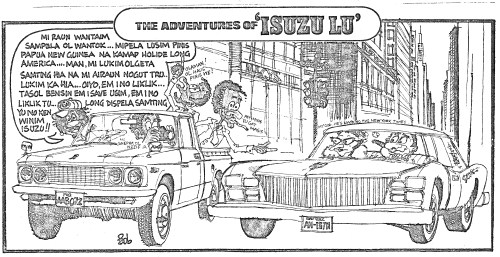
Tok Pisin with Isuzu Lu: Holide long NYC

Isuzu Lu: Holide long NYC

Isuzu Lu: Holide long NYC

Lu: Mi raun wantaim sampela ol wantok … Mipela lusim pinis Papua New Guinea na kamap holide long America … Man, mi lukim olgeta samting hia na mi airaun nogut tru … Lukim ka hia … Oiyo, em i no liklik … Tasol bensin em i save usim, em i no likliki tu … Long dispela samting yu no ken winim Isuzu!!

Lou: I’m traveling with some friends … We have left Papua New Guinea and arrived on holiday in America … Man, I see all the things here and I’m overwhelmed … Look at this car … Wow, it’s not little … but the gasoline it uses, that’s no little bit either … For that you can’t beat Isuzu!!

Photographer: Mi snepim ol netif ia / I’m snapping (photos of) the natives

Man pointing up: Olaman! Ol haus i pinis we? / Oh man! Where do the buildings end? (= How high do they go?)

Man with cigarette: Hey misis, Yu gat masis? / Hey lady, you got a match?

Lady: My God. He’s smoking the New York Times …

This is a scan from a faded old photocopy of a cartoon ad by Bob Browne for New Guinea Motors in the Papua New Guinea Post-Courier, 1976. According to the Foreword in Isuzu Lu Book 5, Browne’s Isuzu Lu ads paved the way for locally created cartoon strips in PNG newspapers. The Phantom was among the most popular strips in 1976.

1 Comment

Filed under language, Papua New Guinea, travel, U.S.