
In remembrance of Wally Yonamine (24 June 1925–28 February 2011), here is a collection of links to excerpts I blogged a few years ago from a fascinating biography of him, Wally Yonamine: The Man Who Changed Japanese Baseball, by Robert K. Fitts (U. Nebraska Press, 2008).
Category Archives: U.S.
High-speed Rail in 1826
From A Most Magnificent Machine: America Adopts the Railroad, 1825-1862, by Craig Miner (U. Press of Kansas, 2010), pp. 1-2:
A young lady wrote to a Pennsylvania newspaper in the summer of 1827 about her journey along the state-operated system of internal improvements. Having left Reading at three in the afternoon, she arrived at Mount Carbon the next evening after a passage of 49 miles by canal, “a great journey for me to make in one day.” The mountain scenery impressed her, as did the band on board the canal boat, but greater wonders awaited. From Mauch Chunk (population 1,300), she elected to ride to the nearby coal mines, 9 miles up a considerable slope, on the Mauch Chunk Railway. This line, built in September 1826, comprised, along with a shorter (3-mile) one from the Boston tidewater to a granite quarry at Quincy, Massachusetts, the first elements of the railway system in the United States.
There were three carriages that day each loaded with six passengers. A horse drew the train up the 3-foot, 7-inch gauge track to the mine, 900 feet above the Lehigh River, in 1 hour and 25 minutes. Coming down, there was no horse, only a rope wound at the top around a wheel with a friction brake to control the descent. That ride reached speeds of 30 miles per hour—faster than the passengers had ever experienced. The cars seemed at times on the verge of shooting off a cliff before a curve came into view and took the gasping tourists around. Wrote the young lady, clinging to her seat: “It really appeared like flying.”
The Mauch Chunk and Quincy Railroads were in those years (the mid-1820s) a national phenomenon, a tourist attraction of a magnitude far beyond their limited economic function. Newspapers competed for details. Also, they collected news from British journals of the architecturally impressive railroad lines completed in 1826 between Stockton and Darlington and Liverpool and Manchester.
At Quincy the attraction was the tremendous weights that could be moved with relatively little effort by means of rails. A load of 21 tons of stone made its way down a slight grade along the Quincy road in October 1826, pulled by a single horse. The horse easily pulled the empty cars back. “It is a matter of astonishment,” went a Massachusetts governmental report, “to consider how great an advantage is gained, by merely providing smooth iron tracks for the wheels of carriages to run on; and though, in every kind of machinery, simplicity tends to increase its value and beauty, yet in no instance, can we find, from so simple an arrangement, effects so striking, or which promise to be so extensively beneficial.” An extension of a railroad system, the report concluded, would impart energy to all kinds of business and produce circumstances that would improve the reputation of the state and of society in general. By the spring of 1827, people from around the nation were visiting the Quincy railroad, giving business to an inn and interfering substantially with the main business of the road in order to satisfy the demands of tourists. The little Quincy Railroad became an object of study for civil engineers and legislative committees thinking of more ambitious rail projects. The economic advantages were obvious. The railroad had made granite so inexpensive that in Boston a house could be built of that durable material more cheaply than with bricks, even when the bricks sold for as low as $4 per thousand.
The Mauch Chunk line drew more attention still, so much that one editor commented it had become a “place of notoriety” Pleasure cars made the round-trip once every day and were always booked in advance.” One passenger reported riding “in pleasure carriages, which have seats like sleighs, and precisely like the sleigh, but longer and without back and front, and have small iron wheels.” It seemed a pleasant way to travel, “not a jolt, jar, or movement, to the right or left.” Birds, cats, and cows flew for their lives before the train: “They must have thought the end of the world was at hand.”
Japanese Attitudes toward Urakami Christians, 1868-1871
From: American Missionaries, Christian Oyatoi, and Japan 1859–73, by Hamish Ion (UBC Press, 2009), pp. 100-101, 121-122:
In June 1868, A. Bertram Mitford, then serving as British consul in Osaka, wrote a most interesting letter about Japanese views on the Urakami Christians. Mitford had polled his Japanese friends, very likely the same politically well-connected friends who had provided him with the political intelligence on the imperial side that allowed the British to navigate skilfully through the tortuous months leading up to the Restoration. Mitford observed how little sympathy there was for the Urakami Christians among Japanese of all classes because they had begun to openly preach the Gospel in defiance of the government’s prohibition. He stressed that the Japanese thought the Roman Catholic priests were trying to gain secular as well as spiritual power through their proselytizing activities in Urakami, known as a hotbed of anarchy and revolution. He also pointed out that a new Roman Catholic bishop had been appointed with the ill-chosen title of “bishop of Japan,” which Japanese regarded as “thoroughly offensive to the pride of the nation.” The Japanese saw the crisis in political terms: as a challenge to the political power of the government. According to Mitford, the Japanese already believed that Roman Catholic fathers were exerting an unfortunate influence on the Urakami Christians by forbidding them, to sell flowers as decoration in local temples and shrines and by preaching sedition and treason, which had led to the tearing down of images of the native gods. The spectre of religious warfare was raised.
The Japanese were too diplomatically astute to deny the excellence of Christian teaching but did argue that “the school of Urakami is but a bastard form of Christianity,” that the Roman Catholic priests were not famihar enough with the Japanese language to explain the dogmas of their religion, and that the Urakami Christians had little in common with true Christian. This argument was in keeping with a common snub about the missionaries language ability, with the hint that the Japanese knew a little bit more about the true nature of Christianity and of Urakami Christian beliefs than the Roman Catholic missionaries did. Mitford wrote, “The Japanese claim a high degree of merit for their own faith, which for centuries has taught the people the duties of children and parents, husbands and wives, masters and servants, brothers and friends. This is the religion which the people understand; the mystic doctrines of the Fathers only bewilder them.” Mirroring the contemporary position, he then added, “The danger of a little knowledge in matters of religion is shown by the Taiping Rebellion, which founded on a few Christian tracts, at one time threatened to lay waste the Chinese Empire.” Elements of Christianity could be seen in the ideology of the Taiping rebels, and 1868, the year in which Mitford was writing was only four years after that destructive rebellion’s final defeat. Although it is difficult to see the Urakami Christians leading a rebellion with the same impact on Japan as the Taiping had on China, the new government saw them-as a danger because they could spark a resurgence of armed Tokugawa opposition to the government’s rule. In any case, despite Western ministers’ calls for the Meiji government to take a more moderate stance, Mitford thought the government was still going ahead with its policy to scatter the Urakami Christians throughout the territories of different daimyo. Mitford’s intelligence was very good, for this scattering of Christians was, in fact, carried out. It was all about politics and political power.
…
In late November 1871, the British diplomat Ernest Satow had dinner with Kido Kōin, a senior member of the Meiji government, during which Kido said “he respected highly the Christian religion and was in favour of introducing it into Japan or at least of allowing its practice.” Certainly, this would appear to be a volte-face on the part of someone who was instrumental in carrying out the new government’s policies against the Urakami Christians in 1868. But by late 1871, Kido was concerned with currying favour with the Western powers in advance of the Iwakura embassy‘s imminent departure for the West. The persecution of Christians was an issue that was not going to go away quietly. As Helen Hardacre has pointed out, the question of religious freedom was “a tremendous stumbling block in the achieving of the main goal of Japanese diplomacy at that time,” that is, the revision of the treaties of 1858. When the Iwakura embassy was confronted with the issue of religious freedom, Japanese Christians had already been largely brought to heel.
The Meiji government was quite prepared to take down the public notice boards of edicts prohibiting Christianity (this was, in itself, an economizing measure, as the notice boards were expensive to maintain), but it had no intention of altering its proscription of Christianity. The timing of the removal of the public notice boards was dictated not by Western diplomatic pressure but by the Japanese government in light of its preparations to mitigate the potential harmful consequence to Japan of this action. The Japanese people understood from the example of the Urakami Christians what could happen if they became Christians. Given their determination during the Urakami crisis, it is quite clear that the Meiji oligarchs were not going to allow Christianity to gain headway in Japan. The removal of the notice boards was interpreted by missionaries as the start of a new era in which Christianity could be openly propagated among the Japanese, but it was, in reality, a hollow gesture by a government that had no intention of stopping its search for counter-Christian measures to contain Christianity. Indeed, the major beneficiaries of the dismantling of the anti-Christian notice boards were not Christians but Buddhists, who were now seen as playing an important part in countering any major Christian advance – with the removal of the notice boards, the Meiji government, which had previously been persecuting Buddhists as part of its attempt to promote Shinto, now looked to Buddhists to help them resist the spread of Christianity outside the treaty settlements (something that the government feared might be a possible and undesirable consequence of removing the proscription edicts from public view). Certainly, Ōhama Tetsuya sees Buddhist attempts to counter Japanese Christian evangelistic activities in the provinces becoming particularly pronounced in 1881 and 1882 at a time when Buddhist intellectuals were also trying to discredit Christian theological ideas. Christianity had failed in Japan before it was actively propagated among the Japanese. Missionaries, of course, did not recognize this. Their energies were directed toward overcoming all obstacles to their religious goal of spreading the Christian message throughout Japan. Optimism was a marked, if not an essential, characteristic of their work.
The uproar of protest against the deportation of the Urakami Christians came from Western diplomats and not from missionaries in Yokohama. In this, there is a residue element of anti-Roman Catholic sentiment that saw the persecution of the Urakami Christians as something involving the Roman Catholics and having little to do with Protestants. “Those horrible papists,” Verbeck (who was by no means unusual among Protestant missionaries in his contempt for Roman Catholics) was wont to call Roman Catholic priests. Yet, it is evident that anti-Christian Japanese polemicists saw Protestant missionaries as being as bad, if not worse, than their Roman Catholic counterparts. The Japanese government argued that the Japanese who wanted to learn about things Western found missionaries, in contravention of the treaties, forcing them to read the Bible as an English textbook. From the government’s perspective, private religious beliefs would be tolerated so long as the individual believer did not challenge the public policies of the government. Thus, in the opinion of the Meiji government, the Urakami Christians were not being persecuted for their private religious beliefs but because they had defied established authority.
Filed under Britain, Japan, nationalism, religion, U.S.
Winchester, Virginia: My First American Hometown
Fifty years ago this month, I arrived in a snow-covered city I would come to think of as my first American hometown, Winchester, Virginia. I had just spent most of my elementary school years in Kyoto, Japan, which I still think of as my Japanese hometown. My parents were missionaries. I was born in Louisville, Kentucky, where my father was in seminary, and I later attended first grade there during our first furlough while he finished his coursework toward a Th.D. But our two-and-a-half years in Winchester gave me my first prolonged exposure to life in small-town America.
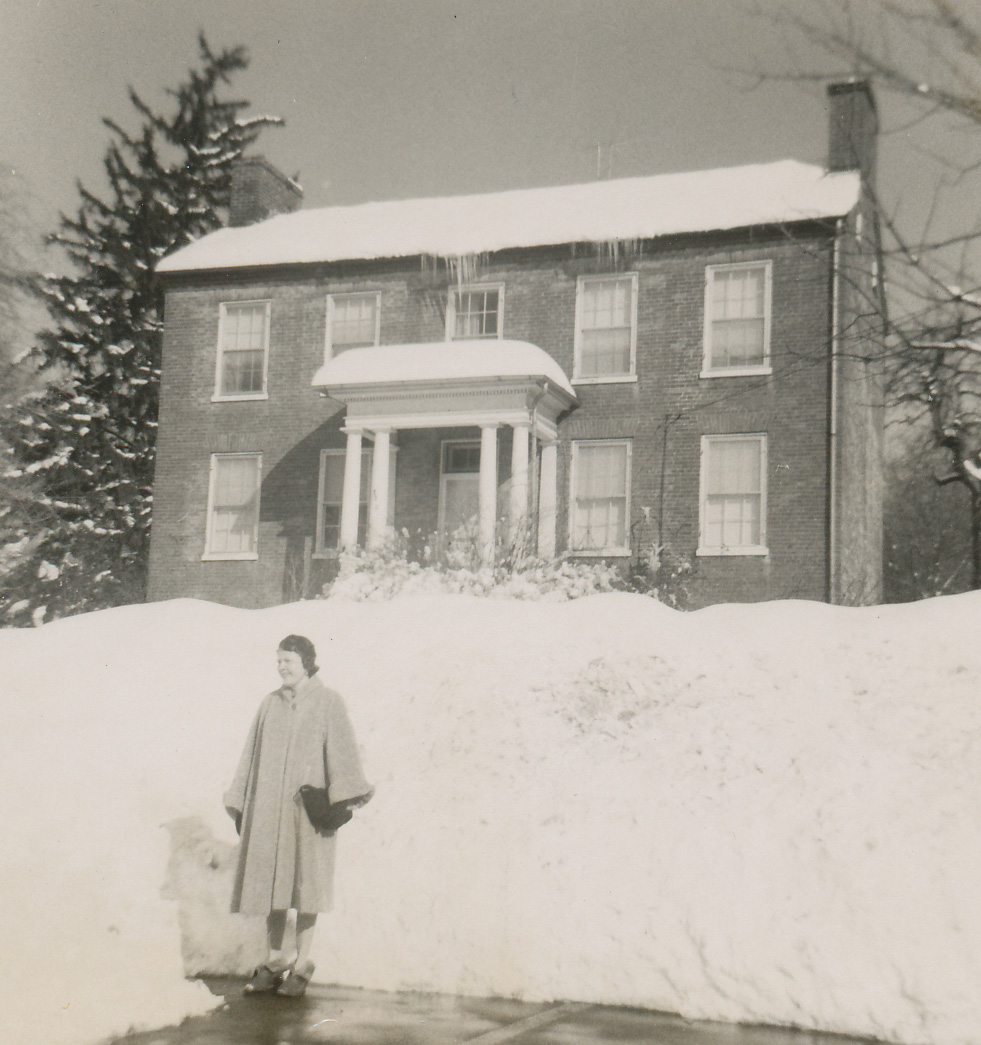
Mom in front of our house on Amherst St., Dec. 1960

Our house on Henry Ave., c. 1962
Meanwhile, my mother had her hands full with five kids. Our family car was a Rambler station wagon with an extra rear-facing seat in back. One summer we drove it to Sebago Lake in Maine, where our pastor let us use his summer cabin, where in the evenings my mother would read to her own five children from The Five Little Peppers and How They Grew (one of whom—in each family—was named Joel). My mother, who had dropped out of Berea College after her junior year to get married and become a missionary, always felt inferior to the more educated missionary wives, especially the registered nurses at the Japan Baptist Hospital in Kyoto, where my father had served as chaplain. Perhaps she compensated to some extent by being somewhat of a Japanese-style kyōiku mama (at least where I, her eldest, was concerned).
But I remember those years as the least bookish, most outdoorsy era of my life. We went sledding on the slope above our big old house on Amherst St., and built igloos and snow forts behind our smaller house on Henry Ave. One summer, Uncle Bill took us waterskiing on the Shenandoah River. Dad took us oldest boys along for a campout in Monongahela National Forest with a group from his little country church in Gore. With Boy Scouts, I took a 50-mile hike along the Appalachian Trail through the Shenandoah Mountains, and I remember one Camporee that got hit by such a heavy rainstorm that many parents came to rescue their boys and a few boys abandoned their pup tents to spend the night in the scoutmasters’ vehicles.
Sometime during 8th grade, I started to show signs of near-sightedness. I don’t think it was while trying for my rifle-shooting merit badge in the old Winchester Armory. I think I first noticed it when I had trouble reading the blackboard from the back of the classroom during algebra class or my tryout semester of Latin. But Uncle Bill likely noticed it sooner when I accompanied him on trips to Baltimore to bring back a tanker of gas for his filling station. He used to ask whichever nephew accompanied him to be on the lookout for certain road signs, landmarks, or maybe patrol cars, and I don’t think I was as good at spotting them as he was—or as my brother was. I went for an eye exam and got a prescription for contact lenses (newfangled and expensive at the time), which were soon replaced by regular eyeglasses after I lost one down the drain.
Sometime during that same school year, my parents opted to return to the mission field, this time to Hiroshima, which became the Japanese hometown of my three youngest siblings. We two eldest sons went off to boarding school in Kobe, and I began my evolution into the most bookish nerd one can ever hope to become.
Legacies of Clara Hepburn’s Juku in Yokohama, 1863
From: American Missionaries, Christian Oyatoi, and Japan 1859–73, by Hamish Ion (UBC Press, 2009), pp. 59-60:
Before he rented it out in May 1864, Hepburn had taught students Western medicine in his dispensary. Among those whom he taught was Yamanouchi Bunzaburo, the uncle of Hayashi Tadasu, and Hayashi Yuteki, who founded the famous Maruzen Bookstore. Clara Hepburn also taught them English. She was a trained teacher, having taught at the Norristown Academy in Pennsylvania before marrying, and was teaching several boys whose progress in reading and writing English had been altogether satisfactory and in some cases remarkable.
Hepburn Juku ([supplementary, a.k.a. “cram”] School), which Clara began in November 1863 shortly after her return from the United States, had its beginning in a Sunday school for the young boys and girls in the treaty settlement that she held in the front waiting room of the dispensary (being Sunday, there were no patients). Japanese children were also allowed to attend. It was from this Sunday school that an English-language school developed. Hepburn Juku had among its young students some who would become famous figures, including future prime minister Takahashi Korekiyo; foreign minister Hayashi Tadasu; leading businessman Masuda Takashi, who helped to establish the Mitsui zaibatsu, a major industrial and financial conglomerate; and surgeon general Miyake Hiizu (Shigeru). Thirteen-year-old Hayashi, the nephew of a doctor who had studied with Hepburn, was the first student. It was a manifestation of a growing awareness of the importance of English that these young boys came to Yokohama in order to learn it. However, their successful careers were predicated on the fact that these boys did not become Christians, and their presence at Hepburn Juku was often merely a brief interlude (by way of attending an English-language crammer, which prepared them for entry into American schools, and familiarizing themselves with Americans) before setting out to the United States or elsewhere overseas to study.
It was Hepburn’s later deep involvement in the establishment of Meiji Gakuin University in Tokyo that allowed the university to claim that its origins can be traced back to 1863 and to Hepburn Juku (and so bask in the reflected light of being connected to such a great figure in modern Japanese history as Takahashi, whose abiding reputation has been undoubtedly helped by his vicious assassination by militarists in the attempted coup of February [1936]. Takahashi made a special visit to Hepburn’s house in East Orange, New Jersey, when he was in New York on government business during the Russo-Japanese War. Clara was too ill in hospital to see him, but he had a conversation with Hepburn in which he expressed his gratitude for Clara’s efforts in teaching English. More immediately, the success of Clara Hepburn’s efforts undoubtedly contributed to a very significant development, as it turned out, taking place in Yokohama in 1864.
Some Japanese officials at the customs house in Yokohama had approached Hepburn with a request that he establish a school for the benefit of interpreters and others who might obtain government permission to attend it. After consulting with the Dutch Reformed missionaries, the Yokohama Eigakujo (Eigakko, also known as the Yokohama Academy), was organized and opened. From the start the school was a success.
Legacies of Hepburn’s First Dictionary of Japanese, 1867
From: American Missionaries, Christian Oyatoi, and Japan 1859–73, by Hamish Ion (UBC Press, 2009), pp. 80-81:
[In 1866] Hepburn‘s dictionary was being printed at a rate of 6 pages a day, with nearly 250 pages of the first part of Japanese to English – out of a total of 600 pages – finished. Hepburn was now writing out a second part to the dictionary of English to Japanese (something he had not previously contemplated), which would add approximately another 300 pages. He had a deadline of 1 June to have it completed. It was an expensive business, costing two dollars a page for composition alone, and even though Walsh had agreed to cover any losses, Hepburn was obliged to pay him back all monies from sales until the debt was cancelled. There was going to be no immediate financial benefit to Hepburn from all his work.
Surprisingly, the dictionary was finished ahead of schedule, and Hepburn was back in healthy Yokohama by late May 1867 and able to send off a copy to the mission library back home. Although Hepburn was discounting the early work of his friend Brown in claiming his was the first dictionary, it was an immense achievement, far surpassing any nineteenth-century rival. Yet, the dictionary had its limitations for those learning Japanese. Interestingly, in early 1870, Christopher Carrothers, a new Presbyterian missionary then learning Japanese, wrote that Hoffman’s Japanese grammar was the best assistant for the written language: “Dr. Brown’s Grammar and Dr. Hepburn’s Dictionary are more adapted to the Colloquial. Hoffman is soon to issue a Japanese Dictionary for which we are anxiously waiting. Carrothers was referring to J.J. Hoffman, a German linguist who learnt Chinese, Japanese, and Korean in Europe and in 1868 produced a Japanese grammar in Dutch and English. Even though Hepburn’s dictionary might have been more suited for those using colloquial speech than wanting to acquire the written language, it remains Hepburn’s greatest contribution to opening Japan, not only to missionaries but also to the English-speaking world. It should not be forgotten that Hepburn was helped by the work of other Western scholars who had attempted Chinese or Japanese grammars and dictionaries before him, including W.H. Medhurst, Karl Gutzlaff, and S.W. Williams among China missionaries, and Liggins, Brown, and Hoffman when it came to Japan and Europe. He also benefited from the assistance of Kishida Ginkō, who had been with Hepburn in Kanagawa and accompanied him to Shanghai. In September 1872, the Japan Weekly Mail noted that the second edition of the dictionary “is a fresh encouragement to foreigners in this country to pursue the study of the Japanese language, and to the Japanese it will afford invaluable assistance in the study of ours.” The newspaper predicted that its print run of three thousand would be quickly sold out. It was close to a century later – in the early 1960s with the publication of the Nelson dictionary – before another American missionary produced a dictionary that would have a similar profound impact on those learning Japanese. The Hepburn system of romanization of Japanese, which the earlier dictionary first introduced and the Nelson dictionary used, remains the standard system of romanization.
The dictionary was typeset and printed in Shanghai, where it required “making copper matrices and casting of new Japanese as well as specialized English type, so the actual printing was moving at a snail’s pace” (p. 79).
Filed under anglosphere, language, publishing, religion, scholarship, U.S.
Interpreting Sino-Soviet Border Clashes, 1969
From: The Man on Whom Nothing Was Lost: The Grand Strategy of Charles Hill, by Molly Worthen (Mariner Books, 2007), Kindle Loc. 1202-26:
It remained unclear whether Beijing was simply using the Soviet border threat to galvanize internal party unity, or whether genuine geopolitical realignment was in the making.
The answer came in the spring of 1969, on a tiny, uninhabited fragment of land about 250 miles down the Ussuri River from the Soviet city of Vladivostok. Called Damansky by the Russians and Zhen Bao by the Chinese, the island appeared to be of only symbolic worth. Little over a mile in length and a half mile in breadth, Zhen Bao and its environs were mostly swampland and under water for much of the year. The island is closer to the Chinese side of the river, but both countries had long claimed it. According to Soviet press reports from March 2, 1969, that morning 300 Chinese troops on the island opened machine-gun fire on a Soviet patrol of frontier guards, killing 31 and wounding 14. The Soviets sent reinforcements, but these too were ambushed. Chinese accounts of the encounter, predictably, blamed the aggression on the Soviets (counting 70 Soviet dead), and although at first most Western observers jumped at a chance to blame the Chinese, the reality of that cold morning remained foggy. Both sides had withdrawn from the island by the afternoon, but Zhen Bao marked only the beginning of the conflict. As spring turned to summer, violence erupted again on Zhen Bao as well as thousands of miles to the southwest, on the border between Soviet Kazakhstan and China’s Xinjiang province, and along the Amur River. These skirmishes were more prolonged and bloody than the first brief encounter in March. Both sides issued conflicting accounts of the hostilities, but the geography of the battle sites in Xinjiang—easily accessible from nearby Soviet installations, and hundreds of miles from the nearest Chinese railhead at Ürümqi—suggested that the Soviets started the trouble there.
It was Hill’s job to report on the border conflicts in daily cables to Washington. His commentary was circumscribed by lack of trustworthy eyewitness accounts, and as always he relied heavily on careful reading of the rhetoric coming out of Beijing and Moscow. But by 1969, these had become well-worn limitations for Hill. He was used to sorting through fighting versions of the same story and extracting some shadow of the truth. The responsibility was thrilling. The cables required him to draw on all his experience as a China watcher and to write cogently under extreme pressure—a skill that is learned only by necessity.
Once Nixon and his staff had time to reflect on Hill’s anonymous cables, the significance of intensifying conflict between the world’s two Communist giants was clear. As then national security adviser Henry Kissinger reflected in his memoirs, a Soviet invasion of China would capsize “not only the geopolitical but also the psychological equilibrium of the world; it would create a momentum of irresistible ruthlessness.” Moscow’s periodic threats to attack Chinese nuclear installations or employ nuclear weapons to push People’s Liberation Army forces back from the border were particularly disturbing to Washington. On the other hand, an opportunity suddenly existed to soften China’s raving isolation and cultivate a triangular balance among the world’s three great powers. The situation was delicate. Beijing’s propaganda still accused America of colluding with the Soviets in a renewed attempt at “imperialist encirclement.”
Benefits of Strong, Silent Diplomacy (and Ego)
From: The Man on Whom Nothing Was Lost: The Grand Strategy of Charles Hill, by Molly Worthen (Mariner Books, 2007), Kindle Loc. 1227-47:
In the months that followed, Kissinger became a prime mover behind a series of symbolic gestures and guarded diplomatic advances toward China. On a late summer world tour, Nixon remarked cautiously about opening channels with the Chinese to intermediaries in Romania and Pakistan, who, it was assumed, would relay the message to Beijing. As the Soviets grew increasingly nervous that autumn, Kissinger authorized the end of the U.S. destroyer patrol in the Taiwan Strait—a signal whose military significance was dwarfed by its symbolic value. What followed, Kissinger wrote, was “an intricate minuet between us and the Chinese so delicately arranged that both sides could always maintain that they were not in contact, so stylized that neither side needed to bear the onus of an initiative, so elliptical that existing relationships on both sides were not jeopardized.”
Those brief clashes in the desolate reaches of southeastern Siberia set off a geopolitical chain reaction that would culminate in President Nixon’s much-vaunted trip to China in 1972. His visit, to those who had been watching most vigilantly, was less a diplomatic coup than an inescapable executive act confirming several years of geopolitical transformation. The shift in the balance among the Soviet Union, China, and the United States was, for those who knew what to look for, well marked along the way—in official editorials’ compromised turns of phrase, in remote clashes over an inhospitable bit of land, and, sometimes, in what was not said at all.
Hill was never bothered that Kissinger, for whom he would be a top speechwriter in a scant few years, had no idea who had written the cables he read with such interest. Although no reasonable junior officer expected to see his name attached to most of his work, Hill was distinct in his attitude. “Others said, ‘We’re working like dogs, but the time will come when we’ll be ambassadors and we’ll cash in,'” he recalled. “I didn’t. I thought this was great—way beyond anything I’d been asked to do before.” Hill’s self-confidence was more valuable for its noiselessness. It was unusual in a profession that attracted ambitious men and women intent on achieving power and making names for themselves. That breed of officer was often frustrated in the Foreign Service—a highly constrained job, bounded by meddlesome supervisors and a lethargic bureaucracy that shuttled its officers around the globe, granting them little notice or say in their futures. Hill was better suited to it than most. Although every telegram he drafted was revised and chewed up by his superiors, his ideas still confined by a system that offered no guarantee that those on high would listen, he felt that the months spent covering the Sino-Soviet border dispute were the apex of his career thus far. He loved the chance to shape information, to tell the story of the border clashes as he saw it. His was a silent ego, not a meek one.
The Loo-Choo Naval Mission, 1846–1861
From: American Missionaries, Christian Oyatoi, and Japan 1859–73, by Hamish Ion (UBC Press, 2009), pp. 9-11:
Although Britain was loath to open trade relations with Japan, British naval officers were instrumental in beginning what is now considered by many (especially Japanese Anglicans) to be the first Protestant mission to the Japanese, the Loo-Choo Naval Mission. Bernard Jean Bettelheim and his English wife were associated with the British Anglican Church Missionary Society and were the Loo-Choo Naval Mission’s resident medical missionary couple in Naha between 1846 and 1854. A miserable time Bettelheim had of it, for he was beaten and ostracized by the Ryūkyūans and held in contempt by commanders of Royal Navy gunboats that infrequently visited them. In early February 1852, Bettelheim wrote to Commander Charles Shadwell of HMS Phoenix complaining about his treatment at the hands of Japanese soldiers and arguing that British settlers would never be safe until gunboat diplomacy was used to teach the Japanese a lesson. Shadwell strongly disagreed about the need for gunboat diplomacy and thought Bettelheim exaggerated his complaints about the Ryūkyūan authorities. In his report on his visit to the Ryūkyūs, Shadwell wrote that Bettelheim’s enthusiastic zeal was undoubted but that he was narrow-minded in his view of the world and that his isolation in Naha had led to “an idiosyncratic turn of mind which renders him an unsafe guide in matters which might involve grave political consequences.” The charge that Bettelheim was narrow-minded was a common criticism of evangelistically minded missionaries, but there is no doubt that he had developed in Naha an idiosyncratic turn of mind.
Bettelheim fared little better when Commodore Perry first visited Naha in May 1853. He had a long conversation with Perry soon after his arrival, very likely giving him a full report of his frustrations with the Ryūkyūans and what he saw as their negative characteristics. McOmie has suggested that as a result of his meeting with Bettelheim/ Perry was prepared to match the chicanery and duplicity that Bettelheim saw in the Okinawan authorities with “a little Yankee diplomacy.” By the end of Perry’s visit to Naha, however. Perry’s relations with Bettelheim were not good, and the commodore rejected Bettelheim’s offer to join the expedition to Japan as an interpreter. This was much to the relief of Samuel Wells Williams, the expedition’s missionary interpreter, who had developed a real dislike for Bettelheim while Perry’s flagship was anchored off Naha. Part of the problem was Bettelheim’s acting as an agent for the American warships in the purchase of provisions during their extended visits in 1853 and 1854, leading to suspicions that he was lining his own pockets. Yet, the officers of USS Plymouth thought his services had been so valuable to them during the winter of 1853 that they presented him with a silver goblet worth $80. Attitudes toward Bettelheim among Americans with Perry’s squadron were mixed. Lieutenant George Henry Preble of the USS Macedonian was generally sympathetic, but he thought that despite Bettelheim’s sincerity and enthusiasm, he was the worst kind of person to be a missionary to the Ryūkyūans: his great contempt for them meant that he knew less about the Ryūkyūans after eight years than some knew after eight months. William Heine, the official artist with Perry, clearly liked Bettelheim. Heine was very impressed when he became, by chance one night in February 1854, an unseen onlooker at the Bettelheim family’s evening prayers. The German-speaking Heine was a young man and possibly a little homesick, which might account for why he found the prayers of a close-knit family so touching. His overall generosity of feeling toward Bettelheim might also be a reflection that the polylingual missionary’s German was better than his English. On 15 January 1854, Bettelheim preached aboard the Macedonian; Preble recorded that “it was an ingenious and animated discourse to which his foreign accentuation and broken English gave additional force. Reading the Hymns was rather a stumbling block to him but he showed he conceived their sense.” Since Bettelheim was unable to convert the Ryūkyūans to Christianity, Preble thought his chief contribution was the translation of the Scriptures into Ryūkyūan language and the construction of a Ryūkyūan dictionary. A linguist said to have mastered thirteen languages, Bettelheim managed to translate four chapters of the New Testament into the Ryūkyūan language. This work was probably the most positive and lasting legacy of his sojourn in Naha. Under pressure from the Ryūkyūan authorities. Perry agreed to evacuate the Bettelheims from Naha.
In March 1854, Perry’s supply ship Supply took Bettelheim’s family to Shanghai, and later in June Bettelheim himself left Naha for good aboard USS Powhatan. He left behind his replacement, C.H. Moreton, formerly of the London Missionary Society, and Moreton’s wife, who had arrived in Naha that February, to continue on the mission alone. Bettelheim made the first step toward establishing Protestant missions in metropolitan Japan, which the northward movement of American warships under Perry from the Ryūkyūs presaged. Unfortunately, in December 1855, his successor, Moreton, fell ill and left Naha to return home. There was difficulty finding another missionary, and in 1861 the Loo-Choo Naval Mission was formally ended. What monies were left over were given to the British Anglican Church Missionary Society for the development of its future Japan mission, which eventually began in 1869.
A Japanophile Dutch Banker’s Disillusionment, 1970s
From The Magatama Doodle: One Man’s Affair with Japan, 1950–2004, by Hans Brinckmann (Global Oriental, 2005), pp. 210-211:
My ‘Magatama Doodle’ metaphor was inspired by the whimsical linking of an observed physical habit (the doodling of comma-shapes on tabletops and chair arms) of certain functionaries, when confronted with a problem or pressed for an answer, to their assumed preference for evasion and procrastination. Japan’s leaders, I had always felt, were fully capable of taking decisions, and if they did not, that was because they chose not to.
I still believed this analysis to hold good for the corporate sector, but I no longer could credit the government and the bureaucracy with similar ability. After all, the cabinet members, from the prime minister on down, were beholden to their party colleagues waiting in the wings for their turn at government. And all politicians lived at the mercy of the business establishment, which financed their election campaigns. They were also constrained by the bureaucratic elite, which provided continuity and expertise for the government of the day. Some bureaucrats in turn were rumoured to be supplementing their income with donations from the major corporations, to whom they also looked for their eventual amakudari on their retirement from the civil service in their early fifties. Few senior civil servants could afford to retire at that age, so they were all interested in a second career as adviser or senior director at a major bank or corporation. The result of these cosy relationships was a woeful lack of discretionary power on the political level, and even a prime minister travelling overseas had to weigh every word and frequently backtrack on his public statements in the face of opposition at home.
I could now see that it was the stasis in Japan’s body politic that had bedevilled its relations with other countries, most of all the US, for decades. Earlier on I had, like probably almost every Japanese, habitually blamed the periodic strains in Japan-US ties largely on American impatience or intransigence. American leaders and negotiators, I was convinced, did not understand Japan, and their patronizing attitude only managed to infuriate their Japanese counterparts and thus stall progress in the talks. But without exculpating pushy American negotiators altogether I had come to suspect that the cause of the recurring tensions, especially in matters of trade and investment, lay mostly with the Japanese.
Through my Investment Committee at the American Chamber of Commerce and other sources I had heard stories about the ‘impossibility’ of dealing with Japanese negotiators on issues such as regulating the flow of car exports and improving access to Japan’s still heavily protected consumer market. The negotiators had no mandate and had to refer to Tokyo on every detail without in the end coming up with any kind of helpful response or compromise. The US side would be kept waiting interminably while their counterparts tried to placate them with pleas for understanding Japan’s slow-moving consensus system and promises of an eventual satisfactory outcome. More often than not, no such outcome ensued, and the Americans either had to back off with gritted teeth or threaten unilateral action to force an agreement. On several occasions the US Congress stepped in with mandated sanctions when negotiations stalled, to the consternation of the Japanese, whose own parliament had no such power.
All this would not have been so bad if the Japanese had put their cards on the table. But they seldom did. To the home audience they usually played the victim card, blaming the heavy-handed Americans for bullying them into concessions, and asking the public to accept these ‘sacrifices’ in the interest of preserving good relations with the American ally. In this way they not only shifted the blame for any unwelcome outcome to the Americans, but they also obfuscated the system’s structural inability to produce effective and timely decisions, actually turning this shortcoming into an advantage.
Filed under economics, Japan, Netherlands, U.S.


 Far Outliers