
Category Archives: U.S.

Salt Lake City Bees, 1915: “Godsend to the Pacific Coast League”

From The Greatest Minor League: A History of the Pacific Coast League, 1903-1957, by Dennis Snelling (McFarland, 2011), Kindle Loc. 1119-25, 1192-99:

A group of local speculators built a new stadium, called Majestic Park, on the site of the old Salt Palace, an amusement park that had been a major venue for bicycle racing. The Rotary Club handled the opening festivities and encouraged businesses to close for the day, or at least allow some of their employees to have the day off. Ten thousand fans attended the Pacific Coast League’s debut in Salt Lake City as the local citizenry celebrated “the transformation of a low swampy field covered with mud, snow and stones into one of the finest baseball fields in the United States.”

By the end of May the Bees were averaging three thousand fans per game. When the team was on the road, hundreds of people, including scores of enthusiastic children, gathered around an electronic scoreboard at the ballpark to watch results being posted. In other parts of the city, men with megaphones shouted out the scores. Although many considered it doubtful the level of interest would be maintained through the hot summer, Pacific Coast League owners were nonetheless delighted. [San Francisco Seals owner] Henry Berry said, “Salt Lake City is the salvation of the league.”

Meanwhile, the surprising Salt Lake City Bees, which had charged from last place in late July to finish second, reaped the financial rewards Henry Berry must have thought rightfully belonged to him as league champion. The week prior to Berry’s bankruptcy court date, the directors of the Bees declared a ten percent dividend for their stockholders. The team was so successful it had not been necessary to issue all of the authorized stock. The Bees drew more than two hundred thousand fans with total gate receipts of $105,000; even after paying out the dividend and purchasing Majestic Park, the team still had $14,000 cash on hand and was debt-free.

It had been another rough season financially for the Pacific Coast League, but the team in the Great Salt Desert had been invaluable in helping the circuit survive another year. Henry Berry had been absolutely correct when he hailed Salt Lake City as the league’s savior, especially following the disaster of 1914. [Portland Beavers manager] Walter McCredie called Salt Lake “a godsend to the Pacific Coast League,” while league President Baum declared that Salt Lake City ranked with any minor league city in the country. It was impossible to over-emphasize the city’s role in the league’s survival.
Leave a comment

Filed under baseball, U.S.

Pacific Coast Baseball, 1890

From The Greatest Minor League: A History of the Pacific Coast League, 1903-1957, by Dennis Snelling (McFarland, 2011), Kindle Loc. 80-98:

The crowd began congregating on a gray, drizzly December morning in 1890 at San Francisco’s Clay Street Wharf. Bracing themselves against the cold wind and brisk dampness of the seafront, people from all walks of society had assembled in response to the arrival of the U.S. Navy flagship Charleston, which sat anchored in the bay. Undaunted by the dreary weather, the throng waited patiently in the hope of catching a glimpse of the Charleston and its famous passenger, David Kalakaua, the King of Hawaii. The King disembarked at fifteen minutes to four o’clock in the afternoon and, accompanied by Admiral George Brown, boarded a twelve-oar barge that rowed him ashore. Shouts went up as royal salutes were fired from other ships in the harbor, and smoke enveloped the entire scene. Emerging from the smokescreen, the barge reached the gangplank and the coxswain shouted, “Way enough! Toss oars!” King Kalakaua, cutting an impressive figure in his Prince Albert coat and a black, chimney pot hat, stepped onto the wharf and was greeted warmly by General John Gibbon and the Fourth United States Cavalry. The King acknowledged his crowd of admirers and was escorted to one of twelve carriages waiting to transport the dignitaries up Market Street to the Palace Hotel.

Numerous events were held in the King’s honor, including an all-star baseball game staged five days before Christmas at Haight Street Grounds between a team of native Californians who played in the eastern professional leagues and a group of locals from the California State League.’ The King, whose attendance made him the first monarch to attend a baseball game on American soil, was quite familiar with the sport thanks to his financial advisor, Alexander same Alexander Cartwright often credited with creating the modern game. The King’s presence was a measure of how far Cartwright’s favorite game had progressed.

The story goes that baseball was introduced in the West during Cartwright’s journey to California via wagon train during the Gold Rush. Whether true or not, it is almost certain that he or some other veteran of East Coast “base ball” planted the seed, and by the early 1850s there were accounts of people playing “town ball” in the streets of San Francisco. Cartwright did not linger, instead sailing on to Hawaii where he sent for his family and became a prominent citizen. By the time of his death in 1892, Cartwright’s connection to baseball was forgotten, even in his native New York. Nearly a half-century would pass before the ex-bank clerk/volunteer fireman and his Knickerbockers teammates received credit for their contributions to the game. By that point, the Abner Doubleday myth was entrenched and Cooperstown had the Baseball Hall of Fame.

Although Cartwright may have been forgotten, the game he promoted was not. It developed, thrived and spread everywhere, including the West. Teams were soon being established all over California, although they initially functioned as social clubs requiring little physical activity beyond drinking and exaggerated storytelling. That began to change by 1860 when players from Sacramento and San Francisco met in a state championship series. The San Francisco team, the Eagles, captured the silver ball engraved “For The Best Base Ball Playing, September 25, 1860.”

For more about the earliest baseball in the Hawaiian Islands, see Punahou and Baseball in the Hawaiian Kingdom.

Leave a comment

Filed under baseball, Hawai'i, U.S.

Doshisha University’s Debt to Hakodate

From Hokkaido, A History of Ethnic Transition and Development on Japan’s Northern Island, by Ann B. Irish (McFarland, 2009), pp. 93-94:

Hakodate played a small part in the life and adventures of Niijima Jo (westerners have anglicized his name in several ways and have referred to him as Joseph Hardy Neesima). He became a prominent Christian in nineteenth century Japan and is honored today as the founder of a distinguished private university in Kyoto, Doshisha. Niijima grew up in Edo. When he was a youth, a friend who knew of his interest in boats and seamanship told him of a vessel soon to sail to Hakodate. Niijima, who had a secret desire to visit a foreign land, thought he might be able to do so form Hakodate. He knew an influential man who obtained permission for the young man to take a trip north. After arrival in Hakodate in 1864, Niijima’s goal was to meet foreigners who could help him travel abroad. He soon met Father Nikolai, who engaged him as a Japanese language tutor. Meanwhile, an English trader agreed to teach the young Japanese man English.

Niijima desperately wanted to travel outside Japan, despite the government prohibition of this. After several months in Hakodate, his dream took shape. He made arrangements to slip out of the city and secretly board an American ship. Arriving in the United States via China, he studied for some ten years and adopted Christianity. After being baptized, he chose his western name to honor Alpheus Hardy, owner of the ship that had taken him to America. Niijima graduated from Amherst College, the first Japanese student ever to obtain a college degree in the United States. Returning to Japan, he founded the school in 1875 which grew into Doshisha University.

As Niijima’s story shows, because foreigners from several important nations lived in Hakodate, Japanese found the city a good place to study foreign languages and foreign ways, and a number of men who later served as interpreters learned languages there.

Leave a comment

Filed under education, Japan, language, religion, travel, U.S.

Hakodate’s Consular Heyday, 1863-1934

From Hokkaido, A History of Ethnic Transition and Development on Japan’s Northern Island, by Ann B. Irish (McFarland, 2009), pp. 89-90:

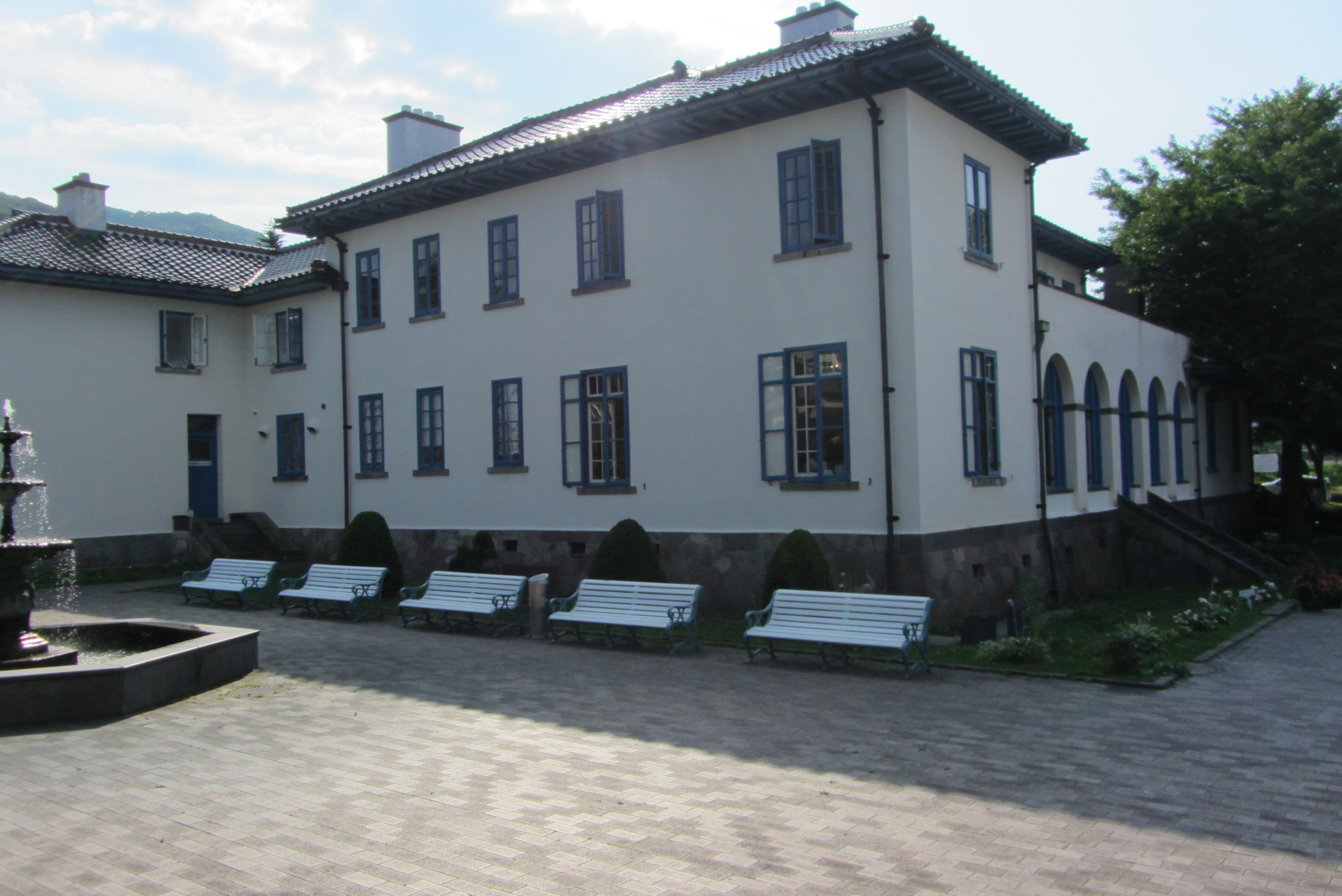
A new British Consulate opened for business in 1863, and Richard Eusden assumed consular duties in 1867, serving here until 1880. He was by far the most effective British consul in Hakodate. Both he and his wife became involved in the community; she helped create the city’s public garden. Over the years several fires damaged the consulate and it burned down in 1907. brit-faroblA few years later, the British government’s Shanghai Construction Bureau built a new consulate, a two-story-high tile-roofed structure on a site a few blocks away. This building still exists, looking rather like a large bungalow transplanted to Asia. Nowadays it is open to tourists, featuring interesting historical exhibits about early western experiences in Hakodate, an English tea room and a souvenir shop carrying articles from Britain. The British ceased consular operations in Hakodate in 1934.

The foreign consuls in Hakodate acted as judicial officials. When an American, Charles H. Smith, was charged in the death of a Japanese, the American, English and Russian consuls, the Hakodate bugyo and other Japanese and western men sat at the court and agreed that the defendant was not guilty, for he had shot in the darkness at a burglar.

Hakodate at different times had consulates representing not only Russia, the United States and Great Britain, but also France, the Netherlands, Portugal, Germany, Switzerland, Denmark, Italy, Austria, Hungary and Spain, though these other nations were mostly represented by men who were consuls of other countries. Even Hawaii, when it was an independent nation, briefly had consular representation in Hokkaido. The foreigners perceived Hakodate as a safe, if sleepy place; they did not feel the need for weapons in Hakodate. “We do not go armed as all foreigners do in Yedo, wrote E. E. Rice and, while Yokohama had a specific area set aside for foreign settlement, Hakodate featured no special area for foreigners, though the various consulates were not far from each other.

Leave a comment

Filed under Britain, Europe, Japan, Russia, U.S.

High Oil Prices and the Brezhnev Era

From Revolutionary Russia, 1891-1991: A History, by Orlando Figes (Metropolitan, 2014), Kindle Loc. 4290-4335:

By the end of the 1970s, these small garden plots, which took up 4 per cent of the country’s agricultural land, were producing 40 per cent of its pork and poultry, 42 per cent of its fruit and over half its potatoes.

Brezhnev responded to the agricultural crisis by allowing larger garden plots to stimulate production. He might have improved the Soviet system’s chances of survival by doing what the Chinese were doing at this time: de-collectivizing agriculture and returning to an NEP-like system of cooperatives and household farms on contracts, with the state allowing them to sell what they produced beyond their quotas on the free market. Soviet reformers were not unsympathetic to these policy ideas, even if they stopped short of recommending them. Gorbachev, who at this time was in the Agricultural Department of the Secretariat, proposed giving more autonomy to enterprises and associations in deciding various production and financial questions in a memorandum to the Central Committee in May 1978 (an idea repeated by Andropov on becoming General Secretary in 1982). But the Brezhnev leadership would not accept these proposals—even as trial policies. The old guard was too committed to the Stalinist collective farm system which they had implemented as young men. The Party’s power was heavily invested in the direct management of the collective farms by thousands of officials in the localities. Perhaps, in any case, fifty years of collectivization (twice as long as in China) had destroyed any hope of bringing the Soviet peasantry back to life.

Relying on their tiny garden plots to feed themselves, the kolkhoz workers lived in squalid poverty. Many inhabited houses without running water or electricity. The ablest and most enterprising, mostly men of conscript age, ran away from the countryside, which became a ghetto of the old, the infirm and the alcoholic, who worked badly. Entire villages were abandoned or left to rot with only a few elderly inhabitants where once perhaps a hundred families had lived.

Alcohol consumption more than doubled in the Brezhnev years. People drank out of despair. By the early 1980s, the average kolkhoz family was spending one third of its household income on vodka—an official figure which does not include the moonshine made by kolkhoz workers in their homes (for every bottle bought from shops, they drank a bucket of moonshine). Alcoholism was the national disease. It had a major impact on crime rates (around 10 million people every year were detained by the police for drunkenness) and a bad effect on male life expectancy, which declined from 66 in 1964 to just 62 in 1980. The regime was unconcerned by the problem. It increased its vodka sales to extract money from the population which had little else to buy. Better to have people drunk than protesting against shortages.

Oil revenues rescued the regime from probable food riots and possible collapse. They gave a lease on life to the Soviet economy, which would have been in severe trouble without a five-fold increase in crude oil prices as a result of the 1973 crisis. The Soviet Union doubled oil production in the 1970s, mainly by developing new fields in Siberia. With its dollar earnings from the sale of oil and gas, the government was able to buy consumer goods and foodstuffs from the West. Before the revolution, Russia had been a major agricultural exporter. But within sixty years it had turned into the biggest food importer in the world. One third of all baked goods in the country were made from foreign cereals. Cattle production was totally dependent on imported grain.

High oil prices also allowed the Soviet Union to be more assertive in its foreign policy. They financed an eight-fold increase in military spending under Brezhnev’s rule. By 1982, the military budget consumed approximately 15 per cent of the country’s GNP. The rise showed the growing power of hardliners in the Brezhnev government, particularly in the KGB, the armed forces, and the defence and foreign ministries, who were committed at all costs to maintaining military superiority over NATO as the foundation of Soviet security.

Their confidence was boosted by the failure of NATO to respond to the Soviet invasion of Czechoslovakia to crush the reformist government of Alexander Dubcek in August 1968—an invasion that the Soviet Defence Minister, Andrei Grechko, had pledged to carry out ‘even if it leads to a third world war’. The Kremlin emerged from the crisis with renewed boldness. ‘The new correlation of forces is such that [the West] no longer dares to move against us,’ claimed Andrei Gromyko, the Foreign Minister.

Moscow justified its invasion and reinforced its grip on Eastern Europe by issuing the Brezhnev Doctrine, outlined in a speech by the Soviet leader to the Polish Communists in November 1968. When ‘forces hostile to socialism try to turn the development of a socialist country towards capitalism,’ Brezhnev warned the Poles, ‘it becomes not only a problem of the country concerned, but a common problem and concern of all socialist countries.’ In practice what this meant was that the Soviet Union reserved for itself the right to intervene in the internal affairs of any Warsaw Pact country if it deemed it necessary for its own security.

Revolutionary ambitions also fuelled the Kremlin’s military spending. While Brezhnev talked détente with the Americans, the hardliners in his government were increasingly directing Soviet arms in support of Third World socialist revolutions and anti-colonial movements. The Americans approached détente in the belief that the Soviet leadership was becoming more pragmatic and less ideological or revolutionary in its foreign policy—a rational approach allowing them to ‘manage’ and contain it through deterrents and rewards. A CIA report of 1969 maintained that the ‘USSR tends to behave more as a world power than as the center of the world revolution’. But this assumption soon proved wrong.

Leave a comment

Filed under Eastern Europe, economics, energy, food, military, nationalism, U.S., USSR

U.S. Drone Attacks on Rabaul, 1944

From Target: Rabaul: The Allied Siege of Japan’s Most Infamous Stronghold, March 1943–August 1945, by Bruce Gamble (Zenith, 2013) Kindle Loc. 7089-7112:

Throughout 1944 and well into 1945, bombers, dive-bombers, and fighter-bombers continued to hit Rabaul’s airfields to prevent their use; they kept a watchful eye on Simpson Harbor and attacked barges trying to resupply the garrison; they destroyed gardens to prevent the Japanese from growing food; and they strafed vehicles hauling supplies from remote caches. The number of sorties per month gradually declined, from a peak of approximately 2,200 in January 1944 to less than 300 by December. At the lowest ebb, an average of ten planes hit Rabaul every day, and the effort surged again in mid-1945 to more than five hundred sorties per month.

Of all the missions flown against Rabaul—or even throughout all of World War II—few were as unusual as the sixteen one-way sorties by unmanned “assault drones” in October 1944. Almost seventy years before the proliferation of unmanned aerial vehicles (UAVs) such as those used in the Global War on Terror, expendable radio-controlled drones were used to attack Rabaul. The TDR-1 looked conventional in almost every respect, with two inexpensive Lycoming six-cylinder engines, tricycle landing gear, and the capability to carry an external bomb or torpedo. A cockpit with flight controls was included for test or ferry flights, then faired over for the unmanned attack. Equipped with an RCA television camera in the nose, along with a gyro stabilizer and radar altimeter, the drones were flown by an operator in a stand-off TBM (General Motors–built) Avenger using radio control. Almost two hundred drones were manufactured, using lightweight tubular frames supplied by the Schwinn Bicycle Company, before the contract was cancelled. Most of the completed TDRs were shipped overseas with a unit called the Special Task Air Group (STAG)-1.

Before launching the drones against enemy targets, a live demonstration was conducted on July 30 for the benefit of the ComAirSols [Commander, Aircraft, Solomon Islands] brass. Four drones carrying two-thousand-pound general purpose bombs were directed by their control planes against Yamazuki Maru, a 6,500-ton merchantman beached on Guadalcanal. Technically the drones scored three direct hits, although one bomb failed to detonate. The fourth drone missed the superstructure by a matter of feet, exploding against the tree line.

On the heels of that success, two missions were conducted against ships off southern Bougainville, along with other well-defined targets such as antiaircraft emplacements. Initial results due to malfunctions and equipment failures were disappointing. Nevertheless four separate strikes were flown against Rabaul by STAG-1 in October. Flying from Nissan in the Green Islands, each strike consisted of four drones for a total of sixteen sorties against Rabaul. A great majority either missed due to radio interference or malfunction, or crashed en route. (One of the wrecked drones was partially recovered by the Japanese, who discovered that the lightweight generator assembly and a sparkplug from one of the engines made an excellent cigarette lighter.) The last strike, on October 27, resulted in one direct hit on a secondary target, and a couple of hits on buildings near their intended target. The following day, the program was officially terminated.

Leave a comment

Filed under Japan, military, Papua New Guinea, U.S., war

First American Graves in Hakodate, First Japanese Graves in Honolulu

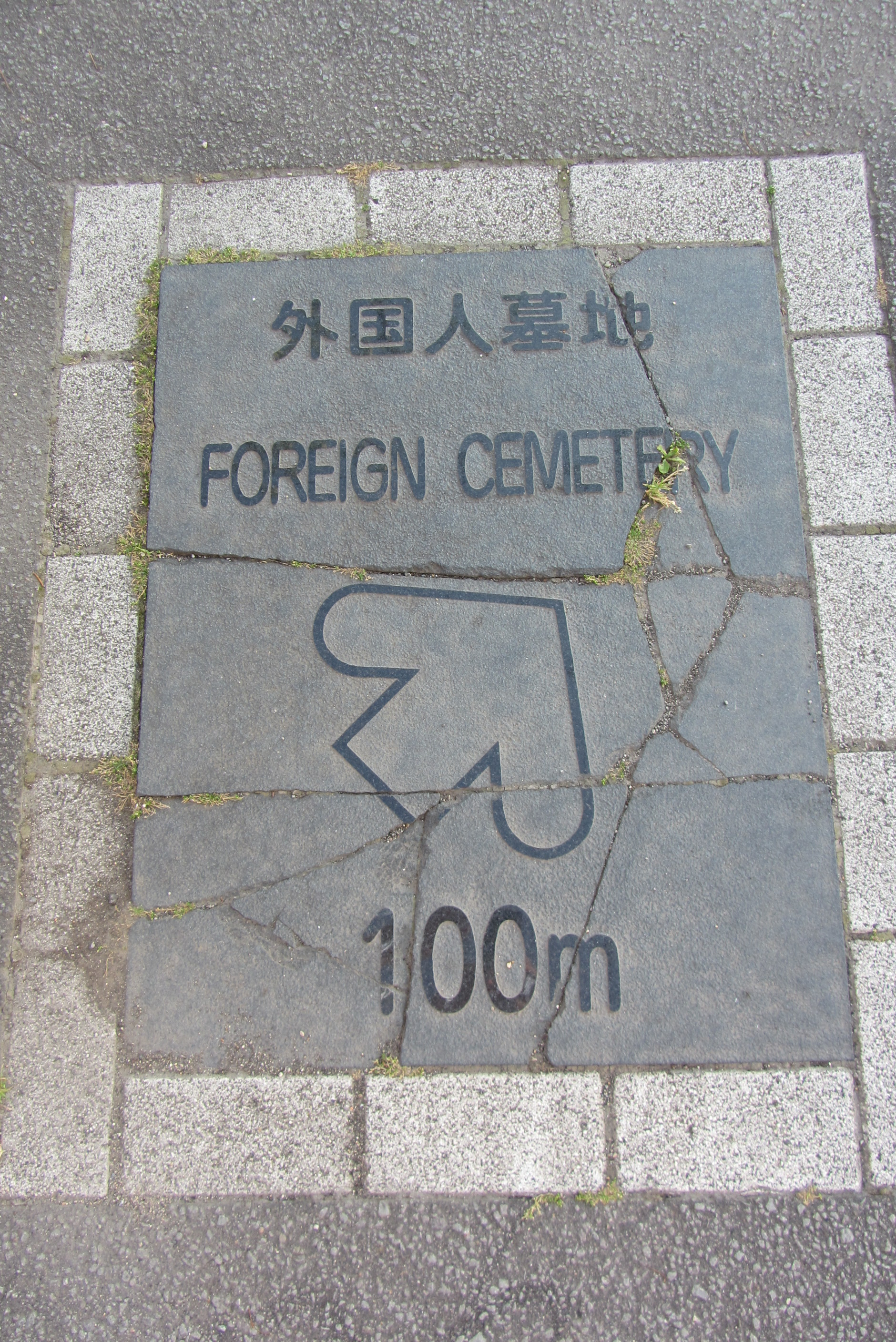
cemetery-foreigner-100mIn 1854, while Commodore Matthew C. Perry‘s U.S. Navy squadron was surveying the future treaty port of Hakodate on Hokkaido, two sailors aboard the USS Vandalia died. Seaman James C. Wolfe died on 25 May and Seaman G. W. Remick died on 27 May 1854. Both were interred in a seaside plot in what later became the city’s Foreign Cemetery, now a tourist attraction.

In 1860, as a result of Perry’s efforts in Japan, the Tokugawa Shogunate dispatched its first embassy to the United States aboard the Kanrin Maru, a Dutch-built ship skippered by Katsu Kaishū. Also aboard was Fukuzawa Yukichi, perhaps Japan’s most effective early Westernizer.

The Kanrin Maru stopped at Honolulu on its return voyage to Japan, and so did many other ships of the fledgeling Imperial Japanese Navy after the Meiji Restoration of imperial rule in 1868. Many of the earliest Japanese immigrants to Hawai‘i in 1868 and 1886 were interred in Makiki Cemetery, which thus came to include the first Japanese cemetery in Hawai‘i. In 1876, (Apprentice?) Seaman Second Class (二等若水夫 nitou waka suifu ‘2-class young waterman’) Arakawa Matajuro (荒川又十郎) of HIMS Tsukuba (筑波) died and was buried in what became the first Japanese Navy cemetery outside Japan. Twelve more enlisted men from the ironclad Ryūjō (龍驤) were buried in 1883. By 1899, seventeen IJN sailors were buried there.

The most interesting gravestone is that of Midshipman K. Hara of HIMS Takachiho (大日本軍艦高千穂), who died on 8 April 1894. (‘Midshipman’ translates 海軍少尉候補生 kaigun shōi kōhosei ‘navy ensign cadet’.) Hara’s is the only marker engraved in both English and Japanese. The former gives his year of death as 1894, while the latter says he died in Kigen 2554, exactly 660 years later. The Kigen (紀元 ‘record-origin’) calendar dates from 660 BC, when the Japanese empire’s mythical founder, Emperor Jimmu, is said to have begun his reign. Kigensetsu (紀元節 ‘record-origin-season’), 11 February, became a national Shinto holiday and festival season in 1872, during the early years of Emperor Meiji’s reign, but was abolished after World War II, then re-established in 1966.

The British-built, Naniwa-class cruiser Takachiho is also an interesting story. It is named for the town of Takachiho (in Miyazaki Prefecture), where Emperor Jimmu’s brothers are supposed to have come from; where his progenitor and Japan’s creator deity, the Sun Goddess Amaterasu, is said to have spent time in a cave, hiding her light, before being lured back out; and to which Amaterasu later dispatched her grandson Ninigi to plant rice and found Japan’s imperial line. In the much more recent and less mythical past, the cruiser Takachiho had visited Honolulu in 1893, to protect its Japanese citizens and to show concern about the overthrow of the Hawaiian monarchy.

Makiki Cemetery lies on the outer slopes of Punchbowl Crater, which later became the National Memorial Cemetery of the Pacific, housing the remains of thousands of members of the U.S. military, many of whom died fighting against Japan during the Pacific War (1941–45). It may seem ironical to have an Imperial Japanese Navy cemetery just below Punchbowl, but the Makiki Japanese cemetery marks a much longer period—a sesquicentennial—of productive cooperation between the United States and Japan.

Leave a comment

Filed under Japan, language, migration, military, U.S.

Wordcatcher Tales: Honi Kuu Okole, Ka Puhio Wela

At least two of the U.S. Army Air Force B-17 bombers that operated in the Southwest Pacific Theater during World War II sported Hawaiian nicknames.

Honi Kuu Okole ‘Kiss My Ass’ (from Fortress Rabaul: The Battle for the Southwest Pacific, January 1942-April 1943, by Bruce Gamble [Zenith, 2010]) – The Hawaiian words would be spelled differently these days, but honi ‘kiss’ + ku‘u ‘my [beloved]’ + ʻōkole ‘ass’ would seem to render ‘Kiss My Ass’ pretty effectively. However, I suspect the syntax might be more accurate if the verb were preceded by the auxiliary e that marks the imperative (or future).

Ka Puhio Wela – Though well-researched and well-written, Bruce Gamble’s Target: Rabaul: The Allied Siege of Japan’s Most Infamous Stronghold, March 1943–August 1945 (Zenith, 2013), p. 275, nevertheless repeats a bit of well-entrenched American military lore that is linguistically incorrect:

“One of the more creatively named bombers in the Fifth Air Force, the B-17 wore Double Trouble on the left side of the nose and Ka-Puhio-Wela, the Hawaiian phrase for double trouble [emphasis added], on the opposite side.”

There is no way to construe Ka Puhio Wela literally as ‘double trouble’. Ka ‘the’ and wela ‘hot, heat’ are pretty unambiguous, but puhio doesn’t show up in exactly that form in any of the major Hawaiian dictionaries. It may be an abbreviated form of pūhihio (= pūhiohio) ‘whirl, blow (like the wind)’ or ‘break wind’. By itself, the root hio can mean ‘a sweep or gust of wind’ or ‘to break wind silently’ (perhaps descended from an earlier Polynesian form *fio ‘whistle’). Another similar form, pūhiʻu (also spelled puhiu) means ‘to break wind audibly, rudely’. So the most literal English translation of Ka Puhio Wela may be ‘Hot Blast (of Wind)’ or ‘Hot Fart’.

Leave a comment

Filed under Hawai'i, language, military, U.S., war

Wordcatcher Tales: Taiatari, Hineri-komi, Lufbery circle

体当たり tai-atari ‘body-hit’ (from Target: Rabaul: The Allied Siege of Japan’s Most Infamous Stronghold, March 1943–August 1945, by Bruce Gamble [Zenith, 2013], Kindle Loc. 1909-1916):

High above [Tsili-Tsili Airfield], the Oscars lagged behind the seven [Ki-48 “Lily”] bombers. Too late, they charged in to break up the intercepting Airacobras. Captain Shigeki Namba, leading one of the cover elements, later lamented that “one by one the Ki-48s were shot down in flames.”

Two of the doomed bomber crews attempted a taiatari, or suicide dive. Literally translated as “body crashing,” taiatari was the honorable choice for a crew whose plane was crippled over the target. Bailing out and becoming a prisoner, akin to surrendering, was anathema to those who subscribed to the Bushido philosophy of an honorable death in combat. Fliers who deliberately chose to crash into an enemy ship, plane, or structure were therefore hailed as heroes in Japan. On this day, at least one taiatari succeeded: a falling bomber smashed directly into the chapel, killing the chaplain and six or seven men inside.

The chapel was the only structure seriously damaged by the Japanese attack.

捻り込み hineri-komi ‘twisting entering’ (from Target: Rabaul: The Allied Siege of Japan’s Most Infamous Stronghold, March 1943–August 1945, by Bruce Gamble [Zenith, 2013], Kindle Loc. 1608-1621):

But the bomber continued to fly on four good engines. The bad news was that it still had to cross five hundred miles of ocean before reaching safety. Disoriented and losing blood, sometimes in agony, at other times semiconscious, Zeamer grimly held the controls as he headed toward New Guinea. It was now about 0900, the sun still relatively low in the sky. The remaining Zeros stunted around the damaged B-17 in what the crew later described as “a Lufbery,” a compelling comment which indicates that the Japanese employed a maneuver known as hineri-komi (literally, “twisting in”). The tactic involved multiple fighters in a looping tail chase.

Upon seeing the maneuver for the first time, most Allied pilots called it a “Lufbery Circle,” referring to a World War I tactic named for French ace Raoul Lufbery. The Japanese adaptation puzzled Allied airmen, for it often seemed that they were merely performing the maneuver to taunt their enemy or show off. Perhaps, in the absence of Oki, his subordinates resorted to the hineri-komi as a fallback. Periodically, one of them would peel away from the circle and commence a gunnery run on the B-17, usually pressing in close. But the crew of Old 666 kept up their defensive fire, and the slicing attacks caused no additional damage.

After forty-five minutes, the Hamps [= Zekes/Zeros] turned away and headed back to Buka. American gunners had hit three more, bringing the total number of damaged fighters to four. And thanks to the preservation of the kodochosho [行動調書 koudouchousho ‘action records’?], some interesting statistics are available. Air Group 251’s seven participating Zeros expended about five hundred 20mm shells and more than seven hundred 7.7mm rounds during this intercept. Curiously, however, while Yamamoto emptied his ammunition canisters at the bomber, Koichi Terada, a pilot of the same rank, apparently never fired a shot.

Hinerite (捻り手 ‘twisting techniques’) account for nearly a quarter of the 82 officially recognized kimarite (‘deciding techniques’) in Japanese sumo.

Leave a comment

Filed under France, Japan, language, military, Papua New Guinea, U.S., war

Japanese Slaughter of PNG Civilians, 1943

From Target: Rabaul: The Allied Siege of Japan’s Most Infamous Stronghold, March 1943–August 1945, by Bruce Gamble (Zenith, 2013) Kindle Loc. 925-960:

AMONG THE DOZENS of church-based missions in New Guinea, some of the oldest were German organizations established before World War I, when New Guinea was a territory of Imperial Germany. During World War II, Japanese forces in New Guinea did not regard German missionaries as allies, even though Nazi Germany and Japan shared a military allegiance. Instead, missionaries came under the jurisdiction of the minsei-bu as neutral civilians. Soon after the Japanese occupied Wewak, they rounded up the local missionaries and transported them to Saint John’s Catholic mission on Kairiru. At first the civilians were free to move about the island, but the situation soon changed.

Some missionaries and natives were willing to risk their lives for the Allied cause. At least two clergymen, Father Manion and Brother Victor Salois, members of the Society of the Divine Word, were American citizens. According to postwar testimonies, the Japanese discovered that several downed Allied airmen were not only hiding in the region, but had contacted the mission with the help of “local people who harbored anti-Japanese sentiment.” Mot’s visit to Kairiru fits this description precisely, and the timing of his trip is more than coincidental.

On the morning of March 17, a few days after the Japanese patrol failed to find the Americans on Wokeo, forty-two civilian men, women, and children were rounded up at Saint John’s and escorted to the destroyer Akikaze, anchored at Kairiru. Included among the mission staff were the two Americans; there were also Chinese nationals, at least one native girl, and two Chinese infants, thought to be orphans. All were treated as neutral civilians aboard Akikaze, which sailed from Kairiru at noon. Late that afternoon the warship stopped at Manus in the Admiralty Islands, where another twenty civilians boarded—again mostly European missionaries, including six women. The next day, Akikaze arrived in Kavieng Harbor, New Ireland, stopping only long enough to receive a message delivered by boat. Akikaze then steamed south, navigating a maze of small islands until it reached the Bismarck Sea. Once safely in open water, the warship headed toward its Eighth Fleet base at Rabaul.

Akikaze’s captain, Lt. Cmdr. Tsurukichi Sabe, evidently presumed he would deliver the civilians to New Britain. Several hundred missionaries and associates were already interned at Vunapope, the largest Catholic mission in the territory. But the message delivered at Kavieng rattled him. With a pale, somber expression, Sabe gathered his officers and informed them that Eighth Fleet Headquarters had issued orders “to dispose of all neutral civilians on board.”

No one would dare question the order. In the Japanese military, instructions from a superior were regarded as though issued by the Emperor himself.

Sabe directed his crew to carry out the orders. First, the civilians were moved to forward berthing spaces below the main deck. Then, within about an hour, a wooden rig was erected over the ship’s fantail. It consisted of a platform covered with mats and a simple hoisting structure. Canvas screens were spread amidships to keep the civilians from viewing the aft third of the ship.

When the preparations were complete, Akikaze throttled up to her maximum speed of twenty-four knots (approximately twenty-seven miles per hour). One at a time, beginning with the men, the civilians were escorted to the bridge. After an interpreter recorded each individual’s name and nationality, they were led aft. Suddenly, they were seized, blindfolded, and bound at the wrists. With no time to comprehend what was happening, they were led onto the platform, attached to the overhead rig, and then hoisted into the air.

At a signal from a junior officer on a nearby gun platform, each victim was shot by four crewmen: one armed with a light machine gun, the other three with rifles. The rig was designed so that the force of the wind from the destroyer’s high speed, together with the impact of the bullets, would swing the victims beyond the platform, where their bodies were released into the churning wake. In theory, at least, this would minimize the amount of gore that collected on the deck. It was also surmised that the sound of gunfire would not carry forward against the wind, thereby reducing psychological stress on the civilians.

The process dragged on for three hours as sixty individuals—priests, friars, nuns, staff, and family members—were systematically hauled into the air, riddled with gunfire, and dumped off the fantail. The two infants were simply thrown into the sea. Afterward, sailors unrigged the platform and hosed the bloodstains off Akikaze’s steel deck. Finally, the officers conducted a funeral ceremony for the souls of the dozens of Christians they had just murdered—almost certainly with a Shinto ritual. Perhaps that, too, was in response to orders.

Leave a comment

Filed under Australia, Germany, Japan, military, Papua New Guinea, religion, U.S., war