
Busy with travel, family, and other things.
Category Archives: travel
Abkhazia: Landmined, Leftover Resort
Not many people these days—except Russians—visit the Black Sea resort enclave of Abkhazia. Travel writer Graeme Wood shares his recent impressions of the place in an article in The Smart Set. Here are a few tidbits to nibble on.
The Republic of Abkhazia is one of the few countries, if you can call it that, where every tourist who shows up gets a handshake and a friendly chat with the deputy foreign minister. Or rather, it would be such a country, if it were a country at all. A wee seaside strip in the Republic of Georgia, Abkhazia hasn’t yet persuaded anyone to recognize its independence, even though it boasts many of the trappings of nationhood — a president, a parliament, and an army that guards the border in case the government in Tbilisi wants to invade again….
Before the war began in 1991, Gorbachev, like Khrushchev before him, kept a dacha here. Stalin kept five, one of which the Abkhazian government rents out to tourists for $50 a night. Still today, all Russians know Abkhazia as the balmiest coast in the otherwise frigid ex-Soviet empire — “a corner of Spain or Sicily,” wrote one 19th-century explorer, “dropped at the foot of Old Man Caucasus.”…
In the mouths of the troupe of Abkhazian pensioners who shared my bus, the Abkhaz language sounded dissonant and buzzy, as if they all kept wasps and crickets in their mouths. (It has 64 consonants and only two vowels, so typical Abkhazian villages are cursed with names like “Adzjwybzha.”) Abkhaz signs appeared on the roadside, written in a Cyrillic script modified by a mad array of curlicues.
Clouds followed for a couple hours’ drive through Gal, a heavily mined zone from which the Abkhazians expelled thousands of Georgians at gunpoint during the civil war. The buildings looked derelict and rotten, like the abandoned houses of Chernobyl after 20 years’ vacancy. Abkhazian soldiers along the road waved us past rusty demining agency placards toward the holiday resorts of the capital….
A decade of war has left Sukhumi shabby, run down badly since its Brezhnevian heyday. Windows are smashed and ceilings have collapsed. The old Intourist, an impressive Colosseum of a hotel on the waterfront, is as derelict as Roman ruins, but inhabited by weeds instead of cats. Palms line the esplanade, but the balustrades are crumbling and the waterfront is disfigured with concrete blocks and chunks of corroded metal. If Tbilisi’s tanks do try to come back to Abkhazia’s capital, Sukhumi, they can expect bitter resistance, and this beautiful seaside promenade will be spattered with blood, just as it was when Abkhazia originally fought for its independence in the early 1990s….
Russians crowded the waterfront cafés, and their presence felt oppressive. The bewitching beaches have beguiled them from noticing the bitter irony, that to escape the misery of Mother Russia they make a lavish holiday in a war zone. I minded this irony more than they did. After days in Sukhumi, I had seen aspects of Abkhazia that reminded me of Moscow, of Miami Beach, of the Italian Alps, and of Plum Island Animal Disease Center, but little that was distinctively Abkhazian.
Mengele’s Nueva Alemania in Paraguay
In Drexel University’s online publication, The Smart Set, Graeme Wood portrays Joseph Mengele’s Germany in exile in Paraguay. Here’s a taste of it.
Eugene, a Belgian computer programmer, has retired to a cottage in southern Paraguay, and the pride of his golden years is his view. From his stone patio, he sees forested hills, the fringes of yerba mate plantations, and, in the distance, the crumbling ruins of a Jesuit settlement two centuries old. “Like a picture,” he says, and I nod to agree, even though my mind is not on the beautiful vista, but on the dark figure who once shared it.
The Nazi doctor Josef Mengele cheated justice for decades by hiding out in South America, sometimes in these very hills. Had he stayed in Germany he would almost certainly have died by the noose. Jews and Gypsies at Auschwitz called him “the Angel of Death”: He killed men and women for the dubious medical value of dissecting them, and for pleasure. He injected dyes into children’s eyes to see if he could change their color. When he ran out of Jews, he sent memos asking for more, and he got them.
Here in southern Paraguay, he found a life not of fear and seclusion but of relaxation and, like Eugene, retirement. After the war, an organization called die Spinne operated a shadowy network of safe houses and travel agents around South America, a sort of Hosteling International for Nazis on the lam. In Argentina and Brazil, they buried Mengele’s tracks well. But in 1960 and then again from 1963 to 1964, he lived openly in a lovely German town on the outskirts of Encarnacion, and even took a Paraguayan passport as “José Mengele.”
This community, called Hohenau, gave Mengele a life in some ways superior to the one he left behind in his native Swabia. Today, rich from the profits of cultivating yerba mate tea (consumed at a rate of gallons a day by all Paraguayans), Hohenau looks like northern California, with sunny drags and boutiques upscale enough to take plastic. The climate is hot but not miserable, and well-suited to exiles from northern European winters. Old Germans remember the doctor kindly, and a friend of Eugene’s says Mengele frequently hitched scooter rides into town, to see a dentist about a recurrent toothache.
The property next to Eugene’s, a lovely and secluded holiday resort, hosted Mengele at least twice. Nowadays it bears no sign of its former guest, except perhaps in its proudly Teutonic name: Hotel Tyrol. The hotel still hints at a European past. Unlike most buildings in this stiflingly hot land, its roof slants sharply, as if to shake off the Tyrolean snow that never falls. Narrow passageways among its rooms feel like those of an old German monastery, repurposed as a spa.
via Megan McArdle
Bucharest, 1984/2008: Back to Tineretului
 One of our goals during our very brief visit to Bucharest in January was to see how much things had changed in the neighborhood we used to live in during 1983–84. The first change we noticed was that we could get there on the M2 north–south metro line, getting on at Aviatorilor and getting off five stops later at Tineretului. In 1984, the metro line (now M1) only ran in a broad northeast-to-west arc from (I think) Republica to Semănătoarea (lit. ‘the inseminator’), apparently designed to serve the huge housing blocs in the most populous new suburbs. So the Bucharest Metro has improved a lot since 1984.
 We lived at Bulevardul Pionierilor 25, Blocul Z7. Note that Romanian place names look a lot like those in other Romance languages, except that the definite articles are suffixed, as in the masculine singular bloc, blocul ‘bloc, the bloc’, and feminine singular semănătoare, semănătoarea ‘planting machine, the planting machine’. (The masculine semănător, semănătorul indicates a human planter.) There are a few wrinkles. On masculine nouns that end in -e, like câine ‘dog’, the singular article is -le, as in câinele ‘the dog’. On feminine nouns that end in stressed -a, like the Turkish borrowing cafea ‘coffee’, the singular definite article is -ua, as in cafeaua [kafjáwa]. And on the huge majority of feminine nouns that end in unstressed -ă (schwa), like casă ‘house’, the singular article -a replaces the schwa, as in casa ‘the house’.

Like quite a few other streets in Romania, Bulevardul Pionierilor changed its name after the “Revolution” (or lovitură de stat ‘coup d’état’) in 1989. The Young Pioneers were so discredited under Communist rule that the boulevard is now named after the neighboring Parcul Tineretului ‘the Park of the Young’ (in the sense of tinerime ‘collective offspring’). Compare the adjective ‘young’, tânăr/tineri for masc. sg./pl., and tânără/tinere for fem. sg./pl., each stressed on the first syllable; and the noun ‘youth’, tinereţe/tinereţi fem. sg./pl., stressed on the penultimate syllable. Compare also the masc. sg. vs. pl. genitive forms, tineretului ‘of the young’ vs. pionierilor ‘of the pioneers’; and the fem. sg. vs. pl. genitive forms in fântâna tinereţii ‘the fountain of youth’ vs. poluarea apelor ‘the pollution of the waters (= bodies of water)’.
 These genitive nouns are used as place names in their own right, as in other Bucharest Metro stops like Eroilor ‘of the Heroes’ or Industriilor ‘of the Industries’. The first things that caught our eyes when we came out of the metro at Tineretelui were the large video panel and billboard advertisements at the corner of the park. Big, ugly commercial billboards hide a lot of distinctive architecture and scenery in Bucharest these days. There’s a lot more traffic, too, than there was in 1984.
 Some things were still the same, though: treacherous winter sidewalks with layers of uncleared snow and ice, litter discarded in public spaces, and the odd open manhole cover. One dark night in 1984, we almost stepped in an open manhole while walking down a street with no lights except those of a passing tram. This year, we noticed that someone had thoughtfully stuffed a Christmas tree into an open manhole on Strada Trestiana, right in our path. We were lucky it was daytime.

Our bloc at Pionierilor 25 contained several other flats housing Fulbright and IREX scholars from the U.S. (and apparently still did in 1995). We were a long way from the nicer northern neighborhoods cluttered with foreign embassies. I remember that, as Halloween approached in 1983, someone in the American, British, or Canadian embassy arranged for the diplomats to borrow costumes from the National Opera for an embassy costume party. We were a little worried that some embassy kids might come trick-or-treating at our doors. We had nothing that would pass muster for treats, but I prepared to shock the kids by offering them the boiled heads and feet of four whole chickens we had managed to find at the local market (rationed at two per customer). The chicken with lots of fresh garlic made a tasty broth, but no one came trick-or-treating that Halloween, so we discarded the heads and feet.
 We did not eat too well that winter. Fresh food was hard to find. You had to supply your own containers, but eggs and (unpasteurized) milk, yogurt, sour cream, cream cheese, stale bread, wheat flour, and corn meal were usually available at local shops. Oil and sugar were rationed. However, in order to find fresh meat, hard cheeses, fresh fruit, or toilet paper, we had to keep an eye out for people queueing up at storefronts on our way to and from the city center, then get in line to find out what they were waiting for. At one point, we managed to obtain a big chunk of fresh pork through one of my Chinese classmates in Romanian language class.
 On our open balcony, we stored apples, onions, and potatoes in cardboard boxes insulated with newspaper. They were usually available throughout the winter in the central open markets, along with sour cabbage and its broth (used to make ciorbă). The common wisdom for canned goods was not to buy anything that had been produced toward the end of each month, when factories were rushing to fill their quotas. (Each label carried the production date.) We ate a lot of bean soups and stewed apples that winter.
 Well, a lot has changed on the food front. Now there is a small but convenient Mega Image supermarket (with signs on the doors saying, “Now hiring“) across from the entrance to the park. We walked in to have a look around and, after a little hesitation, I couldn’t resist photographing the shelves of goods, none of which would have been remarkable had we not longed for such a local market when we lived there 24 years ago. The bread, meat and deli shelves were not in danger of going bare. They even had Romanian-made vegetarian products like tofu in natural, cumin, dill, and pimiento flavors.
However, the prices did not seem very cheap. The average Romanian monthly wage is about 1400 RON (new lei), which works out to about US$600 at current exchange rates, or about $1000 in purchasing power parity. Nevertheless, the Romanian economy has been growing at a feverish pace since 2000. Bucharest, in particular, seems in 2008 to be a bit of a boomtown, much less dreary and downbeat than it was in 1984. But the countryside seems to be lagging behind.
Not the Orient Express
On our first trip to Romania in 1983, we booked our reservations with an agency who knew what they were doing—Thomas Cook, I believe it was. We took the Orient Express from Paris to Bucharest. This time we bought our Eurail passes online and booked our reservations as we went along. Being well into middle age, we bought the First Class Saver passes (for groups of two or more people) good for 15 consecutive days of travel, which we planned for the first two weeks of January.
 Our first mistake was buying the passes from eurail.com, which offers no help with reservations after the sale. Other rail pass vendors, like railpass.com or eurail-pass.com or raileurope.com, will book reservations for people who bought passes from them. Commercial travel agents are not very interested in Eurail pass bookings for just a fraction of the small reservation fee; and national railway systems, even within the EU, may work well with their immediate neighbors, but not with national systems farther down the line.
Romania is pretty far down the line from France. A helpful agent of the SNCF in Strasbourg booked us to Vienna (via Stuttgart and Munich), and gave us the timetable of an overnight train from Vienna to Bucharest, but could not reserve us a sleeping car. (The current Orient Express only runs between Strasbourg and Vienna.) The DB office in Munich had no problem booking us through to Bucharest. The DB certainly impressed us as the gold standard for train travel on both sides of the Atlantic, while Lufthansa similarly impressed us as the gold standard for air travel across the Atlantic, especially after they upgraded us to business class for our Xmas Day flight from Boston to Frankfurt (for no good reason, unless we looked like Herr Santa und Frau Klaus).
 On the 1983 Orient Express, we stayed in the same Wagon-Lit compartment both nights (between France and Germany and between Hungary and Romania), but we noticed a degradation in quality at each change of dining car. We enjoyed an excellent German breakfast in a spotless dining car as we passed through Bavaria the first morning. That evening we enjoyed a pleasant dinner in a clean Hungarian dining car as we headed for Budapest. The dingy Romanian dining car at breakfast was full of smokers drinking ersatzkaffee and plum brandy.
Crossing the Hungarian border at Hegyeshalom around sunset the night before was memorable, but not nearly as traumatic as our wee-hour awakening at Curtici on the Romanian border, where we were asked to open our luggage and tell the officials if we had any bibles, dynamite, or typewriters—a dangerously subversive trinity. The only bright spot was that it was my first real chance to use Romanian since finishing Army language school in 1970.
This year our trauma—and long-awaited dormant language revival—began much earlier, as we tried to find car 419 in the train awaiting us across the platform when we arrived at Wien Westbahnhof. We found car 420, then backtracked to 418, then 417, then forward again, then even farther back to—lo and behold—car 419. This was but the first indication that our train was not the Orient Express, but the Dacia Express (D 345). The second, third, and fourth indications were that the car attendant spoke Romanian, that he had to evict a hopeful squatter from our 2-berth compartment, and that the car was labeled vagon de dormit as well as wagon-lit and carrozza letto.
When I went looking for a dining car after the train got underway, I noticed that several of the outside doors were chained shut, and that chains also hung at the ready from doors separating first and second class. I quickly retreated to our compartment, where the car attendant soon stopped by to explain that we should use the extra deadbolt lock to keep out the regular midnight burglars that plagued the border area between Hungary and Romania, and that we were to make sure that anyone who knocked on the door was a real border control official before opening up. Fortunately, the door had a peephole, and we had enough snacks and drinking water to last until our arrival.
 The Romanian border crossing was far more pleasant this time around, though still at an ungodly hour. When I responded in Romanian, the customs official asked where I learned it. I said I learned it in the US Army the first time around, then revived it later during a year a the University of Bucharest. He suggested that perhaps I had been a democracy activist. I protested that I had never done anything very useful with the language.
In the early hours before dawn we could see the highway from our train window. We saw a good bit of truck traffic and well-lit gas stations at regular intervals—quite a change from the Romania we remembered—but the Transylvanian countryside looked a lot bleaker after sunrise, with poorly built, poorly heated houses in silent, sleepy, snow-covered towns with many abandoned factories between the occasional clusters of plants newly built by foreign investors and fed by much more robust powerlines than we saw in the rest of the countryside. (Further observations about changes we noticed will have to wait for another blogpost.)
 For our return trip from Bucharest to Vienna on Saturday, we boarded the same overnight train (D 346) after stocking up on food and drink at a grocery store in the station. And we got the same lecture about securing our compartment door overnight, this time from a new car attendant with a new trick that employed a coat hanger. He also explained that the teams of burglars only infested the train between Curtici, where it stopped for Romanian customs, and Békéscsaba, the first station on the Hungarian side of the border.
We survived the border crossing unmolested, but also unmoved. We arrived about 2 a.m. and spent most of 3 hours at a standstill, far more than the time required for the Romanian and Hungarian passport control. We finally got underway about the time we should have been arriving at Budapest Keleti, where we had missed the train that was supposed to pull our cars to Vienna. Instead of pulling in to the platform, we spent two hours waiting at a siding, periodically trundling to and fro in front of Budapest’s new Arena Plaza.
 Our car attendant hibernated while the Keleti station loudspeaker blared forth long announcements, only in Hungarian, to otherwise empty platforms. I couldn’t find a Hungarian speaker among the Romanian passengers to translate. So I finally walked up the tracks to the engine and asked the driver if he spoke Romanian, German, or English. He spoke just enough German to tell me that we would not be leaving until after 9 a.m., about the time we had been scheduled to arrive at Vienna and make our connection back to Strasbourg. The engine had had some kind of trouble.
We finally made it into Wien Westbahnhof around noon on a sleepy Sunday. When we informed the solitary, unsympathetic clerk at the ÖBB travel desk that our train from Bucharest had missed its connection, she was not at all surprised. She said we would have to contact the DB, which sold us the reservations, to get any refund, and she gave us the choice of spending the next 20 hours changing trains and waiting in various German stations at ungodly hours, or boarding the real Orient Express for another overnight trip into Strasbourg. We chose the latter.
How many people would resent having to spend 8 hours in Vienna on a Sunday? Well, we did. Almost every shop and restaurant on Mariahilfer Straße was closed. We wanted to treat ourselves to a nice long lunch, but nothing was open. The Russian Vladimir restaurant was closed until five, but we finally found a Greek restaurant, Mythos, run by an Egyptian couple with a cute 2-year-old boy who came around to our table to play with his retractable tape measure, whose housing functioned as a self-propelled vehicle. Thank goodness, once again, for the Mediterranean work ethic in Northern climes.
 The rest of the way back was uneventful. Service on the Orient Express was excellent, door locks were unnecessary, and our couchette mate was an Algerian man who spoke no German, but decent English and much better French than I did. It was nice to get back to Strasbourg, even though we had a rather long wait in Karlsruhe, to be unhooked from the cars headed for Amsterdam, and again in Kehl, to be hauled across the Rhine from Germany to France.
I would love to make another trip to Romania, but not by overnight train.
Pfalzgrafenweiler, Ancestral Truckstop
On the last Sunday in 2007, the Outliers made a pilgrimage desultory excursion to Pfalzgrafenweiler, in Baden-Württemberg, whence Mrs. Outlier’s paternal ancestors emigrated via Odessa to Russia (now Ukraine) around 1800, then later to the Dakotas around 1890. This devoutly religious and devoutly rural line can be traced back to Pfalzgrafenweiler from as early as the 1500s.
 Pfalzgrafenweiler itself goes back at least to Count Palatine (= Pfalzgraf) Hugo II of Tübingen, whose Pfalzgrafenburg there was stormed and razed by a Welf (= Guelph) Duke (= Herzog) of Bavaria in the 12th century. There is also a Herzogweiler within the Weiler Wald portion of the Schwarzwald (Black Forest), which is now a getaway spot for the lumpen as well as the grafen.
Weiler can nowadays be translated ‘hamlet’, something smaller than a Dorf ‘village’, and there are many such placenames stretching far out along both sides of the Rhine, from Basel to Cologne. The equivalent in Alsace and Lorraine is usually spelled -willer (as in Bischwiller, Dettwiller, Ingwiller) or -viller (as in Abreschviller, Guntzviller, Hartzviller). The Alemannisch equivalent is -wiiler. Although related to villa, ville, and village, the term is an early Germanic borrowing from Romance wilare or villare, indicating farmsteads attached to a villa, not the villa itself.
On Saturday, we had made a trip across the Rhine to the Deutsche Bahn (DB) travel desk in Kehl to find out how to get there and buy tickets. (We had not yet initiated our 15-day Eurail Passes.) Despite being just over the border from Strasbourg, France, the DB rep forced his customers to deal with him only in German or English. I chose English after watching the poor Francophone ahead of me struggle along in German no better than mine.
Pfalzgrafenweiler is a bit off the trunklines of public transport. We had to make four transfers to get there. We took the Strasbourg city tram from Langstross/Grand’Rue to the southwest terminus at Aristide Briand, then the old city bus across the river to Kehl. There we caught a tiny Ortenau S-Bahn (OSB) shuttle south over flat farmland to Offenburg, where we caught another tiny OSB shuttle up the scenic hillsides of the Schwarzwald to Freudenstadt, where we hopped a shuttle bus to our final destination. (The DB ticket was good for the bus, too.)
The Kehl to Offenburg leg reminded us a bit of the JR Ryomo line we used to take between Oyama and Ashikaga along the foothills north of Tokyo, while the Offenburg to Freudenstadt leg reminded us more of the scenic Keikoku line running up the upper Watarase River gorge from Kiryu toward Nikko.
Along the way to Freudenstadt (‘Happyville’), the train passed a number of stations whose names ended in -ach (not -bach ‘brook’, but related), meaning ‘watercourse’ and ultimately cognate with Latin acqua: Biberach ‘Beaver Run’, Steinach ‘Stone Run’, Haslach ‘Hare Run’, Hausach ‘House Run’, Wolfach ‘Wolf Run’, Schiltach ‘Shield Run’—but, alas, no Bullach. In the local Alemannisch dialects, the final consonant is lost and the vowel reduced, thus: Biebere, Steine, Hasle, Huuse, Wolfe.
The even more common placenames suffixed with -heim (in High German) suffer a similar fate in Ortenau Alemannisch, where Griesheim = Griese, Meißenheim = Mißne, Ringsheim = Ringse/Rinse; and in Alsatian, where Blotzheim = Blotza, Merxheim = Märxa, Sentheim = Santa. You can see why Baden-Württembergers claim Wir können alles. Außer Hochdeutsch. ‘We can handle everything. Except High German.’

Freudenstadt is roughly comparable in size to Aberdeen, SD, but is even sleepier on a Sunday. The tiny railway station is on the edge of town and lacks even a public toilet. When I followed the arrows on a wall map, I ended up at a port-a-potty in an isolated (and unheated) area nearly 100m from the station. (At least I didn’t have it as bad as Santa did in Pfalzgrafenweiler, where he had to bathe outdoors.) To its credit, Freudenstadt station had a gift shop full of snacks, souvenirs, magazines, travel info about far corners of the globe, and a very impressive collection of cigars for sale in a specially humidified room.
 We had left my brother’s house in Strasbourg a little before 9 a.m. The bus dropped us at the Pfalzgrafenweiler Rathaus at 2 p.m., just as the town went into its deepest Sunday siesta. The local pizza delivery shop had finished its last run. Even the local kebap shop had closed.
 We walked the silent, empty streets meandering uphill toward the highway, where we found EverRast, a combination truck stop, restaurant, and internet café that was just about the only happening place in town on a Sunday afternoon. We ordered German-style salad plates and sampled the local Alpirsbacher Klosterbräu. The friendly waitress looked African American and switched easily between English and German.
 It was already getting dark by 4 p.m. as we meandered back toward the bus stop for the 5 p.m. bus. We had just enough time to snap a few more photos, then stop in at Thome’s Schwanen hotel and restaurant, which was just opening for the Sunday dinner crowd. We asked the gracious hostess for a telephone book and snapped a photo of the handful of listings for Mrs. Outlier’s family name. Most of the telephone numbers had only 4 digits.
It was too dark to enjoy the beautiful scenery on the way back, but we had just enough layover time in Offenburg to explore a few of its cold, empty streets. The only warm, bright spot near the station was the Turkish-run Imbiss Stube. Thank goodness for the Mediterranean work ethic. We ordered hot lentil soups and hot spiked teas. The menu offered not just kebap, pizza, and pide, but also Seele (calzone), which (misleadingly or not) belatedly made the connection for me between Italian calzone and Romanian încălţăminte ‘footwear’.
Out of Town on a Eurail
The Far Outliers will be on the road again for the next month, traveling by air, shank’s mare, and Eurail pass. Today we fly to Boston to visit our daughter for a week, then fly on to Frankfurt on Christmas Day on our way to Strasbourg to visit my historian brother who’s supervising a study-abroad program there. We plan to visit friends in Brittany the weekend of 4 January and make a return trip to Bucharest the weekend of 11 January, with a stop in Miklósvár in Székelyland, Transylvania, on the way there.
My brother speaks pretty good Central African French, and I’ve been working on reviving and expanding my high school French—il y a quarante ans! (I also passed a graduate reading exam in French.) Mrs. O and I can get around a bit in our high school German, and we will make a pilgrimage to the Black Forest town of Pfalzgrafenweiler from which her paternal ancestors emigrated to Ukraine during the Napoleonic era, only to emigrate to the Dakotas during the third Tsar-Alexandrine era and first or second President-Clevelandic era. I haven’t been working on my Ceauşescu-era Romanian, but I’m pretty sure it’ll come back enough to get around. We had hoped to branch out in more northerly and southerly directions from Strasbourg, but our long east–west jaunts won’t leave us much time.
While we’re away, you can get some interesting perspectives about where we’ll be by exploring Europe Endless (formerly Rhine River), Notes from a Tunnel, and the always entertaining travels of Dumneazu. If you can’t ignore Asia for that long, the latest Asian History Carnival at Frog in a Well should provide you with a lot of good reading.
Auf Wiedersehen, au revoir, şi la revedere.
To Save or Not Save a Wife
From Throwim Way Leg: Tree-Kangaroos, Possums, and Penis Gourds—On the Track of Unknown Mammals in Wildest New Guinea, by Tim Flannery (Atlantic Monthly Press, 1998), pp. 96-97 (NYT book review here):
On our last evening in Yominbip we were working restlessly in our hut, packing and repacking the equipment, when Maria, Oblankep’s wife, paid an unexpected visit. As she spoke her voice was low and desperate, and hatred and fear mingled as she told her story in Pidgin.
She had grown up in a small village just outside of Madang; although her family was poor, she was used to the city life and loved it. She met Oblankep in the market at Madang while he was living there. She thought him handsome and took him home to meet her family. He told stories about Yominbip—describing it as a large village not far from a great town and the coast.
Maria’ s parents accepted the marriage offer. Knowing that she was unlikely to see her parents again, she bade them a tearful farewell.
Oblankep’s manner changed when they arrived at Telefomin. He assaulted her and forced her to walk, pregnant, to Yominbip. The journey almost killed her. Since then, alone among strangers, she had borne him a child. She worked daily in the remote gardens. She had grown to hate Yominbip. Those stories about this place—he had told her lies.
She whispered hoarsely, ‘Please take me with you. When the helicopter comes, please take me with you.’
‘But what about your child?’
‘Leave it,’ she said savagely.
When she slipped away I felt a great sense of unease. Should we steal Maria from Yominbip (for that is how Oblankep would doubtless see it), or should we refuse her request? I dared not mention her visit, for she might be severely beaten for what she had done thus far. A failed escape attempt might even result in death.
Most murders in Papua New Guinea result from the theft of women, pigs or land. We would be compromising our own safety were we to attempt to help her escape. And there were other more complex issues to consider. Virtually the entire community of Yominbip had come together as a result of kidnappings. Oblankep had kidnapped his wife, but he himself had been taken by force from his original family. In such a situation it would be useless to try to explain the rights and wrongs of Maria’s case. Morality as I knew it would simply not be understood.
I worried at the problem all morning until a faint mechanical sound announced the imminent arrival of the helicopter. I ran to Oblankep’s hut, and found Maria seated firmly in a corner, her father-in-law standing near her. I could not see her face. With forced jocularity I asked if there were any messages I could take out for anyone. No response. I filled the awkward silence by asking Oblankep to come to my hut so that I could give him some gifts. Everything I was leaving behind I then put in his and his father’s care, to be used by the entire community.
The chopper drew nearer. When it had almost touched down on the new pad I saw Maria crying at the door of Oblankep’s hut. In the din of the rotor blades Lester began loading our specimens and equipment into the cargo hold, unaware of what was going on. I turned back to Maria, her face contorted with tears.
Behind her Oblankep watched, his eyes hard and angry.
The strange title of this book is an anglicized rendition of the Tok Pisin phrase otherwise spelled toromoi lek or tromwe lek, meaning ‘to shake a leg, to get going’.
Filed under Papua New Guinea, science, travel
Eating Across America: Road Trip Food Stops
On the long travel days during our Great Square Route (MN – MS – GA – CT – MN) car trip in May, we would aim to get on the road early, then stop for a late breakfast at some place with local flavor, trying to avoid national chains. We might snack a bit on the road, but would not eat another meal until the evening, again trying to avoid national chains. Here are the most memorable food stops. Like my father and brothers, when I travel I tend to remember the meals above all else.
First breakfast stop – Our first breakfast stop on I-35 South out of Minneapolis was at the Perkins restaurant in Clear Lake, IA. Despite being a national chain, it offered the big plate of biscuits and gravy that I was determined to indulge in at least once on this trip.
Greasiest omelet – After a nice visit with my stepbrother and his family in Kansas City, MO, we hit the road early on I-70 East. We didn’t see much with local flavor until we got to the Midway Auto/Truck Plaza near exit 121 between the Missouri River and Columbia. Their Southwestern Omelet needed extra tabasco to cut the grease as much as to add spice.
Most filling meal – We made good time around St. Louis, whose waterfront we had each visited before, then dawdled down I-55 South on the way into Sikeston, MO, where I was determined to subject my wife and mother-in-law to regionally famous Lambert’s Cafe, “The Only Home of Throwed Rolls.” I ordered just 4 vegetables (cole slaw, green beans, turnip greens, and white beans), but helped my mother-in-law with her (very tasty) catfish and my wife (very little) with her polish sausage and kraut. Between those ample portions and the irresistible black-eyed pea and fried okra “pass-arounds,” I came away stuffed to the gills.
Tiniest restaurant – After stopping two nights in Paducah, KY, to see two brothers, a new sister-in-law, a niece, and a nephew-in-law, grand niece, and grand nephew that I hadn’t met yet, and also to pick up my wife’s sister who flew in from Minneapolis to join us for the jaunt across the South, we headed out on I-55 South, stopping for breakfast at The Grill on Main Street in New Madrid, MO. It had only three or four tables, but served a steady stream of take-out customers and had a lot of local flavor. Above the kitchen doorway was a sign honoring a local U.S. Army lieutenant killed in action.* Every table had a well-used ashtray, emptied but not washed between customers. The restroom in the kitchen contained various cosmetics used by the staff. And the steak I ordered with my eggs—on the chef’s recommendation—was very nicely marinated, very nicely grilled, and very tender.
(*The New Madrid KIA was 1st Lt. Amos C. R. Bock, 4th Battalion, 320th Field Artillery Regiment, 4th Brigade Combat Team, 101st Airborne, killed when a roadside bomb exploded near his vehicle in Baghdad, Iraq, on 23 October 2006.)
 Fanciest restaurant – We found a motel in Jackson, MS, before driving over to Vicksburg. After little success finding a restaurant overlooking the Mississippi River, we ended up at Bourbon’s in the Ameristar Casino. (It was my first time in a casino.) The food and drinks were excellent and we could look out on the river when we weren’t fiddling with the wooden blinds trying to keep the glare of the sunset off the water out of the eyes of our neighbors and ourselves. I had a cup of their Seafood Gumbo (which turned out to be dirty rice, not soup) and Caribbean Steak Salad.
Emptiest restaurant – Traveling east the next day on I-20, we stopped for breakfast at a Barnhill’s restaurant in a ghost-town of a shopping center in Meridian, MS. Barnhill’s is a regional chain that mostly offers Southern-style buffets, but some branches offer breakfast buffets on the weekends. I had sausage, grits, and a good bit more. It was Sunday morning about time for Sunday school to start, so the huge dining hall was practically empty.
Strangest smell – We crossed most of Alabama on U.S. 80, passing through Selma and Montgomery on the way to visit old friends from Micronesia who now live on Ft. Benning, GA, where the father, a Sgt. 1st Class born and raised on Yap, has been teaching infantry tactics to officers ever since he returned from deployment in Afghanistan with the 10th Mountain Division (Light Infantry). During his 20+ years in the Army, he earned a B.A., and is now pursuing an M.A. in international relations.
After a long visit and a quick chew of betel nut, we repaired off-base to Country’s Barbecue in Columbus for a late supper. The food was tasty, but the dining room smelled more like a wet mop than a hot grill. When the party at the booth next to us left, I understood why. The waitresses not only cleared, wiped, and reset the table, they also pulled it out and mopped the floor beneath it. The wait help doubled as bus help and tripled as janitorial help. We left a good tip.
Best grits – It was slim pickings for breakfast the next morning along GA 96 through the heart of pecan and peach country. We got off course in the old railroad junction town of Fort Valley and ended up in Perry, where we settled on an outlet of the Krystal regional fastfood chain. I tried their breakfast “scrambler” with egg and sausage atop grits in a bowl. It was surprisingly tasty, billed as low-carb but plenty high in fat, salt, and cholesterol. The outlet we stopped at seemed exceptionally well managed.
 Second most gimmicky (after Lambert’s Cafe) – After an afternoon exploring a bit of historic downtown Savannah, GA, we drove out to Tybee Island on U.S. 80, which ended at a sign saying “my other end is in San Diego” (an assertion that hasn’t been true for several decades). We dined that night at The Crab Shack, at an outdoor table that had a hole in the middle to discard the shells and corncobs from our heaping platter of seafood. The baby alligator pond was the gimmick that most caught my fancy. I asked the host on the way in if I could pick which one I wanted to eat. He said, “You can pick one, but we ain’t gonna cook it for you.”
Homiest atmosphere – Driving up I-95 from Savannah, we stopped for breakfast at the Olde House Cafe in Walterboro, SC. It was the only “unchained” restaurant we could find. The food was great but the architecture was more interesting. As the name suggests, the building really was built to be someone’s home. We ate in what may once have been a bedroom, and the front porch had a rocking chair on it.
Second worst chitlins – Before we arrived at my dad’s place in South Boston, VA, I had asked him to find some place in his neck of the wood that served decent chitlins (= chitterlings). A long time ago, when he lived in Roanoke, he had taken my wife and me to a mostly black restaurant that served the only good Southern-style chitlins I’ve ever tasted. They were chopped, marinated, and sauteed with vinegar and pepper. (Since then, I’ve had pretty decent Korean-style chitlins several times, both grilled and in soup.) The worst (and first) chitlins I ever tasted was when I was a kid in Winchester, VA. My mother boiled them without enough flavor to disguise the taste and they were terrible. I couldn’t get them past my tongue (or nose). I’m sure my father made a valiant effort to eat them, but we kids all turned up our noses.
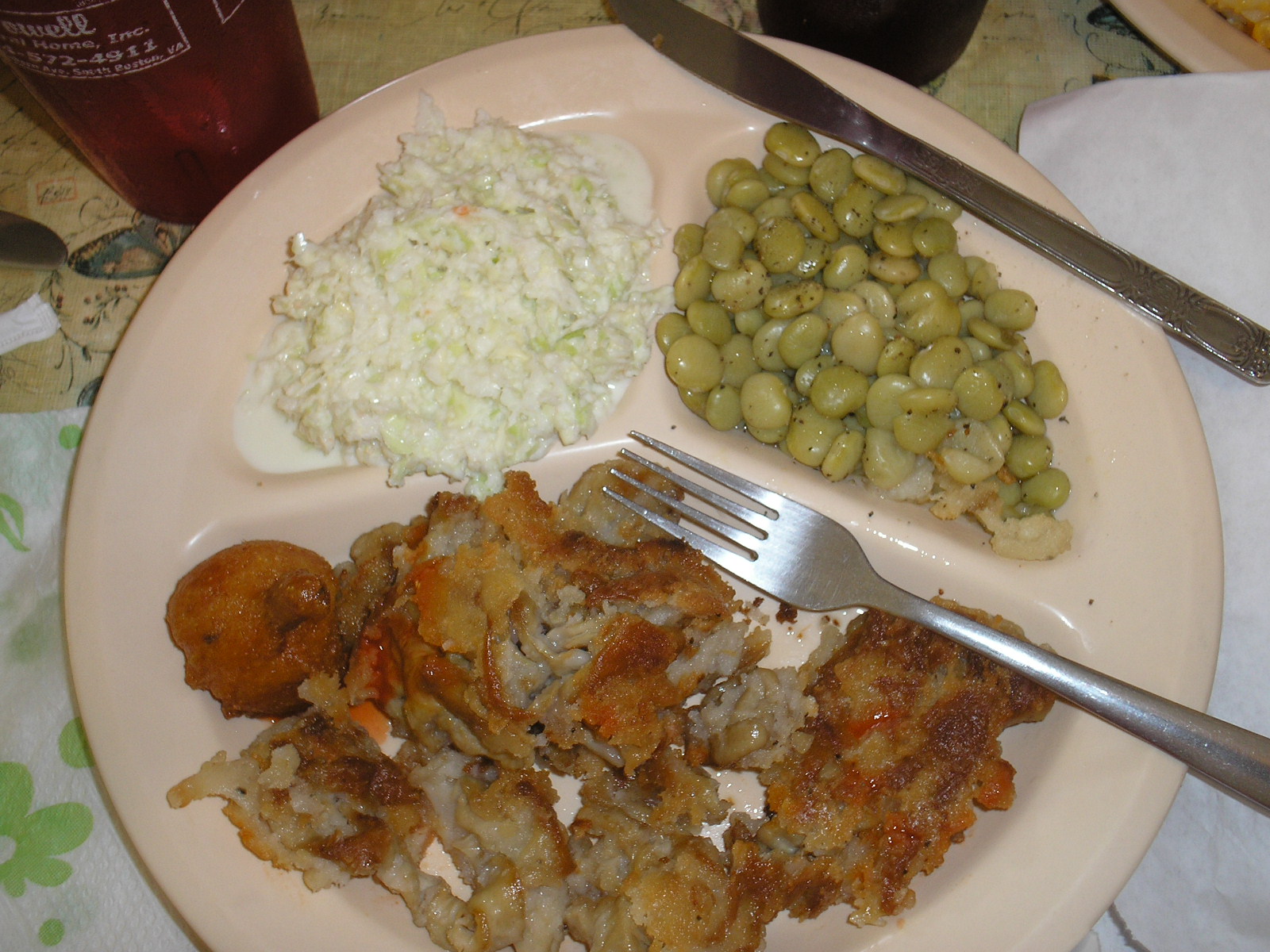 Well, on this occasion, my youngest uncle and an older cousin and their respective spouses had driven over from Tidewater Virginia, so we all went out to Paulette’s Place in Halifax, which served batter-fried fish, shrimp, oysters, and chitlins. My father, my uncle, and I ordered the chitlins. Everyone else had better sense. My uncle drowned his in vinegar, and I dumped tabasco on mine, but I think my father was the only one who didn’t leave any on his plate. The rest of the menu was fine.
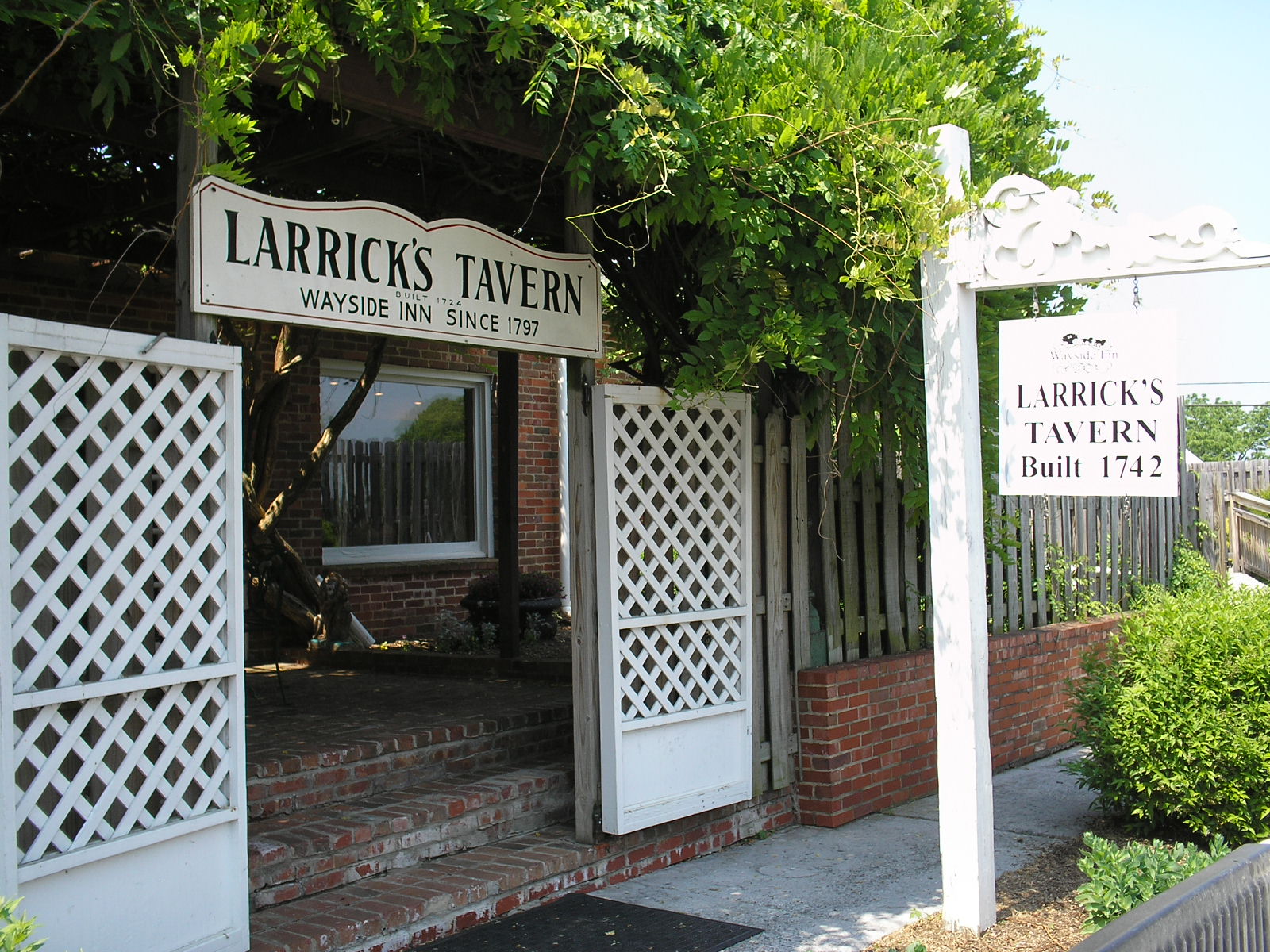 Oldest restaurant – The next leg of our journey ran through the Blue Ridge Mountains and up the Shenandoah Valley to Middletown, VA, where we stopped for a light snack at the historic Wayside Inn, founded in 1797, before paying respects to my aunt, who lives on a farm nearby, and my cousin’s wife and mother-in-law, who live up the road a bit in a house that dates back to the 1740s. (My cousin was off hunting big game on a South African preserve.) The four of us confused the waitress by ordering three house salads and three bowls of their signature Colonial Peanut Soup, reputed to be one of George Washington’s favorites.
Most sushi – The reason we snacked so lightly in Middletown is that we were headed for another family reunion at the other end of I-66, at the Todai [= Lighthouse] Restaurant in Fairfax with: my brother, sister-in-law, and their two kids; my sister and brother-in-law from Annapolis, MD; my father, who came up from South Boston; and my mother-in-law and sister-in-law, who were flying back to Minneapolis the next day, leaving us the car for the rest of our trip. When I eat at Todai, I concentrate on the huge variety of sushi and a few cold salads. When my brother in Fairfax turned 50, I took him to Todai for lunch and we ate 50 pieces of sushi between us.
 Best oasis – Our worst day of driving, by far, was between Fairfax, VA, and New Haven, CT, on the Friday before Memorial Day. Even though we avoided I-95 as much as possible, we spent far too much time in bumper-to-bumper traffic until we got past Baltimore during the morning rush hour, then again after we got across the Hudson on the Tappan Zee Bridge later that afternoon. After trying a stretch of U.S. 1 between Greenwich and Stamford, we decided to break for an early supper in Stamford. After finding the food court still under construction at a brand-new downtown shopping plaza, we discovered Fiesta Atlantic, a refreshing Peruvian restaurant across Atlantic Street that was already open for dinner before 5 pm. Their Sangria had canned fruit cocktail in the bottom of the glass, but tasted quite refreshing, and the two appetizers and two side dishes we ordered were fresh, flavorful, and nicely presented. We had cebiche (ceviche) mixto, ensalada de pulpo (octopus), platano (plaintain) frito, and yuca (yucca) frita.
Most unexpected language – After a long but lovely ride through Pennsylvania on I-80, then through a rather ugly corner of Ohio, we took the North Ridgeville exit on the way to the pleasant Cleveland suburb of Avon Lake, OH, where a busy friend had invited us to stay the night. We had agreed to meet her for breakfast the next morning, so we looked for supper on our own. The Gourmé [sic] Family Restaurant (“Good Home Cooking”) on Lorain Road caught our fancy, so we sampled their fare. I had their lake perch and pierogie combination. Two things puzzled me. Why did every table have a squeeze bottle of syrup as well as ketchup on it? (If ketchup was for the fried fish, was syrup for the pierogies?) And which language was the staff speaking to each other? Their appearance and their accents were vaguely Eastern European, but I heard enough of their talk to rule out Germanic, Slavic, Romance, Hellenic, Turkic, and even Finnic and Ugric. It turned out to be Albanian. We never did solve the mystery of the syrup.
Black Memphis vs. Black Nashville
From Our Kind of People: Inside America’s Black Upper Class, by Lawrence Otis Graham (Harper, 2000), pp. 276-277:
I am still a devoted fan of Memphis because of my childhood memories and because of the progressive people—both black and white—who I know are working together today; but like its black elite, who were educated elsewhere, I feel it is a town trying to overcome great odds. The thriving downtown that it once had along Main Street—between Beale and Jefferson—was killed in the 1970s when the whites abandoned the increasingly black city, which now is only 44 percent white. There is not a department store within ten miles of City Hall. Big stores like Gerber’s, Lowenstein’s, and Bry’s are all gone now. The area surrounding the municipal buildings, courthouses, and county offices is littered with pawnshops, bail bondsmen, and vacant storefronts. What would have long ago been a well-developed Mississippi River waterfront in any other town is just now seeing walking paths, green grass, and trees. With the exception of a few tall buildings built by the city’s superior hospitals—Baptist and Methodist—and by First Tennessee Bank and Union Planters Bank, one gets the sense that no major company or industry calls Memphis its home. Federal Express is there—several miles out of downtown, near the airport, but the headquarters for Holiday Inn and Cook Industries left years ago.
Even the city’s premier hotel, the Peabody—as plush as it is, by Memphis standards—seems a bit corny and anachronistic. Founded in 1869 and rebuilt in the 1920s, the imposing brick structure attracts tourists to its main lobby each morning for a ritual that began in the 1930s and continues today, seven days a week. At 11:00 A.M. sharp, an elevator door opens on the main floor, and marching in line across the carpeted floor are five trained ducks. Marching in unison to taped music that plays over the lobby speakers, the small ducks waddle toward a small, ornate fountain and pool in the middle of the floor. One by one, they hop up to the fountain and then dive into the pool. The routine is repeated in reverse at 5:00 each afternoon. Since the hotel had a policy of segregation thoughout my older relatives’ lives, it was not until we were teenagers that they permitted us to visit the building and view this amusing event.
“Memphis used to have the largest and most developed metropolitan area in Tennessee,” explained a black former city councilman who acknowledges that a fear of integration is what kept Memphis small and rather underdeveloped. “It can’t be blamed on the people who are in power today,” he says, “but those who were making decisions in the 1950s and 1960s created a problem between the races and within the corporate community that was hard to correct.”
The city’s black elite seem to be painfully aware of how much better their black counterparts are doing in Nashville—a city whose metropolitan area had once been less affluent, less respected, and less populated than that of Memphis. In fact, most of the Memphis black elite who had grown up in the city prior to the 1960s had to leave town and go to Nashville in order to get their education. Although the town had the small, all-black LeMoyne College since 1870, it lacked the truly elite black institutions that Nashville had: Fisk University and Meharry Medical College. The black Memphians also lacked Nashville’s Tennessee State University, a black public college that ran itself like an elite private school.
“Although I grew up in Memphis—a city that looked down on Nashville at the time,” explains a sixty-year-old physician who attended Fisk, “I always had the feeling that Nashville was going to catch up and then leave us behind—intellectually and racially. Memphis had no premier schools for whites or blacks, and Nashville had Vanderbilt for whites and these other top schools for us. White Memphians—and even some black Memphians—seemed to get more backward and more provincial as other cities outgrew us. So few blacks here were able to break out of the box and really gain national exposure the way that blacks in Nashville did.”


 Far Outliers
