Category Archives: Philippines

The Last Japanese Holdouts in the Philippines

A little over 30 years ago, in 1974, Lt. Onoda of the Imperial Japanese Army surrendered on Lubang Island in the Philippines.

February 1946 – Post WWII island campaign

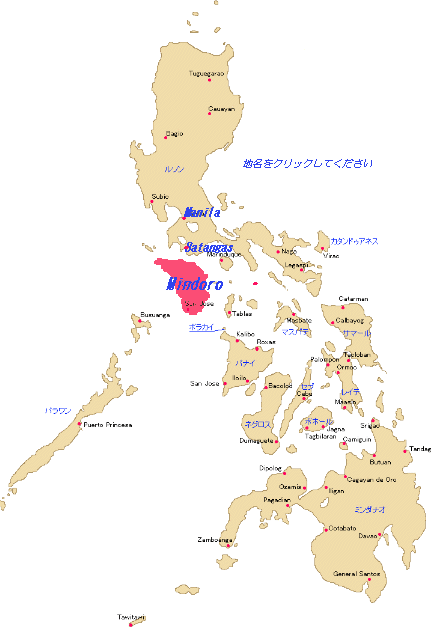
In February 1946 on 74 square mile Lubang Island, 70 miles southwest of Manila Bay a seven week campaign to clear the island was begun by the Filipino 341st and American 86th Division.

February 22, 1946 – Lubang island Allied casualties in a post WWII battle

Intense fighting developed on February 22, 1946 when troops encountered 30 Japanese. Eight Allied troops were killed, including 2 Filipinos. The Filipino and Americans sent for an additional 20,000 rounds of small arm ammunition, but not future battles occurred of this magnitude. In early April, 41 members of the Japanese garrison on Lubang island came out of the jungle, unaware that the war had ended….

March 5, 1974 – Lubang Island – 2nd Lt. Hiroo Onoda Born in the town of Kainan, Japan in 1922 and when he turned seventeen, he went to work for a trading company in China. In May of 1942, Onoda was drafted into the Japanese Army. Unlike most soldiers, he attended a school that trained men for guerilla warfare. On December 26, 1944 (age 23), Hiroo Onoda was sent to the small tropical island of Lubang Island, which is approximately seventy-five miles southwest of Manila in the Philippines. Shortly after Americans landed, all but four of the Japanese soldiers had either died or surrendered. Hiroo Onda was also with three other holdouts, who had different fates:

Private First Class Yuichi Akatsu – (age 22 in 1944) Left the group in September 1949. He managed to live six months on his own before surrendering to the Philippine Army. In 1950, the remaining three found a note left by Akatsu stating that he had been greeted by friendly troops. He even led a group of soldiers into the mountains in search of the remaining men. Onoda and his men quickly concluded that Akatsu was now working for the enemy.

Corporal Shoichi Shimada – (age 30 in 1944) In June of 1953 was shot in the leg during a shootout with some fishermen. Onoda nursed him back to health, but on May 7, 1954, Shimada was killed instantly from a shot fired by another search party sent in to find the men.

Private Kinshichi Kozuka – (age 24 in 1944) Killed by two shots fired by local police on October 19, 1972 when Kozuka and Onoda burned rice that had been collected by farmers, as part of their guerilla activities.

Circumstances of His Surrender

Despite the efforts of the Philippine Army, letters and newspapers left for them, radio broadcasts, and even a plea from Onoda’s brother they did not believe the war was over. On February 20, 1974, Onoda encountered a young Japanese university dropout named Norio Suzuki who was traveling the world and told his friends that he was “going to look for Lieutenant Onoda, a panda, and the Abominable Snowman, in that order.” The two became friends, but Onoda said that he was waiting for orders from one of his commanders. On March 9, 1974, Onoda went to an agreed upon place and found a note that had been left by Suzuki. Suzuki had brought along Onoda’s one-time superior commander, Major Taniguchi, who delivered the oral orders for Onoda to surrender. Intelligence Officer 2nd Lt. Hiroo Onoda emerged from the jungle of Lubang Island with his .25 caliber rifle, 500 rounds of ammunition and several hand grenades. He surrendered 29 years after Japan’s formal surrender, and 15 years after being declared legally dead in Japan. When he accepted that the war was over, he wept openly.

Afterwards

He returned to Japan to receive a hero’s welcome. He was a media sensation and was hounded by the curious public everywhere he went. He was unable to adapt to modern life but wrote his memories of survival in a book, No Surrender: My Thirty-Year War. After publication, he moved to Brazil to raise cattle. He revisited Lubang island in 1996, and still alive today. He then married a Japanese woman and moved back to Japan to run a nature camp for kids.

Actually, the last confirmed surrender was by Captain Fumio Nakahira, who held out until April 1980 near Mt. Halcon in Mindoro Island.

Leave a comment

Filed under Japan, Philippines, war

Philippine Doctors Retraining as Nurses

Cronaca (“Past Imperfect, Present Subjunctive, Future Conditional”), a wonderful history blog that Regions of Mind reminded me of, notes a report about new medical developments:

The Philippines is increasingly witnessing a trend that carries alarming implications for the future — its medical doctors are training to be nurses so they can leave the country and make more money.

Leave a comment

Filed under Philippines

New Offensives in Mindanao?

Belmont Club reports on ominous new developments in the Philippines.

The scene is now set for a possible resurgence of fighting. A glance at the map dramatically illustrates the bind that Gloria Macapagal Arroyo and the Philippine Government have worked themselves into. For the first time in a century, Muslim rebels have established themselves in force on the Mindanao mainland, away from their traditional strongholds of Sulu, Basilan and Tawi-tawi, island groups in the southwest corner of the archipelago. They are positioned on the west side of Mindanao’s breadbasket, the Cotabato valley. The MILF [Mindanao Islamic Liberation Front] camps guard the approaches to mountain massifs to the west which then give on the sea, their line of supply. They isolate the predominantly Christian Zamboanga peninsula from Northern Mindanao and essentially cut the huge island in two. The Armed Forces of the Philippines, despite a nominal strength of ten divisions, has very little combat power. A lack of logistical support and ammunition stockpiles means that (Belmont Club estimate) it can sustain offensive operations with only two battalions for a period of 12 weeks after which it simply runs out of everything. Thus, Manila has long lacked an offensive option against the MILF and has tried to compensate by “peace talks”, which are another name for appeasement.

Leave a comment

Filed under Islam, Philippines, war

The Dilemma of the Overseas Filipino Worker

Dean Jorge Bocobo of Philippine Commentary captures the dilemma of the OFW (Overseas Filipino Worker):

The Philippines Overseas Employment Administration (POEA) reports that about 2500 Filipinos leave the country every day for jobs abroad. Many like hostage Angelo de la Cruz actually seek out the most dangerous jobs, such as truck driver in Fallujah for a Saudi oil company, precisely because these are the highest paying jobs and therefore also the ones that will require the shortest stints away from their families. In fact, last Saturday when the government “banned” Filipino workers for leaving for jobs in Iraq, some 100 of them stranded at the airport expressed a willingness to still continue with their plans to work there, saying they had already done everything necessary to go, sometimes even selling the family’s last remaining possessions to do so….

Here then, exposed for all to see, is the viscera of Filipino despair and heroism packed neatly into a kind of pact with the Devil: The Overseas Filipino Worker goes willingly even to perilous places like Iraq, with its daily toll of death, because they figure like this: If I stay in the Philippines, my family and I will probably starve to death or be forced into lives of crime and prostitution. If I go to work in a place like Iraq, we shall all have a chance at salvation and happiness in which there can only be two outcomes: If I live, then we shall all be saved and happy. If I die, only I shall die, but my family will surely be saved by the insurance policy granted by POEA. Either way, my family will be saved by my sojourn abroad. I therefore go willingly, please do not stop me at the airport.

That is the essential heroism of the modern OFW.

Leave a comment

Filed under Philippines

"Crucifixation" in the Philippines

Dean Bocobo of Philippine Commentary has a different take from most Anglosphere bloggers on Mel Gibson’s “crucifixation” movie.

The shedding of real blood by real people is a real part of our celebration of Christianity and its seminal event in the Crucifixion of Jesus Christ. That event, we don’t only voyeuristically make the subject of gory movies, public prayers and pious displays, but some Filipinos exhibitionistically crucify themselves in a literal imitation of Christ on Good Friday. Others participate in organized self-flagellations that occur all over the Philippines during Holy Week.

via Belmont Club, who adds his own unique take.

There are three points to be made in this respect. The first is that most American and European Christians will find the Filipino Lenten practices about as incomprehensible as non-Christians may find the cinematic rendition of Jesus’ sufferings. The second is that the Filipino penitents are entirely sincere in their devotion. The inability of Westerners to understand this Filipino tradition in no way reduces its value to the people of that Archipelago. The third is that anti-Semitism is wholly unknown, indeed, incomprehensible to Filipinos for the simple reason that they have never encountered Jews in any quantity. The average Filipino has never nor will probably ever meet a Jew. Anyone who takes the trouble to view a Filipino Lenten commemoration will see Romans depicted as the villains and the Jews — in one glorious lump including “the Apostles, Mama Mary and the other Mary the Magdalene, Pilate, Caiphas, Barabas (he was loudly cheered), Judas, and of course Jesus Christ himself” — played by the townspeople themselves.

Most Christians now live in Asia, Africa and Latin America. They far outnumber the dwindling congregations of Western Europe. The vast majority of Third World Christians know nothing about the historical conceptions of anti-Semitism — the Ghetto, the Pogrom, the Holocaust. To a very large extent, the debate over the anti-Semitic content, or lack thereof, in The Passion of the Christ is not between modern day Christians and Jews, but across a fault line in Western and Middle Eastern history.

Leave a comment

Filed under Philippines, religion