Category Archives: Papua New Guinea

Tok Pisin with Isuzu Lu: Ol Skulmanki

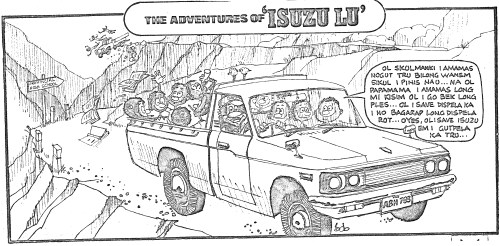
Isuzu Lu: Ol Skulmanki

Isuzu Lu: Ol Skulmanki

Lu: “Ol skulmanki i amamas nogut tru bilong wanem sikul i pinis nau … na ol papamama i amamas long mi kisim ol i go bek long ples … Ol i save dispela ka i no bagarap long dispela rot … Oyes, ol i save Isuzu em i gutpela ka tru …”

Lou: “The schoolkids are awfully happy because school is over now … and the parents are happy for me to bring them back to the village … They know this car won’t break down on this road … Oh yes, they know Isuzu is a very good car …”

This is a scan from a faded old photocopy of a cartoon ad by Bob Browne for New Guinea Motors in the Papua New Guinea Post-Courier, 1976. I’ve got a lot more, but I’ll have to limit my scanning to just a sample because I see that the author/illustrator has published a collection of these cartoons. I just bought the last copy of Isuzu Lu Book 5 available on Amazon.com.

Leave a comment

Filed under education, language, Papua New Guinea

Tok Pisin with Isuzu Lu: Hey, Poro!

Isuzu Lu: Hey, Poro

Isuzu Lu: Hey, Poro

Lu: “Hey, Poro … Mobeta yu baim wanpela Isuzu Utility … Ol i strongpela moa … inap long karim ol kain kain kago long baksait … Yu traim, laka!?!”

Lou: “Hey, Friend … You’d do better to buy an Isuzu Utility … They’re very strong … enough to carry all kinds of cargo in back … Try it, okay!?!”

This is a scan from a faded old photocopy of a cartoon ad by Bob Browne for New Guinea Motors in the Papua New Guinea Post-Courier, 1976. I’ve got a lot more, but I’ll have to limit my scanning to just a sample because I see that the author/illustrator has published a collection of these cartoons. I just bought the last copy of Isuzu Lu Book 5 available on Amazon.com.

Leave a comment

Filed under economics, language, Papua New Guinea

Balkans & Papua New Guinea: Sprachbund issues

The following draft of a paper was presented at the Fourth International Conference on Austronesian Linguistics (FoCAL), in Suva, Fiji, in August 1984, under the title “The Balkans and Papua New Guinea: Language Contact Issues.” It briefly touches on some of the new (and disturbing) ideas about Sprachbund issues that I encountered during my Fulbright year in Romania in 1983–84. It was a frustrating year for linguistic research, but a wonderful year for language learning—and for travel, it being my first trip to Europe.

Introduction

To many who limit themselves to the study of European languages, “the Balkan languages represent a unique case of evolution from genealogical divergence toward typological convergence” (Saramandu 1979:177). It is likely, however, that any large language family has some members who have to some extent forsaken their relatives for their neighbors. One such group in the Austronesian (AN) language family comprises the New Guinea Oceanic languages. (I continue to use “New Guinea Oceanic” as a typological, not a genetic, label.)

The Balkan Sprachbund may receive more publicity than its counterpart in Papua New Guinea, but in neither area are the issues anywhere near resolved. I intend here to outline some of these issues and to compare the progress being made toward resolving them in each of the two areas of study. The Balkans will receive greater attention because I assume that most Austronesianists are less familiar with that area.

Composition

The core of the Balkan Sprachbund is composed of five languages: Albanian, Bulgarian, Macedonian, Modern Greek, and Romanian. Compared to the hundreds of languages involved in New Guinea, the number seems quite manageable. Moreover, Bulgarian and Macedonian are sufficiently close that they can be considered together for most purposes. More peripherally involved in the Balkan Sprachbund are Serbocroatian and Turkish. Turkish is usually considered only as an outside donor language, but it would be interesting to compare Balkan or western Turkish with eastern dialects or with other Turkic languages to see to what extent it may also have acquired Balkan, or at least European features.

In order to determine what is specifically “Balkan” about the core languages, one can compare Bulgarian with the other Slavonic languages and with Old Bulgarian (that is, Old Church Slavonic) dating from the 9th to 11th centuries A.D. (Rosetti 1978:480). One can compare Romanian with the other Romance languages and with Latin. The earliest documents in Romanian itself date from the 16th century (Rosetti 1978:482). Records of Greek go back millennia, so it is perhaps the most tractable of the Balkan languages. Albanian, being an isolate with only a brief written history, is harder to deal with, but at least there are two dialects to compare. The southern (or Tosc) dialect shares more features with Bulgarian, Greek, and Romanian than does the northern (or Gheg) dialect. (Comrie 1981:198.)

The surviving languages of the Balkan Sprachbund, then, all belong to different branches of Indo-European. For most of these branches, there is some documentary or comparative basis for sorting out areal features from genetic features. (Comrie 1981:198.) Matters are considerably complicated, however, by the knowledge that the original Balkan substratum did not survive. The most common terms used to refer to this substratum are “Thracian”, “Dacian”, and “Illyrian”. No one is sure whether these are different names for the same language, different dialects of the same language, or three different languages, each with separate dialects. Assumptions vary from linguist to linguist. So does the importance assigned to the role of the substratum in accounting for the similarities shared by the present-day Balkan languages. I shall discuss the substratum issue in greater detail shortly.

Intertranslatability

Early studies of the Balkan languages taken as a unit perhaps tended to overstate the similarities among them. Sandfeld, in his classic synthesis on the subject (1930), says that, “in going from one of these languages to another … one is struck by the fact that the manner in which things are expressed remains essentially the same throughout the entire territory covered by these languages” (1930:6-7; Grace’s [1981:27] translation).

First, let me illustrate the kinds of explanations I had hoped to find, by briefly summarizing the loss of the infinitive.

In the Balkan languages, finite verbs are used where other European languages would use the infinitive. The loss of the infinitive in Greek can be explained on language-internal grounds. Loss of word-final [n] in Greek made the infinitive formally identical to the 3d person present indicative form of the verb. Distributional evidence suggests that this innovation spread north from Greece. Bulgarian lacks an infinitive entirely. Citation forms of verbs are usually 1st person present indicative. The infinitive exists in Albanian but is used more in the northern dialect than in the southern one. In Serbo-Croation, Serbians prefer to use subordinate finite verbs where Croatians use the infinitive. In Romanian, too, more northern dialects use the infinitive more than the southern ones. I believe there is general agreement on this question.

Unfortunately, not many other issues are as well resolved.

One can say almost the same thing about some areas of Papua New Guinea, but only where the languages involved are all from the same family. The convergence between AN and Papuan languages is on a much grosser level, at least in most cases.

More recent work on Balkan languages, especially that by scholars from the Balkan countries themselves, seems to pay more attention to the differences among the various languages. One reason may be that the Balkan scholars have a greater concern for questions of their own national identity than did the outsiders who originally popularized the concept of the Sprachbund. In fact, Dumitru Macrea, a Romanian scholar, has expressed the view that the whole concept of a Balkan linguistic union being somehow comparable to a language family had its origin in the desire of Germany and Austria to propagate the idea of a unitary Balkan area which those powers then planned to dominate politically, economically, and culturally (Macrea 1982:284).

Another reason more recent scholarship may emphasize the differences among the languages is that there is simply much more data available than there used to be. Finer differences have become more salient. The same thing is happening with regard to Papua New Guinea languages too, as more data becomes available. I suspect that detailed study of the Kupwar village languages would also turn up many, many cases in which those languages are not as perfectly intertranslatable as they are often assumed to be. Even if many texts are morpheme-for-morpheme translatable, I suspect comparable morphemes are never full synonyms.

This raises an important issue. Is absolute convergence necessary? Is it desirable? Is it even possible? What kinds of differences are most tolerable? If fluently bilingual speakers maintain one of their languages solely for emblematic purposes, that is, solely to mark themselves off from speakers of other languages, what portion of their language will serve that emblematic function? Will they be content to say, “You say tomayto and we say tomahto,”, or “You call it eggplant and we call it aubergine”? Or might they also focus on larger differences, like “You put object complements before the verb and we put them after,” or “You have all those heart idioms and we have all those liver ones”? Virtually any recognizable difference would seem sufficient to be emblematic.

Unifying factors

What is it that accounts for the unity that does exist among the Balkan languages? It is significant that no mention at all is made of the possibility of a common Balkan substratum in two recent general works in English that devote some attention to Balkan areal features. These two works are Comrie’s (1981) introduction to typology and universals and Bynon’s (1977) textbook in historical linguistics. Bynon mentions the Byzantine Empire and Greek Orthodox church as unifying factors, while Comrie emphasizes the mutual bilingualism that enabled innovations to spread across language boundaries. Schaller’s (1975) introduction to Balkan linguistics (in German) also tends to discount the role of the substratum and appeal more to the Greek and Latin adstrata as unifying factors. The over dependence on substratum by earlier linguists to explain language change seems to have made many western linguists shy of using the term.

Substratum is generally given a more prominent role, however, by those linguists for whom it is not just an academic issue but also a question of national ethnogenesis. Romanian linguists, for instance, often talk of the history of their language in geological terms. Romanian is said to consist of an autochthonous (pre-Roman Dacian) substratum, a core stratum from Latin, and a superstratum of Slavic. To some, the central problem in Balkan linguistics is the identification of pre-Roman, pre-Slavic, autochthonous elements in the Balkan languages (see Brancus 1978). In spite of much effort, not much progress has been made in this direction (Brancus 1978:374). The only records we have of the Dacian language are a handful of proper names and between 10 and 20 Dacian glosses in two Greek lists of medicinal plants (Academia R.S.R. 1969:314-316).

Al. Rosetti, the Romanian linguist who has concerned himself most with Balkan linguistics in the broader sense—that is, the study of the Sprachbund as a whole, not just the attempt to reconstruct the pre-Roman substratum—nevertheless uses the term “substrate influence”, rather loosely to designate any sort of interference between two languages (Rosetti 1978:205). This perhaps parallels the use of loaded terms like “mixed language” or “language mixture” to describe any sort of contamination between AN and Papuan languages in the New Guinea area.

Gheorghe Ivanescu, one of the principal Romanian Indo-Europeanists, holds a fascinatingly particular view that requires a substrate motivation for each and every sound change. He attacks the “neolinguist” view that phonetic changes are imitative and therefore transferable across language boundaries (1980:735). He asserts instead that a phonetic change is realized only by a change in the “base of articulation”, that is, by a change in the characteristic shape of the oral cavity at rest within a given population (1980:8). He attacks the structuralists for failing to recognize the innateness of certain articulatory tendencies, and suggests that phonetic similarities between some Caucasian languages and Romanian (such as the presence of phonemic schwa) “are to be explained by the anthropological relationship between the peoples of the Caucasus and those of the Carpathians” (1980:733).

An interesting corollary of Ivanescu’s view is that languages do not change at a constant rate. Instead, language change depends on external changes in the speaker population. The “base of articulation”, for instance, changes over time “through changes in the quantitative relationships between the component human types [of a population], as well as through mixtures with other populations, maybe even through biological mutations between one generation and the next” (1980:9).

However, according to Ivanescu (1980:11), the “articulatory basis” of a language can be suppressed. “It does not manifest itself in those eras in which there exists an intense traffic of goods and people” (1980:11). It “cannot manifest itself either in the capitalist era or in the socialist era, except in popular speech … [It] only shows itself in eras in which there is a natural economy, thus in the primitive-commune and feudal eras” (1980:11). For instance, “the adaptation of Latin to the articulatory and psychological bases of the romanized populations, thus the birth of the Romance languages, was not possible except with the change from a trade economy during the slavery era to a natural economy during the medieval era” (1980; 11). (This “natural” economy was organized on a feudal basis in the West and on the basis of village collectives in the East [1980:11].)

A “natural” economy, however, does not allow languages to attain their “natural” condition. In a “natural” economy, divergent local bases of articulation are free to influence phonology, while divergent local temperaments are free to influence morphosyntax (1980:13). These influences are “completely avoided only in eras of intense circulation” of people and goods, thus in eras of higher technological development when unitary literary languages are born (1980:13). “[O]nly in such eras can languages completely attain their natural condition: that of relative stability” (1980: 13).

I’ve lingered over Ivanescu’s views somewhat more than might be necessary for two reasons. In the first place, we often tend to take our shared assumptions for granted. It is healthy sometimes to bring some of them into sharp relief by considering radically different viewpoints. Second, the divergence of assumptions among those of us working on New Guinea language history is relatively narrow compared to that encountered among those working on Balkan language history. Let me give a few more illustrations:

I have already mentioned Macrea’s opinion that Germanic imperialism is responsible for propagating the Sprachbund idea. Macrea (1982:285) and Ivanescu (1980:48 ff.) see similar forces at work in an early hypothesis that attempted to explain the particularly close similarities between Romanian and Albanian. The hypothesis was that the Romanian language and people originally took shape south of the Danube close to where the Albanians are now. A corollary assumption is that when the armies of the Roman Empire retreated south of the Danube in A.D. 275, the whole Romanized population came with them. One can see why this hypothesis would weaken the historical argument for Romanian territorial claims. Although this hypothesis is still kept alive by some Hungarian irredentists (see Du Nay 1977), it is no longer considered seriously by any present-day Romanian linguists. Instead, Romanian linguists are inclined to attribute the similarities between Romanian and Albanian to a common Thraco-Dacian substrate, on the theory that the Romanians continue that portion of the substrate population that adopted Latin as its mother-tongue, while the Albanians continue that portion that borrowed a lot from Latin but did not switch over to Latin (Ivanescu 1980:57).

Romanian linguists, then, are far less reticent than their Western counterparts about appealing to a common substratum as a unifying factor in the Balkan Sprachbund. I believe that part of the appeal to substratum as an explanatory factor is motivated by the desire to establish prior territorial claim to present Romanian-speaking areas. So far, historical linguistics in the New Guinea area has been relatively free from involvement in territorial claims. I hope that situation continues.

Other unifying factors mentioned in the Romanian literature are:

(1) similar conditions of life among the Balkan peoples, particularly the relative mobility their livestock-centered economy afforded them;
(2) exposure to Byzantine civilization, especially the Eastern Church;
(3) subjugation to the Ottoman Empire, a condition which actually reinforced the church as a unifying factor;
(4) widespread bilingualism (Saramandu 1979).

Saramandu (1979), a younger Romanian Balkanologist, distinguishes what he calls “passive” and “active” bilingualism. The distinction is not unfamiliar, but I would use the terms “restricted” and “unrestricted” to describe the two types. By “passive” bilingualism, Saramandu means bilingualism restricted to certain social occasions (religious services, for instance) or certain social strata (priests, administrators, itinerant merchants or craftsmen). The mass of the population would presumably recognize but not use another tongue. By “active” bilingualism, Saramandu means the bilingualism of a person who masters and uses two or more languages in more or less equal measure.

I’m not sure that, for a given population, the end result of either of these types of bilingualism would be very different, except that the second permits the possibility of complete language shift. On an a priori basis, one might suppose that the foreign languages in which a population is passively bilingual might contribute more loanwords or loan translations, and have less effect on phonology, morphology, or syntax; while the foreign languages controlled actively by the mass of a population would influence the phonology and phraseology as much as the lexicon. But French, for instance, seems to have penetrated into every corner of English (except perhaps phonology) even though the great mass of Anglo-Saxons after 1066 were certainly no more than passively bilingual. If sufficiently influential, active bilinguals can spread foreignisms among their own passively bilingual kith and kin at least as efficiently as foreigners can.

Here ends the draft of the paper I presented but never submitted for the conference proceedings. The only record I preserved was a hand-annotated printout from the Wang word processor at the accounting firm where I was working (the Honolulu office of Deloitte). Unfortunately, the bibliography seems to have gone missing. I scanned, OCRed, and then cleaned up those pages to get the text above.

My wife and I began that fascinating year teaching summer extension courses in Yap, Micronesia, during a severe drought that had us bathing out of buckets in our air-conditioned hotel room. Little did we realize at the time what types of shortages we would face during our long, cold, dark winter in Romania. We both made the trip to Fiji, where we stayed in a village near the conference hotel, along with several other participants from far corners of the globe. For the two of us, especially after Romania, that Pacific Island village made us feel we were back home again.

2 Comments

Filed under Balkans, language, nationalism, Papua New Guinea, scholarship

Causative Makeovers in New Guinea Oceanic Languages, 3

In contrast to Austronesian languages almost everywhere else, the Oceanic languages on the north coast of the Papua New Guinea mainland show an unusual disinclination to make use of the morphological causative inherited from Proto-Oceanic and Proto-Austronesian. Innovative causatives derived from causative serial constructions appear to have supplanted to varying degrees the inherited prefix *pa(ka)-. Part 1 summarizes the dethroning of the inherited prefix. Part 2 outlines the replacement pattern of serial causatives. Part 3 (here) suggests reasons for preferring the serial causatives.

Ambiguous syntax preferred

What accounts for the decline of the inherited morphological causative and the rise of the serial causatives in the Oceanic languages along the north coast New Guinea? From a strictly structural point of view, the path of causative serialization seems an unnecessarily complicated way to move from SVO to SOV. The most grammatically economical way would be to add one rule inverting every VO to OV. But what is grammatically economical in this case seems sociolinguistically implausible.

I assume that speakers of neighboring Austronesian and Papuan (non-Austronesian) languages were often familiar with each other’s languages, at least to the extent that each could understand when spoken to in the other language(s) and could be assured of being understood when using their own language. Even when fluent in the other language(s), speakers may have wished to speak their own language for emblematic reasons, to signal their identity as members of a particular linguistic group. Or they may have had to speak to monolinguals some of the time. In such circumstances, speakers may have tended to mitigate the differences between the various languages they used. They may increasingly have favored structures that were originally highly marked or syntactically ambiguous in their own language(s) precisely because such structures resembled the patterns of their interlocutors’ language(s). Some of these structures could have been analyzed according to the patterns of either language type.

Causative serial constructions permit just this sort of multiple analysis. They contain no clause boundary markers and thus permit speakers and hearers to parse the constructions to suit their own preconceptions about clause structure and word order. At the same time, serial causatives run little risk of being misunderstood. They describe cause-and-result events in an order matching the unfolding of those events in the real world. The first verb denotes the manner in which the Agent behaved; the second describes the effect of that behavior on the Patient.

(NOTE: Slobin [1982] presents evidence that children have a harder time learning periphrastic causatives than they do learning morphological causatives. I claim only that serial causatives, not periphrastic causatives, are semantically transparent. The periphrastic causative verb [‘do’, ‘make’, ‘cause’, etc.] carries more grammatical information than it does information about the extralinguistic world. The serial causative verb [‘chop’, ‘hit’, ‘grab’, ‘twist’, etc.], on the other hand, carries more real-world than grammatical information. The periphrastic causative indicates a causative relationship between one event or entity and another event. The entity responsible for the causing event may be described but the specific nature of the causing event must be inferred from context. The serial causative describes both causing event and resulting event. It leaves the causative relationship to be inferred from the construction—from the order in which the two events are described and from the semantic and grammatical bonds between the two descriptions. The periphrastic causative involves embedding. The result verb is grammatically subordinate to the causative verb. The serial causative involves no embedding. The cause and result verbs share one or more arguments but neither is subordinate to the other.)

Serial causatives can be parsed in various ways depending upon where the parser decides to insert a clause boundary and whether the construction involves a same subject or switch subject relationship between the verbs. A further option is not to insist on parsing the structure into two separate clauses.

If one decides the construction contains two clauses, one can insist on perceiving a clause boundary in either of two likely locations: either before or after the Patient NP. A clause boundary after the Patient NP will produce an initial SVO clause and thus make the structure compatible with SVO word order. In the switch-subject type, the second clause will be intransitive, with no overt subject NP; while in the same-subject type, the second clause will be transitive but contain neither a subject nor an object NP. As an illustration, take the serial construction, ‘I chopped the tree toppled’. If one inserts a clause boundary between ‘the tree’ and ‘toppled’, then one has an SVO clause ‘I chopped the tree’, and a second clause with just the verb ‘toppled’. A switch-subject reading would produce ‘I chopped the tree and it toppled’ while a same-subject reading would yield ‘I chopped the tree and toppled it’.

But suppose one felt that a clause boundary before the Patient was more in line with one’s preconceptions. In this case, the first clause would consist of a subject and a verb with no object NP, while the second clause would contain either a Patient NP acting as subject of an intransitive verb, or a Patient NP acting as object of a transitive verb. Again take the example ‘I chopped the tree toppled’. A switch subject version could be parsed into ‘I chopped and the tree toppled’, while a same subject version could be parsed to read ‘I chopped and toppled the tree’. Both versions with the clause boundary before the Patient are thus compatible with SOV word order. The switch subject version contains no overt object NP and the same subject version contains an object NP in front of the final verb.

If one exercises the option of not inserting any clause boundary in a serial causative, then one has a clause that is both verb-medial and verb-final. An interpretation under which the manner verb is the main verb will be compatible with SVO prejudices, while one in which the result verb is the main verb will conform to SOV prejudices. Semantics will not easily decide. There seems no more reason to suppose that the manner-of-action is ancillary to the result-of-action than there is to presume that the result is subordinate to the manner. The manner verb describes the role of the Agent while the result verb describes the effect on the Patient. Neither the Agent nor Patient is a dispensable member of the Agent-Patient transitive clause. These parsing options are summarized in Table 1.

Table 1: Parsing Options for SVOV Serial Causatives

One clause
Parsed as SVO: S Vmain O Vsub
Parsed as SOV: S Vsub O Vmain
Two clauses
with switched subject
Parsed as SVO: S V O ## Vi
Parsed as SV: S V ## S Vi
with same subject
Parsed as SVO: S V O ## Vt
Parsed as SOV: S V ## O Vt

Reflexes of both switch-subject and same-subject serial causatives are found throughout NGO languages. Very often, reflexes of both types are found in the same languages, as in Manam. However, it appears that same-subject serial causatives are more common. In Manam, for instance, the only intransitive result verb that appears in homologs (inherited similarities) of the serial causative is -mate ‘to die, be dead’ (Lichtenberk 1983).

Table 2: Reflexes of Two Types of Serial Causatives in Manam

Switch subject: *S s-V-o O=S s-V ==> S O s-V-V-o
boro i-mate ‘the pig died/is dead’ (Vi)
pig 3s-die
(di) boro di-rau-mate-i ‘they killed the pig’ (Vt + Vi)
(3p) pig 3p-hit-die-3s
Same subject: *S s-V-o O s-V-o ==> S O s-V-V-o
(ngai) ‘ai i-sere‘-i ‘he split the wood’ (Vt)
(3s) wood 3s-split-3s
(ngai) ‘ai i-zan-sere‘-i ‘he split the stick lengthwise’ (Vt + Vt)
(3s) wood 3s-punch-split-3s

There is also evidence that speakers of Oceanic languages in New Guinea adopted the one-clause analysis of causative serial constructions. In almost every language, either the manner or the result verb has lost its verbal status. Prevailing word-order patterns seem to have been the sole determinant of which of the two verbs became grammaticalized (reduced to a smaller, more restricted grammatical class). Many of the languages that have not made the full shift to SOV (those in Morobe Province) have grammaticalized the clause-final result verbs. The reflexes of those verbs now form a class of resultative particles. In contrast, the nonfinal manner verbs have grammaticalized in the fully SOV languages. They have yielded a set of prefixes classifying the manner of action by which various results are achieved. Some of these prefixes have degenerated to the point where their meanings are indeterminable on solely language-internal evidence. These contrasting patterns of grammaticalization are summarized in Table 3.

Table 3: Different Resolutions for Two Verbs in One Clause

The VO Solution, adopted by Numbami and other VO languages:
S Vmanner O Vresult ==> S Vmain O Result
The OV Solution, adopted by Manam and other OV languages:
S Vmanner O Vresult ==> S O Manner-Vmain

One way to get the verb from one position to another within a clause, then, is to render the information of that clause in such a way that verbs fall in both positions in a construction that contains no boundary markers and thus permits multiple analyses. The evidence suggests that Oceanic languages on the north coast of New Guinea adopted this strategy in changing from SVO to SOV. The availability of this strategy suggests that serialization need not arise from either coordinate or subordinate relationships between two separate clauses. In fact, there is no evidence that I am aware of—at least in the Oceanic languages on the New Guinea mainland—that causative serial constructions were ever two fully separate clauses. The languages are adequately supplied with conjunctions, conjunctions that are often ubiquitous in other constructions. But no conjunctions show up between the constituents of serial causatives, not even as morphological remnants. Serial causatives in these languages were apparently from their very inception structures containing one clause worth of event-construction semantics and two or more clauses worth of verbs, without any intonational or morphological indication of a clause boundary.

References

Lichtenberk, Frantisek. 1983. A grammar of Manam. Oceanic Linguistics Special Publication No. 18. Honolulu, University of Hawaii Press.
Slobin, Dan I. 1982. Universal and particular in the acquisition of language. In: Eric Wanner and Lila R. Gleitman, eds., Language acquisition: The state of the art. Cambridge, Cambridge University Press.

2 Comments

Filed under language, Papua New Guinea

Causative Makeovers in New Guinea Oceanic Languages, 2

In contrast to Austronesian languages almost everywhere else, the Oceanic languages on the north coast of the Papua New Guinea mainland show an unusual disinclination to make use of the morphological causative inherited from Proto-Oceanic and Proto-Austronesian. Innovative causatives derived from causative serial constructions appear to have supplanted to varying degrees the inherited prefix *pa(ka)-. Part 1 summarizes the dethroning of the inherited prefix. Part 2 (here) outlines the replacement pattern of serial causatives. Part 3 suggests reasons for preferring the serial causatives.

Serial causative reflexes in New Guinea

Over 40 years ago, Milke (1965:346–347) pointed out correspondences between certain classificatory prefixes in Gedaged and certain ones in Papuan Tip languages. Such prefixes broadly classify the manner in which a result is achieved: by beating, by grabbing, by kicking, by piercing, and so forth. He proposed that the classificatory prefixes were a morphological innovation providing evidence for a New Guinea Oceanic subgroup. He was apparently unaware of the presence of identical constructions in Manam. However, Milke was hard put to find classificatory prefixes in Huon Gulf languages. If he had been looking for main verbs rather than prefixes, he would have had better luck.

There are no classificatory prefixes in Huon Gulf languages, but there are main verbs that play roles similar to those of the prefixes. And there are result verbs or resultative particles in Huon Gulf languages whose semantics resemble those of the verbs occurring with classificatory prefixes in the verb-final languages elsewhere on the northeast coast of New Guinea. Some of the morphemes involved are cognate as well.

Proto-Oceanic (POC) *taRaq ‘to hew, chop, cut into’ is virtually ubiquitous as an initial verb in serial and compound causative constructions.

Reflexes of POC *punu ‘to strike, kill, extinguish’ are universal as resultatives in the Huon Gulf languages. However, in Kairiru the reflex of *punu appears as a manner transitive. In Gedaged, it appears as either a manner or a result verb. Reflexes of *punu turn up in result position in causative compounds in Papuan Tip languages.

Capell (1943:177) reconstructs a form *tomu ‘to cut or break off’ widely reflected in Papuan Tip languages. Its reflexes appear in result position in Misima (= Panayati), Nimowa, and Sudest; and in classificatory prefix position in Suau and Iduna. In Numbami, a Huon Gulf language, tomu is a resultative meaning ‘broken off’.

POC *kabit (PAN *kampit) ‘to hold, take, snatch, carry, gather’ is widely reflected in initial position in phrasal causative and incorporated object constructions in Huon Gulf languages. Its reflexes occur in the same position in compound causative, classificatory prefix, and incorporated-object constructions in Gedaged, in Madang Province, and in Papuan Tip languages.

Reflexes of POC *mate ‘to die’ show up in Kairiru, Manam, Gedaged, and Gitua as result verbs.

Perhaps one of the most productive manner-transitive verbs is reconstructible as *rapu meaning ‘to strike, hit, beat’. It shows up as a transitive verb in Huon Gulf serial causatives and incorporated-object constructions; as the only classificatory prefix without an independent verb counterpart in Manam; and as an almost meaningless, general causative prefix in almost every Papuan Tip language. Many of the Papuan Tip languages also show a less phonologically reduced, independent verb of a similar shape with the meaning ‘to hit’.

The innovative causative constructions—no matter whether the object noun occurs before or after the verb—thus resemble each other in the semantics of the components involved, in the order in which verbal and incorporated-object components occur (VO), and, in many cases, in the shapes of the individual morphemes as well. Moreover, the two groups of innovative causatives are in complementary distribution in Papua New Guinea and both differ from the causative pattern commonly found in Oceanic languages elsewhere. These circumstances seem to invite the reconstruction of a single ancestral pattern that will account for both the VO (verb before object) and OV (object before verb) constructions.

Distributional evidence within the Austronesian language family suggests that the VO, serializing languages around the Huon Gulf are more conservative of ancestral word order than the OV languages elsewhere around the New Guinea mainland. The syntactic pattern ancestral to both the serial and compound causative constructions should thus be compatible with VO basic word order. The Huon Gulf languages already provide evidence for an SVOV pattern in which the first verb indicates a causing action and the second a result. SVOV syntax is compatible with VO basic word order and such a reconstruction will also account for the compounding pattern if we assume that the compounding languages shifted their basic word order from VO to OV after serial causative constructions were well established. (Perhaps Central Papuan languages like Motu have no classificatory prefixes because they shifted before the serial causative was well established.)

Two major changes are thus sufficient to account for the causative compounds in OV languages along the north coast of the Papua New Guinea mainland. First, SVOV serial causative constructions developed. This stage is attested in the VO languages around the Huon Gulf. The languages to the northwest and southeast then underwent a further change: they shifted from VO to OV basic word order. The SVOV causative thus became an SOVV causative. In some of the Morobe languages, which apparently never made the full shift to OV basic word order, the SVOV serial causative produced an SVOR phrasal causative when the final verbs in the construction lost their verbal status and became resultative particles. In most of the OV languages, the SOVV serial causative produced SOVV compound causative and classificatory prefix constructions. The OV languages show progressive deverbalization of the nonfinal verb in the construction. These developments are outlined below.

Reflexes of serial causatives in New Guinea Oceanic languages

* S Vt O Vi (Switch Subject) ‘they hit pig die’
* S Vt O Vt (Same Subject) ‘they hit pig kill/cause-die’

The VO languages

S V O V (Switch Subject) GITUA
ti-rap nggaya mate
3P-hit pig 3S-die

S V O Result (< Same Subject) NUMBAMI
ti-lapa bola uni
3P-hit pig dead (< ‘killed’)

The OV languages

S O V V (Switch Subject) KAIRIRU
bur rro-un-i a-myat
pig 3P-hit-3S 3S-die

S O V-V (< Same Subject) GEDAGED
boz du-punu-fun-i
pig 3P-shoot-kill-3S

S O classifier-V (< Switch Subject) MANAM
boro di-rau-mate-i
pig 3P-hit-die-3S

S O classifier-V (< Same Subject) IDUNA
bawe hi-lu-ve-‘alika-na
pig 3P-*hit-cause-die-3S

References

Capell, Arthur. 1943. The linguistic position of South-Eastern Papua. Sydney, Australasian Medical Publishing.

Milke, Wilhelm. 1965. Comparative notes on the Austronesian languages of New Guinea. Lingua 14:330–348.

3 Comments

Filed under Fiji, language, Pacific, Papua New Guinea, Polynesia

Causative Makeovers in New Guinea Oceanic Languages, 1

In contrast to Austronesian languages almost everywhere else, the Oceanic languages on the north coast of the Papua New Guinea mainland show an unusual disinclination to make use of the morphological causative inherited from Proto-Oceanic and Proto-Austronesian. Innovative causatives derived from causative serial constructions appear to have supplanted to varying degrees the inherited prefix *pa(ka)-. Part 1 (here) summarizes the dethroning of the inherited prefix. Part 2 outlines the replacement pattern of serial causatives. Part 3 suggests reasons for preferring the serial causatives.

The morphological causative supplanted

Both in Oceanic languages and in Austronesian languages more generally, the causative prefix is ubiquitous. In virtually any grammatical description of a Philippine language one can find mention of a pa- causative affix. Pa- causatives also occur in all the aboriginal (Austronesian) languages of Formosa, and even in distant Malagasy. The causative prefix is also well attested in Oceanic languages. In fact, it is one of the prefixes most characteristic of Oceanic languages. In Pawley’s (1972) grammatical comparison of Eastern Oceanic languages, it is the first verbal prefix listed and also the best attested—all but one of the 31 languages compared show an appropriate reflex. The same is true of Codrington’s (1885:183–184) table of verbal prefixes in 32 Melanesian languages. (The two lists overlap by about 50 percent. Only Ambrym lacks the prefix in Codrington’s list; only Tasiko lacks it in Pawley’s.) A sample of Austronesian causative constructions follows.

AUSTRONESIAN CAUSATIVES

RUKAI, Formosa
‘a-‘acay kuani taraalu‘ sa babuy
cause-die that hunter ART boar
‘that hunter killed a boar’

ILOKANO, the Philippines
im-pa-kan na diay baboy
GOAL-cause-eat 3S that pig
‘he fed the pig’

MALAGASY, Madagascar
n-amp-anasa ny lamba aho
PAST-cause-wash the clothes 1S
‘I had the clothes washed’

ROVIANA, the Solomon Islands
va-mate-a sa si keke boko pa inevana
cause-die-3S 3S PRT a pig for feast
‘he killed a pig for the feast’

BAUAN, Fiji
eratou vaka-mate-a na vuaka
3P cause-die-3S ART pig
‘they killed the pig’

HAWAIIAN, the Hawaiian Islands
ho‘o-make lākou i ka pua‘a
cause-die 3P OBJ the pig
‘they killed the pig’

The widespread occurrence of the prefix in most Eastern Oceanic languages is matched by a widespread multiplicity of function. Pawley (1972:45) notes three common functions of the prefix in the languages supporting his reconstruction of *paka- for Eastern Oceanic: causative (‘causing/allowing …’); multiplicative (‘repeatedly/extensively …’); and similative (‘resembling/characteristic of …’; as in Fa‘asamoa). The prefix is so productive in Polynesian and Fijian languages that Churchward’s (1959) Tongan dictionary, for instance, has 112 pages of words beginning with faka-, the Tongan form of the prefix.

In the Papua New Guinea languages with reflexes of the serial causative, on the other hand, the prefix has markedly diminished in function and in some cases disappeared altogether.

The Manam reflex of *paka- is aka-/a‘a-. It only serves to derive transitives from a limited number of statives and psychological verbs (Lichtenberk 1983:217).

The reflex of the morphological causative in Gedaged and its congeners is variously pa-, pe-, pi-, or pu-. Mager (1952:233) defines it as “a petrified prefix” and says:

It is not always clear when this prefix (and its variants) is a prefix and when it is a reduplication or a part of the root. Some times we can discern that it is a causative prefix, at times it expresses intensification, or it gives the word an opposite meaning.

In Gitua, the reflexes of causative *pa(ka)- and reciprocal *paRi have fallen together as pa-. (Lincoln 1977:24). Pa- can indicate reciprocal or multiple action, but its causative function has been almost entirely displaced by serial causative constructions. Thus, pa-mate (lit. ‘to cause to die’) only means ‘to extinguish (fire)’. The serial causative is required to render the literal sense of ‘to kill’.

The causative prefix appears completely lost elsewhere in Morobe Province. I have been able to find no evidence of it in the Huon Gulf languages.

The Papuan Tip languages show a proliferation of causative prefixes. Reflexes of causative *pa(ka)- are well attested but are not always easy to tell—either semantically or phonologically—from the reflexes of reciprocal *paRi- (Capell 1943:113, 237–242). Other causative prefixes have arisen due to the near-total semantic bleaching of some of the classificatory prefixes (see the compilation in Ezard 1992:238-248). The prefixes, which—as transitive action verbs—used to describe the manner in which the result was achieved, now indicate little more than that the result was achieved. Capell used the vague gloss ‘assumption of state’ for such prefixes. The new causative prefixes now perform functions often identical to the functions of the inherited causative prefix. The same is true of many manner-transitive verbs in the languages that retain Verb-Object word order. A comparison of some morphologically causative verbs in Hawaiian (Pukui and Elbert 1986) with analogous new causative constructions in Papua New Guinea Oceanic languages will illustrate the way in which transitive action verbs have taken on the functions of the morphological causative inherited from Proto-Oceanic. The usual Hawaiian reflex of *paka is ho‘o-.

HAWAIIAN ho‘o-hana (‘make-work’) ‘to employ, cause to work’
WEDAU rau-karäi (*‘hit-work’) ‘to set (s.o.) to work’

HAWAIIAN ho‘o-helele‘i (‘make-falling’) ‘to scatter, sow’
WEDAU ravi-awawari (‘*hit-falling’) ‘to sow broadcast’

HAWAIIAN ho‘o-hua (‘make-fruit’) ‘to bear fruit’
NUMBAMI -ambi ano (‘hold-fruit’) ‘to bear fruit’

HAWAIIAN ho‘o-huli (‘make-turn over’) ‘to turn, change, convert’
IWAL -amb nalili (‘hold-turned around’) ‘to turn (s.t.) around’

HAWAIIAN ho‘o-loli (‘make-turn/change’) ‘to change, amend’
NUMBAMI -ambi lele (‘hold-turned’) ‘to translate’

HAWAIIAN ho‘o-luli (‘make-shake’) ‘to rock (so); to sway’
WEDAU ravi-dagudagu (‘*hit-restless’) ‘to shake, disturb’

HAWAIIAN ho‘o-make (‘make-die’) ‘to kill, let die’
MANAM rau-mate (‘hit-die’) ‘to kill’

HAWAIIAN ho‘o-piha (‘make-full’) ‘to fill’
TUBETUBE ro-karapowani (‘*hit-full’) ‘to fill’

HAWAIIAN ho‘o-pi‘i (‘make-ascend’) ‘to cause to rise’
GEDAGED bi-sa (‘hold-ascend’) ‘to lift up, raise’

HAWAIIAN ho‘o-puka (‘make-perforation’) ‘to make a hole or opening’
NUMBAMI -so bozoka (‘stab-pierced through’) ‘to make a hole or opening’

References

Capell, Arthur. 1943. The linguistic position of South-Eastern Papua. Sydney, Australasian Medical Publishing.

Churchward, C. Maxwell. 1959. Tongan dictionary. London, Oxford University Press.

Codrington, Robert. 1885/1974. The Melanesian languages. Oxford, Clarendon Press. Reprint. Amsterdam, Philo Press.

Ezard, Bryan. 1992. Tawala derivational prefixes: A semantic perspective. In: M. D. Ross, ed., Papers in Austronesian linguistics no. 2. Canberra, Pacific Linguistics.

Lichtenberk, Frantisek. 1983. A grammar of Manam. Oceanic Linguistics Special Publication No. 18. Honolulu, University of Hawaii Press.

Lincoln, Peter C. 1977. Gitua–English vocabulary. Photocopy.

Mager, John F. 1952. Gedaged–English dictionary. Columbus, Ohio, The American Lutheran Church Board of Foreign Missions.

Pawley, Andrew K. 1972. On the internal relationships of Eastern Oceanic languages. In: R. C. Green and M. Kelly, eds., Studies in Oceanic culture history, vol. 3, pp. 1–142. Honolulu, Department of Anthropology, Bernice P. Bishop Museum.

Pukui, Mary Kawena, and Samuel H. Elbert. 1986. Hawaiian dictionary: Hawaiian–English, English–Hawaiian, rev. and enl. ed. Honolulu, University of Hawaii Press.

2 Comments

Filed under Fiji, language, Pacific, Papua New Guinea, Polynesia

Possessive vs. Attributive Genitives in Numbami

Genitival modifiers in Numbami, an Austronesian language of Morobe Province, Papua New Guinea, may either precede or follow their head nouns. This word order difference has consistent semantic correlates. For convenience, I will refer to the Modifier + Head genitive order as the “possessive” genitive. This contrasts with the “attributive” genitive, which has Head + Modifier order.

MODIFIER + HEAD ORDER

There are two types of genitives with Modifier + Head order. One is simply a noun-noun compound without any intervening markers of a genitive relationship. Such compounds express whole-part relationships. The modifier indicates the type of larger entity of which the principal entity (that denoted by the head noun) is a part. This modifier is descriptive rather than referential. There are no restrictions on the referentiality of the compound as a whole. It can be nonspecific—that is, it can denote some not-yet-uniquely-identifiable member(s) or quantity of the set it describes. It can be generic—that is, it can refer to any and all members (or the entire quantity) of the set it describes. Or it can be specific—that is, it can refer to some individually identifiable subset of the set it names. Because the term “generic” is sometimes used in both the nonspecific and the generic sense (as just defined), it will be convenient to use different terminology in the discussion that follows. The term “attributive” (or “nonreferential”) will substitute for “nonspecific” and the term “referential” will take the place of both “generic” and “specific”. Examples of whole-part genitives in Numbami follow.

Whole-part Genitives

    wuwu lau ‘betel pepper leaf’
    wuwu ano ‘betel pepper fruit (catkin)’
    nima kuku ‘finger’ (lit. ‘hand digit’)
    nima daba ‘thumb’ (lit. ‘hand head’)
    nima duga ‘elbow’ (lit. ‘arm joint’)
    nima gidu ‘wrist’ (lit. ‘arm nape’)
    tina daba ‘headwater’
    tina gidu ‘river mouth’
    kapala lalo ‘inside of house, indoors’
    kapala zamoka ‘veranda of house’
    Awayagi dume ‘back (windward) side of Awayagi Island’
    Buzina bubusu ‘Buzina (Salamaua) point’

In contrast to the modifiers in whole-part genitives, those in possessive genitives must be referential. The reference of the head noun is also restricted. It must be referential.

Possessive Genitives

    wuwu na lau ‘the leaves of the betel pepper plant; particular betel pepper plant’s leaf’
    kapala na lalo ‘the insides of house: particular house’s inside’
    kakawa na kapala ‘the houses made for chickens; particular chicken’s house’
    kaila ndi kapala ‘the houses built by inlanders; house(s) belonging to a specific group of inlanders’
    Siasi ndi gutu ‘the Siassi Islands; islands belonging to a particular group of Siassi people’
    bumewe ndi nomba ‘the things or concerns peculiar to whites; thing(s) belonging to a particular group of whites’
    bumewe ndi bani ‘the food typically eaten by whites; food belonging to a particular group of whites’

The possessive genitive is the only type in which the modifiers may be pronominal. The internal structure of the majority of genitive pronouns parallels that of the genitive nominals. The independent pronoun appears in the same position as other nominals.

Pronouns Pronominal genitives
woya na-ŋgi kapala ‘my house’
aiya a-na-mi kapala ‘your (sg) house’
e e-na kapala ‘his/her/its house’
i i-na-mi kapala ‘our (excl) house’
aita aita-ndi kapala ‘our (incl) house’
amu amu-ndi kapala ‘your (pl) house’
ai ai-ndi kapala ‘their house’

The preposed genitive is also the only way to express a possessive relationship between personal possessors and inalienable possessions. Remnants of former suffixed possessives show up in the middle of a few body-part and kin-term compounds, however. Only the kin-term infixes show agreement with the preposed pronouns, and then only with the singular pronouns.

Inalienable Possession

    ena taŋa-n-owa (lau) ‘his/her/its (outer) ear’
    anami nisi-n-owa (awa) ‘your nose (nostril)’
    naŋgi tai-n-owa (bibi) ‘my buttocks (rectum)’
    ena gode(-n-ewe) ‘his/her (female) cross-cousin’
    anami gode(-m-ewe) ‘your (female) cross-cousin’
    naŋgi gode(-ŋg-ewe) ‘my (female) cross-cousin’

Noun-noun possessive constructions are distinguished from noun-noun (whole-part) compounds by morphology as well as by semantics. Singular possessors are indicated by na and plural possessors by ndi. One of these two morphemes intervenes between the preposed referential genitive modifier and the head noun.

HEAD + MODIFIER ORDER

There are two types of simple attributive constructions with Head + Modifier order. Noun-adjective constructions are one type. In Numbami they contain no markers of a genitive relationship. The adjectives themselves are attributive rather than referential, and the construction as a whole may be either attributive or referential.

Noun-Adjective Attributives

    wuwu wiya ‘good betel pepper’
    wuwu maya ‘bad betel pepper’
    tina wawana ‘hot water; tea’
    tina luluwila ‘cold water, ice water’
    niwila masoso ‘dry coconut, copra’
    niwila teliŋa ‘liquid coconut, drinking coconut’
    kole goiya ‘big man, prominent man’
    kole bodama ‘ordinary man, worthless man’
    usana pisipisi ‘drizzling rain’
    usana wami ‘downpour’
    kapala kae ‘little house; toilet’
    kapala kaikaila ‘poor quality house’ (kaila ‘inlander’)

While adjectives carry no morphological indication of an attributive or genitive relationship, attributive nominals are marked as genitive. They are followed by either na or ndi. Singular na is far more frequent. Plural ndi is only used when the attributive nominal denotes a type of people with whom the referent of the head noun is characteristically associated. Attributive nominals never refer to a particular subset within the set they name. Instead, they only restrict reference to a subset of the prototype set denoted by the head noun. The construction as a whole may be referential or attributive, but the modifying nominal is nonreferential.

Attributive Genitives

    wuwu weni na ‘forest (wild) betel pepper’
    wuwu dadaŋa na ‘outside (domesticated) betel pepper’
    wuwu Buzina ndi ‘type of betel pepper associated with the Buzina people at Salamaua’
    wuwu Zena ndi ‘type of betel pepper associated with the Zena people at the mouth of the Waria river’
    kulakula kundu na ‘sago work’
    kulakula uma na ‘garden work’
    lawa teteu na ‘village people’
    lawa da na ‘people of the spear (= police)’
    walabeŋa tamtamoŋa na ‘fish poison, native means of stunning fish’
    walabeŋa bumewe na ‘dynamite, explosives, European means of stunning fish’

The attributive genitive seems very close in meaning to the possessive genitive when the reference of the construction as a whole is generic (as earlier defined). Both bani bumewe ndi ‘European food’ and bumewe ndi bani ‘the Europeans’ food (the food of Europeans as a “genus”), can refer to the same set of food. But the difference is this: The attributive nominal helps identify the referent by subtyping the head noun according to its association with another type of entity. The possessive nominal helps identify the referent by associating the head noun with another referent. Possessive genitives, in fact, are as much a means of referring to possessors as they are of referring to possessions. The following example illustrates.

Kundu, ena lau wa kapole, ena wambala tiyamama
sago its leaf and leafstalk its cargo all
nomba sesemi. Sese ena bolo luwa.
thing one&same but its skin two
‘Sago, its leaf and stalk, all its content is the same. But its husk is of two kinds.’

The semantics of the attributive genitive, on the other hand, make it suitable for other functions. Since it identifies entities by subclassifying them, it is useful in distinguishing homophonous or polysemous words and in creating new classes of entities.

    awila buwa na ‘betel lime (betel awila)’
    awila iya na ‘fishhook (fish awila)’
    waŋga aidudu na ‘airplane (treetop canoe)’
    waŋga tailalo na ‘submarine (undersea canoe)

Neologisms and periphrastic translations of foreign terms are frequently attributive genitives. The head noun denotes a familiar general prototype and the genitive identifies some familiar domain with which the new entity is associated. The attributive genitive construction thus characterizes the novel entity by creating a novel association between familiar entities. This is the point at which genitive constructions shade into relative constructions.

1 Comment

Filed under language, Papua New Guinea

Early Research on New Guinea-area Preposed Genitives

In my dissertation on word-order change in the Austronesian languages of New Guinea, I reviewed some of the earliest published typological research in the area. Here is a glimpse of what obsessed some of the earliest European researchers.

Over most of the territory occupied by Austronesian (AN) languages, genitive (or “possessor”) nominals (= GEN) follow head (or “possessed”) nominals (= N) in noun–noun genitive constructions. However, the reverse order (GEN + N) prevails in the neighborhood of New Guinea and nearby islands of Indonesia (from Sulawesi and Flores east). The distinctive “preposition of the genitive” in the AN languages of the latter area engendered much discussion by European scientists during the earliest era of their work in the area, when hardly any other syntactic information was available.

Various explanations were offered. Kanski and Kasprusch (1931) reviewed some of these explanations and concluded that the preposed genitive most likely resulted from the influence of Papuan languages, which also have preposed genitives and which share a very similar geographical range. This still seems the most likely explanation, although it remains a mystery why the preposed genitive has a wider distribution than any of the other grammatical features attributed to Papuan influence.

Even leaving Papuan influence aside, however, the narrower and contiguous geographical distribution of the preposed genitive, when compared with the unrestricted distribution of the postposed genitive, suggests that the former is innovative and originated somewhere in “extreme eastern Indonesia” (Blust 1974:12). (Genitives may have been optionally preposed in Proto-Austronesian, as they are in many Philippine languages. This would have made it easier for preposed genitives to become the dominant pattern in New Guinea-area Austronesian languages.)

The boundary between languages with preposed genitives and those with postposed genitives forms a wide arc running to the west, north, and east of the island of New Guinea. The southwest-to-northwest portion of this arc is frequently referred to as the “Brandes line” (after Brandes 1884), and the northwest-to-southeast portion has been called the “line of Friederici” (after Friederici 1913). (See, for example, Kanski and Kasprusch 1931, Cowan 1952).

The Brandes line was first assumed to be a genetic boundary (a linguistic analog of the Wallace Line perhaps). However, there was some disagreement about which genetic units it separated. Brandes (1884) himself thought it set off two groups of Indonesian languages. Jonker (1914) argued that two such Indonesian subgroups could not be distinguished. Schmidt (1926) thought the Brandes line marked the border between Indonesian and Melanesian languages.

(Brandes and Jonker were more familiar with the languages of Indonesia and were impressed with how similar in other respects the languages with preposed genitives were to Indonesian languages in general. Schmidt was more familiar with Melanesian languages and was impressed with how similar the genitive-preposing languages were to Melanesian languages in general. See Kanski and Kasprusch 1931:884.)

Kanski and Kasprusch (1931) offered a compromise. They identified four groups of languages:

    1. Indonesian, west of the Brandes line
    2. Papuan-influenced Indonesian, east of the Brandes line
    3. Papuan-influenced Melanesian, west of Friederici’s line
    4. Melanesian, east of Friederici’s line

Like Kanski and Kasprusch (and Jonker), most scholars today would not consider genitive word order to be a valid criterion for subgrouping. Another feature of genitive constructions was put forth as a better basis for distinguishing Indonesian from Melanesian languages. In western Austronesian (“Indonesian”) languages, genitive pronouns can be suffixed (or encliticized) to all nouns. In eastern Austronesian (“Melanesian”) languages, genitive pronouns can be suffixed directly to nouns only in case the possessed entity is an inalienable relationship to the possessor. In practice, this means that most body-part and kin terms are directly suffixed. Most other nouns are not. Instead, head nouns (denoting possessed entities) in constructions expressing an alienable relationship are preceded by genitive pronouns.

Schmidt (1926:424) and Kanski and Kasprusch (1931:889) regarded the influence of Papuan languages as responsible for the origin of the grammatical distinction between alienable and inalienable possession in eastern Austronesian languages as a whole. Under Papuan influence, they argued, the AN languages in transition from Indonesia to Melanesia began to lose their original postposed genitives and to acquire preposed ones. Nouns denoting alienables formed the vanguard of this change. Nouns denoting inalienables, such as body parts and kin terms (which involve animate—usually human—possessors, one could add), were slower to lose the original genitive pronouns because reference to an inalienable almost always requires reference to a possessor as well. The inalienables retained their postposed pronouns long enough for the latter to become an integral part of the noun itself. The general change was thus arrested, with inalienables forming a relic category.

One major weakness of this hypothesis is that it ignores the distinction between pronominal and nominal genitives. In eastern AN languages generally, it may be more common for independent genitive pronouns to precede head nominals in cases of alienable possession. (There is considerable variation.) In all but the more narrowly defined “Papuan-influenced” languages, however, genitive nominals follow head nominals (N + GEN), whether or not alienable possession is involved. This hypothesis, then, leads one to the false expectation that genitive nominals precede head nominals in all languages in which the alienable–inalienable distinction exists.

The alienable–inalienable distinction is reconstructible for Proto-Oceanic (Pawley 1973:153–169), the ancestor of most of the languages of eastern Austronesia. However, it is not unique to that group. It also occurs in many languages of eastern Indonesia that are not daughters of Proto-Oceanic (Collins 1980:39 ff., Stresemann 1927:6). So even the presence or absence of the alienable–inalienable distinction does not adequately indicate genetic affiliation.

The traditional recognition of differences between “Indonesian” and “Melanesian” languages is now generally phrased in terms of “Oceanic” and “non-Oceanic” languages. The former term denotes what is generally recognized as a genetic unit (primarily on the basis of phonological criteria). The negative term “non-Oceanic” lumps together all other AN languages without implying that they form a single genetic unit. The boundary between the two groups of languages distinguished by the new phraseology has also shifted somewhat farther to the east since the time of Brandes, Schmidt, and Friederici. The new boundary, which in an earlier era would have been called “Grace’s line” (after Grace 1955:338, 1971:31), is assumed to have a firmer genetic basis than the two earlier boundaries. Grace’s line, separating Oceanic from non-Oceanic languages, runs north-northeast to south-southwest, intersecting 140° E longitude between New Guinea and Micronesia. The scope of this thesis is restricted to the AN languages west of Friederici’s line and east of Grace’s line. These languages can be characterized as “Papuan-influenced Oceanic.” However, before restricting discussion to these languages, it will be helpful to review the various boundaries and the nature of the groups of languages they set apart.

The Brandes line marks the western boundary of a group of languages with innovative genitive word order. This group of typologically similar, but genetically not so closely related, languages is bounded on the east by Friederici’s line. Somewhere east of the Brandes line is the western boundary of a group of languages showing an innovative grammatical distinction between alienable and inalienable genitives. Most of these languages are members of the Oceanic subgroup, a genetic unit, but the westernmost languages are not. East of this boundary lies Grace’s line, the western boundary of the Oceanic subgroup. The eastern boundary of the Oceanic subgroup, and of all AN languages showing the alienable–inalienable distinction, is the eastern border of Austronesian as a whole (east of Easter Island). (I am assuming that the distinction between a and o genitives in Polynesian can be considered somewhat akin, semantically but not structurally, to the alienable–inalienable distinction in the rest of Oceanic.)

References

Blust, Robert A. 1974. Proto-Austronesian syntax: The first step. Oceanic Linguistics 13:1–15.

Brandes, Jan Lourens Andries. 1884. Bijdrage tot de vergelijkende Klankleer der westersche Afdeeling van de Maleisch-Polynesische Taalfamilie. Utrecht, P.W. van der Weijer. 184 pp.

Collins, James. 1980. The historical relationships of the languages of Central Maluku, Indonesia. Ph.D. dissertation, University of Chicago.

Cowan, H. K. J. 1951–1952. Genitief-constructie en Melanesische talen. Indonesië 5:307–313.

Friederici, Georg. 1912. Wissenschaftliche Ergebnisse einer amtlichen Forschungsreise nach dem Bismarck-Archipel im Jahre 1908, vol. 2, Beiträge zur Völker und Sprachenkunde von Deutsch-Neuguinea. Mitteilungen aus den Deutschen Schutzgebieten, Ergänzungsheft 5. Berlin, Mittler und Sohn.

Friederici, Georg. 1913. Wissenschaftliche Ergebnisse einer amtlichen Forschungsreise nach dem Bismarck-Archipel im Jahre 1908, vol. 3, Untersuchungen über eine melanesische Wanderstrasse. Mitteilungen aus den Deutschen Schutzgebieten, Ergänzungsheft 7. Berlin, Mittler und Sohn.

Grace, George W. 1955. Subgrouping Malayo-Polynesian: A report of tentative findings. American Anthropologist 57:337–339.

Grace, George W. 1971. Notes on the phonological history of the Austronesian languages of the Sarmi coast. Oceanic Linguistics 10:11–37.

Jonker, J. C. G. 1914. Kan men bij de talen van den Indischen Archipel eene westelijke en eene oostlijke afdeeling onderscheiden? Mededeelingen der Koninklijk Akademie van Wetenschappen, afdeeling Letterkunde, 4e Reeks, deel 12, pp. 314–417.

Kanski, P., and P. Kasprusch. 1931. Die indonesisch melanesischen Übergangssprachen auf den Kleinen Molukken. Anthropos 26:883–890.

Klaffl, Johanne, and Friederich Vormann. 1905. Die Sprachen des Berlinhafen-Bezirks in Deutsch-Neuguinea. Mitteilungen des Seminars für Orientalische Sprachen 8:1–138. (With additions by Wilhelm Schmidt.)

Pawley, Andrew K. 1973. Some problems in Proto-Oceanic grammar. Oceanic Linguistics 12:103–188.

Schmidt, Wilhelm. 1900, 1902. Die sprachlichen Verhältnisse von Deutsch Neuguinea. Zeitschrift für afrikanische und oceanische Sprachen 5(1900):354–384; 6(1902):1–99.

Schmidt, Wilhelm. 1926. Die Sprachfamilien und Sprachenkreise der Erde. Heidelberg, C. Winter. 595 pp.

Stresemann, Erwin. 1927. Die lauterscheinungen in den ambonischen Sprachen. Zeitschrift für Eingeborenensprachen, Beiheft 10. Berlin, Reimer. 224 pp.

Leave a comment

Filed under Germany, Indonesia, language, Netherlands, Papua New Guinea, scholarship

Siassi: A Culture of Maritime Trade in PNG

From Alice Pomponio’s “Seagulls Don’t Fly into the Bush: Cultural Identity and the Negotiations of Development on Mandok Island, Papua New Guinea” in Cultural Identity and Ethnicity in the Pacific, edited by Jocelyn Linnekin and Lin Poyer (U. Hawai‘i Press, 1990), pp. 51-52:

For the Siassi Islanders, trade implies sailing. Knowledge of the sea, winds, and stars is crucial to overseas sailing in the precarious Vitiaz and Dampier straits. In pre-European times men who were renowned sailors and good navigators were therefore highly regarded. Along with maritime knowledge, such a man would also possess the magical incantations to control the weather, wind, and seas, and in some cases, the sorcery by which to control or destroy his rivals. A traditional leader would combine as many elements as possible to expand his wisdom and enhance his renown. However, merely having the talent or the personality to lead is not enough: one must demonstrate that power continually. Before pacification and missionization, demonstrating prowess entailed aggressive overseas trade, navigation and sailing skills, competitive feasting, sorcery, multilingualism, and social networking to establish and maintain trade alliances. Definitions of manhood stressed creative abilities, mental shrewdness, knowledge concerning economic investment/return ratios, and manipulation of social relationships. Finally, all of these displays and trading exploits must be carried out with the aplomb of a “man of wisdom.”

Out of this constant travel and trade emerged a big-man status system oriented not toward the accumulation of land and wealth in a sedentary environment, but toward manipulation and management of others’ products through mobility and trade—that is, the control and redistribution of wealth. I call this kind of system “middleman culture.” Though recognizably Melanesian, it is distinct from the more familiar patterns of entrepreneurship studied to date in Melanesia in three crucial respects: (1) the relative lack of land or utilization of land resources (horticulture and pig husbandry) as a basis for the local economy; (2) the emphasis on trade as a primary, rather than secondary, feature of the subsistence economy, and as a standard for evaluating entrepreneurial talents and achievements; and (3) a social and distributive system that militates against the accumulation of significant amounts of wealth and favors instead the control and manipulation of goods, food, and people.

Siassi big-men are not “men of anger” or warriors. They are craftsmen, clever investors, and men of knowledge. They succeed not by overpowering their adversaries physically, but by outsmarting them—not by production, but by clever manipulation. Through generations of trading they have transformed a landless society of maverick immigrants into a patterned system of seagoing salesmen, trading their own and others’ products for a profit. This profit is then recycled into their own system of exchanges, politics, and prestige.

This sounds rather more benign than the cultures of maritime raiding that have also plagued the coasts and islands of so many parts of the globe, including PNG before the imposition of a pax Germanica in New Guinea and a pax Britannica in Papua.

Leave a comment

Filed under economics, Papua New Guinea, piracy, travel

Lamarckian Identities in PNG

From James B. Watson’s chapter “Other people do other things: Lamarckian identities in Kainantu Subdistrict, Papua New Guinea” in Cultural Identity and Ethnicity in the Pacific, edited by Jocelyn Linnekin and Lin Poyer (U. Hawai‘i Press, 1990), pp. 17, 26:

The aboriginal peoples of Papua New Guinea’s Eastern Highlands are organized in autonomous polities, some with as few as one or two hundred members. Many if not most of these local peoples experience episodes of radical revision in their membership. Most groups are formed in a highly fluid sociopolitical field, intermittently marked by relocations, realignments, and the patriation of alien immigrants who have been expelled by hostile neighbors from their own lands elsewhere. Restless or disgruntled insiders split off to form new groups; refugee outsiders are recruited from time to time to reinforce the ranks of those remaining. To the literal-minded genealogist, the long-term kinship and continuity of each such group seem confused, even compromised.

A truncated local sense of history nevertheless contains the frequent events of fission and fusion. In spite of ongoing exchanges of personnel, a common and ostensibly continuous local identity immerses not only long-established elements of the community but, in time, the descendants of recent immigrants….

Over half a dozen languages are spoken in the immediate vicinity of Kainantu, and all the communities I resided in have close social ties to at least one community of alien speech. Often two or three other languages are represented in these linkages. Many communities of the vicinity have incorporated refugees who arrived speaking a language other than that of their hosts. With time, if the refugees remain, their original language may be lost, but probably not without a distinct residue of the sounds, words, attitudes, and cultural practices they brought with them. In some communities in the 1960s there were refugees or their descendants still speaking their original language, … resulting in their designation by the community (from Pidgin) as “hapkas” [half-caste].

What does this mean for language documentation and conservation efforts in the area? To whom does any particular language belong, and for how long?

Leave a comment

Filed under language, migration, Papua New Guinea