Category Archives: Mongolia

Takasago-beya as Both the Yankees and the Dodgers

While Azumazeki-Beya had been open for only two years, Takasago-Beya was steeped in sumo history. Of the fifty-odd sumo-beya [sumo stables] currently housing rikishi [professional sumo wrestlers] in various parts of the surrounding neighborhood, Takasago ranked fifth in years of operation, dating back to 1878—by no means the beginning of sumo, but an age when the sport began to take on its present structure. In addition to Azumazeki-Beya, Takasago spawned Takadagawa-Beya, Nakamura-Beya, Wakamatsu-Beya, and Kokonoe-Beya. Takasago Oyakata had risen to yokozuna [grand champion] back in 1959, competing as Asashio [one of my childhood favorites—J.]. The fifth Takasago Oyakata, he had taken over in 1971 when the previous Takasago Oyakata, who had also risen to yokozuna competing as Maedayama, died. The line of oyakata stretched back to Takasago Uragoro, who oversaw two yokozuna and three ozeki [champions] of his own. Over the years, nearly one-tenth of the yokozuna promoted since the inception of the rank in the mid-nineteenth century (six of sixty-two, by this time) stomped their first shiko [raise one leg, stomp it, squat] into the Takasago-Beya keikoba [practice room]. If American Major League Baseball were a hundred years older (and if baseball players shared this unforgiving, monastic lifestyle), Takasago-Beya might be comparable to Yankee Stadium.

Takasago-Beya was perhaps more notable in a Brooklyn Dodger way than in a way befitting Yankee pinstripes. In addition to Taylor [Wylie], John [Feleunga], Konishiki [Saleva’a Atisano’e], and Nankairyu, Chad [Rowan] saw two other foreigners in the room, members of Takasago-Beya. While other sumo-beya had recruited rikishi from Brazil and Argentina, and would later look to Mongolia, the only foreigners yet to have really impacted the national sport were limited to this room. Twenty-four years earlier on a demonstration tour to Hawai‘i, the fourth Takasago Oyakata had taken a chance on Jesse Kuhaulua, the beginning of Hawai‘i’s connection with Japan’s national sport. Kuhaulua had trained and competed for more than twenty years at Takasago-Beya as Takamiyama. He now presided over asa-geiko [morning practice] next to the present Takasago Oyakata, on nearly equal terms, as Azumazeki Oyakata.

SOURCE: Gaijin Yokozuna: A Biography of Chad Rowan, by Mark Panek (U. Hawai‘i Press, 2006), pp. 38-39

In looking for links for this post, I came across an interview with Hawai‘i-raised amateur sumotori Kena Heffernan, Yale ’96, Sumo cum laude.

Leave a comment

Filed under baseball, Hawai'i, Japan, Mongolia, sumo

Sumo’s Battle of the Ozeki

With the only consistent tournament winner and only reigning yokozuna (grand champion), Asashoryu, on the injured list, the competition is tight among the remaining top wrestlers as they reach the home stretch of the Natsu Basho, which ends on Sunday. (Inconsistent ozeki Tochiazuma, who won the opening tournament in January, also dropped out after a string of losses.)

Two veteran Japanese rikishi, ozeki (champion) Chiyotaikai and sekiwake (junior champion) Miyabiyama, share the lead (at 9-1) with the newly promoted Mongolian ozeki, Hakuho. However, both the Japanese veterans are relying on relatively crude techniques, mostly unrelenting thrusts and slaps, as they try to avoid the clinch. They face each other today, so one of them is going to fall off the lead. Hakuho seems favored to win, and he already has the calm, confident gravitas of a yokozuna (more so than Asashoryu, in my opinion).

Just one loss (at 8-2) behind the leaders are Japanese veteran ozeki Kaio (my favorite among the Japanese contenders), Mongolian “Supermarket of TricksKyokushuzan, and the Estonian phenom Baruto (the “Balt”), Kaido Hoovelson, whose ceremonial apron shows a Viking helmet, and who rose to sumo’s Makuuchi division (the “Majors”) after winning the last Juryo (“Triple A”) division tournament with a perfect 15-0 record.

UPDATE, Day 12: Chiyotaikai lost first to Miyabiyama, and then to Kotomitsuki, dropping off the pace at 9-3; while Miyabiyama defeated the struggling Bulgarian Kotooshu to preserve his one loss at 11-1. So Miyabiyama, a veteran Japanese ozeki, remains neck-and-neck with Hakuho, a rookie Mongolian ozeki, in the home stretch, with the giant newcomer Baruto just one loss behind.

UPDATE, Day 13: All three leaders won. Hakuho (now 12-1) pulled down fellow ozeki Kotooshu (now 6-7), who risks demotion if he doesn’t win the next two bouts. Miyabiyama (now 12-1) shoved out Kyokushuzan (now 9-4). And Baruto (11-2) managed to get both hands on (yokozuna Asashoryu’s stablemate) Asasekiryu’s belt, immobilize him, then lift him up and drop him outside the ring. The rookie has done his homework and is winning respect. You might expect a wrestler of his size to just drive his opponents backward out of the ring, but over 13 days Baruto has won by 10 different techniques, many of them defensive moves where he helps his opponent charge down toward the clay or out of the ring.

UPDATE, Day 14: Well, Miyabiyama quickly ended the Estonian rookie’s dreams of winning the tournament during his makuuchi debut, handing him his 3rd loss. Baruto made the mistake of trying to force Miyabiyama’s head down. All that accomplished was to lower the center of gravity and concentrate the weight of the heaviest rikishi still wrestling. Hakuho and Miyabiyama remain at 13-1 and could face a final playoff if both win or both lose on Day 15, when Hakuho gets his shot at Baruto (11-3) and Miyabiyama faces Asasekiryu (10-4). Even if he doesn’t win the tournament, Miyabiyama is sure to win promotion from sekiwake to ozeki, while the Bulgarian Kotooshu (7-7) risks demotion from ozeki back to sekiwake unless he can defeat fellow ozeki Chiyotaikai (10-4) tomorrow.

UPDATE, Day 15: New ozeki Hakuho wins his first tournament after defeating Miyabiyama in a playoff. Both rikishi finished at 14-1 after Hakuho quickly left Baruto (11-4) prone on the clay and Miyabiyama shoved out Asasekiryu (11-4). Miyabiyama is likely to be the newest ozeki at the Nagoya basho in July. Kotooshu (8-7) barely managed to retain his rank by defeating fellow ozeki Chiyotaikai (10-5). However, the two Mongolian komusubi are likely to lose their ranks: small but scrappy Ama (4-11) and middle-of-the-pack Kyokutenho (5-10). Asasekiryu and Baruto may well replace them.

RELATED POSTS: Japundit’s Danny Bloom notes a Japan Times article about the differences between how well foreigners in Japan master Japanese in professional sumo and in professional baseball.

Twenty years ago, the most prominent foreign rikishi (sumo wrestlers) tended to be from Hawaii, which has a large Japanese-American population and close cultural ties with Japan. More recently, however, most foreign rikishi have hailed from Mongolia (Asashoryu), as well as Bulgaria (Kotooshu), Russia (Rohou) and other former Soviet bloc countries. Frequently appearing in TV interviews, the wrestlers do, of course, make the occasional error — but when they speak, they sound like sumo rikishi, and they express themselves in a manner remarkably similar to their Japanese counterparts [yeah, mumbling and inarticulate in both cases–J.].

This language proficiency, particularly among foreign grapplers from countries with only tenuous historical and cultural ties to Japan, has become a topic of academic study. Dr. Satoshi Miyazaki, a professor at the Graduate School of Japanese Applied Linguistics, Waseda University, began his field work in 1997….

“To learn the language, they don’t need a teacher or a dictionary,” Miyazaki says. “They just learn through osmosis. Foreign rikishi are not here to learn Japanese, but to learn sumo. But by learning sumo they have to learn Japanese. That’s their motivation. Many students who learn in classroom studies don’t know what to do with the language they learn. So it’s a matter of identity.”

And Japundit‘s baseball contributor (and NY Yankees fan) Mike Plugh has two informative posts about ironman Hideki Matsui’s wrist injury: a backgrounder, Godzilla vs. Misfortune, and an update on fan reactions in Japan and the U.S., Feeding the monster.

Leave a comment

Filed under baseball, Japan, Mongolia, sumo

Naadam: Mongolia’s Three Manly Games

Mongolia’s 3-day Naadam period of traditional summer games ended today, but fans of Mongolian wrestling can console themselves for another ten days by watching Mongolian yokozuna Dolgorsuren Dagvadorj (aka Asashoryu) thrash Japanese, Russian, Bulgarian, Georgian, and fellow Mongolian opponents in the Nagoya Grand Sumo Tournament that started Sunday.

via Ulaan Ken Baatar and The Marmot’s Hole

Intrepid book reviewer Danny Yee is now in Mongolia. Pathologically polymathic though he be, I didn’t realize he was into archery, wrestling, and horse-racing! Be sure to look for his travelogue. It’s sure to be a treat.

1 Comment

Filed under Mongolia, sumo

A Steppe Inside the Forbidden City

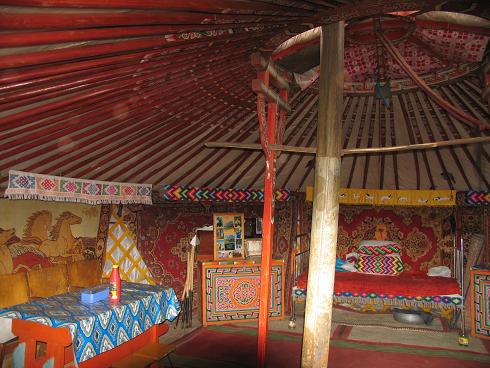
Ultimately, at the heart of [Khanbalik], Khubilai created a Mongol haven where few foreigners, including Chinese, could enter. Behind high walls and guarded by Mongol warriors, the royal family and court continued to live as Mongols. The large open areas for animals in the middle of the city had no precedent in Chinese culture. This Forbidden City constituted a miniature steppe created in the middle of the Mongol capital. During the Mongol era, the whole complex of the Forbidden City was filled with gers [yurts] where members of the court often preferred to live, eat, and sleep. Pregnant wives of the khan made sure that their children were born in a ger, and the children received their school lessons in the ger as they grew up. While Khubilai and his successors maintained public lives as Chinese emperors, behind the high walls of their Forbidden City, they continued to live as steppe Mongols.

When the Franciscan friar Odoric of Pordenone visited the Mongol territories in the 1320s, he described the Forbidden City in Khanbalik: “Within the precincts of the said palace imperial, there is a most beautiful mount, set and replenished with trees, for which cause it is called the Green Mount, having a most royal and sumptuous palace standing thereupon, in which, for the most part, the great Can is resident.” In a passage that sounds very close to earlier descriptions of Karakorum, he wrote, “Upon the one side of the said mount there is a great lake, whereupon a most stately bridge is built, in which lake is great abundance of geese, ducks, and all kinds of water-fowl; and in the wood growing upon the mount there is a great store of all birds, and wild beasts.” …

Inside the confines of their Forbidden City, Khubilai and his family continued to act as Mongols in dress, speech, food, sports, and entertainment. This meant that they consumed large amounts of alcohol, loudly slurped their soup, and they cut meat with knives at the table, thereby disgusting the Chinese who confined such acts to the kitchen during preparation. With the emphasis on alcohol and rituals of drinking and drunkenness, the scenes at court must have been somewhat chaotic as the free-roaming, individualistic Mongols tried to imitate the complex and highly orchestrated rituals and ceremonies of the Chinese court. In contrast to the Chinese imperial tradition of courtiers lining up according to rank, the Mongols tended to swarm chaotically, and, perhaps most disturbing to the Chinese, the Mongol women mingled freely among the men on even the most important occasions. The ceremonies in the Mongol court became so disorganized that sometimes the khan’s bodyguards had to beat back the crowds of officials and guests with batons.

SOURCE: Genghis Khan and the Remaking of the Modern World, by Jack Weatherford (Three Rivers Press, 2004), pp. 199-200

Leave a comment

Filed under China, Mongolia

Khubilai’s Move from Xanadu to Khanbalik

To appear as a powerful Chinese leader, Khubilai needed an impressive court located in a real city, not a peripatetic tent court nor the ad hoc structures erected at Shangdu (Xanadu), in modern Inner Mongolia. The place held special importance for him because he had first been proclaimed Great Khan at the khuriltai there, but it had no obvious advantages. Not only was that capital located in a nomadic zone, which the Chinese found quite alien and barbaric, but it had also been the traditional staging area used by his grandfather in the raiding and looting of Chinese cities. Khubilai sought to disassociate himself from the less desirable aspects of that history.

While keeping Shangdu as a summer home and a hunting preserve, he commissioned the building of another city, a real Chinese-style imperial capital, farther south at a place better situated to exploit the agricultural wealth of the lands along the Yellow River. He chose the site of the former Jurched capital of Zhongdu, which had been conquered by Genghis Khan in 1215, the year of Khubilai’s birth. In 1272, Khubilai ordered the building of his new capital, and he connected it by canal to the Yellow River. The Mongols called the place Khanbalik, the City of the Khan. His Chinese subjects called it Dadu, the Great Capital, and it grew into the modern capital of Beijing [‘North Capital’]. Khubilai brought in Muslim architects and Central Asian craftsmen to design his city in a new style that offered more of a compromise between the tastes of the nomadic steppe dwellers and the sedentary civilization.

In contrast to the maze of winding alleys in most Chinese cities of the era, Khubilai’s capital had broad, straight streets run on a north-south axis with east-west streets perpendicular to them; the guards at one gate could see straight through the city to the guards at the opposite gate. From the imperial palace, they built boulevards, more to accommodate the horses and military maneuvers of the Mongols than the wheelbarrows or handcarts of the Chinese laborers. The boulevards stretched wide enough for nine horsemen to gallop abreast through the city in case the native people rose up against their foreign rulers.

Furthering the Mongol interest in profits from international trade, Khubilai Khan designated sections of the city for Middle Eastern and Mongol populations as well as for people from all over what is today China. The city was host to merchants from as far away as Italy, India, and North Africa. Where so many men lingered, as Marco Polo pointed out in great detail, large numbers of prostitutes gathered in their own districts to serve them. Scholars and doctors came from the Middle East to practice their trades. Roman Catholic, Nestorian, and Buddhist priests joined their Taoist and Confucian counterparts already practicing in China. Muslim clerics, Indian mystics, and, in some parts of Mongol China, Jewish rabbis added to the mixture of people and ideas that thronged the empire. Far larger than Karakorum, but with many of the same internationalist principles, the city was a true world capital and fit to be capital of the world.

SOURCE: Genghis Khan and the Remaking of the Modern World, by Jack Weatherford (Three Rivers Press, 2004), pp. 197-199

Leave a comment

Filed under China, Mongolia

How the Mongols Quelled the Assassins

For Hulegu [Khan, grandson of Genghis], the ultimate prize was to conquer the Arab cultural and financial capital of Baghdad, but to get there, he had to reassert Mongol authority over several rebellious areas en route. The most difficult of these was to conquer the strongholds of the Nizari Ismailis, a heretical Muslim sect of Shiites more commonly known in the West as the Assassins. They were holed up in perhaps as many as a hundred unconquered mountain fortresses stretching from Afghanistan to Syria, the most important of which was Alamut, the Eagle’s Nest, in northern Persia. Members followed without question the orders of their hereditary leader, who was known by many titles, such as Imam, the Grand Master, or Old Man of the Mountain. Because they believed that God chose the Imam, he was therefore infallible; he needed no education since everything he did, no matter how odd it might appear to mortals, was considered divinely inspired. His followers accepted seemingly irrational acts, frequent changes of the law, and even the reversal of the most sacred precepts as evidence of God’s plan for humanity.

Despite the lack of a conventional army, the Ismaili sect exercised tremendous political power through a highly sophisticated system of terror and assassination, and the secrecy and success of the group bred many myths, making it, still today, difficult to factor out the truth. The cult apparently had one simple and effective political strategy: kill anyone, particularly leaders or powerful people, who opposed them in any way. The cult recruited young men who were willing to die in their attacks with the assurance that they would achieve instant entry into paradise as martyrs of Islam. The Chinese, Persian, and Arabic sources all relate the same account of how young men were lured by ample quantities of hashish and other earthly delights that awaited them in the special gardens of the cult’s castles and fortresses. This was the foretaste of the paradise that awaited them if they died in the Grand Master’s service. He then trained them and controlled them with a steady supply of hashish to keep them obedient and make them fearless. Supposedly, because of the importance of narcotics for the Ismailis, the people around them called them hashshashin, meaning “the hashish users.” Over time, this name became modified into the word assassin. Whether the killers had actually used hashish to inspire them or not, the name spread into many languages as the word for the murderer of high officials.

Earlier, in the time of Genghis Khan’s first invasion of the region, the Grand Master willingly swore obedience to the Mongols. In the following decades, the Assassins flourished in the power vacuum created by Genghis Khan’s defeat of the Turkic sultan of Khwarizm and then the withdrawal of most of the Mongol forces. By the time Mongke Khan ascended the throne, the Assassins feared that the return of a large Mongol army might interfere with their newfound powers. In what may have been only a pretext for Hulegu’s attacks, some chroniclers wrote that the Grand Master sent a delegation to Karakorum ostensibly to offer submission to Mongke Khan, but actually trained to kill him. The Mongols had turned them away and prevented the assassination, but because of it Mongke Khan decided to crush the sect permanently and tear down their fortresses.

Before Hulegu’s army reached the Assassin strongholds, the drunken and debauched Grand Master was murdered by disgruntled members of his own entourage and replaced by his equally incapable son. Hulegu assessed the difficulty of capturing the heavily fortified castles one by one, and he devised a simple and more direct plan. Because of the sacred role of the Grand Master, Hulegu concentrated on capturing him with a combination of massive military might and the offer of clemency if he should surrender. The Mongols bombarded the Ismaili stronghold, and the Mongol warriors proved capable of scaling the steepest escarpments to surprise the defenders of the fortress. The combination of force, firepower, and the offer of mercy worked, and on November 19, 1256, on the first anniversary of his coming to power, the Imam surrendered to the Mongols.

Once Hulegu had control of the Imam, he paraded him from Ismaili castle to Ismaili castle to order his followers to surrender. To encourage the cooperation of the Imam and keep him happy until the end of the campaign, Hulegu indulged his [the Imam’s] obsessive interest in watching camels fight and mate, and he supplied him with girls. In the spring of 1257, once the Assassins’ castles had been taken, the Imam recognized his loss of usefulness to the Mongols, and he requested permission to travel to Karakorum to meet with the Great Khan Mongke himself, perhaps to work out some plan for his own survival. Hulegu sent him on the long journey to Mongolia, but once the Imam arrived there, Mongke refused to see him. Instead, the Mongol escort took the Imam and his party out to the mountains near Karakorum and stomped them to death.

SOURCE: Genghis Khan and the Remaking of the Modern World, by Jack Weatherford (Three Rivers Press, 2004), pp. 178-180

4 Comments

Filed under Afghanistan, Mongolia

Medieval German vs. Mongol Shock and Awe

Holy Roman Emperor Frederick Barbarossa, who ranks as one of Germany’s greatest historical and cultural heroes, best exemplified the use of terror in the West. When he tried to conquer the Lombard city of Cremona in the north of modern Italy in 1160, he instituted an escalating series of violent acts of terror. His men beheaded their prisoners and played with the heads outside the city walls, kicking them like balls. The defenders of Cremona then brought out their German prisoners on the city walls and pulled their limbs off in front of their comrades. The Germans gathered more prisoners and executed them in a mass hanging. The city officials responded by hanging the remainder of their prisoners on top of the city walls. Instead of fighting each other directly, the two armies continued their escalation of terror. The Germans then gathered captive children and strapped them into their catapults, which were normally used to batter down walls and break through gates. With the power of these great siege machines, they hurled the living children at the city walls.

By comparison with the terrifying acts of civilized armies of the era, the Mongols did not inspire fear by the ferocity or cruelty of their acts so much as by the speed and efficiency with which they conquered and their seemingly total disdain for the lives of the rich and powerful. The Mongols unleashed terror as they rode east, but their campaign was more noteworthy for its unprecedented military success against powerful armies and seemingly impregnable cities than for its bloodlust or ostentatious use of public cruelty….

One of the worst slaughters was unleashed on the citizens of Omar Khayyám‘s home city of Nishapur. The residents revolted against the Mongols, and in the ensuing battle an arrow fired from walls of the city killed Genghis Khan’s son-in-law, Tokuchar. In revenge for the revolt and as a lesson to other cities, Genghis allowed his widowed daughter, who was pregnant at the time, to administer whatever revenge she wished upon the captured city. She reportedly decreed death for all, and in April 1221, the soldiers carried out her command. According to widely circulated but unverified stories, she ordered the soldiers to pile the heads of the dead citizens in three separate pyramids–one each for the men, the women, and the children. Then she supposedly ordered that the dogs, the cats, and all other living animals in the city be put to death so that no living creature would survive the murder of her husband….

While the destruction of many cities was complete, the numbers given by historians over the years were not merely exaggerated or fanciful–they were preposterous. The Persian chronicles reported that at the battle of Nishapur, the Mongols slaughtered the staggeringly precise number of 1,747,000. This surpassed the 1,600,000 listed as killed in the city of Herat. In more outrageous claims, Juzjani, a respectable but vehemently anti-Mongol historian, puts the total for Herat at 2,400,000. Later, more conservative scholars place the number of dead from Genghis Khan’s invasion of central Asia at 15 million within five years. Even this more modest total, however, would require that each Mongol kill more than a hundred people; the inflated tallies for other cities required a slaughter of 350 people by every Mongol soldier. Had so many people lived in the cities of central Asia at the time, they could have easily overwhelmed the invading Mongols.

SOURCE: Genghis Khan and the Remaking of the Modern World, by Jack Weatherford (Three Rivers Press, 2004), pp. 116-118

1 Comment

Filed under Central Asia, Europe, Germany, Mongolia

How Genghis Khan Reformed Looting on the Steppe

In [his] campaign against the Tatars, Temujin [later Genghis Khan] would institute yet another set of radical changes to the rules that had long governed steppe life, and these changes would both antagonize some of his followers, those of the aristocratic lineages, and deepen the loyalty felt for him by many others, those of the lower lineages whose lives he enriched with his reforms and distribution of goods. While conducting raid after raid, Temujin had realized that the rush to loot the gers of the defeated served as an impediment to more complete victory. Rather than chasing down the warriors of the raided camps, attackers generally allowed them to flee and focused instead on immediately looting their camps. This system allowed many defeated warriors to escape and eventually return for a counterattack. So on this raid, his second conquest of the Tatars, Temujin decided to order that all looting would wait until after a complete victory had been won over the Tatar forces; the looting could then be carried out in a more organized fashion, with all the goods being brought under his central control and then redistributed among his followers as he determined fit. He distributed the goods along the same lines by which the hunting men of the forest traditionally distributed the kill at the end of a group hunt.

In another innovation, he ordered that a soldier’s share be allocated to each widow and to each orphan of every soldier killed in the raid. Whether he did this because of the memory of his own mother’s predicament when the Tatars killed his father, or for more political purposes, it had a profound effect. This policy not only ensured him of the support of the poorest people in the tribe, but it also inspired loyalty among his soldiers, who knew that even if they died, he would take care of their surviving families.

After routing the Tatars, some of Temujin’s followers ignored his order against individual looting, and he demonstrated how serious he was about this reform by exacting a tough but appropriate punishment. He stripped those men of all their possessions and deprived them of the goods seized in the campaign. By controlling the distribution of all the looted goods, he had again violated the traditional rights of the aristocratic lineages under him to disperse the goods among their followers. The radical nature of his reforms angered many of them, and some deserted him to join the forces of [his blood brother and principal rival] Jamuka at this point, further drawing a line between the higher-prestige lineages and the common herders. Again, he had shown that rather than relying on the bonds of kinship and tradition, members of his tribe could now look to Temujin for direct support; with this move, he greatly centralized the power of his rule while at the same time strengthening the commitment of his followers.

Despite the minority discontent from within the Mongol ranks, Temujin’s new system proved immediately effective. By postponing the looting until the end of the campaign, Temujin’s army amassed more goods and animals than ever before. But the new wealth system also posed a new problem; the Mongols had not only defeated the Tatars, they had also captured almost the entire army and all the civilians.

SOURCE: Genghis Khan and the Remaking of the Modern World, by Jack Weatherford (Three Rivers Press, 2004), pp. 50-51

Leave a comment

Filed under China, Mongolia

Siberian Light on Mongolian Elections

Siberian Light shines a spot on the Mongolian elections:

Nabetz at New Mongols has a look at some international rankings, showing that not all of Russia’s non-European neighbours have problems with democratising, or resisting pressure from Russia and China to maintain pliable authoritarian regimes:

With numbers like this, it’s easy to understand why Mongolia has been able to have nine national parliamentary and presidential national elections in about 15 years–all of them free, fair, and, perhaps most tellingly, friendly (compare elsewhere in the region). That political power has changed been passed back and forth between several parties is an indication that the Republic is advancing more strongly, more peacefully, and more openly than ever….

Hopefully, the example of Mongolia will also bring an end to the sometimes fashionable belief that countries without a Christian tradition and/or occupation by American troops can’t democratise.

Leave a comment

Filed under China, Mongolia

Molokans in Armenia and a New Mongolia Blog

The invaluable Siberian Light notes a couple of far-outposts: a report on Molokans, Russian Old Believers in Armenia, and a link to a new blog from Mongolia.

Leave a comment

Filed under Mongolia