Category Archives: labor

A Korean Worker’s Take on Korea, Japan, & China

Four or five years ago I was asked by one work site manager to make the “direct commute” (as we day laborers say) to a job that I had originally obtained through the Center. I did this for about ten days running. Two Koreans, one about fifty and the other in his mid twenties, were working there, and they would chat with me in their broken Japanese during rest periods and the noon break. I couldn’t figure out their relationship. That they were not parent and child was obvious I enough. I decided that they were two men of differing ages who just happened to be getting work, illegally (or so I surmised), with the same firm. That peculiar rule in Korean society of deference by the junior party to the senior (something I learned from my reading), which would have applied had they been acquaintances from the same village and come to work in Japan together, was not in effect between them. If the older man were indeed fifty, he would have been just a couple of years older than I, yet he had a commanding presence that made him seem for all the world like my father. When I got to talking with him, I realized that he was a fervent patriot. Somehow I was not surprised. He said his name was Shin.

“We go ahead of Japan. This I am sure. Less than ten years.” These are the kinds of things he liked to say. The younger Korean appeared to be uninterested in talk of this sort and simply wolfed down his boxed lunch. For ten days I teamed up with this Korean duo and took orders along with them from the site manager. The older Korean assumed the role of team leader and told us what to do. He was far more proficient at Japanese than his young compatriot, and it was possible to carry on an extensive conversation with him.

“I am not man who works like this. I was company president. Do you understand? My company closed. I was forced to come to Japan and earn money.” As he spoke, Kim, the younger Korean, would look on with an ironic smile without really listening. (He rarely spoke a word; indeed, it’s possible that he understood no Japanese.) Kim did not have the face of an educated person—that much was certain.

“I have three children,” Shin said. “Oldest one in college. ——— University. You know it?” When I shook my head, he continued, “Good school. He join elite. Give orders. We three here take orders. This is difficult thing.”

Shin may have had a problem with Japanese at the level of nuance, not being able to inflect his emotions correctly, but his very direct and open manner of expressing his desire to advance in the world definitely got my attention.

Shin asked me how old I was and learned that I was a bachelor and living alone. “You have no family at your age?” he proclaimed haughtily. “That shameful! You should not tell it to others. I feel sorry for you.”

Sometimes I would get into arguments with Shin.

“Japan not apologize for things they did to us. This no good. One day maybe we attack Japan. But we not do to you what you do to us. We are moral people. We are most moral and most superior people in Asia. This I am sure.” …

“Japan number one in Asia now, Korea number two. some day Korea number one.” The hierarchy featured in these pronouncements appeared to have nothing to do with morality, however, and everything to do with economic and political power in the global pecking order.

“That’s not true at all,” I countered. “China’s number one in Asia now, if you ask me.

Shin immediately shook his head. “No, very wrong—very wrong!” he snapped, curling his lips in contempt of China. “Look at Chinese. They fall behind. Long ago they were teacher. Now they are backward country. Their income less than one tenth of Koreans. That country is lowest country. It is dirty country.” …

And so I learned that not only was Shin a stalwart anticommunist, he also had no love, as I’d heard most Koreans had, for China, the country that Korea once recognized as its master.

SOURCE: A Man with No Talents: Memoirs of a Tokyo Day Laborer, by Ōyama Shirō, trans. by Edward Fowler (Cornell U. Press, 2005), pp. 92-95

Leave a comment

Filed under China, Japan, Korea, labor

Tobi, the Aristocrats among Day Laborers

Tobi [鳶 ‘kite (bird)’, or ‘steeplejack‘, the latter short for 鳶職 tobishoku ‘high-rise scaffolding work’] are the aristocrats of San’ya. In the same way that it is possible, in Europe, to distinguish the aristocracy from the common folk by how they look, so it is possible to distinguish tobi from common day laborers by their appearance (their faces more than their physique). The training required to nurture their skills to a level worthy of their calling and the confidence gained through having those skills recognized by their peers give them a commanding presence and bestow on their countenances a certain poise. All in all they cut a very dashing figure. There is a certain crispness about their movements and indeed about their entire demeanor. I would imagine that their individual abilities vary considerably, but the best have a truly unmistakable aura about them. One can tell at a glance: yes, this man, without question, is a tobi.

Carpenters and ironworkers are not employed as day laborers or as contract laborers, so there are none in San’ya. Here, the word shokunin—skilled worker—means only one thing, and that is tobi. Men like Saito (Mr. “One-Man Salvation Army”) and Ikeno (the former stockbroker) are exceptions; you could never surmise from their characters what the typical tobi is like. I have never actually met a tobi who treats laborers like slaves, barking at them and driving them into the ground; I have, however, run across several who were proud to the point of arrogance—so much so that they never paid us laborers any heed. (It was as if we never even entered their field of vision.) And I must say that I was not necessarily put off by their arrogant pride.

My hatred of working as a tobi’s assistant and being hounded on the job lives side by side with my admiration for the tobi “race.” Yet when all is said and done, it seems to me far preferable that the haughty arrogance of these men live on than that it wither away—these men who work closer to death’s door than any other group of skilled workers in Japan. There are among tobi some men (although admittedly few in number) who actually consider themselves works of art. I would much rather that such men never vanish from the scene. More and more of late I hear stories of this or that tobi doing the work of a common laborer. I fervently hope that these men—San’ya’s very own aristocrats—will be able to ride out this terrible recession. Speaking as a common laborer from San’ya’s “plebeian class,” I pray that San’ya’s spiritual patricians, defending their manly pride and honing their reputations in the face of great danger, manage to survive these hard times and live another day.

SOURCE: A Man with No Talents: Memoirs of a Tokyo Day Laborer, by Ōyama Shirō, trans. by Edward Fowler (Cornell U. Press, 2005), pp. 61-62

Leave a comment

Filed under Japan, labor

A Visit to Japan’s "Little Brazil"

Recently, we set out from Ashikaga for 大泉 Ōizumi, Japan’s “Little Brazil” in neighboring Gunma Prefecture’s fanhandle to our southwest. At 太田 Ōta (‘Widefield’), we transferred to a 2-car, 2-stop, infrequent shuttle train running back toward the southeast to Higashi Koizumi (‘East Littlespring’). There we had to transfer to yet another 2-car, 2-stop, infrequent shuttle train running back southwest to the end of the track at Nishi Koizumi (‘West Littlespring’). The fare adjustment official at Ōta described Nishi Koizumi as the most bustling (にぎやか) of the three Littlesprings (East, Middle, and West) that make up Bigspring.

Well, wherever the bustle was, we didn’t see it. The tracks ended where the single platform ended at Nishi Koizumi. We walked straight south from the train station, crossed over a highway busy enough to warrant a pedestrian overpass, past a small fountain (maybe the ‘littlespring’ itself) that marked the beginning of a very long and pleasant walkway and bikepath (the Izumi 緑道 ‘Greenway’) shaded by a great variety of trees and bushes, most of them labeled, so that I repeatedly stopped to punch the katakana names into my little electronic dictionary to find the English equivalents.

To our right ran the kilometer-long fence punctuated by gated driveways enclosing a quiet but huge Sanyo electronics factory. To our left ran sleepy Hanamizuki-dori ‘Dogwood Avenue’, which hosted occasional trucks and vans making deliveries. Hardly anyone but a few stressed-out middle managers was making use of the jogging path. Across the road were a variety of smaller enterprises: a few stores, a few restaurants, and a preschool teacher-training school followed by Santa Clara (聖クララ) preschool.

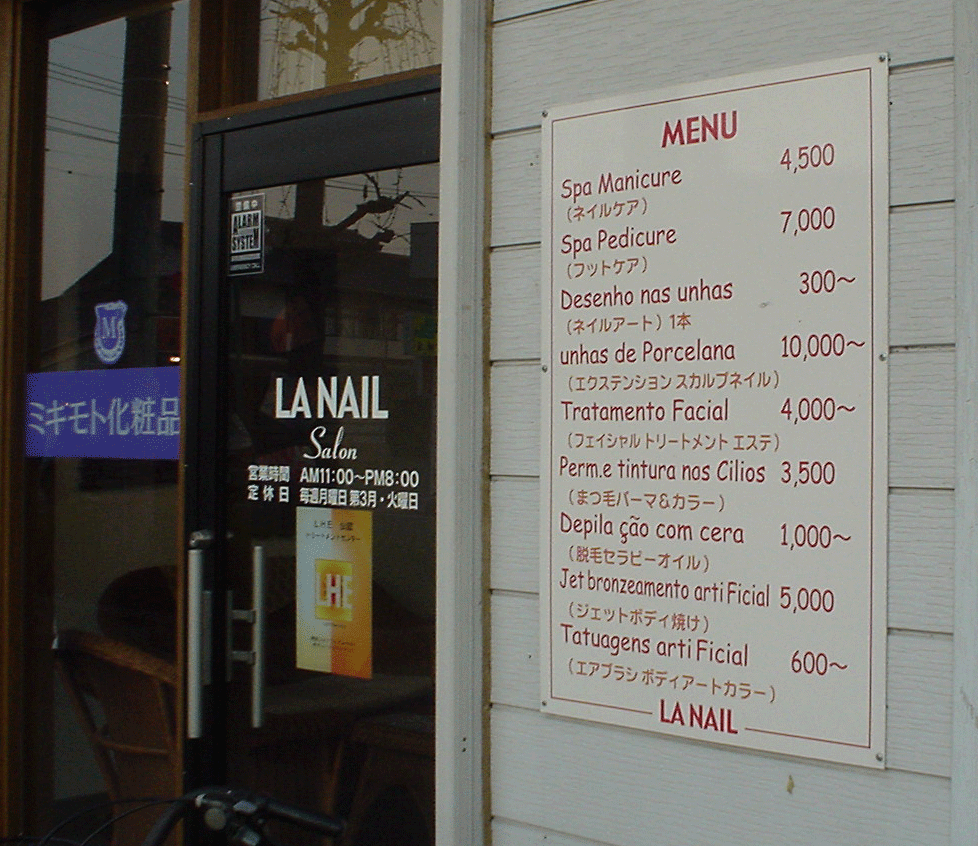
The name of the school and the distant sounds of Portuguese rather than Japanese coming from its parking lot were among the few signs of the town’s large Brazilian population. Other clues were: a cardboard sign next the train ticket vending machine at the station that listed all the destinations in a Portuguese-friendly transcription; a small shop near the station that sold goods imported from Brazil, Peru, and Bolivia; and the Primavera Restaurant, which we noted for our return. It was nearing lunchtime.

Primavera was an interesting oasis, like a midwestern truck stop in many ways. The kitchen help spoke mostly Japanese, the customers spoke mostly Portuguese, and the menus and wait help were bilingual in Japanese and Portuguese. The music was mostly Country & Western in style, but with the lyrics in Portuguese. The featured buffet (バイキング [Viking] = smorgasbord) was discounted from ¥1600 to ¥1000 because it had run out of most of the grilled meats–and also the feijoada, I discovered after I ordered it. My wife went for just the salad bar portion. At the register, I asked the European-looking owner (in Japanese) how long he had been in Japan. He said 2 years this time, but 5 years in all. (Nikkei Brazilians can easily get work visas for 3-year stints.) His soft-spoken Japanese was even more limited than mine. He estimated the local population was at least 10% Brazilian, maybe 15%.

On our way back to the station, we stopped in at the small import shop, whose owner greeted all his customers with “Tudo bem?”–followed by “Konnichi wa!” if they looked Japanese. He looked to be Nikkei, and his Japanese was very fluent. He said he had been in Japan 7 years in all. He said the local population was 15% Latin American, with 10% from Brazil alone.

When we got back to the sleepy station, we found that we had a 45-minute wait until the next train, so we east headed down the line of shops beside the main highway (National Route 354), finding nothing at all. When we stopped to ask, we were directed to the Mos Burger, with its American southwestern decor, and sipped our tall ice coffees until it was time for the zigzag sequence of short train hops back home.

There are no doubt many North American equivalents of Nishi Koizumi, but it reminded me of the hidden charm and factory-sequestered bustle of an Austin, Minnesota–the Hormel company town that hosts the Spam Museum–especially if Austin had a little larger Hispanic population.

1 Comment

Filed under Brazil, Japan, labor, migration

1932 Aso Coal Strike: Korean-Japanese Relations

The 20-day-long Korean strike against the Aso coal mines in 1932 was the only sustained strike by a large number of Korean miners in prewar Japan and the largest strike of the year in Chikuho, Japan’s most important coal field. The 400 strikers demonstrated courage and cohesion but won at best a partial victory that left most of them without jobs. This article draws on union documents and a contemporary report by the Kyochokai, a semiprivate organization devoted to labor-capital harmony, to explore the background of the strike, the tactics employed by the male strikers and their wives, and the many obstacles they faced in their fight for better wages and working conditions. The author argues that there was little the workers could do to overcome the harsh antiunion environment of prewar Japan or the surpluses in both coal and labor brought on by the Great Depression, but that the strike might have been more successful if rank-and-file Japanese miners had shown even a hint of solidarity. While a Japanese mining union provided organizational support, the failure of even one Japanese miner to join the strike suggests that Japanese working-class racism severely limited the potential for joint Korean-Japanese action.

SOURCE: W. Donald Smith, “The 1932 Aso Coal Strike: Korean-Japanese Solidarity and Conflict,” Korean Studies 20 (1996): 94-122

Leave a comment

Filed under industry, Japan, Korea, labor

Cultural vs. Situational Factors in East Asian Industrialization

In 1991, Ezra Vogel published a slim volume that attempted to analyze for lay audiences some of the reasons why certain East Asian nations achieved notable success in industrializing. He compared Taiwan, South Korea, Hong Kong, and Singapore, which he labelled the “Four Little Dragons.” Here are some highlights, from a book review published in 1994.

British and American advocates of minimal government interference in the marketplace will be countered not just by how different the role of Hong Kong’s government has been from the other little dragons, but by the historical perspective offered in the introductory chapter, where Vogel notes that only the earliest wave of industrialization, in England and later the United States, had the luxury of a rather leisurely pace of industrialization with relatively little government direction. The later waves in continental Europe and then East Asia had to rely much more heavily on government to secure the ever larger amounts of capital, complex technology, and skilled labor needed to leap the ever-widening gap between preindustrial and industrial society. Each new entrant in the race to industrialize had a clearer view of the finish line and ran down a better-trodden path to get there.

East Asian nationalists who, like European and American imperialists before them, tend to credit their success primarily to their own harder work and superior cultural heritage, will be forced to consider Vogel’s lists of the many situational factors that aided their efforts. And anti-American nationalists will object to the prominent position of U.S. aid on those lists. Vogel enumerates new global opportunities offered by the postwar world: (1) The United States, supremely self-confident and fervently anticommunist, was willing to open its markets and universities and share industrial technology with its allies to an unprecedented degree. (2) Thanks to the demise of colonialism and to bitter lessons learned during the prewar depression, international trade was far less restricted than before. (3) The growth of mass consumption enabled smaller countries to achieve manufacturing economies of scale that their domestic markets could not have supported. (4) Large Western corporations acquired a multinational outlook that placed loyalty to profits above loyalty to country of origin, making them willing, for profit, “to buy, sell, and lend anywhere in the world” (p. 11).

Vogel also lists more particular situational advantages East Asia enjoyed during the postwar period: (1) The U.S. poured in massive amounts of aid to build a bulwark against communism. Just as the Japanese economy benefited from U.S. procurement during the Korean War, the other regional economies benefited during the Vietnam War. (2) Confucian conservatives were discredited and large landowners were dispossessed. The postwar governments were not beholden to the traditional elite, so they were free to concentrate on production of new goods, not control of existing assets. (3) A keen awareness of external military threats and of inadequate land and natural resources lent an urgency that made leaders more willing to cooperate and citizens more willing to sacrifice for the common good. (4) Each country had large numbers of refugees and displaced people who comprised an “eager and plentiful labor force” (p. 88) dependent on their labor, not their land, for income. (5) Japan’s pioneering effort provided the little dragons with a goal, a way to get there, and the confidence that they could succeed in their drive to industrialize. As wages rose in Japan, corporations there were willing to transfer limited technology and manufacturing capacity to the other East Asian countries. However, some of those countries, most notably South Korea, succeeded in transferring more technology than Japan intended.

Did particular cultural traditions shared by East Asian societies confer any advantages? Vogel begins his chapter on explanations by downplaying the role of Confucianism in the spread of industrialization. He asks whether the ongoing industrial transformations of Islamic Malaysia and Turkey, Buddhist Thailand, and Roman Catholic Brazil and Mexico will not utterly invalidate cultural tradition as an explanatory factor. He further notes that Confucianism was blamed just as frequently during the 1940s and 1950s for retarding modernization, and asks why China, the heartland of Confucianism, has been slower to industrialize than the periphery, even before the socialist era. In answer, Vogel offers a tantalizing suggestion:

“If anything, just as Max Weber found that the greatest drive to industrialize in his time came in areas located far from Catholic orthodoxy, so in East Asia industrialization prospered in areas far from the centers of traditional Confucian orthodoxy, where trade and commerce were most highly developed. And successes occurred not under the old Confucian-style governments but in societies that had cast them aside for new governments, with very different political systems.” (p. 84) …

It is long past time to lay aside such vague, chauvinist notions as the Protestant ethic, the Confucian ethic, or the samurai spirit, and examine instead the more specific cultural traditions that aided industrialization. Vogel identifies four such traditions shared by Japan and the little dragons: (1) a “meritocratically selected bureaucracy” (p. 93) that not only implemented policy decisions, but formulated them; (2) an entrance examination system that afforded the means to overcome feudal favoritism and channel the most talented people into key leadership positions; (3) an emphasis on group loyalty and subordination of individual to group demands that well suited the level of centralized coordination needed to effect a modern industrial transformation; and (4) a tradition of lifelong self-cultivation.

Of course, the challenge today is not just to find a way for all nations to climb onto an industrial plateau, but to find ways to keep scaling new heights of innovation and growth in a postindustrial world. Orthodoxies of all kinds still seem to be among the primary obstacles.

SOURCE: Review of The Four Little Dragons: The Spread of Industrialization in East Asia, by Ezra F. Vogel (Harvard U. Press, 1991).

Leave a comment

Filed under China, economics, industry, Japan, Korea, labor, Vietnam