
Category Archives: Japan

Crescent, Star, and Cherry Blossoms, 1943

The Japanese had promised less to the Malays than they had to the Burmese, but by early 1943 they seemed to be offering a little more. The Marquis Tokugawa’s scheme to reform and diminish the Malay sultanates was abandoned, and the Japanese became more solicitous towards the rulers themselves. The also began to dabble in Islamic affairs. On 5-7 April 1943, the ulama, Islamic religious leaders from across the peninsula and from Sumatra, were summoned to a conference in Singapore…. The mayor even went to the trouble of having a room set aside for the delegates’ evening prayers. The ulama was regaled with a show, a film presentation and speeches on the progress of the war. The Japanese impressed on the Malays that Nippon was the true defender of the faith….

The delegates were each sent home with a white commemorative medal, enamelled in scarlet, embossed with a crescent and a star, surrounded by twelve cherry blossoms. The Malay phrase Sehiduplah dengan Nippon – ‘Live with Nippon’ – was inscribed on the back in Arabic script. The ulama left giving formal expressions of satisfaction at Japan’s commitment to protect Islam and of support for the war.

The gestures were token on both sides. Before the Mufti of Pahang had left for the meeting he had met with his sultan and the Japanese governor of the state. The governor had posed the question: ‘Can the Malay States declare a holy war (jihad) against the British and her allies?’ The question was referred to the Mufti. He quickly answered: ‘Yes, provided that the Japanese emperor is a Muslim.’ And there the matter rested. There was confusion and anger when the Japanese followed through their initiative by thrusting prepared texts on kathis to be included in their Friday sermons and by encouraging prayers for the emperor and the success of the war. On occasion, Japanese officers themselves invaded mosques and interrupted prayers with speeches, even ordering the worshippers to turn their prayer mats 180 degrees away from Mecca and towards Tokyo. This propaganda became more subtle over time, but it generated anxieties. In some areas attendance at the mosque for Friday prayers fell. More generally, religious values were felt to be under threat; divorce rates, gambling and opium use were dramatically on the rise. These were profane times. Like all Japan’s efforts at political engineering, the most important effects of the Islamic conference were unforeseen by its initiators. It realized a long-held ambition of many clerics: the creation of a more unified voice for Islam, outside of the control of the rulers and their courts. This was to have far reaching implications for politics of religious reform in Malaya after the war. The real significance of pan-Asianism lay not in what it achieved for the Japanese Empire but in what it allowed others to achieve for themselves.

SOURCE: Forgotten Armies: Britain’s Asian Empire & the War with Japan, by Christopher Bayly and Tim Harper (Penguin, 2004), pp. 315-316
Leave a comment

Filed under Japan

Japanese History to Chew on

Here‘s a history course that really gives you something to chew on.

Last semester I gave a course on the historical development of East Asian cuisines and food cultures. While some food history courses take anthropological approaches, this was a conventional history course. We traced a narrative arc from the earliest known foods of the region, examining how political, economic, technological and trade developments affected diet and foodways. So, for example, when we got to the Tokugawa period, we discussed both how sankin kotai, by creating a permanent population of temporary bachelors in Edo, spurred the development of restaurant culture and dramatically increased the popularity of foods suitable for take-away dining, like sushi and noodles, and how the closed country policy meant that Japan experienced a much slower process of assimilating New World ingredients than China did. Plus we had some “cool show-and-tell cultural events.”

via Frog in a Well

Leave a comment

Filed under China, Japan

Fruitful English? Or a Dying Language?

This Fruitful English website tells you all you need to know about teaching English in Japan. (I found it by way of an ad at the top of my Gmail inbox.) It looks like an online 自動販売機 jidouhanbaiki ‘(automatic) vending machine’, with instructions entirely in Japanese. Selling One-Cup English. English classes in Japan explain the language; they don’t teach it. As if it were Hittite. Well, at least that won’t be a problem after the demise of English on March 31, 2058 (according to Language Hat).

Leave a comment

Filed under Japan, language

Wordcatcher Tales: Hata, Hi, Tateito, Yokoito

Ashikaga was once an important center for Japanese textile manufacturing, dating back to the days of silkworm-raising. In the early days of Japan’s industrial revolution, there were waterwheels (水車 mizuguruma) all over this piedmont town. Nowadays, the textile industry has left town, leaving behind a legacy of handicraft artisans, fine textile shops, and a few working pieces of machinery in a “play-learn” emporium (遊学館 yuugakkan), where you can learn how to weave a coaster on a small floor loom. (It costs ¥400 and usually takes 30-45 minutes.) Last week, while my visiting in-laws were trying their hands at weaving, I stood around translating, looking up words in my electronic dictionary, and listening to the two old timers who were demonstrating a braiding machine and a spinning machine that was plying thread from bobbins onto reels (clockwise on one side, counterclockwise on the other). They were excited to have an interested audience for a change.

One of the best things about doing fieldwork in a second language is that you often learn new things in the process, and also get a better command of vocabulary in your primary language. I learned a lot of English fish names a couple of decades ago when I elicited the local names for several hundred fish in a coastal language of New Guinea. Here are a few items of useful vocabulary from my 遊学館 experience.

hata, loom – The Chinese character with which Japanese hata is written also indicates all manner of new-fangled machinery, such as 洗濯機 sentakki ‘washing machine’, 飛行機 hikouki ‘flying machine (= airplane)’, and the Japanese ‘machine man’ superhero Kikaida. So now ‘loom’ can also be rendered as 織機 shokki ‘weaving machine’, and ‘power loom’ as 機械機 kikaibata (lit. ‘machine loom’). Worse yet, the same character also occurs in the famous Sinitic compound meaning ‘crisis’: 危機 kiki, danger + something not quite equal to opportunity—more like ‘wit, resource, device’.

hi, shuttle – In sharp contrast to 機 ‘loom’, the character for ‘shuttle’ is rare enough that my electronic dictionary ranks it last among the ten kanji pronounced hi and Microsoft’s Japanese-language input system doesn’t even offer it among its 42 ways to write the syllable hi. I had to go copy the character from unicode.org. In any case, most Japanese are quite familiar with the word adapted from English: シャトル shatoru, as in shatoru basu and supeesu shatoru.

縦糸 tateito, warp thread; 横糸 yokoito, weft thread – The terms that translate ‘warp’ and ‘weft’ render a whole range of similar oppositions: 縦引き鋸 tatebiki nokogiriripsaw‘ vs. 横切り yokogiricross-cut saw‘; 縦波 tatenami ‘longitudinal wave’ vs. 横波 yokonami ‘broadside wave, cross sea’; 縦揺れ tateyure ‘pitch (of a ship)’ vs. 横揺れ yokoyure ‘roll (or a ship)’; 縦書き tategaki ‘vertical writing’ vs. 横書き yokogaki ‘horizontal writing’. Finally, the highest rank in sumo is the 横綱 yokozuna (lit. ‘horizontal rope’), who is entitled to wear the ceremonial rope (綱 tsuna) across his waist.

Postscript: Weave : Weft :: Heave : Heft :: Leave : Left :: Bereave : Bereft. Can you think of any more English words that follow this pattern? Aha! Language Hat adds Cleave : Cleft.

Leave a comment

Filed under Japan, language

Vengeful Attacks on Burmese Buddhists, 1943

The negative consequence of the first Arakan campaign [on Burma’s border with Assam] was further to envenom relations between the Arakanese Buddhists and the local Muslim population. Zainuddin, a Muslim civil officer posted to the areas which the British temporarily reconquered in Arakan, wrote a confidential account of the hostility between the communities. The British Baluch troops in the area treated the local Buddhist population very badly, he recorded, telling them that the Muslims who had suffered at their hands during the Japanese invasion of the previous year ‘would take full revenge on the Arakanese “Mugs”‘. The coolies and other camp followers who flooded into the region in the wake of the British stole large numbers of local boats and brutalized the people. Zainuddin compared the British treatment of the civilian population very unfavourably with that of the Japanese. Indeed, [Viceroy of India] Wavell himself was worried by rumours that British troops had shot out of hand village headmen in Japanese-occupied areas. All in all, these events seem to reverse the usual stereotypes of Japanese brutality and British solicitude for the civilian population. They were also part of a pattern common to the whole crescent [of British colonies in Southeast Asia]: inter-community conflict became endemic in the wake of the fighting and would persist for at least a generation. Finally, Zainuddin delivered his most savage observation. On the appearance of the Japanese the indifferent and lethargic British troops ‘began to run as no deer had ever run when chased by a tiger’.

SOURCE: Forgotten Armies: Britain’s Asian Empire & the War with Japan, by Christopher Bayly and Tim Harper (Penguin, 2004), pp. 275-276

Leave a comment

Filed under Burma, Japan, religion, war

Wordcatcher Tales: Japonica


Today we have naming of parts. Yesterday,
We had daily cleaning. And tomorrow morning,
We shall have what to do after firing. But today,
Today we have naming of parts. Japonica
Glistens like coral in all of the neighboring gardens,
And today we have naming of parts.

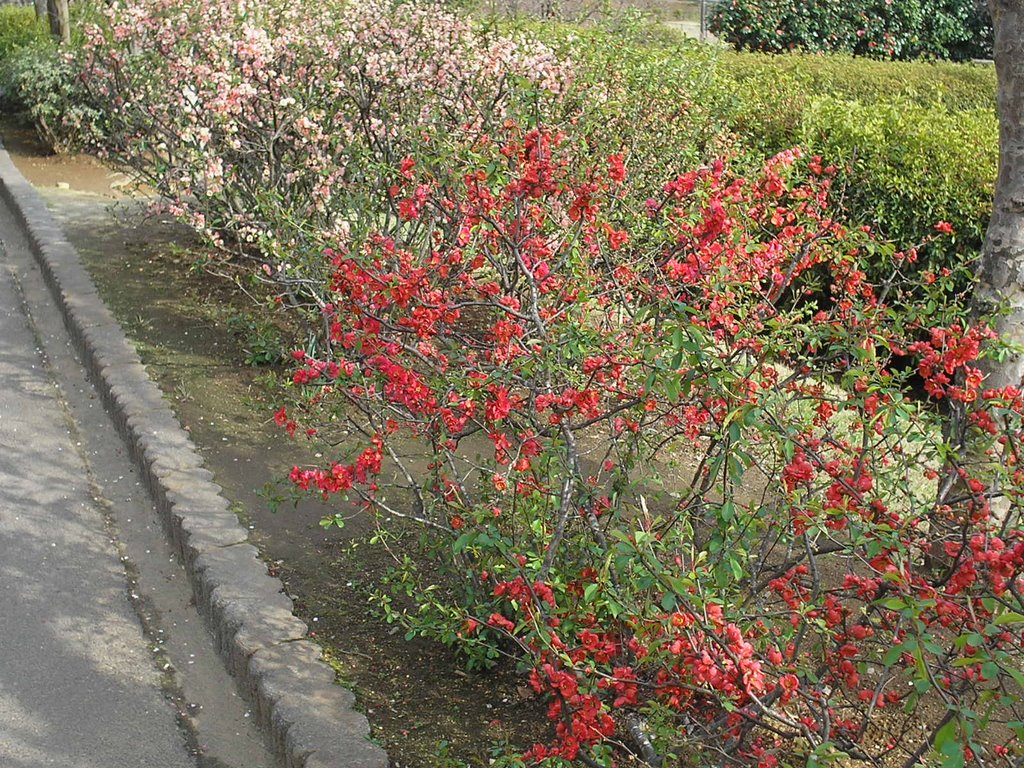
What particular plant did Henry Reed intend to refer to in this poem? (I remember reading it in an English lit class during my freshman year at the University of Richmond in the spring of 1968—before I dropped out of ROTC, and then out of college altogether, ending up in the Army anyway.) I’m guessing either camellia or Japanese quince, both of which bloom in the spring.

My Canon Wordtank edition of Reader’s English–Japanese Dictionary lists three Japanese entries for English japonica, each telling its own story: ツバキ (camellia), ボケ (Japanese quince), and サルスベリ (crape myrtle).

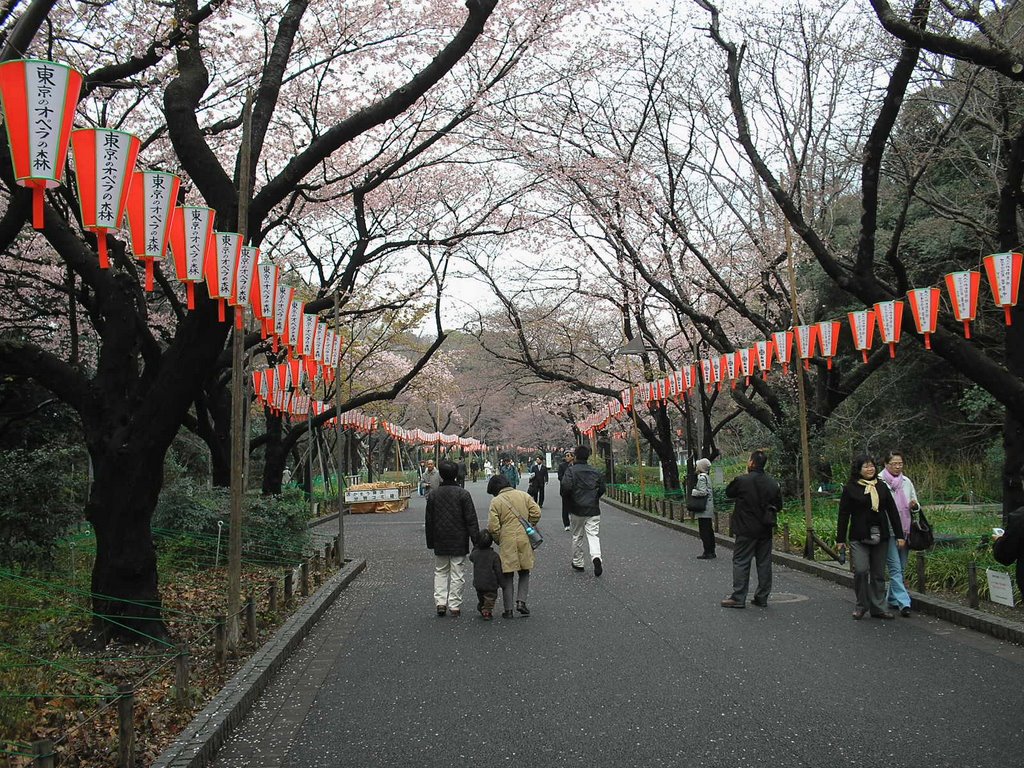
椿 tsubaki, Camellia japonica – The cherry blossoms are getting all the attention in the Kanto (Greater Tokyo) area these days as they reach their peak, but the light pink to dark crimson camellias have been in full flower for a few weeks already. A great variety of cultivars of Camellia japonica are all over the place, often in hedges.

木瓜 boke, Chaenomeles speciosa – Japanese quince is also known as Chaenomeles japonica. The normal Sino-Japanese reading for the name of the plant should be mokka (< moku ‘tree’ + ka ‘melon’), the name owing something to its melonlike fruit. Another name for a flowering tree formed on the same pattern is 木蓮 or 木蘭 mokuren (lit. ‘tree lotus’ or ‘tree orchid’), Magnolia liliflora or lily magnolia. A slightly different variety of Magnolia, Magnolia kobus—from its Japanese name 辛夷 kobushi—is in full, brilliant white bloom these days.

百日紅 sarusuberi (lit. ‘monkey slide’), Lagerstroemina indica – The native Japanese name for crape myrtle describes its smooth (guavalike) trunk and stems, while the Chinese characters describe the flowers, but the two names bear no relation to each other beyond referring to the same plant. You can pronounce the name of the plant according to the characters as hyakunichikou (lit. ‘hundred day red’), but I’m not sure how many Japanese speakers would recognize it by that name on first hearing it. (I would have spelled the name in English as crepe myrtle, but the spelling crape myrtle generates a much larger number of hits on google.co.jp.)

2 Comments

Filed under Japan, language

Foreigners Excel at National Sport: Sumo

Overlapping and eclipsed by Japan’s tortuous but exciting road to victory in the first World Baseball Classic and the start of Japan’s national high school baseball tournament at storied Koshien Stadium has been a rather exciting Spring Grand Sumo Tournament, where the foreigners were cheered as robustly as the Japanese—and did better, too.

The Estonian Baruto (the “Balt”) won the Juryo division (like North American baseball’s AAA league) with a perfect 15-0 record, the first rikishi to do so in over 40 years (since Kitanofuji).

Going into the final day, two Mongolians were tied for the lead in the Makuuchi division (the “majors”), with records of 13-1: yokozuna (grand champion) Asashoryu and sekiwake (junior champion) Hakuho. Moreover, Asashoryu’s only loss was to Hakuho, who had also beaten him in the previous tournament, so they were not scheduled to face off again—unless both lost on the final day. And, sure enough, both did lose. Hakuho fell to veteran Kaio, who was once again on the verge of demotion unless he maintained a winning record (the win put him at 8-7), while Asashoryu fell to ozeki (champion) Tochiazuma, who had been bucking for promotion to yokozuna, but whose 12-3 record—without a tournament win—won’t be good enough. So after all the regular bouts of the final day, Asashoryu and Hakuho had to come back and fight a deciding match, which Asashoryu had to struggle to win. So Asashoryu wins his 16th tournament, and Hakuho wins his 3rd outstanding performance award (and probably a promotion to ozeki).

Leave a comment

Filed under baseball, Japan, sumo

Wordcatcher Tales: Shinobazu Ike

The other day, this Outlier took his in-laws down to Ueno station to pick up our 1-week JR rail passes and take a peek to see how the cherry blossoms were coming along at Ueno Park. The blossoms were just beginning to appear, and so were the snack and sake vendors.

One spot we lingered at was 不忍池 Shinobazu Ike, the name of which illustrates two troublesome aspects of Japanese attempts to write their own language using only Chinese characters.

The name of the pond is written in kanbun, a contorted method of rendering Japanese by means of Chinese syntax. The written Chinese characters, in order, translate as ‘not hide pond’, but the spoken Japanese, in morpheme order, translates as ‘hideth-not pond’. (The verb 忍ぶ shinobu has a range of meanings and, frankly, I’m not sure which one was intended by the placenamers.) The -zu ending is just a more formal and archaic version of the negative -nai. Wikipedia explains the contortions of kanbun rather succinctly, wherein Chinese sentences are read as Japanese in a sort of simultaneous translation (saving the verb to the end, and so forth).

The term 池 ike for the body of water is sometimes translated ‘lake’. As kids in Kyoto, we used to ride our bicycles up to a then rustic reservoir called Takaragaike ‘Treasure Lake’, now the site of a fancy international conference center. But the usual Japanese term for larger lakes is mizuumi, which is transparently composed of 水 mizu ‘(fresh)water’ + 海 umi ‘sea’ but written with a single Chinese character, 湖 (pronounced hu in Chinese and ko in Sino-Japanese, as in Biwa-ko ‘Lake Biwa’). A similar bit of Japanese morphology obscured by a single Chinese character is 雷 ‘thunder’ (Chinese lei, Sino-Japanese rai), which probably could have been rendered as 神鳴り kami-nari ‘god-sound’.

William Wetherall has a lot more on happenings around 不忍池 in a fascinating compilation on Bakumatsu and Early Meiji Newspapers. Here’s how he explains why he translates the 1868 experiment 江湖新聞 (Koko Shinbun, lit. ‘riverlake news’) as World News:

Though “koko” (C. jianghu), literally “rivers and lakes”, is nearly a dead word in Japanese today, it was a fairly common expression in the mid-19th century. It is the keyword in the title of the column that reported stories of social and human interest in Tokyo nichinichi shinbun in 1872. It was part of the title of a popular book in 1873. And it appeared in the inaugural issue of the news nishikie in 1874.

In references to classical China and Zen, “koko” it is pronounced “goko”. [With regard to] China, it refers to the world of the Yangzi river (Changjiang) and Dongting lake, and in certain Chinese folklore it alludes to the fighting spirit of outcasts who protect themselves with martial arts. As a Zen term, it signifies a place where monks and other practitioners gather from all quarters. If all roads lead to Rome, then the whole world is in Rome.

In the title of Koko shinbun, “koko” signifies the “world” or “society” one lives in — much like “sanga” (mountains and rivers) is a somewhat nostalgic reference to one’s country as a homeland. In this sense it is very close to its general usage in Chinese today to mean the wide (and sometimes an idealized) world.

Leave a comment

Filed under China, Japan, language

Japanese Habits Strange to Burmese, 1942

Face slapping became a major issue. In the following year, the Japanese command, rather than prohibiting it altogether, forbade anyone below the rank of lieutenant-colonel to behave in this way.

Japanese troops indulged in other offensive activities: they bathed naked by water hydrants on the streets, to the horror of Burmese women. In some cases they were surprisingly cavalier with Buddhist shrines, stripping them of wood for cooking fires and otherwise violating them. As he escaped overland to India, Thein Pe viewed the eating and living habits of the Japanese soldiers with disgust: ‘we cannot say whether or not they knew what a bed pan was. They were seen eating rice from one’, he reported. A later British compilation of anecdotes noted ponderously, ‘The Japanese gastronomic habits had served them ill: that they ate dogs was observed to their discredit.’ But Japanese soldiers were extremely popular with the Burmese young. The troops were genuinely fond of children. The ‘had made much of Burman boys and girls, given them sweet meats, taught them baseball, played football with them and taught them Japanese songs.’ It was to be a ‘golden age for children’. Parents worried that their offspring were being alienated from them and that the Japanese were using their children to spy on them.

SOURCE: Forgotten Armies: Britain’s Asian Empire & the War with Japan, by Christopher Bayly and Tim Harper (Penguin, 2004), p. 234

Leave a comment

Filed under baseball, Japan

Wordcatcher Tales: Shiomori, Gibo, Atsumono

塩盛り shiomori ‘salt pile’ – The other night, as we were leaving our favorite local fish restaurant in Ashikaga, my recently arrived Minnesota in-laws noticed what looked like a small pile of snow beside the door as we left. It turned out to be salt, and there was a matching salt pile on the other side of the entranceway, so I went back in and asked the very friendly and talkative sushi chef (who trained 3 years in San Francisco and 1 on Maui) what the story was. There were no customers at the sushi bar at that moment, so he came outside in the chilly wind and told us the story. The salt has two functions. The most commonly recognized one is to purify the premises by keeping evil spirits out. But the more interesting one is to attract customers in. The latter function apparently goes back to the days when goods traveled by oxcart. The idea was to tempt the oxen to stop and lick the salt, whereupon the traveler might also decide to stop for food or rest. The salt piles were called 塩盛り shiomori ‘salt helpings’, a term which is otherwise chiefly found in restaurant menus for assorted salty dishes.

義母 gibo ‘mother-in-law’ – Earlier that same evening, I had introduced my visiting in-laws to the waitress in that same fish restaurant. Both she and the sushi chef are always happy to assuage my curiosity about obscure readings (obscure to me, anyway), especially of fish names and sake brands. After I had introduced my mother-in-law as my 義理の母 giri no haha, she referred to her by a shorter version, 義母 gibo. So I asked her what the shorter version is for younger sister-in-law, 義理の妹 giri no imouto. In comprehensive kanji dictionaries, you can find 義妹 gimai, but she had never heard that term. The only such shorter term she had heard was 義兄 gikei ‘elder brother-in-law’. The longer version is 義理の兄 giri no ani, and my New Nelson’s kanji dictionary lists the full range for siblings-in-law: including the combining terms 義姉妹 gishimai ‘elder and younger sisters-in-law’ and 義兄弟 gikyoudai ‘elder and younger brothers-in-law’. (The 義理 giri here is the same one used to mean ‘duty, honor, debt of gratitude’; and the shorter prefix 義 gi is also used to indicate artificial human components, as in 義歯 gishi ‘artificial tooth’ or 義眼 gigan ‘artificial eyeball’.)

紅き羹 akaki atsumono ‘vermilion broth’ – one of our two favorite coffee shops in Ashikaga is Café de Furukawa, an elegant place whose 12-page menu and guide to coffee history and brewing is titled 紅き羹 akaki atsumono, a purposely archaic and obscure phrase that I’ve translated ‘vermilion broth’. Both elements tell a story. The reading aka for 紅 is archaic in Japanese, and the pronunciation akaki for akai ‘red’ is both archaic and regional, I believe. Nowadays, akai ‘red’ in Japanese is written 赤, while 紅 is normally read beni ‘crimson, rouge, vermilion, lipstick’, as in 紅生姜 beni shouga ‘red pickled ginger’, 紅染め benizome ‘red-dyed cloth’, or 紅鮭 benizake ‘red salmon’. Chinese 紅 hong still means ‘red’ (and shows up in many given names of people born during China’s Cultural Revolution). Its Japanese rendition kou- shows up in many compounds such as 紅茶 koucha ‘red tea’ (= ‘black tea’ in English), 紅海 Koukai ‘Red Sea’, and 紅灯 koutoured lantern, red light (district)’. The much rarer character 羹 atsumono ‘hot soup, broth’ (literally ‘hot stuff’) has a much shorter story. It shows up in a Japanese proverb that matches English “Once bitten, twice shy”: 羹に懲りて膾を吹く Atsumono ni korite namasu o fuku ‘Learning from hot broth, you blow on cold pickles’.

UPDATE: Thanks to Language Hat reader Matt for catching a grammar error in my rendition of the coffee-shop title. I originally wrote 紅きの羹 for what is actually 紅き羹. I’ve made the correction in the text above. Another Language Hat commenter turns up a different explanation for the doorway 塩盛り in a fun Youtube video guide to eating sushi.

Leave a comment

Filed under Japan, language