Category Archives: Japan

Sumo’s Female Executives: Okamisan

Among the long list of expectations Yokozuna Akebono faced were that he become a Japanese citizen and that, believe it or not, he get married. Japanese citizenship is a requirement for oyakata [‘stable bosses’], which as a yokozuna [‘grand champion’] he was almost certain to become. While marriage is not an actual Kyōkai [‘Association’] requirement for its oyakata, tradition dictates that one must be married; it is understood that a heya [‘stable’] cannot be run by an oyakata alone. An oyakata’s okamisan [‘headmistress’] does far more than act as a kind of mom away from mom for the heya’s deshi [‘apprentices’], many of whom are still kids. In many cases, the okamisan is a sumo-beya’s primary administrator. She organizes kōenkai [‘fan club’] functions and dinners with other friends and supporters. She can also be involved in recruitment. If the heya has a sekitori [‘paid professional’], she organizes everything related to his promotion parties and his wedding—sometimes right down to introducing prospective brides. In many cases, she handles all of the money coming through the heya. Hers is the only position of importance and respect for any woman in the Nihon Sumo Kyōkai.

SOURCE: Gaijin Yokozuna: A Biography of Chad Rowan, by Mark Panek (U. Hawai‘i Press, 2006), p. 230

Leave a comment

Filed under Hawai'i, Japan, sumo

Wordcatcher Tales: Poi-sute

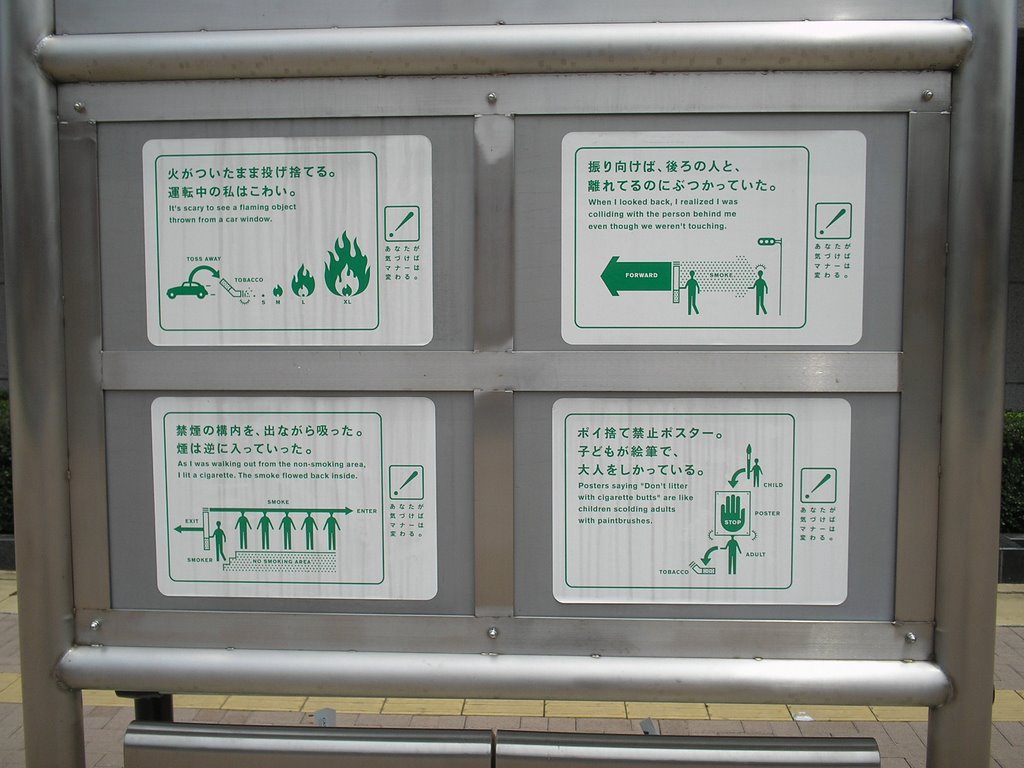
For all the sign-deciphering I did during my months in Japan earlier this year, I’m surprised how long it took me to notice “No littering” signs, which are often rendered in a katakana + kanji combination: ポイ捨て禁止 poi-sute kinshi ‘casual-discard forbidden’. The verb 捨てる suteru means ‘to throw away, discard’ as in the famous legend of Obasuteyama, a mountain where old women were left to die after outliving their usefulness. (I’m not sure if the men were left on a separate Ojisuteyama.) And ぽいと poi-to means ‘casually throwing or discarding something’ (according to my electronic Super Daijirin).

The photo above shows a set of four bilingual anti-smoking signs that can be found in many train stations in Japan. The English version of the sign on the bottom right says, Posters saying “Don’t litter with cigarette butts” are like children scolding adults with paintbrushes. It must be a Zen koan of an advanced type that exceeds my level of enlightenment, because I don’t quite get the point.

Leave a comment

Filed under Japan, language

Asia Watch on "Sea of Japan" vs. "East Sea"

Asia Watch presents a 27-point rebuttal to a Korea.net video that argues for renaming the Sea of Japan as the East Sea.

In summary: This video ignores the claim that “Sea of Japan” came into widespread usage in the early 19th century. Instead, it presents studies of pre-19th century maps, none of which discredit the findings of Japanese researchers with regard to the 19th century. After failing to discredit Japanese claims, it shows that the name “East Sea” has been used by Koreans for 2000 years. It then claims that the entire world is obligated to print foreign terms for seas alongside their traditionally-established native language terms, in accordance with a recommendation of a UN organization (but only in the case of the “East Sea”). The video attempts to disguise the anti-Japanese Korean ultranationalist agenda behind a thin veil of academic arguments, and does a remarkable horrible job. If this is the best argument the Korean government can produce, I doubt they’ll be winning over many converts through the spread of this video.

via Japundit

Why stop at the Sea of Japan? How about the Indian Ocean, the Arabian Sea, the Persian Gulf, the Gulf of Tonkin, the Marianas Trench, the Gulf of Siam/Thailand, and the Gulf of Mexico? Who gave the Coral Sea to the coral? Don’t the sea cucumbers have as valid a claim, or the moray eels? I say let’s restore the proper name for the English Channel: The Sleeve.

UPDATE: I was going to ask who gave the Bay of Pigs to the porkers, but its Spanish name is Bahía de Cochinos ‘Bay of Triggerfish‘. Cochinos are only metaphorically disgusting in behavior or appearance—like pigs, though nowhere near as intelligent. Also:

Some species of triggerfish are known to make a sound akin to a grunt or snarl when taken out of the water.

Leave a comment

Filed under Japan, Korea

Sumo’s Appeal for the Waka/Taka Brothers and Others

THE NAMES “WAKAHANADA” and “Takahanada” meant little of poetic significance. The “waka” and “taka” parts merely evoked their father and uncle, while “hanada” was their real last name. But among those watching in February 1988, it was understood that the boys would one day earn the right to take on the great names “Wakanohana” and “Takanohana.”

Why a young Japanese would want to take up the severe life associated with the national sport, while far less bizarre than when applied to an American, is a question that deserves attention. The total number of the [Sumo] Kyokai’s competitors usually hovers around only 800 in a country of some 120 million people, while baseball and soccer attract a far greater number of Japan’s promising athletes. Some join sumo, believe it or not, because the sumo world is a place where big guys can exist honorably without being teased. Teasing and bullying go on far past adolescence in Japan. Much is made in cultural definitions of Japan as a place of social conformity, and pressure to conform is indeed very real there. But rather than through some kind of Orwellian fear tactics, in practice the social pressure comes in the form of people being relentlessly annoying any time they see something even slightly out of the ordinary. A bigger-than-aver-age Japanese man looks different from most people, and thus becomes the object of constant ridicule, both from those he knows (in the form of obligatory fat jokes at absolutely every social encounter) and those he doesn’t (“Ah, Mr. Tanaka! It’s nice to meet you. Wow, you sure are big. How much do you weigh, anyway?”). For many overweight Japanese teenage boys who may never have had an interest in sport and who find themselves at the age when teasing is at its fiercest, sumo is a way out of mainstream Japan. The saddest part may be that the middle of the banzuke [‘rankings’] is clogged with nonathletic types with no hope of ever reaching the salaried ranks who’ve committed themselves to sumo as an alternative way of life: their topknots turn their size from points of obligatory ridicule to points of honor.

Other Japanese rikishi are recruited from rural areas with little economic opportunity. A former sekitori [‘professional wrestler’] explained, “Some kids, they come to the stable, but the ones the oyakata [‘stablemaster’] scout, they go to their house, they go to their parents, they give ’em a million yen. ‘Give me your boy for sumo.’ These boys are fifteen years old, and their parents are like, ‘A million yen!’ These guys are from the mountains; they don’t see that much money. ‘Oh, okay, okay! You go do sumo!'” They join sumo as a means of support and often toil for years in the lower ranks with no hope of making it, fortunate to be fed and housed. Other Japanese join in a rare show of national pride: “Because it is kokugi,” the national sport, one boy in the jonokuchi [lowest] division told me. Still others join as Jesse Kuhaulua [raised on Maui] had, as a natural progression of their junior high, high school, and/or college sumo careers.

Masaru and Koji Hanada joined because they were born into the sport. Sons of the great Ozeki Takanohana (the first) and nephews of the great Yokozuna Wakanohana (the first), they had sumo in their blood. While Chad Rowan had not known the meaning of the term “sumo-beya” [‘sumo stable’] until he was eighteen, the Hanadas had been raised in one. Young Koji Hanada entered his first sumo tournament when he was in third grade—and won. Six years after setting up his own Fujishima-Beya upon retiring in 1982, Fujishima Oyakata gave in to the relentless pleas from his boys by letting them formally become his deshi. Masaru Hanada’s 2000 autobiography offers a poignant account of the boys declaring themselves no longer Fujishima Oyakata’s sons, upon moving out of Fujishima-Beya’s top-floor apartment and down into a big shared room below, but rikishi under his charge.

By official registration day, Takahanada weighed a healthy 258 pounds, bigger than most of the other boys and a full 40 pounds heavier and nearly an inch taller than his older brother. And unlike the rest of the shin-deshi [‘new apprentices’] registering that day, Waka and Taka had already proved themselves on the dohyo [= ‘in the ring’]. Competing in high school, Masaru (Waka) had taken the All-Japan Senior High School yusho [tournament championship], while his younger brother had easily taken the Kanto District Junior High School yusho. Where Chad Rowan had come from nowhere into a sport as foreign to him as the language, these boys were sumo’s Ken Griffey Jr. and Barry Bonds.

SOURCE: Gaijin Yokozuna: A Biography of Chad Rowan, by Mark Panek (U. Hawai‘i Press, 2006), pp. 122-123

Well, the money must hold considerable appeal for the foreign wrestlers. At the end of Day 5 in the September Basho: two Mongolians, yokozuna Asashoryu and maegashira-6 Ama, are 5-0. Just one loss behind, at 4-1, are Bulgarian ozeki Kotooshu, Japanese ozeki Chiyotaikai, Mongolian ozeki Hakuho, Japanese sekiwake Kotomitsuki, Russian maegashira-1 Roho, Japanese maegashira-11 Homasho, and Korean maegashira-15 Kasugao. I would dearly love to see tiny Ama win the tournament.

UPDATE, Day 6: Asashoryu lost, leaving Ama (now 6-0) in sole possession of the lead!

UPDATE, Day 7: Ama lost, so now two Mongolians (Asa and Ama), one Russian (Roho), and one Japanese (Kotomitsuki) are tied for the lead at 6-1.

UPDATE, Day 8: Kotomitsuki loses, leaving the other three at 7-1.

UPDATE, Day 9: Tiny Ama (185 cm, 115 kg) went up against the giant Estonian Baruto (197 cm, 174 kg) and won! Well, technically, Baruto defeated himself by fumidashi, stepping backwards out of the ring while facing Ama. Asa beat Roho in the hard-fought final bout, so the two Mongolians still share the lead at 8-1.

UPDATE, Day 10: Asa and Ama now share the lead at 9-1, with Roho and Ama’s Ajigawa stablemate Aminishiki one loss behind, at 8-2.

UPDATE, Day 11: Asa and Ama now share the lead at 10-1, while Roho and Aminishiki have both dropped back to 8-3, alongside Chiyotaikai, Futeno, and Hokutoriki. Unbelievable. Ama will certainly regain komusubi rank after this basho.

UPDATE, Day 12: Fellow Mongolian Hakuho lifted Ama up and out of the ring, leaving him at 10-2, one loss behind Asashoryu (11-1), who won his bout against Tochiazuma.

UPDATE, Day 13: Ama had the chance to get back into a tie for the lead if he managed to defeat Asashoryu, but he had no such luck, so Ama stands at 10-3, while Asashoryu lengthens his lead to 12-1.

Topix.net has two sumo photos of interest from a Sadogatake-beya tour of Israel in June: Bulgarian ozeki Kotooshu in yukata and yarmulke at the Western Wall and stablemates Kotomitsuki and Kotoshogiku floating in the Dead Sea.

Leave a comment

Filed under baseball, Hawai'i, Japan, sumo

Percy/Daiki on Chad/Akebono

When I met Chad [Rowan = Akebono], he wasn’t that nice of a person, I guess ’cause all of the stress and stuff, but when I got to know him, he was one nice guy. Real humble. But mean personalities. I’ll tell you how he is. I been over there seven and a half years. The jungyo tournaments, comes in the morning. Doesn’t say one word. Sits down. Lies down. Rests a while. Gets up: “Mawashi!” Put on his belt, put on his yukata, walk straight to the dohyo. After he practice, he comes back, take a shower, then he start talking. “Oh, my back sore.” He neva like joking around. After that, then he jumps out of the shower, then he goes to eat. Different attitude. Quiet again, eating. Then he go back to his room. Joking around, talking story, listening to the radio, talking on the phone. Time for wrestle: pau. Attitude again. That’s why I used to watch his moods. I used to just practice with that. I know how he act already. I know what pisses him off. After practice, he go back to the shower; nobody bother him. Come back from the shower, eat, nobody bother him. After he pau eat, then you can talk story with him. You gotta catch him one perfect time. You don’t catch him one perfect time, he’s a bitch. Nobody can talk to him at all. —PERCY KIPAPA (DAIKI), 12/98

SOURCE: Gaijin Yokozuna: A Biography of Chad Rowan, by Mark Panek (U. Hawai‘i Press, 2006), p. 161

Percy Kipapa was found dead in a truck from multiple stab wounds on 16 May 2005 in Honolulu. —Honolulu Star-Bulletin, 19 May 2005

His friend, Kealiiokalani Meheula, was found guilty of second-degree murder in June 2006, and was sentenced to the mandatory life imprisonment with the possibility of parole on 6 September 2006. —Honolulu Star-Bulletin, 7 September 2006

“Percy Kipapa — he was my friend,” Meheula said yesterday, breaking down as he asked Kipapa’s family for forgiveness. “I loved him with my heart, and I have to live with this for the rest of my life.”

George Kipapa said he did not know how much love Percy, the youngest of the Kipapas’ three children, had shared with the people here and in Japan until his funeral.

“I’m not only proud that he had a career in sumo; most of all, I’m proud he learned the word love,” Kipapa said.

As for Meheula, Kipapa said he hoped God would have mercy on him and that in the future he would learn to let go of his anger and embrace others, not hurt them. “Today we gotta learn to love, not to hate,” Kipapa said.

The Honolulu Advertiser account on 7 September adds another pertinent detail.

Also speaking in court was Mark Panek, a friend of Percy Kipapa and author of a biography on sumo champion Chad Rowan. Panek said he met Percy Kipapa in Japan and said the other sumo wrestlers from Hawai’i miss him.

It looks as if Panek’s next biography has just been assigned to him. A biography with less triumph and more tragedy.

Leave a comment

Filed under Hawai'i, Japan, sumo

A Foreign Sumo Recruit’s Big Mistake

When the television crew left, Boss went upstairs to his third-floor apartment, leaving Chad in the big room with twelve other boys ranging in age from fifteen to twenty-one. They also ranged in size, from surprisingly scrawny younger kids to the imposing, four-hundred-pound Samoans from Hawai‘i, Taylor Wylie and John [Feleunga]. Chad looked from one to the next as they stared at him, sizing him up like a battle-seasoned army platoon eyeing an unlikely recruit. Each had his hair tied into a single knot that was folded over, looking like a samurai in the movies Chad had watched on TV. Purple welts and bruises covered most of their faces. Many of them had their arms folded so that the fabric of their robes stretched tight enough to display bulging biceps. Chad understood the energy he was sensing from them: testosterone. These guys fought for a living, day after day. They fought. As of yet, he did not.

Some of the younger Japanese boys began barking at him in words he could not understand, as if to order him around. Their guttural commands were more reminders of those samurai movies he and his brothers used to mimic in exaggerated grunts and mumbles. He turned to John and said, “Excuse me, John-san, what they wen’ say to me?”

“What I look like?” the Samoan glared at him. “Your fuckin’ interpreter?”

The blast of cold wind back at the airport had shocked him less. He stood motionless, trying to figure out the reaction somehow. It made no sense to him. While he might have expected trouble from the Japanese, John had been through exactly what he was now dealing with. He could have made things smoother for Chad with a few simple words: “they wen’ tell you for layout your futon,” or “they like know why you so tall.” Support from John did not have to last forever, Chad thought, but he had only been in the country a matter of hours. Instead it was, more or less, “just ’cause I local no mean I going help you—you’re on your own, Hawaiian.”

Confined now to silence, Chad continued to look around and take in the complex web of power surrounding him, one based on age, time served, and strength. In the last and most important of these, it was immediately clear that Taylor was The Man. Only eighteen as well, Taylor had come to Japan the year before and now ran the heya, as Chad could already tell, based on the obvious fact that he could kick anybody’s ass in the room. The big Samoan ordered two of the boys to set out a futon for Chad in the corner of the room, which they did immediately. They then showed Chad where he was to lay his futon out in the evenings and store it in the mornings, and finally, a personal storage area much too large for his small bag.

All of the boys, as it happened, shared the big room. As far as he could tell, they spoke more or less freely with each other, laughing occasionally from one corner to the other as much as the boundaries he had noticed permitted. But beyond Taylor’s initial gesture, no one made any effort to include him, including the other boys from Hawai‘i, who bantered fluently in Japanese. Chad realized as he lay on the cold, hard floor that his time in the spotlight was over. This was not the sumo he had seen on television. Konishiki’s limo, stardom, big money—it all may as well have been another ten-day-long flight away from this hard, cold floor. They’ll take care of everything. Right. All he could think about as he drifted off to sleep was home, and what a huge mistake he had just made by leaving.

SOURCE: Gaijin Yokozuna: A Biography of Chad Rowan, by Mark Panek (U. Hawai‘i Press, 2006), pp. 16-17

The 2006 Aki Basho (Fall Tournament) is now underway, with one gaijin yokozuna at the top of the banzuke, two gaijin ozeki, one gaijin komusubi, and seven gaijin maegashira: from Mongolia, Bulgaria, Georgia, Estonia, and Russia. But not a single Polynesian, I’m sad to say. I’m rooting for the Okinawan rookie Ryuho (Ryukyu Roc/Phoenix), who just made his major league (makuuchi) debut.

Leave a comment

Filed under Hawai'i, Japan, sumo

Takasago-beya as Both the Yankees and the Dodgers

While Azumazeki-Beya had been open for only two years, Takasago-Beya was steeped in sumo history. Of the fifty-odd sumo-beya [sumo stables] currently housing rikishi [professional sumo wrestlers] in various parts of the surrounding neighborhood, Takasago ranked fifth in years of operation, dating back to 1878—by no means the beginning of sumo, but an age when the sport began to take on its present structure. In addition to Azumazeki-Beya, Takasago spawned Takadagawa-Beya, Nakamura-Beya, Wakamatsu-Beya, and Kokonoe-Beya. Takasago Oyakata had risen to yokozuna [grand champion] back in 1959, competing as Asashio [one of my childhood favorites—J.]. The fifth Takasago Oyakata, he had taken over in 1971 when the previous Takasago Oyakata, who had also risen to yokozuna competing as Maedayama, died. The line of oyakata stretched back to Takasago Uragoro, who oversaw two yokozuna and three ozeki [champions] of his own. Over the years, nearly one-tenth of the yokozuna promoted since the inception of the rank in the mid-nineteenth century (six of sixty-two, by this time) stomped their first shiko [raise one leg, stomp it, squat] into the Takasago-Beya keikoba [practice room]. If American Major League Baseball were a hundred years older (and if baseball players shared this unforgiving, monastic lifestyle), Takasago-Beya might be comparable to Yankee Stadium.

Takasago-Beya was perhaps more notable in a Brooklyn Dodger way than in a way befitting Yankee pinstripes. In addition to Taylor [Wylie], John [Feleunga], Konishiki [Saleva’a Atisano’e], and Nankairyu, Chad [Rowan] saw two other foreigners in the room, members of Takasago-Beya. While other sumo-beya had recruited rikishi from Brazil and Argentina, and would later look to Mongolia, the only foreigners yet to have really impacted the national sport were limited to this room. Twenty-four years earlier on a demonstration tour to Hawai‘i, the fourth Takasago Oyakata had taken a chance on Jesse Kuhaulua, the beginning of Hawai‘i’s connection with Japan’s national sport. Kuhaulua had trained and competed for more than twenty years at Takasago-Beya as Takamiyama. He now presided over asa-geiko [morning practice] next to the present Takasago Oyakata, on nearly equal terms, as Azumazeki Oyakata.

SOURCE: Gaijin Yokozuna: A Biography of Chad Rowan, by Mark Panek (U. Hawai‘i Press, 2006), pp. 38-39

In looking for links for this post, I came across an interview with Hawai‘i-raised amateur sumotori Kena Heffernan, Yale ’96, Sumo cum laude.

Leave a comment

Filed under baseball, Hawai'i, Japan, Mongolia, sumo

Wordcatcher Tales: Nakayama > Zhongshan

In 1987–88, the Far Outliers spent a year teaching English at newly founded Sunwen College in Zhongshan City, Guangdong Province, China, about an hour by car north of Macao, which at that time was still a Portuguese colony. Our daughter, who was two at the time, learned to recognize the Chinese characters 中山市 (Zhongshanshi), which were ubiquitous on vehicles and signs around the city. (The photo shows her with the principal of her preschool, who was also the auntie of one of our students—otherwise they wouldn’t have taken her. They didn’t realize until too late that she was a year younger than the others in her class.)

We soon came to realize that hardly anyone in China recognized the Cantonese name Sun Yat-sen (孫逸仙), whose famous bearer is known throughout China as Sun Zhongshan (孙中山). The name of the college, Sunwen (孙文) was the same man’s “school name” (学名 xuémíng, informally 大名 dàmíng ‘big name’), the name he signed on official documents. The man had a lot of names.

What I didn’t realize until just recently was that the name by which he is known in China derives from the alias he used in Japan—and not vice versa—at least according to Wikipedia:

In 1897, Sun Yat-sen arrived in Japan, and when he went to a hotel he had to register his name. Desiring to remain hidden from Japanese authorities, his friend wrote down the Japanese family name Nakayama (中山) on the register for him, and Sun Yat-sen chose the given name Shō (樵).

Allegedly, on their way to the hotel they had passed by the Palace of Marquis Nakayama (family home of the Meiji Emperor’s mother) near Hibiya Park in central Tokyo, and so his friend chose the family name which they had seen hanging at the door of the palace.

For the most part of his stay in Japan, he was known as Nakayama Shō (中山樵). The kanji for Nakayama can be read in Chinese as Zhōngshān.

And now you can find universities, roads, and parks named for Zhongshan all over China and Taiwan (thanks to the imperialism of Japanese aliases, or the anti-imperialism of the alias holder, or something).

PS: Our daughter, whose first preschool was Zhongshan No. 2 Preschool (中山第二幼儿园) in Sun Yat-sen’s hometown, later graduated from Sun Yat-sen’s alma mater in Honolulu.

Leave a comment

Filed under China, Japan, language

Newsweek on Multiethnic Japan


The Asia edition of Newsweek for 11 September features “multiethnic Japan”—something that also struck me during my latest visit there.

Consciously or not, ordinary citizens and government bureaucrats still cling to the notion that Japanese society is a unique, homogeneous culture. There is a conspicuous lack of public debate about how this insular country should adjust to the reality that more immigrants are coming—and that those already here are changing Japan. “The government has no [comprehensive] immigration policy,” says Marutei Tsurunen. Rather, the approach is piecemeal, with different agencies issuing often contradictory regulations. Tsurenen should know. He’s a former Finn turned Japanese citizen and the only naturalized member of the national Parliament, or Diet.

Travel around Japan today, and one sees foreign residents holding a wide range of jobs: there are Chinese short-order cooks, Indian software programmers, Bangladeshi used-car dealers, Brazilian textile-factory workers, Sri Lankan department-store cashiers. The overwhelming majority of the approximately 15,000 ex-foreigners who now hold Japanese citizenship are Chinese and Koreans—but increasingly one can also meet people like Kaoru Miki (formerly Colin Restall, born in the United Kingdom). “Generally people don’t expect someone who looks like me to be a citizen,” says Miki, 33, who makes his living translating software into English. He was naturalized this spring.

The number of foreigners in Japan has more than doubled over the past 15 years—rising from 886,000 in 1990 to over 2 million today. That amounts to 1.57 percent of the overall population—still small even by Western European standards (not to mention the United States or Canada). But that figure tells only part of the story. The rise in the foreign population is taking place against the background of Japan’s demographic decline; as the population ages, native-born Japanese constitute a diminishing share of the work force. Meanwhile the number of marriages between Japanese and non-Japanese has been rising sharply. So-called international marriages made up 5.5 percent of the total in 2004 (the last year for which data are available).

The numbers also reveal a growing trend toward what one might call “genuine immigration.” For many decades, the bulk of foreigners in Japan were ethnic Koreans, the vast majority of them born in the country but not automatically entitled to citizenship. In recent years, as their members have either died out or increasingly opted for naturalization, their share of the total number of foreigners has been declining. Meanwhile, so-called permanent residents—foreign-born people who have chosen to live in Japan for the long term—are steadily growing. “It shows that immigrants, not generational foreigners, are now becoming the more common permanent residents in Japan, meaning they’re not going to leave,” says human-rights activist Debito Arudou, a former American turned Japanese citizen. “I used to say half of the foreigners in Japan were born here. Now it’s more like a quarter.”

And the fundamental consequence, says Arudou, is clear: “We’re going to see people who don’t look Japanese being Japanese. That’s undeniable.” Essentially, any foreigner who has lived in Japan for five years, can prove he or she is in good financial health and has no criminal record can petition the Justice Ministry to become a citizen. In reality, the naturalization process is more complicated, and can take about 1 to 2 years to complete.

I’ve added a little bit of visual confirmation on Flickr, where you can search for “international Ota City” in predominantly rural Gunma Prefecture.

Leave a comment

Filed under Japan

Remembering Iwo Jima, Both Victors and Vanquished

Joe Rosenthal has died. By a stroke of good luck, he was able to capture an image of victory after one of the most hard-fought battles of the Pacific War.

Joe Rosenthal, the Associated Press photographer who captured the enduring image of the American fighting man in World War II with his depiction of five Marines and a Navy corpsman raising a huge American flag over the Japanese island of Iwo Jima, died Sunday in Novato, Calif. He was 94….

His photograph of the flag-raising atop Mount Suribachi on Feb. 23, 1945, may be the most widely reproduced photo in American history. It was re-created on at least 3.5 million Treasury Department posters publicizing a massive war-bond campaign. It was engraved on three-cent Marine Corps commemorative stamps that broke Post Office records for first-day cancellations in 1945. It was reproduced as a 100-ton Marine Corps War Memorial bronze sculpture near Arlington National Cemetery. And it brought Mr. Rosenthal a Pulitzer Prize.

But almost from the day the photograph was emblazoned on the front pages of Sunday newspapers as a symbol of embattled patriotism, Mr. Rosenthal faced suspicions that he staged the shot, posing the Marines. He always insisted that he recorded a genuine event, and others on the scene corroborated his account.

“The picture was not posed,” Louis Burmeister, a former Marine combat photographer who was among four military photographers alongside Mr. Rosenthal as the flag went up, said in a 1993 interview for “Shadow of Suribachi,” by Parker Bishop Albee Jr. and Keller Cushing Freeman. [It’s amazing how persistent that rumor is in newsrooms that can’t spot photographs that are not just posed, but photoshopped, from current war zones.–J.] …

After being declared 4-F by the armed forces because he could see only one-twentieth as well as an average person, Mr. Rosenthal joined the United States Maritime Service, taking photos of Atlantic Ocean convoys. In March 1944, he went to the Pacific on assignment for the A.P. and later photographed the invasions of New Guinea, Hollandia, Guam, Peleliu and Angaur.

On Feb. 19, 1945, Mr. Rosenthal accompanied the early waves of a 70,000-man Marine force ordered to seize Iwo Jima, a 7.5 square miles of black volcanic sand about 660 miles south of Tokyo. The island, defended by 21,000 Japanese troops, held airstrips that were needed as bases for American fighter planes and as havens for crippled bombers returning to the Mariana Islands from missions over Japan.

By coincidence, the Japan Times [registration required] recently ran a fascinating profile of Gen. Kuribayashi, who commanded the Japanese forces on the island.

The warrior Japan chose to lead this fight to the last in the spring of 1945 was a mercurial, contradictory man: a samurai descendant and loyal servant of the Emperor who detested much of Japan’s authoritarian, military culture; a fanatical Imperial warrior devoted to his family; an elite graduate of Japan’s top military academy who read Shakespeare, spoke fluent English and narrowly opted for the army over a career in journalism.

“The United States is the last country in the world Japan should fight,” Kuribayashi wrote in a letter home days before his doomed forces inflicted massive casualties on U.S. forces landing on the 22.4-sq.-km (7-sq.-mile) island.

The tensions in Kuribayashi’s character, and his reluctance to go to war with the U.S., slowed his rise through the ranks of Japan’s military, says grandson, Yoshitaka Shindo. “My grandfather was sidelined because he didn’t fit in with military thinking. He had friends in America and respected the country.”

According to colleague Army Capt. Kikuzo Musashino, “The general spoke about his years in America, saying they had enormous industrial resources. He said: ‘When war comes, they can convert all that ability into military use. The people who planned this war in Japan know absolutely nothing about this. Whatever way you look at this war, we can’t win.’ “

Leave a comment

Filed under Japan, Pacific, U.S., war