
Category Archives: Japan

Foreign Outliers in Kyoto 50 Years Ago

Fifty years ago, I was attending second grade at the U.S. Army Base on the grounds of the Kyoto Botanical Garden. I’m not sure whether it might have been called Camp Botanical Garden (Shokubutsuen, 植物園). I remember that some of my military-brat classmates had to ride a school bus from nearby Camp Otsu, which didn’t have its own school at the time.

It was my third school in as many years, and the next year I would enter my fourth. The previous year, while we were on furlough at Southern Seminary in Louisville, Kentucky, I had attended first grade at Greathouse Elementary School in St. Matthews. The year before that, I had attended the Japanese kindergarten on the grounds of Seinan Jo Gakuin, a Baptist girls school where my father served as chaplain.

After we returned from furlough in 1956, my father became chaplain of the newly established Japan Baptist Hospital in Kyoto. The military base closed down the very next year, so the local missionaries hastily organized Kyoto Christian Day School (now KIS), using Calvert School curriculum materials.

The photo above is from a KCDS field trip to the Kyoto police headquarters, maybe in 1958. Our adult chaperone was Mr. Daub, whose eldest son Philip was in my brother’s class (a year behind me). My brother is the disgusted-looking kid in the front row, with Philip to his right. I’m the angry-looking kid in the front row, with my classmate David Thurber to my left. I don’t remember much about David except that he was somehow related to the writer, James Thurber; and that he had a wide-smile contest at his birthday party, which I thought was kind of unfair because he had the widest mouth in the class (and not just because I was such an accomplished frowner).

Behind me are two more of my classmates, Danny Hesselgrave and John Hawley. I remember riding my bike to the Hesselgraves on more than a few weekends, where Danny and I would play with his sets of little plastic cowboy and Indian figures, each of us taking one side or the other. Our games would always start with the question “Peace or War?” I once experimented—only once—with the game-killing answer, “Peace!”

John Hawley was an only child with what we imagined to be a rich grandmother back in England, who used to send him much more impressive sets of little metal figurines: legions of finely crafted toy soldiers in the colors of famous British regiments. I remember only once or twice going out to visit him in a huge mansion on a large estate in Yamashina. To us, he seemed the poor little rich kid. We envied him his toys, but not what we imagined to be his solitude.

AFTERTHOUGHTS: Such, anyway, were my childish impressions at the time. In truth, we were all poor little rich kids relative to our Japanese neighbors at the time. We lived in a large American house on a lot so big that it was later subdivided to accommodate at least half a dozen Japanese houses for employees of the Baptist Hospital. We had a Japanese maid, as did most other American missionaries at the time. And we got presents of various kinds either from relatives or churches back home or from Sears or Montgomery Ward catalogs we ordered from in time for Christmas every year.

At the time, we only knew that John’s father was a writer of some kind, but I’ve just this weekend learned what an extraordinary man he was. Frank Hawley (1906-1961) was a linguist who taught at SOAS, spent the 1930s in Japan, helped found the Japanese language section of the BBC after being repatriated to England during the war, then returned to Japan where he worked as a writer and collector of well over 20,000 books, some of which were destroyed during the war, others first confiscated then purchased by Keio University in Tokyo, and others after his death now housed at the University of Hawai‘i.

It also turns out that Danny Hesselgrave’s father was a very productive author in his own right. I had thought the Hesselgraves were Evangelical Lutheran, but now I’ve found that they belonged to a pietist, congregationalist offshoot of Scandinavian Lutheranism, the Evangelical Free Church, explained further below.

There were also Finnish Lutheran missionaries in Kyoto at the time, and at least two Finnish MKs, John and Eva Kekkonen. Eva taught the kids of KCDS a game that we used to call Finnish Red Rover, where one kid in the middle tried to tag the other kids as they ran between the endzones, turning each person tagged into a tagger until all had been caught. (Eva was also the object of my first secret boyhood crush.)

Thanks to a random, mindful act of Internet archiving [PDF], I’ve discovered more about the first school teacher whose name I remember. Miss Pilcher was the first principal and first credentialed teacher of Kyoto Christian Day School.

Reflecting the keen interest of the denomination to which they belonged, the fledgling church [Evangelical Free Church of Walnut Creek, now known as NorthCreek Church] was very missionary-minded from the start, and this was further demonstrated when Shirley Pilcher left for Japan. Shirley’s folks, Carl and Ada, often had missionaries visit in their home thus exposing their children to the spiritual needs of the wider world.

After high school, Shirley went to Trinity College, the EFCA school in Chicago, and then to San Francisco State where she completed her teaching credential. After a second grade assignment for one year in Walnut Creek, she felt God’s call to overseas work under the Evangelical Free Church Overseas Missions Department, as it was then called. This opportunity had developed on very short notice, so a commissioning service was quickly arranged and held on the evening of July 31, 1958. About 200 people attended. A few days later, with about 100 well-wishers at the airport, Shirley left for Kyoto, Japan, where she spent four years teaching mostly missionary children plus some from U.S. Embassy families. Church records show that the stipend paid to her monthly was $1,287.

Because Shirley would spend her next birthday thousands of miles from home, all in the church family were encouraged to send her appropriate greetings. For those wishing to send money, envelopes were provided. A telephone call to her was initiated from the church during a Sunday school hour; it was probably very early morning in Kyoto. In 1962 she returned home to a public school teaching assignment in Alamo. Later, Shirley met Foster Donaldson and, after they were married, they served for many years in the Philippines with Overseas Crusade where they were engaged in a Bible correspondence ministry and provided literature resources for pastors. They also opened a couple of bookstores there. Shirley lost her life to cancer in January 2004; Fos continues to be active in the church. Following is a reproduction of the farewell program for Shirley’s departure for Japan.

I must confess that, until today, I had never heard of the Evangelical Free Church of America. Here’s a bit of its history, from the document I discovered online.

Scandinavians began streaming to the United States in the late nineteenth century, settling mainly in the East and Midwest. They brought with them all of the thinking, the implements, and the practices of the culture they knew abroad. One big difference was that there was no state church in America. Most Christian immigrants attended a Lutheran Church where their own languages were spoken, Swedish, Norwegian, or Danish. Following their experiences back home, especially where they did not find evangelical messages in the churches here, many began to meet privately for worship, Bible study, and fellowship. In 1884 a Norwegian-Danish Free Church was founded in Tacoma, Washington. It was the first church with “Free church” roots on the West coast. Shortly a group of seven persons formed the next Norwegian-Danish Church, this one in Boston. Those of this European background thus organized two conferences, one “eastern” and one “western.” In time these two joined to form the Evangelical Free Church Association….

Although there were a number of leaders in those early years, the research points to John. G. Princell as the “founder” of the Swedish Evangelical Free Church of America. His counterpart was R. A. Jernberg of the Norwegian-Danish Free Church. Princell attended the University of Chicago, majoring in Latin, Greek, and mathematics. Jernberg graduated from Yale University and the Chicago Theological Seminary. So both of these men were learned and well-trained in the American tradition that the best educated men were those “of the cloth.”

People feared becoming a denomination because that word was associated with Lutheranism in Europe….

In the early history of these Scandinavian free churches, all the preaching was done in the native tongues since the immigrants still spoke them here. But their children were learning English rapidly and so English gradually took over, first in the Sunday schools. And little by little it then followed in the preaching services despite some resistance by the “old timers.” In some churches it was necessary for lay people to provide the pastoral leadership owing to the absence of ordained and capable men. So efforts to unite the two regional Norwegian-Danish associations had taken a long time, and getting those two to agree, despite their long years of political union in Europe, was not accomplished without a lot of discussion. And then there were many further discussions before they united with the Swedes!
3 Comments

Filed under education, family, Japan, religion, U.S.

Japan Missionary Burnout, 1970s

In the early years following the Pacific War … missionaries worked with confidence and optimism among a people bewildered and depressed. By 1970, the situation had reversed. The Japanese were confident and optimistic, and many missionaries were bewildered and depressed. The Protestant missionary force in Japan was declining sharply. Southern Baptists, barely holding their own, were not immune to stress and uncertainty. Upheavals in the Convention were unsettling, and the 1970 world Baptist congress, like the 1963 New Life Movement, was followed by a spiritual and psychic let-down.

In 1971 a charismatic evangelist from Canada, Les Pritchard, conducted a timely series of renewal conferences in Japan that attracted large numbers of missionaries, both Catholic and Protestant. Participants were led to pray for “the baptism of the Holy Spirit,” and many spoke in tongues for the first time. About 12 Southern Baptists were caught up in the movement, somewhat as Edwin Dozier and Max Garrott had been caught up in the Oxford Group Movement that swept Japan in the 1930s. The new Southern Baptist charismatics, claiming that their deepest personal needs had been met, brought their spiritual exuberance to the July 1972 Mission meeting, only to be confronted by others who regarded glossolalia as weird and divisive if not heretical. Providentially, it seems, Bob Culpepper had been chosen to lead the customary time of prayer and sharing. Deeply interested in Pritchard’s ministry, Culpepper had attended charismatic prayer meetings in Tokyo, Kyoto, and Fukuoka, and he had begun a serious theological study that was later developed into the book Evaluating the Charismatic Movement. Himself not a tongues-speaker, Culpepper was able to play a mediating and healing role as testimonies were given from “both sides of the charismatic divide.”

Pritchard visited Japan occasionally over the next several years, conducting well-attended seminars in the major cities. His 1973 seminar in Kyoto, held in an Anglican church, drew about 300 people. “What a wonderful time it was,” exclaimed a Southern Baptist couple, “filled with the anointing of His Holy Spirit and the praises of our Lord Jesus Christ.” The couple joined with pastors andmissionaries of many denominations to form an Agape Kai (“love meeting”) that met monthly for fellowship and prayer. This couple later resigned from the Mission, and some other members ceased speaking in tongues. Southern Baptist participation in Japan’s charismatic movement gradually faded away.

Another 1972-73 visitor to Japan, Everett Barnard, a psychologist from the Sunday School Board, helped missionaries understand and deal with their personal problems from a different perspective. Barnard gave personality profile tests to members of the Mission and met with them privately to interpret the results. He traveled to several areas to render this service and to give counsel when appropriate.

In 1978 missionaries saw themselves through the eyes of Janice and Mahan Siler, counsellors from Winston-Salem, North Carolina, where Mahan was director of the School of Pastoral Care at Baptist Hospital. The Silers spent six weeks in Japan conducting family life enrichment conferences in several areas and one in conjunction with Mission meeting. After returning to America they wrote a follow-up report that identified with professional precision the strengths and weaknesses of the Mission.

The Silers were impressed with the importance of the Mission as a family–an extended, functioning family that satisfied some of the deepest needs of its members. But some members, they noted, especially among the field evangelists, were still searching for their place within the Mission and its work in general. Second- and third-term missionaries seemed to be doing less well than first-termers. The older ones, while subject to “the general mid-life kind of stress,” were far enough into the Japanese language and ministry to experience the severity of their limitations in an alien culture. The Silers described this state as “delayed” or “deferred” shock. Their observations were supported by Foreign Mission Board findings that missionaries were vulnerable to the “middle age syndrome,” a significant factor in resignations.

The Silers called for “more mutuality and partnership” within marriage. Wives especially, they pointed out, wanted more interpersonal fulfillment in their marriage relationship, which often felt more like co-existence. Since there was little opportunity for missionaries to deal with anger and frustration directly with the Japanese, resentment often built up within the marriage and the family, a resentment potentially explosive. Though not mentioned in the Silers’ report, it should be noted that six of the couples who had resigned from the Mission during the previous two decades had also divorced after their return to America. At least three more of the couples divorced later on.

SOURCE: The Southern Baptist Mission in Japan, 1889-1989, by F. Calvin Parker (University Press of America, 1991), pp. 253-254

My parents had earlier resigned in 1961, my father citing both burnout and a feeling “that the work in Japan was too heavily subsidized and too tainted with Southern Baptist and American ways” (p. 218). We spent two and a half years in Winchester, Va., where I had the opportunity to get to know my mother’s side of the family. But my parents were already experiencing marital problems, and those problems got much worse after their five children had left home. They resigned as missionaries at the end of 1975 and divorced a few years later. The divorce came as a surprise to my three youngest siblings, but not to the two eldest, who thought it was long overdue.

Leave a comment

Filed under Japan

The Scent of Sycamores

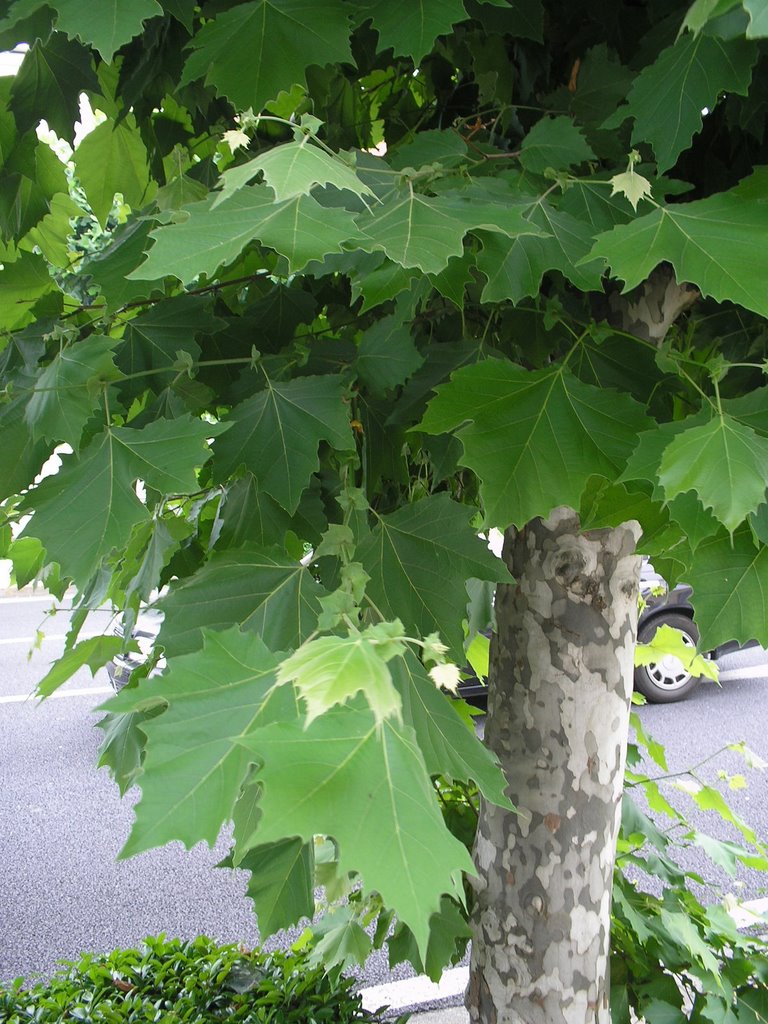
I have a lot of smell memories. One of the most nostalgic for me is the scent of sycamores, a scent I associate both with Japan, where I spent most of my youth, and Virginia, where my parents grew up and I spent several years of my youth. My mother was also sweet on sycamores, as I recall.

When I catch the scent of sycamores, I invariably stop and sniff—like a dog at a curbside tree or fire hydrant—matching the odor against my smell memories from Japan and Virginia. I discovered the same scent along a few sidewalks in Seoul during a visit there in 1995, and wondered whether the Japanese had first planted those hardy trees along those streets. I also caught the scent in the parking lot of the Cincinnati City Museum, during a visit to see my sister when she lived there later in the 1990s. My most recent favorite spot to stop and sniff the sycamores was in Ashikaga, Japan, during my time there last year, where a central city block was lined on both sides with the same trees. I wasn’t there during the heart of winter, but the trees caught my nose during the late summer and early fall (August-September), and then later when I came back in the spring (March-June).

It wasn’t until much later in life that I discovered that the sycamores of my smell memories were the plane trees of my literary memories, whose Latin genus name, Platanus, was borrowed into both Japanese and Korean. The native Japanese name for the tree is suzu-kake-no-ki ‘bell-hanger tree’. The Oriental plane, P. orientalis, is quite hardy, but the American sycamore (P. occidentalis)—also called buttonwood—is more susceptible to a fungus, so the hybrid London plane (Platanus × hispanica or Platanus × acerfolia) is the more likely species to adorn streets in Europe and North America.

The term sycamore has been applied to quite a range of trees, including the biblical fig tree (Ficus sycomorus) and sycamore maple (Acer pseudoplatanus) as well as the plane trees.

UPDATE: The Japanese rendering of Platanus is プラタナス  puratanasu. The Korean name I elicited in Seoul in 1995 sounds very close to that, but I’ve never seen it spelled. The native Korean name for the genus seems to be 식물종 sik-mul-jong (pronounced something like shingmuljong).

Leave a comment

Filed under Japan

Missionary POWs of the Japanese, 1940s

On Monday, December 8, [Max] Garrott was riding a local train to the home of Northern Baptist missionary William Axling when he learned that war had erupted between Japan and the United States. He saw the shocking headlines on a newspaper that a fellow passenger was reading. The next morning Garrott was interned (“for your own protection,” the police told him) at Sumire Girls’ School, a Catholic school and orphanage in Den’enchofu, Tokyo. He was assigned to a room with 12 other American men, a room barely large enough for the cots and beds wedged into it. “Safe, well, profitably interned,” wrote Max to [his wife] Dorothy through the good offices of the Swiss Red Cross. Though some missionaries were tortured by police interrogators during those early months of the war, Max was not mistreated. He even had the use of his piano, which kind officials had transported from his house to the school. They also had brought a picture of his wife. Since the internees were allowed to buy food in addition to what was served them by the authorities, and some talented cooks were among them, Max soon gained back the 10 pounds he had lost doing his own cooking after Dorothy’s departure. The next spring he and his fellow Americans had strawberry shortcake “running out of their ears.”

Humanitarian treatment was also the lot of Floryne Miller in Shanghai, who though an enemy alien was allowed to continue her teaching until February 1943. “Wouldn’t it be fun,” she wrote to her family in January 1942, “if this should get to you one of these days.” The letter was delivered. In 1943, while awaiting repatriation, she spent seven months in Chapel Civil Assembly Center, an internment camp outside Shanghai. “Everyone is so good to us,” she reported through the Red Cross. Words to the contrary would have been ill-advised, of course.

Far less fortunate were those who had transferred to the South China Mission. Oz Quick was in Hong Kong when the city fell to the Japanese on Christmas Day, 1941. He had gone there for medical treatment after falling ill with appendicitis at Kweilin. Quick was committed to Stanley Prison with about 300 Americans, including four other Southern Baptist missionaries and [Mission] Secretary Rankin. They had no furniture or furnishings of any kind, and food was so scarce that Rankin, already trim, lost 30 pounds during the half-year’s confinement.

The Robert Dyers were among eight Southern Baptist missionaries interned in the Philippines with about 500 American and British civilians. One of the eight was Rufus Gray, who was judged a spy because he had taken many pictures while in Peking (photography was his hobby) and had made friends among the Chinese. He died under torture by a Japanese intelligence unit. Bob Dyer was taken twice to the “house of horror” for interrogation, an ordeal that has haunted him ever since. As orderly to the sick in the camp’s makeshift hospital and undertaker to those who succumbed to malnutrition and disease, Bob lived with the specter of death day after day. Mary Dyer helped to boost the morale of the living with her magnificent renderings of hymns, wedding songs, and “God Bless America.” In 1944 the internees were transferred to Manila’s infamous Bilibid Prison, from which they were liberated by American forces in February 1945. Most were on the verge of starvation. After returning to the United States the Dyers resigned from the Board. Bob taught religion at Wake Forest University until his retirement in 1983, and Mary gave private voice and piano lessons.

In June 1942 Max Garrott was put aboard the SS Asama Maru for repatriation to his homeland in the first of two prisoner exchanges arranged through the medium of the Swiss government. The ship left Yokohama with about 430 passengers, mostly notably U.S. ambassador Joseph P. Grew and Mrs. Grew (she had refused evacuation with other dependents). At Hong Kong it picked up 370 more Americans, including Oz Quick and Theron Rankin. The exchange ship had large crosses painted bow and stern for identification, but because of a large Japanese flag painted in the center, the vessel was nearly torpedoed by an American submarine when off course.

After a second stop at Saigon, the Asama Maru proceeded to Singapore for a rendezvous with the Conte Verde, an Italian ship under Japanese control that carried 600 passengers from Shanghai. The two ships steamed to the Portuguese port of Lourenço Marques in Mozambique, where 1,500 Japanese from the United States were waiting aboard the SS Gripsholm, a Swedish vessel leased for this trip by the American Export Line. The Japanese exchanged ships by marching from bow to bow, while the Americans moved from stern to stern. Among the 1,500 Americans, just under 600 were missionaries and their families. Forty of the missionaries were Southern Baptists, 39 from China and one–Garrott–from Japan. One of the China missionaries, Pearl Todd, later served in Japan.

The trip from Japan to America took 10 weeks, half of them on the Gripsholm. The fixed price per person was $575, regardless of what accommodations one had. This made for some irritation on the overcrowded Gripsholm, but all were delighted with the sumptuous American meals, showers, fresh sheets, recent news from the homeland, and the delicious atmosphere of freedom.

After one stop en route, at Rio de Janeiro, the Gripsholm reached New York on August 25, 1942. Passengers without diplomatic status had to be screened for loyalty to the United States, a process that took several days. Three intelligence officers–from the FBI, Army, and Navy–examined each passenger, using dossiers prepared from earlier inquiries made of family members and acquaintances. Garrott met with difficulty because of his conviction that he could not take part in the war effort. He endured several hours of interrogation before he was permitted to go ashore.

SOURCE: The Southern Baptist Mission in Japan, 1889-1989, by F. Calvin Parker (University Press of America, 1991), pp. 165-167

2 Comments

Filed under China, Japan

A Shocking Marriage: Frances Fulghum & Uehara Nobuaki

The Mission was still reeling from the [missionary resignation] shock of 1925 when Sarah Frances Fulghum dropped a bombshell as unexpected as the resignation of the three couples. On May 29, 1927, her 37th birthday, Fulghum visited the Doziers with Uehara Nobuaki, a 23-year-old medical student. “We are engaged to be married,” she announced. The one-time fiancée of Norman Williamson was widely known and highly respected as principal of Maizuru Kindergarten, where she resided, and founder-director of Seinan Gakuin‘s celebrated glee club. Uehara was a member of an English Bible class that Fulghum taught in her home. He was not a Christian, and his family strongly opposed his marrying the middle-aged foreigner.

Shocked and dismayed, the Doziers thought it their duty to share so consequential a matter with the other members of the Mission. The news triggered a barrage of criticism on Fulghum. Grace Mills, herself a single missionary for 12 years, wrote Frances that her relationship with Uehara embarrassed all single women who taught Japanese men in their homes and that the scandal might lead to the closure of Maizuru Kindergarten (it did not). Florence Walne censured her behavior as “selfish and unworthy beyond words.” In rebuttal, Fulghum insisted that she was “not any longer a baby” and “it will all blow over if the Mission will only keep its head.” But missionaries and Japanese alike urged her to return home for talks with her distressed mother before entangling herself with a Japanese mother-in-law. The Board offered to pay her travel expenses back to the States and asked her to indicate by telegram whether she would come. Her telegram read: NO.

Fulghum resigned from the Board and took a teaching position in Fukuoka’s Kaho Middle School. She moved from her Mission residence to a small private house and made preparations for her marriage to Uehara. “They are acting in such a way,” Kelsey Dozier told his diary, ”as to disgust any sensible people.” The wedding took place on June 30, 1928, and the bride took the name Uehara Ranko. “Ran,” a component of the name Frances as pronounced in Japanese, was written with a Chinese character meaning Dutch or Western [蘭 also ‘orchid’]. The “ko,” meaning child [子], is the most common ending for a woman’s name.

Uehara Nobuaki finished medical school at Kyushu University in 1929. Later he ran a small hospital in Wakayama, specializing in internal medicine and skin diseases. Though the hospital bore a Christian name, Immanuel, Uehara remained aloof from the church and was never baptized. During the Pacific War, Ranko suffered hardship and discrimination as a spy suspect. After the war , when the [Southern Baptist] Convention opened work in Wakayama, she helped with the Sunday school and worship services as organist, pianist, and soloist, until she was too feeble to attend. Upon her death in 1973 at the age of 82, funeral services were held in the Wakayama church. Ranko was survived by her husband and by two daughters and three grandchildren who were living in California and New Jersey.

SOURCE: The Southern Baptist Mission in Japan, 1889-1989, by F. Calvin Parker (University Press of America, 1991), pp. 121-122 

Leave a comment

Filed under Japan

Japan Missionaries and the Russo-Japanese War

The Russo-Japanese War of 1904-5, even more than the Sino-Japanese War of the previous decade, opened new doors for Christian witness in Japan. Prime Minister Katsura Taro, whose first wife was a Christian, went out of his way to assure missionaries and pastors that Japan’s war against a so-called Christian nation in no way implied an anti-Christian stance on the part of the government. The YMCA was permitted to minister to soldiers at the front, and churches were given access to military hospitals where the wounded were cared for. A few Christians, notably Uchimura Kanzo, opposed the war as unjust, but the vast majority supported it with enthusiasm, thereby demonstrating their loyalty as Japanese subjects.

The effects the war had on Southern Baptist work were mixed. At Moji, from which the majority of men and munitions were sent to the front on the Asian mainland, and to which many sick and wounded were evacuated, the war had “a decidedly demoralizing effect,” reported Maynard, “causing many to neglect their church duties.” At Sasebo, headquarters of Admiral Togo‘s fleet (which won the war for Japan by destroying the Russian fleet sent from the Baltic Sea), the congregation virtually disappeared, for nearly all the men were connected with the navy. The church’s rented quarters had to be returned to the landlord. Security in the town was so tight that no missionary was allowed to enter, though Pastor Ozaki was able to minister in homes and hospitals. The work at Nagasaki was similarly hampered. Among those drafted into service were the Sunday school superintendent and Pastor Sugano’s wife, a Red Cross nurse who served aboard an army hospital ship. Without a tear, it was reported, Mrs. Sugano left her two-year-old daughter in the care of the sick father and a feeble grandmother.

In Kokura, where the Mission now had a new chapel seating 125, a gift from Maryland Baptists, the war gave a boost to the work. “The physician in charge of the three military hospitals at this place,” said Maynard, “being a devoted Christian, gave us every facility for reaching the sick and the wounded.” The physician even preached in the Baptist church several times. Tens of thousands of Scripture portions and tracts were distributed, and a number of conversions were reported. Afterwards the Baptist Sunday school received a lacquer cup and a letter of thanks from military headquarters in Tokyo.

In Kumamoto the story was much the same. “The war has in no way retarded the progress of our work,” wrote Harvey Clarke, “but our sympathy for those in distress seems to draw us closer to the people.” The missionaries were permitted to conduct services in the military hospitals and to deal personally with the soldiers. For this ministry each was given a bronze medal. Lucile Clarke ministered so effectively through her singing and her genuine interest in the soldiers that she received from the emperor a silver cup bearing the imperial crest. She treasured the award as long as she lived. It can be seen in retrospect, however, that such actions on the part of the government helped to blind the missionaries to the injustices and ultimate consequences of Japan’s growing involvement in Korea and China. This “first victory of yellow armies over white,” followed by dissatisfaction with the spoils of war, paved the way for Japanese imperialists to “restore Asia to the Asiatics.”

SOURCE: The Southern Baptist Mission in Japan, 1889-1989, by F. Calvin Parker (University Press of America, 1991), pp. 64-65

Academic area specialists have similar problems these days.

Leave a comment

Filed under China, Japan, Korea

Baptist Evangelical Preoccupations in Japan, 1880s

In their approach to evangelism, Baptist missionaries gave priority to Bible translation and literature distribution…. The chief reason for the preoccupation with Scripture translation was the conviction that the Greek word for baptism should be rendered by a term clearly denoting immersion. The time and resources devoted to this effort could have been more fruitfully invested in churches or schools, for Japanese Baptists eventually adopted the interdenominational translation of the Bible in preference to the immersionist version….

Unlike the other denominations, Baptists were reluctant to utilize Christian education as a means of evangelism, for they sought more immediate results through direct means. True, most Baptist missionaries taught pupils informally, and by 1888 four schools had been started for girls. But no school was established for boys until 1895, when Duncan Academy opened in Tokyo. The delay was costly, for Christian schools–34 were reported in 1882 and 72 in 1888–produced the majority of converts in the 1880s. At a time when churches bore the onus of foreign colonies, the schools, being compatible with the traditional value system, served as a spearhead for the gospel and the “birthplace of the church.” It has even been argued that “the Christian school was the only field of Christian evangelism that could be called successful.”

Lacking a boys’ school, Baptists failed to attract and develop strong Japanese leaders–with two exceptions. One was Kawakatsu, a proselyte from Ballagh’s group of converts. The other was Chiba Yugoro, who was sent to America for college and seminary training. Baptists had no seedbed of leadership like the Yokohama schools conducted by Hepburn, Ballagh, and Robbins Brown [Presbyterians who founded Meiji Gakuin University]. There was no Baptist equivalent of the Kumamoto Band, converts of Leroy Janes in Kyushu [many of whom went on to Doshisha University in Kyoto], nor of the Sapporo Band, followers of William Clark [“Boys Be Ambitious”] in Hokkaido. From such dynamic teachers came the early giants of Protestantism in Japan.

SOURCE: The Southern Baptist Mission in Japan, 1889-1989, by F. Calvin Parker (University Press of America, 1991), pp. 18-19

From what I understand, the Southern Baptist International Mission Board is once again concentrating almost all its foreign mission efforts on “church-planting” rather than schools. It no longer pays salaries for the foreign professors at the Southern Baptist Seinan Gakuin University seminary, as it used to from its earliest days.

UPDATE: In googling references for this, I discovered that a true giant among missionary educators—of both Japanese and Americans—died in April this year (while I was in Japan). He was a man of my father’s generation, whose kids were classmates and schoolmates and worthy successors—third generation MKs. My heart goes out to them. Elaine Woo of the Los Angeles Times wrote an obituary worth reading in full. Here’s how it starts.

When Otis Cary interrogated Japanese prisoners during World War II, he softened them with gifts of magazines, cigarettes and chocolates. He broke through their reserve with humor. And he spoke to them in flawless Japanese — shocking from a blond-haired American.

Cary spoke like a native because he was one — the son and grandson of New England missionaries in Japan. With missionarylike ardor, he proselytized for the Allied cause, convincing many of the prisoners to cooperate in efforts to end the war and help rebuild Japan as a democracy.

“Prolonged contact with Americans in the prison camps clearly had an impact on many prisoners, and for none more than those influenced by Otis Cary,” wrote Ulrich Straus, a former diplomat whose study of Japanese prisoners of war, “The Anguish of Surrender,” was published in 2003.

Cary, 84, who died of pneumonia April 14 in Oakland, Calif., played a unique role in U.S.-Japan relations during and after World War II. He was one of the 1,100 Japanese linguists trained by the Navy to serve as interrogators, translators and interpreters after the 1941 attack on Pearl Harbor. For more than four decades after the war, he bridged cultures as a professor of American studies at Doshisha University in Kyoto.

Leave a comment

Filed under Japan

The Cultural Revolution Hits Seinan Seminary in Japan

In the fall of 1970 [the year right-wing novelist Mishima Yukio committed ritual suicide] the [cultural] battlefield shifted to the seminary campus in Fukuoka, where most [Japan Baptist] Convention ministers were trained. The seminary was–and is–a part of Seinan Gakuin University, which was plagued by student rebellions in 1969…. The rebellions were nationwide in scope, affecting private and public universities alike, though carried out by a militant minority and not by the majority of students. At Aoyama Gakuin University (Methodist) in Tokyo and Kanto Gakuin University (American Baptist) in Yokohama, the theology departments became so involved as to self-destruct over a period of time. Neither has been reopened. Belatedly, though no less ominously, a group of dissident students at the Fukuoka seminary called a strike in September 1970.

The seminary had 34 students: 23 in the theology department of the university and 11 in an unaccredited Bible school. The striking students numbered only 10 at first and never exceeded 11, but they forced the cancellation of all classes until January 1971. With the backing of a few area pastors, they assailed the faculty for not speaking out jointly against the Vietnam War, the Security Treaty, the Baptist congress, Expo ’70, and government efforts to nationalize Yasukuni Shrine, where the war dead are enshrined. A theology that does not address such issues is invalid, the students declared; any evangelism that does not attack the evil structures of society is incomplete.

These social activists declared that the seminary was bankrupt and not salvageable, that the faculty should resign en bloc to clear the way for a new beginning. George Hays had the misfortune of being seminary dean at the time. On October 7, citing “two instances of misunderstanding related to the language,” he resigned the position, no longer confident that he could negotiate with the students. Hays was succeeded by Professor Sekiya….

Numerous meetings were held, some of them loud and boisterous, in quest of reconciliation. Position papers were demanded of each faculty member, and each was interrogated as though an accused heretic at an inquisition. No exceptions were made of the three missionary teachers: Hays, Bob Culpepper, Vera Campbell. Culpepper returned from an emergency furlough in November 1970, in the midst of the turmoil, and went on trial as the others had done. All three handled themselves well and helped the seminary to survive. When the new school year opened in Apri1 1971, however, total enrollment was down to 22. Not until the next decade did it reach 34 again.

Ozaki Shuichi has said that the most tragic result of the strike was the loss of some very promising students to the gospel ministry. If so, a close second was the loss of Ozaki himself to the seminary faculty. This New Testament scholar, second-generation preacher, and sometime interpreter to Billy Graham resigned during the struggle. Consequently, he was scathingly denounced as irresponsible and harassed by late-night phone calls. Dean Sekiya also got calls at night. The harassments came to an end when Ozaki’s daughter Yoko, the seminary librarian, was struck and killed by a train–an apparent suicide. So great was the shock that 16 years were to pass before Ozaki accepted an invitation to speak at the seminary, though he lived in Fukuoka all this time.

SOURCE: The Southern Baptist Mission in Japan, 1889-1989, by F. Calvin Parker (University Press of America, 1991), pp. 238-240

Nowadays Seinan [‘Southwestern’] Seminary is independent of the (U.S.) Southern Baptist Convention, which since the 1970s has imposed stricter doctrinal controls at all the major seminaries in the U.S. (Southern in Louisville, Southeastern in Wake Forest, Southwestern in Fort Worth, and New Orleans). Seinan Seminary pays the salaries of several former missionaries who would likely have trouble passing the current SBC creed tests.

Leave a comment

Filed under Japan, Vietnam

The Sixties Hit Southern Baptist Families in Japan

In 1967 the [Japan Baptist] Mission had voted to encourage couples whose children were grown to consider work opportunities in outlying areas. But no pressures were ever applied, and the clustering of missionaries in central areas continued to bother [Japan Baptist] Convention strategists. Sizing up the problem, one Mission wit compared missionaries to manure. “When spread out,” he said, “they do good; when piled up, they raise a stink.”

Unlike the ’50s, when several couples in outlying areas taught their own children with Calvert School materials and in a few cases sent them to Japanese schools, in the ’60s most parents insisted on living near an English school, and a few demanded a particular school. A major reason for this trend was the growing emphasis on quality education in America, especially as it affected Baptist colleges and universities. A number of Baptist schools that formerly accepted any high school graduate had grown selective, some of them highly selective. To be assured of acceptance, MKs [= missionary kids] now had to submit good SAT or ACT scores.

American military schools were still available in several places, including Fukuoka, but their number was decreasing. To fill a void or meet new needs, international schools had been established in Kyoto (1957), Sapporo (1958), Hiroshima (1962), and Nagoya (1963). Some years would elapse before these schools could offer the higher grades. Most children of high school age, and some of middle school age, attended one of the older schools in Tokyo, Yokohama, or Kobe. Dormitory facilities were available at Christian Academy in Tokyo and Canadian Academy in Kobe, as noted earlier, but not at Tokyo’s American School in Japan, the choice of many parents. So in 1962 the Mission opened its own dormitory in Mitaka near ASIJ.

Baptist Dormitory, as it was called, looked like a dream come true. Built by Homat Homes, the neat and spacious two-story building accommodated a dozen or more students of both sexes in middle or high school. Sadly, the operation was soon plagued with troubles, dashing the dream of a Christian home environment for MKs. The supervisors were changed rather often, and some of them were quite the opposite in discipline and manner. Some were considered too strict and some too permissive. The parents and the trustees sometimes clashed on how the dormitory should be run or how a controversial rule should be worded. It was agreed, for example, that smoking should be strictly prohibited in the dormitory and on the premises. But should a student be retained who smoked off the premises, in violation of the Japanese law forbidding the use of tobacco by minors? The trustees said no, which caused a family to move to Tokyo against their wishes. So divisive and irresolvable were various issues that twice during the decade the trustees voted to close the facility. Each time they then yielded to parents’ demands that it be kept open. To complicate matters, sometimes a parent with a child in the dormitory served as a trustee, contrary to what some considered a sound administrative principle. At any rate, the dormitory was sadly disruptive of the Mission’s fellowship.

The MK problem came to the fore in a shocking manner at the 1969 Mission meeting. The meeting was held July 29 to August 1, not at Amagi Sanso, but at the Kokusai Takamatsu Hotel on Shikoku. On the closing night some of the young people held a “drinking party” in the hotel annex where they were staying. Descriptions of what took place ranged from “drinking only a tiny amount of whisky in a coke” to heavy drinking that left the imbibers “dead drunk” and “staggering.” Some children who witnessed the scene “spent the night sitting in the hall, afraid to return to their room.” The incident caused grave concern throughout the Mission for its effect on the smaller children and on the Christian witness in Takamatsu.

That autumn the dormitory supervisors sent five boys home for one week because of improper conduct. Subsequently the trustees expelled three of the boys for the remainder of the school year. The charges included smoking, theft of several items (even an airplane propeller from a nearby airfield), wrongful possession of dormitory keys that provided access to the girls’ section, obscene writing and speech, damage to property, and intimidation of younger boys with threats of bodily harm. Some parents expressed regret that they had opposed the closing of the dormitory years before. At the end of the 1969-70 school year, in which 12 students had been accommodated, the dorm was closed “for lack of applicants.” The facility was turned into a guest house and later sold.

SOURCE: The Southern Baptist Mission in Japan, 1889-1989, by F. Calvin Parker (University Press of America, 1991), pp. 232-233

A couple of the decades covered in this book intersect a lot with my own biography. I was part of the inaugural class at Kyoto International School, which began as Kyoto Christian Day School, using Calvert School curriculum materials. Although I didn’t attend ASIJ, I later caused my share of trouble at another school’s dormitory during the Sixties.

1 Comment

Filed under Japan

Comfy-chair Fieldwork on a Japanese Cinema Dialect

I recently saw for the first time (via Netflix) a Japanese film from 2002 entitled Twilight Samurai (Tasogare Seibei). It’s a wonderfully restrained and down-to-earth portait (reviewed here and here) of a dutiful but impoverished petty samurai aching to live as a plain farmer (not—like Tom Cruise—aching to die with The Last Samurai).

But an added attraction for me was the combination of English subtitles and a Japanese regional dialect, Yamagata-ben, or at least a Shochiku Film rendition of some of its key features. The dialects of the northern (Tohoku, lit. ‘northeast’) part of Honshu are collectively known as Tohoku-ben, or somewhat less diplomatically as zuzu-ben for their failure to distinguish /i/ and /u/, rendering both as a high central unrounded vowel [ɨ], which then of course fails to palatalize /s/ and /t/, so that sushi, shishi ‘lion’, and susu ‘soot’ all sound something like [sɨsɨ], which can be spelled susu, since /u/ is not rounded in standard Japanese either.

I haven’t been able to find much online in English about Tohoku-ben except for a few sketchy accounts, the most extensive being a sketch of Miyagi-ben by a former JET volunteer. (Yamagata prefecture is on the Japan Sea side of Miyagi prefecture in southern Tohoku.) So I thought I’d offer a few general impressions of (Shochiku emblematic) Yamagata-ben from my second viewing of the film.

/s/ > /h/ in suffixes – I noted the kin terms otohan ‘father’, okahan ‘mother’, and babahan ‘grandmother’, the names Tomoe-han, Naota-han, and the polite expressions gokurou-han ‘thank you’, oboete-naharu ‘do you remember?’, and oyu wakasute kumahen ‘can you boil some water for me?’. This lends a Kansai flavor to the dialect.

/ai/, /ae/ > /ee/ – This is not uncommon elsewhere, but it generally signals plain—even rough—talk. In Yamagata, it also occurs in polite speech. In the film I noted omee ‘you’, deekiree ‘really don’t like’, and nee ‘not’ (as in sabusukunee ‘not sad’).

/-masu/ vs. /-masunee/ – Polite negatives in Yamagata-ben sound like affirmative confirmations in standard Japanese. I noted ikimasunee ‘won’t go’, mattaku arimasunee ‘absolutely don’t have’.

/ne/ = /no/ tag – Yamagata no(u) performs the functions of the standard Japanese tag particle ne(e). In the film, I noted yoi ko da nou ‘(you’re a) good girl, aren’t you?’. (My usage tends toward /na/, thanks to my high school days in Kansai.)

/e/ > [i] – The backing of the high front vowel /i/ to [ɨ] (and its merger with /u/) leaves room for the mid front vowel /e/ to migrate upward. I noted sinko ‘joss stick’ and madi, madi! ‘wait, wait!’. However, there were plenty of unraised /e/ as well, so I suspect the actors were pulling their punches to maintain intelligibility and relying instead on just a few emblematic raisings to give a flavor of the dialect. (This is true of most, if not all, renditions of “dialect” on stage and screen.)

de gozaimasu > de gansu ‘the polite copula‘ – This remapping was so strikingly regular and transparent that I suspect it was not just one of the more salient emblems of Yamagata polite speech, but one of the easiest for dialog coaches to teach: owasure de gansho ka ‘had you forgotten?’; sou de gansuta ‘yes, it was’; omoe-dasu no wa iya de gansu ‘I don’t want to think about it’; ayamaru no wa ante ho de gansho ‘I’m not the one who should apologize’ (I’m not too sure whether my ante ho should be anta no hou ‘your side’ or hantee hou ‘the opposite side’). However, I did catch one instance of de gozeemasunee ‘is not’ (= de gozaimasen).

/-t-/ > [d], /-d-/ > [nd] – Unvoiced obstruents tend to get voiced medially, while voiced obstruents get prenasalized. I didn’t hear a lot of this. Maybe it would reduce intelligibility too much for the audience. Among the examples I noted were: odohan ‘father’, todemo suzuree ‘very rude’, and madi, madi ‘wait, wait’.

Finally, the grammatical construction mou ii de ba (= mo ii deshou) ‘that’s enough, isn’t it?’

Leave a comment

Filed under cinema, Japan