
Category Archives: Japan

Manchuria as Japanese and International Refuge

When we consider the political space of Japanese modernity, Manchuria seems to possess distinctive significance. It is important to remember when considering Japanese modernity that with the exception of only a very small number of people, such as the actress Okada Yoshiko (1903-92) who defected to the Soviet Union in 1938, and the translator and dramatist Sano Seki (1905-66), scarcely any Japanese took refuge abroad. The issue itself of why there were so few Japanese refugees is important, I believe, in understanding the history of Japanese modernity. In modern Japanese history, Manchuria appears to be something of a space for taking quasi-refuge.

The [South Manchurian Railway], too, provided a site accepting of large numbers of leftist converts. In this sense, it was the only asylum in modern Japan. A moment ago, I mentioned a certain image of Manchuria that was invested with ideals and in which was sought that which could not be realized in Japan. I think Shiba Ryōtarō (1923-96), the famed historical novelist, was no different in this regard. He was drawn to Mongolia out of a yearning for the wilderness of Manchuria and Mongolia. It bore the sense for him of an asylum to which one might escape from the space Japan blockaded. This phenomenon was not limited to men, for looking at the memoirs of Japanese women as well we see some who went to Manchuria because they could not develop personally in Japan. For example, there were a certain number of women who had dreams of developing into teachers or who wanted to teach people of other ethnicities.

In this sense, we have two polar images of Manchuria in tandem: the extremely dark image of a Manchuria as a hellish abyss and that of Manchuria as a site for asylum. Whichever extreme would emerge would depend on the person, and the image of Manchuria, then, was inevitably rent asunder. Although this is a bit of personal experience, I became quite close to Professor Matsuda Michio (1908-98). When I was writing Kimera: Manshukoku no shōzō (Chimera, a portrait of Manzhouguo, published in 1993 [the volume herein translated—JAF]), he once said to me: “It’s strange that you’re using your energy on such a thing as this. As far as we’re concemed, it’d be just fine to forget Manzhouguo altogether. It’s bizarre that such a thing ever existed.” I have never forgotten these strong words of his to me. For people who lived through it, Manchuria remained an object to be rejected but which continued nonetheless. I think that this is one of the reasons that evaluations offered by postwar scholarship on Manzhouguo has been split in bipolar fashion….

One additional issue is the existential importance of Manchuria for the Jewish people. Shanghai was the most important Jewish place of asylum in Asia, but second to it was Manchuria. Of course, once the Tripartite Alliance was signed among Japan, Germany, and Italy, they were to be expelled from Manchuria, too, but such schemes as the “Fugu Plan” conceived of a harmony of the six ethnicities—the five initially conjured up and the Jews—and military officers such as Yasue Norihiro (1888-1950) and Inuzuka Koreshige (1890-1965) were actively trying to realize it. “Fugu” or blowfish carried the meaning that, although this kind of fish is delectable, if it disagrees with you, its poison can be especially strong. If Jewish capital could be well used, this scheme envisioned, then it could be of great value. In the sense of using such a plan to control the Jews in the United States, this tactic was an extremely calculated political ploy.

Reading through the memoirs of people who actually lived in Manzhouguo, it appears that places such as Harbin were relatively easy for Jews and White Russians to live in. We know a bit about what happened to White Russian men who graduated from Kenkoku University. We thus need research which will examine what Manzhouguo, or the Kenkoku University, may have meant for White Russians. For not only Jews, but Muslims who had escaped from Central Asia as well, Manzhouguo provided a kind of asylum, as I describe it in my recent book, Shisō kadai to shite no Ajia (Asia as an intellectual task, published 2001), an important site where people who had escaped Soviet oppression could live. It is an undeniable irony of world history that, for people who escaped from Europe, Russia, and Central Asia, Manchuria bore importance as a space for survival. There were many more who traveled through Manchuria en route to the United States, and we need studies which examine this phenomenon.

Needless to say, there is as well the issue of how Manzhouguo tried to use the Jews and Muslims. Research on ethnic groups in Manzhouguo to this point has examined only the “five ethnicities,” but we need to insert into our vision the flows of such world-historical peoples as the Jews and Muslims and consider the place of Manzhouguo in their migrations. We are collecting material in this area now. There is even a recent book about Poles in Manchuria, published in Poland, describing who was there and what they did.

SOURCE: Manchuria under Japanese Dominion, by Yamamuro Shin’ichi, trans. by Joshua A. Fogel (U. Penn. Press, 2006), pp. 233-234, 237-238
Leave a comment

Filed under China, Japan, migration

Japanese Army Drug Lords of Manchuria

Furumi Tadayuki (1900-83), who served as assistant director-general for administrative affairs in Manzhouguo, once said: “Manzhouguo is an immense installation created by a top secret fund of the Guandong Army.” The Japanese army was able to engage in extensive activities, such as intelligence gathering, throughout Asia, because it had sufficient funds which Manzhouguo siphoned off. This practice cast a huge shadow over postwar Japanese politics, beginning right with Prime Minister Kishi Nobusuke (1896-1987). The basic source for the monetary fund was opium. This was the problem which Gotō Shinpei worked hardest on in Taiwan; by making the sale of opium a monopoly, Gotō tried gradually to reduce the quantity of it available. He took the same approach in Manzhouguo, and although it was said to have been well regulated in Manzhouguo, this was in fact not the case. Opium production provided the richest source for such a slush fund. It was not only produced in Manchuria, but steadily flowed into Manzhouguo via Turkey, India, and Shanghai. The opium produced colosgal profits which became the financial source for Japan’s military schemes. The very fact that Amakasu Masahiko (1890-1945) gained such power in Manchuria was due to this money. While Kishi was a mere bureaucrat, Amakasu had at his disposal a slush fund of some ten million yen—which would come to ninety billion yen (roughly $800 million) today—for his special operations. This is difficult to prove on the basis of documents, the only corroboration being oral testimony, but younger scholars are now examining materials in such places as the Public Record Office in Great Britain on the remittance of opium, and this issue will probably be cleared up in the not-too-distant future.

SOURCE: Manchuria under Japanese Dominion, by Yamamuro Shin’ichi, trans. by Joshua A. Fogel (U. Penn. Press, 2006), pp. 231-232

Leave a comment

Filed under China, Japan, opium

On Limiting the Misfortune One Causes Others

I have lived in this same bunkhouse for most of my career in San’ya, sharing a room with six others and separated from them by a single curtain. The manager who sat at the front desk when I moved in has already departed this world, having succumbed to liver cancer. I suppose I can number myself among the old-timers at this doya [ドヤ].

I can’t say that life here has been all that comfortable, but I’ve made an effort to develop something resembling affection for the destiny that has landed me in this place. This is how I look at it: What would have happened if by some mistake I’d remained stuck in a job with an ordinary firm? Unable to resist the all the static around me, I probably would have gotten married and had a family. Yet would such a life course really have been better than my life here in a doya? I think not. I doubt very much that I could have maintained my mental equilibrium had I been placed in those circumstances.

I am a vessel that was made to hold nothing more than my own body and soul. I have been quite incapable of shouldering any other burden than these. My psyche would have been crushed by any added weight. The consequence would have been not just my mental breakdown and a life of confinement but also the certain misfortune visited on family members as a result of my breakdown. At the very least, then, I’ve been able to prevent myself from becoming the source of other people’s unhappiness. Those who are made like me or who have turned out like me would surely have ended up leading the kind of life I’m leading in the sort of place I’m living in, regardless of the era. Yet might I not take secret pride in the fact that I have been able to limit the misfortune I’ve caused others to the bare minimum? (In the case of my parents it really can’t be helped.) This is how I sometimes view things. At other times, when I’m in a more positive mood, I fancy that I have happened upon a life here that quite agrees with me. There is nothing to add or detract, and I really have no cause for dissatisfaction.

I have always tried to steer my thoughts in this direction. I intend to stay the course. If possible, I’d like to remain lost in these thoughts and slide as if in a trance toward death. For someone like me, who is on the threshold of old age, such a wish is akin to a prayer of supplication.

No matter what the future holds, I am determined not to harbor any bitterness toward the fate that has led me to this place.

SOURCE: A Man with No Talents: Memoirs of a Tokyo Day Laborer, by Ōyama Shirō, trans. by Edward Fowler (Cornell U. Press, 2005), pp. 15-16 (reviewed here and here)

UPDATE: I had a heck of a time trying to track down the kanji for the word Japanese word doya, which I couldn’t find either in my dictionaries or on Google. I finally found it spelled in katakana in the Japanese Wikipedia entry for San’ya (山谷), an area of Tokyo that contains many doya.

Leave a comment

Filed under biography, Japan

Daniel Drezner on the Globalization of Baseball

International relations professor (and Red Sox fan) Daniel Drezner has compiled a range of responses to the signing of Japan’s top pitcher, Daisuke Matsuzaka, by the Boston Red Sox. One of the excerpts he cites comes from Bryan Walsh at Time.com.

Most Japanese fans … are celebrating Matsuzaka’s signing as further proof that Japan’s best players can compete on baseball’s premier stage. Japanese players who move to the majors are no longer seen as leaving Japan behind; they are seen as representing their country in the international game. It’s a sign that the globalization of sport is finally penetrating this often isolationist country, that many fans here would rather watch an international game with the top players in the world than settle for a lessened domestic product. As one Japanese baseball blog put it: “Finally, all the dream matches will come true in 2007. Matsuzaka vs. Godzilla Matsui, Matsuzaka vs. Genius Ichiro, Matsuzaka vs. Igawa! I wish the MLB 2007 season would start soon.” He’s not the only one.

I suspect Mongolians feel the same way about the success of their countrymen in Japanese sumo, as people in Hawai‘i once did. Japanese professional sumo is, I think, more internationalized than Japanese professional baseball, but the latter is rapidly catching up. However, if Japan’s Central and Pacific Leagues are at the AAA level relative to the North American major leagues, sumo outside Japan is barely at the A level, in my opinion.

Last Saturday, I caught the last half of “Sumo World Challenge from Madison Square Garden in New York” on ESPN2. The final four were from Japan, Poland, Bulgaria, and the Netherlands. The Japanese wrestler won, and they were all rather skillful, but I found the dumbing down of sumo ritual for the benefit of those provincials in NYC pretty jarring. I got the distinct impression that the low-key—even taciturn—color commentator, retired pro sumo grand champion Musashimaru, was slightly embarrassed.

Leave a comment

Filed under baseball, Hawai'i, Japan, North America, sumo

No-Sword on the Kanji of the Year

Matt the language blogger of No-sword offers some etymological insights into Japan’s Kanji of the Year, 命 inochi ‘life’. Here’s a snippet.

Probably the most interesting way 命 can be used is to write mikoto, which is the “highness” (as in “your”) that I mentioned above. “Highness” is, obviously, a gross translation that takes the cultural context out back and breaks its kneecaps; the word mikoto is from /mi/ (honorific) + /koto/ (“word”) and was first used to refer respectfully to what gods and emperors said, or did, or were — the distinction was not always clear-cut, as is often the case with gods and emperors*. In any case, that is why everyone who’s anyone in Japanese mythology has a name ending in -no-Mikoto.

Leave a comment

Filed under Japan, language

Haruki the Hybrid

Emily Parker in today’s Wall Street Journal profiles the Japanese novelist Haruki Murakami. Here’s a snippet that detours from the primary focus on how Murakami deals with Japan’s dark past.

Even as he chooses to spend much of his time in Honolulu, Mr. Murakami appears to reveal the punctilious ways of his homeland. (He reminded me to take off my shoes before entering his home, an airy Hawaiian residence that offers a breath of quiet and anonymity for the celebrity writer. Then he promptly sat down at a light wood table–in formal repose–and looked at me expectantly, waiting for the interview to begin.) And as if to confirm this impression, the Kyoto-born Mr. Murakami says that, in some ways, he is 100% Japanese. “The difference,” he says, “is that I’m kind of individualist.”

In truth, he is a cultural hybrid. He has spent time living in the U.S., and in our conversation he jumps back and forth between English and Japanese. His own books are dotted with Western cultural references, and he has translated several American classics into his native language, such as the work of J.D. Salinger, Raymond Carver and F. Scott Fitzgerald. He claims to be somewhat of a black sheep in his home country, in part due to his distaste for drinking parties or social conversation. How about Karaoke? “I hate it,” he says in Japanese. “If I enter a store and there is a Karaoke machine there, I leave immediately.”

I wonder if the author knows that removing shoes at the door is a custom that is nearly universal in Hawai‘i.

Leave a comment

Filed under Hawai'i, Japan

Mongolia Extends Its Reach in the Pacific

Korea-blogger The Marmot, who keeps a weather eye out for Mongolia (where his in-laws reside), has noticed some unusual signs of Pacific outreach by that landlocked nation.

In August, Mongolia hosted a military contingent from Fiji for joint exercises in global peacekeeping. The Fiji military has posted photos from Mongolia on its website. Let’s hope they weren’t teaching the Mongolian military how to stage a coup. I wonder if any Mongolian sumo scouts have their eyes on any likely Fijian recruits. The Pacific is no longer adequately represented in Japanese sumo.

Also in August, Flickr photographer Joe Jones in Hakodate snapped the stern of one of the growing number of ships registered in Mongolia, homeported in thoroughly landlocked Ulaan Baatar. A 2004 article in the New York Times explains the origins of Mongolia’s bluewater fleet.

Mongolian flags are not expected to become a common sight at American docks. But it was an unexpected twist of fate that brought Mongolia, a nation of nomadic herders, to the high seas.

In the 1980’s, a Mongolian university student known only as Ganbaatar won a scholarship to study fish farming in the Soviet Union. But the state functionary filling out his application put down the course code as 1012, instead of 1013. As he later told Robert Stern, producer of a documentary on the Mongolian Navy, that bureaucratic error detoured him from fish farming to deep-sea fishing. Upon graduation, he was sent to work with the seven-man Mongolian Navy, which patrolled the nation’s largest lake, Hovsgol. The lone ship, a tug boat, had been hauled in parts across the steppes, assembled on a beach and launched in 1938. After the collapse of Communism here in 1990, Ganbaatar wrote Mongolia’s new maritime law, which took effect in 1999.

The registry opened for business in February, 2003. Perhaps to play down any negative connotations of being landlocked, the glossy color brochure of the Mongolia Ship Registry shows Mongolia surrounded on three sides by a light blue blob that, on closer inspection, turns out to be China. One clue to the international intrigue behind the registry may be in plans to reopen the North Korean Embassy here this fall.

Leave a comment

Filed under China, Japan, Mongolia, sumo

Grand Sumo Tournament Synchronized Upsets

After Day 9, it seemed that the three top Japanese ozeki (champions) and the recent Estonian rookie Baruto would dog the heels of the undefeated Mongolian yokozuna (grand champion) Asashoryu, but then all four stumbled at once on Day 10. Ozeki Chiyotaikai (now 8-2) lost to sekiwake Miyabiyama (5-5), ozeki Tochiazuma (8-2) lost to once-ozeki Dejima (7-3), ozeki Kaio (8-2) lost to fellow ozeki Kotooshu (7-3), and up-and-comer Baruto (8-2) lost to fellow up-and-comer Homasho (9-1), who is now just one step behind Asashoryu. So, it’s still a comeback for the Japanese rikishi, but just not the higher-ranking ones. Last tournament’s phenom, the tiny Mongolian Ama, is at 2-8 this time around, and the Georgian komusubi Kokkai finally broke his 9-game losing streak by lengthening Iwakiyama‘s losing streak to 10.

UPDATE, Day 11: Most of the pack that stood at 8-2 lost again. Only Kaio “protected his 2 losses” to stay in 3rd place at 9-2, behind Homasho at 10-1 and Asashoryu at 11-0.

UPDATE, Day 12: Asashoryu (12-0) handed ozeki Kaio his 3rd loss, dropping him back with the rest of the former contenders, while ozeki Tochiazuma (now 9-3) handed Homasho his 2nd loss. Unless Homasho wins his next 3 bouts, and Asashoryu loses his next 3, the Mongolian grand champion looks to cruise to another tournament victory.

UPDATE, Day 13: The leaders are now Asashoryu (13-0), Homasho (11-2), and Kaio (10-3). At the other end, Iwakiyama (1-12) finally won a bout. The grand champion will cruise to his 19th tournament championship unless he loses his next two bouts, while Homasho wins his next two and then demolishes Asashoryu in a tie-breaker at the end of the basho.

UPDATE, Day 14: Asashoryu (14-0) has clinched it. Homasho (12-2) will likely win the Fighting Spirit award and a higher ranking on the banzuke. No one else has fewer than 4 losses.

UPDATE, Day 15: No surprises. Asa finished at 15-0. Homasho (12-3) won the prizes for both Fighting Spirit and Technique.

Leave a comment

Filed under Japan, sumo

Japanese Public Art over Holes in the Ground

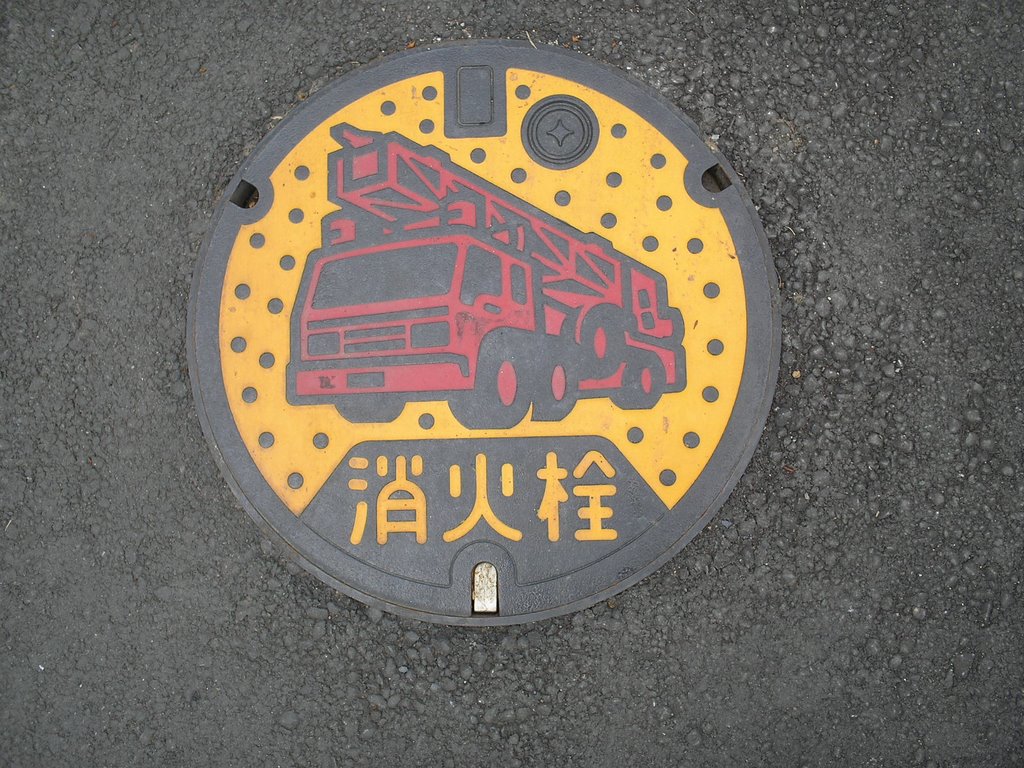
One of the distinctive features of Japan’s public utilities is the wide variety of manhole cover art. The phenomenon is not strictly limited to “manholes” designed to allow humans to enter subterranean conduits; it can also be found on the panels covering Japanese fire hydrants (as pictured here), which are usually under the surface of the street. The link above offers a gallery of over 200 examples of Japanese art over holes in the ground, some quite brightly colored, like this one from Nikko; others rather dull but still locally distinctive, like this one with porpoises from Chichijima in the Ogasawara (aka Bonin) Islands north of Iwo Jima.

Of course, Japan isn’t the only country that indulges in manhole cover art. Take at look at the Russian gallery entitled Sewers of the World, Unite! or the utility cover artist Bobby Mastrangelo at The Grate Works.

Leave a comment

Filed under Japan

Will the Red Sox–Yankee Rivalry Spread to Japan?

Japundit‘s baseball columnist, Mike Plugh, offers some interesting speculation on some possible implications of Boston’s $50 million bid to talk with Japan’s top pitching ace, Daisuke Matsuzaka.

Should those plans fall through, what’s to stop the Red Sox from splashing on Ichiro. It would do two things. One, it would add an All-Star outfielder with a great bat, legs, and throwing arm. Two, it would permanently steal the Japanese spotlight from the Yankees, who are wildly famous and popular, and reposition it on the Red Sox. The Yankees would be famous, but the Red Sox would be Japan’s team. Theo Epstein knows this and I guarantee they are working on a plan to acquire Ichiro already. With Ichiro and Matsuzaka, the Sox would not only be good, they’ll be the most famous franchise in Japan. What kind of dollar figures can you put on that?

The flip side to that situation is that the Yankees know this too. The Yankees could use a centerfielder who hits, runs, and plays defense. Johnny Damon is good, and Melky Cabrera is up and coming, but let’s face it … Damon’s defense is in decline, and Melky is probably better suited to left. If the Yankees choose to counter the Matsuzaka move by spending huge on Ichiro, they will solidify their strong hold on Japan, and perhaps do so irreversibly. That goes double if the Yankees are able to land the Yomiuri Giants’ Koji Uehara in the same 2007 offseason. What is that worth to the Yankees?

In either case, the Red Sox and Yankees rivalry is now global. The frontlines are drawn and they extend all the way around the world. For fans who are already sick of the two teams, it’s more nausea. For Yankees and Red Sox fans, it’s more fuel to the belief that the world revolves around the ebb and flow of Boston against New York. For Mariners fans, it’s something to mourn. Unless Ichiro is so intensely loyal to Mr. Yamauchi, or intent on returning to Japan to end his career, the money that will be out there for him in a year’s time will make A-Rod’s deal look like pocket change.

Coverage of baseball on Japanese TV almost always starts off with footage of individual Japanese players in the U.S. majors—referred to in Japanese as the “Big” (大, Dai) Leagues—before turning to the state of play in Japan. This will only increase the number of Japanese ads in American ball parks.

Leave a comment

Filed under baseball, Japan