Category Archives: Japan

U.S. Eighth Army in Mindanao, July 1945

From Our Jungle Road to Tokyo, by Robert L. Eichelberger (Gorget Books, 2017; first published 1950), Kindle Loc. 4450-62:

I was proud of the job the 41st Division had accomplished at Zambo when the fighting was done. They laid down their guns and went to work. They cut weeds and they cleaned out debris. They became good neighbors. The Japanese had refused to allow Catholic Filipinos — there were a good many in that Moslem area — to worship at the ancient shrine of Bien Bernido al Virgen del Pilar. The shrine was about the size of an American sandwich shop, and it was tucked into a space along a section of the Fort Pilar wall which had fallen into ruin. GIs of the 41st Signal Company (and I hope my good friend Cardinal Spellman will note this) went at the work of repair and finally put up a sign welcoming all nationalities to worship there again. Before long there were hundreds of burning candles, and the glory of Pilar’s ancient shrine was restored. Methodists, Episcopalians, Congregationalists, Presbyterians, and lads of no faith at all took part in that enterprise.

I left General MacArthur at Zamboanga. I knew now what the future held. I would take over-all command of the Philippines on July 1. Sixth Army staff would be retired to plan an invasion of the southern islands of Japan. According to GHQ plan, Sixth Army would invade Kyushu — and hold. General MacArthur told me that Eighth Army later would make the main blow along with reinforcements which were still to come from the States or the European theater. Eighth Army, with most of the armored and paratroop divisions, was to land and to proceed across the Kanto Plain to capture Yokohama and Tokyo. General MacArthur’s choice of Eighth Army to make the strike was a great compliment to my men, but I knew the Kanto Plain — and what a gamble lay ahead.

Leave a comment

Filed under Japan, military, Philippines, religion, U.S., war

U.S. General Meets Sultan of Sulu, 1945

From Our Jungle Road to Tokyo, by Robert L. Eichelberger (Gorget Books, 2017; first published 1950), Kindle Loc. 4267-90:

[General] Doe’s lads of the 41st Division had dug out most of the Japanese on the island of Jolo, and I had promised to pay a formal call on Muhammed Janail Abiri[n] II, Sultan of Jolo and spiritual leader of the three hundred thousand Mohammedans in the Sulu Archipelago. This meant a round trip of approximately a thousand miles in one day, so we departed from Tacloban early. Weather was perfect. The airstrip at Jolo was no La Guardia Field, but, after circling it several times. Downer brought us in without incident. When we returned four and a half hours later, however, the wheels had sunk so far in the soft ground that it was necessary for a pair of tractors to pull the Miss Em out on the runway.

Colonel Moroney, thin and hard-bitten commander of the 163rd Infantry, veteran of Sanananda and Biak and other battles, met us, while his soldiers kept back the great crowd of Moro spectators who wanted to surge across the airstrip. First we drove through Jolo City, an ancient and once beautiful town which had been known as the “Jewel of the Sulus,” and as the “Shrine City of the Moros.” It was in ruins. The Japanese had put it to the torch when American PT boats attacked shipping in the harbor as a preliminary to invasion.

Then we started our drive inland. This was a country of great beauty, of teak and mahogany forests and dark low mountains. I knew the patriarchal Sultan (who had surrendered to Captain Pershing in 1913 at the end of the Moro War) had remained loyal to the United States during the Japanese occupation and had surreptitiously flown the Stars and Stripes at his hideout camp. When Moroney’s men came ashore he brought out the tattered old flag.

The Sultan of Jolo — sometimes called the Sultan of Sulu — had once been a wealthy man. The Japanese had stripped him (he told me) of most of his possessions; he keenly felt the loss of a saber presented to him by General Pershing and a rifle presented to him by General Leonard Wood. I was somewhat surprised by the simplicity of his living. Around his compound there was a fine bamboo fence thickly woven to keep out Jap infiltrators. Inside the compound there was a sunken fort where the women could stay in safety while the men manned the barricades. The Sultan’s unpretentious house stood on a raised bamboo platform well off the ground.

The Sultan was a gaunt, dignified old man with sunken cheeks. The room where we were received by the Sultan and his datus (leaders) seemed to be tapestried on ceilings and walls; I believe now that the tapestries actually were Persian rugs. After some diplomatic talk through interpreters, I presented him with the most modern type of American carbine and a scroll thanking him for his services to the American cause. In his presence I affixed a gold seal with ribbon to the document. I also presented him with a handsome roll of cloth as a tribute to the ladies of his household. The ladies did not appear, but during the visit we glimpsed them peeping out at us from doorways. I was told that the Sultan had eight wives and was, at seventy-two years of age, the recent father of a twenty-sixth son.

Leave a comment

Filed under Japan, military, nationalism, Philippines, religion, U.S., war

Gen. Yamashita’s Surrender, 1945

From Our Jungle Road to Tokyo, by Robert L. Eichelberger (Gorget Books, 2017; first published 1950), Kindle Loc. 4619-68, 4674-83:

The headquarters of the 38th Division, which had been assigned the job of cleaning up central Luzon, was on a ridge only about an hour’s ride east of Manila. Major General William G. Chase, division commander, met me at Nielson Field, and we made the inspection trip to the front together. From a high hill. Chase and General Bill Spence pointed out to me the Ipo Dam area and other battlefields of the 38th; although the tempo of the fighting was now slowed, two hundred and fifty-nine Japanese were killed between dawn and dusk the day I visited there, and twenty-nine were captured. The 38th and elements of the 43rd Division inflicted appalling losses on the enemy during a six-week period. Some sixty-three hundred Japanese were killed or found dead and more than nine hundred were made prisoners. Much of this slaughter was accomplished by combined artillery fire and aerial attack. Losses of the 38th Division and 43rd Division were small.

That evening at Chase’s headquarters I wrote General MacArthur that I had inspected the combat-active divisions on Luzon and found morale very high. My own morale was high. I was convinced that the back of Japanese opposition was broken and that the enemy was incapable of effective resistance. I might not have been so optimistic if I had known that, considerably after the official Japanese capitulation. General Yamashita was to come out of the mountain wildernesses to the northeast of Baguio and surrender forty thousand well-disciplined troops. Although negotiations with Yamashita for surrender were completed after Eighth Army had relinquished control of Luzon, the story should be told here. It must be remembered that Japanese forces at this period had little or no communication with the homeland. On August 7 — the day of the fall of the first atomic bomb — an American pilot was forced to abandon his disabled plane and parachute behind the Japanese lines in northern Luzon. He was picked up by an enemy patrol the next morning and taken after five days of forced marches to General Yamashita’s headquarters, then southwest of Kiangan.

There he was subjected to vigorous and prolonged interrogation. He was threatened with physical violence when he steadfastly refused to answer questions. On August 16 — the Emperor first offered to capitulate on August 10 — the attitude of the Japanese interrogators abruptly changed. The pilot received medical treatment for his parachute-jump injuries and was extended many small courtesies. The next day the American was guided toward the American lines; when the Japanese soldiers had gone as far as they dared, they gave the flier a letter, written by Yamashita himself, which explained the circumstances of the pilot’s capture and commended him for his military spirit and devotion to duty.

On August 24 the same pilot flew an L-5 liaison plane over the area in which he had been held and dropped a message of thanks to General Yamashita and two signal panels of great visibility. The message, written by General Gill of the 32nd Division, suggested that if Yamashita were in the mood for surrender negotiations he should display the two signal panels as evidence of his willingness to parley. The following morning another pilot found the panels staked out according to instructions; also on the ground were many cheering, hand-waving Japanese soldiers, who beckoned the plane to land. Instead, a second message was dropped. It suggested that Yamashita send an envoy to the American lines to receive detailed instructions for his surrender. Late in the afternoon of August 26 a Japanese captain, carrying Yamashita’s answer, entered the American lines under a flag of truce. The letter, which was written in English, follows:

GENERAL HEADQUARTERS
IMPERIAL JAPANESE ARMY IN THE PHILIPPINES
August 25, 1945
TO: General W. H. Gill, Commanding General
Kiangan-Boyombong Area
United States Army in the Philippines

1. I have the honor to acknowledge receipt of your communication addressed to me, dropped by your airplane on August 24th as well as your papers dropped on August 25th in response to our ground signals.

2. I am taking this opportunity to convey to you that order from Imperial Headquarters pertaining to cessation of hostilities was duly received by me on August 20th and that I have immediately issued orders to cease hostilities to all units under my command insofar as communications were possible. I also wish to add to this point the expression of my heartfelt gratitude to you, full cognizant of the sincere efforts and deep concern you have continuously shown with reference to cessation of hostilities as evidenced by various steps and measures you have taken in this connection. To date of writing, however, I have failed to receive order from Imperial Headquarters authorizing me to enter into direct negotiations here in the Philippines with the United States Army concerning the carrying out of the order for cessation of hostilities, but I am of the fond belief that upon receipt of this order, negotiations can be immediately entered into. Presenting my compliments and thanking you for your courteous letter, I remain, yours respectfully,

/s/ T. Yamashita
Tomoyuki Yamashita, General, Imperial Japanese Army, Highest Commander of the Imperial Japanese Army in the Philippines.

This message was the first of a series exchanged between Yamashita and General Gill. The exquisite courtesy of the exchanges probably has for the average reader something of the quality of Through the Looking-Glass; these same troops and same commanders had been fighting each other in the same area with no quarter whatever and in a completely barbaric manner.

Eventually an American radio group, escorted by a Japanese safe-conduct party, moved into Yamashita’s headquarters to take over communications. Details of the surrender were worked out. On the morning of September 2 General Yamashita and a party of twenty-one, which included Vice Admiral Okochi (“Highest Commander of the Japanese Naval Forces in the Philippines”), entered American lines at Kiangan. The party was escorted to Baguio where the formal instrument of the surrender of all Japanese Army and Navy personnel in the Philippines was signed in my former headquarters.

I was sorry that General Griswold who had directed XIV Corps operations could not be there to accept Yamashita’s sword. But it was entirely fitting that the 32nd Division should receive the vanquished enemy. Three years before at Buna they had won the battle that started the infantry on the jungle road to Tokyo.

General Yamashita was tried for “crimes against humanity” by an American Military Court in Manila. He was sentenced December 7, 1945, and hanged on February 23, 1946.

Leave a comment

Filed under Japan, military, Pacific, Philippines, U.S., war

Wordcatcher Tales: Gomou, Togakushi, Komoigi

We encountered a few interesting placename etymologies on our recent travels in Japan.

五毛 Gomou ‘Five Hairs’ < 胡麻生 Gomau ‘Sesame Growth’ – I spent my high school years in a dormitory atop Nagamine-dai (‘longridge-heights’) below towering Maya-san in Nada-ku (‘opensea-ward’), Kobe. The neighborhood at the base of our hillside was called Gomou, written as if it meant ‘Five Hairs’ (五毛). I never paid attention to how it got its odd name until I went back by there on this trip. According to its short Wikipedia article, the name Gomou originated as Gomau (胡麻生 ‘sesame-grow’) because the area was not suitable for paddy fields, so the farmers grew sesame instead. (The city in Gunma Prefecture called Kiryu—桐生 < kiri-u ‘Paulownia-grow’—must have got its name for similar reasons.) Over time, the pronunciation of Gomau changed to Gomou, the sesame fields disappeared under dense urban growth, and someone devised entirely new kanji, with no etymological continuity at all, to match its new pronunciation.

戸隠 Togakushi ‘door-hiding’ – In northern Nagano Prefecture, we explored the lovely mountain forests of Togakushi, site of an extensive old Shinto Shrine complex that also served as training grounds for ninja. Togakushi used to be called Togakure, using the shape of the verb kakureru ‘hide’ that appears in the name of the game kakurembo ‘hide-and-seek’. One of the many schools of ninja tradition is called Togakure-ryu. We looked for ninjas, but of course they remained well hidden. (Bears, however, had left many signs of their presence, including claw marks on tree trunks and chewed up patches of their favorite 水芭蕉 mizubashou ‘skunk cabbage’.)

神居木 Kamoigi ‘god-dwell-tree’ – While walking a woodsy stretch of the old Nakasendō (中山道 ‘Central Mountain Route’) between Magomejuku in Gifu-ken and Tsumagojuku in Nagano-ken, we came across signage about some old, famous sawara cypress trees, one of which had acquired the name 神居木 Kamoigi ‘god-dwell-tree’ because a god supposedly rested in it long ago. I wonder where the -o- came from. The morpheme written 木 ‘tree’ is pronounced -ki in Tochinoki ‘horsechestnut-POSS-tree’ but -gi in the prefecture name Tochigi ‘horsechestnut-tree’. In native Japanese placenames, the kanji 神 ‘god’ is most often pronounced either kami- as in Kamiyama 神山 ‘god-mountain’ or kan- as in Kanda 神田 ‘god-paddy’, but it is also pronounced kō- in Kōbe 神戸 ‘god-door’. The kanji 上 ‘upper’, which appears in many placenames old and new, shows similar variation, ranging from 上山 Kamiyama ‘upper-mountain’ to the ancient province names 上総 Kazusa (now Chiba Prefecture) and 上野 Kōzuke (originally 上毛野, now Gunma Prefecture). In such cases, the long -ō- replaces the earlier -am- or -an-; it does not follow after kam- or kan-. So I suspect the -o- somehow comes from the 居 i(ru) ‘reside, dwell’ (as in 居酒屋 izakaya lit. ‘dwell-sake-shop’), which is pronounced o(ru) in several regional dialects of central and southwestern Honshu. In fact, I wonder if the earlier name for the tree might have been pronounced Kami-o(ru)-gi ‘god-dwell-tree’.

Leave a comment

Filed under Japan, language

Hue 1968: Winning and Losing

From Hue 1968: A Turning Point of the American War in Vietnam, by Mark Bowden (Atlantic Monthly Press, 2017), Kindle Loc. 8484-8494:

Still, there is no question that the Vietnamese people lost something precious when Hanoi won the war. One young woman from Ho Chi Minh City, born decades after the war ended, told me that her generation looks at Seoul and at Tokyo and asks, “Is this what we would have been if we hadn’t chased the Americans away?” And while the Communist Party has relaxed its hold on the economy, to great effect, Vietnam remains a strictly authoritarian state, where speaking your mind, or even recounting truthful stories from your own experience, can get you in trouble. Researching the Battle of Hue was tricky. In telling the story I was revisiting a heroic chapter in the national struggle, but I was also reopening old wounds. The purges in 1968 left many citizens with profound grievances against the state that they remain frightened to voice. Many were reluctant to speak candidly to me, particularly those with sad stories.

On my first visit I worked with an independent translator and guide, Dang Hoa Ho, a former Vietnamese military officer (he is too young to have fought in the American War and served in Vietnam’s modern army), who was skilled at putting people at ease and who fully understood my desire for uncensored memories. On my second trip, against my expressed wishes, Hoa was nudged aside by Dinh Hoang Linh, deputy director of Hanoi’s Foreign Press Center, part of the country’s Ministry of Foreign Affairs. Linh proved to be unfailingly helpful and charming, and a skilled translator, but his presence had a chilling effect.

Leave a comment

Filed under democracy, economics, Japan, Korea, military, nationalism, U.S., Vietnam, war

Wordcatcher Tales: AmePote, Shutsubotsu, ‘Pork Wombs’

During this year’s summer visit to Japan, the Outliers once again encountered a few remarkable new words of interest.

AmePote

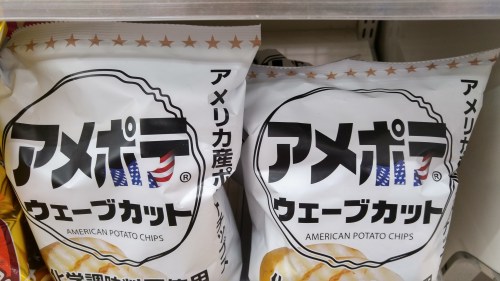
アメポテ Amepote ‘American potato’ – On the shelf of a conbini (convenience store) we encountered a new acronym created from the initial two syllables of a longer pair of words. The katakana label on a package of “American Potato Chips” reads Amepote ueebukatto (‘Amer. Pota. wave-cut’), comparable to Amefuto for ‘American football’. This is a very common pattern of abbreviation in Japanese, one we also encountered in a Japanese TV biography about Amekei (雨敬 < Amemiya Keijiro 雨宮敬二郎), a Meiji-era businessman who first persuaded the Japanese government to build the Chūō (中央 Central) railway line into his native Yamanashi Province to enable farmers to get their produce out to the coastal markets.

Kuma Shuppotsu Chuui

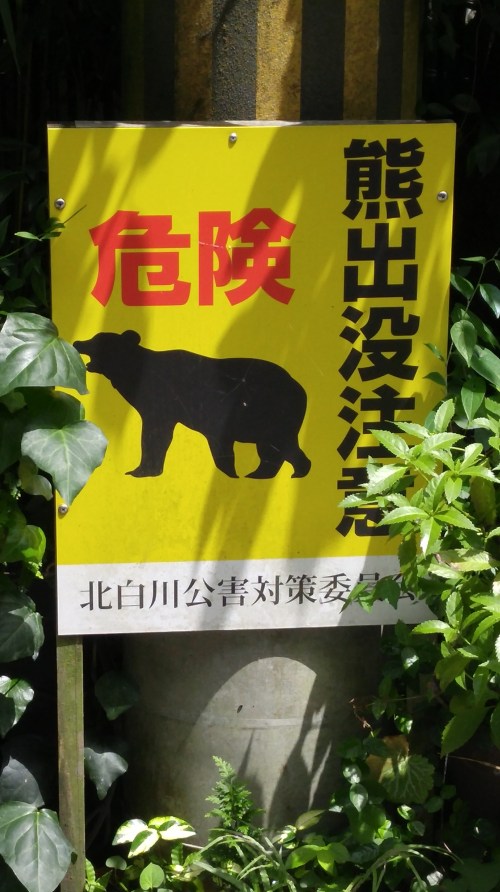
出没 shutsubotsu ‘haunt, infest, frequent’ – We were not surprised to find signs warning of bears while hiking in the forests of rural Togakushi in Nagano Prefecture, but I was quite surprised to see this sign right next to the Japan Baptist Hospital in Kyoto, warning of bears in the very mountains I used to climb during my childhood there (at the foot of Mt. Hiei). The sign reads 危険 熊出没注意 Kiken: Kuma shutsubotsu chuui ‘Danger: Bear infestation alert’. Such signs are very common along Japanese mountain trails these days. When we hiked a very well-traveled section of the old Nakasendō (中山道 ‘Central Mountain Route’) we saw many such bear warnings near small brass bells that travelers were encouraged to ring to scare the bears away.

Pork wombs
蒜泥生肠 “Pork wombs marinated with hot soysauce”! – In a Chubu Airport (Nagoya) restaurant specializing in Taiwanese food, we encountered a menu item that even this experimental gastronome shied away from. It appears to be a dish unique to Singapore and Taiwan. The Chinese menu item is 蒜泥生肠 suànní shēngcháng ‘garlic-mash birth-intestine (= birth canal/fallopian tube)’. (The kanji 蒜 or 大蒜 can be used to write ninniku ‘garlic’ in Japanese.) I couldn’t find shēngcháng 生肠 in my DeFrancis (1996) ABC Chinese-English Dictionary, and whoever translated it into Japanese and Korean seems not to have known the anatomical term for ‘uterus’ (neither did I), which is 子宮 ‘child-shrine = womb’ (Ch. zǐgōng, Ko. jagung, Jp. shikyuu). So the Japanese menu label for the dish is 子袋 ko fukuro ‘child bag’ and the Korean menu label is ai kabang ‘child bag’. I don’t know how the English translator came up with “marinated in hot soysauce” except by looking at the photo.

Leave a comment

Filed under China, Japan, Korea, language

Wordcatcher Tales: 難得糊塗

I just came across a handwritten four-character Chinese phrase on a souvenir magnetic bookmark from Taiwan that leaves me uncertain about its meaning, despite many attempts to parse it.

The first character of what turned out to be 難得 (simplified 难得) nándé ‘rare(ly)’ was written with the more complicated (11-stroke) bird radical 鳥 (called tori in Japanese) on its right, rather than the simpler (9-stroke) 隹 (called furutori ‘old bird’ in Japanese). I searched and searched both the common and rare (難得!) sections of the Rikai Unicode Kanji Tables but couldn’t find a copy to cut and paste into this post. The two ‘bird’ shapes can be combined into one character (in either order, 鵻 or 䳡), but both kanji appear to be obsolete. (According to my old Canon Wordtank Kanjigen, the kanji 鵻, pronounced sui in Sino-Japanese, once named a kind of squab with a short tail.)

The second pair of characters, 糊塗 (simplified 胡涂) hútu, means ‘muddled, confused, bewildered’ or ‘stupid, foolish’ as an adjective in Chinese. But the Japanese verb 糊塗する koto suru means ‘gloss over, patch up’, literally ‘coat with glue’, from 糊 nori ‘starch, paste’ (with the ‘rice’ radical 米) and 塗 nuru ‘paint, daub’ (as in 塗物 nurimono ‘lacquerware’ or 塗工 tokou ‘painter, plasterer’).

So, the four characters on the bookmark probably intend to praise the astute reader as ‘rarely bewildered’, but they could also suggest that the reader is ‘rarely plastered’, is ‘rarely pasty’, or even perhaps ‘rarely [reads] glossy [magazines]’.

Leave a comment

Filed under China, education, Japan, language

Okinawan language souvenir

The following bits and pieces of Okinawan language are on a souvenir banner my brother picked up there in 1975. I’ve romanized the katakana used to write the Okinawan pronunciations and included the Japanese glosses on the banner in parentheses, while adding Japanese pronunciations for the numbers in square brackets.

Numerals
1 teichi [= hitotsu]
2 taachi [= futatsu]
3 miichi [= mitsu]
4 yuuchi [= yotsu]
5 ichichi [= itsutsu]
6 muuchi [= mutsu]
7 nanachi [= nanatsu]
8 yaachi [= yatsu]
9 kukunuchi [= kokonotsu]
10 tou [= tou]

Polite expressions
chuuganabira (= konnichi wa) ‘good day’
chiyaabira (= gomen kudasai) ‘sorry to bother’
imisoore (= ohairi kudasai) ‘please come in’
niheedeebiru(= arigatou gozaimasu) ‘thank you’
usagaimisoore (= omeshi agarinasai) ‘please eat’
ii tenchi (= ii otenki) ‘nice weather’
yukuimisoore (= oyasuminasai) ‘good night’
uyuee (= oiwai) ‘congratulations’

Qualities
ichuunasan (= isogashii) ‘busy’
achisan (= atsui) ‘hot’
hiisan (= samui) ‘cold’
inchiyasan (= mijikai) ‘short’
magii (= ookii) ‘big’
gumaa (= chiisai) ‘little’
funtou (= honto) ‘true, truth’
yugushi (= uso) ‘false, lie’

Verbs
warain (= warau) ‘laugh’
nachiyun (= naku) ‘cry’
kamuin (= taberu) ‘eat’
kachiyun (= katsu) ‘win’
kooyun (= kau) ‘buy’
chichiyun (= kiku) ‘hear’

People
taarii (= otousan) ‘father’
anmaa (= okaasan) ‘mother’
utuu (= otto) ‘husband’
tuji (= tsuma) ‘wife’
chiurakagii (= bijin) ‘beauty’
sato (= kare) ‘him’
nzo (= kanojo) ‘her’
ikiganguwa (= otokonoko) ‘son’
inagunguwa (= onnanoko) ‘daughter’
mooya (= maiko, buki) ‘apprentice geisha’
miiyumi (= hanayome) ‘bride’
umuyaaguwa (= koibito) ‘lover’

Joys
niibichi (= kekkon) ‘wedding’
ashibi (= omatsuri) ‘festival’
saki (= sake) ‘liquor’

Leave a comment

Filed under Japan, language

Okinawa Diary, 1975: Kaiwo Maru

My late brother worked as a guide at the U.S. Pavilion at the Ocean Expo in Okinawa in 1975. While there he typed up many pages of observations about people, places, and words of interest there. I scanned and edited the pages, added Japanese kanji for some of the words, and publish them here as a series.

Ken doesn’t even bother to roll back the sleeves on his brown woolen sweater, or to unband his waterweak wristwatch before doing the dishes. I sauntered into the kitchen to stir my noodles a swirl or two and saw him plunging his paws into the washpool and then pulling them out again, never wet past the hightide line but an inch from his Timex timepiece. What’s more, he had passed the pots and pans and was dredging the dregs for silverware which, by now were coated in grime & grease.

“Didn’t your mother ever teach you that there is a certain order in which you do the dishes?” I began my attack. “And don’t you have any inclination to bare your forearms for action?” I continued to needle him. “I just would not start washing without pulling up my sleeves and taking off my watch. It just wouldn’t feel right. But you just stand there and drop your hands time and time again into the murky mess and never get your wrists wet. It’s disgusting.”

Ken continued complacently. Then he explained, “In the first place, I have utterly no intention of committing my hands in there deep enough to get my arms wet. All sorts of danger await them. When Paul washes dishes, he likes to find the broken glasses, ’cause then he doesn’t have to wash them. Notice we only have three small and two large glasses left.”

He was right. I was just pulling a bottle of Golden Cream Sherry out of the frig where I had left it as a surprise to myself next time I came home, and after an inspection of the glass cabinet, I mixed this ambrosia with ice in a cream pitcher.

“And yes, I do them in an order,” he continued emphatically, “from top to bottom.”

By now I was halfway into the living room, grumbling back over my shoulder something about how Ken had certainly found his station in life. Sitting down to consult the Japanese dictionary on the word chabouzu [茶坊主], I was disappointed with the definition, ‘tea server, palace attendant, flatterer’. Earlier today when I had dropped by the imushitsu [医務室] ‘medical treatment room’, which is next to our Pavilion, the doctor there was telling me how his father and grandfather before him were doctors, but that his hiojiisan [曽おじいさん] ‘great-grandfather’ was a chabouzu, many of whom became men of medical affairs when Edo jidai [江戸時代] ended and Meiji jidai [明治時代] began with the first official recognition of Western medicine. He went on to explain that many of these chabouzu (< cha ‘tea’, and bouzu ‘priest’, but here it means the shaved head of/like a priest) were skilled druggists, some having dealt with the legendary ninja [忍者], or espionage-skilled samurai. I vowed to find out more about this later. The doc gave me a ride home and while he was chatting with the nurse who had introduced him to me, I picked up the words gengochuusuu [言語中枢] ‘speech center (of the brain)’, nenza [捻挫] ‘sprain or wrench’, zensoku [喘息] ‘asthma’, and bettara-zuke [べったら漬け] ‘fresh radish pickles’.

Now it just so happened that in Expo Port today was a very nice daihansen [大帆船] ‘large sailing ship’, by the name of T.S. Kaiwo Maru [海王丸], and that the imu ‘medical officer’ had come to the Expo imushitsu, where my friend was nurse, to check out his appendix. This resulted in us getting a very good tour of the T(raining) S(hip) that is the world’s second largest, the largest sailing ship being in Europe.

This vessel was built in Showa 5 (1930) by Kawasaki Zousensho [川崎造船所] ‘shipbuilding yard’ for about hyakuman [百万] ‘one million’ yen. The same boat as it is today would cost nearly rokujuu oku en [六十億] ‘sixty hundred million’ or ‘six billion’ ¥. The mainmast is 45 meters high, and the deck is made of chiiku-zai [チイク材] ‘teakwood’. A box near the bow had houki [箒] ‘brooms made of bamboo’, and coconut husks for scrubbing the deck. Houki [蜂起] also means ‘revolt’ or ‘uprising’, which made me think of Mutiny on the Bounty, and a houki-boshi [箒星] is a ‘broom/sweep star’ (= ‘comet’).

The name T.S. Kaiwo Maru itself includes some elements of both English and Japanese, and this was also the case on board, with the deck chief’s cabin having “boatswain” written plainly above the door, and the hundreds of ropes going every which-a-way were called by English names having undergone Japanification, but still ending recognizably in the specialized seaman’ brace, block, sheet, halyard, garnet, yard, shroud, stay, and sometimes lead and tack. I’m going to try and visit once more on Thanksgiving Day to find out what these terms mean a bit more. [See Wordcatcher Tales: Japanese nautical terms.]

This imu ‘medical officer’ had enough equipment on board to perform surgery on quintuplets simultaneously, but most of the paraphernalia was packed unused in king-sized silverware cases of a sort that I had never seen the likes of. The medicine cabinet was comparable to the Expo inventory, this ship having 102 cadets and 40-some odd crew (norikumi [乗組]) members, while Expo had 58,000 visitors today, which was a holiday. When I asked about the doc’s license to prescribe drugs and do certain kinds of surgery, he passed it off lightly by saying that the law recognized “special” circumstances on shipboard out at sea. The nurse later told me, when the doc went to borrow a book, not to pursue that topic any further. I obliged her, and not too willingly, because I had seen equipment for “women’s medicine” which I wanted to ask him about, altho with no intention to play the reporter, or investigator.

There was even a rentogen-shitsu [レントゲン室], which did not make sense to me until I had seen the old-time Roentgen, or X-ray apparatus. Leaving that room, we went past an ofuro [お風呂], of which there were seven altogether on board I was told.

After deboarding I dropped by the Korean restaurant to catch a meal before coming home to Kadena airbase tonight. I know the headwaiter there, and he was putting on the old Korean favorite Arirang (instrumental) at the request of a customer. But before long the music reverted back to the tunes of yesteryear in U.S. of A., and Kingston Town was on. I jotted down the name and the line “won’t be back for many a day” to remind myself to play it on harmonica when I got back to the privacy of my room. Meanwhile a very cute girl was smiling openly at me, and after a while she came over and surprised me by initiating what turned out to be a very abrupt conversation. She: “Are you from American pavilion?” Me: “Yes, but I love Korean food.” She: “Do you have an Am. Pavilion badge?” Me: “No, we don’t have any. I know everyone wants one, but us guides were given only five apiece, and they were already promised out long before we got them.” She: “Oh. None at all?” Me, breaking down: “I don’t have any but I’ll see if anyone else has one.” She: “Thank-you,” and Exit Right. That’s all she had to say. Talk about abrupt.

Leave a comment

Filed under Japan, language, military, U.S.

Okinawa Diary, 1975: Atrocities

My late brother worked as a guide at the U.S. Pavilion at the Ocean Expo in Okinawa in 1975. While there he typed up many pages of observations about people, places, and words of interest there. I scanned and edited the pages, added Japanese kanji for some of the words, and publish them here as a series.

Mr. Higa got the job as U.S. pavilion bartender, or “lounge captain” thru an employment agency and a friend he had in it who thought this might be a possible part-time job until the organic chemistry prof. began teaching at RYUUKYUU University next year. Mixology was more than likely the foundation stone of the chemical sciences anyway, and goes back a long, long way in history. Having studied abroad at Ohio State and the University of Hawaii for some eight dedicated years, he is now in his mid-thirties, and so has rather vivid childhood memories of the dreadful, bloody, blitzkrieg invasion of Okinawa that resulted in hundreds of thousands of deaths, a majority of which were Okinawan civilians, over a few short months.

When his house was burned by the U.S. troops in their clean-up operation of Japanese troop hideouts, his family went in afterwards and ate all of the cooked, garlic that had been stored on the shelves for seeding the next crop. The mountains were a refuge in those days, and most of the people of his village, KATSUYAMA [勝山], spent the daylight hours hidden in their cover, slipping down to their homes at nights to dig out SATSUMA [sweet] potatoes from the fields. Sometimes they would find rice and hard crackers in the quickly deserted camps of Japanese troops who had long since fled those posts. Everyone was desperate for grub, and he can remember dirty army deserters who came to their house fully armed and demanded food at the point of a gun. Not every Japanese soldier committed suicide in the face of defeat.

One day, before the clean-up burnings, a few U.S soldiers came to the HIGA home and sat on the front porch. The family was home and they all raised their hands in surrender and waited. The soldiers offered the children candy, but the parents told the youngsters in their tongue that they were not to eat it. Seeing the fear, the squad took the candy and bit off bits of it to show the locals that it was safe. Mr. Higa and his brothers then ate the goods quickly, altho Higa-san claims that he can’t remember if “it was good or not.” The youngest brother, still quite unaware of the whole situation, tried to play with the rifle of one soldier. The man took out the ammunition cartridge and gave the child the weapon to fiddle with.

Since Mr. Higa’s father was the KUCHOU [区長] ‘village head’, their house had been chosen as the temporary living quarters of WATANABE, the commander of a camp of Japanese soldiers who were setting up tents and settling in caves in the area before the invasion. This was an honor of a sort for the HIGA family, and when the commander’s private servant didn’t cook for him, the HIGA family included him in their humble meals. The village was expected to give provisions to the small Japanese post there in the foothills, most of whose men were from the Japanese mainland.

Altho the Okinawan people had been under Japanese gov’t for long enough to feel part of “the nation,” the mainlanders treated them like inferiors at times, even in the midst of a “united” war effort.

When Mr. Higa saw the negative press coverage that Japanese news media gave the My Lai Massacre in Vietnam, he said that the big headlines seem to indicate they had “forgotten their own” atrocities. He mentioned the “massacres” at KUMEJIMA [久米島], and KERAMA [慶良間] of Okinawan civilians who were shot because they tried to surrender, or were given hand grenades to carry into the enemy lines and to blow up their families with. One supposedly responsible Japanese commander by the name of AKAMATSU is reputed to be living in Kobe, Japan, today and is a businessman. Some years ago, he came back to Okinawa and the papers got wind of it and the whole devilish drama was unburied though he denied guilt or responsibility.

One thing that surprised many of the mountain refugees was how little they came in contact with the poisonous HABU [波布] viper which loves the rocky mountains. Only two cases are recalled by Mr. Higa, one being a lovely young girl who was bitten in the arm, the other being a boy a few years younger than young HIGA, who was bitten in the face. The girl’s arm festered and swole up, and was later amputated by the American medical team who treated her area. She is now living in Brazil, one of the many Japanese immigrants. The boy still has an ugly scar on his face, but survived.

When the war finally finished, and families came out of the hills, the U.S. troops relocated them in camps, the villagers of KATSUYAMA [勝山] being assigned to HANEJI [羽地] in the flatlands south of there. Some food was supplied by the Occupation forces but many of the families dug up all the SATSUMA [sweet] potatoes that they could find in their fields, and carried them on their backs to the shoreline shacks. It was there that young HIGA started school, in April, one year after the invasion began.

Leave a comment

Filed under food, Japan, military, U.S., Vietnam, war