Category Archives: industry

Wood-burning Trains: "A Storm of Fiery Snow"

Anthracite country is often called the cradle of American railroading, and with good reason. Apart from a couple of relatively minor exceptions, the anthracite mine operators were the first Americans to use rails, and they greatly advanced the science of building railways. White and Hazard built a nine-mile rail line from their Summit mine down to the Lehigh [River] in 1827. Gravity carried the coal cars and a carload of mules (who refused to walk down once they had experienced rail travel), down to the Lehigh, and then the mules pulled the cars back up.

Rails spread quickly throughout the anthracite region, and the rest of the East, and eventually locomotives followed. Schuylkill county had more track than any other small area in the country. Companies building railroads alongside the canals drained away canal business and bought up much of the region’s coal property. The Philadelphia and Reading Railroad, one of the nation’s largest and most powerful companies, dominated the area, but there would be five railways so intermingled with th anthracite trade that coal and railroading were often considered a single industry.

Surprisingly, these trains didn’t run on coal. For the first few decades, American trains burned wood, even those that existed for the purpose of hauling coal. Anthracite did not burn well in locomotive fireboxes as they were then designed, and the bituminous fields were not yet widely exploited outside of Pittsburgh. Wood was bulky and burned fast, though, so the trains had to stop often to refuel. All along the tracks, people made money cutting wood to sell to the railroads—just one more way that trains would help turn the United States from a forested nation into an agricultural and industrial one.

The era of wood-burning trains is one that train buffs look back on with particular nostalgia. With clean-burning wood, locomotives could be much flashier: They were painted bright red and fitted with polished brass ornamentation. Engineers were flashier, too, often wearing ornate suits and vests with shiny buttons. When the switch to bituminous coal occurred later in the century, the inevitable accumulation of soot and grime meant that engines had to be painted plain black, and engineers switched to overalls. Some say that when the engineer’s uniform was toned down, his status as a workman fell, too.

One problem with the shiny, wood-burning engines proved hard to ignore: They spewed out a continuous shower of sparks and cinders wherever they went, “a storm of fiery snow,” as Charles Dickens called it when he visited the United States. It was a beautiful display at night, but it had a predictable downside. Wood-burning trains commonly set nearby fields and forests ablaze; some said the trains burned more wood outside the firebox than inside.

SOURCE: Coal: A Human History, by Barbara Freese (Penguin, 2003), pp. 121-123

Leave a comment

Filed under industry

Coal Ships as the Royal Navy’s Nursery

By the time of the industrial revolution, Britain already had a relatively sophisticated transportation network. This was partly because of its accommodating waters, but partly because of its coal. As the heaviest and bulkiest of daily necessities, coal was the nation’s cutting edge cargo, the one that kept forcing it to find new ways to move things.

It was noted in the 1600s that “it is the great quantities of Bulksome Commodities that multiplies ships and men,” and commodities didn’t get more bulksome than coal. And so, as the coal trade grew in the latter half of the 1500s and in the 1600s, so did the nation’s shipping fleet. Already in the early 1600s, more ships were used to move coal than everything else combined. England would no doubt eventually have developed its shipping industry without the impetus of the coal trade; but London’s growing dependence on coal left it no choice in the matter, and surely accelerated the nation’s maritime investment. Once they had built the ships, the ports, the sailing fleet, and the skills required for the coal trade, the English found it much easier to expand their maritime trade to other commodities and other locations. According to one historian, “the coal trade may be regarded, in short, as a magnet which helped to draw Englishmen to seek their profit and their livelihood in ocean commerce.”

The expansion of England’s private fleet would prove vital not just commercially but militarily, too. Despite being an island nation, England had not always been a maritime power. Henry VIII built its first real Royal Navy, but it was not strong, and in times of trouble, the nation had to commandeer private vessels: Elizabeth I’s navy was more powerful than her father’s, but even so, it needed the help of dozens of armed merchant ships to defeat the Spanish Armada in 1588. England’s coal ships were particularly important for national defense, and by the early 1600s it was axiomatic that the coal trade was the “chief nursery” for English seamen. Although there were more vessels involved in fishing, they were smaller and of less use to the navy. The sturdier coal ships, with their larger crews, were a vital national asset and could be called up quickly when needed. And when called upon, there was no refusing; the coal ships and their thousands of crew members were pressed into service, by force, many times in English history. In fact, in times of war, those involved in the coal trade demanded additional wages because they ran such a high risk of being forced into the navy.

Paradoxically, the coastal coal trade was another reason a navy was so important in the first place. London and the south of England had become dependent on this fragile lifeline to the north, subject to attack by pirates and foreign powers. The navy was frequently dispatched to escort the coal vessels, in convoys, down the English coast. Still, the coastal coal trade was seen not mainly as a vulnerability but as a national asset, and it came to enjoy what one historian called “an almost superstitious reverence” as the source of England’s naval strength. There were even those in the 1600s who opposed trying to find inland coal supplies closer to London because it would have choked off the precious coastal trade.

SOURCE: Coal: A Human History, by Barbara Freese (Penguin, 2003), pp. 85-87

Leave a comment

Filed under industry

Oil Barons of Baku, 1901-1905

By 1901, Baku was supplying half the world’s oil. It became an international city overnight, and the local Azeris were soon outnumbered by Russians, Georgians, Ossetians, and others from the four corners of the earth. Between 1856 and 1910, Baku’s population grew at a faster rate than that of London, Paris, or New York. The Nobel brothers, who dominated the industry in the first decades, invented the concept of the tanker to handle the demand for Baku oil in the Far East, appropriately naming their first tanker Zoroaster. They made the bulk of the family’s fortune in Azeri oil, though brother Alfred’s invention of dynamite is more famous.

The oilmen came in all stripes—Swedes and Jews and Poles and Armenians—but the dominance of big foreign groups like the Nobels and Rothschilds didn’t last long. By the turn of the century, half of the tanker business and much of the production was in local hands. So-called oil barons arose from both the peasantry and the feudal aristocracy—anyone who dug a hole in the ground and got lucky. (The Nobels tried whenever possible to buy out these new oil barons, along with smaller producers. According to documents in the Baku archives, Abraham Nussimbaum sold the Nobels most of his wells in 1913, on the eve of the Great War, a highly opportune business decision.)

The new oil millionaires became great philanthropists, determined to turn their city from a provincial backwater into the finest Islamic city in the world—a showcase of the possibilities of the positive merger of East and West. As the representative local group, the Muslim oil barons felt the most obliged to make showy public statements with their new wealth. They took grand tours of Europe and hired architects to build copies of the mansions, museums, and opera houses they had seen, all in an attempt to anchor their city in the Occidental future rather than its Oriental past. While some Azeri Muslims were outraged by the education of women or their appearance onstage or in an office building, Baku benefited from having been so long at the crossroads of East and West that people were used to new fashions and change.

Equal parts Dodge City, medieval Baghdad, industrial Pittsburgh, and nineteenth-century Paris, fin de siècle Baku was the last great city built before the First World War spoiled the dream that the West could keep expanding forever in a grand civilizing pageant. It was a place of fantastic extremes of wealth and poverty, where gas lights and telephones made a stark contrast to camel caravans and emaciated Zoroastrian monks. The city’s wild and clashing history came to ahead at the turn of the century, when it was the “Wild East” frontier of Europe, the world’s greatest oil-boom town: A British visitor at the time wrote, “One might almost fancy oneself in an American city out west. There is the same air of newness about everything, the same sanguine atmosphere. Everyone is hopeful.”

Yet by 1905, the entire Russian frontier was bathed in blood, as the empire entered the first of its revolutions. The unrest reached from the coast of Korea to St. Petersburg’s Nevsky Prospekt, and Baku was not spared. The revolution came, as many do, on the heels of a disastrous war, one of the bloodiest in history. The czar’s advisers had dreamed up the 1904–5 Russo-Japanese War in part as a means of diffusing revolutionary tension, by acquiring, via quick victory, an injection of patriotism as well as some much-needed timber concessions on the Korean coast. Instead, the Russians experienced total defeat. The catastrophe in the Far East—against a people the czar called “little, short-tailed monkeys”—made the Russian Empire look fragile and moribund. As the war’s losses sank in—in addition to the hundreds of thousands of dead soldiers, practically the entire Russian Navy was sunk by the Japanese fleet—years of left-wing terrorism and czarist oppression collided in a year of uprisings, ethnic cleansing, and generalized breakdown.

The semi-destroyed Russian military was in no position to quash the unrest. The only part of the vast czarist navy that had not been sunk by the Japanese was the famous Black Sea Fleet, and on its main battleship, the state-of-the-art Potemkin, the sailors rioted in the spring of 1905 and shot their officers. All around the Black Sea and the Caspian, public order broke down. While the staggering numbers of Russian dead, machine-gunned on the icy hills of Manchuria and the Korean peninsula, showed the new lethality of war, the revolutionary terrorism and pogroms that arrived inside Russia that year showed the new brutality of politics—and both foreshadowed what horror might be born through the mediums of modern mass violence.

SOURCE: The Orientalist: Solving the Mystery of a Strange and Dangerous Life, by Tom Reiss (Random House, 2005), pp. 11-13

One of the most intriguing photographs reproduced in the book is labelled “Muslim-Jewish Christmas party, Baku, 1913.” Days long, long gone.

Leave a comment

Filed under Caucasus, Central Asia, energy, industry, Japan, military, nationalism, religion, Russia, Turkey, war

A Visit to International Ota City

Ota City (太田) in Gunma Prefecture is just two train stops southwest from Ashikaga City on the private Tobu line. Ota English School‘s website brags that

Ota itself is quite an international town. The neighboring town [Ôizumi] has one of the largest Brazilian populations in Japan. Ota itself has one of the largest Asian communities outside of Tokyo. This means that, as well as all the usual non-Japanese restaurants (Italian, French, Chinese) there are many Indian, Pakistani and Brazilian restaurants a short walk or drive from the school.

Purdue University‘s The Exponent Online is rather more modest when it compares Ota City to Lafayette, Indiana.

The populations are almost the same, both cities were changed from agricultural centers to industrial centers, both cities are on a river, and for the most part, both are flat cities.

What moved a Purdue student reporter to compare Lafayette and Ota? Well, West Lafayette, Indiana, is home to Purdue’s main campus as well as to Subaru-Indiana Automotive, Inc. Fuji Heavy Industries and Subaru are among the largest employers in Ota, a commercial cluster development center dating back to the days of textiles and then military aircraft.

So, is Ota really as international a city as these websites suggest? The Far Outliers got a skewed impression when we set out to find a Brazilian restaurant to eat dinner at last Saturday evening. We headed south from Ota train station zigzagging between the two widest streets we could find, asking policemen, passers-by, shopkeepers, and even employees at the main post office (open on Saturdays) if they knew of any Brazilian restaurants in the city. No luck. Even those who took the trouble to look through the restaurant listings in the telephone book couldn’t find any Brazilian restaurant. A few people recommended we go instead to neighboring Ôizumi–Japan’s “Little Brazil.” (Been there. Done that. More later.)

We did find a few tiny Filipino restaurants (none yet open) scattered along one of the longest strips of seedy strip joints, hostess bars, and member clubs that I’ve seen in a while. (I’ve never been to Las Vegas.) It went on for at least a full kilometer. It was still early when we walked its length, encountering no more than a few bouncers loitering outside a few doorways. When we retraced a portion of the strip on our way back to the station later that night, there were a lot more drunken males and leggy females on the sidewalks. Judging from the streetside advertising, some portion of Ota City’s international Asian population would seem to be women from China and the Philippines. (A Japanese customer I was chatting with at a yakitori shop in Ashikaga last week demonstrated his few words of “French” by saying Magandang gabi! That’s Tagalog for ‘Good evening!’)

After the trail went cold in that direction, we headed back for the station on a main drag with more vehicle traffic. It was a much more family-oriented strip mall, with a huge shopping center, and plenty of parking, car dealers, tire shops, and the most amazing site entirely dedicated to weddings that I’ve yet seen, the Royal Chester Ota (for “The Brilliant European Wedding”). (Again, I’ve never been to Las Vegas.) We saw plenty of chain restaurants, but nothing representative of Ota City’s large foreign community.

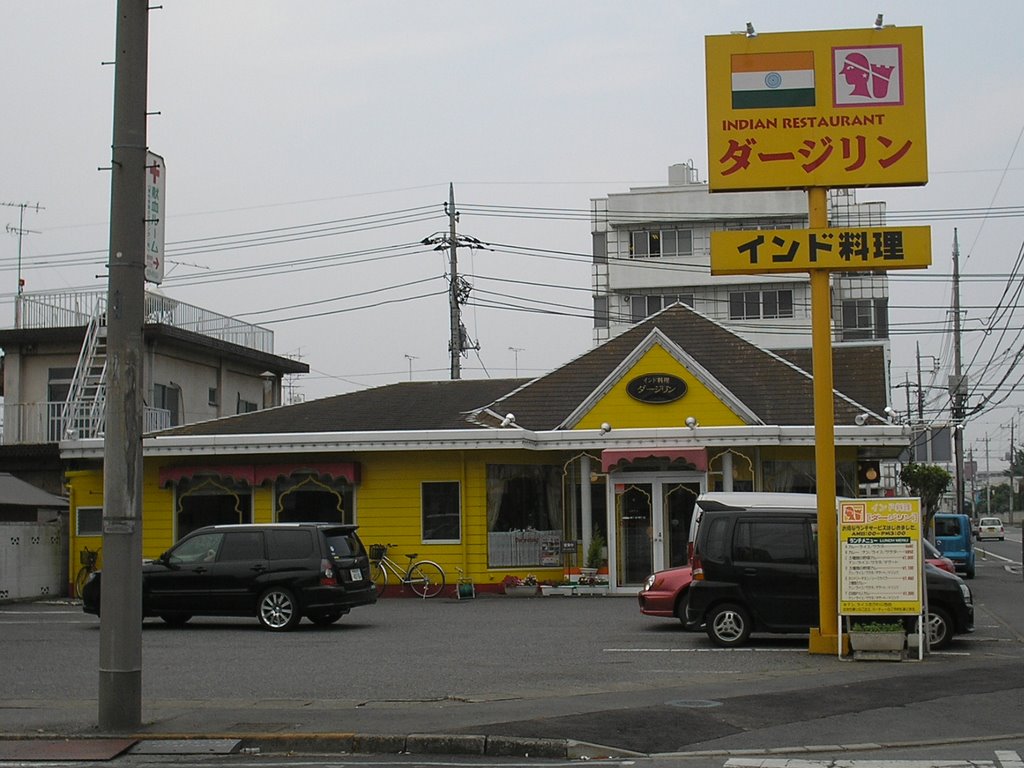
We couldn’t find a clue until a couple hours later when, after circling a few blocks north of the station, we asked at Rana, an “International, Halal” food store run by some Iranians. The only other customer was a Nepali who not only owned an Indian restaurant named Darjeeling, but offered to drive us there, and even to drive us back to the station if his place wasn’t too busy by the time we finished eating. We readily accepted, and had a wonderful meal of chicken tandoori, mutton masala, nan bread, and salad vegetables, washed down with a couple of beers unusual for Japan: Everest and Grolsch. The proprietor came to Japan ten years ago, and his restaurant has been successful enough for his elder brother to open a branch in Tokyo.

Except for a few words of English, he and I communicated entirely in Japanese, quite informally and comfortably. Neither of us had done enough formal study to command formal registers very well anyway. After dinner, we insisted on walking back to the train station, and he came out to the street to confirm his earlier directions and we parted in typical Japanese fashion, with bows and thank yous. On the way back, we passed the Civic Center, with a range of social support facilities for both citizens and foreigners, including an office that handled passports and visas.

The 1 May 2005 issue of Pakistan’s Dawn has more about unskilled foreign workers in Ota.

Kimio Matsudaira, an official at Hello Work, a public labour office in Ota city, Gumma prefecture, 60 kilometres north of Tokyo, said there is now a special programme to help and support foreigners working in the area. Ota has a population of about 200,000 people. The irony is that more than sixty per cent of its people are over 60 years of age, in a city where the economy is dependent on manufacturing. Without doubt, Ota really needs foreign workers badly. To support the city’s automobile and electronic industries, Ota is now host to more than 30,000 Japanese Latin Americans, descendants of Japanese who emigrated to South America in the early 20th century seeking a better future. In the late eighties Japan launched a policy of accepting third and fourth generation Japanese Latin Americans to support a labour shortage in its factories stemming from the bubble economy at that time. More recently, Asians, mostly from South-east Asia, have also arrived to work in factories, comprising a total of 45,000 registered workers in Ota city. Matsudaira said foreign workers are vital to the survival of Ota’s economy.

Leave a comment

Filed under Brazil, China, industry, Japan, migration

Kiryu’s Changing Industries: From Silk to Pachinko

Kiryu (桐生), in Gunma Prefecture’s southeast fanhandle, was an early center of silk manufacture, a later pioneer in textile manufacturing, and now home to Gunma University’s Faculty of Engineering, which offers this glimpse at its industrial transitions.

Kiryu is often referred to as “the Eastern Kyoto”. Like Kyoto, Kiryu has over 1,000 years of history behind it and owes its wealth and tradition to the silk textile industry. Even now, Kiryu is a major centre for the manufacture of kimonos (traditional Japanese wear). The precise origins of the silk industry in Kiryu have been lost in the mists of time, but according to local legend a young man from Kiryu won the heart of a princess at the Imperial Court in Kyoto with his exquisite poetry. They eventually married and returned to Kiryu, where she taught the local inhabitants the art of weaving. There are records of silk production in Kiryu dating from the 10th century. Over the years, the silk industry grew and flourished in Kiryu. Kiryu silk was sent to the Imperial Court and was used by the Tokugawa Shogun for his army’s battle banners in 1600. Kiryu became the site for a major silk market which drew merchants from all over Japan.

However, in recent years the kimono was been largely replaced by Western-style suits and dresses. The golden age of the silk industry has now passed.

With the decline of the silk industry the people of Kiryu adapted themselves to new industries, mainly the production of automotive parts, electronics and related industries. However, Kiryu has become a major producer of another typically Japanese product–pachinko machines! (Pachinko is a type of pinball which is extremely popular in Japan.)

An article by Tomoko HASHINO entitled “Power-looms and the factory system: the relation between production systems and technology choice in the silk textile industry in Kiryu in the 1910s” has more about the early transition from hand looms to power looms. The abstract from Socio-Economic History, vol. 63, no. 4, follows.

Recent studies have clarified some special features regarding the introduction of power-looms, especially in pre-war Japan. One of the more important findings was the close relationship between particular production systems and technologies, for example the factory system and power-looms and the putting-out system and hand-looms.

The purpose of this paper is to investigate the above relationship in the silk textile industry on the basis of the hypothesis that the factors leading to the introduction of power-looms are independent from those leading to the introduction of the factory system. Kiryu is one of the oldest silk textile industry districts in Japan. In the early Meiji period (1870s-80s) it showed a positive response to the introduction of new foreign technology, such as the batten and the Jacquard machine, and helped to spread them to other areas. But Kiryu was slower than other areas in introducing power- looms. The putting-out system was widely adopted in Kiryu and had a long history. It has been assumed that this acted as an obstacle to the introduction of power-looms.

In the 1910s, there were four types of factory in Kiryu: factories with power-looms only, factories with hand-looms only, those with both, and those with none, which were often called orimoto (clothiers). Neither the production systems nor the technology dramatically changed in Kiryu in the 1910s; however, some factories began to introduce power-looms.

There were some reasons that promoted the adoption of the factory system. OJT (on-the-job-training), which played a role in maintaining the quality of goods, was an important reason in Kiryu in the 1910s. As past studies point out, institutional, technological and market factors were other reasons that promoted the introduction of power-looms there. While both electrification and the establishment of domestic and local power-loom suppliers were very important, it appears that the change in raw material from raw silk to rayon in the 1920s was the decisive factor in accelerating mechanization. The fact that hand-loom factories have often been categorized as “manufacture” has been a controversial issue among historians. But we must recognize the significance of their role in controlling workers and turning them into a skilled labor force.

Leave a comment

Filed under industry, Japan

An Economist’s Take on Jared Diamond’s Collapse

Alaska-based econoblogger Ben Muse cites fellow economist Partha Dasgupta’s review of Jared Diamond’s Collapse in the London Review of Books. Seems Diamond fails to understand the relationship between pricing and scarcity in modern economies. Of course, if the government controls pricing, then it effectively slaughters that bellwether.

Forests loom large in Diamond’s case studies. As deforestation was the proximate cause of the Easter Islanders’ demise, he offers an extended, contrasting account of the way a deforested Japan succeeded, in the early 18th century, in averting total disaster by regenerating its forests. Now consider another island: England. Deforestation here began under the Romans, and by Elizabethan times the price of timber had begun to rise ominously. In the mid-18th century what people saw across the landscape in England wasn’t trees, but stone rows separating agricultural fields. The noted economic historian Brinley Thomas argued that it was because timber had become so scarce that a lengthy search began among inventors and tinkerers for an effective coal-based energy source. By Thomas’s reckoning, the defining moment of the Industrial Revolution should be located in 1784, when Henry Cort’s process for manufacturing iron was first successfully deployed. His analysis would suggest that England became the centre of the Industrial Revolution not because it had abundant energy but because it was running out of energy. France, in contrast, didn’t need to find a substitute energy source: it was covered in forests and therefore lost out. I’m not able to judge the plausibility of Thomas’s thesis – there would appear to be almost as many views about the origins, timing and location of the Industrial Revolution (granting there was one) as there are economic historians – but the point remains that scarcities lead individuals and societies to search for ways out, which often means discovering alternatives. Diamond is dismissive of the possibility of our finding such alternatives in the future because, as he would have it, we are about to come up against natural bottlenecks…

via Regions of Mind

Here’s a link to an interview with Diamond about that same book.

Leave a comment

Filed under economics, industry, Pacific

Nissan vs. Mitsubishi Management Style

The BBC reports on Remodelling Japan Inc.

Nissan and Mitsubishi, two of the world’s most famous car companies, have both stared into the economic abyss in the last five years.

But while one has recovered to become Japan’s most profitable automaker, the other remains in deep trouble.

Their crises expose weaknesses in Japan’s traditional corporate model – weaknesses that were hidden until the economic downturn exposed them….

Just five years ago, Nissan had debts of $22bn and was close to bankruptcy.

The company had been complacent about its place in the market and its designs were felt to lack imagination, analysts say.

Toshiyuki Shiga, head of Nissan’s General Overseas Markets, explained that although Nissan’s problems were widely reported by the media at the time, the company’s own employees would not believe there was a crisis. They were tunnel-visioned and ostrich-necked, he said….

This was one of the first issues tackled by maverick French national Carlos Ghosn. He took over as Nissan’s CEO when French car-maker Renault announced it was taking a 37% share in Nissan in 1999. That stake has since been increased to 44%.

Mr Ghosn introduced something called “cross-functional team working”. This encourages dialogue across departments and divisions, engendering what Nissan’s Toshiyuki Shiga terms “healthy conflict”. It also enables the ideas of younger employees to get heard.

Mr Ghosn also tackled bloated management – cutting 22,900 jobs, some 15% of the total workforce, and halved the company’s suppliers.

As a result, it is now Japan’s most profitable car company, posting a $7.29bn profit in year end of March 2004.

Like Nissan, Mitsubishi Motors forged an alliance with a foreign car maker, in 2000. Daimler-Chrysler initially took a 37% stake, although that has since been reduced to 20%.

But unlike Nissan, its foreign marriage has not ended happily. When Mitsubishi asked Daimler to bail it out financially, Daimler refused.

Mitsubishi has responded with an aggressive restructuring plan. It has declared it will cut 11,000 jobs in the next three years, and has reduced its departments from 230 to 157.

via Tanuki Ramble

Leave a comment

Filed under industry, Japan

Tobago Tobacco Trinidado

Naipaul’s last chapter of A Turn in the South–entitled “Smoke”–is about eastern North Carolina. Now and then he draws parallels between aspects of the American South and his native Trinidad and Tobago. Here’s one such digression.

THE WORD “tobacco” is thought to have come from Tobago [doubtful!], the dependency or sister island of Trinidad. And before “Virginia” became the word in England for tobacco [huh?], tobacco was sometimes called “Trinidado,” after the island of Trinidad, part of the Spanish Empire since its discovery by Columbus in 1498. Tobacco was a native Indian crop. But after the discovery and plunder of Mexico in 1519-20 and Peru fifteen years later, the Spaniards were interested only in gold and silver; they were not interested in tobacco. It was the English and the Dutch and the French who went to Trinidad to load up with tobacco. ‘there were hardly ever more than fifty Spaniards at a time in Trinidad in the sixteenth and seventeenth centuries.

The Gulf of Paria, between Trinidad and Venezuela, a vast safe harbor, was nearly always full of foreign ships. An English explorer and diplomatist, Sir Thomas Roe (who later went to the Mogul court at Agra in India as the representative of King James), came to the Gulf of Paria one year and saw fifteen English, French, and Dutch ships “freighting smoke.” Another English official reported that the tobacco trade might in time be worth more than all the Spanish gold and silver from the Americas.

The trade was illegal, however–even though crops were grown in Trinidad with the complicity of the Spanish governor. Under Spanish law only Spain could trade with a Spanish colony. Occasional sweeps were made by the Spanish navy against foreign interlopers in the Gulf of Paria; and foreign sea captains and sailors who were caught could be hanged on the spot. And the Indian tobacco fields–tobacco a crop requiring such great care, as I was to see in North Carolina–were flattened: part of the process by which in three hundred years both the native Indian population and tobacco were to be rooted out from Trinidad.

The island that the British captured (without a shot) in 1797 was a sugarcane slave colony. And it was to work in the sugarcane estates that, thirty years or so after the abolition of slavery in the British Empire in 1834, Indians were brought over from India on indenture. It was sugarcane that gave a rhythm to the life of rural Indian communities. Tobacco was no longer a local crop.

I would have been disbelieving, and delighted, to be told as a child that Trinidad had once been known for its tobacco. To me tobacco was glamorous, remote, from England (in absurdly luxurious airtight tins), or American (in soft, aromatic, cellophane-wrapped packets), something from an advertisement in Life.

SOURCE: A Turn in the South, by V.S. Naipaul (Vintage, 1989), pp. 278-279.

Here are a few additional tidbits from the Webster’s Dictionary Online entry for tobacco.

The Foolish Dictionary (1904) defines tobacco thus: “A nauseating plant that is consumed by but two creatures; a large, green worm and–man. The worm doesn’t know any better.

A “Special Definition” adds more history about the plant, including this bit.

Bright Tobacco

Prior to the American Civil War, the tobacco grown in the US was almost entirely fire-cured dark-leaf. This was planted in fertile lowlands, used a robust variety of leaf, and was fire cured or air cured.

Sometime after the War of 1812, demand for a milder, lighter, more aromatic tobacco arose. Ohio and Maryland both innovated quite a bit with milder varieties of the tobacco plant. Farmers around the country experimented with different curing processes. But the breakthrough didn’t come until 1854.

It had been noticed for centuries that sandy, highland soil produced thinner, weaker plants. Abisha Slade, of Caswell County, North Carolina had a good deal of infertile, sandy soil, and planted the new “gold-leaf” varieties on it. When Stephen, Abisha’s slave, used charcoal instead of wood to cure the crop, the first real “bright” tobacco was produced.

News spread through the area pretty quickly. The worthless sandy soil of the Appalachian piedmont was suddenly profitable, and people rapidly developed flue-curing techniques, a more efficient way of smoke-free curing. By the outbreak of the War, the town of Danville, Virginia actually had developed a bright-leaf market for the surrounding area in Caswell County, North Carolina and Pittsylvania County, Virginia.

Danville was also the main railway head for Confederate soldiers going to the front. These brought bright tobacco with them from Danville to the lines, traded it with each other and Union soldiers, and developed quite a taste for it. At the end of the war, the soldiers went home and suddenly there was a national market for the local crop. Caswell and Pittsylvania counties were the only two counties in the South that experienced an increase in total wealth after the war.

So “bright” tobacco is God’s gift to Piedmont farmers with bad soil, just as moonshine is God’s gift to mountaineers who don’t have the roads to get bulkier products of their corn to market. And then, of course, there’s the opium poppy, the coca leaf, etc.

Well, this topic could go on and on, so I’ll just close with a few startling items from Gene Borio’s fascinating tobacco timeline.

  • 1633: TURKEY: Sultan Murad IV orders tobacco users executed as infidels. As many as 18 a day were executed. Some historians consider the ban an anti-plague measure, some a fire-prevention measure.
  • 1634: RUSSIA: Czar Alexis creates penalties for smoking: 1st offense is whipping, a slit nose, and transportation to Siberia. 2nd offense is execution.

Those New World tobacco plantations were the Afghan or Burmese poppy plantations of their day. Three centuries later, however, Turkish tobacco was king.

By 1911, even though Duke’s American Tobacco Co. (ATC) controlled 92% of the world’s tobacco business, most popular American brands were Turkish blends, with names like Fatima (L&M), Omar (ATC), and Zubelda (Lorillard), to be followed in 1913 by Camel (RJR), which by 1923 had captured 43% of the US market.

Leave a comment

Filed under Caribbean, industry, Spain

1932 Aso Coal Strike: Korean-Japanese Relations

The 20-day-long Korean strike against the Aso coal mines in 1932 was the only sustained strike by a large number of Korean miners in prewar Japan and the largest strike of the year in Chikuho, Japan’s most important coal field. The 400 strikers demonstrated courage and cohesion but won at best a partial victory that left most of them without jobs. This article draws on union documents and a contemporary report by the Kyochokai, a semiprivate organization devoted to labor-capital harmony, to explore the background of the strike, the tactics employed by the male strikers and their wives, and the many obstacles they faced in their fight for better wages and working conditions. The author argues that there was little the workers could do to overcome the harsh antiunion environment of prewar Japan or the surpluses in both coal and labor brought on by the Great Depression, but that the strike might have been more successful if rank-and-file Japanese miners had shown even a hint of solidarity. While a Japanese mining union provided organizational support, the failure of even one Japanese miner to join the strike suggests that Japanese working-class racism severely limited the potential for joint Korean-Japanese action.

SOURCE: W. Donald Smith, “The 1932 Aso Coal Strike: Korean-Japanese Solidarity and Conflict,” Korean Studies 20 (1996): 94-122

Leave a comment

Filed under industry, Japan, Korea, labor

Burma, TotalFinaElf, and Bernard Kouchner

A blog I only recently discovered via Belmont Club, the Last of the Famous International Playboys, posted back in January a long, detailed, and nuanced report on a scandal involving Kouchner, Total & Burma:

Good people make mistakes, too. Someone I very much admire, founder of Médecins sans frontiéres Bernard Kouchner, has drawn the wrath of right-thinking people down on his head.In his long career, the popular Kouchner (click on “afficher ma sélection” to plot his rising and falling poll numbers) has been a champion of human rights and was one of the only public figures in France to express support for the removal of Saddam Hussein.

But according to a few articles, France’s illustrious former socialist Minister of Health, Kouchner, has been accused of whitewashing the matter of the complicity of French oil giant Total (which recently merged with its highly corrupt and rapacious competitor Elf, forming the fourth largest oil company in the world) in alleged human rights abuses as part of the construction of a pipeline in the Yadana region of Myanmar.

On 7 April, the “tenth anniversary of the first full day of slaughter in the Rwandan genocide,” Last of the Famous posted another long, detailed, and nuanced retrospective on Rwanda, with a follow-up on 11 April. Both fascinating, but grim reading.

Leave a comment

Filed under Burma, France, industry, NGOs