
Category Archives: Hawai’i

U.S. Patriots at “Tokyo High”

From Ghosts of Honolulu: A Japanese Spy, A Japanese American Spy Hunter, and the Untold Story of Pearl Harbor, by Mark Harmon and Leon Carroll, Jr. (Harper Select, 2023), Kindle pp. 79-81:

People in Honolulu have called McKinley “Tokyo High” since the 1920s. The majority of Nisei in Hawaii attend the public school here; it’s more responsible for the Americanization of Japanese Hawaiians than any other institution besides the city’s movie theaters.

Today’s rally is the work of the Oahu Citizens Committee for Home Defense, a new group formed to promote patriotism on the island. The committee is led by Dr. Shunzo Sakamaki, a University of Hawaii teacher. He’s been at the forefront of the Japanese loyalty movement in Oahu, forming aid groups to assist dual citizens to renounce their Japanese citizenship and promoting student military service.

Behind the scenes, Sakamaki is one of six Nisei leaders who meets Shivers to advise the FBI on domestic security. He endorses incarceration of Shinto and Buddhist priests in the event of war, citing elements of emperor worship in their rituals. He himself is Christian, rare even among the Nisei in Hawaii.

“This meeting is not an end in itself,” Sakamaki tells the crowd. “It’s a step toward the goal of complete national unity, preparedness and security.” If war comes, he adds, “we will do everything we possibly can, giving our lives if necessary, in defense of those democratic principles for which other Americans have lived and fought and died.”

The outreach that produced this display at McKinley would not have been possible if not for Masaji Marumoto, whose relationship with Shivers has developed into a close personal one. Their families vacation together, and Shivers makes sure to invite other government officials to meet the charming attorney. Marumoto makes connections with the military intelligence apparatus amid dinners in Hawaii and bouts of bridge. One of the people he meets through Shivers is Col. Morrill Marston, the new assistant chief of staff for military intelligence for the Hawaiian Department.

The FBI man also gains connections. Marumoto has introduced him to a wide swath of his community, and it’s borne fruit in the form of patriotic citizen groups like the Oahu Citizens Committee for Home Defense, formed earlier this year. The committee’s seventy-five directors, men and women, meet with Shivers or other FBI agents once a week. One goal of the group, Shivers says, is “to prepare the Japanese community psychologically for their responsibilities toward this country in the event of war, and for the difficult position in which the war would place them.” The group’s publicly stated purpose is to “promote racial cooperation, unity and unswerving loyalty to the United States.” That message is certainly on display at the McKinley rally, with each speech and song.

News of the rally is carried across the islands and the nation. It’s a high point of Nisei patriotism in Hawaii, and those in the crowd act on the emotion it inspires. As a direct offshoot of the rally at McKinley, multiple small community advisory groups form to promote unity. A “Speak English” campaign begins, aimed at replacing Japanese characters on public signs and businesses.
Leave a comment

Filed under education, Hawai'i, migration, military, nationalism, religion, U.S., war

AJA Baseball, Honolulu, 1936

From Ghosts of Honolulu: A Japanese Spy, A Japanese American Spy Hunter, and the Untold Story of Pearl Harbor, by Mark Harmon and Leon Carroll, Jr. (Harper Select, 2023), Kindle p. 13:

It’s the second inning of the scoreless Americans of Japanese Ancestry championship game, played before a packed house. AJA games have been a staple of Hawaiian sports since 1909, and starting for a team is a high-profile position for the university student. Sunday games are major events in Honolulu; most draw about a thousand fans who pay a quarter each to watch. Since the stadium costs just one hundred dollars to rent, profits are guaranteed. There’s even more action to be found in the illegal (but tolerated) betting pools that spring up in and around the stadium.

Today’s game is more than a typical matchup. Wada plays for the Wahiawas, who haven’t won a championship in the twelve years of the league’s existence, and today they’re squaring off against their rivals, the Palamas.

The AJA League is a very public, popular expression of Nisei pride. There’s an outcry in 1936 when the Japanese American owner of the Asahis team appoints Neal “Rusty” Blaisdell as coach. “The Asahis have always been the only strictly one-race team,” writes Hawaii Hochi sports reporter Percy Koizumi. “The Asahis have a tradition to uphold. You might pass this up as a lot of hocus-pocus entertained by fossil-headed fans, but you’d be surprised to see how empty the stands will be if these fossil-heads decide to keep away.” (Blaisdell kept the job [and became mayor of Honolulu, 1955-69].)

Behind the Wahiawas-Palamas rivalry is intra-Nisei racial tension. After some hand-wringing, the AJA League leadership allowed mixed-race players, provided that they have the proper Japanese surnames of their fathers. Not every team holds to the same rules: the Palamas are a mixed-race team, while the Wahiawas are not.

Leave a comment

Filed under baseball, Hawai'i, Japan, migration, military, nationalism, U.S.

U.S. Navy in Wartime Honolulu

From The Mighty Moo: The USS Cowpens and Her Epic World War II Journey from Jinx Ship to the Navy’s First Carrier into Tokyo Bay, by Nathan Canestaro (Grand Central, 2024), Kindle pp. 56-57:

Hawaii had occupied a special place in the American popular consciousness since the 1930s. Even during the darkest days of the Depression, as much as half of the US population saw a movie every week, and “Hawaii Hollywood-style” was a staple of the films of the era. A string of blockbusters romanticized it as a tropical paradise with a hula girl under every palm tree. The islands’ exclusiveness also added to their popular mystique. In the prewar era, a Hawaiian vacation was well out of reach of the vast bulk of American society, affordable only for the very affluent.

Once servicemen arrived in Honolulu, it was difficult to reconcile the popular image of the place with reality. Rather than an idyllic paradise, Honolulu was just another crowded Navy town, “full of sunlight and sailors and bad liquor.” Pearl Harbor was a major shipyard, supply center, and way station for the Pacific Fleet, and from 1941 to 1945 more than a million servicemen and defense workers passed through it on their way to or from the war. Sam Sommers commented that with the huge volume of men, equipment, and supplies pouring into Hawaii, “the island could have fought a pretty good war by itself.”

Few servicemen said much good about it, however, dubbing it “the rock.” Some of this was just a case of unrealistic expectations, although there were also plenty of legitimate gripes. These included overcrowding by fellow servicemen, high prices, a male-to-female ratio that most men swore was at least several hundred to one, and the seedy industries that sprung up to separate the sailors from their $50-a-month salary. The complaint that there were just too many servicemen was the most common. The men waited in line for everything—restaurant, movie theater, bar, or brothel. The crowds would reach their peak in December 1944, when 137,200 soldiers, sailors, and Marines were ashore, more than half of Honolulu’s 1940 population. The islands had a tradition of hospitality, but many residents felt they had avoided a Japanese invasion only to suffer through a Navy one.

Cowpens had six days at anchor in Pearl Harbor before putting out to sea for exercises, and during that time McConnell released the crew for liberty in rotating shifts. While the officers enjoyed time in the O clubs or playing golf and tennis, some of the sailors went sightseeing, or swam or sunbathed on Waikiki Beach, seeing for the first time that the iconic beach was marred with double lines of barbed wire and patrolled by sentries. Other popular destinations were the USO clubs, the largest being the Army-Navy YMCA in downtown Honolulu. At these clubs, A-list celebrities such as Bob Hope and Jack Benny put on lavish musical variety shows, which interspersed big band music with stand-up or dance routines. The Navy had its recreation center, the Breakers Club, on Waikiki Beach—Artie Shaw and his Navy band made it famous, and up to 4,400 men visited every day.

The Army’s Maluhia Club, at the other end of Waikiki, had the best dance floor on the island. Many soldiers and sailors went there in hopes of meeting women, but the odds were skewed against them. Paraphrasing Winston Churchill, the men joked that “never have so many pursued so few, with so much, and obtained so little.” The Maluhia was staffed by a cadre of volunteer USO girls, many of them the daughters of socially prominent Hawaiian families, each accompanied by a watchful chaperone. Perhaps 250 or so were there on any given night to dance with 3,500 or so men. There was no cutting in until the whistle blew, which it did every 2.5 minutes. The female volunteers danced for three or four hours at a stretch just to make sure each of the lonely servicemen got their turn. One such group of patriotic women volunteers called themselves the “Flying Squadron,” and in twelve months from 1942 to 1943 they attended 127 dances with more than sixty thousand men.

The most popular destination for the enlisted men in Honolulu was Hotel Street, the city’s vice district—where they went to get “stewed, screwed, and tattooed.” While the men had arrived looking for the Hawaii they had seen in the movies, on Hotel Street they found the Hawaii later depicted in From Here to Eternity. James Jones’s iconic 1951 novel detailed the intersection between the island’s servicemen and its seedy side, what one scholar of the period called “a small world of rough men and prostitutes, of drinking, gambling, sex, violence, and despair.”

Leave a comment

Filed under democracy, economics, Hawai'i, labor, migration, military, Pacific, U.S., war

Photos of Historic Sites in Maui

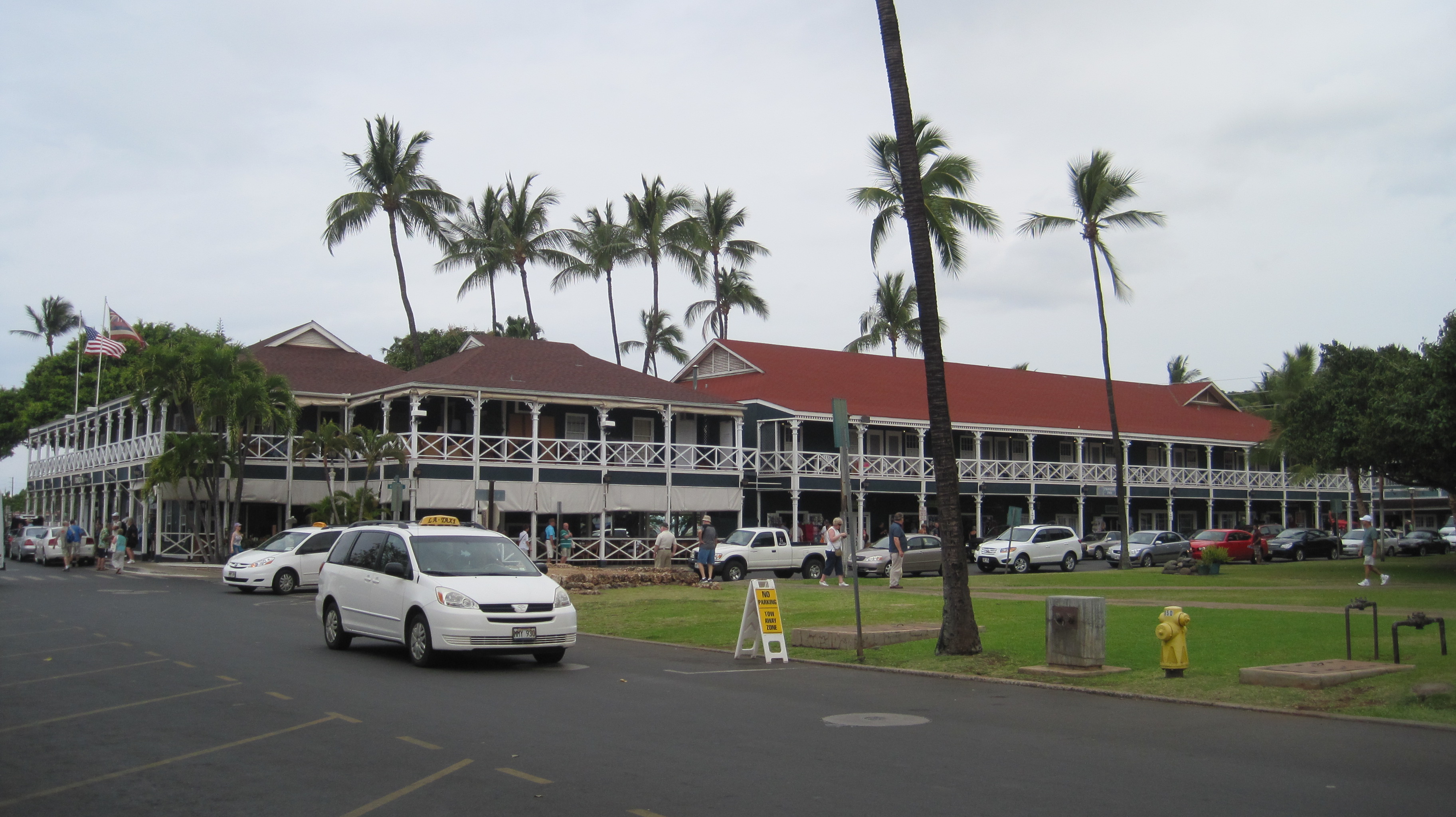
Pioneer Inn, Lahaina, Maui

Pioneer Inn, Lahaina Historic District, 2010, destroyed by wildfire in 2023

The Far Outliers paid a visit to Maui in March 2010 and, as is our custom, we made an effort to photograph sites on the National Register of Historic Places. I uploaded most of them to Wikimedia Commons, put them in the public domain, and then inserted them into the Wikipedia NRHP listings and articles for sites in Maui. The rest I uploaded to my Flickr site, where I created a separate album for Maui. In the wake of the destructive wildfires on Maui, I’m now adding my Wikimedia Commons photos to my Maui album on Flickr for extra backup.

Leave a comment

Filed under Hawai'i, publishing, travel

Kalakaua Visits Meiji, 1881

From Emperor of Japan: Meiji and His World, 1852–1912, by Donald Keene (Columbia U. Press, 2005), Kindle pp. 346-347:

On February 23 the emperor had word from John Bingham, the American minister, that King Kalakaua of Hawaii would be arriving in Japan on a round-the-world journey. The king would be traveling incognito, but he had some state business to transact: he wished to encourage Japanese migration to Hawaii and to sign a treaty with the Japanese government. He was accordingly treated as a state visitor, and Prince Yoshiaki was appointed as the commissioner for the visit. Two other officials were charged with entertaining the king.

Kalakaua arrived in Yokohama on March 4. He was greeted with twenty-one-gun salutes by Japanese and foreign warships anchored in the bay. When the boat sent by the Japanese to take the Hawaiians from the Oceanic to their hotel touched shore, they heard the Hawaiian national anthem, played with explosive vigor by a Japanese military band. They were astonished that the Japanese musicians had learned the anthem of so remote and unimportant a country. The king and the others of his retinue, touched, were all but in tears. Along the way to the palace where they were to stay, they noticed that the houses of Yokohama were decorated with crossed Japanese and Hawaiian flags. The king and his party were stunned by the welcome.

Kalakaua traveled to Tōkyō the next day aboard the imperial train and, after receiving an official reception at Shimbashi Station, proceeded directly to the Akasaka Palace. The emperor, following the etiquette of European courts that requires a monarch to receive a visiting monarch at the threshold of his palace, went to a room close to the entrance of the palace to meet his royal visitor. He was resplendent in a dress uniform studded with medals. The two monarchs shook hands. The Hawaiians, having been informed that the emperor normally did not shake hands, interpreted the gesture as a special honor. The two monarchs, after exchanging formal greetings, walked side by side into an interior room. W. N. Armstrong, the king’s chamberlain and the chronicler of his journey around the world, had heard that because of his divine origin, the emperor had never before permitted anyone to walk by his side; even the empress followed him. “But, for the first time in his own reign, and in those of his predecessors, he walked by the side of his kingly guest.”

The empress was waiting for the royal visitor in the audience chamber. Meiji presented Kalakaua to the empress. “She did not rise, but returned the king’s salutation with the least movement of her head and eyes.” Sueko, the daughter of Inoue Kaoru, who had spent several years in England, served as her interpreter. (Armstrong wrote that she spoke perfect English.) Refreshments were served, but the Hawaiians, having been previously informed that they should not eat in the presence of the emperor, declined them.

Leave a comment

Filed under economics, Hawai'i, Japan, labor, language, migration, nationalism

Okinawan Emigration Destinations

From Liminality of the Japanese Empire: Border Crossings from Okinawa to Colonial Taiwan, by Hiroko Matsuda (U. Hawaii Press, 2018), Kindle loc. ~840:

Before migration to the US mainland became popular in Okinawa, anti-Japanese sentiment spread across the West Coast, where the Japanese population had increased rapidly at the turn of the twentieth century. After the enactment of the Gentlemen’s Agreement in 1908, Okinawans were unable to enter the United States as migrant laborers. Thus, very few Okinawans followed the thousands of Japanese who had migrated to the US mainland. The few who did so during this period were youths pursuing higher education. Some went to the US mainland via Hawai‘i, Canada, and Mexico; a few traveled directly from Okinawa. As the Gentlemen’s Agreement allowed only families of migrants to enter for the purpose of reuniting with husbands and fathers, some female Okinawans arranged to immigrate and join their grooms in the United States as picture brides.

Elderly Okinawans have a saying that best sums up these migration trends: “The richest people were able to immigrate to South America; people with some money migrated to the Philippines; and the poorest worked on mainland Japan.” Indeed, when it proved too difficult to enter the United States as migrant workers, the Japanese turned to South America—especially Brazil—and the Philippines as alternative destinations. Later, the South Sea Islands [Micronesia] became popular as the South Seas Development Company (Nan’yō Kōhatsu) targeted and recruited Okinawan laborers for its sugar industry. While Brazil, the Philippines, and the South Sea Islands were under different governments and Okinawan immigrants there worked in different industries, there are some commonalities among them. First, the initial immigrants in these countries worked in manufacturing and commercial crop industries such as coffee (Brazil), abaca [aka “manila hemp”]  (the Philippines), and sugarcane (the South Sea Islands). Second, Okinawan immigrants accounted for the majority of Japanese immigrant communities in these countries despite their treatment as “second-class Japanese” and “the other Japanese.”

Japan sent the first indentured migrant farmworkers to Brazil in 1908. Okinawans accounted for more than 40 percent, 325 of the 781 immigrants, of that inaugural group of economic immigrants to Brazil. In fact, many of the first Okinawan immigrants left the plantations to which they were allocated shortly after their arrival. This gave a negative impression to both the Japanese and Brazilian governments. In 1913, the Japanese government refused to accept Okinawans wishing to travel to Brazil as indentured laborers, citing their propensity to leave the plantations and their cultural difference from Japanese workers from the other prefectures, but when migration agencies were unable to recruit enough laborers from the other prefectures, Okinawans were once again permitted to go to Brazil as indentured migrant workers. However, as was the case in the United States, Okinawan migration to Brazil was prohibited in 1919, and only immigrants who were currently in Brazil were allowed to send for their families.

In addition to Brazil, Okinawa sent a significant number of immigrants to other Latin American countries. For instance, Peru quickly became one of the most popular destinations for Okinawan migrant workers after the first group of Okinawan immigrants arrived there in 1899. Between 1899 and 1941, Okinawa sent 11,461 immigrants to Peru, accounting for nearly 30 percent of the total number of Japanese immigrants. Although the immigrants were initially employed on plantation farms, many later moved to urban areas, where they became grocery store or restaurant owners.

Similarly, most Japanese immigrants to Argentina were Okinawans. This is despite the fact that Japanese immigrants had been arriving in Argentina since 1910. There were 1,831 Okinawans in Argentina in 1940, accounting for approximately 45 percent of the Japanese population in the country. Not all Okinawans in Argentina had migrated directly from Okinawa; in actuality, many ended up in Argentina after traveling to Brazil and Peru. In Argentina, many Okinawans initially found work as factory laborers or porters. A sizeable number eventually set up small businesses such as coffee shops and laundries.

Leave a comment

Filed under Argentina, Brazil, Canada, economics, Hawai'i, industry, Japan, labor, Mexico, Micronesia, migration, nationalism, Peru, Philippines, U.S.

Arrival in Honolulu, 1840

From Twenty Years Before the Mast, by Charles Erskine (Fossil, 2016), Kindle pp. 126-128:

AT daylight on the morning of the 23d of September we made Oahu, one of the Sandwich Islands, and about eight o’clock entered the harbor of Honolulu. A couple of small hawsers were run out from the starboard bow, and these were seized by several hundred natives, men, women, and children, who were on the reef, up to their necks in water, and very soon the ship was warped over the bar and into port, amid such shouting and singing that it seemed as though bedlam had broken loose. All Honolulu, including its land-sharks, was at the waterside and joined in the shouting and cheering. It was not the novelty that created the excitement, for the arrival of a man-of-war, in their port, was no uncommon thing; but they looked upon the event as a sort of golden shower which was to fill their pockets. They had been expecting our arrival for six months.

There were nine whale-ships lying here, besides our squadron. Five of them were American. The next morning between five and six hundred American sailors, all dressed in white frocks and trousers, black tarpaulin hats and neckerchiefs, and their pockets well filled with Spanish dollars, went on shore. Passing the American consul’s house, half-way up Main Street, we hove to, and saluted the Star Spangled Banner, which was proudly waving from his house. The consul, Mr. Brinsmade, and his wife, bowed very gracefully to us from the veranda.

It astonished the natives greatly to see so many sailors let loose at once. The principal street of the town was Main Street. The first settlers lived on this street, in frame houses. Some of these were painted white, with green blinds, and were inclosed with neat picket-fences. The next street was about half a mile back, and ran crosswise. The buildings on this street had thatched roofs and sides, with glass windows and frame doors. Here were located the grog-shops, dancing-halls, billiard-rooms, cock-pits, sailors’ boarding-houses, and gambling-saloons. Some of these houses were inclosed by walls of brick, dried in the sun, and were whitewashed. These were occupied by the middle classes. European garments were worn by this class of people. On the next street the houses were rudely fashioned. They were built of sticks, vines, and half-formed sun-dried bricks, and plastered with mud. The residents on this street were not quite half-dressed. Some of the men wore hat and shirt, and some wore trousers and no shirt. The dress of the ladies was made very much like a bag with a hole in the bottom, for the head to be slipped through, and arm-holes in the sides. It reached to the ankles, and appeared to be of the same width throughout its entire length.

In the outskirts, mud huts were found, which once formed the only habitations of the Sandwich Islanders. The natives occupying these were dressed in the garb of the heathen, a narrow strip of tapa tied around the loins, or a blanket of the same material thrown corner-wise over the left shoulder and tied in a large knot on the breast.

The greatest curiosity I saw while here was the Seaman’s Bethel. This was built in Boston by the Boston Seaman’s Friends’ Society, taken down and shipped to this port in 1826 or 1828. It was in this bethel that Father Damon preached so many years.

Leave a comment

Filed under economics, Hawai'i, military, nationalism, U.S.

Islands Seeking Hawaiian Protection

From A Power in the World, by Lorenz Gonschor (Perspectives on the Global Past, U. Hawaii Press, 2019), Kindle Loc. c. 2340ff:

Unsurprisingly, one of the key elements of this reassertion of Hawaiian political, cultural, and spiritual identity during Gibson’s premiership was a public reiteration of the concept of Hawaiian primacy in the Pacific. In late 1880, still dealing with the aftermath of the Moreno affair and preparing for his voyage around the world, Kalākaua had received a request by Tonga’s King George Tupou I to enter negotiations for a friendship treaty with Hawai‘i, modeled after those Tonga had already concluded with Germany in 1876 and Great Britain in 1879. The Hawaiian king had responded enthusiastically. Tonga did not follow through on it, however, likely because it experienced domestic instability throughout the 1880s (Rutherford 1996, 143). Against this backdrop of renewed interest in the South Pacific for engagement with Hawai‘i, shortly after the king’s return from the world tour, Gibson had once more written an editorial urging that “the policy of this kingdom should be to assist, in every way that is practicable, to preserve the independence of all those communities of Polynesian race which have not already been driven by circumstances to seek the protection of foreign Powers.” He went on to mention “the significant fact that twenty years ago the Hawaiian Government had been thus represented in the South Pacific by a Commissioner, Mr. St. Julian, whose assistance had been gladly availed of by the inhabitants of the islands.” When this proposal was ridiculed by the Missionary Party press, Gibson had provided a lengthy Hawaiian-language rebuttal, written as a fictional discussion between a Hawaiian diplomat and the minister of foreign affairs of the island of Rarotonga. As the new head of the foreign office, Gibson had now full access to the department’s archives and further studied St. Julian’s earlier correspondence with Wyllie (Bailey 1980, 200–201). Being of like mind with the king on this matter, the two men now intended to bring those visionary ideas to fruition at last.

At the same time, during 1882 and 1883, petitions were received from Butaritari and Abaiang in the Gilbert Islands, asking for Hawaiian protection or outright annexation by the kingdom (Horn 1951, 62). One such petition had already been received in 1878 from Tabiteuea in the same archipelago (60), which had led to detailed discussions in the English-language press, referring to Wyllie’s and St. Julian’s earlier project. Replying to these requests, Kalākaua refused outright Hawaiian annexation but declared his intent to establish closer political relations with the islands’ leaders and unsuccessfully invited them to attend his coronation (63). In May 1883, the king of the Tokelauan atoll of Fakaofo also wrote Kalākaua, requesting him to bring back his people who had left the island. To follow up with the Gilbertese chiefs, in July 1883, Gibson commissioned Alfred Tripp, a ship captain involved in recruiting Gilbertese laborers who had been a member of Kalākaua’s privy council since 1874, as special commissioner for Central and Western Polynesia. Tripp’s mission was cut short because his ship was wrecked in the Gilbert Islands, but he communicated with all major chiefs of that archipelago and brought home more petitions for Hawaiian aid or protection.

Leave a comment

Filed under Britain, Germany, Hawai'i, Micronesia, migration, nationalism, Polynesia, U.S.

Sources of Samoan Legal Terms

From A Power in the World, by Lorenz Gonschor (Perspectives on the Global Past, U. Hawaii Press, 2019), Kindle Loc. c. 3412ff:

What is also intriguing about the Samoan constitutional system is that despite the absence of classical state-like political structures, the vocabulary created for concepts of modern statecraft was remarkably traditional, much more than the equivalent terms in Tongan and Fijian. For instance, the Samoan term for law is tulāfono, a concept clearly grounded in classical concepts of governance. Other terms for innovative institutions were literal translations, such as failautusi (someone doing writing or accounting) for secretary (that is, cabinet minister). Very few words, however, were direct borrowings from foreign languages comparable to Tahitian ture and basileia or Tongan lao and minisitā.

In the end, however, the Constitution failed to produce a stable government, but this was due to antagonistic foreign interests, agitation by settlers, and naval intervention. In early 1876, Steinberger was arrested and deported by a visiting British warship due to a conspiracy of the US and British consuls who objected to the premier’s pro-Samoan policies, especially his commitment to examine fraudulent land sales in the past and prevent further such sales (Gilson 1970, 321–331).

In the resulting chaos, the Ta‘imua deposed Laupepa, who then set up a rebel government. Although all parts of the Constitution were not fully in force, the Ta‘imua continued to run at least the external affairs of the government quite successfully for a while. This included sending High Chief M. K. Le Mamea on a diplomatic mission to the United States to sign a Samoan-American treaty in 1878 and concluding similar, albeit unequal, treaties with Germany and the United Kingdom in 1879. After multiple crises and hostilities between the rivaling parties, Malietoa Laupepa was restored to the throne in 1880—Mata‘afa Iosefo, another paramount title holder, serving as premier—but the government’s authority remained tenuous (Gilson 1970, 332–382; So‘o 2008, 39–41). Nonetheless, the Samoan government published a new set of laws, a copy of which was sent to the Hawaiian government (Kingdom of Sāmoa 1880).

In the absence of Steinberger or another trusted European, the position of premier was abolished and a more extensive executive cabinet created instead. By the mid-1880s, this cabinet included a failautusi sili (secretary of state), failautusi mo Sāmoa (secretary of interior, literally secretary for Sāmoa), failautusi teu tupe (secretary of treasury), failautusi o taua (secretary of war), failautusi o fanua (secretary of lands), failautusi o galuega (secretary of works), the faamasino sili (chief justice), and a failautusi faamau-upu (registrar). The American-derived terminology for these offices reflected the continuing legacy of Steinberger’s political ideas.

In Samoa, Robert Louis Stevenson was called Tusitala ‘Write-story’.

Leave a comment

Filed under Fiji, Hawai'i, language, nationalism, Polynesia, Samoa, U.S.

Sources of Tahitian Legal Terms

From A Power in the World, by Lorenz Gonschor (Perspectives on the Global Past, U. Hawaii Press, 2019), Kindle Loc. 3001:

Unlike the Hawaiian constitutional model with its hybrid forms combining classical elements of statecraft with Western forms, the Tahitian legal code and its derivatives primarily used concepts from either biblical or English law, for example, the word ture for “law,” a Tahitian form of the Hebrew word ה רָוֹתּ (torah), basileia (pātīreia in contemporary Tahitian spelling), deriving from Greek βασιλεία (basileía) for kingdom, or tāvana, Tahitian rendering of governor (>*gāvana>tāvana) to designate the heads of the formerly independent clans or chiefdoms that were reorganized as districts within the new Christian kingdom (Académie Tahitienne 1999, 530; Montillier 1999, 270–271).

The marked contrast to the terminology for the equivalent political institutions in the Hawaiian kingdom—namely, kānāwai, aupuni, and kia‘āina, all of which derive from classical Hawaiian statecraft—is clear. It is also hardly surprising, given the nature or Pomare’s kingdom and the other Tahitian-language realms as secondary states modeled on outside examples, and not primary states that developed endogenously, such as the classical Hawaiian predecessor states of the Hawaiian Kingdom (Hommon 2013, 184–185).

For this book, the contrast becomes most relevant where influence of the Tahitian model intersected with that of Hawai‘i. For a short period, this also included the Hawaiian Islands themselves, where Tahitian converts played a significant role in converting the leading figures of the Hawaiian court to Christianity in the 1820s. However, this influence was short lived, and the Hawaiian political system developed along significantly different lines as we have seen earlier in this book.

Leave a comment

Filed under Hawai'i, language, nationalism, Polynesia, religion