
Category Archives: food

Foreign Tourists in Hanoi

From Catfish and Mandala: A Two-Wheeled Voyage Through the Landscape and Memory of Vietnam, by Andrew X. Pham (Farrar, Straus and Giroux, 2010), Kindle pp. 225-226:

The one thing a solo traveler can count on finding in an area crawling with backpackers and expatriates is a bargain bed for the night. Usually, the food isn’t bad either. I have no idea where Hanoi’s tourist town is, so I buy a map and meander. It is an easy task since Hanoi is a more sedate city than Saigon. The traffic is much lighter, and in the cooler air under tree-shaded avenues, the smog is more tolerable. Hanoi lives on a scale more comprehensible than Saigon. The trees are smaller, more abundant, and not so tall and tropical like those of Saigon. I stroll along the fine mansions, taking in their faded, colonial French glories, their expressive arches, French windows, and wrought-iron balconies. Every structure holds itself up proudly in a state of elegant decay. At the north end of Hoan Kiem Lake, I find six young Caucasian travelers, lurking timidly on different street corners. Backpackers, baby-faced, flushed even in the tropic winter, treading about, wide eyes eating up all the sights, the details. Their pilgrim hands clench dog-eared copies of The Lonely Planet Guide to Vietnam. Alas, I have found my home for the next few weeks.

For tourists, everything that happens in Hanoi happens in the backpacker cafés. Anything that can be had, rented, chartered, borrowed, exchanged, and bought can be obtained or arranged in them. They sneak tourists illegally across the border into China for day jaunts, book hotel rooms, lodge people in-house, serve decent Western food, sell traveling supplies, fresh baguettes, and Laughing Cow cheese, which is the staple travel food for foreigners who fear stomach bugs. They book anything. Legal, illegal. You got the dollars, they can find your pleasure.

I bum around Hanoi with Australians, French, Danes, Brits, Germans, and Americans just soaking up the culture, exploring the urban sprawl one district at a time. The city is broken up into ridiculously distinct commercial sections, guild oriented, another French legacy. If you want to buy shoes, you go to the shoe district, where thirty or so adjacent stores sell only footwear, often the same style and brand. There is a part of town for every category of goods and services: clothing, poultry, silk, jewelry, and electronics. There is even an area with shops making headstones, where dust-covered men kneel on the sidewalk chipping names into slabs of granite. Our favorite is the street of nem nuong diners. Around dinnertime, straddling the sunset hour, the street is perfumed and grayed with the smoke of meat sizzling over coals. If you catch a whiff of this scent, you never forget it. It is a heady mixture of fishsauce marinade, burning scallions, caramelized sugar, pepper, chopped beef, and pork fat. Women sit on footstools grilling meats on hibachi-style barbecues. Aromatic, stomach-nipping smoke curls to the scrubby treetops and simply lingers, casting the avenue into an amber haze. When hungry folk flock from all over the city to this spot, they have only one thing on their mind. And the entire street, all its skills and resources, is geared to that singular satisfaction.

The days pass without difficulty. I am at last among friends of similar spirit, all non-Asian, not one of them Vietnamese. And I am happy, comfortable merely to be an interpreter. Every day, we troop off to some part of the city on sight-seeing missions. At night, we congregate for great bouts of drinking and barhopping. We splinter into smaller parties and sign up for organized boat tours in Ha Long Bay and ride rented motorcycles to the countryside. We joke, we romance each other with the wild abandon of strangers cohabiting in exotic moments. We ask about Hanoi and its people, we ask about each other. Bonding, trading addresses, and fervently believing that we will never lose touch.

Leave a comment

Filed under food, language, migration, travel, Vietnam

Breakfast Options in Vietnam

From Catfish and Mandala: A Two-Wheeled Voyage Through the Landscape and Memory of Vietnam, by Andrew X. Pham (Farrar, Straus and Giroux, 2010), Kindle pp. 122-123:

I wait for the rice-cake woman on the stoop. Normally, I mimic her cry from any part of the house, and no matter how noisy the neighborhood is, she hears and waits for me in the alley. I buy a mug of tea and two rice cakes—Vietnamese Twinkies wrapped in banana leaves. The gooey grains of glutinous rice, green and fragrant with the banana leaves, taste fat and fruit-sweet, like candied caviar. Embedded at the center, the ladyfinger banana has changed to a lavender hue haloing an ivory core. Hot tea in hand, I savor them, standing in the alley, back against the wall, watching the strip of sky navying over.

One by one the breakfast women weave through the alleys. The parade of food baskets ribbons the morning air with the varied aromas from every region of Vietnam: banh canh (udon in chicken broth), bun bo hue (spicy beef and anchovy-paste noodle soup), hu tieu (Chinesestyle noodle soup), banh beo (rice dumpling with shrimp powder and fishsauce), tau hu (soft tofu with ginger syrup), banh cuon (rice crepes with Vietnamese sausage and fishsauce), soi (sweet rice with mung beans and coconut shavings), banh mi thit (ham-and-pickled-daikon sandwiches), and a host of other morning food. Vietnam is a country of food, a country of skinny people obsessed with eating.

Leave a comment

Filed under food, language, migration, U.S., Vietnam

A Vietnamese Fishsauce Baron

From Catfish and Mandala: A Two-Wheeled Voyage Through the Landscape and Memory of Vietnam, by Andrew X. Pham (Farrar, Straus and Giroux, 2010), Kindle pp. 52-53:

My step-grandfather Grandpa Le was a fishsauce baron, born into a sea-heritage that dated back before the Japanese and the French occupation. He used to claim that his ancestors invented fishsauce. The whole town was built on this industry. Everyone knew how it was made and at one time most people in town, when they weren’t dragging the ocean for fish, were putting fresh fish, unwashed and ungutted, into salt barrels to ferment. While they waited on the decomposition process, all they ever talked about was fishsauce. Which fish produced the best-tasting extract? How to mix various types of fish to make a balanced bouquet. Indeed, there were many varieties of fishsauce, each suitable for a certain style of cooking. The finest batches were flavorful enough to be savored directly from the bottle. In a few weeks, a smelly black ooze seeped out the bottom of the barrel. Fisherfolk diluted and bottled this black gold and sold it all over the country. Blend masters—like Grandpa Le—guarded their secrets zealously and made fortunes. In the old days, the village folk prized bottles of fishsauce concentrate as great gifts, the equivalent of fine wine and cash.

Uncle Long said these days people treated it like an illicit narcotic, hiding their production from the tax collectors, squirreling bottles of it away for bartering. Liberated into Communism or not, Vietnamese needed fishsauce the way we needed air. For us, it was salt and a thousand other spices, the very marrow of the sea to a country of coastal people. It was a good thing Grandpa left us a stockpile of fishsauce when he died.

Grandma Le’s house and sundry shop sat five yards from the main road, the national highway. The bus dropped us at the front door. Grandma, Auntie Dung, and all my siblings—Chi, Huy, Tien, and Hien—came out to greet us. Grandma took me into her shop and said I could eat as much candy from her store as I could swallow on account that she hadn’t had chance to spoil me as she had my siblings. They had been living with Grandma when we came back from prison. While I was locked up in Saigon, they were running wild with the local kids.

Auntie Dung took all of us out for milkshakes. We walked down the shady avenue, holding hands, singing, our sandals scrunching on sand—this a beach town—to a kiosk that had been in the same spot under a tamarind tree since I could remember. The vendor, whose laughs were as fresh as the sweet fruits she served, hand-shaved ice for us until her arms ached. Huy and Chi had durian milkshakes made with shaved ice and condensed milk. Tien had his favorite, a breadfruit milkshake. I had soursop.

Leave a comment

Filed under economics, food, migration, Vietnam, war

The Spark that Toppled Ceauşescu

From Uncivil Society: 1989 and the Implosion of the Communist Establishment, by Stephen Kotkin (Modern Library Chronicles Series Book 32; Random House, 2009), Kindle pp. 111-115:

László Tőkés had a history of conflict with Romania’s Reformed (Calvinist) Church authorities as well as with the political authorities; that’s how the pastor had ended up in Timişoara. At previous postings in Braşov and Dej, both in Transylvania (which has a large ethnic Hungarian minority), Tőkés had spoken out against the leadership of the Reformed Church, whose congregation in Romania was entirely ethnic Hungarian, and the condition of Romania’s Hungarians. This had provoked his relocation to Cluj—where his father had been dismissed as deputy bishop—and then, in 1986, to Timişoara (outside Transylvania), a predominantly Romanian Orthodox yet cosmopolitan city of about 350,000. What major trouble could the Hungarian pastor possibly cause there? In Timişoara, Tőkés set about reviving the small local Reformed church with his charisma. He allowed students to recite poetry at services, which was expressly forbidden, and spoke out against Ceauşescu’s unpopular “systematization” (destruction) of villages and their Orthodox churches. The Timişoaran authorities, faced with the prospect of organized dissent, pressured the Reformed Church bishop to remove Tőkés as pastor, which he did in March 1989. On that ground, the authorities set eviction proceedings in motion. Tőkés appealed. At Timişoara’s Reformed church building—three modest stories of grimy brick and stone, lacking even a cross or spire—every window of the pastor’s flat was smashed. In November, Tőkés was slashed in a knife assault by thugs during a break-in; police who were posted outside to keep him under house arrest did nothing. Finally, losing his official appeals, Tőkés appealed to parishioners at Sunday Mass to witness his scheduled “illegal” eviction on the coming Friday, December 15. That’s right: the authorities had informed the pastor of the precise date.

Around forty parishioners, mostly elderly, formed a human chain outside the pastor’s residence. They benefited from a sudden unseasonably warm winter stretch, following a brutal cold snap, but, more important, they defied the conspicuous Securitate. When the Securitate did not disperse the small crowd, more people beyond the pastor’s supporters joined, including ethnic Romanians, Germans, Serbs, Greeks, and, some have said, a few Gypsies. The Hungarian pastor spoke from his windows to the crowd outside in Romanian. Some who joined were from other Protestant denominations, such as the Baptists and Pentecostals, religious minorities that were similarly harassed. Others came from an adjacent stop for the tram that ferried workers to the city’s outlying industrial plants and students to the big local universities. The tram also facilitated the spread of information about the confrontation throughout the town. Timişoara’s inhabitants that winter, as previously, had no electricity for most of the day and often for much of the evening, including during the interval from 6:00 until 9:00 P.M., when people needed it most. Elevators were avoided, since the blackouts, coming without warning, trapped people in them. The strongest lightbulbs sold were only 40 watts. The temperature inside homes was no more than 55 degrees Fahrenheit in winter, and hot water usually came on just once a week.

People in Timişoara, as elsewhere in Romania, were given coupons to buy a few kilos of meat and fifty grams of butter—a month. They queued for hours, and sometimes even the meager allotments their coupons permitted ran out. Meanwhile, as everyone in Timişoara knew, on the outskirts lay one of Europe’s largest pork-processing plants. The town also had large local bread factories and other major food production facilities. Many Timişoarans labored in these plants, and they doubtless told others what was made in them and in what quantities. But much of this locally produced food, like everything else, was being exported for hard currency. The furious townsfolk, spending years shoulder to shoulder in queues, were united in their deprivation. But they could call upon no forms of social organization other than their churches, which were under Securitate surveillance. Their workplaces belonged to the regime. Furthermore, crowds on the streets were permitted only in connection with scripted holidays and soccer matches. In fact, back on November 15, following Romania’s defeat of Denmark in a World Cup qualifier in Bucharest, Timişoara’s streets had filled with elated fans, some of whom had apparently chanted “Down with Ceauşescu!” This unpublicized incident had indicated the potential for a wider conflagration if some thing set it off. That is exactly what the pastor’s principled, stubborn defiance had triggered on December 15.

On December 16, Timişoara’s mayor, summoned to intervene by the Securitate, arrived at the Reformed church with workmen to replace the shattered windows and with doctors to examine the pastor’s pregnant wife. In turn, the mayor requested that Tőkés instruct the crowd to disperse. In order to avoid bloodshed, the pastor agreed. But the crowd, by then much beyond his congregation, was in no mood to go home; some began accusing Tőkés of collaboration. Others assumed that his dispersal request resulted from pressure by the Securitate. Tőkés discovered himself a “prisoner” of the people’s anger. But “in that street,” recalled one eyewitness, “was a tension and a feeling of power that you could almost touch.” Both joyous and apprehensive, the gathering crowd began to relocate from the small church toward the city center, Opera Square, several blocks away. Having initially assembled to defend the ethnic Hungarian pastor, the crowd began singing the 1848 nationalist anthem, “Awake, Romanians.” Shop windows were smashed—the regime’s blackouts enabled some people to hurl rocks without being seen—and some chanted “Down with Ceauşescu!” “Down with tyranny!” “Freedom!” This lightning escalation—precisely what the appearance of the mayor had sought to preempt—had transpired in a single day.

It was the beginning of a political bank run.

Leave a comment

Filed under democracy, economics, energy, food, industry, nationalism, religion, Romania

Indochina, 1945: Famine & Coup

From Asian Armageddon, 1944–45, by Peter Harmsen (War in the Far East, Book 2; Casemate, 2020), Kindle pp. 200-202:

The famine lasted for five months in early 1945 but its causes could be traced back to the year before, and similar to the mass starvation that had struck British-ruled India earlier in the war, it was the result of both natural calamities and official policies. Drought and insect attacks caused the spring harvest in 1944 to drop steeply below expectations, and the following autumn devastating typhoons cut down the agricultural output dramatically. The worst effects of the hunger disaster could have been mitigated if rice had been sent to the north from southern regions, where the crops were more plentiful. However, American bombing had destroyed bridges, railroads, and other infrastructure, and anyway both the Japanese army and the French colonial authorities, who were still in charge despite the presence of large Japanese forces, prioritized the transportation of their own military forces over vital food supplies for the civilian population. Between one and two million people died as a result of the 1945 mass starvation in Indochina. This overall figure covered vast regional variations, and in the worst hit areas of northern Indochina, society teetered on the brink of collapse.

The food scarcity also affected those inhabitants of Indochina who were not directly pushed to the limit by starvation, but still saw a precipitous drop in the standard of living due to steep prices in rice. The result was that the French colonial authorities became even more unpopular than before. The fact that the French administration had helped prevent the kind of mass conscription of forced labor that had happened in other parts of Japanese-controlled Asia mattered less. To many Indochinese it made a much deeper impression to see sharply dressed Japanese officers walk the streets of the major cities, in humiliating contrast to the often flabby-looking French colonial troops.

Therefore, there was widespread anticipation of better times when on March 9, 1945, the Japanese Army in Indochina took over control from the French colonial authorities in a swift coup. French officers were taken into custody, and their soldiers ordered to lay down their arms. Those who resisted were met with trademark brutality. A few French garrisons opposed the Japanese move, and in some cases extended firefights took place. At the end of the battles, French prisoners were bayoneted or beheaded. Defeated foreign legionnaires were forced to watch as Japanese soldiers hauled down the French flag, tore it to shreds, and stamped it into the ground. Rapes of French women were commonplace. Duong Thieu Chi, the official who had witnessed instances of cannibalism, was shocked to see a senior French colonial official be thrown to the floor by a Japanese captain and then beaten bloody with the hilt of a sword.

The new Japanese rulers took steps to improve the food supply, for example by handing out grain from public granaries under much publicity, and also ensured a fairer distribution of rice where it was needed. However, they were less enthusiastic about nationalistic sentiments in the population, who suddenly believed that colonialism might be a thing of the past, resulting in mass gatherings and strikes. “The defense of Indochina against the enemy outside the country will be completely ineffective if domestic order is not perfectly maintained,” the Japanese military authorities warned in a statement. The people of Indochina gradually came to understand that their new masters were perhaps not all that different from the old ones.

Leave a comment

Filed under Britain, food, France, Japan, Laos, military, U.S., Vietnam, war

Missouri River Travelogue: ND

The first stops in North Dakota on our 4250-mile road trip up the Missouri River and back were the tiny towns of Hague and Strasburg, not because the latter was the hometown of Lawrence Welk (another German via Odessa), but because it contained one of several cemeteries in Emmons County that contained distinctive wrought-iron crosses, whose National Register of Historic Places listing in Wikipedia had no photos. The crosses were made by German-Russian blacksmiths in central North Dakota who developed individual styles and whose work was known for miles around.

Our next stop was in Bismarck at the North Dakota Heritage Center and State Museum, which had a special exhibit on Native American storytellers in addition to its many exhibits on natural history, including lots of dinosaurs whose fossils are abundant in the Dakotas.

On our way to Minot the next day, we stopped to photograph (for Wikipedia) historic (1885) Ingersoll School in Underwood and later to view the Garrison Dam and Lake Sakakawea, the largest water storage reservoir in the U.S. (Lake Oahe in SD is the second largest.) In Minot, where Ms. Outlier spent her college years, we visited the attractive Scandinavian Heritage Center.

The next day we drove US2 west to Williston, stopping at Stanley and Ross in Mountrail County to photograph two NRHP sites for Wikipedia: the (1937) Great Northern Railway Underpass (very helpful when long freight trains are passing) and the unexpected (1929) Assyrian Muslim Cemetery. The Great Northern Railway (now merged into BNSF) was extended from Minot as far as Tioga, ND, in 1887, thanks primarily to Japanese immigrant labor. (US2 follows the railroad.) It brought many immigrant settlers onto the northern plains and carried enormous quantities of grain out. In 1951, Amerada Petroleum Corporation (now Hess Corp) discovered oil near Tioga and the resulting oil boom has made Mountrail and Williams counties the richest in North Dakota. Nearly every large farm has an oil well on it.

That afternoon, we took ND1804 (named for the year Lewis and Clark went upriver) to Fort Buford Historical Site at the confluence of the Yellowstone and Missouri Rivers, then drove farther to Fort Union Trading Post National Historic Site right at the state line. (The parking lot is in Montana.) For dinner, we enjoyed big servings of northern pike at the Williston Brewing Company in the old but renovated El Rancho Hotel.

On our way back to Bismarck the next day, we drove through the north unit of Theodore Roosevelt National Park, with lovely vistas of the North Dakota Badlands, the Little Missouri River, and herds of bison. After a long drive on I-94, we had fish again for dinner that night with one of Ms. Outlier’s old school friends, and lunch with another on our way south on US83 the next day.

Halibut en papillote

Leave a comment

Filed under education, energy, family, food, labor, migration, travel, U.S.

Missouri River Travelogue: SD

Back on the Lewis and Clark National Historic Trail, we followed the Missouri River into South Dakota, stopping first at Vermillion to photograph the fine architecture of the University of South Dakota. We made another stop in downtown Yankton to visit the waterfront before driving across Gavins Point Dam to see the hydroelectric plant and the visitor center on the Nebraska side of the river. After many attempts, I managed to get a clean shot of one of the many pelicans fishing and basking there.

From there, we headed north to visit the Corn Palace and eat lunch at the Cattleman’s Club Steakhouse in Mitchell before stopping for the night at Huron, where Ms. Outlier was born. In Huron, we photographed the world’s largest pheasant and visited the State Fair Grounds, where we found a monument to La Société de Quarante Hommes et Huit Chevaux Grand du South Dakota (a.k.a. French Boxcar), whose history was entirely new to me. After our meaty lunch, we were not very hungry that evening, but the rich aroma of South Asian spices coming from the motel owner’s suite enticed us to walk to a neighboring steakhouse where we ordered salads and wine.

The next day, we drove up to Aberdeen, where we visited the Dakota Prairie Museum and other historic sites downtown, including a building that had collapsed under heavy snowfall in March. We had dinner with cousins and lunch the next day with Ms. Outlier’s last remaining aunt. Our convention-oriented Ramkota Motel was hosting several high school graduation parties. (The Super 8 motel chain originated in Aberdeen, but we were not impressed with it on an earlier visit there.)

On our way to Bismarck, ND, we passed through Leola, SD (Rhubarb Capital of the World), and Eureka, SD (Kuchen Capital), once filled with Germans from Bessarabia. Ms. Outlier’s German ancestors had a farm in Eureka but there was no sign of it now. They immigrated to the Dakotas from Neudorf, now called Carmanova in Transnistria. There is a Neudorf cemetery outside Eureka, but it is not accessible to the public.

On our way back downriver several days later, we overnighted at another, much emptier Ramkota Motel in pleasant little Pierre, SD, the second least populous state capital in the U.S. (Montpelier, VT, is smaller.) Its capitol building is modeled on the one in Helena, MT. We drove across the river to Fort Pierre to visit Oahe Dam, which generates power for Minnesota, Montana, and Nebraska, as well as the Dakotas. The Missouri River usually marks the boundary between the Central and Mountain time zones in the Dakotas, but all businesses in Fort Pierre observe Central time—except the bars, which allow patrons to enjoy another hour of drinking before Mountain closing time.

Leave a comment

Filed under energy, food, industry, labor, migration, travel, U.S.

Missouri River Travelogue: MO

Last month the Far Outliers took a long road trip up the Missouri River and back to visit a few of the old friends, family, and stomping grounds of Ms. Outlier’s youth. We roughly followed the Lewis and Clark National Historic Trail. Our new Honda CR-V hybrid recorded 90 hours of driving time over 4230 miles between the time we picked it up at Nashville airport and the time we turned it back in. Here are a few notes about Missouri, with links mostly to photos on my Flickr site.

From Paducah, KY, we drive I-24, I-64, and I-44 right through St. Louis until we reached the scenic route along the Missouri River, MO100 and MO94, with stops at the well-maintained German  town of Hermann and the once bustling riverboat port of New Haven. We stopped for the night in Jefferson City. The next day we explored historic Arrow Rock, where the Santa Fe Trail crossed the Missouri River, then took I-70 and I-29 right through Kansas City up to the faded glory of St. Joseph, where we had drinks at The Angry Swede and spent the night at the (1885) Whiskey Mansion B&B. Missouri’s many wooded roadsides generated an enormous number of roadkills: not just the occasional deer, but lots of raccoons, opossums, and armadillos!

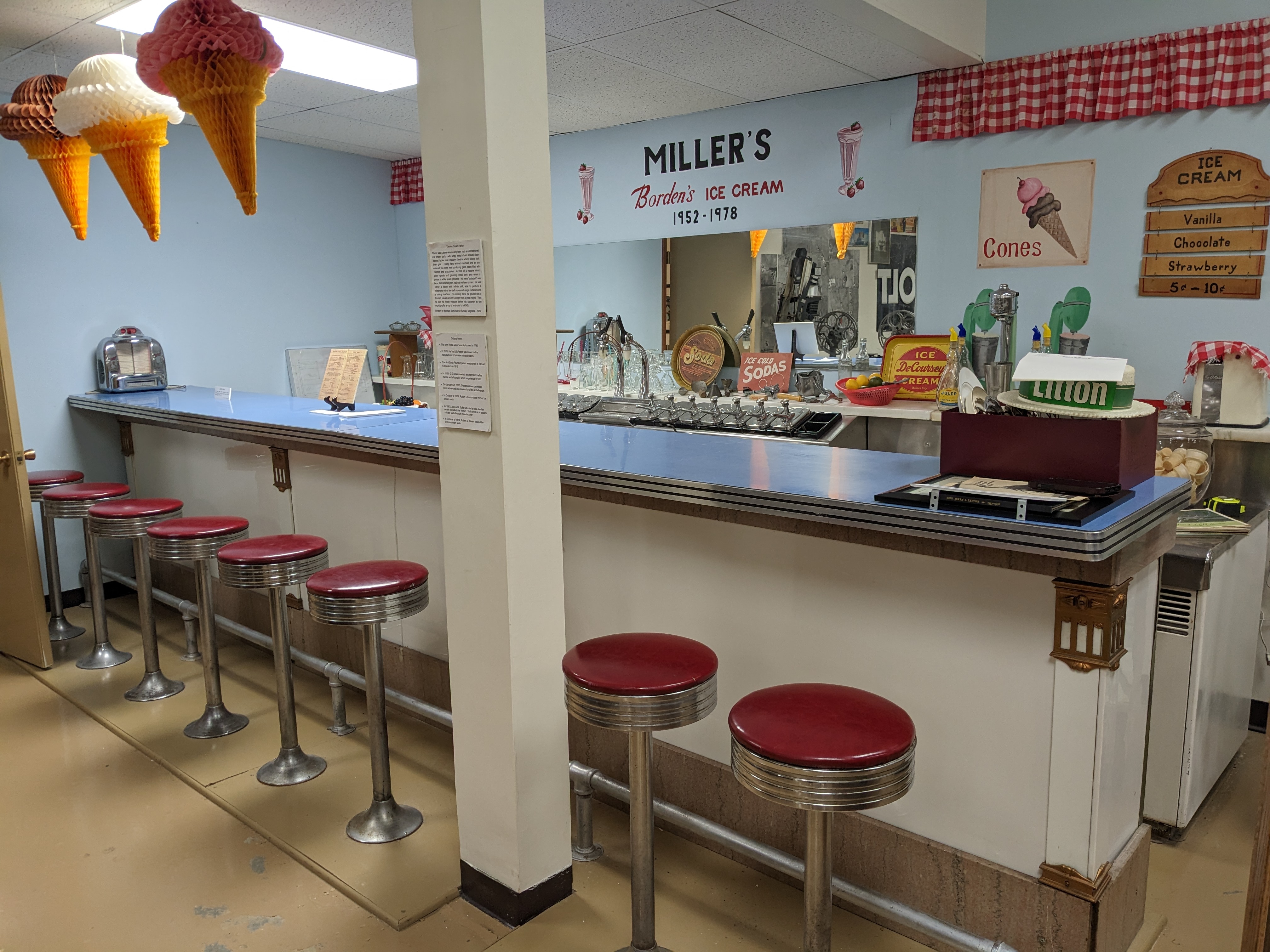
On the way back through Missouri on the Saturday of Memorial Day weekend, ladies at the first Visitor Center on I-29 warned us about traffic through Kansas City, which was hosting a Royals game, and advised us to take US36 from St. Joe across to Macon, then US63 down to Columbia, where we were booked for the night. The drive was far more pleasant than the Interstates, and we very much enjoyed exploring the quirky Grand River Historical Society Museum in Chillicothe, MO, where Otto Rohwedder invented the first automated bread-slicing machine for commercial use. A 1928 model of the Breadslicer was on display, on long-term loan from the Smithsonian. They also had a full display of an old-style ice cream and soda fountain.

Miller's ice cream and soda fountain, 1952-1978Miller’s ice cream and soda fountain, 1952-1978

Leave a comment

Filed under food, industry, migration, travel, U.S.

Eastern Europe After Mohacz

From The Making of Eastern Europe: From Prehistory to Postcommunism, by Philip Longworth (Lume Books, 2020), Kindle pp. 250-252:

The political consequences of the battle of Mohacz were also considerable. Louis II had died childless; and the Habsburgs of Austria, long-sighted dynastic politicians and shrewd diplomatists, became the leading contenders for the thrones of both Hungary and Bohemia, and soon gained both. But in Hungary there was strong backing for a local candidate, John Zapolyai, and he, too, was crowned king. This political division weakened resistance to the Turks, who by the end of 1541 had occupied the southern and central parts of the country, including the capital Buda; and gained suzerainty over the east, which became a largely autonomous principality, Transylvania.

The death of Louis had ended one Eastern European dynasty. Two others failed to survive the sixteenth century. The last Jagiellonian King of Poland-Lithuania died in 1572; the last of Russia’s ancient Riurikid dynasty in 1591. In both instances political hiatus encouraged tumults, though, as we have seen, the long-term outcomes were quite dissimilar. While Russia returned to dynastic rule, Poland abandoned it. In this respect she came to resemble the smaller polities in the region, the Danubian Principalities, self-governing tributaries to the Turk, which also lacked dynastic rule: The instability of their domestic politics is suggested by the fact that, in the course of one century Wallachia had twenty-four, and Moldavia no fewer than forty, changes of ruling prince, or hospodar.

These religious and political changes were obvious to contemporaries. But there were other shifts, no less profound in their effects, which were much less noticeable at the time, or recognized only in retrospect.

Europe’s centre of economic gravity had been moving from the Mediterranean to the countries bordering on the North Atlantic; from the basin of the River Po to that of the Rhine (where it has remained); and from the emporia of Istanbul and Venice to that of Amsterdam. Furthermore, a surge in the population of Western Europe, and in particular of its cities, was stimulating a sharply increasing demand, and hence higher prices, for imported foodstuffs which Eastern Europe was able to supply. This was to have marked social as well as economic effects, especially on those regions with access to the Baltic, not least in encouraging the rise of serfdom.

At the same time the importation of silver from the Americas was promoting a sharp increase in the money supply and hence serious inflation. This was to throw the finely-tuned mechanisms of the Ottoman state out of kilter and prove a major factor in its subsequent decline. And there was one change perceived by very few, if at all, the indirect effects of which were felt by almost everyone. This was ‘the little ice age’, a slight but insidious drop in the average temperature beginning late in the sixteenth century. By restricting the latitude and height at which agriculture was viable this precipitated famines, population movements and the great disorders which were to overtake most of Eastern Europe at the turn of the century, turning the frontier lands especially into a crucible of violence.

And there was a plethora of other factors which intervened at various points with varying intensity to influence the course things took. Linguistic differences, for example, sometimes fed into religious and political struggles; and social classes sometimes gained or lost constitutional rights according to the religion they embraced at a particular moment. Low population density in Poland-Lithuania contributed to the enserfment of the peasant; yet high population density in the Ottoman Empire contributed to the disruption of that state. Sometimes the effects seem paradoxical. The Turkish presence, so often assumed to be a wholly negative influence, slowed down and even reversed the process of enserfment in Hungary for a time. The Baltic grain boom had helped to promoted serfdom, yet the end of the boom around the turn of the century served not to remove serfdom, but to entrench it. And though Protestantism is often associated with the origins of modern science Copernicus was a priest whom Polish Protestants rejected, while the patron of Tycho Brahe and Kepler was a Habsburg. The interactions of circumstances and catalysts that shaped Eastern Europe in the period from 1526 to 1648 far exceeded in complexity the most complicated transmutation process in any alchemists’ laboratory.

Leave a comment

Filed under Britain, Eastern Europe, economics, food, Germany, migration, military, nationalism, Netherlands, religion, science, slavery, Spain, Turkey

Defeated Lakota, 1880s

From Lakota America: A New History of Indigenous Power, by Pekka Hämäläinen (The Lamar Series in Western History; Yale U. Press, 2019), Kindle pp. 374-375:

The army’s withdrawal only opened the door for another assault by the federal government, now in the form of assertive agents, missionaries, school teachers, and “civilization” programs. The agents no longer sought to reform the Lakota society; that policy had expired the moment Custer died. They now aimed to hollow out Lakota society and fill the void with white American values, norms, words, customs, and thoughts. Once tribalism was pulverized, so went the logic, Lakotas could be absorbed into the American society as individuals and nuclear families.

Some Lakotas accepted and actively embraced farming and schools, but most were horrified by the assimilationist zeal. After all, Lakotas had possessed an extensive reservation and dominated the vast northern plains only a year earlier; their fall from power had been shockingly fast and complete. The acreage under the plow increased across the reduced reservation, but so too did resentment and despair. Chiefs struggled to maintain their status in a strange world where government agents incited rivalries among them, mobilized the akíčhitas [= marshals, camp police] to control them, and withheld rations to weaken them. Former hunters and warriors were reduced to eking out a living by driving wagons, hauling freight, and cutting wood. Women’s traditional roles narrowed in the male-dominated reservation milieu and their standing as providers deteriorated as men took up farming and secured wage jobs. Children were removed from their families and taken to boarding schools where, separated from what was traditional and safe, they received an education geared to extinguish the Lakota culture.

The Great Sioux Reservation became a battleground for competing visions of the Lakota future. In 1881 Spotted Tail was killed by Crow Dog, a captain of the Indian police, who could not accept the old chief’s defiant traditionalism, persisting popularity, and multiple wives. That same year Sitting Bull, no longer able to hold on to his starving followers, crossed the medicine line [Canadian border] again and formally surrendered at Fort Buford with Crow King. He gave his rifle to his six-year-old son who handed it over to an army officer. “I wish it to be remembered that I was the last man of my tribe to surrender my rifle,” the fifty-year-old chief said. “This boy has given it to you, and now wants to know how he is going to make a living,” he said, intimating the struggles his son and others of his generation would face in the alien world the wašíčus [whites] imposed on the Lakotas. Crow King asked a Chicago Tribune correspondent for two dollars to buy dolls for his girls.

Sitting Bull was taken to Fort Randall on the Missouri River where he was held as a prisoner of war for nearly two years. He then settled in the Standing Rock Agency where James McLaughlin, a ruthlessly effective assimilation crusader, was tearing the fabric of the Lakota society apart by recruiting “boss” farmers, policemen, and judges among the Lakotas to educate, monitor, and punish other Lakotas. The rift between the Indian police and traditional spiritual leaders became particularly corrosive.

Leave a comment

Filed under economics, education, family, food, labor, language, migration, nationalism, U.S.