Category Archives: Romania

Not the Orient Express

On our first trip to Romania in 1983, we booked our reservations with an agency who knew what they were doing—Thomas Cook, I believe it was. We took the Orient Express from Paris to Bucharest. This time we bought our Eurail passes online and booked our reservations as we went along. Being well into middle age, we bought the First Class Saver passes (for groups of two or more people) good for 15 consecutive days of travel, which we planned for the first two weeks of January.

Passing Bavarian countrysideOur first mistake was buying the passes from eurail.com, which offers no help with reservations after the sale. Other rail pass vendors, like railpass.com or eurail-pass.com or raileurope.com, will book reservations for people who bought passes from them. Commercial travel agents are not very interested in Eurail pass bookings for just a fraction of the small reservation fee; and national railway systems, even within the EU, may work well with their immediate neighbors, but not with national systems farther down the line.

Romania is pretty far down the line from France. A helpful agent of the SNCF in Strasbourg booked us to Vienna (via Stuttgart and Munich), and gave us the timetable of an overnight train from Vienna to Bucharest, but could not reserve us a sleeping car. (The current Orient Express only runs between Strasbourg and Vienna.) The DB office in Munich had no problem booking us through to Bucharest. The DB certainly impressed us as the gold standard for train travel on both sides of the Atlantic, while Lufthansa similarly impressed us as the gold standard for air travel across the Atlantic, especially after they upgraded us to business class for our Xmas Day flight from Boston to Frankfurt (for no good reason, unless we looked like Herr Santa und Frau Klaus).

Original BudweisersOn the 1983 Orient Express, we stayed in the same Wagon-Lit compartment both nights (between France and Germany and between Hungary and Romania), but we noticed a degradation in quality at each change of dining car. We enjoyed an excellent German breakfast in a spotless dining car as we passed through Bavaria the first morning. That evening we enjoyed a pleasant dinner in a clean Hungarian dining car as we headed for Budapest. The dingy Romanian dining car at breakfast was full of smokers drinking ersatzkaffee and plum brandy.

Crossing the Hungarian border at Hegyeshalom around sunset the night before was memorable, but not nearly as traumatic as our wee-hour awakening at Curtici on the Romanian border, where we were asked to open our luggage and tell the officials if we had any bibles, dynamite, or typewriters—a dangerously subversive trinity. The only bright spot was that it was my first real chance to use Romanian since finishing Army language school in 1970.

This year our trauma—and long-awaited dormant language revival—began much earlier, as we tried to find car 419 in the train awaiting us across the platform when we arrived at Wien Westbahnhof. We found car 420, then backtracked to 418, then 417, then forward again, then even farther back to—lo and behold—car 419. This was but the first indication that our train was not the Orient Express, but the Dacia Express (D 345). The second, third, and fourth indications were that the car attendant spoke Romanian, that he had to evict a hopeful squatter from our 2-berth compartment, and that the car was labeled vagon de dormit as well as wagon-lit and carrozza letto.

When I went looking for a dining car after the train got underway, I noticed that several of the outside doors were chained shut, and that chains also hung at the ready from doors separating first and second class. I quickly retreated to our compartment, where the car attendant soon stopped by to explain that we should use the extra deadbolt lock to keep out the regular midnight burglars that plagued the border area between Hungary and Romania, and that we were to make sure that anyone who knocked on the door was a real border control official before opening up. Fortunately, the door had a peephole, and we had enough snacks and drinking water to last until our arrival.

Snowy Romanian countrysideThe Romanian border crossing was far more pleasant this time around, though still at an ungodly hour. When I responded in Romanian, the customs official asked where I learned it. I said I learned it in the US Army the first time around, then revived it later during a year a the University of Bucharest. He suggested that perhaps I had been a democracy activist. I protested that I had never done anything very useful with the language.

In the early hours before dawn we could see the highway from our train window. We saw a good bit of truck traffic and well-lit gas stations at regular intervals—quite a change from the Romania we remembered—but the Transylvanian countryside looked a lot bleaker after sunrise, with poorly built, poorly heated houses in silent, sleepy, snow-covered towns with many abandoned factories between the occasional clusters of plants newly built by foreign investors and fed by much more robust powerlines than we saw in the rest of the countryside. (Further observations about changes we noticed will have to wait for another blogpost.)

Doorlock with coathangerFor our return trip from Bucharest to Vienna on Saturday, we boarded the same overnight train (D 346) after stocking up on food and drink at a grocery store in the station. And we got the same lecture about securing our compartment door overnight, this time from a new car attendant with a new trick that employed a coat hanger. He also explained that the teams of burglars only infested the train between Curtici, where it stopped for Romanian customs, and Békéscsaba, the first station on the Hungarian side of the border.

We survived the border crossing unmolested, but also unmoved. We arrived about 2 a.m. and spent most of 3 hours at a standstill, far more than the time required for the Romanian and Hungarian passport control. We finally got underway about the time we should have been arriving at Budapest Keleti, where we had missed the train that was supposed to pull our cars to Vienna. Instead of pulling in to the platform, we spent two hours waiting at a siding, periodically trundling to and fro in front of Budapest’s new Arena Plaza.

Phantasy Schmuck, Vienna, AustriaOur car attendant hibernated while the Keleti station loudspeaker blared forth long announcements, only in Hungarian, to otherwise empty platforms. I couldn’t find a Hungarian speaker among the Romanian passengers to translate. So I finally walked up the tracks to the engine and asked the driver if he spoke Romanian, German, or English. He spoke just enough German to tell me that we would not be leaving until after 9 a.m., about the time we had been scheduled to arrive at Vienna and make our connection back to Strasbourg. The engine had had some kind of trouble.

We finally made it into Wien Westbahnhof around noon on a sleepy Sunday. When we informed the solitary, unsympathetic clerk at the ÖBB travel desk that our train from Bucharest had missed its connection, she was not at all surprised. She said we would have to contact the DB, which sold us the reservations, to get any refund, and she gave us the choice of spending the next 20 hours changing trains and waiting in various German stations at ungodly hours, or boarding the real Orient Express for another overnight trip into Strasbourg. We chose the latter.

How many people would resent having to spend 8 hours in Vienna on a Sunday? Well, we did. Almost every shop and restaurant on Mariahilfer Straße was closed. We wanted to treat ourselves to a nice long lunch, but nothing was open. The Russian Vladimir restaurant was closed until five, but we finally found a Greek restaurant, Mythos, run by an Egyptian couple with a cute 2-year-old boy who came around to our table to play with his retractable tape measure, whose housing functioned as a self-propelled vehicle. Thank goodness, once again, for the Mediterranean work ethic in Northern climes.

Te iubesc, Nicu. M.N.The rest of the way back was uneventful. Service on the Orient Express was excellent, door locks were unnecessary, and our couchette mate was an Algerian man who spoke no German, but decent English and much better French than I did. It was nice to get back to Strasbourg, even though we had a rather long wait in Karlsruhe, to be unhooked from the cars headed for Amsterdam, and again in Kehl, to be hauled across the Rhine from Germany to France.

I would love to make another trip to Romania, but not by overnight train.

Leave a comment

Filed under France, Germany, Hungary, Romania, travel

Out of Town on a Eurail

The Far Outliers will be on the road again for the next month, traveling by air, shank’s mare, and Eurail pass. Today we fly to Boston to visit our daughter for a week, then fly on to Frankfurt on Christmas Day on our way to Strasbourg to visit my historian brother who’s supervising a study-abroad program there. We plan to visit friends in Brittany the weekend of 4 January and make a return trip to Bucharest the weekend of 11 January, with a stop in Miklósvár in Székelyland, Transylvania, on the way there.

My brother speaks pretty good Central African French, and I’ve been working on reviving and expanding my high school French—il y a quarante ans! (I also passed a graduate reading exam in French.) Mrs. O and I can get around a bit in our high school German, and we will make a pilgrimage to the Black Forest town of Pfalzgrafenweiler from which her paternal ancestors emigrated to Ukraine during the Napoleonic era, only to emigrate to the Dakotas during the third Tsar-Alexandrine era and first or second President-Clevelandic era. I haven’t been working on my Ceauşescu-era Romanian, but I’m pretty sure it’ll come back enough to get around. We had hoped to branch out in more northerly and southerly directions from Strasbourg, but our long east–west jaunts won’t leave us much time.

While we’re away, you can get some interesting perspectives about where we’ll be by exploring Europe Endless (formerly Rhine River), Notes from a Tunnel, and the always entertaining travels of Dumneazu. If you can’t ignore Asia for that long, the latest Asian History Carnival at Frog in a Well should provide you with a lot of good reading.

Auf Wiedersehen, au revoir, şi la revedere.

1 Comment

Filed under France, Germany, Romania, travel

To Ceausescu and Back: Notes from a Tunnel

I recently discovered a new autobiographical blog called Notes from a Tunnel by someone who “was born as a member of the Hungarian minority in Transylvania, a child during Ceausescu’s dark 1970s, a teenager during the surreal Romanian ’80s, a student during the radical ’90s and a visiting émigré in recent years.” Here are some of the blogger’s earliest recollections about life in Romania during those years.

The First Glance Back

The following recollections though, from the Romanian pre- and post-Revolutionary years, are street-level snapshots with often surprising similarities between the old and the new country. They come together not as a grand portal into the past and quasi-present, but a small window for just one head at a time to peer through it….Having left that country eleven years ago, returning there regularly to this day, I can still meet and converse with many ghosts, ghosts cosily nesting in the altered, recently became ultra-material(istic) world of the Carpathian mountains.

This is about both the past when those ghosts still possessed powerful bodies in my weathered homeland, making Europe seem just some distant mirage, and the present when that world, still silently and slowly being kneaded by these ghosts, has gone through hasty re-decorating for its welcome party into a suddenly so reachable and tangible Europe…

It is also about the surprising and worrying parallels that one sees between that, thought to be defunct, world and the present day experiences in a historical democracy, the latter paradoxically resorting to exponentially increasing amounts of control in an attempt to safeguard its values…

Home

My home town, Marosvasarhely… A medieval city in Transylvania, comfortably resting in the valley of river Maros, in just one of the many valleys which spread themselves on the map like half-open protecting hands… Valleys that so often were not protective enough, but at least were able to soften the sounds of thunderstorms and too numerous battles into a gentle rumble that used to reverberate along the many rivers of that bruised land… A town that in peacetime used to gaze down on lively markets unfolding their tents on the plains outside its old walls… hence its name, ‘marketplace on river Maros’ ….

All this sits pretty much right in the middle of Transylvania where eminently non-fictional creatures have been spilling and consuming blood for too many centuries. They did this in broad daylight, totally immune to garlic, casting onto those hills and plains of ever-changing colour very long and dense shadows which persist to this day in political life, in the ethnic tensions arising from the echoes of annexing the former Hungarian territory to Romania… These shadows are also present in the collective psyche that only in the last few years was freed from the most recent non-fictional, demented, but so calculated Evil.

I grew up there, during Ceausescu’s ‘Golden Era’… and can’t recall whether there was a certain moment when I realised that everything surrounding me was a tragicomic absurd play, set in a theatre made to seem considerably smaller than the world entire.

I still find it difficult to reconcile those two sides of me… One, the small kid opening his eyes and ears tentatively and initially very fearfully, a happy kid enjoying to the max a very minimalist childhood, accepting the food rationing and powercuts, propaganda and fake celebrations as the normal and, above all, the only possible reality. Then there is the other person, the grown-up looking back and finding that weird reality filled with funny and sad absurdities, contradictions still tying the mind into a confusing identity-warping knot.

Light

My school days and years came after I learnt the fundamental physics of light and heat. Not the complex laws defining and governing them, but how ideological darkness and cold calculation can alter them when it came to what I then perceived as normal everyday existence. The joyous and by all means luminous play of the mind that took over for brief hours my early school days was quite opposite to what came after school, when due to shortages of class rooms we started doing ‘afternoon shifts’ alternating with our normal weeks of 8AM daily start…

I was finding my way on streets rendered pitch black by power saving measures, with constellations of warm orange and yellow and reddish dots, daubs and flecks of lights coming through the windows, coming from kerosene lamps and candles and the occasional battery-powered torches, projecting shadows of tired bodies animated by tired souls inhabiting the houses and block flats.

The economics of these cuts didn’t make any sense, as the consumption of the population was infinitesimal compared to what was engorged by old-fashioned, hopelessly obsolete industrial monsters. For example, the aluminium plant at Slatina was making deplorable quality aluminium with old electrolysis methods, soaking up every electron that the also inefficient power plants around it could squeeze out of low-grade coal or methane.

Leave a comment

Filed under Romania

Judt on Ceausescu and His Downfall

I’ve been rationing my posts from the eminently quotable Judt in order to excerpt this whole section on Nicolae Ceauşescu (illustrated with my own photos from 1984) from Postwar: A History of Europe Since 1945, by Tony Judt (Penguin, 2005), pp. 622-626:

[I]t seems clear that in December 1989 one faction within the ruling Romanian Workers’ Party did indeed decide that its best chance of survival lay in forcibly removing the ruling coterie around Nicolae Ceauşescu. Romania, of course, was not a typical Communist state. If Czechoslovakia was the most western of the Communist satellite countries, Romania was the most ‘oriental’. Under Ceauşescu, Communism had degenerated from national Leninism to a sort of neo-Stalinist satrapy, where Byzantine levels of nepotism and inefficiency were propped in place by a tentacular secret police.

Compared with Dej’s vicious dictatorship of the Fifties, Ceauşescu’s regime got by with relatively little overt brutality; but the rare hints of public protest—strikes in the Jiu mining valley in August 1977, for example, or a decade later at the Red Star tractor works in Braşov—were violently and effectively suppressed. Moreover, Ceauşescu could count not only on a cowed population but also upon a remarkable lack of foreign criticism for his actions at home: eight months after imprisoning the strike leaders in the Jiu Valley (and murdering their leaders) the Romanian dictator was visiting the United States as the guest of President Jimmy Carter. By taking his distance from Moscow—we have seen how Romania abstained from the 1968 invasion of Czechoslovakia—Ceauşescu bought himself freedom of maneuver and even foreign acclaim, particularly in the early stages of the ‘new’ Cold War of the 1980s. Because the Romanian leader was happy to criticize the Russians (and send his gymnasts to the Los Angeles Olympics), Americans and others kept quiet about his domestic crimes.* (*At least until the rise of Mikhail Gorbachev, after which the West had no further use for an anti-Soviet maverick.)

Romanians, however, paid a terrible price for Ceauşescu’s privileged status. In 1966, to increase the population—a traditional ‘Romanianist’ obsession—he prohibited abortion for women under forty with fewer than four children (in 1986 the age barrier was raised to forty-five). In 1984 the minimum marriage age for women was reduced to fifteen. Compulsory monthly medical examinations for all women of childbearing age were introduced to prevent abortions, which were permitted, if at all, only in the presence of a Party representative. Doctors in districts with a declining birth rate had their salaries cut.
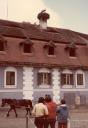
Stork nest, Rasinari, 1984The population did not increase, but the death rate from abortions far exceeded that of any other European country: as the only available form of birth control, illegal abortions were widely performed, often under the most appalling and dangerous conditions. Over the ensuing twenty-three years the 1966 law resulted in the death of at least ten thousand women. The real infant mortality rate was so high that after 1985 births were not officially recorded until a child had survived to its fourth week—the apotheosis of Communist control of knowledge. By the time Ceauşescu was overthrown the death rate of new-born babies was twenty-five per thousand and there were upward of 100,000 institutionalized children.

The setting for this national tragedy was an economy that was deliberately turned backward, from subsistence into destitution. In the early Eighties, Ceauşescu decided to enhance his country’s international standing still further by paying down Romania’s huge foreign debts. The agencies of international capitalism—starting with the International Monetary Fund—were delighted and could not praise the Romanian dictator enough. Bucharest was granted a complete rescheduling of its external debt. To payoff his Western creditors, Ceauşescu applied unrelenting and unprecedented pressure upon domestic consumption.

In contrast to Communist rulers elsewhere, unrestrainedly borrowing abroad to bribe their subjects with well-stocked shelves, the Romanian Conducator set about exporting every available domestically-produced commodity. Romanians were forced to use 40-watt bulbs at home (when electricity was available) so that energy could be exported to Italy and Germany. Meat, sugar, flour, butter, eggs, and much more were strictly rationed. To ratchet up productivity, fixed quotas were introduced for obligatory public labour on Sundays and holidays (the corvée, as it was known in ancien régime France).
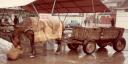
Horsecart in Sibiu, 1984Petrol usage was cut to the minimum: in 1986 a program of horse-breeding to substitute for motorized vehicles was introduced. Horse-drawn carts became the main means of transport and the harvest was brought in by scythe and sickle. This was something truly new: all socialist systems depended upon the centralized control of systemically induced shortages, but in Romania an economy based on over-investment in unwanted industrial hardware was successfully switched into one based on pre-industrial agrarian subsistence.

Plowing with oxen in the western mountains of Romania, 1984Ceauşescu’s policies had a certain ghoulish logic. Romania did indeed payoff its international creditors, albeit at the cost of reducing its population to penury. But there was more to Ceauşescu’s rule, in his last years, than just crazy economics. The better to control the country’s rural population—and increase still further the pressure on peasant farmers to produce food for export—the regime inaugurated a proposed ‘systematization’ [sistematizare] of the Romanian countryside. Half of the country’s 13,000 villages (disproportionately selected from minority communities) were to be forcibly razed, their residents transferred into 558 ‘agro-towns’. Had Ceauşescu been granted the time to carry through this project it would utterly have destroyed what little remained of the country’s social fabric.

The rural ‘systemization’ project was driven forward by the Romanian dictator’s mounting megalomania. Under Ceauşescu the Leninist impulse to control, centralize and plan every detail of daily life graduated into an obsession with homogeneity and grandeur surpassing even the ambitions of Stalin himself. The enduring physical incarnation of this monomaniacal urge was to be the country’s capital, scheduled for an imperial make-over on a scale unprecedented since Nero. This project for the ‘renovation’ of Bucharest was to be aborted by the coup of December 1989; but enough was done for Ceauşescu’s ambition to be indelibly etched into the fabric of the contemporary city. A historic district of central Bucharest the size of Venice was completely flattened. Forty thousand buildings and dozens of churches and other monuments were razed to make space for a new ‘House of the People’ and the five-kilometer-long, 150-meter-wide Victory of Socialism Boulevard.

The whole undertaking was mere façade. Behind the gleaming white frontages of the boulevard were run up the familiar dirty, grim, pre-cast concrete blocks. But the façade itself was aggressively, humiliatingly, unrelentingly uniform, a visual encapsulation of totalitarian rule. The House of the People, designed by a twenty-five-year-old architect (Anca Petrescu) as Ceauşescu’s personal palace, was indescribably and uniquely ugly even by the standards of its genre. Grotesque, cruel and tasteless it was above all big (three times the size of the Palace of Versailles …). Fronted by a vast hemicycle space that can hold half a million people, its reception area the size of a football pitch, Ceauşescu’s palace was (and remains) a monstrous lapidary metaphor for unconstrained tyranny, Romania’s very own contribution to totalitarian urbanism.
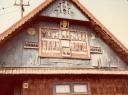
Woodcutter’s pantheon, Maramures, 1984Romanian Communism in its last years sat uneasily athwart the intersection of brutality and parody. Portraits of the Party leader and his wife were everywhere; his praise was sung in dithyrambic terms that might have embarrassed even Stalin himself (though not perhaps North Korea’s Kim Il Sung, with whom the Romanian leader was sometimes compared). A short list of the epithets officially-approved by Ceauşescu for use in accounts of his achievements would include: The Architect; The Creed-shaper; The Wise Helmsman; The Tallest Mast; The Nimbus of Victory; The Visionary; The Titan; The Son of the Sun; A Danube of Thought; and The Genius of the Carpathians.

What Ceauşescu’s sycophantic colleagues really thought of all this they were not saying. But it is clear that by November 1989—when, after sixty-seven standing ovations, he was re-elected Secretary General of the Party and proudly declared that there were to be no reforms—a number of them had begun to regard him as a liability: remote and out of touch not just with the mood of the times but with the rising level of desperation among his own subjects. But so long as he had the backing of the secret police, the Securitate, Ceauşescu appeared untouchable.

Timisoara cathedral, 1984Appropriately enough, then, it was the Securitate who precipitated the regime’s fall when, in December 1989, they tried to remove a popular Hungarian Protestant pastor, Lázslo Tökés, in the western city of Timisoara. The Hungarian minority, a special object of prejudice and repression under Ceauşescu’s rule, had been encouraged by developments just across the border in Hungary and were all the more resentful at the continuing abuses to which they were subject at home. Tökés became a symbol and focus for their frustrations and, when the regime targeted him on December 15th, the church in which he had taken refuge was surrounded by parishioners holding an all-night vigil in his support.

The following day, as the vigil turned unexpectedly into a demonstration against the regime, the police and the army were brought out to shoot into the crowd. Exaggerated reports of the ‘massacre’ were carried on Voice of America and Radio Free Europe and spread around the country. To quell the unprecedented protests, which had now spread from Timisoara to Bucharest itself, Ceauşescu returned from an official visit to Iran. On December 21st he appeared on a balcony at Party headquarters with the intention of making a speech denouncing the ‘minority’ of ‘troublemakers’—and was heckled into shocked and stunned silence. The following day, after making a second unsuccessful attempt to address the gathering crowds, Ceauşescu and his wife fled from the roof of the Party building in a helicopter.

At this point the balance of power swung sharply away from the regime. At first the army had appeared to back the dictator, occupying the streets of the capital and firing on demonstrators who tried to seize the national television studios. But from December 22nd the soldiers, now directed by a ‘National Salvation Front’ (NSF) that took over the television building, switched sides and found themselves pitted against heavily armed Securitate troops. Meanwhile the Ceauşescus were caught, arrested and summarily tried. Found guilty of ‘crimes against the state’ they were hastily executed on Christmas Day, 1989.* (*The trial and execution by firing squad were filmed for television, but not shown until two days later.)

The NSF converted itself into a provisional ruling council and—after renaming the country simply ‘Romania’—appointed its own leader Ion Iliescu as President. Iliescu, like his colleagues in the Front, was a former Communist who had broken with Ceauşescu some years before and who could claim some slight credibility as a ‘reformer’ if only by virtue of his student acquaintance with the young Mikhail Gorbachev. But Iliescu’s real qualification to lead a post-Ceauşescu Romania was his ability to control the armed forces, especially the Securitate, whose last hold-outs abandoned their struggle on December 27th. Indeed, beyond authorizing on January 3rd 1990 the re-establishment of political parties, the new President did very little to dismantle the institutions of the old regime.

As later events would show, the apparatus that had ruled under Ceauşescu remained remarkably intact, shedding only the Ceauşescu family itself and their more egregiously incriminated associates. Rumours of thousands killed during the protests and battles of December proved exaggerated—the figure was closer to one hundred—and it became clear that for all the courage and enthusiasm of the huge crowds in Timisoara, Bucharest and other cities the real struggle had been between the ‘realists’ around Iliescu and the old guard in Ceauşescu’s entourage. The victory of the former ensured for Romania a smooth—indeed suspiciously smooth—exit out of Communism.

The absurdities of late-era Ceauşescu were swept away, but the police, the bureaucracy and much of the Party remained intact and in place. The names were changed—the Securitate was officially abolished—but not their ingrained assumptions and practices: Iliescu did nothing to prevent riots in Tirgu Mures on March 19th, where eight people were killed and some three hundred wounded in orchestrated attacks on the local Hungarian minority. Moreover, after his National Salvation Front won an overwhelming majority in the elections of May 1990 (having earlier promised not to contest them), and he himself was formally re-elected President, Iliescu did not hesitate in June to bus miners in to Bucharest to beat up student protesters: twenty-one demonstrators were killed and some 650 injured. Romania still had a very long road to travel.

Leave a comment

Filed under Romania

Romania, 1984: Toilet Paper Tales

During our Fulbright orientation session for Romania in 1983, we had been warned about the difficulty of finding many of the basic consumer commodities to which we had become accustomed. In order to cope with the absence of fresh green vegetables during the long winter, we arrived with several kilograms of alfalfa seeds, which made Romanian customs officials suspicious but allowed us (and others) to eat fresh sprouts all winter. In order to make sure we had enough toilet paper to last the year, we ordered a box of 100 rolls of Scott tissue in the first of our three orders to Peter Justesen that the U.S. Embassy allowed us during our time there. We split that order with two other Fulbright households in Bucharest and we never ran short.

It wasn’t that our bums were too delicate for the coarse Romanian toilet paper. It’s just that the latter was rarely available. We always kept a sharp lookout for queues of shoppers on the streets in our long walks between our apartment and the University of Bucharest in the city center. We would join any queue at least long enough to find out what they were waiting to buy. Paper products appeared very rarely and were usually sold right from the sidewalk, with a quota of, say, six rolls of paper and two packs of napkins (serviettes) per person. Everyone carried an expandable shopping bag (pungă) or two, but some would carry rope as well, so that two people could thread it through their ten or twelve rolls and carry it between them on the way home. Or one person could wear a lei or bandolier of toilet paper rolls and still have two hands free to carry other goods.

Public toilets were never stocked with paper. Instead, you paid a small fee to the attendant at the entrance, and received in return a few inadequate squares of paper to use. It was safest to carry your own supply. As in France and Italy, public urinals (vespasiene) were named for Emperor Vespasian, who reinstituted Nero’s Vectigal Urinae. I remember entering one public toilet downtown where one of the urinals was clogged and overflowing, and someone had helpfully placed a perforated plastic waste basket underneath to collect rechannel the overflow.

Of course, few Romanians in 1984 could order paper products from abroad. They had to make do by other means. The most amusing alternative I encountered was in the house of a retired schoolteacher in Rădăuţi, Bucovina. He was a kinsman of the Romanian American Fulbrighter in our group. Next to his toilet was a small basket with scraps of used student papers he had once collected and graded. I’m sure he thought of his students every time he used their papers.

5 Comments

Filed under Romania

A Tale of Two Baptist Churches in Romania, 1984

During our year in Romania on a Fulbright linguistics research grant during 1983–84, the Far Outliers were able to attend a few Baptist church services, thanks to one of our colleagues who had both family ties to Baptists in Georgia, where she was from, and relatives in Romania, where her parents were from. I’m not sure whether she also had ties to the Bible smugglers active at the time. (When we first crossed the border into Romania, the customs officers who came through the train asked if we had any Bibles, guns, or typewriters—three signature items of subversion forbidden to private citizens at the time.)

One Sunday evening, our friend led us to a small church far out on the outskirts of Bucharest where we attended a pleasant two-hour service that mostly featured singing and mandolin-playing. There were a lot young people in the congregation, all of whom knew each other and who were very friendly and welcoming toward us.

Another Sunday morning, our friend led us to an unofficial house church in a suburb of Bucharest, but it was so overflowing with people that we couldn’t even get in the door. So we turned around and headed for an officially recognized church where we found a seat in the balcony of a fairly large sanctuary. Before an audience of several hundred that included both casual visitors and regular informers, the pastor chose his words carefully. After recounting various afflictions of war and famine elsewhere in the world—in Cambodia, Ethiopia, Iran and Iraq, Nicaragua and El Salvador—he was careful to add that Romania was better off than ever before. The congregation was mostly middle-aged and elderly, with very few young people.

We made one more visit to the small church on the outskirts to hear a visiting evangelist from Florida preach. Two more resident American couples joined us. The American evangelist was accustomed to preaching in Spanish as well as English, and he would sometimes forget that his audience on this occasion understood Romanian, but not Spanish. His interpreter was the Romanian pastor’s son, who spoke excellent English and hoped to go abroad for seminary training. He did a spectacular job, translating not just the words, but mimicking every gesture and change in voice quality. I have never seen the like of it, before or since, even though I had witnessed as a missionary kid in Japan more than a few bilingual sermons, translated sentence by sentence or paragraph by paragraph from one language to the other, usually in manner that was stultifying in either language.

1 Comment

Filed under religion, Romania

Doina Bumbea: A Romanian Abducted to North Korea

The Romanian newspaper Evenimentul Zilei (‘The Event of the Day’) has managed to confirm the identity of a Romanian woman abducted to North Korea during the 1970s.

Doinea Bumbea was a Romanian painter who disappeared in the 70s after telling family an Italian agent will arrange an exhibition for her in Japan….

The story was reconstructed by EVZ reporters after they found the woman’s family. The reporters also found out that she died ten years ago.

Radio Free Asia has more.

WASHINGTON—A Romanian newspaper says it has identified a Romanian woman, kidnapped in 1978, who married the U.S. Army deserter James Dresnok—reportedly the last U.S. defector still living in North Korea.

In its March 20 issue, the Bucharest-based Evenimentul Zilei reports that the late Doina Bumbea, a Romanian sculptor and painter born in 1950, was abducted in 1978 from Italy to North Korea.

There, she married an American soldier who had deserted his unit by fleeing across the heavily fortified Demilitarized Zone that divides North and South Korea

In his Japanese-language memoir To Tell the Truth, another American defector, Charles Jenkins, describes a woman named Doina, a Romanian abductee, who died of cancer in January 1997….

Romanian officials have verbally sought clarification from Pyongyang regarding the alleged Romanian abductee, but North Korean officials haven’t replied.

Dresnok, a U.S. Army private at the time, crossed over to North Korea in 1962. He reportedly still lives in the North Korean capital Pyongyang. The U.S. military has said that Dresnok, from Norfolk, Virginia, left the army in August 1962 at age 21.

via The Marmot

3 Comments

Filed under Korea, Romania

Romanian Synonymy: Romanian and French

The following synonym sets are formed from Romanian and French components.

  • călătorie ~ voiaj ‘trip’
  • întrecere ~ concurs/competiţie ‘competition’
  • convorbire ~ conversaţie/discuţie ‘conversation, discussion’
  • însufleţire/înflăcărare ~ entuziam ‘inspiration, enthusiasm’
  • cleveteală/bârfeală ~ calomnie ‘gossip, slander’
  • indignare ~ revoltă ‘revolt’
  • dovadă ~ argument ‘evidence, argument’
  • putere/tărie ~ forţă ‘power, force’
  • a înfăptui/îndeplini ~ a realiza ‘to fulfill, realize’
  • a zugrăvi/înfăţişa ~ a reda/descrie ‘to depict, render’
  • a contrazice ~ a combate/obiecta ‘to contradict, object’
  • a înapoia ~ a restitui ‘to give back, make restitution’
  • a pregăti ~ a prepara ‘to prepare’
  • a întrece ~ a depăşi ‘to overtake’
  • a înştiinţa ~ a comunica/anunţa ‘to inform, announce’

SOURCE: Section 3.1.5.7 in “Formation of Synonyms” Probleme de sinonimie, by Onufrie Vinţeler (Bucureşti: Editură Sţiinţifică şi Encliclopedică, 1983) [my translation].

In sharp contrast to the mostly rural, earthy Slavic borrowings examined earlier, these adoptions from French seem to reflect usage by cosmopolitan, high-society types, thus conforming to one of the earliest assumptions about why speakers of one language borrow words from another: because the lending language has more prestige. However, note that the Romanian equivalents of French Bon voyage and Bon appétit are Drum bun and Poftă bună, respectively, where the nouns are in both cases of Slavic origin.

Leave a comment

Filed under France, language, Romania

Romanian Synonymy: Latin and Slavic

Romanian synonym sets formed from Latin and Slavic components.

Nouns (Latin ~ Slavic ‘English gloss’):

  • lac ~ iezer ‘lake’
  • cale ~ drum ‘road’
  • călare ~ potecă ‘path’
  • pulbure ~ praf ‘dust’
  • nea ~ zăpadă ‘snow’
  • timp ~ vreme ‘time’
  • secure ~ topor ‘axe’
  • piuă ~ dârstă ‘mortar, fulling vat’
  • mâncare ~ hrană ‘food’
  • stup ~ ulei (regional) ‘beehive’
  • scoarţă ~ coajă ‘bark, crust’
  • vită ~ dobitoc ‘cow, ox, cattle’
  • fiară ~ dihanie ‘beast, monster’
  • vacă ~ ialoviţă (obsolete) ‘cow’
  • corp ~ trup ‘body’
  • cap ~ glavă (obs.) ‘head’
  • faţă ~ obraz ‘face’
  • popor ~ norod ‘people’
  • şerb ~ sclav, rob ‘serf’
  • spaimă ~ groază ‘fear’
  • tristeţe ~ jale ‘sorrow’
  • ştire ~ veste ‘news’
  • ceartă ~ svadă ‘quarrel’

Adjectives (Latin ~ Slavic ‘English gloss’):

  • deşert ~ gol ‘empty, barren’
  • roşu ~ rumen ‘red, ruddy’
  • umed ~ jilav ‘damp, moist’
  • sănătos ~ citov (obs.) ‘healthy’

Verbs (Latin ~ Slavic ‘English gloss’):

  • a lucra ~ a munci/trudi ‘to work, labor’
  • a treiera ~ a îmblăti (regional) ‘to thresh’
  • a săpa ~ a prăşi ‘to dig, weed’
  • a înnegri ~ a cerni ‘to blacken’
  • a păcătui ~ a greşi ‘to sin, err’
  • a se deprinde/învăţa ~ a se obişnui ‘to get used to’
  • a vindeca ~ a lecui ‘to cure’

SOURCE: “Synonymy and dialects” (4.1.1.4) in Probleme de sinonimie, by Onufrie Vinţeler (Bucureşti: Editură Sţiinţifică şi Encliclopedică, 1983) [my translation].

The nature of the borrowings that gave rise to these synonym sets suggests to me intermixed language communities with high degrees of bilingualism, and not contact between old and new technologies at a linguistic frontier, as was typical during the expansion of colonial languages across the globe.

UPDATE: There are also synonym sets of purely Slavic origin, but some of the alternates are rare, regional, or even obsolete:

  • nămol ~ tină ‘mud, silt’
  • mlacă ~ mlaştină ~ mocirlă ‘marsh, swamp, mud’
  • stog ~ claie ~ căpită ‘hayrick, shock (of hair)’
  • coteţ ~ cocină ‘sty, kennel’
  • război ~ stative ‘loom’
  • cobiliţă ~ coromâslă ‘carrying pole’
  • cârpă ~ zdreanţă ~ otreapă ‘rag’
  • lele ~ nană ‘auntie’ (term of address for older women)
  • doică ~ mancă ‘wetnurse’
  • a osteni ~ a obosi ‘to tire’

Leave a comment

Filed under language, Romania

Romanian Synonymy: Horse Traders and Maize

Regional synonyms constitute a “pair” of two or more words identical in sense, known and used by a group in at least one locality at a given moment in time [emphasis in original]. Thus, with regard to regional synonymy as well, the degree to which we accept words as synonyms depends on how they fit in time and place.

Sever Pop (cf. 1929) used to note that, within the territory of Romania, the following terms can be found to denote the concept of ‘horse trader’: barâşnic, craşcadău, cupeţ, factor, fleşer, geambaş, gheşeftar, ghiambabău, gârgez, făznar, hendler, herghelier, hâmbluitor, liverant, mecler, năstrăpaş, negustor, peţer, pilar, potlogar, precupeţ, precupitor, semsar, sfârnar, sfârnăroiu, şmecher, ţânzar, ţigan, tuşer. No one doubts that all the terms listed denote the same concept. The question that arises is the following: can each and every one of these words be considered synonyms? According to some definitions, still in circulation, all words that express the same notion are considered synonyms. Glancing over the list of words above, we observe that only the word negustor, which is the general term, and to a certain degree the word geambaş, are more widely known and can be considered synonyms; the rest are known only in more or less restricted areas. For the great majority of Romanians, words like barâşnic, gârgez, hendler, mecler, tuşer, and so forth do not mean anything; they are just as unintelligible as any others in a foreign language. Of course, in many places negustor can be a synonym of făznar, and geambaş with herghelier [‘herder’], and so on, but this only happens in certain places and not across the whole territory where Romanian is spoken.

These examples prove once again that for two or more words to be considered synonyms it is not sufficient that they express the same notion. And in cases of regional synonymy, the notion of synonym must be localized and made concrete.

Situations like those discussed above are very common in Romanian; they may be found on almost every linguistic map but are not mentioned except sporadically. So, for example, Marius Sala (1958), after analyzing the distribution of terms for ‘maize’, established that porumb is synonymous with păpuşoi [cf. păpuşă ‘doll, puppet’], cucuruz [usu. ‘corncob’; Russian кукурузы, South Slavic kukuruz], mălai [usu. ‘cornmeal’]. All of these words are fairly widely distributed (cf. map 900 in the Atlas of Romanian Linguistics). At present, porumb, being the general, literary term, is synonymous with păpuşoi, cucuruz, mălai in those areas where the latter are used. But the question arises whether păpuşoi, cucuruz, and mălai can be considered synonymous with each other. In the first place, at their points of intersection, they can be completely synonymous, except in cases where certain semantic differences intervene. Second, because of their wide usage, even in literature by great writers, we can admit that they form a set of synonyms at the level of literary language, if not everywhere, at least widely enough. But what do we do with the term tenchi, borrowed from Magyar and recorded at just one locale on the same map? In every other zone, tenchi is a foreign word, and therefore cannot be synonymous with the other words that denote ‘maize’. (Tenchi may eventually become synonymous with porumb or with mălai to the extent that the latter are known and used in the locality where tenchi was recorded.)

SOURCE: “Synonymy and dialects” (4.1.1.4) in Probleme de sinonimie, by Onufrie Vinţeler (Bucureşti: Editură Sţiinţifică şi Encliclopedică, 1983) [my translation].

I don’t have any problem with considering terms in different languages to be synonyms. That’s what translationese, calques, and 直訳 are all about.

UPDATE: In response to Language Hat, I need to clarify that when I accept “synonyms” across separate languages, I’m thinking of communities where nearly everyone speaks at least two languages, and where people switch between them as frequently and as easily as they or others might switch between dialects of the same language. I’ve spent some time in such communities. In fact, my first published paper in graduate school after returning from fieldwork in a New Guinea village whose unique language I had been sent to describe was not a paper just about the new , undocumented language but one on “multilingualism and language mixture” among the people of that village. People borrowed and calqued all the time, and even recreated for my benefit “pure” equivalents (rarely used by anyone else) in their own language by calquing backwards out of either the local church lingua franca, whose usage has since faded to the point that young people are no longer likely to recognize the source of those words; or else Tok Pisin, which supplies nearly every community in New Guinea an extra set of very general synonyms for specific words in their own languages. Romanians did much the same a few centuries ago when they borrowed a load of new vocabulary from French, then creating Romanianized shapes for many of the words. Those pairs became synonyms. Sometimes the synonyms carved up semantic space in complementary fashion, and sometimes one form gave way to the other.

I plan to translate several more chunks from Vinţeler’s chapter on borrowings and synonymy. He compiled a lot of good examples.

Leave a comment

Filed under language, Romania