Category Archives: China

Traditional China: Multilingual

A new reader in traditional Chinese culture is in the works that places long-overdue emphasis on just what a complex, multilingual, multiethnic, and multireligious place it always has been and will continue to be. Here’s an excerpt about China’s multilingualism from the introduction by the indefatigable Victor H. Mair:

For many students, this book will be part of their first systematic exposure to learning about China. As such, we wanted to make it as comprehensive as possible within the limits naturally imposed by the amount of material that can reasonably be absorbed within a single semester. One of our main goals has been to help the student realize that China is not a monolithic state with a monotonous culture and a static past. The myth of a thoroughly homogeneous, ultrastable empire, although widespread and persistent, is far from true. China never existed as a “nation of uniformity.” To the contrary, we are faced with a multifaceted country that possesses an extremely complicated history and a richly varied mix of regional and ethnic traditions.

Take language, for example. When one thinks of what defines “China,” perhaps the first thing that comes to mind is that it is a place where the people all speak “Chinese.” But what is this “Chinese” that everyone is supposedly speaking to each other? Unfortunately, China does not today possess, nor has it ever in the past possessed, such a universally understood tongue. For starters, we have to take into account the tens of millions of speakers of non-Sinitic languages who make up a significant proportion of the population of the Chinese nation as it is currently configured…. These languages belong to such disparate groups and families as Tibeto-Burman, Austroasiatic, Austronesian, Turkic, Tungusic, Iranian, and Slavic. These are the “minorities” of the Peoples Republic of China, all of whom have roots that lie deep in the past of East Asia, West Asia, Central Asia, Southeast Asia, and Northeast Asia.

And then there is the so-called majority group who, it is claimed, speak a language called “Hanyu” or “Chinese.”…

However we ultimately choose to define it, Hanyu is related in some fashion (not yet well understood by scholars) to Tibeto-Burman. Since the combined family is customarily styled Sino-Tibetan, we may–for the sake of linguistic precision–refer to Hanyu as “Sinitic” in English. Sinitic is often said to have eight (or more) major fangyan (‘topolects’ …). Among these fangyan are “Northern” (i.e., Mandarin in the broadest of terms; it actually stretches to the far southwest), Wu (typified by Suzhou and Shanghai), Xiang (Hunanese), Gan (spoken in Jiangxi), Hakka (the language of those displaced “guests” from the north who have played a particularly important role in modern Chinese history), Northern Min, Southern Min (including Amoy and Taiwanese), and Cantonese. If analyzed by the standards applied to languages in Europe or South Asia, these fangyan would be classified as branches of the Sinitic group.

Speakers from any one of the major fangyan are incapable of conversing with speakers from those of any of the other major fangyan. Even within the major fangyan or branches of Sinitic, there are numerous more or less unintelligible varieties of speech. What is more, it is essential to note that, throughout history, the fangyan have never been written down in their unalloyed form, except latterly by missionaries using alphabets. Traditionally, there have been only two acceptable forms of writing in China: Literary Sinitic (wenyan or Classical Chinese), strictly a book language …, and Vernacular Sinitic (baihua[wen]), a written manifestation of Mandarin that developed–largely under the influence of Buddhism–out of a presumed Tang-period koiné. Despite their lack of a written form, the fangyan are still vibrant. As clear indications of the continuing vitality of fangyan, Taiwanese is now the preferred mode of expression on Formosa, and the Chinese government on the mainland is constantly threatening to cashier officials and teachers who fail to learn Mandarin.

As an aside, let me note that during the graduation ceremony at Sun Wen [= Sun Yat-sen] College (now affiliated with Sun Yat-sen University [= Zhongshan University]) I witnessed in 1988, all of the administrators and teachers spoke in Mandarin, while the mayor and other local politicians spoke in Cantonese (Sun Wen = Sun Yat-sen = Sun Zhongshan).

Sinitic evolved through a complex process of interaction with the non-Sinitic languages mentioned above, borrowing (and lending) not only words, but also structures and phonemes. The internal development of Sinitic is equally intricate, such that historical linguists are still seriously puzzled over the relationships among the various fangyan, the phonology of their earlier stages, and the identification of the fundamental etyma for the group en masse.

UPDATE: Language hat adds, “Incidentally, anyone who wants a more detailed look at the linguistic situation should get hold of S. Robert Ramsey’s The Languages of China (reviewed here).” I second that endorsement. Ramsey’s book (Princeton U. Press, 1987) gives a lot of attention to the minority languages. Language hat‘s entry has also attracted a nice range of comments. See also the follow-up entry above, The “Cultural Glue” of Chinese Writing.

Leave a comment

Filed under China

Hazel Smith: A view from inside North Korea

Let me recommend a new blog, NKzone, which aims to get a better sense for what is going on inside North Korea, largely from unofficial channels. For example, one of the earliest is an interview with Hazel Smith, who has spent a lot of time in North Korea since 1990 with the World Food Program and other agencies. Here’s a sample of what she has to say:

Up to a million people died of hunger in the 1990s – but probably up to 21 million survived – one question is how did they do that and how do they continue to do that when the government cannot deliver on basic needs (enough food all the year round, decent water and sanitation supplies, medicine and medical equipment).

At first what happed is that individuals and local communities – including local workplaces, farms, counties even – were left with the problem of how to feed starving people when the government centrally could not. The local officials were forced to respond to the people they represent – certainly not in a democratic manner but because they live in the same places and may often be part of close knit kinship networks – in an accountable manner. Those living near the China border had some options – selling lumber across the border for a start. Those with access to foreigners tried to obtain hard currency. But most were forced into petty trade domestically. And because the party officials (remember this is a mass party not a vanguard small party) were often as badly in need of food and basic goods and anyone else, they actively connived with local entrepreneurs to get around the rules so as to obtain food by any means possible.

The government tried to stop this, vacillated, then realized it couldn’t stop this. Then in the end – about the beginning of the 2000s – accepted this transformation in the way people lived their economic lives as a fact of life. From then they decided to try to direct the process of socio-economic change (while not permitting much political; change) – rather than be directed by it.

By this time also local party – and security officials – had become transformed into the new core class of petty traders (not all of them but significant numbers). They were the ones best placed – contacts, access to transport, knowing how to get round the rules – and with the most motivation. As desk workers they mostly didn’t grow much of their own food and their income in the local won was virtually literally worthless.

The visible change is the enormous increase in personal mobility throughout the country. In Pyongyang in the early 1990s there were just government vehicles on the streets and no bicycles. Not many people walking about either as the underground and buses more or less functioned. In the countryside virtually no vehicles and not much in the way of mass pedestrian movement.

Now if you can afford transport or if you can make it (lots of home made vehicles – it’s a miracle they can move never mind transport anything) and lots of bicycles.

In addition people walk everywhere – there is hardly any working public transport outside Pyongyang – so people walk between counties – to go and get food from relatives, to take children to stay with relatives so they can get fed, to take food to relatives, etc.

The difference is because now they are allowed to move – it is also a sign of the crumbling effectiveness of the security apparatus (in some parts of the country) and the different priorities these days. Nowadays it is seen as a duty to engage in private trading – and sensible – because people need to survive and the state no longer provides enough to survive on.

Leave a comment

Filed under China, Korea

The Founding of Manila and the Origin of Global Trade, 1571

In 1995, historians Dennis O. Flynn and Arturo Giráldez published a seminal article in the Journal of World History entitled “Born with a ‘Silver Spoon’: The Origin of World Trade in 1571.”

Global trade emerged with the founding of Manila in 1571, at which time all important populated continents began to exchange products continuously. The silver market was key to this process. China became the dominant buyer because both its fiscal and monetary systems had converted to a silver standard; the value of silver in China surged to double its worth in the rest of the world. Microeconomic analysis leads to startling conclusions. Both Tokugawa Japan and the Spanish empire were financed by mining profits–profits that would not have existed in the absence of end-customer China. Europeans were physically present in early modern Asia, but the economic impact of China on Western lands was far greater than any European influence on Asia.

SOURCE: Journal of World History 6 (1995): 201-221

2 Comments

Filed under China

Muslims and Hindus in South China, 10th-13th Centuries

In 1995, Hugh R. Clark published an exploratory essay in the Journal of World History about China during the Song Dynasty (960-1279), arguing

that China’s maritime frontier, especially the coastline south of the Yangzi River, was an important site for the shaping of Chinese culture during the later imperial era. This frontier therefore deserves attention alongside the better known and more frequently studied “inner Asian” frontier of the north. Archaeological evidence demonstrates the presence of communities of Muslims from west Asia and Hindus from south and southeast Asia in the port city of Quanzhou throughout the Song dynasty. Those communities and the trade ties they represented influenced a range of cultural innovations, including the introduction of the Champa strain of rice, which transformed Chinese agronomy, and the conception of the monkey god popularized as Sun Wukong in the Chinese novel Journey to the West.

SOURCE: Journal of World History 6 (1995): 49-74.

Leave a comment

Filed under China

Cultural vs. Situational Factors in East Asian Industrialization

In 1991, Ezra Vogel published a slim volume that attempted to analyze for lay audiences some of the reasons why certain East Asian nations achieved notable success in industrializing. He compared Taiwan, South Korea, Hong Kong, and Singapore, which he labelled the “Four Little Dragons.” Here are some highlights, from a book review published in 1994.

British and American advocates of minimal government interference in the marketplace will be countered not just by how different the role of Hong Kong’s government has been from the other little dragons, but by the historical perspective offered in the introductory chapter, where Vogel notes that only the earliest wave of industrialization, in England and later the United States, had the luxury of a rather leisurely pace of industrialization with relatively little government direction. The later waves in continental Europe and then East Asia had to rely much more heavily on government to secure the ever larger amounts of capital, complex technology, and skilled labor needed to leap the ever-widening gap between preindustrial and industrial society. Each new entrant in the race to industrialize had a clearer view of the finish line and ran down a better-trodden path to get there.

East Asian nationalists who, like European and American imperialists before them, tend to credit their success primarily to their own harder work and superior cultural heritage, will be forced to consider Vogel’s lists of the many situational factors that aided their efforts. And anti-American nationalists will object to the prominent position of U.S. aid on those lists. Vogel enumerates new global opportunities offered by the postwar world: (1) The United States, supremely self-confident and fervently anticommunist, was willing to open its markets and universities and share industrial technology with its allies to an unprecedented degree. (2) Thanks to the demise of colonialism and to bitter lessons learned during the prewar depression, international trade was far less restricted than before. (3) The growth of mass consumption enabled smaller countries to achieve manufacturing economies of scale that their domestic markets could not have supported. (4) Large Western corporations acquired a multinational outlook that placed loyalty to profits above loyalty to country of origin, making them willing, for profit, “to buy, sell, and lend anywhere in the world” (p. 11).

Vogel also lists more particular situational advantages East Asia enjoyed during the postwar period: (1) The U.S. poured in massive amounts of aid to build a bulwark against communism. Just as the Japanese economy benefited from U.S. procurement during the Korean War, the other regional economies benefited during the Vietnam War. (2) Confucian conservatives were discredited and large landowners were dispossessed. The postwar governments were not beholden to the traditional elite, so they were free to concentrate on production of new goods, not control of existing assets. (3) A keen awareness of external military threats and of inadequate land and natural resources lent an urgency that made leaders more willing to cooperate and citizens more willing to sacrifice for the common good. (4) Each country had large numbers of refugees and displaced people who comprised an “eager and plentiful labor force” (p. 88) dependent on their labor, not their land, for income. (5) Japan’s pioneering effort provided the little dragons with a goal, a way to get there, and the confidence that they could succeed in their drive to industrialize. As wages rose in Japan, corporations there were willing to transfer limited technology and manufacturing capacity to the other East Asian countries. However, some of those countries, most notably South Korea, succeeded in transferring more technology than Japan intended.

Did particular cultural traditions shared by East Asian societies confer any advantages? Vogel begins his chapter on explanations by downplaying the role of Confucianism in the spread of industrialization. He asks whether the ongoing industrial transformations of Islamic Malaysia and Turkey, Buddhist Thailand, and Roman Catholic Brazil and Mexico will not utterly invalidate cultural tradition as an explanatory factor. He further notes that Confucianism was blamed just as frequently during the 1940s and 1950s for retarding modernization, and asks why China, the heartland of Confucianism, has been slower to industrialize than the periphery, even before the socialist era. In answer, Vogel offers a tantalizing suggestion:

“If anything, just as Max Weber found that the greatest drive to industrialize in his time came in areas located far from Catholic orthodoxy, so in East Asia industrialization prospered in areas far from the centers of traditional Confucian orthodoxy, where trade and commerce were most highly developed. And successes occurred not under the old Confucian-style governments but in societies that had cast them aside for new governments, with very different political systems.” (p. 84) …

It is long past time to lay aside such vague, chauvinist notions as the Protestant ethic, the Confucian ethic, or the samurai spirit, and examine instead the more specific cultural traditions that aided industrialization. Vogel identifies four such traditions shared by Japan and the little dragons: (1) a “meritocratically selected bureaucracy” (p. 93) that not only implemented policy decisions, but formulated them; (2) an entrance examination system that afforded the means to overcome feudal favoritism and channel the most talented people into key leadership positions; (3) an emphasis on group loyalty and subordination of individual to group demands that well suited the level of centralized coordination needed to effect a modern industrial transformation; and (4) a tradition of lifelong self-cultivation.

Of course, the challenge today is not just to find a way for all nations to climb onto an industrial plateau, but to find ways to keep scaling new heights of innovation and growth in a postindustrial world. Orthodoxies of all kinds still seem to be among the primary obstacles.

SOURCE: Review of The Four Little Dragons: The Spread of Industrialization in East Asia, by Ezra F. Vogel (Harvard U. Press, 1991).

Leave a comment

Filed under China, economics, industry, Japan, Korea, labor, Vietnam

First Southernization, Then Westernization

The West began to have an impact on the rest of the globe from about the fifteenth century. According to the historian Lynda Shaffer in a seminal article in the Journal of World History in 1994, the South began to have a similar impact a millennium earlier. “The term southernization is meant to be analogous to westernization.”

A process called southernization first began in Southern Asia. By the fifth century C.E. [= A.D.], developments associated with southernization were present in India, whence they spread to China and then to the Middle East and the Mediterranean basin. After 1200 they began to have an impact on southern Europe. These developments included the discovery of bullion sources, the emergence of a new mathematics, the pioneering of trade routes, the trade in tropical spices, the cultivation of southern crops such as sugar and cotton, and the invention of various technologies.

Cotton was first domesticated in the Indus River valley and Indian cotton virtually clothed the world until Britain’s Industrial Revolution.

During the Mauryan Empire (321-185 B.C.E), Siberia had been India’s main source for gold bullion, but when that route was disrupted, Indians began to look for gold in the Malay and Indonesian archipelagos, and then in East Africa. By the fifth century C.E., Indian traders and Malay sailors had established sea routes all the way from the Red Sea to China, and even into the Pacific.

Until 1621 C.E., the Moluccas (Maluku) was the only place on earth able to produce commercial quantities of cloves, nutmeg, and mace. Sugar may have been first domesticated in New Guinea, but the Indians were the first to discover how to turn it into granulated crystals that could be easily stored and transported.

Indians also invented the concept of zero, which the Arabs eventually conveyed to the Europeans. What the West called Arabic numerals, the Arabs called Hindi numerals.

During the period of Southernization in Sui, Tang, and Song China (6th to 13th centuries C.E.), Buddhism and rice agriculture spread from south to north, and the north became less dominant intellectually, socially, and politically.

During the early Muslim Caliphates, sugar, cotton, and citrus fruits spread north. The Arabs were the first to import large numbers of East African (Zanj) slaves to work sugar plantations near Basra at the north end of the Persian Gulf. By 1000, sugar and cotton had become important crops from Iran to Spain. Arabs also pioneered new trade routes and discovered new sources of silver in Tashkent and in Afghanistan that rivaled the later discoveries near Potosi in the New World. After silver became relatively abundant, Arabs sought new sources of gold in East and West Africa.

“By 1200 the process of southernization had created a prosperous south from China to the Muslim Mediterranean.” The Mongol conquests then helped to southernize northern regions across Eurasia. “Southernization was not overtaken by westernization until the Industrial Revolution in the eighteenth century…. Only after the northwestern Europeans had added to their own repertoire every one of the elements of southernization did the world become divided into a powerful, prestigious, and rich north and an impoverished south perceived to be in need of development.”

SOURCE: Linda Shaffer, “Southernization,” Journal of World History 5:1-21.

Leave a comment

Filed under Afghanistan, China, Iran

Tonga Favors China, But Not the Chinese

Head Heeb has an interesting post on “Tonga’s ambivalent relationship with China, one that favors the Chinese government but not the Chinese people. Overseas Chinese make up about three percent of Tonga’s population.”

Leave a comment

Filed under China

China’s Natural Mason-Dixon Line

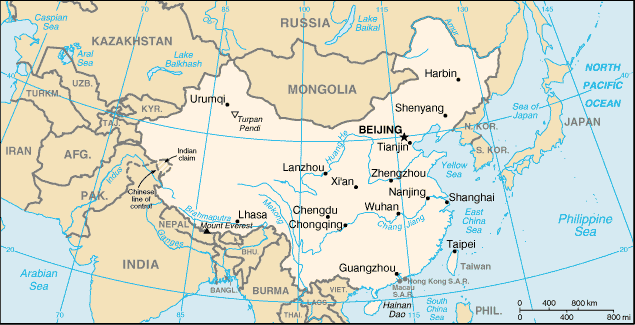
The rough dividing line between North and South China (at least “China Proper“) is the Yangtze River, officially referred to as the Changjiang (‘Long River’) in Chinese. Unlike the Mason-Dixon line in the U.S., this division in China is the result of natural geological forces, not the result of any artificial human compromise. Like the Mason-Dixon line, however, the boundaries get fuzzier the farther you go west. (See maps; scroll down.)

South of the Yangtze, people depend mostly on rice as their staple, they prefer black tea, and they generally get by without heating their houses during the winter. (The coldest winter I ever spent was in one of those unheated houses in South China. Another foreign family there made the same claim–and they were from Winnipeg, Manitoba!) The old southern capital, Nanjing (‘South Capital’) lies on the south bank of the Yangtze. (See maps and photos; scroll down.)

North of the Yangtze, people grow a variety of hardy staples such as wheat, corn (maize), sorghum, and millet, which they make into pastas, breads, or gruel. They prefer green tea, and they generally do a better job of heating their houses during the winter. (See maps and photos; scroll down.)

In popular stereotype, the North has more than its share of hardheaded ideologues, while the South has more than its share of unprincipled pragmatists. However, the pragmatic leader Zhao Ziyang was a northerner from Henan (although he rose to prominence in Guangdong), while the arch-ideologue Mao Zedong was a southerner from Hunan. The smooth diplomat Zhou Enlai was from Jiangsu, which straddles the Yangtze. (See maps of major provinces.)

If bureaucratic Beijing (‘North Capital’) is the northern archetype, hustling Guangzhou (‘Wide State’) is its southern counterpart. (See map of major cities.) Shanghai, at the mouth of the Yangtze, has a reputation for combining both ideological and mercantile hustle. Shanghai literally means ‘rise-up sea’, which may originally have meant ‘the beginning of the sea’ (and the end of the river), but I can’t find any confirmation.

Unfortunately, many Cantonese seem to think that the North starts at the northern border of Guangdong Province–or that you have to speak Cantonese to be a southerner. Several of the teachers at the brand new college we taught at in Zhongshan City, Guangdong, were from Jiangxi Province, which stretches from Guangdong north to the Yangtze. They were frequently dismayed to be identified as beifangren ‘northerners’ when they spoke their southern dialect of the national language (putonghua, or Mandarin) rather than Cantonese. To Cantonese, they were just not southern enough. It was like Georgians calling Virginians–or Mississipians calling Tennesseans–“Yankees”! (Hmm. Come to think of it …)

Recommended Browsing: A Visual Sourcebook of Chinese Civilization.

Leave a comment

Filed under China

Asian Acronyms: Did you teach at GWYX or at Guangwai?

Discriminating linguists sometimes distinguish between acronyms pronounced as if they were a word, like NATO and UNICEF; and initialisms pronounced as a series of letters, like IBM or the UN. This distinction breaks down in orthographies that write whole syllables at a time, like Chinese.

In Chinese, for instance, acronyms are composed of the initial syllabic characters of (usually) two-syllable words. So, Peking (= Beijing) University, or Beijing Daxue [lit. ‘NorthCapital BigSchool’] becomes Beida [lit. ‘NorthBig’]. In Korean, Korea University, or Koryo Taehak [lit. ‘HighBeautiful BigSchool’] becomes Kodae [lit. ‘HighBig’]. In Japanese, it’s a bit more complicated. Chinese characters can be pronounced not just in their Chinese loan forms, but as native Japanese words that mean (more or less) the same thing. This is what makes Japanese far and away the most complex, least efficient writing system on earth. In either case, each character is usually pronounced as two syllables, since Japanese had to add final vowels to one-syllable Chinese roots in order to pronounce any final consonants, most of which have been lost in modern Mandarin Chinese. (The same thing happens to current Japanese borrowings from English: ranchi < lunch, setto < set, beisubouru < baseball, and so on.) So the acronym for Hiroshima University, or Hiroshima Daigaku [lit. ‘WideIsland BigSchool’] becomes HiroDai [lit. ‘WideBig’]. The name Hiroshima is native Japanese (the Sino-Japanese pronunciation would be Koutou = Ch. Guangdao), but Daigaku is Sino-Japanese [= Ch. Daxue].

After China adopted the supplementary Latin-based alphabetic pinyin writing system, which is increasingly used in computer input, you could begin to see alphabetic abbreviations, some of them rather alarming and most of them quite unpronounceable. Very few Chinese syllables start with vowels: a- is not uncommon, but e- and o- are rare, and i- and u- are nonexistent. Even worse, initial q-, x-, y-, and z- are way too common.

So, if you were to take the first pinyin letter of each syllable, Guangzhou Foreign Language Institute would be abbreviated GZWGYYXY < GuangZhou WaiGuo YuYan XueYuan [lit. ‘WideState OutCountry SpeechTalk LearnYard’]. You would do better to take the first letter of each two-syllable word rather than the first letter of every single syllable, in which case the same school would end up as GWYX < Guangzhou Waiguo Yuyan Xueyuan [lit. ‘Guangzhou Foreign Language Institute’]. However, most Chinese acronyms are more economical than that. The common name for this particular school was equivalent to “GuangFor” (Guangzhou Foreign), namely, GuangWai [lit. ‘WideOut’]. (It has now merged into GDUFS, the Guangdong University of Foreign Studies, which would still qualify for the acronym GuangWai in Chinese. The unfortunate English acronym must certainly be guh-doofs.)

These syllabic acronyms aren’t unique to Chinese. Indonesian (or Malay) uses a Latin-based alphabetic writing system, but is chock full of syllabic as well as alphabetic acronyms (and initialisms). Acronyms seem to proliferate under big bureaucracies–especially if the military has a free hand. Examples of syllabic acronyms in Indonesian include the names of provinces like Sulsel < Sulawesi Selatan [‘south’], Sulut < Sulawesi Utara [‘north’], and Sulteng < Sulawesi Tengah [‘central’] on the island of Sulawesi (Celebes); schools like UnHas < Universitas Hasanuddin in Sulawesi and UnPatti < Universitas Pattimura in Maluku (Molucca); and terms like tapol < tahanan politik [‘political prisoner’].

UPDATE: Like Japanese and Korean, Vietnamese used to be written in Chinese characters and has lots of Chinese loanwords. Judging from the website of Vietnam National University – Ho Chi Minh City, Vietnamese seem to abbreviate by taking the first letter of each separately written syllable. Thus, (ignoring diacritics) Dai hoc Quoc gia Thanh pho Ho Chi Minh [lit. ‘University National City Ho Chi Minh’] is abbreviated DHQG-HCM. Ho Chi Minh City is also abbreviated TP.HCM, which I’m pretty sure is often pronounced Saigon. Otherwise, I don’t have a clue how these abbreviations are pronounced.

FURTHER UPDATE: Korean usage of taehak seems to be diverging from that of its cognates in Japanese (daigaku) and Chinese (daxue). While each term applies to a variety of institutions of tertiary education, Korean now distinguishes between taehak ‘college’ and taehakkyo ‘university’ very much long the lines of American usage. Taehakkyo indicates a larger institution that offers graduate education. So Kodae now stands for Koryo Taehakkyo, as the Chinese characters and Korean title on their homepage shows. I don’t think the cognate forms, Jp. daigakkou and Ch. daxuexiao, even exist, much less serve a similar function.

Leave a comment

Filed under China, Indonesia, Japan, Korea, language

Soviet Koreans vs. Volga Germans: Deportation Smackdown

Prof. Lee Chai-mun of Kyungpook (North Kyôngsang) University published an article in the June 2003 issue of The Review of Korean Studies entitled “The Lost Sheep: The Soviet Deportations of Ethnic Koreans and Volga Germans“:

The goal of this paper is to compare the forced deportations of two Soviet minorities, Soviet Koreans and Volga Germans in the early [20th] century. Most existing Korean studies tend to emphasize the uniqueness of Korean expulsion, thereby missing crucial factors which explain the origins of forced Soviet Korean deportations in 1937. In this comparative study, first, histories of Soviet Koreans and Volga Germans and their forced deportation processes were reviewed, and then the motives of the deportations were examined. The result of this comparative study gives credibility to the espionage theory for the forced deportations. It also strongly suggests that ethnic conflicts over land issues during collectivization as one of the most important motives for the forced deportations of the Soviet Koreans and Volga Germans.

The published PDF version of the article generates errors, but a more easily accessible earlier draft is online. In it, Prof. Lee notes that individuals and groups from both minorities were deported earlier on for a variety of reasons, such as resistance to collectivization and various other counterrevolutionary activities, but the mass deportations directly followed the outbreak of war in each region. War between Japan and China became official after the Marco Polo Bridge Incident in July 1937. Over 170,000 Koreans in the Soviet Far East were deported to Central Asia beginning in October that year–after they had a chance to bring in the harvest. Germany’s Operation Barbarossa attack on the Soviet Union began in June 1941. About 450,000 Volga Germans were deported to Central Asia in September that year. In all, more than 1 million Soviet Germans were deported.

Nadira Artyk, a London-based Uzbek journalist, describes the ebbing of that flood of deportations many decades later, after the collapse of the Soviet Union, in the wonderful Czech journal Transitions Online, in an October 1998 article entitled “An Exodus of Minorities“:

Central Asia has a variety of minority groups, including European settlers (predominantly Slavic), diaspora minorities indigenous to the region (such as Tajiks in Uzbekistan and Kyrgyz in Tajikistan), and people forcibly deported to the area under Josef Stalin (such as Crimean Tatars, Germans, and Koreans).Under Soviet rule, people who belonged to completely different ethnicities and different religions were put together. But in Uzbekistan, for example, Russians and Uzbeks always remained largely separate communities. There was no tension between them simply because they led different lives. They even resided in different places–Russians in apartment blocks, Uzbeks in traditional makhallyas.

The collapse of the Soviet Union heralded a rebuilding of national identities in all Central Asian states, which used to be subjected to merciless Russification. By reviving national language, culture, and history, the Central Asian governments tried to restore their nations’ pride. Ethnic groups had to adopt to the dominating nation or leave.

Thus, after more than 70 years under the Soviet roof, many nonindigenous ethnic minorities chose to return to their historic homelands.

There has been widespread emigration of Germans, Russians, Ukrainians, Jews, Crimean Tatars, and Meskhetiyan Turks. Some other groups (such as Koreans) have shown little desire to leave Central Asia. [Well, sure, if the alternative is North Korea–ed.]

Kazakhstan and Kyrgyzstan, countries with significant Russian-speaking minorities, tried to strike a balance between restoring their predominant national cultures and not upsetting other ethnic groups. Kazakhstan’s President Nursultan Nazarbayev guaranteed equal rights to all ethnic groups, but there are clear signs of power being concentrated in Kazakh hands. Until last year, non-Kazakhs held one-third of all ministerial posts in the country’s cabinet. Now only a quarter of the government consists of Russians and representatives of other ethnic groups….

Of the ethnic groups, deported to Central Asia by Stalin before and during World War II (Volga Germans, Crimean Tatars, Koreans, Poles, Greeks, Chechens, Meskhetiyan Turks, the Ingushe, and so on), only Koreans and Germans adapted successfully [emphasis added]. Others, such as Chechens and the Ingush, after Stalin’s death returned in large numbers to their homelands at the earliest opportunity, in the late 1950s.

Among the ways Koreans “adapted successfully” was to abandon their native language and to achieve educational levels second only to Soviet Jews. Among the most prominent are the government official Georgy Kim, who attained one of the highest levels of any non-Russian in the former Soviet Foreign Ministry and now serves as Minister of Justice in the Republic of Kazakhstan; and the writer Anatoly Kim.

Until the age of eight, Anatoly Kim spoke only Korean. Then he learned Russian and unlearned his native language forever. Studying painting and later literature in Moscow, Kim’s short-stories and novellas have as varied geographical backgrounds as his own life. In some narratives, Kim alluded to the Korean community on Sakhalin or in Kazakhstan, but he never told of the horrible events of 1937. And only when he was in his fifties–after the Soviet Union crumbled–could he visit Korea for the first time. This voyage, as well as his subsequent stay there for a number of years as a professor of Russian, proved a veritable revelation. For Anatoly Kim’s discovery of the real Korea was that same “voyage in search of a continent,” only that it was not an entirely new one. It was the continent of his roots.

One of the most interesting developments now is the attempt by South Korean religious, linguistic, and cultural evangelists to reclaim these “Lost Sheep.” Recent Fulbright scholar Steven S. Lee has some very interesting observations on identity questions in his Koryo Saram archive.

My project has narrowed to two specific foci: (1) the growing body of literature (mostly in Russian) by Korean Central Asians, and (2) interactions between the Koreans here with Koreans from elsewhere in defining ethnic identity. For this second focus, my driving question is: Who is claiming authority in delineating what it means to be Korean? According to my adviser, German Kim, the South Koreans doing business and mission work here were at first welcomed with open arms by local Koreans, but gradually, these outsiders were perceived as arrogant and condescending, i.e. they considered themselves as the proper purveyors of Korean cultures. Of course, one could hardly call South Korea during the past 50 years as a vacuum for cultural preservation, and more and more, I find it useful to regard ethnicity and tradition as invention, as fiction. This is where my focus on literature comes into play: what I’m searching for is literature that defines ethnic identity–slyly and subtly, I’m hoping.

On this note of ethnicity as fiction, it’s interesting how well Koreans seem to blend in with Kazakhs. I am ethnically Korean, and yet I’ve been mistaken for Kazakh. Accordingly, Koreans here are said to be more contented than Koreans in Uzbekistan, partially because they can blend in more easily. Although Almaty is a wonderful and quite liveable city, I certainly hope to be able to compare the Koreans here with those in Tashkent, where they are a more conspicuous and perhaps less integrated minority group….

Lee is far from impressed after translating Anatoly Kim’s story “A Cry About a Mother in Seoul“:

Considering current attempts at religious awakening within the Korean community, this story is somewhat interesting. The author clearly intends to associate religiousness with ethnic identity; religion as both provoking and salving the dilemmas of ethnicity. Death (the ultimate displacement) provokes the narrator’s (inherent, insufferable) sense of alienation, which is exacerbated further when he visits his historic “motherland,” where, for some reason (probably to make a clever mother-mother connection, one lost figuratively and one lost literally), he can’t stop thinking about his deceased mother. His unstated dilemma (alluded to at the party) is one of faith–the aspersions cast on Providence and ancestors by his displacement and, perhaps, by his saintly mother’s death. The funeral scene serves as the uneasy nexus of spirituality and ethnicity, the deceased mother all alone in a sea of Russian names, the bow as a futile attempt to recoup loss; the mound of snow may be a reference to traditional Korean graves. The dog doesn’t quite work as a symbol.

In lieu of subtlety, the author resolves these conflicting threads with vague promises of Providence, love, the future, and cultural reawakening (that rice field), and I don’t think this works; in fact, this strikes me as an attempt at auto-exoticization. It’s interesting how the mother doesn’t at all raise the point of ethnic alienation. Her prayers and death are essentially commandeered by the narrator, who crudely hammers in ethnic questions….

My adviser, German Kim, returned from some conferences in East Asia last week, and was not at all amused when I began panning Anatoliy Kim. Apparently, he’s a respected Russian author, but according to German, his speciality is surreal “Russian-soul” questions rather than ethnic writing. I’m now translating a longer, much more promising story by a Lavrentii Son, and I’ll post whatever I’ve done by next week then. Sadly, I’ve been told that after a period of euphoria in the early ’90s, interest in ethnic literature and cultural reclamation has waned; people have a hard enough just making ends meet.

Which leads me to the Association of the Koreans of Kazakhstan, once dominated by scholars, but now headed by wealthy businessmen, suggesting an interrelation between ethnic identity and fiscal aspirations. It’s interesting to note that the Korean geh [or kye], in which a group of entrepreneurs regularly pool their money and rotate its distribution (one reason why so many Korean-Americans own small businesses), does not exist here in Kazakhstan. However, some Korean-Kazakhstanis have made a pretty penny by acting as intermediaries between S. Korean conglomerates (eg LG and Samsung) and local markets. LG is the most visible electronics company in Almaty….

Before independence, the Koryo saram had ties to North Korea only, and while in Tashkent, I examined magazines distributed by Pyongyang, propagating their version of Korean culture—for instance, presenting socialist realist art as traditional Korean. By many local accounts, South Korean contacts with the Koryo saram have also been dubious at times. In April I translated an unpublished satire by Almaty writer/director Lavrentii Son, recounting how he was duped by two South Korean professors into providing copies of his films….

I don’t know if Son’s charges are true, and I hope that nobody in the surprisingly politicized field of Koryo saram studies will take offense that I’m posting the satire on this site. I wonder if he’ll satirize me someday…

Leave a comment

Filed under China, Korea