Author Archives: Joel

Joel's avatar

About Joel

Executive Editor, Journals Dept. University of Hawai‘i Press

Naadam: Mongolia’s Three Manly Games

Mongolia’s 3-day Naadam period of traditional summer games ended today, but fans of Mongolian wrestling can console themselves for another ten days by watching Mongolian yokozuna Dolgorsuren Dagvadorj (aka Asashoryu) thrash Japanese, Russian, Bulgarian, Georgian, and fellow Mongolian opponents in the Nagoya Grand Sumo Tournament that started Sunday.

via Ulaan Ken Baatar and The Marmot’s Hole

Intrepid book reviewer Danny Yee is now in Mongolia. Pathologically polymathic though he be, I didn’t realize he was into archery, wrestling, and horse-racing! Be sure to look for his travelogue. It’s sure to be a treat.

1 Comment

Filed under Mongolia, sumo

A Steppe Inside the Forbidden City

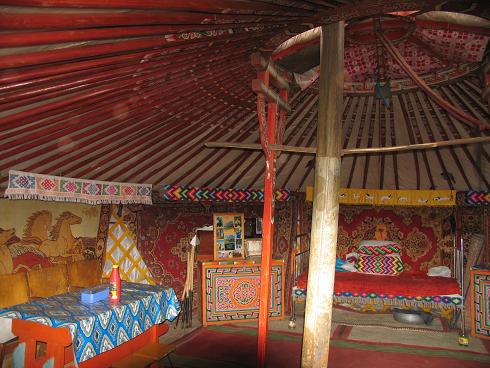
Ultimately, at the heart of [Khanbalik], Khubilai created a Mongol haven where few foreigners, including Chinese, could enter. Behind high walls and guarded by Mongol warriors, the royal family and court continued to live as Mongols. The large open areas for animals in the middle of the city had no precedent in Chinese culture. This Forbidden City constituted a miniature steppe created in the middle of the Mongol capital. During the Mongol era, the whole complex of the Forbidden City was filled with gers [yurts] where members of the court often preferred to live, eat, and sleep. Pregnant wives of the khan made sure that their children were born in a ger, and the children received their school lessons in the ger as they grew up. While Khubilai and his successors maintained public lives as Chinese emperors, behind the high walls of their Forbidden City, they continued to live as steppe Mongols.

When the Franciscan friar Odoric of Pordenone visited the Mongol territories in the 1320s, he described the Forbidden City in Khanbalik: “Within the precincts of the said palace imperial, there is a most beautiful mount, set and replenished with trees, for which cause it is called the Green Mount, having a most royal and sumptuous palace standing thereupon, in which, for the most part, the great Can is resident.” In a passage that sounds very close to earlier descriptions of Karakorum, he wrote, “Upon the one side of the said mount there is a great lake, whereupon a most stately bridge is built, in which lake is great abundance of geese, ducks, and all kinds of water-fowl; and in the wood growing upon the mount there is a great store of all birds, and wild beasts.” …

Inside the confines of their Forbidden City, Khubilai and his family continued to act as Mongols in dress, speech, food, sports, and entertainment. This meant that they consumed large amounts of alcohol, loudly slurped their soup, and they cut meat with knives at the table, thereby disgusting the Chinese who confined such acts to the kitchen during preparation. With the emphasis on alcohol and rituals of drinking and drunkenness, the scenes at court must have been somewhat chaotic as the free-roaming, individualistic Mongols tried to imitate the complex and highly orchestrated rituals and ceremonies of the Chinese court. In contrast to the Chinese imperial tradition of courtiers lining up according to rank, the Mongols tended to swarm chaotically, and, perhaps most disturbing to the Chinese, the Mongol women mingled freely among the men on even the most important occasions. The ceremonies in the Mongol court became so disorganized that sometimes the khan’s bodyguards had to beat back the crowds of officials and guests with batons.

SOURCE: Genghis Khan and the Remaking of the Modern World, by Jack Weatherford (Three Rivers Press, 2004), pp. 199-200

Leave a comment

Filed under China, Mongolia

Khubilai’s Move from Xanadu to Khanbalik

To appear as a powerful Chinese leader, Khubilai needed an impressive court located in a real city, not a peripatetic tent court nor the ad hoc structures erected at Shangdu (Xanadu), in modern Inner Mongolia. The place held special importance for him because he had first been proclaimed Great Khan at the khuriltai there, but it had no obvious advantages. Not only was that capital located in a nomadic zone, which the Chinese found quite alien and barbaric, but it had also been the traditional staging area used by his grandfather in the raiding and looting of Chinese cities. Khubilai sought to disassociate himself from the less desirable aspects of that history.

While keeping Shangdu as a summer home and a hunting preserve, he commissioned the building of another city, a real Chinese-style imperial capital, farther south at a place better situated to exploit the agricultural wealth of the lands along the Yellow River. He chose the site of the former Jurched capital of Zhongdu, which had been conquered by Genghis Khan in 1215, the year of Khubilai’s birth. In 1272, Khubilai ordered the building of his new capital, and he connected it by canal to the Yellow River. The Mongols called the place Khanbalik, the City of the Khan. His Chinese subjects called it Dadu, the Great Capital, and it grew into the modern capital of Beijing [‘North Capital’]. Khubilai brought in Muslim architects and Central Asian craftsmen to design his city in a new style that offered more of a compromise between the tastes of the nomadic steppe dwellers and the sedentary civilization.

In contrast to the maze of winding alleys in most Chinese cities of the era, Khubilai’s capital had broad, straight streets run on a north-south axis with east-west streets perpendicular to them; the guards at one gate could see straight through the city to the guards at the opposite gate. From the imperial palace, they built boulevards, more to accommodate the horses and military maneuvers of the Mongols than the wheelbarrows or handcarts of the Chinese laborers. The boulevards stretched wide enough for nine horsemen to gallop abreast through the city in case the native people rose up against their foreign rulers.

Furthering the Mongol interest in profits from international trade, Khubilai Khan designated sections of the city for Middle Eastern and Mongol populations as well as for people from all over what is today China. The city was host to merchants from as far away as Italy, India, and North Africa. Where so many men lingered, as Marco Polo pointed out in great detail, large numbers of prostitutes gathered in their own districts to serve them. Scholars and doctors came from the Middle East to practice their trades. Roman Catholic, Nestorian, and Buddhist priests joined their Taoist and Confucian counterparts already practicing in China. Muslim clerics, Indian mystics, and, in some parts of Mongol China, Jewish rabbis added to the mixture of people and ideas that thronged the empire. Far larger than Karakorum, but with many of the same internationalist principles, the city was a true world capital and fit to be capital of the world.

SOURCE: Genghis Khan and the Remaking of the Modern World, by Jack Weatherford (Three Rivers Press, 2004), pp. 197-199

Leave a comment

Filed under China, Mongolia

Some Fire and Brimstone on Srebrenica

The Wall Street Journal has a harsh editorial today.

Ten years ago today, Bosnian Serb forces under the command of General Ratko Mladic entered the Bosnian Muslim town of Srebrenica, then being defended by Dutch peacekeepers. General Mladic made three demands: that the townsmen surrender their weapons; that all males between the ages of 12 and 77 be separated out for “questioning”; and that the rest of the population be expelled to Muslim areas. Within two days, 23,000 women and children had been deported. Another 5,000 Muslim men and boys who had taken refuge on a nearby Dutch base were also delivered to the Mladic forces.

As we now know, most of the people surrendered by the Dutch to the Serbs were slaughtered, as were more than 2,000 others, bringing the estimated tally of the Srebrenica massacre to 7,200. Yet the scale of the atrocity alone is not why we remember it. We remember because the men of Srebrenica were betrayed by their ostensible protectors, and that carries some lessons for today.

But Christopher Hitchens is far more brutal.

We still have to endure the disgrace (and the victims and survivors have to endure the humiliation) of knowing that Mladic and his psychopathic political boss Radovan Karadzic are still cheerfully at large. They are not hiding in some dingy cave in the unmapped hinterlands of Waziristan. They are in mainland Europe. Last Friday, when the New York Times covered both the London atrocities and the coming anniversary of Srebrenica, it ran an editorial that smugly inquired “why the wealthy nations have not done enough about the root causes of terrorism and why Al Qaeda and Osama bin Laden continue to function after almost four years of the so-called war on terrorism. Many will wonder why the United States is mired in Iraq while Al Qaeda’s leader still roams free.”

Prettily phrased, you have to admit. Others might wonder why the wealthy nations took so long to address the “root cause” of Serbian terrorism-­-the root cause being Serbian fascism and irredentism­–and why it is that Mladic and Karadzic are still gloatingly free after 10 years, not four. The “hunt” for the latter two gentlemen began during the Clinton administration, and on the turf of the sophisticated and multilateral Europeans, as the writer of the above words might have had the grace to admit.

Aljazeera.com also weighs in–and attracts a lot of reader comments.

People in the West who lazily look back on the 1990s as the good old days fail to realize just how much diplomatic, economic, military, and moral credibility the West–the UN, EU, US, NATO–squandered during that halcyon decade before the end of history reversed itself so abruptly at the end of the millennium.

In the summer of 1984, I remember the great relief of returning to normalcy, to the tolerably functional societies of the West after spending a year in Ceausescu’s Romania, the bleakest and most dysfunctional society I have yet encountered. (I know there are, have been, and will be worse.) We could easily endure Romania because we knew that we would eventually escape to a better place. The Romanians, however, remained trapped in their hell, whose brimstone has taken a long time to lose its potency even after the fall of Ceausescu.

Since the beginning of the 1990s, one safe area after another has been attacked from either the inside or the outside, until normalcy has come to include the possibility of yet another outbreak of savage barbarism any place, any time. As last week’s attacks in London reminded us yet again, there is nowhere left to hide. We can only meet those threats head on, anywhere and everywhere, with violent warnings where necessary, as we should have done in Bosnia and Rwanda, while steadily destroying the attraction of the noxious ideologies that feed the barbarism.

Here’s more from David Aaronovitch in The Times Online: ‘If we don’t provoke them, maybe they will leave us alone.’ You reckon so?

Leave a comment

Filed under Romania

PTSD in UN Peacekeepers

Among the many retrospectives published today, on the 10th anniversary of the massacre at Srebrenica, is an article in the Washington Post focusing on the Post-Traumatic Stress Disorders suffered by the Dutch troops under UN command who were charged with preventing such atrocities.

For days, the [Dutch] battalion had waited for reinforcements and air support. None came. One soldier already had been killed by Muslim forces. By the time the Serb attack started on July 11, the soldiers’ nerves were shot.

“All those people … screaming and crying. A truck, normally fit for 18 people, was packed with 200 refugees. We helped them from the truck and gave them a place in the factory hall,” Poortinga recalled in the book.

“It was hell. I did my best, but after a while I collapsed. The shouting became louder and louder. The shooting came close, grenades fell, dust came from the ceiling. I found myself crying like a baby. I am not a baby at all, but then I was like a child.”

Co-author Hendrina Praamsma said 40 percent of those interviewed had needed psychological treatment at some point. Some had attempted suicide. “Most of them feel abandoned, rejected, falsely accused,” she said.

A 1999 report by the United Nations said Yugoslavia’s then president, Slobodan Milosevic, bore primary responsibility. Milosevic is now on trial in The Hague.

Nonetheless, Holland remained traumatized.

In 2002, an exhaustive study by the Netherlands Institute for War Documentation concluded the government of Prime Minister Wim Kok had sent ill-prepared troops on an impossible mission because it wanted to boost its international prestige. The report prompted the government, still headed by Kok, to resign.

A subsequent parliamentary inquiry also cleared the troops of blame. But Srebrenica isn’t over for Holland.

A district court in The Hague is hearing a civil suit by Bosnian Srebrenica survivors seeking $2.6 billion in compensation from the state for its troops’ failure to protect them.

One of them is Hassan Nuhanovic, a U.N. translator whose brother and father were forced off the U.N. base by Dutch troops and haven’t been seen since.

Their accusations reawakened the shame among some veterans, said Jan Burger, head of the Veterans Institute’s social services. In the past two months, with the approach of the 10th anniversary, another half dozen Srebrenica veterans have sought help.

Back in April, the Canada-resident Dutch blogger Peaktalk compared Karremans, the Dutch commander at Srebrenica, with Dallaire, the Canadian commander at Kigali.

If you google Karremans you will find lots more, but I think you get it: the Dutch commander not only failed to do anything to sa[v]e Bosnian Muslim lives, he couldn’t even bring himself to make a moral distinction between the warring parties. Of all people, Robert Fisk has a good summary with this sobering observation:

The Dutch published their own miserable, chilling account of Srebrenica. But Karremans was packed off to become Dutch military attaché in Washington, under orders not to talk. And silent he was, to the great relief of the Dutch.

We can’t accuse Dallaire of failing to see the difference between right and wrong, or, for remaining quiet. His book and the documentary of his return to Rwanda are getting ample attention and rightly so. Cynics may argue that Dallaire learned from the Karremans experience and went on a media blitz to defend his record, but having studied the man and the mandate he had, the Canadian commander comes out far cleaner than some of his critics now argue. Sure, he made mistakes and there may be braver people who would have been willing to die to take a stand against the terror in front of them. We can even entertain the notion that the post-war military of left-liberal nations like Canada and Holland has failed to produce the battle-hardened moral men that we like to see when we think of war, or when we watch an epic Hollywood rendition of some historic struggle. Heroes like that are in short supply, reality is different.

Leave a comment

Filed under military

How the Mongols Quelled the Assassins

For Hulegu [Khan, grandson of Genghis], the ultimate prize was to conquer the Arab cultural and financial capital of Baghdad, but to get there, he had to reassert Mongol authority over several rebellious areas en route. The most difficult of these was to conquer the strongholds of the Nizari Ismailis, a heretical Muslim sect of Shiites more commonly known in the West as the Assassins. They were holed up in perhaps as many as a hundred unconquered mountain fortresses stretching from Afghanistan to Syria, the most important of which was Alamut, the Eagle’s Nest, in northern Persia. Members followed without question the orders of their hereditary leader, who was known by many titles, such as Imam, the Grand Master, or Old Man of the Mountain. Because they believed that God chose the Imam, he was therefore infallible; he needed no education since everything he did, no matter how odd it might appear to mortals, was considered divinely inspired. His followers accepted seemingly irrational acts, frequent changes of the law, and even the reversal of the most sacred precepts as evidence of God’s plan for humanity.

Despite the lack of a conventional army, the Ismaili sect exercised tremendous political power through a highly sophisticated system of terror and assassination, and the secrecy and success of the group bred many myths, making it, still today, difficult to factor out the truth. The cult apparently had one simple and effective political strategy: kill anyone, particularly leaders or powerful people, who opposed them in any way. The cult recruited young men who were willing to die in their attacks with the assurance that they would achieve instant entry into paradise as martyrs of Islam. The Chinese, Persian, and Arabic sources all relate the same account of how young men were lured by ample quantities of hashish and other earthly delights that awaited them in the special gardens of the cult’s castles and fortresses. This was the foretaste of the paradise that awaited them if they died in the Grand Master’s service. He then trained them and controlled them with a steady supply of hashish to keep them obedient and make them fearless. Supposedly, because of the importance of narcotics for the Ismailis, the people around them called them hashshashin, meaning “the hashish users.” Over time, this name became modified into the word assassin. Whether the killers had actually used hashish to inspire them or not, the name spread into many languages as the word for the murderer of high officials.

Earlier, in the time of Genghis Khan’s first invasion of the region, the Grand Master willingly swore obedience to the Mongols. In the following decades, the Assassins flourished in the power vacuum created by Genghis Khan’s defeat of the Turkic sultan of Khwarizm and then the withdrawal of most of the Mongol forces. By the time Mongke Khan ascended the throne, the Assassins feared that the return of a large Mongol army might interfere with their newfound powers. In what may have been only a pretext for Hulegu’s attacks, some chroniclers wrote that the Grand Master sent a delegation to Karakorum ostensibly to offer submission to Mongke Khan, but actually trained to kill him. The Mongols had turned them away and prevented the assassination, but because of it Mongke Khan decided to crush the sect permanently and tear down their fortresses.

Before Hulegu’s army reached the Assassin strongholds, the drunken and debauched Grand Master was murdered by disgruntled members of his own entourage and replaced by his equally incapable son. Hulegu assessed the difficulty of capturing the heavily fortified castles one by one, and he devised a simple and more direct plan. Because of the sacred role of the Grand Master, Hulegu concentrated on capturing him with a combination of massive military might and the offer of clemency if he should surrender. The Mongols bombarded the Ismaili stronghold, and the Mongol warriors proved capable of scaling the steepest escarpments to surprise the defenders of the fortress. The combination of force, firepower, and the offer of mercy worked, and on November 19, 1256, on the first anniversary of his coming to power, the Imam surrendered to the Mongols.

Once Hulegu had control of the Imam, he paraded him from Ismaili castle to Ismaili castle to order his followers to surrender. To encourage the cooperation of the Imam and keep him happy until the end of the campaign, Hulegu indulged his [the Imam’s] obsessive interest in watching camels fight and mate, and he supplied him with girls. In the spring of 1257, once the Assassins’ castles had been taken, the Imam recognized his loss of usefulness to the Mongols, and he requested permission to travel to Karakorum to meet with the Great Khan Mongke himself, perhaps to work out some plan for his own survival. Hulegu sent him on the long journey to Mongolia, but once the Imam arrived there, Mongke refused to see him. Instead, the Mongol escort took the Imam and his party out to the mountains near Karakorum and stomped them to death.

SOURCE: Genghis Khan and the Remaking of the Modern World, by Jack Weatherford (Three Rivers Press, 2004), pp. 178-180

5 Comments

Filed under Afghanistan, Mongolia

Justice vs. Due Process in Haiti, 1994

Six years after the fact, Dr. Paul Edward Farmer reminded me, “We met because of a beheading, of all things.”

It was two weeks before Christmas 1994, in a market town in the central plateau of Haiti, a patch of paved road called Mirebalais. Near the center of town there was a Haitian army outpost–a concrete wall enclosing a weedy parade field, a jail, and a mustard-colored barracks. I was sitting with an American Special Forces captain, named Jon Carroll, on the building’s second-story balcony…. I was in Haiti to report on American soldiers. Twenty thousand of them had been sent to reinstate the country’s democratically elected government, and to strip away power from the military junta that had deposed it and ruled with great cruelty for three years. Captain Carroll had only eight men, and they were temporarily in charge of keeping the peace among 150,000 Haitians, spread across about one thousand square miles of rural Haiti. A seemingly impossible job, and yet, out here in the central plateau, political violence had all but ended. In the past month, there had been only one murder. Then again, it had been spectacularly grisly. A few weeks back, Captain Carroll’s men had fished the headless corpse of the assistant mayor of Mirebalais out of the Artibonite River. He was one of the elected officials being restored to power. Suspicion for his murder had fallen on one of the junta’s local functionaries, a rural sheriff named Nerva Juste, a frightening figure to most people in the region. Captain Carroll and his men had brought Juste in for questioning, but they hadn’t found any physical evidence or witnesses. So they had released him.

The captain was twenty-nine years old, a devout Baptist from Alabama. I liked him. From what I’d seen, he and his men had been trying earnestly to make improvements in this piece of Haiti, but Washington, which had decreed that this mission would not include “nation-building,” had given them virtually no tools for that job. On one occasion, the captain had ordered a U.S. Army medevac flight for a pregnant Haitian woman in distress, and his commanders had reprimanded him for his pains. Up on the balcony of the barracks now, Captain Carroll was fuming about his latest frustration when someone said there was an American out at the gate who wanted to see him.

There were five visitors actually, four of them Haitians. They stood in the gathering shadows in front of the barracks, while their American friend came forward. He told Captain Carroll that his name was Paul Farmer, that he was a doctor, and that he worked in a hospital here, some miles north of Mirebalais…. He asked the captain if his team had any medical problems. The captain said they had some sick prisoners whom the local hospital had refused to treat. “I ended up buyin’ the medicine myself.”

Farmer flashed a smile. “You’ll spend less time in Purgatory.” Then he asked, “Who cut off the head of the assistant mayor?”

“I don’t know for sure,” said the captain. “It’s very hard to live in Haiti and not know who cut off someone’s head,” said Farmer.

A circuitous argument followed. Farmer made it plain he didn’t like the American government’s plan for fixing Haiti’s economy, a plan that would aid business interests but do nothing, in his view, to relieve the suffering of the average Haitian. He clearly believed that the United States had helped to foster the coup–for one thing, by having trained a high official of the junta at the U.S. Army’s School of the Americas. Two clear sides existed in Haiti, Farmer said–the forces of repression and the Haitian poor, the vast majority. Farmer was on the side of the poor. But, he told the captain, “it still seems fuzzy which side the American soldiers are on.” Locally, part of the fuzziness came from the fact that the captain had released the hated Nerva Juste.

I sensed that Farmer knew Haiti far better than the captain, and that he was trying to impart some important information. The people in this region were losing confidence in the captain, Farmer seemed to be saying, and this was a serious matter, obviously, for a team of nine soldiers trying to govern 150,000 people.

But the warning wasn’t entirely plain, and the captain got a little riled up at Farmer’s denunciation of the School of the Americas. As for Nerva Juste, he said, “Look, that guy is a bad guy. When I do have him and the evidence, I’ll slam him.” He slapped a fist into his hand. “But I’m not gonna stoop to the level of these guys and make summary arrests.”

Farmer replied, in effect, that it made no sense for the captain to apply principles of constitutional law in a country that at the moment had no functioning legal system. Juste was a menace and should be locked up.

So they reached a strange impasse. The captain, who described himself as “a redneck,” arguing for due process, and Farmer, who clearly considered himself a champion of human rights, arguing for preventive detention.

SOURCE: Mountains Beyond Mountains: The Quest of Dr. Paul Farmer, a Man Who Would Cure the World, by Tracy Kidder (Random House, 2004), pp. 3-5

Leave a comment

Filed under Caribbean, military, U.S., war

Medieval German vs. Mongol Shock and Awe

Holy Roman Emperor Frederick Barbarossa, who ranks as one of Germany’s greatest historical and cultural heroes, best exemplified the use of terror in the West. When he tried to conquer the Lombard city of Cremona in the north of modern Italy in 1160, he instituted an escalating series of violent acts of terror. His men beheaded their prisoners and played with the heads outside the city walls, kicking them like balls. The defenders of Cremona then brought out their German prisoners on the city walls and pulled their limbs off in front of their comrades. The Germans gathered more prisoners and executed them in a mass hanging. The city officials responded by hanging the remainder of their prisoners on top of the city walls. Instead of fighting each other directly, the two armies continued their escalation of terror. The Germans then gathered captive children and strapped them into their catapults, which were normally used to batter down walls and break through gates. With the power of these great siege machines, they hurled the living children at the city walls.

By comparison with the terrifying acts of civilized armies of the era, the Mongols did not inspire fear by the ferocity or cruelty of their acts so much as by the speed and efficiency with which they conquered and their seemingly total disdain for the lives of the rich and powerful. The Mongols unleashed terror as they rode east, but their campaign was more noteworthy for its unprecedented military success against powerful armies and seemingly impregnable cities than for its bloodlust or ostentatious use of public cruelty….

One of the worst slaughters was unleashed on the citizens of Omar Khayyám‘s home city of Nishapur. The residents revolted against the Mongols, and in the ensuing battle an arrow fired from walls of the city killed Genghis Khan’s son-in-law, Tokuchar. In revenge for the revolt and as a lesson to other cities, Genghis allowed his widowed daughter, who was pregnant at the time, to administer whatever revenge she wished upon the captured city. She reportedly decreed death for all, and in April 1221, the soldiers carried out her command. According to widely circulated but unverified stories, she ordered the soldiers to pile the heads of the dead citizens in three separate pyramids–one each for the men, the women, and the children. Then she supposedly ordered that the dogs, the cats, and all other living animals in the city be put to death so that no living creature would survive the murder of her husband….

While the destruction of many cities was complete, the numbers given by historians over the years were not merely exaggerated or fanciful–they were preposterous. The Persian chronicles reported that at the battle of Nishapur, the Mongols slaughtered the staggeringly precise number of 1,747,000. This surpassed the 1,600,000 listed as killed in the city of Herat. In more outrageous claims, Juzjani, a respectable but vehemently anti-Mongol historian, puts the total for Herat at 2,400,000. Later, more conservative scholars place the number of dead from Genghis Khan’s invasion of central Asia at 15 million within five years. Even this more modest total, however, would require that each Mongol kill more than a hundred people; the inflated tallies for other cities required a slaughter of 350 people by every Mongol soldier. Had so many people lived in the cities of central Asia at the time, they could have easily overwhelmed the invading Mongols.

SOURCE: Genghis Khan and the Remaking of the Modern World, by Jack Weatherford (Three Rivers Press, 2004), pp. 116-118

1 Comment

Filed under Central Asia, Europe, Germany, Mongolia

Senator Fong as King Lear

Today’s Honolulu Star-Bulletin carries a long sad story by reporter Sally Apgar about the familial and financial legacy of Sen. Hiram Fong, the first Asian American U.S. senator.

In sorting through the personal papers of the late Sen. Hiram Fong Sr., daughter Merie-Ellen Fong Gushi found what she believes are clues to why her twin brother, Marvin, has spent the last eight years waging wars in boardrooms and courtrooms against his parents and three siblings.

A letter dated Dec. 6, 1985, written in Marvin’s spidery handwriting, was addressed to his father and began: “I have never in my life hated anyone, but I hate you.

“For 37 years you have degraded me, making me feel I was ‘good for nothing.'”

Marvin wrote: “I promise to hurt you as much as you have hurt me in 37 years…. I will publicly embarras (sic) you; I will destroy whatever is left of your precious name. It may be tomorrow, a year from now or in five years, just expect it in your lifetime. You only care about your name and money…. I will rejoice in your downfall.”

Marvin’s battles, played out publicly in at least three major lawsuits, ripped apart the family financial empire, drove his parents to declare bankruptcy as a strategy to protect their remaining wealth and resulted in Marvin and his wife, Sandra Au Fong, gaining ownership of Market City Shopping Center and control of the most valuable remaining family assets.

In a symbolic end to the Fong saga, the U.S. Bankruptcy Court trustee auctioned off the family estate on Alewa Drive for $1.68 million to a developer last week.

In 1950, Hiram Fong Sr., the ambitious son of poor Chinese immigrants who graduated from Harvard Law School and became the first Asian-American elected to the U.S. Senate, built that house high on a ridge overlooking the sea and downtown Honolulu. Fong, a Republican, served from 1959 to 1977.

As a businessman, Sen. Fong made and lost millions. He lived his last weeks on a bed in the living room of that once-elegant house, which, like his fortune, declined into ruin.

“This whole thing with Marvin is like ‘King Lear‘ or something out of the Bible,” said Hiram Jr., the oldest son, in a recent interview at the house, which is now crowded with moving boxes.

Referring to Marvin’s 1985 letter, Hiram Jr. shook his head sadly and said, “He accomplished what he set out to do in the letter.”

Junior, as he is nicknamed, is trained as a lawyer and served briefly in the state Legislature and on the City Council before trying his hand at various disastrous business ventures, including a failed floating restaurant and a Laotian gold mine.

As the firstborn in a Chinese family, Junior was the anointed son destined to follow in his father’s footsteps.

Today, Junior, 65, who has languished in involuntary bankruptcy since 2001, is living at the family home until the sale is complete. For several years, Junior, who chain-smokes and reads westerns by Louis L’Amour, chauffeured his father every morning to his office at Finance Factors, one of the companies he helped found.

Several afternoons a week, he drove his father to St. Francis Medical Center for dialysis treatments. Junior and his sister Merie-Ellen, known as Muffy, who lives on Maui and works in her husband’s landscape business, have been the chief caregivers for their parents. Before Sen. Fong died, he asked the two to take care of their mother, Ellen Lo, who now lives in a care home.

In February, Junior was evicted from the family’s dilapidated former Kahaluu vacation home by its new owners, Finance Factors. Junior unsuccessfully represented himself in the eviction proceeding held in Kaneohe District Court against a team of lawyers from Finance Factors.

Asked what he will do when the family home is sold, Junior joked, “I will buy a van to live in and park it in Finance Factors’ parking lot.”

In an interview, Marvin, 57, said sadly, “My father was never fair to us. He always took Junior’s side.”

In court documents, Marvin, who was the “baby” of the family, refers to Junior as “the preferred son” who his father bailed out of a series of failed investments, taking on loans until the banks turned him down for more and the foreclosures began.

In documents filed in his father’s bankruptcy case, Marvin wrote that his father and Junior began their downward slide in the 1970s when the two co-signed loans “on a disastrous investment in the Oceania floating restaurant” and lost about $1 million. In the same court documents, Marvin said, “Since then, and in part because of that catastrophe, Fong Sr. has willingly and actively participated in Fong Jr.’s downward spiraling mishaps and wrongdoing.”

There’s lots more to the story. The sage advice of Lear’s Fool comes too late.

Have more than thou showest,
Speak less than thou knowest,
Lend less than thou owest,
Ride more than thou goest,
Learn more than thou trowest,
Set less than thou throwest;
Leave thy drink and thy whore,
And keep in-a-door,
And thou shalt have more
Than two tens to a score.
(Act I, Scene IV, Lines 31-140)

The version of Lear that I grew up on was entitled “Like Meat Loves Salt” in the Grandfather Tales collection by by WPA-funded folklorist Richard Chase, whose Jack Tales are my favorite “reading aloud” stories. I remember trying to tell one, I think it was Jack and the Varmints in Tok Pisin during fieldwork in Papua New Guinea.

P.S. “Learn more than thou trowest” seems to mean “Take in more than you believe”–exceedingly sage advice for anyone in these days of information overload.

Leave a comment

Filed under Hawai'i

How Genghis Khan Reformed Tribalism on the Steppe

In traditional steppe systems of thought, everyone outside the kinship network was an enemy and would always be an enemy unless somehow brought into the family through ties of adoption or marriage. Temujin [later Genghis Khan] sought an end to the constant fighting between such groups, and he wanted to deal with the Tatars the same way that he had dealt with the Jurkin and the Tayichiud clans–kill the leaders and absorb the survivors and all their goods and animals into his tribe. Although this policy had worked with clans of hundreds, however, the Tatars were a tribe of thousands. For such a massive social transformation, he needed the full support of his followers, and to achieve that support he summoned a khuriltai [= loya jirga] of his victorious warriors.

The members of the khuriltai agreed to the plan, determining to kill Tatar males taller than the linchpin holding the wheels on a cart, which was not only a measure of adulthood but a symbolic designation of the nation itself, in much the same way that maritime people often use the ship as a symbol of their state. Once again, as a counter to the killing, Temujin wanted the surviving Tatars taken in as full members of his tribe, not as slaves. To stress this, he not only adopted another Tatar child for his mother, but also encouraged intermarriage. Until this time he had only one official wife, Borte, who bore him four sons and an unknown number of daughters, but he now took the aristocratic Tatar Yesugen and her elder sister Yesui as additional wives. The Tatars had had a much greater reputation than the Mongols, and after this battle, the Mongols took in so many Tatars, many of whom rose to high office and great prominence in the Mongol Empire, that the name Tatar became synonymous with, and in many cases better known, than the name Mongol, leading to much historic confusion through the centuries.

Intermarriage and adoption would not suffice, however, to achieve Temujin’s goal of merging the two large groups into one people. If kin groups were allowed to remain essentially intact, the larger group would eventually fragment. In 1203, therefore, the year after the Tatar conquest, Temujin ordered yet another, and even more radical, reformation of the Mongol army and tribe.

He organized his warriors into squads, or arban, of ten who were to be brothers to one another. No matter what their kin group or tribal origin, they were ordered to live and fight together as loyally as brothers; in the ultimate affirmation of kinship, no one of them could ever leave the other behind in battle as a captive. Like any family of brothers in which the eldest had total control, the eldest man took the leadership position in the Mongol arban, but the men could also decide to chose another to hold this position.

Ten of the squads formed a company, or zagun, of one hundred men, one of whom they selected as their leader. And just as extended families united to form lineages, ten Mongol companies formed a battalion, or mingan, of one thousand men. Ten mingan were then organized into a tumen, an army of ten thousand; the leader of each tumen was chosen by Temujin, who knew the qualities needed in such a leadership position. He allowed fathers and sons and brothers and cousins to stay together when practical, but by forcing them into new units that no man could desert or change, under penalty of death, he broke the power of the old-system lineages, clans, tribes, and ethnic identities. At the time of his reorganization, he reportedly had ninety-five mingan, units of a thousand, but since some of the units were not staffed to capacity, the total number of troops may have been as low as eighty thousand.

The entire Mongol tribe became integrated by means of the army. Under this new system, all members of the tribe–regardless of age or gender–had to perform a certain amount of public service. If they could not serve in the military, they were obliged to give the equivalent of one day of work per week for public projects and service to the khan. This included caring for the warriors’ herds, gathering dung for fuel, cooking, making felt, repairing weapons, or even singing and entertaining the troops. In the new organization, all people belonged to the same bone. Temujin the boy, who had faced repeated rejections ascribed to his lower-status birth, had now abolished the distinction between black bone [distant relatives] and white bone [near relatives]. All of his followers were now one united people.

Historical speculation abounds as to how Temujin adopted the decimal organization of his people. Some of the earlier Turkic tribes used a similar military organization based on units of ten, and Temujin may well have borrowed it from them. Temujin, however, not only utilized the system as a military tactic for war, but he also employed it as the permanent structure for the whole society.

SOURCE: Genghis Khan and the Remaking of the Modern World, by Jack Weatherford (Three Rivers Press, 2004), pp. 51-53

Leave a comment

Filed under Central Asia