
Author Archives: Joel

Joel's avatar

About Joel

Executive Editor, Journals Dept. University of Hawai‘i Press

Hiroshima Carp’s Manager Marty Brown

Last night, I was watching the only Pro Baseball game in Japan that wasn’t rained out. My old underdog favorite Hiroshima Carp lost to the newly revitalized Yomiuri Giants and their superb, three-hit shutout pitching of Jeremy Powell. I was shocked to see that the super-traditional Carp had a foreign manager, former Carp player Marty Brown. The funniest part of the game for me was watching Brown’s translator while Brown was flashing signs to his outfield after the Giants broke the game open with a series of hits in the 7th inning. Brown’s translator was repeating, sign for sign, what his manager was signing. That surely must be the easiest translation task one could ask for.

It sounds like Brown has a much harder job, judging from a recent report by Jim Allen in the Daily Yomiuri.

Marty Brown is a firm believer in tradition, and traditionally no team has exerted more energy in practice than the Hiroshima Carp. Yet after finishing fifth or worse for four straight seasons, the fish lured their former outfielder back to Hiroshima Citizens Stadium to turn that energy into results….

The club’s spring training camp was like going to a living history museum, an homage to pro baseball’s past. Other clubs go through pre-programmed drills in small groups until noon when individuals go off to work on specific skills, but Hiroshima’s habit was old-school regimentation–working in groups from morning to late afternoon.

“Something had to be changed and I think it took a lot of guts to hire me to do this job, this being Hiroshima and [me] a foreign manager,” Brown said. “I respect that. I think it is good that I played in Hiroshima and I know the city and I still have a lot of friends there….

Brown has instructed all the players to plan their own skill workouts–instead of simply following programs planned out by coaches–and to have a focus and rationale for their work.

“Until now, the Carp have had very tough workouts. Just amazing,” said Arai. “But Marty has said we’ll finish group workouts earlier … [and] with the time remaining, players should … work individually on their weak points.”

This is nothing new in Japan.

The Chunichi Dragons won the CL in 2002 after rookie manager Hiromitsu Ochiai told veteran players to plan their own spring routines. But for the tradition-bound Carp this was a radical departure.

“Up to now, camp had the feeling of, ‘Do this.’ Now it is, ‘Let’s go.’ That’s really a significant difference,” Arai said.

Asked if players could confidently do their own thing after years of conformity, Arai insisted it was no problem.

“Essentially, action must originate with a player. When coaches are telling you ‘do it, do it,’ it is about their expectations,” Arai said. “But every action depends on the ability of the player, himself.

“Marty said, ‘You are professionals and I expect you to take responsibility.’ To take responsibility and think for yourself, and turn that into action, that is part of being a professional ball player.”
1 Comment

Filed under baseball

Amateur vs. Professional Revolutionaries, 1917

The final downfall of the Romanov dynasty came on 3 March [1917], with the renunciation of the throne by the Grand Duke Mikhail, who had been nominated to be the Tsar’s successor…. The sudden collapse of the aristocracy took professional revolutionaries, such as Lenin and Trotsky, completely by surprise. They were exasperated to find themselves so far from the centre of events. But as things turned out, they had not missed their opportunity. The leaders of the Provisional Government, acting out of high-minded liberal naïvety in the case of Prince Lvov, and theatrical vanity in the case of his successor, Aleksandr Kerensky, proved easy to outmanoeuvre. The neck of the new freedom was exposed to the unscrupulous Leninists.

Kerensky was a lawyer. He was small and his starting eyes and curved nose made him look like a very intelligent frog, yet with ringing rhetoric and bursts of emotional energy he could dominate huge crowds. (Olga Chekhova later observed that whenever she saw Dr Goebbels speak, she could not help thinking of Kerensky.) Kerensky managed to convince many highly educated people – Stanislavsky and Nemirovich-Danchenko among them – that he was a political genius, the Napoleon who would bring revolutionary excesses back under control and produce human justice. But historical parallels, especially in times of revolution and war, are often dangerously misleading. The balancing act which he had to undertake between reassuring the bourgeoisie and Russia’s Western allies on one hand, while at the same time appeasing the impatience of workers and peasants to take over factories and farmland, would have undermined the credibility of even the greatest leader.

Stanislavsky’s family business, the Alekseiev factories, were seized by the workers, and his house, as he admitted to a friend, had been ‘done over’. Respect for private property had collapsed with the elastic notion of ‘revolutionary expropriation’. Stanislavsky now had nothing more than a salary from the Moscow Art Theatre. Yet his enthusiasm for this new world of freedom did not diminish. He was certain it would lead not only to a fairer world, but to a more beautiful one. On the other hand, he also admitted that he was politically illiterate.

SOURCE: The Mystery of Olga Chekhova: The true story of a family torn apart by revolution and war, by Antony Beevor (Penguin, 2005), pp. 43-44

Leave a comment

Filed under Russia, USSR

The Shinto Torii: A Reminder to Purify the Heart

[The torii (鳥居)] does not demarcate something external into which I can simply tap. To function properly, the mysterious power beyond the torii must be in an internal relation with the person passing through it. If your mind is befuddled and clouded, if your heart is defiled and disingenuous, passage through the gateway will only return you to that. A symbol sacred to Shinto is the mirror. In fact, in many shrines, large and small, major and minor, the altar contains nothing other than a mirror. Along with the sword and comma-shaped jewel [magatama], the mirror is part of the official regalia of the emperor as chief priest of the tradition. A mirror’s capacity to reflect depends on its cleanliness. Hence Shinto sites usually have a water trough for purification near the entrance. As people enter the heart of the shrine, they are expected to wash their hands and mouth, cleansing themselves of any pollution from physical or verbal misdeeds. Washing away dirt from the journey, they are ready to be a home in the kami-filled, tama-empowered shrine. Their hearts and minds are pure. Even the torii along the path on Mount Fuji serves a similar function. The torii reminds pilgrims to cleanse their inner self in preparation for approaching the peak.

SOURCE: Shinto: The Way Home, by Thomas P. Kasulis (U. Hawai‘i Press, 2004), p. 23

I’ve never climbed Mt. Fuji, but I can well imagine the female voice recording familiar to every train passenger in Japan telling the pilgrims as they approach the torii of their impending arrival at the summit, thanking them for having climbed up, and asking them to mind their magokoro ‘truehearts’ instead of their ashimoto ‘footsteps’ as they pass through the torii: 間もなく山頂に到着いたします。ご乗山真にありがとうございました。鳥居を通るとき真心にご注意願います。(Mamonaku sanchou ni touchaku itashimasu. Gojousan makoto ni arigatou gozaimashita. Torii o tooru toki, magokoro ni gochuui negaimasu.)

And then telling them where to find the toilets and vending machines.

Leave a comment

Filed under Japan

From Revolutionary to Reactionary in 20 Years

Theatres … were much more tightly controlled [after the Russian Revolution]. The Moscow Art Theatre soon had to search for a repertoire more attuned to the new era, just as Stanislavsky and Nemirovich-Danchenko had to forget their enthusiasm for Kerensky, who had fled into exile following the Bolshevik coup in Petrograd. In fact the tall and distinguished Stanislavsky now strode down Moscow streets with his fur coat thrown wide open to show a large red bow, demonstrating his revolutionary loyalty. The actors and stage crew of the Moscow Art Theatre became state employees on pitiful salaries and answerable to People’s Commissar for Enlightenment Anatoly Lunacharsky.

Bolshevik agitprop groups brought factory workers into the much larger Solodovnikovsky Theatre, just across the road, where Stanislavsky and his colleagues performed as part of a programme, designated ‘Proletkult’, to bring culture to the factory floor. This organization, promoted so strongly by Lunacharsky, was designed through groups of actors, musicians and singers to create a cultural revolution for the working class, just as the encyclopédistes had produced one for the bourgeoisie of eighteenth-century France. Lenin, however, was privately scathing about such efforts, partly because his own tastes owed more to the ancien régime, but also because he knew perfectly well that this was not real proletarian culture. At best, it was simply an attempt to force-feed the masses on high-minded political correctness. At worst, it was an excuse for cultural nihilists, such as Futurists like Mayakovsky, to call for the destruction of all traditional art works as a shock tactic of cultural liberation.

Some of these workers gaped in bewilderment at the Moscow Art Theatre production or simply ignored the proceedings and just ate, drank, smoked and chatted together. Others, however, shuffled their feet in irritation at what seemed to them a sympathetic portrayal of bourgeois life. Many yelled their opinions. On some occasions, the noise and behaviour struck Stanislavsky as so unseemly that he went front of stage to remonstrate with the audience. The Moscow Art Theatre, which had appeared so revolutionary when it began in 1898, now looked dated, if not reactionary. It was a depressing twentieth anniversary for those who, in Stanislavsky’s phrase, ‘always served beauty and nobility’. But he also acknowledged rather abjectly that ‘we have become the representatives of experience; we have been placed as conservatives with whom it is the holy duty of the innovator to struggle. One must have enemies to attack.’

SOURCE: The Mystery of Olga Chekhova: The true story of a family torn apart by revolution and war, by Antony Beevor (Penguin, 2005), pp. 52-54

Leave a comment

Filed under USSR

The Palestinian Diaspora in Latin America

The Head Heeb has compiled a longish account on a fascinating topic, the Palestinian diaspora in Latin America, much of it dating from Ottoman times. Here’s just the beginning.

I’ve been doing some fascinating reading lately about the 600,000-strong Palestinian diaspora in Latin America. Their story is, in considerable part, the story of four countries. There are Palestinians throughout Latin America, but in most of the region they are a minority within a minority, overshadowed by the far larger Lebanese community. In four New World countries, it is the Palestinians who are the dominant presence within the Arab diaspora and who have left a cultural impression.

Chile is one. The Palestinian community in Chile is the largest in the region, possibly exceeding 300,000, and a saying quoted (or possibly invented) by emigre Mario Nazal holds that every village “is sure to have three things, a priest, a policeman and a Palestinian.” …

The New World region most associated with Palestinians, however, is Central America. El Salvador and Honduras each have a Palestinian population of 100,000 to 200,000, constituting the overwhelming majority of the Arab diaspora in those countries. In Honduras, Palestinians make up as much as three percent of the population, which is the highest proportion in Latin America and possibly the highest in any non-Arab country. The Palestinians are prominent in the retail trade, the professions and politics, with both countries currently having ethnic Palestinian presidents. And these countries are joined, surprisingly enough, by Belize, where the Palestinian population consists of six extended families but includes the prime minister, the country’s pre-eminent historian and much of the professional class.

These success stories, though, are only the surface of what sets the Latin American Palestinians apart. One of the overwhelming impressions that comes through from studying these Palestinian communities is that the term “Palestinian diaspora” is something of a misnomer. It may be more accurate to say that there are two Palestinian diasporas, because the communities in Central and South America differ in age, religion and reasons for migration from their counterparts in the Arab world and Europe.

The rest of the essay analyzes these differences.

Leave a comment

Filed under Latin America, Middle East

How AIDS in Africa Was Systematically Overstated

A new study reported in the Washington Post (6 April) drastically redefines the extent of the AIDS epidemic in Africa.

The new data suggest the rate never reached the 30 percent estimated by some early researchers, nor the nearly 13 percent given by the United Nations in 1998.

The study and similar ones in 15 other countries have shed new light on the disease across Africa. Relying on the latest measurement tools, they portray an epidemic that is more female and more urban than previously believed, one that has begun to ebb in much of East Africa and has failed to take off as predicted in most of West Africa.

Yet the disease is devastating southern Africa, according to the data. It is in that region alone — in countries including South Africa, Botswana, Swaziland and Zimbabwe — that an AIDS Belt exists, the researchers say….

Years of HIV overestimates, researchers say, flowed from the long-held assumption that the extent of infection among pregnant women who attended prenatal clinics provided a rough proxy for the rate among all working-age adults in a country. Working age was usually defined as 15 to 49. These rates also were among the only nationwide data available for many years, especially in Africa, where health tracking was generally rudimentary.

The new studies show, however, that these earlier estimates were skewed in favor of young, sexually active women in the urban areas that had prenatal clinics. Researchers now know that the HIV rate among these women tends to be higher than among the general population….

In West Africa, Sierra Leone, just then emerging from a devastating civil war, was found to have a national prevalence rate of less than 1 percent — compared with an estimated U.N. rate of 7 percent.

Such disparities, independent researchers say, skewed years of policy judgments and decisions on where to spend precious health-care dollars.

“From a research point of view, they’ve done a pathetic job,” said Paul Bennell, a British economist whose studies of the impact of AIDS on African school systems have shown mortality far below what UNAIDS had predicted. “They were not predisposed, let’s put it that way, to weigh the counterevidence. They were looking to generate big bucks.”

via Foreign Dispatches

Prevalence of male circumcision correlates with lower rates of AIDS.

Leave a comment

Filed under Africa, disease, NGOs

Burma’s Sir Paw Tun in Exile in Simla, 1940s

In the Himalayan foothills near the Solan beer factory [Burma’s ex-prime minister] Sir Paw Tun, the last pre-war prime minister wrote the obituary of the old order in a long, rambling series of letters to [Burma’s ex-governor] Dorman-Smith, part combative, part self-pitying. He wrote as an Arakanese who had imbibed some at least of Britain’s imperial ideas and had tried to reconcile them with Buddhism and his deep sense of Arakanese and Buddhist Burmese identity. He recalled during his school days in a Christian convent he had read Samuel Smiles’s essay on ‘character’. He had prayed daily for his governor, his king and his country. ‘My mother taught me to be absolutely loyal to the British crown’, he wrote. But this was difficult when many British officials acted with arrogance and racial pride. It was natural for well-brought up Burmans to bow before superiors. But more than once he had ‘straightened up from my bending posture to show that he [the British official] no longer deserved respect because he was bullying me’. Mortal man, he said, was liable to be blinded by greed, passion and ignorance. This was particularly true of the old British administration in Burma which knew little of the people or their religion. The British, of course, were not as corrupt as the Burmese ministers such as Ba Maw and U Saw. They were less tempted by money as such, but they still fell victim to ‘other attractions – in some cases women, and in other cases, flattery, platitudes and kow-towing’.

Paw Tun loathed British racism and arrogance, but he believed the Thakins were beneath contempt, merely low-class upstarts. What worried him was the way in which the Thakins and Japanese had rallied the monkhood and the faithful in his ‘priest-ridden country’. He noted how the Japanese were giving liberal donations to the Shwedagon Pagoda and how their commanders had liberally fed the monks and taken part in Burmese religious ceremonies. Despairing of the British, because Dorman-Smith seemed intent on bringing back the new plebeian Buddhism of the Thakins, Paw Tun slowly came to see that he had no future. It was this that lay behind his increasingly erratic behaviour and protacted bouts of illness.

SOURCE: Forgotten Armies: Britain’s Asian Empire & the War with Japan, by Christopher Bayly and Tim Harper (Penguin, 2004), p. 354

Leave a comment

Filed under Britain, Burma

Shinto’s Material Spirituality

One of the books I brought along to read while in Japan is Shinto: The Way Home, by Thomas P. Kasulis (U. Hawai‘i Press, 2004). The introduction is available online in PDF form. Here’s how it begins.

Westerners with some exposure to Shinto know it also as a religious tradition stressing sensitivity to nature, purification, and simplicity. Most foreign tourists to Japan have been impressed with the extraordinary serenity, restrained design, and natural beauty of many Shinto sites. Towering trees, white gravel grounds, carefully pruned shrubs, and beautiful flowers instill peace in many visitors, a peace arising not from an aesthetic flight from the world but from a heightened appreciation and outright enjoyment of it. Boisterous Japanese families with young children and old folks on pilgrimages suggest Shinto not only celebrates life but also brings celebration to life. I have heard many foreigners say they felt oddly at home in such environs. Some who have lived in Japan for some time have gone so far as to say that on many occasions they have “felt Shinto” themselves.

Most people are aware of another dimension of Shinto as well: the Shinto of nationalism, imperial reverence, and ethnocentricity. It is the Shinto of kamikaze pilots and militarist fervor, the Shinto of a divine emperor leading a unique global mission for the Japanese nation and its people. It is the Shinto that dominated the international politics of the first half of the twentieth century.

This book investigates how these aspects—the traditional festivals and rites, the celebration of nature and life, the nationalism and militarism—can coexist in the same religion. Is there perhaps something about the paradox in Shinto that can shed light on other religious traditions as well? Or, on the contrary, is the case of Japanese Shinto unique? In exploring such questions we will examine Shinto spirituality as both point of departure and ultimate destination. By framing the discussion in this way, we will find subtle links within the development of Shinto that we might otherwise overlook. There are two warnings, however, about the term “spirituality” as employed in this book. First, the term is not being used to emphasize personal over social or institutional religiosity. Second, the term does not necessarily imply something mystical or transcendent. Let us consider each point briefly.

With respect to the first admonition, when some people hear the word “spirituality” rather than “religion” they think of a religious experience that is especially personal, individual, and outside “organized” religious institutions. Yet reflection shows that spirituality is seldom a strictly private affair. Felt as an inner resonance, spirituality is not an external phenomenon we can study simply by looking at it. Its character emerges only through the intimation of those who share their intimate experiences with us. The neophyte internalizes spirituality by doing what others do and talking how they talk. To express one’s own spirituality, one must first be impressed by the spirituality of others. Even the Buddhist or Christian hermit, alone in an isolated cave or cell, sits in the lotus position or kneels in prayer. The hermit did not invent these postures but learned them from someone else. Even in solitude, the hermit reflects a communal context. We must not overlook this vital communal dimension in even the most personal expressions of the spiritual.

The other admonition is not to assume that “spirituality” always implies a belief in something transcendent or supernatural. People sometimes think that spirituality is inherently mystical, a withdrawal from everyday affairs. It need not be so. Whereas any religious tradition may include ecstatic departures from the ordinary, religious people frequently find the spiritual in the most quotidian of human experiences. Spirituality can be like our awareness of light: we might experience it as a blinding, all-encompassing flash or as the medium through which we see the configuration and coloration of our ordinary world. It is the difference between a flashbulb going off near our faces in a darkened room and our being engrossed in the luminescent nuances of an Ansel Adams photograph. Both are experiences of light. Indeed the light of the flashbulb and the highlights on the misty peak of El Capitan are in some respects the same thing—light. Yet the different contexts make for a different kind of experience. So, too, for spirituality. It may appear so intensely and abruptly that it obliterates everything else, or it may be reflected off or refracted through the most mundane events. As we will see, Shinto spirituality most often takes the latter form. To limit our sense of spirituality to the mystical would be to miss a major part of what it means to be Shinto.

Long ago, when I was freelance proofreading to support myself in grad school, I had the chance to proofread Kasulis’s Zen Action/Zen Person, a book that very much impressed me with its creative thinking and clear writing. This one looks to be similar.

Leave a comment

Filed under Japan, religion

Wordcatcher Tales: Bokeh, Shidare-zakura

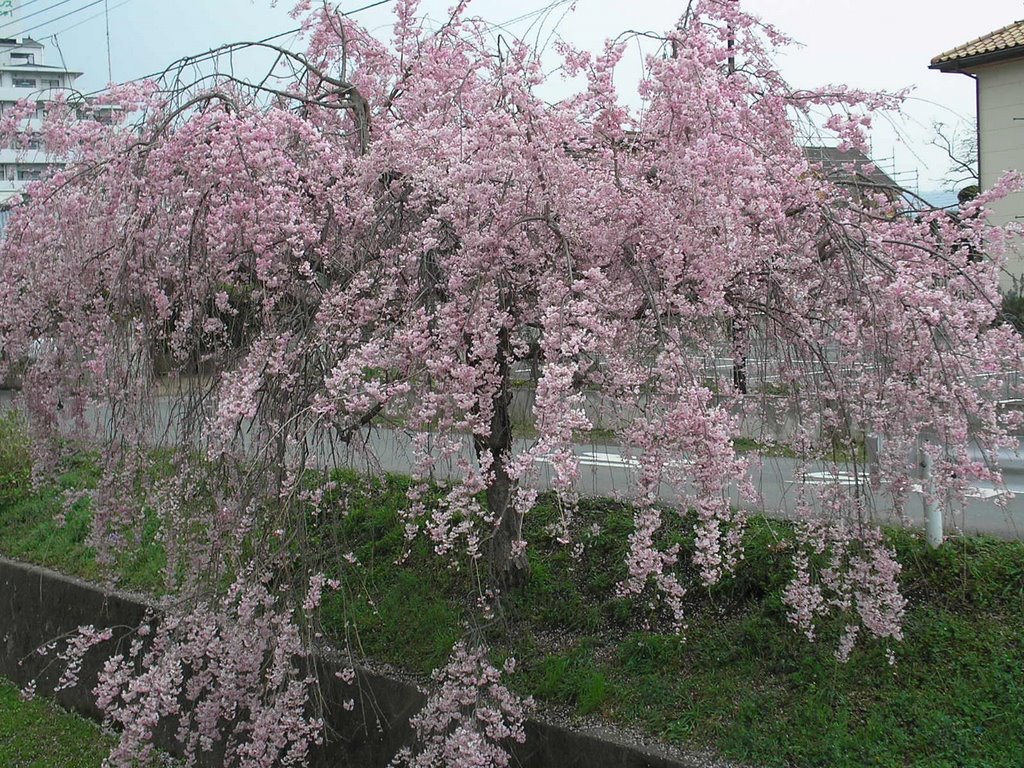
Yesterday the weather was clear and my wife was still on term break this week, so we took local trains through small towns and sometimes scenic countryside from Ashikaga to Oyama to Mito to visit the nationally famous Kairakuen (偕楽園 ‘shared pleasure park’), one of Japan’s three most beautiful landscape gardens. As the name implies, the park is open to the public; and the views are indeed spectacular. The blossoms on the 3,000 plum trees for which the park is most famous may have been a few weeks past their prime, but the cherry blossoms were in full bloom (満開, compare 満タン ‘full tank [of gas]) both in the park and across the broad expanse of Senba (千波 ‘thousand wave’) Lake and Park, which the Kairakuen hillside overlooks. Here are two verbal souvenirs from the trip.

Bokeh – This is an English technical term borrowed from Japanese, as I learned from Philbert Ono’s PhotoWords. The Photoxels Glossary of Digital Photography Terms defines it thus:

Boke (pronounced BOH-KEH), and increasingly referred to in print as “Bokeh” – Japanese word meaning “fuzzy” and referring to the out-of-focus (OOF) portions of a picture. A lens is said to have “good boke” if the OOF is pleasant and does not detract from the main subject. A lens with good boke produces out of focus smooth-edged highlights and reproduces an out of focus point of light as bright in the middle and progressively getting fainter with a fuzzy edge.

I’m not sure which Japanese boke this English borrowing comes from. Certainly not 木瓜 ‘Japanese quince, japonica’, which I was excited to find in full bloom, glistening like coral on the garden path down to Senba Lake. My best guess is 惚け/呆け, whose several meanings include ‘dull, dullheadedness’, as in 呆け色 boke iro ‘dull color’, from a verb 惚け/呆け meaning ‘grow senile; become mentally weak; fade, discolor’. The New Nelson kanji dictionary and Kenkyusha’s New Japanese–English Intermediate Dictionary, 5th ed. (in my Canon Wordtank), are not quite in synch on this, and neither of them mentions usage in photography. In any case, both my digital photographs and my digital words here are sure to provide plenty of evidence of boke.

Oddly enough, while English has borrowed a Japanese word for the out-of-focus part of a photo, Japanese appears to have borrowed a Dutch word for the in-focus spot: Japanese ピント pinto, from Dutch punt van focus or (focus)punt. (Dutch u is a front-rounded vowel—front like Italian i, round like Italian u—while Dutch oe renders the equivalent of English oo.)

枝垂れ桜 shidare-zakura ‘branch-drooping cherry tree’, Prunus pendula – Among the few types of cherry trees I can now reliably recognize are the branch-drooping ones. I’m also pretty good on 枝垂れ柳 shidare-yanagi ‘branch-drooping willow’. Yes, yes, I know that most people characterize both types as ‘weeping’, but that bit of poetic license completely bypasses the etymological briar patch that this prosaic pedant intends to poke his nose into.

Leaving out the tree itself, there are two pieces to the attribute 枝垂れ: 枝 shi ‘branch’, whose Japanese reading is eda, as in edamame ‘(soy)beans on the branch (or at least in their pods)’; and 垂れ tare ‘drippings, sauce, gravy, jus’. When it relates to apparel, 垂れ can also mean ‘hanging, curtain, lapel, flap, skirts of a coat’. So 垂れ tare covers the range of ‘drip, drop, droop, drape’ (which helped inspire one English linguist to coin the term phonaesthesia).

The Sino-Japanese phonetic element 支 shi of the two-part kanji 枝 itself means ‘branch’ in a lot of compounds, such as 支社 shisha ‘branch (company) office’; 支流 shiryuu ‘branch (flow), tributary’; 支族 shizoku ‘branch family, tribe’. To be more specific, one can rely on the semantic element 木 ki ‘tree’, which often relates to wood (either woody plants or items once made of wood), to disambiguate the 枝 shi that specifically means ‘tree branch’. Another contrast relies on the semantic element 肉 ‘meat’ (= 月 in combination), which usually relates to the body, so 肢 shi indicates ‘limbs of the body, arms and legs’.

Finally, 支 (in the shape of 枝) shi can be completely redundant. The New Nelson gives shidareru as an alternate reading for simple 垂れる tareru (vi and vt) ‘hang, droop, drop, lower, pull down; dangle; sag; drip, ooze, trickle’, so it’s perfectly okay to say 柳の枝が枝垂れている yanagi no eda ga shidareteiru ‘the branches of the willow are (branch-)drooping’. Webster’s Online Dictionary offers more—much more—on the semantics of droop in a wide range of languages. Turkish and Romanian are particularly rich.

Leave a comment

Filed under Japan, language

Italian POWs in India, 1944

One of the most intriguing organized units involved in road building [in India] was the Italian Auxiliary Pioneer Corps. This was raised from so-called Italian ‘co-operators’. During 8th Army’s campaigns against the Italians in 1941 and 1942, thousands of Italians had been brought to POW camps in India as they could not be taken to Britain. At first, the Italians were something of a nuisance in a jocular sort of way. They were adept at spreading anti-Allied propaganda to the Indian population – for example on the backs of cigarette packs with one or two cigarettes left in them. British military intelligence was particularly struck by one jape. The POWs had fabricated an Italian fascist flag from old clothes. They captured a vulture which flew into their compound and tied the flag to it. The unfortunate bird was seen flapping around the surrounding villages for hours displaying the insignia of Mussolini’s new Roman Empire. After the fall of the dictator and the German invasion of Italy, however, many Italian soldiers who were not committed fascists agreed to work on the Allied side. The valleys of Assam were alive with the sounds of the songs of Sorrento.

SOURCE: Forgotten Armies: Britain’s Asian Empire & the War with Japan, by Christopher Bayly and Tim Harper (Penguin, 2004), p. 426

Leave a comment

Filed under Britain, India, war