
Author Archives: Joel

Joel's avatar

About Joel

Executive Editor, Journals Dept. University of Hawai‘i Press

Wordcatcher Tales: Akagane, Shinsui, Kougai

Two Saturdays ago, the Outliers rode the full length of the Watarase Ravine/Valley Railway (渡良瀬渓谷鉄道) in order to hike to the headwaters of the Watarase River (渡良瀬川), which runs right past our apartment in Ashikaga on its way to join the Tone River (利根川) and eventually the Edo River (江戸川) above Tokyo. We had long been impressed by the combination of public parks, levees, and other flood control measures along the river, and were aware of the devastating floods caused by Typhoon Catherine in 1947 (followed by Ion in 1948 and Kitty in 1949). But we were blissfully unaware of the river’s earlier, manmade disasters.

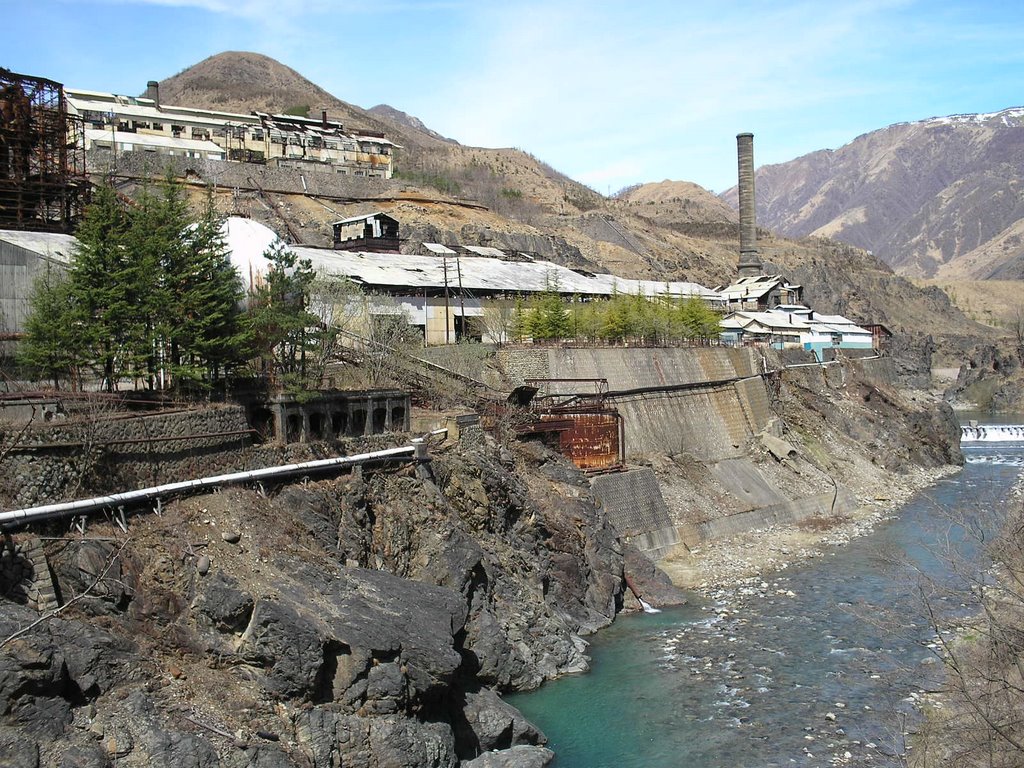
Our destination was the Akagane Water Control Park (銅親水公園 Akagane Shinsui Kouen)—billed as Japan’s “Grand Canyon”—about a one-hour walk from the end of the tracks, which start from Kiryuu (桐生 < kiri ‘paulownia’ + u birth’?) along the eastern edge of Gunma Prefecture, and end at Matou (間藤 ‘room wisteria’?) in the Ashio (足尾 ‘leg tail’) region of what was once Tochigi Prefecture’s wild west (its Butte, Montana, in fact), but has just been incorporated into Nikko City, renowned for its tourist industry, not for its copper mines.

First the tale of the words, then the tale of the tailings.

akagane (lit. ‘red metal’) ‘copper, bronze’ is more commonly read in its Sino-Japanese pronunciation dou, as in 銅山 douzan ‘copper lode (= mountain)’, 銅線 dousen ‘copper wire’, or 銅器時代 doukijidai ‘Bronze (Utensil) Age’. Nevertheless, tourist maps almost always either spell the name in hiragana or gloss the Chinese character with its native Japanese reading—in both cases: あかがね.

親水 shinsui (lit. ‘parent water’) would seem a pretty good match for English ‘headwaters’, but I couldn’t find the compound in my New Nelson kanji dictionary. Worse yet, my Canon Wordtank Daijirin defines it as ‘affinity (親和性 shinwasei) or intimacy (親しみ shitashimi) with water’, but then offers the prosaic 疎水 sosui ‘drainage canal’ as an alternate. A Japanese ecology word site gives a whole plethora of usage ranging from ‘water encounter’ to ‘drainage ditch’ to ‘water projects’.

公害 kougai (lit. ‘public damage’) ‘industrial pollution’ is a more historically justifiable head noun for this compound than 公園 kouen ‘public park’.

Kichiro Shoji and Masuro Sugai, two researchers at UN University in Japan, have published a detailed account of the rise and fall of the Ashio Copper Mine, parts of which are excerpted below to mark the 50th anniversary of the official recognition of Minamata mercury-poisoning disease, Japan’s worst case of postwar 公害.

In 1868, the newly established Meiji government of Japan made the modernization of the country by increasing military strength and expanding industrial production its first national priority. The government established a Department of Industry in 1870 and came to control all industries other than the military. On the basis of land taxes, this new department took the initiative in starting new industries, and looking after private enterprise until the department was disbanded in 1885. The work that the department had done was to introduce new technologies and machines from the advanced capitalist countries and also to invite technicians to Japan to provide new industrial production models and technologies.

Related industrial laws were established and, by 1877, mining, financed by private capital, had grown rapidly. Copper was especially important for the new government, because its exports brought in much-needed foreign money. The demand for copper overseas supported the copper industry in Japan. As table 1.1 indicates, most of the copper produced in Japan was exported. Copper earned 9.5 per cent of Japan’s export earnings in 1890 and through this Japan became established as a world-level copper producer. The earnings were used to purchase mining equipment, military weapons, and other industrial machinery. Copper played an important role in the development of Japan’s capitalism, and the main domestic copper producer was the Ashio copper mine.

The Ashio copper mine had been the property of the Tokugawa shogunate, and as such had produced 1,500 tons annually, which was the maximum possible output in the 1600s. However, this high output level had been dropping gradually. The mine was temporarily closed in 1800, but in 1871 it became a private operation, and finally in 1877 it came to be owned by Ichibei Furukawa. In 1881 a new but small lode of ore was discovered, followed by a much larger one in 1884, and, as indicated in table 1.2, copper production rose very rapidly as a result of these discoveries. In 1884, the production stood at 2,286 tons per year. Thus Ashio became the mine with the highest output in Japan, producing 68 per cent of the total output of Furukawa mines and 26 per cent of Japan’s production….

As indicated in figure 1.1, the discovery of the large copper ore lode caused all the trees surrounding it to die by the end of 1884. In August 1885. the use of a rock-crushing machine and a steam-operated pump in the Ani mine greatly increased production but led to massive fish kills in the Watarase River. In August 1890, when all modern technology systems had been installed, [a] flood occurred in the Watarase river basin, and 1,600 hectares of farmland and 28 towns and villages in Tochigi and Gunma prefectures were heavily damaged by the floodwater, which contained poisons from the Ashio mine.

In October 1890, Chugo Hayakawa led a movement against the mine and asked the prefectural hospital to do some tests for water-borne poisons. In December, the residents of Azuma Village, Tochigi Prefecture, appealed to the governor of the prefecture to call a halt to the mining operations at Ashio. This was the first of such appeals and of the movements against Ashio….

Essential to waging the Sino-Japanese War was an increase in iron and steel production. However, Japan’s smelting techniques were still immature. From 1896 to 1900, Japan could meet only about 50 per cent of its demand for iron, and one-twentieth of that for steel. As a result, it was absolutely essential that Japan import iron and steel. In this context, the importation of refining equipment, weapons, and other steel-fabricating machinery was greatly increased, and the foreign money earned by the copper-mine output played an important role in paying for these foreign goods….

In September 1896 a massive flood, larger than the one visited on the area in July of the same year, was caused by torrential rains, and the Watarase, the Tone, and the Edo overflowed their banks. One large city, five prefectures, twelve provinces, and 136 towns and villages over a total area of 46,723 hectares were damaged by the water-borne mine poisons. The loss sustained was about 23 million yen, which was eight times the annual income of the Ashio copper mine.

Because of the seriousness of the mine-related damage to the natural environment, [Tochigi Prefecture Diet member] Shozo Tanaka set up a mining damage office in the Unryu Temple of Watarase Village in Gunma Prefecture, and with other volunteers began to take action to end operations at the mine. He started by organizing people in the areas most heavily destroyed, suggesting to them that the farmlands in the flooded areas be exempted from national taxes.

This was the beginning of one of Japan’s first mass-based citizens’ movements….

The flood of 1898 did even worse damage to the surrounding areas because massive amounts of slag had been released from the sedimentation pond built by the mining company. In extreme anger and frustration, over 11,001) farmers started out for Tokyo 26 September for the third mass demonstration, with demands for reinforcement of the river banks, for the sparing of the poisoned areas from further insult and for a policy of support for the bankrupt local governments. They were confronted on the way by the police and military forces. However, some 2,500 succeeded in getting to Hogima Village, Minami Adachi Province, Tokyo.

Although Shozo Tanaka had been sick at the time, he went to meet the farmers and advised them to leave 50 representatives with him and go back to their villages. Tanaka pledged that if their demands were not met, he would fight to the death for their cause. In this manner Tanaka became the leader of the struggle against the copper mine and began to organize the farmers….

The Mainichi shimbun published a series of articles, written by women journalists, on the miseries brought about by the copper-mine poisonings. Related news articles on the struggles of the people were also printed, and the editorials took up the cause. On 30 November, Tameko Furukawa, the wife of Ichibei Furukawa, took her own life by drowning under the Kanda Bridge.

On the morning of 10 December 1901, when, after presiding at the opening of the sixteenth National Diet Upper House session, Emperor Meiji was going to his carriage, Tanaka came up to him, a written appeal in hand, shouting to him. By this action Tanaka had planned to bring the scandal of the mine poisonings into public view, hoping that one of the imperial guards would either kill or injure him. But in fact, the sergeant-at-arms fell from his horse, which had reared up in surprise, and Tanaka also stumbled and fell on his face, so he was neither killed nor injured. He was arrested on the spot and taken into custody by the police….

Tanaka’s appeal did not work as planned. but it astounded the public at large. Many people from different walks of life began to involve themselves in attempts to improve the terrible situation caused by the mine poisonings. On 27 December 1901, a trip to the poisoned areas was planned and about 800 students from 40 colleges, universities, and high schools joined it. They were deeply moved by the damage done to the environment, and so they organized movements designed to spread the news about the grim reality of the destruction and the need to help the farmers. This was the first of the numerous student movements that were to come.

Tomorrow Later, we’ll continue with more on the environmental effects of copper-mining.

Leave a comment

Filed under Japan, language

Who Are the Best Custodians of Shinto?

A major problem for Shinto today is that [existential and essentialist] forms of spirituality exist alongside each other without much clarity about their precise relation. It is as if there were two separate spiritual traditions known as Shinto. One Shinto has the existential emphasis and is functional, either consciously or subconsciously, in the daily lives of almost all Japanese. The other Shinto is driven by essentialist assumptions and is much more limited in its following. Yet whenever Shinto is conceived as an organized spiritual tradition, its essentialist forms come to the fore because this is the spirituality connected with most major Shinto institutions. After all, who can speak for existential Shinto? …

If a Japanese really wants to deepen her or his existential Shinto spirituality, therefore, the place to go may not be the bookstore. The true experts in existential Shinto spirituality are not the scholars and priests who write books but Mom and Pop, Grandma and Grandpa. They carry the heritage of Shinto praxis in its existential form. Of course, in answer to many questions, especially those about the “real meaning” of this ritual behavior or that Shinto term, their answers may often be “I don’t know.” But this may be the best answer. It tells us three things. First, it is sincere: the true answer is in the mindful heart, not the analytic mind. The elders may not be able to explain it, but perhaps they express it in how they think, act, and feel. Sometimes a poet can express or evoke what the philosopher can never quite articulate in rational analysis. The same may be true of the existentially spiritual person. Second, their answer implies that the question asked has not come up in their own experience of “feeling Shinto” and “being Shinto” in an existential way. The question may be legitimate, but this does not mean its answer is crucial to spiritual growth. And third, some kinds of questioning are not just beside the point but actually counterproductive. This was [Motoori] Norinaga‘s theme in critiquing what he called the “Chinese mentality.” If he were alive today, he might have called it the “scientific” or “scholarly” mentality: any approach that thinks “I don’t know” can only be the beginning, not the appropriate end, of an investigation. The scientist’s “I don’t know” triggers a research grant proposal. For the professor to say “I don’t know” is a confession, not a profession. This mentality, as Norinaga argued, cannot accept the wondrous, the marvelous, and the awesome for being just what they are. Because this mentality cannot accept such phenomena at face value, it never really comes face-to-face with the wondrous awe. Such experiences get peripheralized, filed away as something odd to talk about at the tavern on a cold winter night with friends, but not to be taken seriously in one’s “real life.”

Having such existential Shinto sensibilities, many Japanese today are wary of politicians and Shinto leaders who display a normative, prescriptive, or essentialist bias. Their essentialist Shinto spirituality is often so thoroughly interwoven with a nationalist, right-wing political agenda that many Japanese hold them in disdain for “trying to refight the war.” They hope that as the decades pass, the old essentialist Shinto of the foreign war years will die out as the people of that generation pass away. As the Yasukuni controversy indicates, however, this does not seem to be happening.

SOURCE: Shinto: The Way Home, by Thomas P. Kasulis (U. Hawai‘i Press, 2004), pp. 148-151

By coincidence, Japundit notes a recent Mainichi Shimbun report of at least one prominent Shinto priest with his heart in the right place.

The late Fujimaro Tsukuba, who served as the head priest at Tokyo’s Yasukuni Shrine until 1978, deliberately avoided the enshrinement of class-A war criminals, sources close to him have revealed.

Tsukuba had expressed concern that enshrinement of the criminals of World War II could hinder visits by emperors, which were still continuing at the time. The former priest’s stance was revealed by a former public relations official at the shrine and others close to him.

Tsukuba died in March 1978, and the class-A war criminals were enshrined at Yasukuni soon afterwards….

Visits by Emperor Showa to the shrine were performed eight times since 1945, but they stopped from 1975. It has been suggested in some circles that this change was due to the enshrinement of the class-A war criminals.

Leave a comment

Filed under Japan

Kasulis on How Not to Translate Kokutai

[State-sponsored] Shrine Shinto affirmed a national quintessence for the Japanese—a spiritual essence even more fundamental than any “religion.” To criticize this essence was itself proof that one was not of the “body [or essence] of our (Japanese) state,” the literal meaning of kokutai [国体]. Originally emphasized by the Mito school thinkers, kokutai became a favored term among political thinkers during the foreign war years. The term referred … to both the empire and the emperor. Loyalty to the emperor was not a choice but a recognition and expression of one’s own Japaneseness….

It has become commonplace, incidentally, to translate kokutai into English as “national polity,” but this rendering is linguistically and philosophically inappropriate. Linguistically one can say in English that virtually every civilized country has some kind of “national polity,” but in Japanese kokutai applies specifically to the purportedly unique form of Japan’s political/spiritual/imperial structure. In fact, technically speaking, kokutai is not a political structure at all but a metaphysical ideology legitimating a certain form of polity. Furthermore, it is linguistically peculiar to translate kokutai as “polity” when the word “polity” is not translated into Japanese as kokutai unless it is applying specifically and uniquely to Japan. And philosophically there is the history of the idea of polity itself in the West going back through medieval thought to the ancient Greeks. In this intellectual development, the Western assumption has usually been that people or societies fashion their particular polity. The Japanese idea, by contrast, is that the organization is a sacred unit going back to the time of creation, a unit that resonates affectively, intellectually, and uniquely in the soul of every Japanese. In this respect, to translate kokutai simply as “national polity” is to despiritualize, obscure, and defang the distinctive force of the Japanese term.

SOURCE: Shinto: The Way Home, by Thomas P. Kasulis (U. Hawai‘i Press, 2004), pp. 139-140

I’ve wondered about this from the time I took my first Japanese history class in high school. I don’t think I’ve ever heard the term “polity” used except in the Japanese context.

Leave a comment

Filed under Japan

Moldova’s Drastic Population Drop

Since it became independent in 1989, Moldova’s population has dropped by about one quarter, due mostly to mass emigration, according to a report by Randy McDonald on demography.matters.blog. Why might this concern anyone outside Moldova?

Moldovan emigration is important on its own terms, not only for the effects of this massive emigration on Moldova but for the effect that it has on receiving countries. Moldova represents a sure pool of potential migrants for central European countries suffering population decline; already, something like one percent of the population of Romanian citizens are Moldovans. Moldova also should be studied as a prototype for rapid population decline in peripheral states; the Moldovan example has been echoed in the independent South Caucasus, arguably also in an East Germany where the population has shrunk by a quarter since reunification. Moldova’s example demonstrates that, when economic conditions become sufficiently bad and/or when the benefits accuring to emigrants become sufficiently great, regional and national populations can contract at speeds more reminiscent of wartime depopulation than anything else. Where Moldova goes now, perhaps any number of relatively small and relatively impoverished states (Serbia, Paraguay, Cuba, Laos, Lesotho) in the future, perhaps–who knows?–even much larger countries.

Leave a comment

Filed under Eastern Europe, Romania

Nyazi v. Gatsby in Tehran

“This book preaches illicit relations between a man and woman. First we have Tom and his mistress, the scene in her apartment—even the narrator, Nick, is implicated. He doesn’t like their lies, but he has no objections to their fornicating and sitting on each other’s laps, and, and, those parties at Gatsby’s … remember, ladies and gentlemen, this Gatsby is the hero of the book—and who is he? He is a charlatan, he is an adulterer, he is a liar … this is a man Nick celebrates and feels sorry for, this man, this destroyer of homes!” Mr. Nyazi was clearly agitated as he conjured the fornicators, liars and adulterers roaming freely in Fitzgerald’s luminous world, immune from his wrath and from prosecution. “The only sympathetic person here is the cuckolded husband, Mr. Wilson,” Mr. Nyazi boomed. “When he kills Gatsby, it is the hand of God. He is the only victim. He is the genuine symbol of the oppressed, in the land of, of, of the Great Satan!” …

“Gatsby is dishonest,” he cried out, his voice now shrill. “He earns his money by illegal means and tries to buy the love of a married woman. This book is supposed to be about the American dream, but what sort of dream is this? Does the author mean to suggest that we should all be adulterers and bandits? Americans are decadent and in decline because this is their dream. They are going down! This is the last hiccup of a dead culture!” he concluded triumphantly.

SOURCE: Reading Lolita in Tehran: A Memoir in Books, by Azar Nafisi (Random House, 2004), pp. 126-127

Leave a comment

Filed under education, Iran

Sam Harris on Religious Moderates

While moderation in religion may seem a reasonable position to stake out, in light of all that we have (and have not) learned about the universe, it offers no bulwark against religious extremism and religious violence. From the perspective of those seeking to live by the letter of the texts, the religious moderate is nothing more than a failed fundamentalist. He is, in all likelihood, going to wind up in hell with the rest of the unbelievers. The problem that religious moderation poses for all of us is that it does not permit anything very critical to be said about religious literalism. We cannot say that fundamentalists are crazy, because they are merely practicing their freedom of belief; we cannot even say that they are mistaken in religious terms, because their knowledge of scripture is generally unrivaled. All we can say, as religious moderates, is that we don’t like the personal and social costs that a full embrace of scripture imposes on us. This is not a new form of faith, or even a new species of scriptural exegesis; it is simply a capitulation to a variety of all-too-human interests that have nothing, in principle, to do with God. Religious moderation is the product of secular knowledge and scriptural ignorance—and it has no bona fides, in religious terms, to put it on a par with fundamentalism. The texts themselves are unequivocal: they are perfect in all their parts. By their light, religious moderation appears to be nothing more than an unwillingness to fully submit to God’s law. By failing to live by the letter of the texts, while tolerating the irrationality of those who do, religious moderates betray faith and reason equally. Unless the core dogmas of faith are called into question—i.e., that we know there is a God, and that we know that he wants from us—religious moderation will do nothing to lead us out of the wilderness.

SOURCE: The End of Faith: Religion, Terror, and the Future of Reason, by Sam Harris (Free Press, 2005), pp. 20-21. The beginning of of chapter 1, Reason in Exile, is available online.

Leave a comment

Filed under religion

Religious Trends in Tokugawa Japan

Religion was a particularly thorny issue that Ieyasu’s two military predecessors, Nobunaga and Hideyoshi, had already begun to address. Collectively the policies of the three successive generalissimos led to the following situation. First, the upstart religion from the West, Christianity, was banned. The small numbers of Christians who refused to renounce their faith had to go underground. The squelching of the Christian movement in Japan was the precursor of closing Japan off from almost all contact with the outside world. This policy was initiated in 1639 and officially continued through 1854. Second, the Tendai Buddhist main temple on Kyoto’s Mount Hiei had grown to be the most powerful religious institution in Japan. In 1571 Nobunaga burned down the complex, destroying its three thousand buildings and its army of ten thousand warrior monks. Third, the most populist Buddhist religion of the time, the Shin Buddhist Honganji sect, had assembled a huge peasant army of its own that Nobunaga defeated in 1580. The sect then underwent a schism in 1603, breaking into Eastern and Western Honganji, thereby dividing the unity of this Buddhist group. And fourth, under Ieyasu the shogunate began to monitor the philosophical-religious schools of scholars, hoping to maintain at least some control over new developments and ideologies. Accompanying these four political events were intellectual circumstances equally important to the future of Shinto.

The key factors of intellectual change came to a head in the late sixteenth century when something philosophically new took hold in Japan. Throughout Japanese history there had been periods when Japanese groups (mainly religious or diplomatic) made the dangerous journey across the stormy Sea of Japan to the mainland, bringing back home cultural innovations and artifacts. In the fifteenth and sixteenth centuries especially, groups of Japanese Buddhist monks, mainly from the Zen tradition, went to the mainland to study. When they returned, they brought with them not only further materials related to Buddhism but also books from other philosophical traditions popular in China at the time. For our present concerns, the most significant items in their cargo were works of Chinese Neo-Confucianism. Although Zen Buddhist monastic scholars were studying the texts and introducing them to Japan, the books contained a philosophical system that would ultimately undermine the intellectual hegemony of Buddhism in the country. Neo-Confucianism was a sophisticated syncretistic philosophical movement in China that enriched traditional Confucian teachings with ideas from Buddhism and Daoism. By incorporating key ideas from these traditions into its own, Neo-Confucianism had disarmed the most powerful Buddhist and Daoist criticisms against Confucianism. As a result, from about the twelfth century up to the early twentieth century, Neo-Confucian philosophy (in various forms) generally dominated the Chinese intellectual scene.

These Neo-Confucian arguments against Buddhism entered Japan just before Tokugawa stability and peace brought rapid urbanization. The growth of city life supported schools of learning outside the traditional Buddhist temple complexes that had trained monk-scholars. The samurai (who needed job retraining to find a useful place in the peacetime society of the Tokugawa bureaucracy) and the aspiring merchant class (who needed to acquire culture fast) frequented such urban schools. Furthermore, the increasingly literate urbanites created a demand for widely distributed, printed publications. By the late seventeenth century, literary culture, including philosophy, was thriving in the cities.

SOURCE: Shinto: The Way Home, by Thomas P. Kasulis (U. Hawai‘i Press, 2004), pp. 106-107

Leave a comment

Filed under China, Japan

Imelda’s Still Imelda, 20 Years Later

Sunday’s Japan Times carries an exclusive profile by David McNeill of Imelda Marcos, who seems to have changed very little since she and her husband were ousted from power twenty years ago.

By the time the brilliant ex-lawyer and his beauty-queen wife boarded a U.S. helicopter on Feb. 25, 1986, they had become synonymous with the corruption and cronyism that made the Philippines one of the poorest nations on the planet. To his eternal credit, Marcos ordered his army not to fire on Manila crowds before he left, but then he expected to be back within days. Instead, he was to die in Hawaii three years later, leaving Imelda to carry on the Marcos legacy.

Today, astonishingly, Imelda is back in Manila and again a force in Philippine politics. Many believe the beautiful young country girl who caught the eye of the ambitious Marcos and helped him win a million votes in 1965 was the real power behind the throne by the end of their reign, when Ferdinand was desperately ill. Her political survival “makes a mockery” of the 1986 revolution, according to one of her biographers.

Now living on the 34th-floor suite in one of Manila’s most exclusive apartment blocks, the former first lady seldom gives interviews because she is invariably skewered by incredulous journalists when she brandishes her innocence and new poverty. She was, after all, once one of the 10 richest women in the world….

When Ferdinand died in 1989, aged 72, Imelda had to fight U.S. federal grand jury charges alone: principally that the couple stole over $200 million from the Philippine treasury and spent it on a real-estate spree in New York. After enjoying the backing of five U.S. presidents, and the close friendship of Ronald and Nancy Reagan (with whom she shared an interest in astrology), the shock of America turning on her was profound.

“They did this to me when I was alone, widowed and orphaned,” she says, on the verge of tears. “Even the Bible says there are special places reserved in hell for those who persecute widows and orphans. And it was not individuals who did me in, it was governments and superpowers.”

Though acquitted, few expected Imelda to survive the humiliation of being ditched by the White House, lampooned in the media and chased across the world by prosecutors who accused the pair of plundering the Philippines of $ 10 billion or more. But showing the irrepressible energy and brazenness that made her a legendary force in Philippine politics, Imelda bounced back, returned to Manila in 1992 and won a senator’s seat in 1995 after a failed bid for the presidency.

Today, she is again the matriarch of a minor political dynasty. Her son, Ferdinand Jr., is governor of Ilocos Norte Province in the north of the country, where daughter Imee is a congresswoman. Her nephew, Alfred Romualdez, sits in the congressional seat she vacated, and her brother is mayor of Tacloban City. She has been acquitted several times on domestic charges of corruption and extortion and, of the 901 separate cases she claims were filed against her family, she is now down to the last three. Considering her regime was recently ranked as the second-most corrupt (after Suharto’s Indonesia) of the late-20th century, it is not a bad end to a life. “I am still standing up at 76, fighting superpowers.”…

It is not difficult at times like this to imagine the young, naive, fun-loving Visayas beauty dazzled by the ambitious senator Ferdinand Marcos and the jet-set life he promised; much harder to put this tearful, almost childish woman together with the picture painted of her in many biographies. Did she really offer her archrival Benigno Aquino $1 million to stay in U.S. exile, then order his 1983 assassination in broad daylight and in front of the world’s press when he returned? Would the money she and her husband embezzled really, as many say, pay off the Philippines foreign debt?

And the biggest mystery of all: why have the people who threw her out accepted her back?

“Some people look at the chaos now and think things were probably better then under Marcos,” says taxi driver Mike Avila. “He was strong and kept people in line. Things don’t seem to have improved much since they left.”

An interesting profile, despite the always irritating deus ex imagina taxi-driver quote at the end.

Leave a comment

Filed under Philippines

Shinto-Buddhist Syncretism in Heian Japan

Esotericism was central to both Buddhist traditions ascendant in the Heian period (794–1185): Shingon and Tendai. Shingon is an exclusively esoteric school founded in Japan by Kukai (774–835) whereas Tendai, founded in Japan by Saicho (766–835), includes esotericism as part of its grand synthesis of many Buddhist perspectives. Although several Buddhist schools had entered Japan by the end of the Nara period, for the most part none had developed into fully independent, religious establishments in their own right. That is: Shingon and Tendai were the first to flourish and develop as distinctively Japanese independent schools. Furthermore, both schools developed forms of Buddhist-Shinto synthesis. Both Shingon and Tendai arose about the time the capital moved from Nara to Kyoto (called “Heian” at the time). Their success was due in part to the fact that Buddhist esotericism shares central assumptions with early Japanese spirituality. With its centuries of doctrinal and practical development on the mainland, esoteric Buddhism was uniquely positioned to give early Shinto spirituality a full-blown philosophical justification, albeit admittedly a justification in Buddhist garb. Let us consider three points where the worldviews of ancient Shinto and esoteric Buddhism intersected—areas of similarity on which Shingon and Tendai Buddhism were able to capitalize.

First, for both early Shinto and Buddhist esotericism, the world was alive with spirituality, as there is no sharp divide between spirit and matter….

Second, Buddhism and early Shinto both stressed the purely mindful heart….

There is, as well, a third commonality: both esoteric Buddhism and early Shinto assume the sacred can be in the form of celestial deities (in Shinto, the kami deities; in esoteric Buddhism, the celestial buddhas and boddhisattvas)….

Not surprisingly, then, with syncretism as the norm, the term “Shinto” had no popular use in Japan until the development of state ideology in the middle of the nineteenth century. In that era, an essentialist Shinto spirituality was on the rise and the agenda was to separate “real” Shinto from its Buddhist “distortions.” Because of Buddhist-Shinto syncretism, however, it seems that for a thousand years of Japanese history most people did not ordinarily find it useful to distinguish “Shinto” from “Buddhist.” These people did all along refer to kami, of course, but they knew that on some level (perhaps understood only by intellectuals) kami were just alternative forms of buddhas.

SOURCE: Shinto: The Way Home, by Thomas P. Kasulis (U. Hawai‘i Press, 2004), pp. 95-102

Leave a comment

Filed under Japan

Letters of a True Believer, 1937

During the Great Terror, Lev [Knipper], like hundreds of thousands of Soviet citizens, was clearly going through a personal and political crisis. He was desperately trying to convince himself of the rightness of the Stalinist purges, even when surrounded by the madness of arrests and denunciations all around him….

In early April 1937, not long after the second wave of show trials, Lev wrote a striking letter to Aunt Olya [Knipper-Chekhova]. ‘My life has become a lot more complicated, confused, and harder than it was before, when I still had many illusions of youth, self-importance, young unspent strength and boiling energy which covered up for everything else. And now the time has come to pay the bills. And it’s turned out that I’ve accumulated next to no interest on my capital, and that I will have to pay from the reserve.

‘When I was twenty-three, a new life began for me, thanks to you … I was somehow careless about everything – like a bird which knows nothing of tomorrow, like a creature who, it seemed to me, was “lucky” in its life. And really, I’d soared over dozens of my colleagues, like a rocket. I won’t even say it was undeserved. My talent isn’t a minor one, I possess a huge supply of energy, and my will for life is also not small … Selfishness and a somewhat exaggerated self-assurance are the reasons for my loneliness. And now, thirty-nine years old, I am facing myself, absolutely alone in all senses. And this is the most terrible of all. With all the force of my brain, I desire to be a true Bolshevik, and for this I lack knowledge. This has impeded my development as a composer in the last three to four years … Nothing can ever remove my feeling of guilt towards the party and the Soviet regime about the years of the civil war. “White Guardist” in my presence, it’s like a knife in my flesh, and I always think they’ve said it about me. This is the hardest trauma in my life, and there’re only two ways to cure it – either the party would accept me in its ranks, or death will get me. I am not afraid of it, and I’ve thought of it frequently in the last five to six years.’ …

You see, my dearest Aunt Olya, politics is one of the reasons which make the two of us unable to talk to each other from soul to soul. And the reason for this is that for me politics is something deeply personal, lyrical, exciting. I am fighting for the Soviet regime (and therefore love it, and mistakes are painful for me).’ The ‘mistakes’ he referred to were presumably the millions of false accusations of the Great Terror. But Lev was unrepentant. ‘For me, my personal life, my creative work, absolutely everything is intertwined with the issues of the party life. You don’t want to believe in this, you think that I want to “be this way”, rather than I already am this way.’

He went on to reject ‘absolute’ human values, dismissing them as ‘intelligentsia ethics’. Lev had imbibed the essential ruthlessness of Leninism. ‘More than anything else, I can’t stand people who use “intelligentsia principles” and “humanity” to justify a general, deeply anti-Soviet behaviour.

‘I need to learn what sort of a person one has to be to become, in this decisive moment of the fight, part of the millions giving all of themselves (not from the brain, but from the heart) to the future of humankind.’

SOURCE: The Mystery of Olga Chekhova: The true story of a family torn apart by revolution and war, by Antony Beevor (Penguin, 2005), pp. 144-147

Leave a comment

Filed under USSR