
Author Archives: Joel

Simplifying Chinese Characters

From Kingdom of Characters: The Language Revolution That Made China Modern, by Jing Tsu (Riverhead Books, 2022), Kindle pp. 170-171, 174-175, 177-178:

Mao did not speak a word of Putonghua, the common speech derived from the northern-based Beijing Mandarin. Yet Mao went down in history as, among other things, the political figure who guided the Chinese language through its two greatest transformations in modern history. The first was character simplification, which would reduce the number of strokes in more than 2,200 Chinese characters. The second was the creation of pinyin, a standardized phonetic system using the Roman alphabet and based on the pronunciation of Putonghua (“pinyin” means “to piece together sound”). Mao would lead the country through these dramatic changes, but not by example; he would never get used to writing simplified characters in his lifetime, or even Roman letters. Following Mao, the Communists had fought and won a civil war in the name of the people—workers, peasants, and every member of the exploited underclass. At the founding of the PRC, more than 90 percent of the country was still illiterate and communicated in regional dialects. Romanization would be Mao’s way of delivering his promise to the people, and the people to their linguistic destiny. It would be a new bridge to learning Chinese characters, employed in aggressive anti-illiteracy campaigns. The Committee on Script Reform was appointed to orchestrate the effort.

While the Nationalists dawdled, the Communists took up the cause of simplification and made it their own. During the War of Resistance against the Japanese, they began to print simplified characters in the local newspapers that were circulated in the areas under their control. The use of these characters fanned out into the rest of the country after 1949. Simplified writing attracted more and more attention as discussions and debates grew. Eventually the Ministry of Education selected around five hundred simplified characters to be reviewed by experts and linguists. The task was handed over to the Committee on Script Reform for further investigation once it was established in 1952.

The committee completed the first draft of the official simplification scheme by late 1954. A list of 798 characters was formally introduced the following January to great enthusiasm. The Ministry of Education delivered three hundred thousand copies of the Preliminary Draft of Han Character Simplifications to various cultural organizations and educational institutions around the country for comment and feedback. More than two hundred thousand individuals weighed in with opinions. The Committee on Script Reform alone received more than five thousand letters. Up to 97 percent of those polled approved of the preliminary simplification scheme.

While there were reservations and objections to the simplified script—largely for cultural and aesthetic reasons—the rate of illiteracy began to decline under the twin implementation of character simplification and pinyin. By 1982, the literacy rate for people over age fifteen nationwide had risen to 65.5 percent, and it reached 96.8 percent in 2018.

Whatever support there was for character simplification among the Nationalists dwindled after 1949. After losing the mainland to the Communists and retreating to Taiwan, the Nationalists appointed themselves the true guardians of traditional culture and have kept the traditional written characters intact to this day. By distancing themselves from character simplification, they left room for the Communists to claim it as a central platform for New China.

The wounds of this contentious past are still fresh and reopen from time to time. The political weaponization of simplified scripts since 1949 on both sides of the Taiwan Strait, which divides mainland China from the proclaimed Republic of China in Taiwan, has only sharpened the differences between the old and new scripts. Proponents and opponents of simplification continue to hurl jabs and insults at one another. The character for “love” (愛 in traditional form and 爱 in simplified form) is a favorite example. The simplified version replaces the component for “heart” 心 with “friend” 友. What is love, the champions of traditional characters ask, with no heart? One online critic argues that “since the simplification of Han characters, one can no longer ‘see’ one’s ‘relatives’ (親 vs. 亲). . . . The ‘factories’ are ‘emptied’ (廠 vs. 厂 ), while ‘flour’ is missing ‘wheat’ (麵 vs. 面). ‘Transportation’ has no ‘cars’ (運 vs. 运). . . . ‘Flying’ is done on one ‘wing’ (飛 vs. 飞).”

Advocates of simplified characters, in turn, have come up with their own character tales to tell. They argue that simplified “love” is more expansive and modern, extending generously to friends and comrades rather than being narrowly guided by the selfish heart. Another case is “masses.” After some strokes were judiciously pruned away, the character is now composed entirely—and rightly—of “people” (眾 vs. 众). “To destroy” no longer has the superfluous radical of “water” (滅 vs. 灭), which served no semantic or phonetic purpose. And as for the character for “insect,” who wouldn’t want to avoid the creepy-crawly pests as much as possible? At least one is better than three (蟲 vs. 虫).
Leave a comment

Filed under China, democracy, education, labor, language, nationalism, philosophy

Early Chinese Telegraph Codes

From Kingdom of Characters: The Language Revolution That Made China Modern, by Jing Tsu (Riverhead Books, 2022), Kindle pp. 91-92, 106-108, 110-111, 123-124:

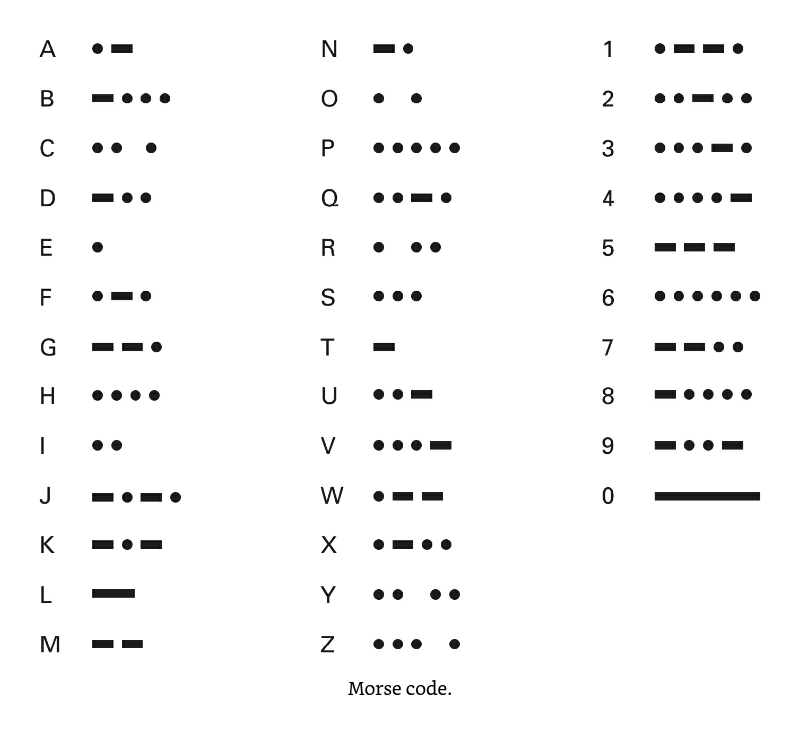
In Morse code, the basic symbols were dots and dashes. The system’s twenty-six combinations of dots and dashes, ranging from one to four symbols, were meant to accommodate the twenty-six letters of the alphabet, with another ten combinations of five symbols each for numbers zero to nine.

To send a message, a telegraph operator pressed an electric switch, in the form of a key: a short tap for a dot and a long one for a dash. The message was converted into an electric current that traveled along the wires and was reverse translated into letters and numbers on the receiving end. The sound of clicking patterns could become so familiar that an experienced telegrapher could tell what word was being coded from its distinct rhythm. Telegraph costs were determined by how long they took to transmit—each dot or space was a single unit, and a dash—three times as long as a dot—was three units. As Morse explained early on, his system was designed to be cost-efficient. The most frequently used letter in English, “e,” was also the least expensive: It was represented by a single dot. The high frequency of “e” holds true for most European languages, from Italian to Dutch. But Morse code clearly favored the American English alphabet. An English letter takes up somewhere between one and thirteen units. To add even a single diacritical mark to the letter “a”—as when making the French “à”—required ten more units. So there was already plenty to disagree about among Roman alphabet users.

The inequities of Morse code were on a different scale for the Chinese. International telegraphy recognized only the Roman alphabet letters and Arabic numerals used by the majority of its members, which meant that Chinese, too, had to be mediated via letters and numbers. Whereas English could be English, and Italian mostly Italian, Chinese had to be something other than itself. Every Chinese character was transmitted as a string of four to six numbers, each of which cost more than a letter. The assigned code for a Chinese character first had to be looked up in a codebook before being converted to the dots and dashes of Morse code. Coding and converting Chinese characters into an ordinary telegram of twenty-five words required at least half an hour, whereas a comparable message in English took only about two minutes. Untold opportunity costs accrued with every telegraph that was delayed when the operator had to pause to check a character against its assigned number in a codebook or had to take extra time to correct an error.

[Septime Auguste] Viguier possessed the confidence and skill set that Great Northern [Telegraph Company (大北電報公司 / 大北电报公司 Dàběi Diànbào Gōngsī)] was looking for. He had already worked on developing a code for Chinese telegraphy years earlier for the French government in support of their failed efforts to interest the Chinese Empire in their telegraph cables. He was well versed in early word-copying machines like the Caselli pantelegraph, a precursor to the modern-day fax machine. When the French project was shelved, Viguier ended up in Shanghai—ripe for the Danes’ recruitment. He was the best candidate but not well-liked. Colleagues immediately noted his preening and boastfulness—the French way, they sneered. Viguier later also had a nasty exchange with the managing director Suenson, and his relationship with the company soured over questions of compensation and credit. Nonetheless, Viguier was able to work quickly enough to build out the Danish professor’s incomplete scheme. By June 1870, he had the first version. In 1872, he delivered the final, standardized telegraphic code table for 6,899 characters in The New Book for the Telegraph (Dianbao xinshu).

Viguier came up with a tabular form of twenty rows and ten columns per page. He assigned an arbitrary four-digit code from 0001 to 9999 to each character, with empty spaces left for potentially 3,000 more codes to accommodate customized vocabulary for individual business purposes. Each page contained 200 square spaces for listing 200 characters and their numerical codes. The code only included a relatively small number of characters out of the 45,000 or so that were extant. The mass scaling of telegraphy meant that it was geared toward the common person and the common tongue, so restricting the number of characters was not only efficient but also practical.

But Viguier’s telegraphic code did not go unchallenged. Almost immediately, the Chinese tried to outdo and improve upon it. A quiet young Chinese translator who had been part of that diplomatic mission to Europe in 1868, Zhang Deyi, became the first Chinese to do so. Zhang noted the pain of having to send Chinese messages back to the Chinese office in China in “foreign letters” whenever more urgent service was required. He also saw how Western telegrams were more secure, as secret messages were sent in numbers. That inspired Zhang to construct his own Chinese telegraphic codebook by following a similar format.

While the published version of Viguier’s work was an important landmark, Zhang zeroed in on its sloppiness. Viguier’s numbering of characters did not make them terribly easy to use for the Chinese. The continuous numbers did not separate out characters into groups, which was how the Chinese were accustomed to searching for characters in a dictionary. He decided to trim down the format of Viguier’s system and do some reorganization to make its content clearer. Zhang’s own New Method of Telegraphy (Dianxin xinfa) was published two years after Viguier came up with a draft of his telegraphic code in 1873. It reordered the characters so that the numbers were less arbitrary. Zhang used the same 214 radicals, but reselected about 7,000 characters from the Kangxi Dictionary and assigned them numbers from 0001 to 8000.

Westerners like Viguier had mapped Chinese onto numbers. Then the Chinese themselves had tried to use numbers to remap the alphabet. They kept bending the stick back and forth. Wang [Jingchun] was increasingly of the mind that one could put the Western alphabet in service of Chinese Romanization more permanently. He turned to Bopomofo, the Chinese phonetic alphabet approved at the 1913 National Language Unification Conference in Beijing, and its idea of an auxiliary phonetic alphabet formed from different styles and parts of Chinese characters. Working from this basis, Wang designed a use for Roman letters that was Latin in name but readapted to signal the three linguistic properties of Chinese characters: the phonetic representation of sound, tone, and the radical.

To indicate sound in his New Phonetic System, Wang mapped the sounds of Bopomofo—represented by symbols ㄅ, ㄆ, ㄇ, ㄈ, etc.—onto alphabet letters that shared similar starting consonant sounds. So ㄅ, ㄆ, ㄇ, ㄈ would match the letters “b,” “p,” “m,” and “f.” To show tone, Wang picked five letters to represent the five tones used in traditional and medieval phonology: “B” stands for the level or even tone; “P” marks the second or rising tone; “X” represents the third tone, which falls first then rises; “C” is fourth or falling tone; and “R” denotes the fifth or neutral tone. The last property, the radical, takes up two letters—a consonant and a vowel. Wang used two letters to spell the pronunciation of the radical part of the character only; e.g., tu for 土, li for 力, ko for 口, etc., in a way that was not dissimilar to what Wang Zhao had done with the Mandarin Alphabet. With one letter for sound, another letter for tone, and two more for phoneticizing the radical’s spelling, this system yielded a four-letter code for every character. The Chinese character could then be transmitted via telegraphy without using numbers at all. Wang’s idea took after other Romanization systems of the time, which were developed not for telegraphy per se, but to address the broader question of literacy. He borrowed from that conversation, run by linguists and ethnographers, to design a solution for what he had seen in the diplomatic arena.

During the year the Far Outliers spent in China in 1987-88, we had occasion to send a telegram to fellow teachers who were spending winter holidays in their hometown of Jingdezhen, famous for its pottery. They had written most of the text of the telegram and all we had to do was add the day and time when our train would arrive. So before we boarded the train for Jingdezhen, I handed the text of the telegram to a clerk at the telegraph office who proceeded to rewrite the message in a series of 4 digits for each Chinese character. It was very short and she had probably memorized some of the most frequent codes for ‘arrive’, ‘depart’, and dates and times, but it still looked like a tedious chore.

This interesting chapter includes a very misleading table, shown below. It shows American Morse code (also called Railroad Morse) that was standardized in 1844 and used by American railroads as late as the 1970s. Also called Morse landline code, its variable spacing and variable lengths did not travel well through undersea cables. Central Europeans used a modified code, the Hamburg alphabet, that evolved into the International Morse Code standardized in 1865. Working in the 1870s, Viguier and Zhang almost certainly used the international standard, the one where ‘SOS’ is rendered by the familiar dit dit dit dah dah dah dit dit dit.

Erroneous Morse Code


Leave a comment

Filed under China, economics, Europe, language, nationalism, North America, publishing, travel

First Chinese Typewriter Designs

From Kingdom of Characters: The Language Revolution That Made China Modern, by Jing Tsu (Riverhead Books, 2022), Kindle pp. 64-69:

Zhou’s breakthrough was figuring out how to correlate the physical act of selecting and retrieving a character in a tray with the mechanical motion of preparing a character, etched onto a cylinder, to be inked and printed. The result was a single coordination of mechanical motions, optimally economized and completed by a human operator. In his article for The Chinese Students’ Monthly, Zhou documented the details of his typewriter and the technical challenges he had to overcome. He had known, of course, that he was not the first. There was Sheffield’s machine and an earlier Japanese prototype, both of which he acknowledged as having arrived at similar ideas independent of his endeavor. It was a respectful nod to those who came before him.

Just as he was preparing to publish his article, though, an unexpected challenger nearly derailed Zhou’s debut. Qi Xuan was a fellow Chinese student studying engineering at New York University. Unbeknownst to Zhou, Qi had been on a parallel track. Relying on a different set of principles for building his own Chinese typewriting machine, he figured out how to do what Zhou, Sheffield, and others thought was impossible: arrange the characters by parts.

In place of Zhou’s character grid, the keyboard of Qi’s machine had only three keys—a back spacer, a forward spacer, and one that selected the character. But Qi’s machine also relied on cylinders of type (two cylinders instead of Zhou’s four). The upper cylinder, with characters inscribed on paper, served as a guide. The lower cylinder, with corresponding characters engraved on a copper surface, made the actual impression. An operator would use a hand wheel to rotate the machine’s upper cylinder until the correct row appeared in a viewfinder on the front of the machine. Then three keys would be used to select the correct character from the row and lock the cylinders in position, aligning the corresponding character cast on the lower cylinder and stamping it on the page.

Though they looked very different, the underlying design and mechanisms of Zhou’s and Qi’s machines were very similar. And Qi’s handled 4,200 actual Chinese characters, just 200 more than Zhou’s core lexicon. Qi’s machine, however, was different in one very important respect: he had broken with the prevailing commitment to reproduce whole, complete characters. Of his 4,200 individual Chinese characters, 1,720 were in the form of character components, radicals, and their possible variant positions in a square space, which allowed his machine to generate, in theory, more versions out of the same parts. In three steps, using these keys, the operator could purportedly produce 50,000 combinations.

Operating his machine, Qi explained, was closer to spelling an English word than producing a Chinese character. If you treat radicals like groups of letters, you can play with different combinations the way you would in a word game. Let’s say you have three English words—“exist,” “expect,” and “submit.” You can generate more words by mixing and matching their parts to form new words like “sum,” “suspect,” “subsist,” “bit,” “mist,” “its,” and “sex.” Unlike modern English words, which have equal spacing for each letter and line up in a neat row, components and radicals can move around from character to character. In print they can occupy different quadrants of the square space that each character fills, which means their position, and consequently their size, can change. For example, the character for “fire,” 火, fills an entire square space when standing alone, but it becomes thinner when it is a radical put on the left of the character “braise,” shao 燒. In turn, it changes form altogether—into four flames—when placed at the bottom of the character for “hot,” re 熱. Qi accounted for possible variant positions like these by giving them separate engravings on the cylinders. Consequently, there are at least three options for “fire” to be combined with other components and thereby form a greater number of characters.

Qi challenged the idea that characters had to be individual, stand-alone units. He thought of them as more modular, like alphabet-based words, things that could be recycled to compose different characters. And once he started tinkering, some of the Kangxi radicals did not sit well with him. He took more liberties and slipped in a few radicals he had devised that he thought worked better. A bigger shift than Zhou’s was creeping in. Others would also start to ask whether exclusively using radicals for character classification still made sense.

For different reasons, Sheffield and Zhou both concluded that characters were the way they were for good reasons and preserving them was of the utmost importance. Qi’s scheme “looked well on the face of it,” Zhou cautioned, “but they forgot, that the same ‘radical’ in different characters differ [sic] not only in size but also in shape, and, furthermore, they occupy different positions in a character.” He named one example, the square-shaped radical meaning “mouth” 口, which shows up in the characters for “ancient” 古 and “cry” 哭 but in each its size and location are quite different. Consequently, one cannot use the same square for “mouth” in both cases, as they were designed to fit into different configurations. If the different sizes of 口 were forced together, they would create absurd-looking characters with overlapping strokes in all the wrong places.

Zhou’s design eventually won out.

Japanese modernizers had a much easier time adapting katakana for use in typewriters, semaphore, and telegraphy.

Leave a comment

Filed under China, economics, education, language, nationalism, U.S.

How Mandarin Became the Standard

From Kingdom of Characters: The Language Revolution That Made China Modern, by Jing Tsu (Riverhead Books, 2022), Kindle pp. 37-39:

As for the best model of this everyday speech, each delegate [to the 1913 Commission on the Unification of Pronunciation] could only see the merits of his own spoken version. They all had a stake in promoting the dialectal or topolectal variant from their home provinces. The Guangdong delegates wanted Cantonese, while those from Sichuan fought hard for Sichuanese. The odds were stacked in favor of the southern speakers. Proportionally speaking, they had more representatives across similar dialect groups.

After the careful inspection of more than 6,500 samples collected from all over the country, factions emerged as the members moved to the more sensitive question of which geographical area would lead the standard pronunciation. Attendance dwindled as the deadlock persisted. It was not a contest for the fainthearted. Those with slightly weaker constitutions or who suffered from tuberculosis—a common affliction at the time—endured a few weeks of contentious lobbying before their health gave out. Some delegates fell ill from exhaustion and had to withdraw from the congress. Others spat up blood during the heated debates, unable to carry on after being cornered and humiliated by their opponents. Wang [Zhou] barely grunted through a violent flare-up of hemorrhoids from sitting for days on end. Blood, he later recalled proudly, soaked through his pants and trickled down to his ankles. Eventually, only the diehards remained.

One of the southern representatives made the appeal that no southerner could go about his business for a single day without using a particular inflection. To be a truly national pronunciation, then, his southern colleague argued, the standard had to bend toward the south. To prove his point, the man broke into an operatic demonstration. Wang had little patience for such theatrics. There was no way that the north, the seat of the nation’s capital, would cede to the south on the national tone question. Wang called a separate meeting less than half a mile away at the oldest Anglican church in Beijing. Inside those thick walls, under the famous three-tiered traditional pagoda bell tower sitting atop the sparse lines of Anglo-Saxon architecture, he carried out his mutiny. He instituted a new rule that carefully rearranged how the votes were counted. Each province would now cast only one vote, regardless of the number of delegates it sent. This maneuver didn’t just level the numerical advantage of the south, it transferred the advantage to the northern vernacular Mandarin-speaking provinces, which were greater in number. The other delegates protested when they found out what Wang had done on the sly, but it was too late.

Leave a comment

Filed under China, democracy, language, nationalism

Finding Chinese Character Sounds

From Kingdom of Characters: The Language Revolution That Made China Modern, by Jing Tsu (Riverhead Books, 2022), Kindle pp. 25-26:

As part of a serious education, any learned Chinese down to Wang’s time [c. 1900] would have had to master the reverse-cut method for learning how to pronounce characters. Reverse-cut first appeared in the third century and remained in use until the early twentieth. Each Chinese character has a one-syllable sound associated with it, and all syllables have two parts: an “initial” (the consonant sound that begins a syllable) and a “final” (the rest of the syllable sound). For a guide, a novice would turn to a rhyme book, which functioned like a dictionary of pronunciation. In it, the sound of each listed character was “spelled out” by cutting together two more commonly used and familiar characters. One character’s initial sound was added to another’s final sound to indicate the pronunciation of the character in question. To pronounce the character for “east” 東 (dong), for instance, you would look up 東 in a rhyme book and it would tell you that the pronunciation is the initial of “virtue” 德 ([d]ek) combined with the final of “red” 紅 (h[ong]).

This technique used the phonetic parts of two known characters to sound out an unknown third character in the same way that (5 – 3) × (1 + 1) conveys the number 4. That’s a complicated way to arrive at 4 if all you want is the number.

The old reverse-cut phonetic system solved many problems—like accommodating the translation of the exotic sounds of Sanskrit when Mahayana Buddhism’s scriptures were introduced into China in the late seventh century—but now it had itself become the problem. It required years of rote memorization to learn and was no longer accurate—speech habits had drifted and evolved over time. “Virtue,” for example, is no longer pronounced as “dek” but as “de” in modern-day Chinese. Pronunciation also differed wildly between dialects.

The Chinese spelling system was woefully outdated. At the same time, the Western alphabet was viewed with suspicion in a climate of hostility to foreigners. A middle path had to be found. People like Wang [Zhao] realized there needed to be a system that acted like an alphabet for Chinese without simply using Roman letters.

Leave a comment

Filed under China, education, language

Chinese Orthographic Revolutionaries

From Kingdom of Characters: The Language Revolution That Made China Modern, by Jing Tsu (Riverhead Books, 2022), Kindle pp. 24-25:

While working on his alphabet, Wang [Zhao] never strayed from the beliefs he had shared with the emperor back in 1898: China was losing its power because language was failing its people. Their low literacy and divided dialects impeded China’s ability to govern, negotiate with foreign powers, and keep pace with the outside world. China’s success as a nation and an international power hinged on the single issue of an accessible spoken and written language.

There had been others who shared Wang’s analysis of the problem, although they offered different answers to it. Lu Zhuangzhang, a Chinese Christian from Amoy (now Xiamen), developed the first phonetic system for a Chinese language by a Chinese. His 1892 Simple Script used fifty-five symbols, some of which were adapted from Roman letters to Chinese sound rules, to represent the southern dialect spoken in Amoy. Lu nearly went bankrupt in the process. Lu’s children would bemoan how he squandered the family’s livelihood financing his linguistic experiments.

Among those who followed in Lu’s footsteps was Cai Xiyong, an attaché to a Chinese diplomatic delegation to the United States. He developed his Quick Script for the major southern topolect group of Min, using a rapid writing system—a kind of shorthand—created by David Philip Lindsley. Shorthand, pioneered by Isaac Pitman for the English language in 1837, was a transcription system that used specially simplified notations to record phonemes, words, and phrases in real time.

The real innovator, many later thought, was Shen Xue, a brilliant medical student from Shanghai whose reputedly ingenious scheme, according to eyewitnesses, was originally written in English but has survived only as a preface printed by a Chinese journal. Shen devoted his life to propagating and offering free lessons on his Universal System at a local teahouse. He died a pauper at the tender age of twenty-eight.

Wang stood out from the rest in one important way: while he believed in giving people the power of literacy and the ability to connect with speakers of other dialects, he ultimately wanted to hold them to a single standard—Beijing Mandarin. He saw the critical importance of a unified language, and he was the first to propose Beijing Mandarin as the nation’s standard tongue. It would become the basis of the modern Mandarin, or Putonghua, that the Chinese speak today. For Wang, increasing literacy was only possible if one simultaneously created linguistic unity. To unite China’s hundreds of tongues with a single phonetic scheme would be like deconstructing China’s own Tower of Babel. Before Wang could tackle this problem, however, he had to contend with the native sound system that had been in place for centuries: a way of learning and teaching characters based on sounds called the reverse-cut method.

Leave a comment

Filed under China, education, language

Slavonic Substrates in Eastern Europe

From The Making of Eastern Europe: From Prehistory to Postcommunism, by Philip Longworth (Lume Books, 2020), Kindle pp. 367-370). Lume Books. Kindle Edition.

Population pressure seems to have been the primary cause of the Slav’s expansion; but, unlike most other barbarian groups who moved in large, warlike, parties, the Slavs seem to have extended their areas of settlement gradually, seeping into more and more territory, moving in little groups along the waterways of Eastern Europe, building small, unfortified villages on river banks, and, when need arose, moving into the forests, slashing, burning and growing grain in the resultant clearings. The idea that the Slavs were peaceful, however, is mythical: they wielded a variety of weapons and were adept at ambush and the use of poisoned arrows. But they mingled with, as well as fought, other peoples, and were sometimes dominated by them. They constituted a significant portion of the subject population of Atilla [sic] the Hun, for example, as they did of the Bulgars.

The Bulgars were Turkic-speaking pastoralists who crossed the lower Danube into Byzantine territory at the end of the fifth century. By the middle of the sixth they had become a menace to Byzantine order in the Balkans and more than once threatened Byzantium itself. To a Byzantine chronicler it seemed that ‘these barbarians, having once tasted the wealth of the Romans, never forgot the road that led to it’.

The Bulgars were soon displaced as the major threat by a people called Avars, who had been driven out of Central Asia to the northern Caucasus. In 557 they proposed an alliance with Byzantium. By 570 they dominated central Europe. The fact that a particular tribal grouping occupied an area, of course, does not imply that its former inhabitants had disappeared. In fact the Avars, like the Bulgars, had, as one scholar expresses it, turned from herding animals to herding men. In doing so they had to ensure that their slaves had sufficient to live on. Such may have been the purpose of the Avars in overrunning Greece together with the Slavs in the 580s. At least, many Slavs remained after the Avars withdrew. It should be noted that the dominant group in any tribal mingling did not necessarily impose its language and customs on those they ruled. It was often the conqueror that was absorbed linguistically by the conquered. The language of the Bulgars, for example, became primarily Slavonic rather than Turkic; and the Slavs in Greece adapted themselves not only to mountains and to an economy dominated by the olive and the vine, but to the Greek language and the Christian religion. On the other hand Greek nationalists who to this day insist that the modern Greeks are the genetic descendents of the ancient Greeks, uncontaminated by Slav blood, conveniently overlook the predominance of Slavonic place names in parts of the Pelepponese [sic].

The spurious association of language, territory and genetic inheritance became a particular curse of the region in the nineteenth century (see Chapter 5), and a study of the early mediaeval period reveals many modern nationalist claims to be romantic invention and embroidery. The nationalities of the modern age were to emerge out of a swirl of dialects and cultures. The ancient Greeks and Romans, like the Thracians and Dacians, left their marks. They are to be found, along with the Illyrian legacy, in modern Albanian.

At the same time Romanian (for all the work of ‘purification’ done on it in the nineteenth century) reveals strong traces of Illyrian, Bulgar, and Slavonic as well as Latin. And Dacians, Romans, Gepids, Goths, Bulgars, and Slavs, among others, contributed to the genetic inheritance of the Romanians, as they did in varying proportions to those of other modern nations of the Balkans. At the same time languages, like peoples, changed and even disappeared. The Russian Primary Chronicle, composed centuries later, was essentially correct in stating that Slavonic was a single language, and that Slavonic and Russian were the same; and this was certainly no less true in the time of the great migrations than it was around 1100 when the Chronicle was composed. In the course of time, however, contacts with different peoples and adaptations to different ways of life in different geographical environments promoted linguistic changes. The West Slavs, including proto-Czechs and proto-Poles, were gradually to draw apart from the East Slavs; and the south Slavs from the others. The arrival in the later ninth century of the Hungarians, who spoke a quite different language, was to accelerate the process because they interposed themselves as a linguistic barrier between the South Slavs and the rest. However, even before this the Slavs did not constitute a homogenous mass geographically. Other linguistic groups, Lithuanians, Prussians and proto-Romanians, constituted barriers of sorts as did the topography of the region: the mountains, the marsh-lands and the forests.

Later still, differentiations were to occur within each major grouping of Slavs so that Ukrainian, under Polish and Romanian influences, drew apart from Russian, and Serbian from Slovene. At the same time the Slavs in Greece were not the only ones to be assimilated, and no doubt distinctive Slavonic dialects, if not languages, disappeared along with them. It was the extinction in the mid-eighteenth century of Polabian, which had been spoken in an area west of the River Elbe in Germany, and the decline of the Sorbian-speaking communities on the banks of the River Spree that was to move Herder so deeply. But for all the differences between them the Slavonic languages which survived remained closely related. Even today Russians do not find great difficulty in understanding Bulgarians or Slovaks, and there are Macedonians and Croats who will admit that speaking to each other is akin to using a different dialect rather than a different language. In the seventh century, as indeed in the ninth, we may be certain that all Slavs could understand each other.

Leave a comment

Filed under Eastern Europe, labor, language, migration, military, nationalism

Losing Your First Language: Cantonese

From Face[t]s of First Language Loss, by Sandra G. Kouritzin (Routledge, 1999), pp. 164-165:

Nellie remembers that she really didn’t want to come here from Hong Kong when she was 6 years old, and she remembers saying “I don’t want to go there; I don’t know how to speak the language” (October 6th, 1995, p. 1). At first, she was really quiet in class, and she’d spend time on her own during recess, and eat lunch alone, because she was too afraid to talk to anybody, but she remembers also feeling confident during math class because her math skills were so far advanced. After her first year (Grade 2), which she spent in an ESL class with six other students from different grades and different first languages, she began to feel more confident in English, but she sometimes slipped in Cantonese words when she got excited, and then she became fluent, and then she began using English at home. Her parents even commented to her that “it’s good that you learned English, but when you’re home, we’d like you to speak Cantonese” (October 6th, 1995, p. 2). But, there was no one in her school or her neighborhood who spoke Cantonese, and she was able to speak to her siblings and her parents in English without being punished, and so that is what she did. From that time forward, she remembers being quiet whenever she was immersed in a Cantonese-language environment.

The pampered baby in her family, Nellie found that language loss did not really affect her relationships with her father or sister, but it did make her relationships with her mother and her brother more distant. As her brother was never able to become comfortable in English, he chose not to respect her language abilities, refusing even to slow his speaking pace, or adjust his vocabulary, in Cantonese. Nellie speaks of him with coldness. Her mother now admits that she really disliked Nellie when Nellie was growing up because her mother was unable to understand her.

As a teenager and young adult, Nellie had a long-term relationship with a Caucasian boyfriend. Her parents, particularly her mother, were extremely upset by the relationship, even moving to Toronto in the hope that she would forget about him. Their plan backfired; Nellie instead refused to leave Vancouver, and moved out on her own. Over time, and with the evolution of her relationship, she decided to move to Toronto, but, by the time she announced her decision to her parents, they had already made arrangements to move back to Vancouver. Nellie was also frustrated by Chinese cultural standards. Whereas she was an above-­average student who didn’t drink, smoke, or do drugs, who never got into trouble, who didn’t date until she was 16, and who took on responsibility in school, she didn’t meet the criteria for a “good” Chinese girl. Only over time, when Nellie was in her mid-20s, and with Canadianization did her parents come to appreciate her in Canadian terms.

Leave a comment

Filed under Canada, China, education, language, migration

Losing Your First Language: Korean

From Face[t]s of First Language Loss, by Sandra G. Kouritzin (Routledge, 1999), pp. 162-163:

Born in Korea, Hana Kim came with her parents on a temporary overseas assignment to Canada when she was 4 years old. Because they were planning to return to Korea in 3 years, her parents did not expect the children to speak Korean, but instead let them “do what came naturally” (June 20th, 1995, p. 1), going to English playschool, watching TV, and speaking English at home. At the end of 3 years when her parents had decided to immigrate, Hana Kim was still able to speak Korean, but she began losing it when she was in Grade 2. By the time she was 11 years old and they returned to Korea for a visit, she was almost unable to communicate. She returned again when she was 17 years old, and was able to understand some basic things, but was unable to say what she wanted to say. Oddly enough, Hana Kim returned to Korea once again when she was in her late 20s, and, at that time, many of her relatives commented that her Korean had improved. She mused that,

“I think as I’ve gotten older—I think maybe I’m concentrating more, and I understand how the language works more, because you’re more mature, and I think that’s allowing me to speak it a bit better.” (June 20th, 1995, p. 2)

Yet, accustomed to being a very articulate speaker (Hana Kim works as a television broadcaster and anchorwoman), she felt frustrated by her inability to communicate her ideas and comments. She was also frustrated that people in Korea would “see that you’ve got a Korean face” and then “they kind of expect you to be able to speak Korean too. If you’re White it doesn’t matter; they don’t have those expectations, you know” (June 30th, 1995, p. 7).

Even were she to still speak Korean, Hana Kim would likely have become a broadcaster. As a child in Korea, she used to mimic the broadcasters on the radio from the time she began to talk. On the other hand, she also feels that growing up speaking English to parents who couldn’t speak the language also contributed to her choice of profession because she had to learn to speak slowly, deliberately, and carefully, and to constantly evaluate the difficulty of her vocabulary. She therefore didn’t have to change her speech habits in order to train as a news reporter.

Leave a comment

Filed under Canada, education, Korea, language, migration

Smear Campaign vs. Vlad the Impaler

From The Making of Eastern Europe: From Prehistory to Postcommunism, by Philip Longworth (Lume Books, 2020), Kindle pp. 308-310:

The nickname Dracul (‘the Dragon’) probably derives from his father’s membership of the Hungarian chivalric Order of the Dragon, although in Romanian it takes on the meaning of a devil, and Vlad was certainly to earn the name with his draconian behaviour. A member of the ruling house of Basarab, he had, like Skanderbeg, been a hostage of the Turks, then turned against them, serving with John Hunyadi, and he was related by blood to King Matthias. Becoming Hospodar (lord) of Wallachia in 1448, he was promptly ousted by a rival, but in 1456 he regained power and this time took better care to keep it.

He built up a personal army of retainers, executed a number of hostile boiars [nobles] and took harsh measures against anyone else who opposed his will. He also tried to promote commerce, established Bucharest as the country’s capital, and in 1459 responded positively to Pius II’s call for a Crusade against the Turks. He withheld the Sultan’s tribute, killed Ottoman emissaries sent to deal with him, and then, in the winter of 1461–2, carried out a devastating assault into Ottoman territory. In a night attack, he routed an Ottoman force that had driven him back across the Danube – an occasion marked by a great slaughter of Turks.

At this point Vlad’s luck began to change. The Turks supported a bid by his half-brother Radu the Handsome to replace him and the movement gained increasing support within Wallachia, partly because of party interests, not least because it promised peace. Then, late in 1462, when the reluctant crusader King Matthias at last reached the ‘Saxon’ city of Brasov in Transylvania at the head of his troops, Vlad went to meet him, expecting, as did the Pope himself, that they would launch a joint operation against the Turks. Instead, Matthias arrested Vlad, took him back to Buda and kept him imprisoned there for thirteen years.

Vlad’s diminishing support in Wallachia no doubt prompted Matthias to have second thoughts about the crusading action he had promised the Pope, though there was another consideration: in an attempt to enrich Wallachia, Vlad had tried to regain territories that had been lost and wrest control of the profitable oriental trade away from the ‘Saxon’ cities of Transylvania (which supported pretenders to his throne) and even attacked them. A new Turkish-backed regime in Wallachia promised to restore the old pattern of trade and, for his part, Matthias was anxious to reassure them, for Transylvania, and the prosperous Saxon cities in particular, constituted an important source of income to the Hungarian treasury. However, he now had to justify his actions to the Pope. This he did so by mounting a highly effective campaign of disinformation against Vlad, incidentally drawing our attention to a facet of humanist activity that is sometimes overlooked: the manufacture of propaganda. In fact the Dracula legend was largely the creation of humanist officials at Matthias’s court.

The motive was both strong and simple: Pope Pius had to be convinced that, so far from being a doughty Crusader, Vlad was an oppressor, a murderer, a sadist – a disgrace to the Christian cause, from whom he should at all costs distance himself. To this end Janos Vitez, who was to become Primate as well as Chancellor of Hungary, Janus Pannonius, later Bishop of Pecs, and other literary talents at the court of Matthias were set to work. They used the complaints made by the Saxon merchants and stories put about by Vlad’s enemies in Wallachia in their apparently successful attempts to convince Pius; and these stories were essentially true. Vlad had undoubtedly had many people impaled (it was a commonplace form of execution in the region); he had fired many villages (as part of a scorched earth policy in the war against the Turks) and put many Ottoman subjects to death (though Matthias’s own father had once slaughtered a thousand Turkish prisoners).

However, by carefully ignoring the reasons for his actions, and by inventing new tales (for example about his allegedly favourite pastime in prison: slowly picking off the limbs of live insects) they were able to create the impression that Vlad was a traitor, a capricious despot, a sadist and a psychopath. A Latin poem by Pannonius picturing Vlad as a tyrant gained wide currency, and in 1463, as part of a wider propaganda effort, the printing, in German, of the ‘Story of Prince Dracula’ was arranged. It proved highly popular and was subsequently republished many times with embellishments and in several languages. Ultimately it was to provide Bram Stoker with the inspiration to invent a modern, fictional, Dracula. Opinion manipulators of our own times would have had little new to teach a Renaissance humanist.

Leave a comment

Filed under Balkans, Hungary, publishing, religion, Romania, Turkey, war