Monthly Archives: August 2004

The New Guinea Schoolboy and the Japanese Straggler

The following story was told to me in 1976 by a man from Morobe Province, New Guinea who was a noted traveler and raconteur whose nickname was “Samarai,” because he had once spent time there. An earlier The following story was told to me in 1976 by a man from Morobe Province, New Guinea who was a noted traveler and raconteur whose nickname was “Samarai,” because he had once spent time there. An earlier episode, The New Guinea Schoolboy and the Japanese Officer, was posted in May.

In this rough translation, I’ve tried to capture the storyteller’s idiom without presuming too much specialized knowledge on the part of my readers. We can be sure the story has “improved” over countless retellings, but it nevertheless conveys a third-party perspective on the Pacific War that is too rarely heard. For more local reactions to the Pacific War in Papua New Guina, consult the Australian-Japan Research Project.

We went and slept until the first crack of dawn when it was my time to sound reveille. So I went and struck the, dakine, slitgong: “Kuing, kuing, kuing, kuing, kuing.” So then the boys woke up and bathed and washed their faces. When they finished, okay, the bell rang.

The bell rang and all the people went to school and were singing. As soon as they finished, I ran right up behind the school and stood atop a rock.

When I looked out, I could see as far as the Huon Gulf and, okay, it was completely dark.

I said, “Hey guys, come look at something. The boys said, “What is it?”

“Come look!” And when they looked, “Guys, let’s scatter!”

Okay, they went and gathered up their things and fled into the forest. Before we left, the guns started sounding, “Bum, bum, bum.” They were firing at the soldiers at Singkau and Kabwum and Lae and Salamaua. You could see fire and smoke all over the place.

Okay, all the Bukawa and Hopoi people went into the forest. I ran to my house and roasted some taro cakes under a tree. I planned to take two to eat in the forest.

I was doing that and our teacher Gidisai and his wife and kids came up. And just then a crazy Japanese man came up. He had no gun, no knife, just walking around empty-handed.

“E, Kapten!”

So I said, “What?”

“E, Kapten, Japan boi hangre, ya.”

“Oh, I don’t have any food.”

“A, banana sabis [= ‘free’], ya? Japan boi hangre, ya.”

The teacher said, “Are you crazy or what? You go fight!”

“O, nogat [= ‘no’], ya. Japan boi sik na hangre, ya.”

“Oh.” I heard that so I stayed and thought, “Oh, if he stays there, the guns will kill our teacher for sure.” So I stood by and didn’t go into the forest.

I was standing there waiting and, suddenly, “Japan boi, yu mekim wanem [= ‘you do what’]?”

“Boi, hangre, a, imo [= ‘tuber’] sabis, ya? Imo sabis?”

“O, imo planti planti istap faia [= ‘are on the fire’]. Olgeta sabis [= ‘all free’]! Kam kaikai [= ‘come eat’]!

He went and sat down and ate taro and I said to the teacher, “You all go quickly!”

So they ran way over into the forest and hid themselves in the rocks. And then I said, “Japan boi! Yu kaikai. Yu stap. Yu slip haus. Mi go.”

“Mm.”

Okay. I took my things and ran into the forest.

1 Comment

Filed under Japan, Papua New Guinea, war

Khazaria’s Legacy in Central Asia

IIAS Newsletter 34 in July 2004 contains yet another article of interest, “Assessing Khazaria” (PDF), by Paul Meerts.

The Khazars enter history in the fifth century AD. In the thirteenth, they disappear. Why are these seminomads, who reigned from the Caucasus and the Urals to the Caspian and the Dnieper of interest to students of Eurasian history?

First, because the Khazars, along with the Franks and the Byzantines, served as a dam against the tide of Islam, then threatening Europe from three sides. Second, because the Khazarian Empire had a very particular dual structure of government. Third, the Khazars had an enduring influence on their neighbours, and as allies of the Greeks, contributed to the perpetuation of Eastern Rome. Last but not least, religion draws our attention. Though many Khazars were Muslim or Christian, the leading clans, as well as the royal family, adopted the Mosaic laws.

Independent Khazaria

With the disintegration of the Western Turkish Empire in the seventh century AD, the Khazars were freed from the yoke of their Turkic brethren. Henceforth Khazar external relations were with neighbouring tribes, the Bulgars and Magyars who became their vassals, Byzantines, Arabs, Russians and to a lesser extent, Ostrogoths and Vikings. The Khazars influenced world history through the Bulgars, Seljuks and Magyars. They split the Bulgars into two confederations, one which moved West and conquered present-day Bulgaria, the so-called proto-Bulgarians. Arpad, leading his people to present-day Hungary, was a Khazar-nominated Khan. Seljuk who took his Turks to present-day Turkey, was the son of Timuryalik, an officer in the service of the Khazars….

The beginning of the end

By the tenth century Khazar relations with the Byzantines had soured…. Arab-Khazar relations were more hostile. Although many more Khazars were Muslim than Christian, the history of Khazaria is riddled by wars with Arab invaders. Arab forces made deep incursions into Khazar territory, conquering the Caucasus, destroying the former Khazar capitals of Balanjar and Samandar and threatening the capital Khazaran-Itil (Atil) on the lower stretches of the Volga.

With the rise of the Kievan-Rus state in Ukraine a new enemy arose at the end of the tenth century…. The downfall of the Khazar Empire came in 1016 as a consequence of combined Byzantinian and Kievan actions….

Power dispersed

Khazaria’s political system might provide the key to understanding Khazaria’s downfall. Like other Turkic peoples, the Khazars had a system of tribal and clan rule. Of the many tribes that made-up the empire, one or two were dominant. Within these tribes, leading clans existed, and within the clan were leading families; the royal family came from the leading clan. This did not mean, however, that the royal family held de-facto power in the country. Real power was wielded by the Beg, comparable to the great-vizir, shogun, or hofmeijer….

Economic dependency

Khazaria’s economy, unlike the steppe empires where cattle breeding was the dominant source of income, depended on trade and agriculture. Cattle, rice, fish and wheat were the most important products. The country was situated at a crossroads on the silk-route. The Khazars’ tolerance attracted many traders, among them Greeks, Arabs and Jews. Besides the trade with Byzantium, the Caspian offered numerous possibilities for exchange with Persians and Arabs. This oriental trade was supported by raw materials found in the Caucasus, such as gold and silver. The slave trade was also important. Russians brought slaves from the North to the slave-market in Itil, who where then shipped to the Muslim lands in the South. Russians, Bulgars and Burtas brought in furs and fish. Tributes paid by vassal tribes and the Caliph added to the Khazar treasury, as did transiting merchants who paid ten percent of the value of their goods to tax collectors….

The odd man out

The third factor undermining the power of Khazaria was its religion. The Khazar Khagan Bulan accepted the Jewish faith in the second half of the ninth century; his successor Obadiah established synagogues and Judaic schools. The reason for the conversion to Judaism might well have been political. Conversion to Islam would have brought Khazaria under its archenemy, the Caliph. Conversion to Christianity would have made the country too dependent on Constantinople, which, though Khazaria’s main ally, could never be fully trusted.

Judaism was an elegant third way out. But this choice also meant isolation and the danger of being crushed between two powerful monotheist faiths, one from the South and one from the West. And so it happened. There was no brother power to call to in the end….

Khazaria was an enigma in world history. The Khazar Empire governed a crucial region on the Eurasian crossroads for over three hundred years, with social and state structures not readily found elsewhere. The conversion to Judaism of their leaders and tribes might not be unique in history, but remains a fascinating event that has stirred the imaginations of many.

Like many other horse riders, their state withered away, leaving traces that can be seen today. Without the Khazar Empire, present-day Bulgaria and Hungary might not exist in their present forms; this may be true for Turkey and Ukraine as well. Even after a millennium we find words pointing to Khazaria, such as the name of the largest inland sea on earth (Khazar Sea in Farsi, Turkish and Arabic).

There’s more at www.khazaria.com.

Leave a comment

Filed under Central Asia

Pacific War U.S. Soldier’s Photo Album

The Library of Congress collection Experiencing War: Stories from the Veterans History Project includes a photo album by Denton W. Crocker, a “bug-chaser” medic in a malaria survey unit who trained at Camp Pickett, Virginia, and New Orleans, Louisiana, and was then deployed in 1944-45 to Milne Bay in Papua, Hollandia in Dutch New Guinea, Morotai off Halmahera, Mindoro Island outside Manila Bay, Cape Zampa in Okinawa, and finally Takarazuka near Osaka, Japan. It contains 81 photos.

Leave a comment

Filed under malaria, Papua New Guinea

Political Clans in Central Asia (and the U.S.)

The Argus, which anyone interested in Central Asia should read regularly, has a post on the Clan system in Central Asia: threat or opportunity?

I think it is impossible to build civil and democratic societies in Central Asia without taking into account this informal, but decisive paradigm of central Asian politics. My idea is that the existing clans are the only forces capable to create opposition, which is the basis for any further democratic change.

However, this political confrontation between clans should remain peaceful and constructive, or else, it can lead to catastrophic results, like the civil war in Tajikistan, which was, basically, the result of competition between Leninabad-Kulyab alliance against Pamiri-Garm group.

In any case, what I am absolutely sure of is that any political change in central Asia in the foreseeable future will be fashioned and led by the dynamics between and within the clans.

Noting that many Americans in Central Asia tend to regard the role of clans as detrimental, a commenter reminds us of the role of political clans in the U.S.: the Kennedy clan from Massachusetts, the Bush clan from Connecticut and Texas, and the Daley clan in Chicago. And what about the Roosevelts of New York and the Rockefellers of Pennsylvania, New York, West Virginia, and Arkansas?

Brookings Institution Senior Fellow Emeritus Stephen Hess wrote on this topic before the 1978 election, and things haven’t got any better since then.

In Minnesota, the son of Hubert H. Humphrey is opposing the son of Orville Freeman for a Democratic congressional nomination. In Virginia, the son-in-law of Lyndon B. Johnson has just been sworn in as lieutenant governor. Last fall in New York City a third-generation Robert F. Wagner was on the ballot….

We seem to be surrounded by the scions of great political families. A second Edmund G. Brown is governor of California. There is a third Rockefeller governor, this time in West Virginia. The acting governor of Maryland, Blair Lee, is the 21st member of his family to have held elective office in America since a Lee entered the Virginia House of Burgesses in 1647.

The U.S. Senate has a Stevenson of Illinois, a Long of Louisiana, a Kennedy of Massachusetts, a Byrd of Virginia, a Talmadge of Georgia.

The membership of the U.S. House of Representatives includes another Hamilton Fish of New York, another Albert Gore of Tennessee, another Clarence Brown of Ohio, another John Dingell of Michigan, another Paul Rogers of Florida. There is also a Kentucky Breckinridge, a Virginia Satterfield, a Dodd from Connecticut, and, of course, a Long of Louisiana.

Leave a comment

Filed under Central Asia, U.S.

Legacy and Legality in Central Asia

IIAS Newsletter 34 in July 2004 contains three short articles presenting historical overviews of Central Asian law. Longer versions will appear in a Journal of Asian Legal History monograph entitled Central Asian Law: An Historical Overview (October 2004). Here are substantial excerpts from the article by Irina Morozova on “Legal systems and political regimes in post-socialist Central Asia” (in PDF format). It is all I can do to resist quoting the whole thing. It does a good job of sketching fundamental contradictions facing newly independent Central Asian nations today.

Traditional systems of law informing current practice include customary law (adat) and religious law (Sharia except in Christian Georgia and Armenia and Buddhist Mongolia). Adat has proven remarkably stable while Sharia has survived the centuries; they are closely linked and often identified as one. Customary law, functioning in the form of strong communal relationships and the awarding of social status according to age and kinship hierarchies, is strong in rural areas and exists in modified form in the cities. Religious systems of law in post-Soviet societies are weaker; seventy years of secular education have left their mark. While the new independent states all proclaim themselves to be secular republics, ideas of Muslim law are still alive. Sharia, however, is no longer in serious use. [A little optimistic, perhaps?]

Of the social institutions informing customary law, the social class of agsakals has been especially durable. At the top of the social pyramid resides the agsakal, an old man seen as experienced and wise; his decisions are to be followed by family and community. The institution of the agsakal is legally recognized in Turkmenistan where it is called The Council of Agsakals. In Mongolia, often called the most open and democratic country in Asia, respect for agsakals still persists, albeit in weaker form. The social group also survives in the Eastern and Southern regions of the Russian Federation – Buryatia, Tuva, Kalmykiya, Tatarstan, and especially in the Northern Caucasus.

Customary law is also reflected in the system of clans, very much alive in the contemporary politics of Central Asia and the Southern Caucasus. In the beginning of the 1990s the struggle between clans in Tajikistan became so acute that it led to civil war. One of the threats to the rule of the President of Turkmenistan S. Niyazov is consolidation of an oppositional clan. The Uzbek President I. Karimov regularly purges members of the Samarkand, Tashkent and Bukhara clans from his administration. In Kazakhstan, strategic industries and the most profitable sectors of the economy belong to, or are controlled by, members of the presidential family and their relatives. The principle of social-economic redistribution among members of the clan is one of the main obstacles to the development of Western-style legal institutions. Clan identity ill fits individually based democratic conceptions of law; the effective application of the latter is routinely sacrificed to the pursuit of clan interests.

The Soviet legal system imposed on the Central Asian and Caucasian peoples had a certain modernizing effect on traditional societies. While Soviet legal institutions appeared Western, they did not work in practice the way they were supposed to on paper. While social systems based on clan patronage and kinship were criticized during the Soviet period, they did not disappear – they adjusted themselves to Communist state-party hierarchies. By the 1960s, the reform of administrative systems was complete; clan relationships and the social cult of the agsakal had mutated into the structures of national nomenclatura….

The Soviet legacy

To date, debate on the state of law has focused on overturning the Soviet legacy. Concepts of legitimacy and law are now expressed in terms of democracy, civil society, human rights and the market economy. These concepts serve as antonyms to another range of terms: Soviet one-party system, totalitarian state, communist ideology and planned economy. Post-Soviet politicians, journalists and populists, perhaps believing that the new terms reflect acquired sovereignty, juggle them for career purposes. The active use of the democratic lexicon, however, has yet to further the understanding, much less the application, of democratically based law….

The past legitimizes

Central Asian intellectual elites play a significant role in developing legal concepts. During the late Soviet and post-Soviet periods, university professors and scholars in academies of science aspired to political influence; sociologists, historians and philologists now advise politicians. Academics are charged with developing discourses of nationhood and national development, and to emphasize their democratic and legal nature. [A formula for self-delusion?]

Concurrently governments appeal to the legacy of ancient and medieval Central Eurasian empires and khanates. There are simply too few regional analysts able and allowed to write on the essential contradictions between the political culture of the medieval khanates, the successors to which the present states pretend to be, and the democratic civil societies that they claim to be building…. Here we may be witnessing a modification of customary law: the more ancient the history of the nation, the longer the genealogy of the ruler, the more lawful the regime.

Leave a comment

Filed under Mongolia

Hiroshima, Streetcars, and Edward Teller

On this day every year, those who remember will think of the Hiroshima Peace Memorial Museum.

But Hiroshima also has a lesser-known museum that celebrates construction rather than destruction, the Hiroshima City Transportation Museum, with its famous streetcar collection, thanks to Hiroshima Dentetsu (Hiroshima Electric Railway Company). Hiroshima, the home of Hiroden, is one of the few Japanese cities that still have streetcars running–and Hiroden still operates them, including the new Green Mover car from Germany. Like San Francisco, Hiroshima has salvaged rolling stock from all over the country, so that citizens can ride museum exhibits around the city.

The popular cars have a mixed parentage–some were inherited from the Kansai district and some came from Hannover and Dortmund in Germany. The company … operates what has become one of Japan’s busiest tramways. The light rail line takes passengers to the ferry to Miyajima Island where Itsukushima Shrine is located, and provides through connections on the urban tram network, offering convenient transit for some suburban residents.

By curious coincidence, H-bomb pioneer Dr. Edward Teller lost his right foot to a German streetcar in the 1920s.

In 1926, he left Budapest to study chemical engineering in Germany…. It took Dr. Teller only two years to become captivated by quantum mechanics, a field then revolutionizing nuclear physics. It commanded his attention at the University of Munich. While in Munich, Dr. Teller lost his right foot in a streetcar accident, but that barely affected his studies. Moving on to the University of Leipzig, Dr. Teller worked with Werner Heisenberg, a giant of 20th-century physics, and received his doctorate in 1930.

Leave a comment

Filed under Japan

Overseas Koreans Now Exceed 6 Million

The Korea Times reports that:

6.08 million Koreans were living overseas as of July 2003, recording a 7.56 percent increase from 2001, according to statistics released by the Foreign Affairs-Trade Ministry recently.

The largest population of overseas Koreans, about 3 million, is in the Asia-Pacific region, with over 2 million in China alone, and nearly 200,000 in Australia and New Zealand. The largest growth in the Americas was in North America, where nearly 2.5 millions Koreans now live. Europe and the CIS (Commonwealth of Independent States) account for another 600,000 or so. Korean populations actually declined in Japan, South America, the Middle East, and Africa.

South Korea’s population is now approaching 50 million, while North Korea’s is about 22 million–and probably falling.

I remember attending a talk once by a pair of Korean government-sponsored speakers whose purpose seemed to be to flatter Koreans abroad and enlist their support in Korea’s drive to achieve its rightful place in the universe. A Korean raised in the Soviet Union talked about the disproportionate success of the Korean minority there–second only to the Jews in educational attainment. He even suggested that Koreans were a “chosen people” although he became somewhat defensive about the comment later. The other speaker framed his message in terms of competition with Japan. Korea might lack Japan’s population, its wealth, its resources, and its head start, but it had a secret weapon: its huge population of well-placed Koreans abroad. During the question period, my favorite fearlessly contrarian antinationalist among the Korean graduate students asked the speaker what made him think that Koreans abroad might be willing to be shills for either the Korean government or Korean businesses.

1 Comment

Filed under China

Lankov on a Human-Rights Monitoring Paradox

Andrei Lankov’s latest column in the poorly edited Korea Times discusses a fundamental paradox of human-rights monitoring: The most repressive societies yield the least reliable evidence, while the most open societies yield the best evidence. This favors apologists for the most repressive regimes, and undermines apologists for more open regimes.

Attempts to study repressive systems in non-democratic societies unavoidably hit a paradox: the more effective and stringent the controls over the population, the less the outside world knows about ongoing horrors. In the late 1960s, when the terror of Mao’s regime reached its apex, information about the horrors perpetrated was seldom reported by the Western press. Under Mao’s successors, when the regime softened, the Western press took up reporting the “abuse of human rights in China.” A few decades earlier, something similar had been happening in the USSR after Khruchshev’s [sic] reforms.

In both cases, the current ideological fashions among Western intellectuals played a major role: the self-appointed “progressive thinkers” of the 1960s loved Mao almost as much as their predecessors loved Stalin in the 1930s. Solzhenitsyn was not the first to tell the world about Stalin’s terror — there had been earlier reports. However, leftist thinkers who reigned supreme in academic and intellectual circles ignored those reports. Solzhenitsyn’s exposures in the 1960s were taken seriously only because by his time the Soviets had gone out of fashion. However, former fans of Stalin switched their adoration to Mao.

The same has often been the case in Korea where the left is increasingly powerful in academia and the media. The leftist intellectuals tend to dismiss reports of North Korean terror. However, in recent decades it has become quite difficult to ignore the growing number of testimonies coming from the North.

via The Marmot

Leave a comment

Filed under China

The Last Japanese Holdouts in the Philippines

A little over 30 years ago, in 1974, Lt. Onoda of the Imperial Japanese Army surrendered on Lubang Island in the Philippines.

February 1946 – Post WWII island campaign

In February 1946 on 74 square mile Lubang Island, 70 miles southwest of Manila Bay a seven week campaign to clear the island was begun by the Filipino 341st and American 86th Division.

February 22, 1946 – Lubang island Allied casualties in a post WWII battle

Intense fighting developed on February 22, 1946 when troops encountered 30 Japanese. Eight Allied troops were killed, including 2 Filipinos. The Filipino and Americans sent for an additional 20,000 rounds of small arm ammunition, but not future battles occurred of this magnitude. In early April, 41 members of the Japanese garrison on Lubang island came out of the jungle, unaware that the war had ended….

March 5, 1974 – Lubang Island – 2nd Lt. Hiroo Onoda Born in the town of Kainan, Japan in 1922 and when he turned seventeen, he went to work for a trading company in China. In May of 1942, Onoda was drafted into the Japanese Army. Unlike most soldiers, he attended a school that trained men for guerilla warfare. On December 26, 1944 (age 23), Hiroo Onoda was sent to the small tropical island of Lubang Island, which is approximately seventy-five miles southwest of Manila in the Philippines. Shortly after Americans landed, all but four of the Japanese soldiers had either died or surrendered. Hiroo Onda was also with three other holdouts, who had different fates:

Private First Class Yuichi Akatsu – (age 22 in 1944) Left the group in September 1949. He managed to live six months on his own before surrendering to the Philippine Army. In 1950, the remaining three found a note left by Akatsu stating that he had been greeted by friendly troops. He even led a group of soldiers into the mountains in search of the remaining men. Onoda and his men quickly concluded that Akatsu was now working for the enemy.

Corporal Shoichi Shimada – (age 30 in 1944) In June of 1953 was shot in the leg during a shootout with some fishermen. Onoda nursed him back to health, but on May 7, 1954, Shimada was killed instantly from a shot fired by another search party sent in to find the men.

Private Kinshichi Kozuka – (age 24 in 1944) Killed by two shots fired by local police on October 19, 1972 when Kozuka and Onoda burned rice that had been collected by farmers, as part of their guerilla activities.

Circumstances of His Surrender

Despite the efforts of the Philippine Army, letters and newspapers left for them, radio broadcasts, and even a plea from Onoda’s brother they did not believe the war was over. On February 20, 1974, Onoda encountered a young Japanese university dropout named Norio Suzuki who was traveling the world and told his friends that he was “going to look for Lieutenant Onoda, a panda, and the Abominable Snowman, in that order.” The two became friends, but Onoda said that he was waiting for orders from one of his commanders. On March 9, 1974, Onoda went to an agreed upon place and found a note that had been left by Suzuki. Suzuki had brought along Onoda’s one-time superior commander, Major Taniguchi, who delivered the oral orders for Onoda to surrender. Intelligence Officer 2nd Lt. Hiroo Onoda emerged from the jungle of Lubang Island with his .25 caliber rifle, 500 rounds of ammunition and several hand grenades. He surrendered 29 years after Japan’s formal surrender, and 15 years after being declared legally dead in Japan. When he accepted that the war was over, he wept openly.

Afterwards

He returned to Japan to receive a hero’s welcome. He was a media sensation and was hounded by the curious public everywhere he went. He was unable to adapt to modern life but wrote his memories of survival in a book, No Surrender: My Thirty-Year War. After publication, he moved to Brazil to raise cattle. He revisited Lubang island in 1996, and still alive today. He then married a Japanese woman and moved back to Japan to run a nature camp for kids.

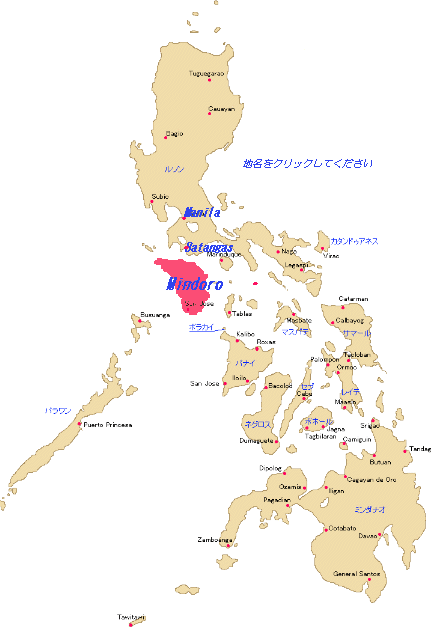
Actually, the last confirmed surrender was by Captain Fumio Nakahira, who held out until April 1980 near Mt. Halcon in Mindoro Island.

Leave a comment

Filed under Japan, Philippines, war

Philippine Doctors Retraining as Nurses

Cronaca (“Past Imperfect, Present Subjunctive, Future Conditional”), a wonderful history blog that Regions of Mind reminded me of, notes a report about new medical developments:

The Philippines is increasingly witnessing a trend that carries alarming implications for the future — its medical doctors are training to be nurses so they can leave the country and make more money.

Leave a comment

Filed under Philippines