A Language Freak Wandering in Siberia

If you feel the need to follow an ever farther outlier, check out this blog by pf, a language freak wandering through Siberia on his own.

Oddly, Russia is the only country I’ve been in where you can’t find manaiacal Australian tourists scurrying out wherever you step. In Europe, you can’t find a town so small but it’s got an Australian (or, if you’ll pardon the expression, a New Zealander) in it, or having just left it, or on the way to it. Here, though, I haven’t met a single antipodean, curiously. Though a couple Indian billionaires in April stayed in the hotel I stayed at in Suntar. I was called upon to verify their English, which I pronounced to be competent, but clearly not that of a native speaker. All marvelled at my deductive powers, for indeed, the Indians had been born in India, and not, as appearances might lead to believe, in any other country.

Americans do occur up here, though. There’s one, I don’t know if I mentioned him, who lived on Kamchatka for a year in high school, and now is studying Japanese (Japanese!) at Yakut State U. (Yakut State!) for a year. There was another who came to a village near Suntar, I wasn’t clear on which, and stayed for two years, or maybe three, hung around the local museum a lot, and then went home, where she turned into a doctor of anthropology. Everybody still remembers her, and, shaking their heads, say, “We’ve lived with this museum all our lives, and she comes here, looks at it for a couple years, writes some stuff down, and gets a doctorate!” She married a local, and took him home with her, where he now makes Sakha (Yakut) jewelry in North Carolina. I’m sure you can track him down, there’s probably not many Sakha (Yakut) jewellers in North Carolina. He’s got his own wall, with pictures of him, and a special cabinet for pictures of his brothers, local jewellers, and a picture of his father, touchingly hung next to a photocopy of his death certificate.

Hat tip: languagehat

Leave a comment

Filed under language, Russia, travel

South Korea and the Vietnam-era Mindset

A Vietnam-era mindset still influences many Americans, perhaps especially longtime leftists. The same is true in South Korea. But the Vietnam era meant rather different things to South Koreans than it did to Americans.

For one thing, many South Koreans mapped their images of a divided Vietnam onto a divided Korea, and vice versa. This shows up very starkly in a novel like The Shadow of Arms, by Hwang Suk-Young, whose English translation by Chun Kyung-Ja was published by the Cornell University East Asia Program in 1994. I had the chance to write a review of the book for the journal Korean Studies in 1996.

At one point during a huge antiwar rally in San Francisco that I attended while on a weekend pass from the Defense Language Institute in Monterey in 1969, a speaker standing beneath the flag of North Vietnam began attaching conditions to his hitherto well-received calls for peace. But almost as soon as his “We demand peace” turned to “We will accept no peace until …” the more-alert members of the crowd began to chant “Peace now! Peace now!” More and more people took up the cry until they drowned out the rest of the speech. For the speaker, peace was a step on the road to partisan victory. For the crowd, it was an end in itself. The crowd won that round but, in typical fashion, the partisan peaceniks were better represented among the organizers, while the naive peaceniks were far more numerous among the organized.

Although utterly cynical about the enterprise (and especially the entrepreneurs) of war, The Shadow of Arms is not exactly an antiwar novel. It is written more in the spirit of that partisan peace activist beneath the North Vietnamese flag in San Francisco. Set almost entirely amidst the logistics-and-supply cornucopia behind the lines rather than in the more intense violence of the free-fire zones, it presents the war as essentially a struggle between self-sacrificing patriots (supported by the communist North Vietnamese) and self-indulgent profiteers (supported by the capitalist Americans). This focus on the wartime black market in South Vietnam may well reflect Hwang Suk-Young’s own experience in the 2nd ROK Marine Brigade, which was deployed to Vietnam from 1965 to 1972. But it also appears to reflect his vision of Cold War South Korea, whose greedy and corrupt military leaders presumably abandoned the goals of reunification and independence for personal profit. By implication, North Korea is the preserve of self-sacrificing patriots still wedded to nationalist, rather than capitalist, goals.

This novel thus evokes the shared fate of Korea and Vietnam. It does not explore the motives (other than profit) for South Korean participation in the war, nor the reactions of individual Koreans to the experience. There is no hint, for instance, of the kind of introspection found in Ahn Junghyo’s [war novel] White Badge, where the protagonist is reminded of his own childhood picking through the garbage of the American soldiers when he sees Vietnamese kids sifting through the rubbish of the Korean troops. Nevertheless, Hwang’s novel is an engrossing tale of individuals caught up in blackmarket plunder within a command economy during the chaos of war. (Although Hwang appears to consider such plunder typical of capitalist economies, I suspect–having spent a year in Romania under Ceausescu–that it is typical of any economy in which an elite has monopoly control of crucial resources, whether that elite meets in corporate boardrooms or in people’s palaces.)

For many Koreans, their participation on the American side during the Vietnam War was quadruply shameful. Not only did they fight on the losing side, but they fought to preserve a divided country, they fought for capitalism, and they fought in a mercenary capacity. Many others, of course, were eager to combat communism and to repay a debt to a vital ally.

The mercenary issue is particularly nettlesome. It’s a toxic label. But it’s hard to deny that, to a certain extent, the Vietnam War provided the same kind of stimulus to South Korea’s postwar economy that the the Korean War did to Japan’s earlier postwar economy (and European wars did to the U.S. economy even earlier). That’s why the same review also considered a related book, Mercenaries and Lyndon Johnson’s “More Flags”: The Hiring of Korean, Filipino and Thai Soldiers in the Vietnam War, by Robert M. Blackburn (McFarland, 1994).

The mercenary nature of foreign involvement in the war is the central theme of Robert M. Blackburn’s fascinating nonfiction account of U.S. President Lyndon Johnson’s attempt to beg or buy international support for South Vietnam under “The Free World Assistance Program” (commonly labeled “More Flags”), which began in 1964. Blackburn, like Hwang, is a Vietnam War veteran who “had the good fortune to fight alongside, though never with, some units of the ROK Marines, and was never bothered by what label they wore” (155). He is careful to distinguish the soldiers who fight wars from the politicians who make wars, observing that any stigma attached to the word mercenary belongs to the leaders, not to the soldiers.

However, Blackburn offers a more subtle analysis of the status of mercenaries. He notes that individual soldiers may choose to fight for a foreign country for reasons other than simply pay, although the pay itself defines their status as mercenaries. Soldiers-of-fortune may fight for the thrill of it. Others enlist because they believe in the cause they are being paid to fight for. Much the same can be said for entire military units, or even for nations that inject their own troops into foreign wars. “In the Spanish Civil War of the 1930s, for example, Franco’s Moroccan battalions fought only for pay, while the opposing members of the Abraham Lincoln Brigade fought for a cause. Both units, however, … shared the common status of mercenaries” (146).

Australia and New Zealand sent military units to Vietnam at their own expense (and therefore not as mercenaries) and for their own reasons. In fact their support for South Vietnam began before Johnson’s More Flags program. Both countries had helped fight communist insurgencies in the Malay Peninsula, and both were alarmed by what Sukarno and his Communist Party allies were doing in Indonesia. Each apparently considered it in its own national interest to help assure the survival of a capitalist South Vietnam. South Korea had at least as much national interest in the survival of South Vietnam as those two countries did. But it also had a “debt of honor” (46) to repay to the allies who helped assure its own survival little more than a decade earlier.

Other countries contributed varying amounts to South Vietnam, from Morocco’s “10,000 cans of sardines worth $2,000” to Japan’s “$55 million worth of economic assistance from a World War II reparations agreement” (141). Most contributed medical supplies and equipment. Costa Rica (actually the Costa Rican Sugar Growers Association) sent an ambulance (143), and South Korea’s first military unit to arrive was a Mobile Army Surgical Hospital (MASH) [emphasis added] (159). However, of all the More Flags allies, South Korea committed the most troops (50,000 out of the 65,000 in 1968 [158]), suffered the most casualties (4,407 out of the 5,241 killed [xiii]), and reaped the greatest economic benefits in return. Blackburn (64-65) estimates that South Korean soldiers received about $1 billion just in pay, allowances, and benefits alone in 1967-73. A ROK private with a base pay of $1.60 a month could earn $1.00-$1.25 for each day’s service in Vietnam. Still, each ROK soldier cost the U.S. only about half as much as a comparable American soldier.

2 Comments

Filed under Indonesia, Korea, military, Vietnam

A White Nigerian?

“Where are you from?” I ask, directly, for this is what I have learned to do in North Carolina whenever I hear someone from West Africa. She answers, “We live in Cary,” once a town outside Raleigh but now a tidy upscale suburb.

But this isn’t what I mean. “No,” I correct her. “Where are you from originally?” And she sturdies herself. “I am from Africa,” only it’s more like Ah-free-ka, with the emphasis on the Ah and the ree vibrating on her tongue. Still she doesn’t take me seriously. “No.” I venture, more sternly this time, “what country?” And now she says, relaxing, “I am from Nigeria.” She draws it out: Nigh-jyyy-rria.

Tears come to my eyes and then my body warms, as if I have had a transfusion. “I know,” I tell her, I was born in Ogbomosho.” Every Nigerian knows Ogbomosho, in Yoruba land.

“Ah,” she replies quietly, as if this is a mystery, and we stand for a moment in recognition of a kinship impossible to speak. She is from Ibadan, just down the road from my original home. Her name is Joanna. Finally her husband approaches, for he is in no hurry at all; he wears one of those West African print shirts with the embroidered necks and sleeves to the elbows, and you can see his stomach protruding slightly. “Johnny,” she calls out, “this woman is a Nigerian.” I am as happy as the child was moments earlier.

So few people know me. I am white. I have blonde hair and blue eyes. I teach American literature in the English department of North Carolina State University. No one in my neighborhood would imagine that I grew up in Africa. For years, even I forgot where I am from. So I am thankful for Joanna’s discernment. In Nigerian thinking, anyone born in Nigeria is Nigerian. She may be a bad Nigerian or a lost Nigerian, but she is still a Nigerian.

SOURCE: Gods of Noonday: A White Girl’s African Life, by Elaine Neil Orr (U. Virginia Press, 2003), pp. 2-3.

Leave a comment

Filed under Nigeria, U.S.

To Keep Nigeria One Is a Task That Must Be Done

On August 16 [1966], my father’s birthday, the Biafrans reached the Ofusu River Bridge which marks the border with the Western region, our region. On my birthday, August 19, the Biafrans were continuing to advance. All around, the savannahs were quiet; there was a lull in the rains. The air was as dry as a stone. Around that beautiful dining room table, I had a birthday party with our little compound clan. I was thirteen and my mother made a white cake with yellow icing and on it she placed a ceramic Siamese cat as a decoration. I wore a dress pink as a carnation. My birthday gift appeared in a small box, a birthstone ring–peridot–in an oval setting, rather plain really, like my face. I didn’t like it. I was disappointed. My mother explained that we were in a war and it was not a good time to buy record players when we were so uncertain of our immediate future. She said this to me in our living room after the party and I stared at the philodendron as she spoke, determined not to look at her or signal the least agreement. She could speak if she liked; I would not listen.

The Yoruba had finally got off the fence and appeared to be aligned with the North in its mission to keep Nigeria unified. This was a blow to the Igbos. On the radio you could hear the refrain, To Keep Nigeria One Is a Task That Must Be Done.

The next day, August 20, the Biafrans attacked Ore, putting them within 130 miles of Lagos and about 90 miles from Oshogbo where I was unhappily viewing my new ring in its box, for I would not wear it. If they reached either Ibadan or Lagos, the Federation of Nigeria would fall like a bulleted elephant. But just as Gowon was about to flee, the British and Americans intervened. Who knows what happened in Ore. We never knew. But the war turned around. Perhaps today there is an old woman in Ore who was there that day, who saw what happened when the Biafrans stopped and then backtracked. Her eyes may hold the secret.

SOURCE: Gods of Noonday: A White Girl’s African Life, by Elaine Neil Orr (U. Virginia Press, 2003), pp. 238-239.

Leave a comment

Filed under Nigeria

Tana Toraja: From Ethnogenesis to Ethnotourism

A hundred years ago, the Toraja people did not exist. “Toraja” was merely a derogatory term applied by the Bugis and Makassarese living in the lowlands of the southwest peninsula of Sulawesi (then called Celebes) to any of the many different peoples living in the mountainous regions of the peninsula and central Sulawesi. Today, Tana Toraja (Toraja Land) is an administrative district in the province of South Sulawesi, the people living there comprise one of the four official suku bangsa (ethnic groups) of the peninsula, and the Toraja are celebrated (at least amongst anthropologists, tourists, and television crews) for their fantastic architecture and elaborate funerals. People who have been born in the area of Tana Toraja now call themselves Toraja, bringing this identity with them in their migrations throughout Indonesia and the rest of the world.

So begins a fascinating paper entitled From “You, Toradja” to “We Toraja”: Ethnicity in the Making, in which an anthropology graduate student, Jaida n’ha Sandra, attempts “to trace how a pejorative turned into a people.” The extended quotes below are from the same article. (Read the whole thing.)

Before the arrival of the Dutch, the Muslims in the lowlands had regarded the politically fragmented highlanders as a major source of slaves, as well as coffee and other highland products.

The Dutch had been a colonial presence on Sulawesi since the seventeenth century but had mainly ignored the inaccessible and agriculturally unproductive mountain areas. In the late nineteenth century, however, they became increasingly worried about the growing Islamic influence in Sulawesi. The animist highlanders were viewed as a pool of potential Christians; the company mandate was to convert as many as possible, thereby aligning the highlands with the Dutch should lowland Muslims get too obstreperous.

Starting in 1906, the Dutch influenced the formation of Toraja in four main ways. First, they abolished slavery, bringing peace and relative safety to the area. Second, they introduced Christianity, which would later be adopted as a defense against lowland Islamic fundamentalism. Third, they furthered the cash economy by demanding taxes. And, finally, they drew a line around the Sa’dan area and named it Tana Toraja.

Tana Toraja, like Bali, has since become one of the most intensely anthropologized places on earth. The Toraja are famous for their huge, boat-shaped rice barns and their famously elaborate and gory funeral celebrations, featuring animal sacrifices and often a sizable contingent of foreign funeral tourists. Ethnic identity, however, remains a contentious issue.

The nobility … were satisfied with their power and status under the old system. Lower class Toraja have been less conservative, taking advantage of the egalitarian mores of Christianity, the opportunities presented by education and the cash economy, and the political implications of ethnic identity to contest the authority of the nobility…. Christianity has been increasingly popular as an avenue towards modernity and gaining a transnational identity….

In the 1940s, few Toraja had ever left their village and almost none had left the Indonesian archipelago. By 1978, however, sixty percent of the population was spending extended periods outside Tana Toraja. Many never come back except for the occasional family funeral. Toraja have eagerly pursued education and now work outside Tana Toraja as government officials, professors, medical professionals, and lawyers. At the same time, they have never been above manual labor and so also work in mining and lumber operations on far-flung islands as well as in furniture and clothing manufacture closer to home.

Out-migration has led simultaneously to a greater identification with the Toraja suku (ethnicity) while at the same time facilitated alterations in that identity. On the one hand, Toraja abroad go to great lengths to retain links with family. They follow all the funerals and attendant gossip….

At the same time, there are complaints that the rituals are no longer authentic or “true”. Fewer Toraja can reach a consensus on what aspects of funeral ceremonies are fixed and what can be reinterpreted. There is no longer a shared expectation and experience of ritual. As ritual defines Toraja to the outside world, it is also changing to accommodate outsiders tastes. Some students from Toraja consider having tourists at funerals a travesty and feel tourists should be treated only to staged shows of songs, chants, dances, even sacrifices that are not part of any meaningful ritual. Others feel that removing the ritual practices from the ritual, doing it at inappropriate times or in inappropriate places, is the travesty. The ceremonies should be whole or abandoned, not carved into bits for tourists’ eyes. Discussion groups, seminars, and arguments abound as Toraja try to sort out how they can abide by Church authority and please the tourists while maintaining some meaning in their traditions….

For the sake of tourism, Toraja have also begun to reinvent themselves… They respond to lowland stereotypes of themselves as crude, backwards, non-religious ex-slaves by characterizing themselves as pork-eaters, pacifists, honest, delicate, quick-witted, hard working, and thrifty. At the same time, they discuss at length their own foolishness in racking up huge debts and then wasting wealth on funeral ceremonies….

Meanwhile, the nobility make use of visiting anthropologists to play out family rivalries. Adams reports how she was recruited as a pet anthropologist by one family who asked her to “write a book about the real Torajan identity and history.” What this really meant was a history of that particular family. She came to realize, only later, that she was a pawn in an ancient game. She writes:

[A] rival aristocratic family from another Torajan district visited our village and my Torajan hosts introduced me as “their anthropologist” …. To this, the visitors responded that they, too, had an anthropologist live with them and write about them. After these guests departed, my Torajan family disparaged the other anthropologist’s understanding of Torajan culture and proclaimed that my “book” would be “much bigger and better.”

One of the most famous books on the Toraja, of course, is Nigel Barley’s Not a Hazardous Sport, quoted immediately below.

Leave a comment

Filed under Indonesia

Not a Hazardous Sport

‘Anthropology is not a hazardous sport.’ I had always suspected that this was so but it was comforting to have it confirmed in black and white by a reputable insurance company of enduring probity. They, after all, should know such things.

The declaration was the end result of an extended correspondence conducted more in the spirit of detached concern than serious enquiry. I had insured my health for a two-month period field-trip and been unwise enough to read the small print. I was not covered for nuclear attack or nationalization by a foreign government. Even more alarming, I was covered for up to twelve months if hijacked. Free-fall parachute jumping was specificially forbidden together with ‘all other hazardous sports’. But it was now official: ‘Anthropology is not a hazardous sport.’

The equipment laid out on the bed seemed to contest the assertion. I had water-purifying tablets, remedies against two sorts of malaria, athlete’s foot, suppurating ulcers and eyelids, amoebic dysentery, hay fever, sunburn, infestation by lice and ticks, seasickness and compulsive vomiting. Only much, much later would I realize that I had forgotten the aspirins.

It was to be a stern rather than an easy trip, a last pitting of a visibly sagging frame against severe geography where everything would probably have to be carried up mountains and across ravines, a last act of physical optimism before admitting that urban life and middle age had ravaged me beyond recall.

In one corner stood the new rucksack, gleaming iridescent green like the carapace of a tropical beetle. New boots glowed comfortingly beside it, exuding a promise of dry strength. Cameras had been cleaned and recalibrated. All the minor tasks had been dealt with just as a soldier cleans and oils his rifle before going into battle. Now, in pre-departure gloom, the wits were dulled, the senses muted. It was the moment for sitting on the luggage and feeling empty depression.

SOURCE: Nigel Barley, Not a Hazardous Sport (Henry Holt, 1988).

Leave a comment

Filed under malaria

Diary of Angeles Monrayo, 1924-1928

Strike Camp, Middle St., Honolulu, T.H.

June 9, 1924

Dear Diary:

We had our ‘dancing’ 2 night straight–I made $7.00 the other nite and $7.50 last night–gosh, so many Filipino sailors came, last night and the other night, too. I gave Father $13.50. I kept 1.00 for myself. The men tell me for as young as I was, I can follow them easily like fox-trot and waltzes. I’m not even 12 years old yet, but because there are only few girls living here, I guess that’s why they let me. There’s a saxaphone player, too, only he does not play every time we have a dance. I like the music very much if he plays with the guitar and mandolin player, because the music sound so much better, and it makes you want to dance so much more. I can keep on dancing and forget about eating. Yes, Diary, that is how much I love dancing.”

SOURCE: Tomorrow’s Memories: Diary of Angeles Monrayo, 1924-1928 (U. Hawai‘i Press, 2003).

Leave a comment

Filed under Hawai'i

China’s Natural Mason-Dixon Line

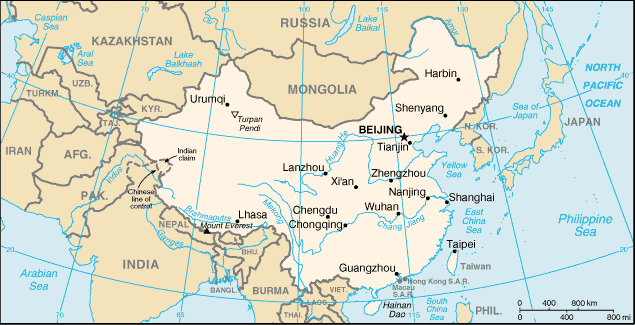
The rough dividing line between North and South China (at least “China Proper“) is the Yangtze River, officially referred to as the Changjiang (‘Long River’) in Chinese. Unlike the Mason-Dixon line in the U.S., this division in China is the result of natural geological forces, not the result of any artificial human compromise. Like the Mason-Dixon line, however, the boundaries get fuzzier the farther you go west. (See maps; scroll down.)

South of the Yangtze, people depend mostly on rice as their staple, they prefer black tea, and they generally get by without heating their houses during the winter. (The coldest winter I ever spent was in one of those unheated houses in South China. Another foreign family there made the same claim–and they were from Winnipeg, Manitoba!) The old southern capital, Nanjing (‘South Capital’) lies on the south bank of the Yangtze. (See maps and photos; scroll down.)

North of the Yangtze, people grow a variety of hardy staples such as wheat, corn (maize), sorghum, and millet, which they make into pastas, breads, or gruel. They prefer green tea, and they generally do a better job of heating their houses during the winter. (See maps and photos; scroll down.)

In popular stereotype, the North has more than its share of hardheaded ideologues, while the South has more than its share of unprincipled pragmatists. However, the pragmatic leader Zhao Ziyang was a northerner from Henan (although he rose to prominence in Guangdong), while the arch-ideologue Mao Zedong was a southerner from Hunan. The smooth diplomat Zhou Enlai was from Jiangsu, which straddles the Yangtze. (See maps of major provinces.)

If bureaucratic Beijing (‘North Capital’) is the northern archetype, hustling Guangzhou (‘Wide State’) is its southern counterpart. (See map of major cities.) Shanghai, at the mouth of the Yangtze, has a reputation for combining both ideological and mercantile hustle. Shanghai literally means ‘rise-up sea’, which may originally have meant ‘the beginning of the sea’ (and the end of the river), but I can’t find any confirmation.

Unfortunately, many Cantonese seem to think that the North starts at the northern border of Guangdong Province–or that you have to speak Cantonese to be a southerner. Several of the teachers at the brand new college we taught at in Zhongshan City, Guangdong, were from Jiangxi Province, which stretches from Guangdong north to the Yangtze. They were frequently dismayed to be identified as beifangren ‘northerners’ when they spoke their southern dialect of the national language (putonghua, or Mandarin) rather than Cantonese. To Cantonese, they were just not southern enough. It was like Georgians calling Virginians–or Mississipians calling Tennesseans–“Yankees”! (Hmm. Come to think of it …)

Recommended Browsing: A Visual Sourcebook of Chinese Civilization.

Leave a comment

Filed under China

Asian Acronyms: Did you teach at GWYX or at Guangwai?

Discriminating linguists sometimes distinguish between acronyms pronounced as if they were a word, like NATO and UNICEF; and initialisms pronounced as a series of letters, like IBM or the UN. This distinction breaks down in orthographies that write whole syllables at a time, like Chinese.

In Chinese, for instance, acronyms are composed of the initial syllabic characters of (usually) two-syllable words. So, Peking (= Beijing) University, or Beijing Daxue [lit. ‘NorthCapital BigSchool’] becomes Beida [lit. ‘NorthBig’]. In Korean, Korea University, or Koryo Taehak [lit. ‘HighBeautiful BigSchool’] becomes Kodae [lit. ‘HighBig’]. In Japanese, it’s a bit more complicated. Chinese characters can be pronounced not just in their Chinese loan forms, but as native Japanese words that mean (more or less) the same thing. This is what makes Japanese far and away the most complex, least efficient writing system on earth. In either case, each character is usually pronounced as two syllables, since Japanese had to add final vowels to one-syllable Chinese roots in order to pronounce any final consonants, most of which have been lost in modern Mandarin Chinese. (The same thing happens to current Japanese borrowings from English: ranchi < lunch, setto < set, beisubouru < baseball, and so on.) So the acronym for Hiroshima University, or Hiroshima Daigaku [lit. ‘WideIsland BigSchool’] becomes HiroDai [lit. ‘WideBig’]. The name Hiroshima is native Japanese (the Sino-Japanese pronunciation would be Koutou = Ch. Guangdao), but Daigaku is Sino-Japanese [= Ch. Daxue].

After China adopted the supplementary Latin-based alphabetic pinyin writing system, which is increasingly used in computer input, you could begin to see alphabetic abbreviations, some of them rather alarming and most of them quite unpronounceable. Very few Chinese syllables start with vowels: a- is not uncommon, but e- and o- are rare, and i- and u- are nonexistent. Even worse, initial q-, x-, y-, and z- are way too common.

So, if you were to take the first pinyin letter of each syllable, Guangzhou Foreign Language Institute would be abbreviated GZWGYYXY < GuangZhou WaiGuo YuYan XueYuan [lit. ‘WideState OutCountry SpeechTalk LearnYard’]. You would do better to take the first letter of each two-syllable word rather than the first letter of every single syllable, in which case the same school would end up as GWYX < Guangzhou Waiguo Yuyan Xueyuan [lit. ‘Guangzhou Foreign Language Institute’]. However, most Chinese acronyms are more economical than that. The common name for this particular school was equivalent to “GuangFor” (Guangzhou Foreign), namely, GuangWai [lit. ‘WideOut’]. (It has now merged into GDUFS, the Guangdong University of Foreign Studies, which would still qualify for the acronym GuangWai in Chinese. The unfortunate English acronym must certainly be guh-doofs.)

These syllabic acronyms aren’t unique to Chinese. Indonesian (or Malay) uses a Latin-based alphabetic writing system, but is chock full of syllabic as well as alphabetic acronyms (and initialisms). Acronyms seem to proliferate under big bureaucracies–especially if the military has a free hand. Examples of syllabic acronyms in Indonesian include the names of provinces like Sulsel < Sulawesi Selatan [‘south’], Sulut < Sulawesi Utara [‘north’], and Sulteng < Sulawesi Tengah [‘central’] on the island of Sulawesi (Celebes); schools like UnHas < Universitas Hasanuddin in Sulawesi and UnPatti < Universitas Pattimura in Maluku (Molucca); and terms like tapol < tahanan politik [‘political prisoner’].

UPDATE: Like Japanese and Korean, Vietnamese used to be written in Chinese characters and has lots of Chinese loanwords. Judging from the website of Vietnam National University – Ho Chi Minh City, Vietnamese seem to abbreviate by taking the first letter of each separately written syllable. Thus, (ignoring diacritics) Dai hoc Quoc gia Thanh pho Ho Chi Minh [lit. ‘University National City Ho Chi Minh’] is abbreviated DHQG-HCM. Ho Chi Minh City is also abbreviated TP.HCM, which I’m pretty sure is often pronounced Saigon. Otherwise, I don’t have a clue how these abbreviations are pronounced.

FURTHER UPDATE: Korean usage of taehak seems to be diverging from that of its cognates in Japanese (daigaku) and Chinese (daxue). While each term applies to a variety of institutions of tertiary education, Korean now distinguishes between taehak ‘college’ and taehakkyo ‘university’ very much long the lines of American usage. Taehakkyo indicates a larger institution that offers graduate education. So Kodae now stands for Koryo Taehakkyo, as the Chinese characters and Korean title on their homepage shows. I don’t think the cognate forms, Jp. daigakkou and Ch. daxuexiao, even exist, much less serve a similar function.

Leave a comment

Filed under China, Indonesia, Japan, Korea, language

Soviet Koreans vs. Volga Germans: Deportation Smackdown

Prof. Lee Chai-mun of Kyungpook (North Kyôngsang) University published an article in the June 2003 issue of The Review of Korean Studies entitled “The Lost Sheep: The Soviet Deportations of Ethnic Koreans and Volga Germans“:

The goal of this paper is to compare the forced deportations of two Soviet minorities, Soviet Koreans and Volga Germans in the early [20th] century. Most existing Korean studies tend to emphasize the uniqueness of Korean expulsion, thereby missing crucial factors which explain the origins of forced Soviet Korean deportations in 1937. In this comparative study, first, histories of Soviet Koreans and Volga Germans and their forced deportation processes were reviewed, and then the motives of the deportations were examined. The result of this comparative study gives credibility to the espionage theory for the forced deportations. It also strongly suggests that ethnic conflicts over land issues during collectivization as one of the most important motives for the forced deportations of the Soviet Koreans and Volga Germans.

The published PDF version of the article generates errors, but a more easily accessible earlier draft is online. In it, Prof. Lee notes that individuals and groups from both minorities were deported earlier on for a variety of reasons, such as resistance to collectivization and various other counterrevolutionary activities, but the mass deportations directly followed the outbreak of war in each region. War between Japan and China became official after the Marco Polo Bridge Incident in July 1937. Over 170,000 Koreans in the Soviet Far East were deported to Central Asia beginning in October that year–after they had a chance to bring in the harvest. Germany’s Operation Barbarossa attack on the Soviet Union began in June 1941. About 450,000 Volga Germans were deported to Central Asia in September that year. In all, more than 1 million Soviet Germans were deported.

Nadira Artyk, a London-based Uzbek journalist, describes the ebbing of that flood of deportations many decades later, after the collapse of the Soviet Union, in the wonderful Czech journal Transitions Online, in an October 1998 article entitled “An Exodus of Minorities“:

Central Asia has a variety of minority groups, including European settlers (predominantly Slavic), diaspora minorities indigenous to the region (such as Tajiks in Uzbekistan and Kyrgyz in Tajikistan), and people forcibly deported to the area under Josef Stalin (such as Crimean Tatars, Germans, and Koreans).Under Soviet rule, people who belonged to completely different ethnicities and different religions were put together. But in Uzbekistan, for example, Russians and Uzbeks always remained largely separate communities. There was no tension between them simply because they led different lives. They even resided in different places–Russians in apartment blocks, Uzbeks in traditional makhallyas.

The collapse of the Soviet Union heralded a rebuilding of national identities in all Central Asian states, which used to be subjected to merciless Russification. By reviving national language, culture, and history, the Central Asian governments tried to restore their nations’ pride. Ethnic groups had to adopt to the dominating nation or leave.

Thus, after more than 70 years under the Soviet roof, many nonindigenous ethnic minorities chose to return to their historic homelands.

There has been widespread emigration of Germans, Russians, Ukrainians, Jews, Crimean Tatars, and Meskhetiyan Turks. Some other groups (such as Koreans) have shown little desire to leave Central Asia. [Well, sure, if the alternative is North Korea–ed.]

Kazakhstan and Kyrgyzstan, countries with significant Russian-speaking minorities, tried to strike a balance between restoring their predominant national cultures and not upsetting other ethnic groups. Kazakhstan’s President Nursultan Nazarbayev guaranteed equal rights to all ethnic groups, but there are clear signs of power being concentrated in Kazakh hands. Until last year, non-Kazakhs held one-third of all ministerial posts in the country’s cabinet. Now only a quarter of the government consists of Russians and representatives of other ethnic groups….

Of the ethnic groups, deported to Central Asia by Stalin before and during World War II (Volga Germans, Crimean Tatars, Koreans, Poles, Greeks, Chechens, Meskhetiyan Turks, the Ingushe, and so on), only Koreans and Germans adapted successfully [emphasis added]. Others, such as Chechens and the Ingush, after Stalin’s death returned in large numbers to their homelands at the earliest opportunity, in the late 1950s.

Among the ways Koreans “adapted successfully” was to abandon their native language and to achieve educational levels second only to Soviet Jews. Among the most prominent are the government official Georgy Kim, who attained one of the highest levels of any non-Russian in the former Soviet Foreign Ministry and now serves as Minister of Justice in the Republic of Kazakhstan; and the writer Anatoly Kim.

Until the age of eight, Anatoly Kim spoke only Korean. Then he learned Russian and unlearned his native language forever. Studying painting and later literature in Moscow, Kim’s short-stories and novellas have as varied geographical backgrounds as his own life. In some narratives, Kim alluded to the Korean community on Sakhalin or in Kazakhstan, but he never told of the horrible events of 1937. And only when he was in his fifties–after the Soviet Union crumbled–could he visit Korea for the first time. This voyage, as well as his subsequent stay there for a number of years as a professor of Russian, proved a veritable revelation. For Anatoly Kim’s discovery of the real Korea was that same “voyage in search of a continent,” only that it was not an entirely new one. It was the continent of his roots.

One of the most interesting developments now is the attempt by South Korean religious, linguistic, and cultural evangelists to reclaim these “Lost Sheep.” Recent Fulbright scholar Steven S. Lee has some very interesting observations on identity questions in his Koryo Saram archive.

My project has narrowed to two specific foci: (1) the growing body of literature (mostly in Russian) by Korean Central Asians, and (2) interactions between the Koreans here with Koreans from elsewhere in defining ethnic identity. For this second focus, my driving question is: Who is claiming authority in delineating what it means to be Korean? According to my adviser, German Kim, the South Koreans doing business and mission work here were at first welcomed with open arms by local Koreans, but gradually, these outsiders were perceived as arrogant and condescending, i.e. they considered themselves as the proper purveyors of Korean cultures. Of course, one could hardly call South Korea during the past 50 years as a vacuum for cultural preservation, and more and more, I find it useful to regard ethnicity and tradition as invention, as fiction. This is where my focus on literature comes into play: what I’m searching for is literature that defines ethnic identity–slyly and subtly, I’m hoping.

On this note of ethnicity as fiction, it’s interesting how well Koreans seem to blend in with Kazakhs. I am ethnically Korean, and yet I’ve been mistaken for Kazakh. Accordingly, Koreans here are said to be more contented than Koreans in Uzbekistan, partially because they can blend in more easily. Although Almaty is a wonderful and quite liveable city, I certainly hope to be able to compare the Koreans here with those in Tashkent, where they are a more conspicuous and perhaps less integrated minority group….

Lee is far from impressed after translating Anatoly Kim’s story “A Cry About a Mother in Seoul“:

Considering current attempts at religious awakening within the Korean community, this story is somewhat interesting. The author clearly intends to associate religiousness with ethnic identity; religion as both provoking and salving the dilemmas of ethnicity. Death (the ultimate displacement) provokes the narrator’s (inherent, insufferable) sense of alienation, which is exacerbated further when he visits his historic “motherland,” where, for some reason (probably to make a clever mother-mother connection, one lost figuratively and one lost literally), he can’t stop thinking about his deceased mother. His unstated dilemma (alluded to at the party) is one of faith–the aspersions cast on Providence and ancestors by his displacement and, perhaps, by his saintly mother’s death. The funeral scene serves as the uneasy nexus of spirituality and ethnicity, the deceased mother all alone in a sea of Russian names, the bow as a futile attempt to recoup loss; the mound of snow may be a reference to traditional Korean graves. The dog doesn’t quite work as a symbol.

In lieu of subtlety, the author resolves these conflicting threads with vague promises of Providence, love, the future, and cultural reawakening (that rice field), and I don’t think this works; in fact, this strikes me as an attempt at auto-exoticization. It’s interesting how the mother doesn’t at all raise the point of ethnic alienation. Her prayers and death are essentially commandeered by the narrator, who crudely hammers in ethnic questions….

My adviser, German Kim, returned from some conferences in East Asia last week, and was not at all amused when I began panning Anatoliy Kim. Apparently, he’s a respected Russian author, but according to German, his speciality is surreal “Russian-soul” questions rather than ethnic writing. I’m now translating a longer, much more promising story by a Lavrentii Son, and I’ll post whatever I’ve done by next week then. Sadly, I’ve been told that after a period of euphoria in the early ’90s, interest in ethnic literature and cultural reclamation has waned; people have a hard enough just making ends meet.

Which leads me to the Association of the Koreans of Kazakhstan, once dominated by scholars, but now headed by wealthy businessmen, suggesting an interrelation between ethnic identity and fiscal aspirations. It’s interesting to note that the Korean geh [or kye], in which a group of entrepreneurs regularly pool their money and rotate its distribution (one reason why so many Korean-Americans own small businesses), does not exist here in Kazakhstan. However, some Korean-Kazakhstanis have made a pretty penny by acting as intermediaries between S. Korean conglomerates (eg LG and Samsung) and local markets. LG is the most visible electronics company in Almaty….

Before independence, the Koryo saram had ties to North Korea only, and while in Tashkent, I examined magazines distributed by Pyongyang, propagating their version of Korean culture—for instance, presenting socialist realist art as traditional Korean. By many local accounts, South Korean contacts with the Koryo saram have also been dubious at times. In April I translated an unpublished satire by Almaty writer/director Lavrentii Son, recounting how he was duped by two South Korean professors into providing copies of his films….

I don’t know if Son’s charges are true, and I hope that nobody in the surprisingly politicized field of Koryo saram studies will take offense that I’m posting the satire on this site. I wonder if he’ll satirize me someday…

Leave a comment

Filed under China, Korea