Officials in the Indonesian capital, Jakarta, failed to issue a tsunami warning despite receiving data about Monday’s earthquake 20 minutes before the first wave struck the island of Java.
One official told the Guardian they were too busy monitoring the aftershocks of the 7.7-magnitude quake that triggered the tsunami to raise the alarm. The government’s science and technology minister, Kusmayanto Kadiman, confirmed last night that Indonesia had received bulletins from the Pacific Tsunami Warning Centre in Hawaii and Japan’s meteorological agency after the quake, but “we did not announce them”….
Aerial television footage showed that virtually all the wooden buildings hit by the tsunami were swept away, along with about half the brick structures. Buildings up to half a mile inland were damaged. Some 30,000 people are thought to have fled their homes.
Indonesia Received Tsunami Warnings
Filed under Indonesia
Who’s Indigenous in Indonesia?
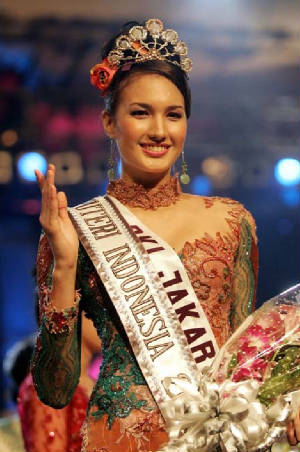
On 17 July, the Jakarta Post ran an interesting opinion piece by Endy M. Bayumi on what it means to be indigenous in Indonesia. The question arose because Miss Indonesia, Nadine Chandrawinata, doesn’t look sufficiently “indigenous.”
It was a coincidence that around the time she gave this interview, the House of Representatives last week unanimously endorsed the new citizenship bill that cleared up the legal definition of “indigenous”.
The bill defines citizens of this republic as Indonesia asli, or indigenous Indonesians, and it goes on to define “indigenous” not by one’s race or ethnicity, but rather by one’s being born on Indonesian soil, and never having taken up any foreign citizenship….
Prior to this law, Indonesians of Chinese descent — and to a lesser extent those of Arab, European and Indian blood — have had to put up with discriminatory treatment because they were not considered indigenous, although they may have been born here or their families may have been here for many generations….
The term “indigenous” itself is a misnomer.
The Malays in Indonesia may lay claim to being the indigenous people in the western part of the country, but the Melanesians (with a darker complexion) dominate the eastern part of the archipelago. So we have two indigenous groups in this country.
But can the Malays in Sumatra, Java, Kalimantan and Sulawesi truly claim to be Indonesia asli? Shouldn’t that claim belong more to the aborigines, like the Suku Anak Dalam in Jambi and others whose existence is on the verge of extinction?
One theory has it that the Malays currently inhabiting much of mainland Southeast Asia and the archipelago are descendants of people who migrated south down the Mekong River many thousand years ago. [Or ancestral Austronesian speakers came off the south coast of China, or out of Taiwan, down through the Philippines. So what? Malay dialects spread throughout the Indonesian archipelago much more recently—hundreds, not thousands, of years ago—probably spreading with Muslim traders along the coasts and up the major rivers of island Southeast Asia.–J.]
The Malays therefore are not Indonesia asli. But they can claim to be “more indigenous” by being here first, long before the Indians, Arabs, Chinese and Europeans came to this part of the world.
Malaysia, being a federation of sultanates, claims that all land belongs to the rulers, and thus to the indigenous Malay and Muslims. Non-Malays (the Chinese and Indians) are guests of the land and treated as second-class citizens with fewer rights.
Thankfully, Indonesia was a republic from its inception, and the land (and the water between the islands) belongs to the republic and its people, and not to any exclusive race or religious group.
The new citizenship law thus essentially recognizes that we are all indigenous, irrespective of the color of our skin, the language we speak, or the religion we follow.
This land is our land. If some of us want to claim to be more indigenous than others, let them be, but don’t expect the law to treat them differently.
And as for Nadine, she has as much right to represent Indonesia at Miss Universe 2006 as anyone else who is an Indonesian by blood and by law.
I don’t care at all about Miss Indonesia, but the new citizenship law sounds like a good thing.
via Colby Cosh
My favorite restaurant in Indonesia’s Ambon City during my academic junket in 1991 was named Pondok Asli, a place fancy enough to be translated Maison d’Indigènes rather than Native Hut. It was destroyed, like most of urban Ambon, after the Laskar Jihad invaded in 2000. Our Fulbright group tour was housed with host families in Poka and Rumah Tiga, near Pattimura University, which was also utterly destroyed by foreign jihadis. I’m not sure how many of our host families were slaughtered in the process. I have fond memories of eastern Indonesia, whether Muslim or Christian, but I scorn anyone who tries to make excuses for the jihadis.
Hollywood Tibetophilia
The impasse over Tibet’s future has increased the volubility of foreign support for the Dalai Lama. When he visited the USA in the summer of 2000, for instance, he had meetings with the National Security Adviser and eminent Washington politicians, and thirty-five minutes with the President. Encased by a huge entourage of State Department security people, he promoted a peaceful solution for Tibet to the American people. His supporters put him on Larry King Live on CNN. He had been on the show six months earlier for a Millennium Special, when King had asked the Dalai Lama, as a leading Muslim, what he thought about the new year celebrations.
This time, the host knew that his guest was a Buddhist, but it was a sorry spectacle, the Dalai Lama, the bodhisattva of compassion, being forced by the exigencies of global politics and celebrity culture to compete for airtime with the passing flotsam of high-speed television …
American Tibetophilia even provoked a two-week happening at the Smithsonian Folklife Festival, including a public speech by the Dalai Lama which drew a crowd of tens of thousands. The Monlam Chenmo, the great prayer festival founded in 1409 by Tsongkhapa, was plucked from its regular home among the exile community in India and incorporated into the commotion. Dozens of monks from Drepung Loseling and Namgyal monasteries were flown into Washington DC to chant in suitably guttural tones and look impressive in maroon and saffron robes. Nobody seemed to notice that the Monlam Chenmo was a central date in the Tibetan state calendar, which had never been hijacked in this way before, and that its cancellation in Dharamsala that year led to acute religious and financial tribulation for the many Tibetan refugees who depend on it.
Meanwhile, at the Forest Lawn Memorial Park in Los Angeles, the Dalai Lama blessed a new Shi-Tro mandala (a three-dimensional religious sculpture) in front of a large, paying audience. The mandala had been created by a Tibetan monk who ran a local Buddhist centre, assisted by his American wife, who worked in creative marketing for Warner Brothers Records Inc. She had generated volumes of publicity, using the slogan “Shi-Tro Happens.” The Los Angeles Times described this as “marketing the mandala in a hip and humorous way.” So, there was the Dalai Lama, up on stage, Shi-Tro happening, the ceremony compered by the requisite Hollywood star, in this case the actress Sharon Stone, famous for lacking underwear in the movie Basic Instinct, but this time wearing a feather boa and bare feet. After musing aloud for a while about how she might introduce the Dalai Lama, she finally settled for, “The hardest-working man in spirituality … Mr. Please, Please, Please let me back into China!” The fact that the Dalai Lama came from Tibet was momentarily lost….
This is what is so curious about the phenomenon of his fame: devoid of egotism, committed to his religious vocation, the Dalai Lama has little interest in the way in which he is re-created by the world. The side-effect of his celebrity, and the way it is projected by his apparent backers, is that the battle over the future of Tibet has become curiously apolitical. We are left with the cry of longing, the repeating slogan of the foreign campaigner, the plaintive call of the refugee, the emphatic claim of the born exile, “Tibet! Tibet!”
SOURCE: Tibet, Tibet: A Personal History of a Lost Land, by Patrick French (Vintage, 2004), pp. 115-117
Get your Free Tibet bumper sticker. Just US$2.95. Or $0.75 on eBay, plus $3.00 shipping worldwide. Or buy the T-shirt from CafePress.com.
Gandhi Has No Message for the Tibetans
The China specialists Frederick Teiwes and Warren Sun have argued that “Westerners think of politics in certain ways which make it difficult to accept Chinese realities,” presuming that “politics is about policy, that a great country has a large policy agenda which naturally preoccupies the politicians,” and that “political power flows to people with certain skills and capabilities.”
In a nationalist dictatorship founded on blood, like the one which gained power in China in October 1949, the assumptions that are taken for granted in a democracy do not hold true. Leaders are selected not for their ability to do a job or to represent the nation, but for their willingness to uphold the Party’s authority and suppress dissent. Vocal popular pressure does not cause a change in policy. Institutions do not act as a check on those in power. Only when the Chinese system starts to fracture from within will it be vulnerable to methods of open defiance, such as street protests and non-cooperation. Mohandas Gandhi, often invoked by the Dalai Lama and his supporters as an exemplar, has no message for the Tibetans. (Mao’s student years might be contrasted with those of Gandhi’s heir, Jawaharlal Nehru: while Mao joined a revolutionary militia in Changsha, where people were hacked to death and a head was paraded outside the governor’s residence on a stick, Nehru studied at Cambridge University, where he joined the college boat club and played plenty of tennis.) Gandhi’s strategy of mass civil resistance was a tactical response to the British political system; had he tried it against Mao or Stalin, he and his followers would have been rounded up and shot.
SOURCE: Tibet, Tibet: A Personal History of a Lost Land, by Patrick French (Vintage, 2004), pp. 114-115
Filed under China
Roots of Tibet’s Modern Military Incompetence
The optimistic view of [Tibet’s] military incompetence would be that it came from instinctive pacifism. Martin Scorsese’s 1997 movie Kundun, a beautifully crafted piece of Dalaidolatry, opens with the claim that “Tibetans have practised non-violence for over a thousand years.” The Jey Tsong Khapa Professor of Indo-Tibetan Buddhist Studies at Columbia University, Robert Thurman, has similarly depicted Tibet as a land of “psychonauts,” where “the cool-revolutionary counter-culture” entered the mainstream. Tibet was “a laboratory for the enlightenment movement to create its model society,” replete with “pacifist monks and nuns spending their days in learning, meditation, and creativity.” Helped by the teachings of the Buddha, the country had developed “industrial-strength mass monasteries in which individuals conquered their innermost energies and transformed their world into a buddhaverse.”
The idea is appealing, but unreal. The Dalai Lamas rode to political power on the back of the military might of the Mongols. Tibet’s history, like the history of any country, is full of war, gore and male domination, even if revenge slaughter never became as popular as in neighbouring lands. As late as May 1947, the footballer Reting Rinpoche was punished for insurrection by having a silk scarf stuffed down his throat, or his testicles crushed, or being poisoned with yellow pills, depending on which version you prefer. Tibet’s lack of initiative in the 1930s came from the loss of focus and ambition caused by extended reliance on the mediation and patronage of outsiders. As the historian Owen Lattimore has written, “the tributary or feudatory status of Tibet” began when the Sakya sect submitted to Kublai Khan in the thirteenth century: “Politically, the supreme pontiffs of Tibet have from the beginning acted as the agents of one or another alien overlord.”
So, while the newly discovered Fourteenth Dalai Lama grew to adulthood and Mao’s Communist rebels edged closer to victory in China’s civil war, the Tibetan government remained rudderless, unsure how to proceed. The three great monasteries—Drepung, Sera and Ganden—continued to be a powerful bulwark of tradition, opposing the very idea of change and progress. As an unnamed British diplomat noted in 1940, “Tibet’s military weakness is a danger to her continued independence, if ever the Chinese should have time and energy to spare to attempt once more to establish their domination over the country.”
Most of the reforms attempted by the Thirteenth Dalai Lama during his lifetime had failed. Ambitious modernising initiatives such as the creation of paramilitary units and secular schools, where football might be played, were overturned by the entrenched conservatism of the monastic establishment. When the army did turn out on parade, it was not for rifle-shooting or machine-gun practice; rather, the soldiers concentrated on the maintenance of decorum, tradition and precedent. Each year, on the penultimate day of the Monlam Chenmo, the Great Prayer Festival, a military review was held at Drabchi.
This was Tibet, alone, reliving its glorious past. Symbolically, it was the days of empire that counted. During the Monlam Chenmo, a pair of Tibetan aristocrats would be temporarily awarded the Mongol title of Yaso, making them commanders of the two wings of the ancient army. Dressed in stupendous brocade robes trimmed with fur, supported by noble attendants, in the decade in which Salvador Dali gave a lecture in a diving-suit in London, they would watch the cavalry turn out in scraps of ancient chain-mail and peacock feathers, each horseman carrying a quiver of five plumed arrows. At their head rode two standard bearers holding tall lances and painted banners, wearing cherished helmets, possibly dating to the eighth century, with the name of Allah inscribed on the front in gold filigree.
The Arab influence, from the days long before Tibet became the forbidden land of European invention, was not forgotten by Tibetans. The past lived. During the early ninth century, soldiers of the Tibetan empire had harassed Muslim forces in Central Asia, and laid siege to Samarkand. Correspondingly, Arab troops, stirred by the spread of Islam, had captured parts of Kashmir and Wakhan, and taken the Tibetan general (“the commander of the cavalry of al-Tubbat,” they recorded) and his horsemen back to Baghdad where they could be paraded in triumph, like downed airmen during the Gulf War.
Martial influence travelled in all directions, with Chinese and Arab sources reporting the superiority of early Tibetan armour. A Tang historian noted the quality of the weaponry of a joint Turkic-Tibetan army in the early eighth century.
SOURCE: Tibet, Tibet: A Personal History of a Lost Land, by Patrick French (Vintage, 2004), pp. 101-102
Filed under Tibet
Bobby Valentine’s Japanese Improving Fast
Daily Yomiuri reporter Yoko Mizui recently profiled Chiba Lotte Marines manager Bobby Valentine’s thrilling success in mastering Japanese in his mid-fifties.
“The most exciting thing that ever happened to me was not winning the Asian Championship and the Japan Championship last year. Nor was it winning the Major League. It was not even winning koryusen [interleague competition] this year,” said Chiba Lotte Marines baseball team manager Bobby Valentine. “The most exciting thing was that at the age of 50 plus, I could discover Step Up Nihongo and learn the language.”
Valentine talked about how he learned the Japanese language and utilizes it in managing his team at a seminar to introduce a new e-learning system, “eSUN,” in Tokyo on June 26….
In 2004, Valentine returned to Japan once again as the manager of the Marines after managing the New York Mets for seven years. He started to study Japanese seriously with the book and CD. “It made me successful–not only in my personal life, where I have derived great satisfaction from learning to communicate in another language, but also in my workplace, where I have been able to gain the respect of the players and the coaches who work for me,” he said.
Although he has hired an interpreter “to ensure that my communication with the players and coaches is always accurate,” he finds it important that he has been able to understand what the players and coaches are saying. “I believe that communication is about words, feelings and actions. What I found with Step Up Nihongo is that it teaches me more than just words,” he said.
“I’ve become able to see and understand so much with my players. Very often, they think they don’t need an interpreter when they come and talk to me in my office. When I’m talking with my players, my coaches, my friends and my fans, I feel very comfortable speaking Japanese.”
Valentine also uses an interpreter when he speaks to the press. “Because I think it is very important to use the correct words as they are writing down what I say and sending it out to the fans,” he said.
Like any dedicated athlete, he spends a lot of time on drills.
SUN employs a lot of pattern drills, as Yamauchi believes mastering the patterns is the best way to rapidly learn Japanese. Valentine studies Japanese during his workout. “I use an exercise bike for about 35 to 45 minutes every day and that is my time for study,” he said.
via Colby Cosh
My father learned Japanese well enough to preach, teach, and counsel in it (starting about age 25), but found it much harder to learn Spanish in his late 60s.
Tempting a Tibetan Exile "Home"
Wangdu went with his father to pay a courtesy call on two local officials, one Chinese, one Tibetan.
The officials had a proposition, communicated gradually over several cups of tea in a squat government block off the muddy main street. Wangdu would be given a senior position in the tourism department if he returned from exile. There were great new opportunities coming up. Tourism was booming, with the forests and lakes of northern Sichuan already attracting the adventurous new rich from cities like Chengdu. The trouble was that local people lacked knowledge of the outside world. Wangdu was an educated man. He spoke English. He knew what tourists would enjoy, and would be able to improve the town’s commercial prospects. He should return to the place of his birth, where he would be honoured as a favoured son.
Wangdu was dismayed by what he heard. He had a good clerical post in a bank in Seattle. The idea that he might abandon the life he had worked so long and hard to create in order to live in such a backwater was inconceivable. Returnees were known dismissively by the exiles as “gyal tshong pa,” or “country-sellers.” His wife, Pema, also a Tibetan although from another part of Tibet, had a job selling white goods in a department store in the suburb of Maple Leaf. Their children, one still in college, the other two just starting out on their careers, would laugh at the idea of migrating to Communist China. They knew the plight of their homeland; even the official statistics looked bad. According to a recent report from CPIRC, China’s state body on population, 60 per cent of people in the Tibet Autonomous Region were illiterate, against a national average of 16 per cent. It had the lowest rural per capita income of any province, and was the only one where life expectancy dropped below sixty years of age, against a national average of sixty-nine. Infant mortality towered at ninety-six per thousand, eleven times the rate in Beijing. Here in the ethnically mixed borderlands the situation was a little better, but the underlying privation was the same.
Wangdu tried to explain all this to the officials as politely as he could. They were not convinced. Naturally, he should bring his wife and children with him; the paperwork would be arranged. The town needed people like him. The pitch continued, and it became apparent that Wangdu’s father, a strong and resolute old man, conscious of the respect that was being shown to his son, was in favour of the plan. He told Wangdu that he should take up the post, but not join the Party. There were several young Tibetans in influential positions in the town who would look out for him; the days had long gone when Tibetan officials were mere stooges, with Chinese “secretaries” controlling their every move.
Repeating a refusal became embarrassing, so Wangdu left the meeting, saying he would think it over. He let the matter drift for a few days, hoping it would go away, despite frequent remarks from his father. He had his return air ticket. His daughter Sonam was keen to get home. I knew that he found it awkward and painful to be put under pressure in this way, and that he would never be persuaded. He was displaced, an exile; it would not be possible for him to feel a true sense of belonging in his ancestral land—or not until Tibet was free.
Wangdu’s dilemma struck me. A Tibetan was being sought for a prominent post in a Chinese province. According to the material put out by Western pro-Tibet groups, much of which I had read and some of which I had written, the authorities discriminated systematically against Tibetans. Words like apartheid, racism and genocide cropped up. Yet from what I had seen so far, the regime was far from homogeneous. Most officials in China seemed to be unsophisticated, poorly educated and badly paid, and envious of those who had made lives abroad. Local people paid fortunes to criminal gangs to smuggle them to Australia, Europe and North America. Although the top Party jobs were occupied by Han Chinese, who make up more than 90 per cent of China’s population, the middle and lower ranks of the bureaucracy in these border regions included many Tibetans, Hui and other minorities. The official newspaper the People’s Daily said that nearly three-quarters of the officials in the Tibet Autonomous Region were ethnically Tibetan.
I asked Wangdu why his father was so keen for him to move back to Amdo: Surely he understood that his future lay in America?
“I guess he doesn’t see it like that. He was in prison for eighteen years,” said Wangdu, in an offhand way, “and he wants the family to be reunited before he passes away.”
SOURCE: Tibet, Tibet: A Personal History of a Lost Land, by Patrick French (Vintage, 2004), pp. 41-42
Filed under China
One Tibetan Activist’s Language Policy
Pemba spoke good English and fluent Chinese. She still used Tibetan at home, but saw Chinese, pragmatically, as the language of progress and communication. Even when speaking in Tibetan, she would break into Chinese to transmit a piece of data, such as a telephone number. Like the younger generation of Tibetan fiction writers, she felt that the Chinese language offered a way to reach out and speak to a larger audience. Pemba had no view on this; unless you used the tongue of the dominant power, you would go nowhere. Many of her friends were Chinese. She avoided discussing Tibet’s political status with them, but otherwise they had similar views on the need for change in China, and matching scorn for the corruption within the Communist hierarchy. “It’s not the Chinese that are the problem,” Pemba had said, “it’s the Communists.”
SOURCE: Tibet, Tibet: A Personal History of a Lost Land, by Patrick French (Vintage, 2004), p. 50
Filed under China
Tibet’s Absentee Rulers
Chen Kuiyuan, ruler of the Tibet Autonomous Region [1992–2000], lived here in Chengdu [in neighboring Szechuan Province], and flew the two hours to Lhasa only when his presence was required. His predecessor as Party Secretary, Hu Jintao …, had even lived in Beijing for the last two years of his tenure. The official explanation for this was that both men suffered from respiratory problems at high altitude. Another reason, which I learned some weeks later, was that Chen was so despised by Tibetans, including those who worked within the Party bureaucracy, for the severity of the crackdown when he arrived in Lhasa in 1992, that he tried to avoid going to Tibet at all. The wandering British mathematician Thomas Manning had noticed a similar problem in 1811, writing: “The Chinese lord it here like the English in India … It is very bad policy thus perpetually to send men of bad character to govern Tibet. It no doubt displeases the Grand Lama and Tibetans in general, and tends to prevent their affections from settling in favour of the Chinese government.”
Party Secretary Chen was an old-style ideologue, resolutely against the political flexibility encouraged by elements within the Party leadership in Tibet. He often lashed out at the Dalai Lama and Buddhism, which he called a “foreign” religion. His speeches did not inspire confidence that he had anything to offer his fiefdom but further repression. In a radio broadcast in 1994, he had said:
As long as Party organisations around Tibet remain pure, strong and capable of fighting, the disturbance caused by the splittist forces is nothing to us … We should never give up our education and guidance to the people and should not allow a laissez-faire attitude towards religions under the pretext that people are free to profess a religion. Communists are not allowed to have any religious belief, much less participation in religious activities.
So Tibet was run from Chengdu, by remote control, in the colonial way. The rulers of empires are rarely interested in those they rule; they administer and deal with them, trying to project a sense of permanence, but find their subjects frustrating and ungrateful. The colonised reciprocate with resentful over-interest, looking to conspiracy to explain their plight, thinking their rulers must have some overarching idea or policy towards them, when really they are doing no more than muddling through, defending their position, trying not to lose control. No Chinese paramount leader—not the emperors of old, not Mao Zedong, not Deng Xiaoping—has been to Tibet, although the Tibetan plateau makes up almost a quarter of China’s land mass. Jiang Zemin visited Lhasa in 1990 before he became president, but has not been back since.
SOURCE: Tibet, Tibet: A Personal History of a Lost Land, by Patrick French (Vintage, 2004), pp. 30-31
Only Bluebloods Battle for Japan’s LDP Leadership
In an opinion piece on 3 July in The China Post, longtime Japan-watcher Joe Hung offers both genealogical and historical perspectives on the three top contenders for leadership of Japan’s ruling LDP.
Nobusuke Kishi vowed on his eighty-eighth birthday he would revise the Constitution to make Japan a normal country. Standing by the side of Foreign Minister Shintaro Abe, who organized the birthday party for him in 1984, Kishi said he would dedicate the rest of his life to the rewriting of what is popularly called the MacArthur constitution, which forbids Japan from waging war. Kishi was the prime minister who signed a new mutual defense treaty between Japan and the United States in 1960 and stepped down after he had rammed it through the Diet for ratification against the opposition-led boycott, that forced President Dwight D. Eisenhower to cancel a scheduled visit to Tokyo after Taipei to celebrate the exchange of ratifications. Abe was Kishi’s son-in-law….
Shinzo Abe, the son of Shintaro Abe, is Prime Minister Junichiro Koizumi’s chief Cabinet secretary. He is far in front of rivals in the Liberal Democratic Party race to succeed Koizumi, come next September…. His chief rival, Yasuo Fukuda, trails far behind with a mere 14 percent support. After Fukuda comes Taro Aso, foreign minister. Both are political bluebloods: Fukuda, the son of former Prime Minister Takeo Fukuda, was the chief Cabinet secretary before Abe, and Aso is a grandson of the legendary Prime Minister Shigeru Yoshida.
via Japundit


 Far Outliers