
The ICC: An International (Neo-)Colonial Court?

In June 1998 the treaty for the International Criminal Court was signed in Rome…. Despite the positive publicity the court has already received from the human rights movement, it can only magnify the dangers of the ad hoc tribunals. The standard of justice that will be delivered has already been widely questioned, as the odds will be stacked high against defendants with the court structured to enable close co-operation between the judges and prosecution at the expense of impartiality and even-handed justice. The dependence of the court on the support of the major powers indicates that those brought to account for ‘international crimes’ will be little different than under the present ad hoc system. Like its ad hoc predecessors, it will be little more than the backdrop for show trials against ‘countries like Rwanda and former Yugoslavia where none of the combatants have superpower support’.

The human rights NGOs have been heavily involved in these international institutional developments. Amnesty International and Human Rights Watch led the lobbying of nearly 200 NGOs with delegates involved at the 1998 Rome Conference. The main message of the NGO reports was summed up by Human Rights Watch: ‘Delegates are urged to ensure that the Rules do not add to the burdens of the Prosecutor, create additional procedural steps or further limit the Court’s jurisdiction.’ Even legal commentators supportive of the new court were taken aback by the desire of these groups to abandon judicial neutrality in the search for ‘justice’. Geoffrey Robertson QC notes ‘what was truly ironic was their zeal for a court so tough that it would actually violate the basic human rights of its defendants’. Amnesty International, an NGO that established its reputation by prioritising the rights of defendants, has even called for the abolition of traditional defences, such as duress, necessity and even self-defence, for those accused of crimes against humanity. The rapidity with which established human rights NGOs, such as Amnesty, which previously defended the rights of all defendants, have taken up the agenda of international institutions, illustrates the shift away from universalist approaches to ‘justice’ today….

The developments in international law since 1990 have been greeted by the human rights community as universalising and extending the law, providing greater protections for the least powerful…. In fact, the reverse is true. Attempts to strengthen international law, without the development of any global authority able to stand above powerful nation-state interests, have instead reinforced the political and economic inequalities in the world. Removing the rights of non-Western states to formal equality in international law has not led to a redistribution of power away from the powerful to the weak, but reinforced existing social and economic inequalities, institutionalising them in law and politics. Despite their rhetorical critiques of the old Westphalian order, the advocates of ‘international justice’ have done much to resurrect it. As we have seen in the Middle East, Africa, the Balkans and Afghanistan, the development of new international jurisdictions has heralded a return to the system of open Great Power domination over states which are too weak to prevent external claims against them. As Simon Jenkins notes:

Augusto Pinochet of Chile is seized from the authority of his own people for inquisition by Chile’s former ruler, Spain. President Saddam Hussein [was] being bombed by Iraq’s one-time overlord, Britain … Post-colonial warlords are summoned from Africa to stand trial for ‘war crimes’ in once-imperial European capitals.

What is different in the twenty-first century is that this open domination is not legitimised by a conservative elite, on the basis of racial superiority and an imperial mission, but by a liberal elite, on the basis of ethical superiority and a human rights mission.

SOURCE: From Kosovo to Kabul and Beyond: Human Rights and International Intervention, new ed., by David Chandler (Pluto Press, 2006), pp. 147-148, 155-156 (reference citations removed)

1 Comment

Filed under Afghanistan, NGOs, Spain

Human Rights vs. Human Agency

With little agreement on the substance of human rights, or the means of implementing them, it is easy to see why the claims made are often declared to be normative ‘wish lists’. To achieve the good ends of human rights advocates … is ‘to reshape political and social relations so that this moral vision will be realised’: ‘Human rights thus are simultaneously a “utopian” vision and a set of institutions – equal and inalienable rights – for realizing at least an approximation of that vision.’

The lack of an autonomous human subject means that human rights advocates’ aspirations for a better and more just society must necessarily focus on a beneficent agency, external to the political sphere, to achieve positive ends. There may be a duty to act to fulfil human rights needs but there is no politically accountable institution that can be relied upon. In order to help bridge this gap, between the ideal critique of the real and solutions which are necessarily part of the profane reality, human rights advocates tend to privilege the role of institutions which can stand above politics.

In the world of realist political and international relations theory, the focus is on existing institutional arrangements. This focus makes it difficult to accept the possibility of institutions that stand independent from social and political pressures. When addressing practical alternatives, the advocates of human rights are forced either to take existing political institutions, at state or interstate level, out of the political sphere or to posit some form of alternative institutional arrangement, which is independent of politics. For some theorists of human rights, the solution is to bring the state back into the analysis. But, of course, only if the political sphere is subordinated through the institution of forms of regulation independent of elected government. This can occur through political actors being bound by a bill of rights and, therefore, capable of acting morally, that is, independently from the economic pressure of the world of business and the political pressure of parliamentary competition.

The idea of the state acting morally to guarantee a set of moral ends seems to fly in the face of the democratic political conception of the state, based on the need to achieve consensus between competing interests within society. To justify the subordination of politics to moral ends, human rights theorists often stress the protective and morally progressive role of the state as the guarantor of democratic political rights as well as potential human rights….

What was lost in the promulgation of human rights theory in the 1990s was the connection between rights and subjects who can exercise those rights, which was at the core of political accountability and democracy. Once the historical and logical link between rights and the subjects of these rights is broken, then democracy is a meaningless concept. The epistemological premise of democracy is that there are no final truths about what is good for society that can be established through the powers of revelation or special knowledge…. If we accept that people are the best judges of their own interests, then only self-determination can be the basis for collective self-government. Democracy, therefore, is only a means to an end, to the realisation of the public good because it allows people to define what that good is, as well as to control the process by which it is realised….

All human rights advocates share the view that social justice, the righting of ‘human wrongs’ should stand above the formal political equality of liberal democracy. The protection of women, national minorities, children, the environment, peace, multi-ethnic society and many other rights-causes are considered, by their advocates, to be too important to be left to the traditional instruments of domestic and international government. Whereas representative government works to realise the derivation of the state from the will of the people, human rights theorists seek to subordinate the will of the people to ethical or moral ends established by a less accountable elite. The traditional conservative critique of democracy was that of the ‘despotism of the multitude’; today’s human rights advocates dress these nineteenth century arguments in the twenty-first century garb of normative rights theory….

In place of the democratic participatory society, assumed as the basis of the political conception of rights, the role of the individual is a much less empowered and passive one. In place of politics, we have the moral advocacy of a liberal elite. The voices of the human rights victims and politically excluded are not expressed through the ballot box but are the raw material for their self-appointed liberal advocates in the media, academia and the international NGOs….

Once humans are universalised, not as competent and rational actors capable of determining their own view of the ‘good’, but as helpless victims of governments and the forces of the world market or globalisation, then democratic freedoms and civil liberties appear meaningless. Under the guise of ‘ethical’ universalism the human subject is degraded to the lowest level, in need of paternalist guidance from the ‘great and the good’ who can establish a moral agenda of human rights to guide, educate and ’empower’ the people. The assumptions and processes of representative democratic government are turned on their head.

SOURCE: From Kosovo to Kabul and Beyond: Human Rights and International Intervention, new ed., by David Chandler (Pluto Press, 2006), pp. 110-111, 114, 116, 119 (reference citations removed)

Leave a comment

Filed under NGOs

Japan Missionary Burnout, 1970s

In the early years following the Pacific War … missionaries worked with confidence and optimism among a people bewildered and depressed. By 1970, the situation had reversed. The Japanese were confident and optimistic, and many missionaries were bewildered and depressed. The Protestant missionary force in Japan was declining sharply. Southern Baptists, barely holding their own, were not immune to stress and uncertainty. Upheavals in the Convention were unsettling, and the 1970 world Baptist congress, like the 1963 New Life Movement, was followed by a spiritual and psychic let-down.

In 1971 a charismatic evangelist from Canada, Les Pritchard, conducted a timely series of renewal conferences in Japan that attracted large numbers of missionaries, both Catholic and Protestant. Participants were led to pray for “the baptism of the Holy Spirit,” and many spoke in tongues for the first time. About 12 Southern Baptists were caught up in the movement, somewhat as Edwin Dozier and Max Garrott had been caught up in the Oxford Group Movement that swept Japan in the 1930s. The new Southern Baptist charismatics, claiming that their deepest personal needs had been met, brought their spiritual exuberance to the July 1972 Mission meeting, only to be confronted by others who regarded glossolalia as weird and divisive if not heretical. Providentially, it seems, Bob Culpepper had been chosen to lead the customary time of prayer and sharing. Deeply interested in Pritchard’s ministry, Culpepper had attended charismatic prayer meetings in Tokyo, Kyoto, and Fukuoka, and he had begun a serious theological study that was later developed into the book Evaluating the Charismatic Movement. Himself not a tongues-speaker, Culpepper was able to play a mediating and healing role as testimonies were given from “both sides of the charismatic divide.”

Pritchard visited Japan occasionally over the next several years, conducting well-attended seminars in the major cities. His 1973 seminar in Kyoto, held in an Anglican church, drew about 300 people. “What a wonderful time it was,” exclaimed a Southern Baptist couple, “filled with the anointing of His Holy Spirit and the praises of our Lord Jesus Christ.” The couple joined with pastors andmissionaries of many denominations to form an Agape Kai (“love meeting”) that met monthly for fellowship and prayer. This couple later resigned from the Mission, and some other members ceased speaking in tongues. Southern Baptist participation in Japan’s charismatic movement gradually faded away.

Another 1972-73 visitor to Japan, Everett Barnard, a psychologist from the Sunday School Board, helped missionaries understand and deal with their personal problems from a different perspective. Barnard gave personality profile tests to members of the Mission and met with them privately to interpret the results. He traveled to several areas to render this service and to give counsel when appropriate.

In 1978 missionaries saw themselves through the eyes of Janice and Mahan Siler, counsellors from Winston-Salem, North Carolina, where Mahan was director of the School of Pastoral Care at Baptist Hospital. The Silers spent six weeks in Japan conducting family life enrichment conferences in several areas and one in conjunction with Mission meeting. After returning to America they wrote a follow-up report that identified with professional precision the strengths and weaknesses of the Mission.

The Silers were impressed with the importance of the Mission as a family–an extended, functioning family that satisfied some of the deepest needs of its members. But some members, they noted, especially among the field evangelists, were still searching for their place within the Mission and its work in general. Second- and third-term missionaries seemed to be doing less well than first-termers. The older ones, while subject to “the general mid-life kind of stress,” were far enough into the Japanese language and ministry to experience the severity of their limitations in an alien culture. The Silers described this state as “delayed” or “deferred” shock. Their observations were supported by Foreign Mission Board findings that missionaries were vulnerable to the “middle age syndrome,” a significant factor in resignations.

The Silers called for “more mutuality and partnership” within marriage. Wives especially, they pointed out, wanted more interpersonal fulfillment in their marriage relationship, which often felt more like co-existence. Since there was little opportunity for missionaries to deal with anger and frustration directly with the Japanese, resentment often built up within the marriage and the family, a resentment potentially explosive. Though not mentioned in the Silers’ report, it should be noted that six of the couples who had resigned from the Mission during the previous two decades had also divorced after their return to America. At least three more of the couples divorced later on.

SOURCE: The Southern Baptist Mission in Japan, 1889-1989, by F. Calvin Parker (University Press of America, 1991), pp. 253-254

My parents had earlier resigned in 1961, my father citing both burnout and a feeling “that the work in Japan was too heavily subsidized and too tainted with Southern Baptist and American ways” (p. 218). We spent two and a half years in Winchester, Va., where I had the opportunity to get to know my mother’s side of the family. But my parents were already experiencing marital problems, and those problems got much worse after their five children had left home. They resigned as missionaries at the end of 1975 and divorced a few years later. The divorce came as a surprise to my three youngest siblings, but not to the two eldest, who thought it was long overdue.

Leave a comment

Filed under Japan

The Scent of Sycamores

I have a lot of smell memories. One of the most nostalgic for me is the scent of sycamores, a scent I associate both with Japan, where I spent most of my youth, and Virginia, where my parents grew up and I spent several years of my youth. My mother was also sweet on sycamores, as I recall.

When I catch the scent of sycamores, I invariably stop and sniff—like a dog at a curbside tree or fire hydrant—matching the odor against my smell memories from Japan and Virginia. I discovered the same scent along a few sidewalks in Seoul during a visit there in 1995, and wondered whether the Japanese had first planted those hardy trees along those streets. I also caught the scent in the parking lot of the Cincinnati City Museum, during a visit to see my sister when she lived there later in the 1990s. My most recent favorite spot to stop and sniff the sycamores was in Ashikaga, Japan, during my time there last year, where a central city block was lined on both sides with the same trees. I wasn’t there during the heart of winter, but the trees caught my nose during the late summer and early fall (August-September), and then later when I came back in the spring (March-June).

It wasn’t until much later in life that I discovered that the sycamores of my smell memories were the plane trees of my literary memories, whose Latin genus name, Platanus, was borrowed into both Japanese and Korean. The native Japanese name for the tree is suzu-kake-no-ki ‘bell-hanger tree’. The Oriental plane, P. orientalis, is quite hardy, but the American sycamore (P. occidentalis)—also called buttonwood—is more susceptible to a fungus, so the hybrid London plane (Platanus × hispanica or Platanus × acerfolia) is the more likely species to adorn streets in Europe and North America.

The term sycamore has been applied to quite a range of trees, including the biblical fig tree (Ficus sycomorus) and sycamore maple (Acer pseudoplatanus) as well as the plane trees.

UPDATE: The Japanese rendering of Platanus is プラタナス  puratanasu. The Korean name I elicited in Seoul in 1995 sounds very close to that, but I’ve never seen it spelled. The native Korean name for the genus seems to be 식물종 sik-mul-jong (pronounced something like shingmuljong).

Leave a comment

Filed under Japan

The Quagmire Continues — in Kosovo

In a story appropriately timed for Halloween, the International Herald Tribune updates us on the continuing quagmire in Kosovo.

PRISTINA, Kosovo: All expectations are that, in the next few months, Kosovo will claim an internationally sanctioned independence, concluding a titanic struggle by the United Nations and Western governments to close a chapter that began with its bloody ethnic war.

But it is unlikely to be the conclusion the United Nations hoped for, after having invested seven years supervising the enclave at a cost of about $1.3 billion a year. That is because it seems increasingly evident that the West will need to retain far greater responsibilities than it wanted.

The outlook has changed with the failure of both the Albanian and Serbian sides to reach an agreement in nine months of negotiations, in particular since the Serbs are refusing to recognize Albanian-dominated institutions in what has been a territory dear to their religious and cultural heritage.

The negotiations are dragging on, raising the likelihood that a solution will be imposed. That would end a process that began with the breakup of the former Yugoslavia 15 years ago, which led to wars in Croatia, Bosnia and, finally, Kosovo.

For Western Europe, the wish has always been that resolving Kosovo, the last of the three problem areas, would end the risk of violent disputes over borders and alleviate the need to have a heavy international presence – both in troops and in civil administration – on the ground. Planning is already under way for a European Union-led mission to take over from the UN.

“Everybody is anxious to solve this,” said Joachim Rücker, head of the United Nations mission in Kosovo. “It is the last bit of the Balkan puzzle.”

The political calendar in Serbia leaves unclear exactly when a resolution might come: possibly next year, after Serbian elections, although the Americans are eager to conclude things without delay. The Americans are not heavily invested in Kosovo but would be expected to pay some of costs of establishing a more independent state.

Whatever the timing, it seems that foreign officials will retain extensive powers for some time to come, UN and EU officials here say.

With high levels of poverty in Kosovo, the financial costs may continue to be substantial.

“I think the EU is going to be in for a bit of a shock,” said Anthony Welch, coordinator of a UN-commissioned review of Kosovo’s future security needs. “I think their role is going to have to be a little more hands-on. And it is going to cost a lot.”

Kosovo has remained under UN control since the province was prized away in June 1999 from Yugoslav security forces accused of committing atrocities against the majority Albanian population. Its sovereignty remains in limbo: While Kosovo is formally part of Serbia, the six nations overseeing the negotiations on its future say it cannot return to Belgrade’s rule.

I’m sure it won’t take any longer—or any more resources—to resolve Kosovo to everyone’s satisfaction than it will have taken to resolve the division of the Korean peninsula, whenever the latter is finally resolved to everyone’s satisfaction resignation. Perhaps in my daughter’s lifetime. Not mine.

Leave a comment

Filed under Eastern Europe, war

A Vlach, Impaled

When they ordered Radisav to lie down, he hesitated a moment and then, looking past the gipsies and guards as if they were not there, came close up to the man from Plevlje and said almost confidentially as if speaking to a friend, softly and heavily:

‘Listen, by this world and the next, do your best to pierce me well so that I may not suffer like a dog.’

The man from Plevlje started and shouted at him, as if defending himself from that too intimate approach:

‘March, Vlach! You who are so great a hero as to destroy the Sultan’s work now beg for mercy like a woman. It will be as it has been ordered and as you have deserved.’

Radisav bent his head still lower and the gipsies came up and began to strip off his cloak and his shirt. On his chest the wounds from the chains stood out, red and swollen. Without another word the peasant lay down as he had been ordered, face downward. The gipsies approached and the first bound his hands behind his back; then they attached a cord to each of his legs, around the ankles. Then they pulled outwards and to the side, stretching his legs wide apart. Meanwhile Merdjan placed the stake on two small wooden chocks so that it pointed between the peasant’s legs. Then he took from his belt a short broad knife, knelt beside the stretched-out man and leant over him to cut away the cloth of his trousers and to widen the opening through which the stake would enter his body. This most terrible part of the bloody task was, luckily, invisible to the onlookers. They could only see the bound body shudder at the short and unexpected prick of the knife, then half rise as if it were going to stand up, only to fall back again at once, striking dully against the planks. As soon as he had finished. the gipsy leapt up, took the wooden mallet and with slow measured blows began to strike the lower blunt end of the stake. Between each two blows he would stop for a moment and look first at the body in which the stake was penetrating and then at the two gipsies, reminding them to pull slowly and evenly. The body of the peasant, spreadeagled, writhed convulsively; at each blow of the mallet his spine twisted and bent, but the cords pulled at it and kept it straight. The silence from both banks of the river was such that not only every blow but even its echo from somewhere along the steep bank could be clearly heard. Those nearest could hear how the man beat with his forehead against the planks and, even more, another and unusual sound, that was neither a scream, nor a wail, nor a groan, nor anything human; that stretched and twisted body emitted a sort of creaking and cracking like a fence that is breaking down or a tree that is being felled. At every second blow the gipsy went over to the stretched-out body and leant over it to see whether the stake was going in the right direction and when he had satisfied himself that it had not touched any of the more important internal organs, he returned and went on with his work.

From the banks all this could scarcely be heard and still less seen, but all stood there trembling, their faces blanched and their fingers chilled with cold.

For a moment the hammering ceased. Merdjan now saw that close to the right shoulder muscles the skin was stretched and swollen. He went forward quickly and cut the swollen place with two crossed cuts. Pale blood flowed out, at first slowly then faster and faster. Two or three more blows, light and careful, and the iron-shod point of the stake began to break through at the place where he had cut. He struck a few more times until the point of the stake reached level with the right ear. The man was impaled on the stake as a lamb on the spit, only that the tip did not come through the mouth but in the back and had not seriously damaged the intestines, the heart or the lungs. Then Merdjan threw down the mallet and came nearer. He looked at the unmoving body, avoiding the blood which poured out of the places where the stake had entered and had come out again and was gathering in little pools on the planks. The two gipsies turned the stiffened body on its back and began to bind the legs to the foot of the stake. Meanwhile Merdjan looked to see if the man were still alive and carefully examined the face that had suddenly become swollen, wider and larger. The eyes were wide open and restless, but the eyelids were unmoving, the mouth was wide open but the two lips stiff and contracted and between them the clenched teeth shone white. Since the man could no longer control some of his facial muscles the face looked like a mask. But the heart beat heavily and the lungs worked with short, quickened breath. The two gipsies began to lift him up like a sheep on a spit. Merdjan shouted to them to take care and not shake the body; he himself went to help them. Then they embedded the lower, thicker end of the stake between two beams and fixed it there with huge nails and then behind, at the same height, buttressed the whole thing with a short strut which was nailed both to the stake and to a beam on the staging.

When that too had been done, the gipsies climbed down and joined the guards, and on that open space, raised a full eight feet upright, stiff and bare to the waist, the man on the stake remained alone. From a distance it could only be guessed that the stake to which his legs had been bound at the ankles passed right through his body. So that the people saw him as a statue, high up in the air on the very edge of the staging, high above the river.

SOURCE: The Bridge on the Drina, by Ivo Andrić (U. Chicago Press, 1977), pp. 48-50 (Reviewed here and here.)

Okay, that’s the last in this series of gruesome Halloween treats.

Leave a comment

Filed under Yugoslavia

Dracula vs. the Transylvanian Germans

In the winter of 1459 Dracula organized one of his most devastating raids on Transylvanian soil, with the clear intention of trying to seize Dan III and his supporters. [The Drăculeşti and the Dăneşti were two factions contending for the crown of Wallachia.] Advancing along the valley of the Prahova River, he delivered his first blows in the vicinity of Braşov [German Kronstadt], where he burned villages, forts, and towns, burned the crops to deprive the population of food, and killed men, women, and children as he progressed. He focused his attention on the exposed Braşovian suburbs, especially the Spenghi and Prund areas, which were located outside the walls of the fortress. This was the Romanian section of town, where Dan III and his dissident boyars resided. Under cover of darkness Dracula’s men burst across the lightly fortified wooden palisade surrounding the section. He then proceeded to burn the whole suburb, including the old chapel of Saint Jacob, built in 1342, located at the foot of Tîmpa Hill; it was never restored. He took as many captives as he could find and impaled them “lengthwise and crosswise,” according to Beheim’s narrative. Their bodies were strung on Tîmpa Hill above the chapel. Dracula meanwhile was seated at a table having his meal; he seemed to enjoy the gruesome scenario of his butchers cutting off the limbs of many of his victims. Beheim tells us the additional detail that the prince “dipped his bread in the blood of the victims,” since “watching human blood flow gave him courage.” The stage was thus set for Dracula’s later reputation as a blood drinker or vampire, and his subsequent fictional reincarnation as Count Dracula. As we will see, this episode at Tîmpa Hill did more to damage Dracula’s reputation than any other act in his whole career. On this occasion Dracula also displayed the perverted black humor that is attributed to him in Russian narratives. A boyar attending the Braşov festivity, apparently unable to endure any longer the smell of coagulating blood, had the misfortune to hold up his nose and express a gesture of revulsion. Dracula immediately ordered an unusually long stake prepared for the would-be victim and presented it to him with the cynical remark: “You live up there yonder, where the stench cannot reach you.” The boyar was immediately impaled….

But these raids and accompanying atrocities against the Germans of Transylvania during the years 1457 and 1460 were to have a long-range impact that reached far beyond the borders of Romanian countries. Those German Catholic monks who were fortunate enough to escape from their monasteries, which had been reduced to ashes, brought with them to the west what in essence became the first Dracula “horror stories.” Thus, Dracula in his own lifetime became a subject of horror literature. At the monastery of Saint Gall in Switzerland, at Lambach near Salzburg, and at the Melk Abbey on the Danube River in Lower Austria — all Benedictine houses — these refugees related their harrowing escapes to the other monks. These stories were copied down, mostly by scribes, and in turn used at the opportune moment as propaganda against the prince by the Hungarian chancellery. Among the refugees who had fled Dracula’s terror was a Bernardine lay brother who is simply referred to as “Brother Jacob.” He was to become the chief informant to the Swabian minnesinger Michael Beheim. Among the later German texts that included Beheim’s account, one printed at Strassburg in 1500 was prefaced by a woodcut showing Dracula seated at a table surrounded by rows of impaled cadavers. This image suggests clearly that the bloodthirsty Count Dracula of fiction and movies was born from the loins of the bloody practitioner of terror in Transylania.

SOURCE: Dracula, Prince of Many Faces: His Life and His Times, by Radu R. Florescu and Raymond T. McNally (Back Bay, 1989), pp. 120, 123-124

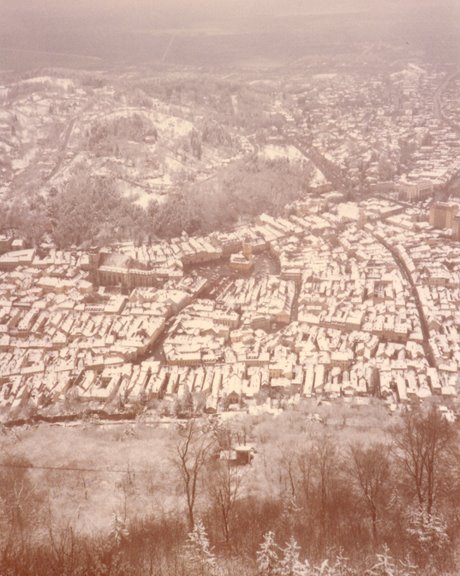
Photo: Fresh snow on the town square of old Braşov, viewed from Mt. Tâmpa, 29 April 1984. The Council House is in the plaza, with the Black Church to its left.

Leave a comment

Filed under Romania

San Juan Capistrano, Defender of Belgrade, 1456

Saint John of Capistrano … was an extraordinary survivor of an earlier period of Medieval crusading (the likes of which was not seen again in Europe until the siege of Vienna in 1683). John of Capistrano, whose imposing bust still adorns the main facade of Saint Stephen’s Dom in Vienna, certainly looked the part of a Peter the Hermit, the crusading leader of the eleventh century. Small of stature, with an emaciated frame, hollow cheeks, deep-set eyes, and parched skin, he had the countenance and stature of a mystic as he gathered the faithful around him in the city of Györ in Hungary and preached the crusade to the common man in Latin. No one understood his exact words, but the tone of the message was unmistakable as he thundered: “God wills it that we chase the Turks out of Europe and for whosoever follows me, I will obtain plenary indulgence for him and his family.” It was more a matter of heart than rational thinking that induced a ragtag army of some 8,000 inexperienced and poorly equipped peasants, lower burghers, students, and clergymen to follow John on his southeastward march. They had gathered all the crude weapons they could assemble: slings, cudgels, scythes, pitchforks, stakes, and other farm implements. It was, however, their determination and fanaticism that proved more than a match for the holy war proclaimed by the sultan and the tried military talent of the Turks and janissaries. The generals and the diplomats who attended John’s demagogic harangue at Györ — Hunyadi, his son László, János Vitéz, Vlad Dracula, even Pope Calixtus III‘s legate, Juan Cardinal de Carvajal — were not impressed by what they regarded as a “mob.” In the end, though, these leaders found they had underestimated the power of faith to move men.

At a meeting summoned by Hunyadi at Hunedoara on January 13, 1456 [three years after the fall of Constantinople], basic strategies for the impending campaign were laid out and assignments to the military leaders given with little reference to John of Capistrano’s crusaders, who worked essentially as an independent force. Dracula, with an army composed mostly of Romanian mercenaries, was instructed by Hunyadi to stay at Sibiu and watch the Transylvanian passes. In addition, his young protégé was given to understand that he could proceed with the offensive against Vladislav II at whatever time he would deem appropriate, thus to relieve pressure at Belgrade by compelling the Turks to keep a body of troops on the Danube. In essence, Dracula’s mission was part of the overall strategy in protecting the eastern flank of the Belgrade defensive operation. In turn, Dracula’s cousin Stephen of Moldavia, also in Hunyadi’s entourage, was waiting for an opportunity to overthrow the other Turkish vassal, Petru III Aaron. By June 1456, in the words of the historian János Thuróczi “as the grain began to ripen, a vast army, accompanied by 300 siege guns and 27 enormous cannons, followed by the fleet on the Danube, moved northward, capturing on the way a number of Serbian cities that had maintained a precarious autonomy under Turkish rule. Hunyadi sent the customary diplomatic appeals to the west by means of his intermediary János Vitéz; as usual, there was no response.

The greatest achievement of John Hunyadi and John of Capistrano, unlikely allies that they were, was breaking through the ring of Turkish land forces, as well as the chains of Turkish flotillas that blocked access to the city, to effect a juncture with the city’s defenders. On July 21, having finally penetrated the outer defenses and moats, Mehmed gave orders for a final assault. In desperation, the sultan tried to arouse enthusiasm in his troops by joining the melée in person, only to be wounded in the thigh for his pains. Though the Turkish army had penetrated the city, it was unable to capture the fortress on the hill, defended by 16,000 men evenly divided between John of Capistrano’s crusaders and Hunyadi’s professionals. For Mehmed, who lost as many as 24,000 of his best soldiers and whose sailors colored the blue Danube red, it was a disastrous defeat. The relief of Belgrade was described as a “miracle” by Bernhard von Kraiburg, chancellor of the archbishop of Salzburg, in which “8,000 simple people” had defeated a vastly overwhelming Turkish force. In retreating toward Sofia, the ailing sultan was so angry that he wounded a number of his generals with his own sword and later had them executed. When the successful defense of Belgrade was reported to Rome, Eugenius IV called it “the happiest event of my life”; believing that a miracle had truly occurred, the pope made preparations for the beatification of John of Capistrano.

SOURCE: Dracula, Prince of Many Faces: His Life and His Times, by Radu R. Florescu and Raymond T. McNally (Back Bay, 1989), pp. 79-80

Before the year was out, Hunyadi, Capistrano, and many others had died of the plague. (Photo, October 1984: The bottom panel on the painted monastery at Moldoviţa in Suceava County, Romania, depicts a Byzantine victory at Constantinople. It must date from 1453 or earlier.)

Leave a comment

Filed under Romania

Missionary POWs of the Japanese, 1940s

On Monday, December 8, [Max] Garrott was riding a local train to the home of Northern Baptist missionary William Axling when he learned that war had erupted between Japan and the United States. He saw the shocking headlines on a newspaper that a fellow passenger was reading. The next morning Garrott was interned (“for your own protection,” the police told him) at Sumire Girls’ School, a Catholic school and orphanage in Den’enchofu, Tokyo. He was assigned to a room with 12 other American men, a room barely large enough for the cots and beds wedged into it. “Safe, well, profitably interned,” wrote Max to [his wife] Dorothy through the good offices of the Swiss Red Cross. Though some missionaries were tortured by police interrogators during those early months of the war, Max was not mistreated. He even had the use of his piano, which kind officials had transported from his house to the school. They also had brought a picture of his wife. Since the internees were allowed to buy food in addition to what was served them by the authorities, and some talented cooks were among them, Max soon gained back the 10 pounds he had lost doing his own cooking after Dorothy’s departure. The next spring he and his fellow Americans had strawberry shortcake “running out of their ears.”

Humanitarian treatment was also the lot of Floryne Miller in Shanghai, who though an enemy alien was allowed to continue her teaching until February 1943. “Wouldn’t it be fun,” she wrote to her family in January 1942, “if this should get to you one of these days.” The letter was delivered. In 1943, while awaiting repatriation, she spent seven months in Chapel Civil Assembly Center, an internment camp outside Shanghai. “Everyone is so good to us,” she reported through the Red Cross. Words to the contrary would have been ill-advised, of course.

Far less fortunate were those who had transferred to the South China Mission. Oz Quick was in Hong Kong when the city fell to the Japanese on Christmas Day, 1941. He had gone there for medical treatment after falling ill with appendicitis at Kweilin. Quick was committed to Stanley Prison with about 300 Americans, including four other Southern Baptist missionaries and [Mission] Secretary Rankin. They had no furniture or furnishings of any kind, and food was so scarce that Rankin, already trim, lost 30 pounds during the half-year’s confinement.

The Robert Dyers were among eight Southern Baptist missionaries interned in the Philippines with about 500 American and British civilians. One of the eight was Rufus Gray, who was judged a spy because he had taken many pictures while in Peking (photography was his hobby) and had made friends among the Chinese. He died under torture by a Japanese intelligence unit. Bob Dyer was taken twice to the “house of horror” for interrogation, an ordeal that has haunted him ever since. As orderly to the sick in the camp’s makeshift hospital and undertaker to those who succumbed to malnutrition and disease, Bob lived with the specter of death day after day. Mary Dyer helped to boost the morale of the living with her magnificent renderings of hymns, wedding songs, and “God Bless America.” In 1944 the internees were transferred to Manila’s infamous Bilibid Prison, from which they were liberated by American forces in February 1945. Most were on the verge of starvation. After returning to the United States the Dyers resigned from the Board. Bob taught religion at Wake Forest University until his retirement in 1983, and Mary gave private voice and piano lessons.

In June 1942 Max Garrott was put aboard the SS Asama Maru for repatriation to his homeland in the first of two prisoner exchanges arranged through the medium of the Swiss government. The ship left Yokohama with about 430 passengers, mostly notably U.S. ambassador Joseph P. Grew and Mrs. Grew (she had refused evacuation with other dependents). At Hong Kong it picked up 370 more Americans, including Oz Quick and Theron Rankin. The exchange ship had large crosses painted bow and stern for identification, but because of a large Japanese flag painted in the center, the vessel was nearly torpedoed by an American submarine when off course.

After a second stop at Saigon, the Asama Maru proceeded to Singapore for a rendezvous with the Conte Verde, an Italian ship under Japanese control that carried 600 passengers from Shanghai. The two ships steamed to the Portuguese port of Lourenço Marques in Mozambique, where 1,500 Japanese from the United States were waiting aboard the SS Gripsholm, a Swedish vessel leased for this trip by the American Export Line. The Japanese exchanged ships by marching from bow to bow, while the Americans moved from stern to stern. Among the 1,500 Americans, just under 600 were missionaries and their families. Forty of the missionaries were Southern Baptists, 39 from China and one–Garrott–from Japan. One of the China missionaries, Pearl Todd, later served in Japan.

The trip from Japan to America took 10 weeks, half of them on the Gripsholm. The fixed price per person was $575, regardless of what accommodations one had. This made for some irritation on the overcrowded Gripsholm, but all were delighted with the sumptuous American meals, showers, fresh sheets, recent news from the homeland, and the delicious atmosphere of freedom.

After one stop en route, at Rio de Janeiro, the Gripsholm reached New York on August 25, 1942. Passengers without diplomatic status had to be screened for loyalty to the United States, a process that took several days. Three intelligence officers–from the FBI, Army, and Navy–examined each passenger, using dossiers prepared from earlier inquiries made of family members and acquaintances. Garrott met with difficulty because of his conviction that he could not take part in the war effort. He endured several hours of interrogation before he was permitted to go ashore.

SOURCE: The Southern Baptist Mission in Japan, 1889-1989, by F. Calvin Parker (University Press of America, 1991), pp. 165-167

2 Comments

Filed under China, Japan

The Real Dracula’s Contemporaries

The real Dracula, who ruled the territories that now constitute Romania, was born in 1431, the year that Joan of Arc was burned as a witch at the stake in Rouen, France. He died in 1476, two years before Spain was united as a kingdom under the rule of Isabella of Castile and Ferdinand of Aragon. He was very much the by-product of the Europe of his day — the Renaissance, essentially a period of transition….

It was in the age of Dracula that the notion was introduced of Balkan crusading, the efforts of the lands on the fringes of the Ottoman conquest, the borderlands of Europe, to resist the power of Islam in the name of the cross. It represented a struggle in defense of Europe quite as significant as the Spanish resistance to the Moors, which had preceded it….

One of the more tragic aspects of the Turkish onslaught on Europe was the western powers’ reluctance to defend the frontiers of their culture in eastern Europe. This extraordinary failure of moral fortitude was not intelligible in the fifteenth century, since French ruling families had originally consolidated the Polish and Hungarian states; Venetians, Pisans, Genoese, and Spaniards ruled in the eastern Mediterranean and Aegean seas; and countless western adventurers occupied a string of threatened colonies along the disputed eastern coast and on the islands near what are now Yugoslavia and Greece.

The pretexts for the fifteenth-century failure of the west to respond to successive crusading appeals were no different from those that had awakened such deep emotional response during the heyday of the crusades, in the age of faith. Charles VII, king of France, the oldest daughter of the Catholic church and foremost crusading power, had just emerged from one of the most crucial conflicts in his country’s history, the Hundred Years’ War. He and his soon-to-be successor, Louis XI, “the Spider King,” who had a predilection for hanging young boys from the branches of trees and placing his enemies in cages to consolidate royal power, had just liberated their country from the English. The French kings were also busy fighting the dukes of Burgundy for supremacy in the French state. The semiroyal dukes of Burgundy were in fact the only rulers within the actual territories of what is now France who for a time remained true to the crusading tradition. Their generous participation in Dracula’s father‘s crusade in 1446 atoned somewhat for the ineffectiveness of their cousins in Paris.

England was to be no more closely drawn than France into fighting the Muslims; the traditions of Richard the Lionhearted were entirely forgotten. Two rival families there were locked in a desperate struggle for survival, the Wars of the Roses (1455–1485). (The white rose was the symbol of the followers of the Duke of York and the red rose represented the House of Lancaster.) This last of England’s feudal wars dragged on throughout Dracula’s lifetime. The only Englishmen connected in any way to our plot were individual soldiers of fortune who enrolled as volunteers in various crusading armies. (One of these veterans, John Tiptoft, Earl of Worcester, later used the impalement technique that he had learned in eastern Europe to kill his Lancastrian enemies. He was executed for his crimes.) …

Of the lands of the future Kingdom of Spain, only Aragon faces eastward. In particular, the Catalans of Barcelona, an important Mediterranean port, were concerned by the Turkish menace, because it threatened ancient commercial routes and their appetite for eastern expansion. Even before Dracula’s time, an effective group of military adventurers had been formed, the famous Catalan Company, to defend the Byzantine emperors against all their enemies, though in effect the Catalans fought for themselves. The Aragonese wished, through Balkan crusading, to forge commercial and political contacts with the Aegean, the Adriatic, and the Black Sea. The ambitions of the Aragonese king, Alfonso V, are best exemplified by the decision of his bastard son Ferrante to make Naples — closer to the eastern theater of war — the center of his power. Ferrante managed to perpetuate his rule through the use of terror: having killed most of his political opponents, he had his victims mummified and placed in the royal museum, where they were shown to his guests.

Fifteenth-century Italy was the headquarters of the Renaissance. Although Niccolo Machiavelli was not born until 1469, the amoral principles he would set out in The Prince (1517) were being applied well ahead of publication. There was certainly little evidence then of Italian patriotism among the warring republics and city-states of northern Italy, and less evidence of crusading spirit, though the straits of Otranto, at the heel of the peninsula, separate Italy from the Balkans by only some thirty miles….

It was the pontificate (1458–1464) of Enea Silvio de’ Piccolomini, the future Pope Pius II, that most closely coincided with Dracula’s reign. Piccolomini began his career as a libertine not devoid of literary talent and changed his ways only when he became a priest in 1446. He was enough of a medievalist to understand the threat inherent in the Ottoman expansion. From 1459 onward the Pope repeatedly appealed to the Christian powers to join in a common crusade, and he raised the monies to subsidize such a concerted movement. Indeed, Pius II, although a “Europeanist,” saw the Ottoman menace not merely as a danger for eastern Europe but for Christianity itself. Dracula alone responded to his call.

SOURCE: Dracula, Prince of Many Faces: His Life and His Times, by Radu R. Florescu and Raymond T. McNally (Back Bay, 1989), pp. 13, 15, 20-21, 23-24

UPDATE: This book is certainly filling in a lot of gaps in my heretofore rather superficial Draculalogy, as well as my understanding of Romanian medieval history more generally. Although I had encountered during my Fulbright year there in 1983-84 many of the famous names in Romanian history—like Ştefan cel Mare, Mircea cel Bătrân, Vlad Dracul, and Dracula—I had not realized that Mircea the Elder (1386-1418), Vlad Dracul (r. 1436-1442), and Vlad Dracula (r. 1448, 1456-1462, 1476) were Father, Son, and the Unholy Impaler; nor that Vlad Dracul acquired his epithet from being named to the crusading Order of the Dragon (not Devil) by the Holy Roman Emperor, in whose court at Nuremberg he served as page; nor that Vlad the Impaler impaled almost as many Transylvanian Germans as he did Turks; nor that the Impaler may have been born in Sighişoara (pictured above, from our visit in 1984), but held court at Târgovişte, on the Wallachian side of the Carpathians and upriver from Bucharest.

Leave a comment

Filed under Romania, Spain