Category Archives: U.S.

Wordcatcher Tales: Huarachudo, Ejido, Municipio, Piloncillo

From True Tales from Another Mexico: The Lynch Mob, the Popsicle Kings, Chalino, and the Bronx, by Sam Quinones (U. New Mexico Press, 2001), pp. 206-210:

The municipio of Turicato [in the State of Michoacán] has always divided along these town-rural lines. The hill folks resented the power, money, and education, relatively speaking, of the people in town. The city folk feared the hillbillies but saw no reason to extend power, or municipal services, to people they considered ignorant and barbaric. In these years the Barajas family—a family of local merchants—dominated Turicato politics….

In this atmosphere “Los Villa,” as the Villaseñor family was known, emerged first as rebels. They took up the cause of the “huarachudos,” the “sandal wearers”—whom they rallied to their cause against the city folk…. The Villaseñores were huarachudos themselves. They were sixteen children whose father, Tomás, had been born a peon on the hacienda San Rafael. In the 1930s President Lázaro Cárdenas ordered a section of the hacienda transformed into a communal farm—an ejido—owned by those who had worked it as peons….

The Villaseñor piloncillo operation also grew. Piloncillo is a small cone of brown sugar about an inch in diameter, processed by a simple mill. It is used to sweeten coffee, in household cooking, or by the soft-drink industry. In the 1990s, piloncillo has all but vanished as a product from the Turicato region. But in the 1970s and 1980s, many sugar cane growers were producing piloncillo. In the Turicato region in the 1970s and 1980s, owning a piloncillo mill was the difference between a life of comfort and one of hopeless poverty….

The emergence of a hillbilly family brought with it the kind of abuses that town residents had feared all along. “What happens is they form into groups,” says Trigo. “There’s one who’s a leader, and around him form people who like to fight and look for trouble. They like to walk into a cantina and throw everybody out. They figure that’s a real achievement. This grows; the group gets larger. Then it becomes, ‘Let’s take over this land.’”…

Yet the Villaseñor family never did fully dominate local politics. They proved in the end to be poor politicians. Their frequent warring—“their bellicose nature” as one man put it—earned them many enemies. By 1989 a significant part of the municipio nurtured in dark silence a pure and vital hatred of the Villaseñores, and among them were many of the same poor peasants—the huarachudos—that the family once rallied to its side….

In 1994 the military put a roadblock between Turicato and Puruarán and set about arresting or killing off the bandit gangs. Others saw that the military meant business and laid down their guns. So five years after the Nueva Jerusalén vote threw Turicato into a civil war, a version of peace came to the municipio.

The chapter from which these excerpts come is a well-told tale, but one sadly familiar in its broad outlines: ambitious évolués (sponsored by distant elites, in this case the PRI) lead others among the oppressed to overthrow and replace an oppressive elite, only to impose a new kind of thugocracy at least as violent and oppressive as the old one. Sort of a Zimbabwe in microcosm. (Zimbabwe, whose independence I long ago celebrated at a big gathering of African students in Honolulu.)

But I want to comment on just two of the four words italicized in the extract.

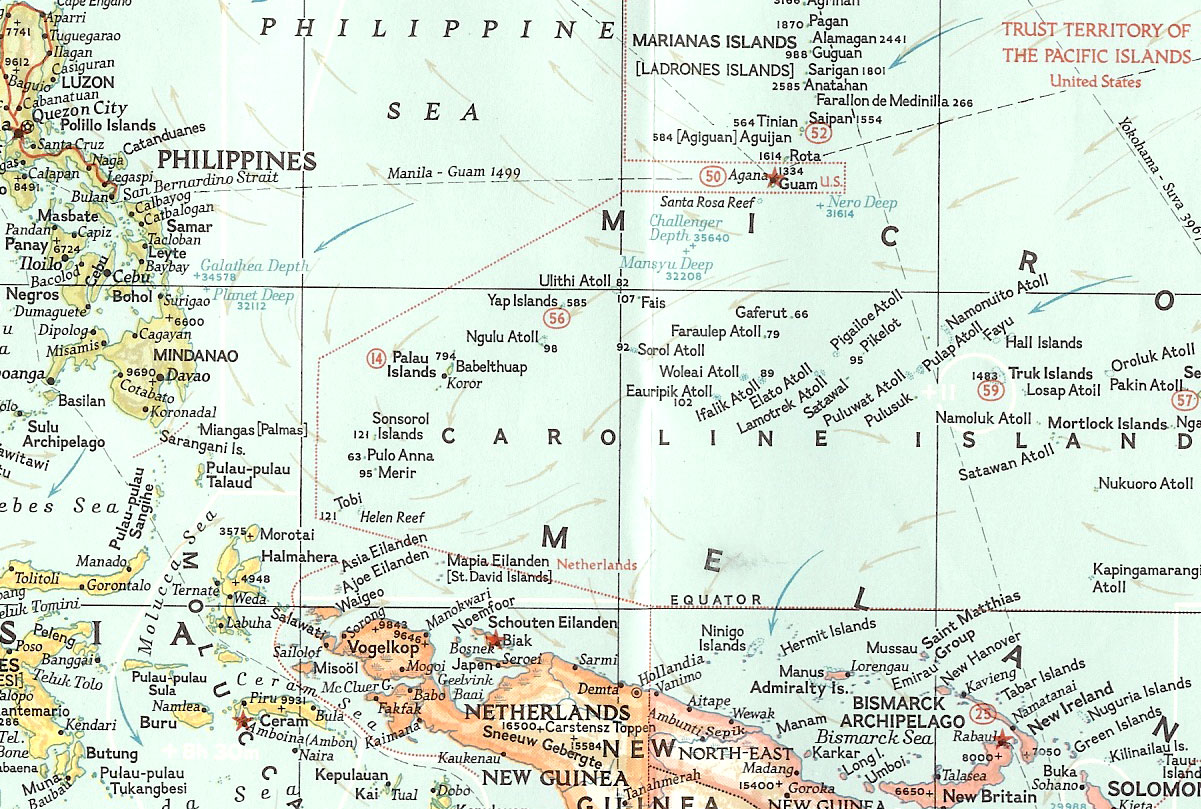
The Spanish term municipio may have survived in the form of an English calque more than a century after the Spanish ceded Micronesia to the Germans. Each of the Federated States (formerly Districts) of Micronesia is divided into what are now called municipalities, a term that no subsequent German, Japanese, or American administrator would likely have come up with, although the Americans are credited with introducing the term by the anthropologist Lingenfelter, who worked in Yap during the early postwar years. If so, U.S. Navy administrators probably calqued on the basis of usage in the Philippines. Micronesian municipalities have never been centered around a town and its hinterland. Instead, they seem to be more like alliances of contiguous villages.

I’m old enough to have purchased a pair of Mexican huarache sandals in the 1970s, when I was a grad student in Hawai‘i. The dye made my feet break out, so I stayed with rubber slippers (zori). (I hardly owned a pair of shoes all through grad school.) The relation between Spanish huarache ‘sandal’ and huarachudo ‘sandaled’ is parallel to that between English beard and bearded. Spanish and English are both related languages. But the same parallel can be observed between, for example, Chamorro sapatos ‘shoes’ (from Spanish) and sinapatos ‘shod, wearing shoes’, or Chamorro relós ‘wristwatch’ (also from Spanish) and rinelós ‘wearing a wristwatch’. Among its myriad functions, the -in- infix in Philippine languages can form adjectives out of nouns in a manner similar to that of participial affixes in Spanish and English.

UPDATE: The Micronesian Seminar‘s Francis X. Hezel, S.J., weighs in on the antecedents of the term municipality in Micronesia.

The term as used in Micronesia after the war has no direct relationship to the Spanish colonial period in these islands. The Spanish weren’t here long enough and they weren’t influential enough to have the term stick. There are very few Spanish loan words that have made their way into the island languages. Actually, islanders used the Japanese term kumi to describe a segment of the island, even well after the war. Muncipality came into the languages through the English term, via the Navy.

The usage of Japanese kumi ‘club, association, gang’ is very interesting, and seems a much more appropriate term for the traditional political alliances before they were recast by the U.S. Navy as local-government structures. The Yapese dictionary translates municipality into Yapese nuug ‘net’ (presumably meaning ‘network’ of political alliances). Other Micronesian dictionaries I’ve consulted don’t list municipality in the English finder list. So it seems U.S. Navy administrators were influenced by Spanish local-government terminology already long-established in the Philippines.

The U.S. Census Bureau glossary does not list the term municipality at all, but it does list and gloss municipio as: “Primary legal divisions of Puerto Rico. These are treated as county equivalents.” The Wikipedia entry for Municipalities of the Philippines begins thus: “A municipality (bayan, sometimes munisipyo, in Tagalog) is a local government unit in the Philippines. Municipalities are also called towns (which is actually a better translation of bayan).”

SHARP DETOUR: My wife and I taught University of Hawai‘i extension courses on Yap, Micronesia, in the summer of 1983, just before heading off to spend a year in Romania on a Fulbright research grant. In fact, she was still there when I got the word that my nearly forgotten application from a year earlier had been approved and that the orientation in Washington, D.C., would begin before she got back to Honolulu. Trying to place a telephone call through to Yap was not easy in those days.

Anyway, for my introductory linguistics course on Yap I used the first edition of Peter Trudgill’s little Penguin paperback Sociolinguistics: An Introduction to Language and Society. Even the main islands of Yap have a good deal of regional variation in pronunciation and word choice, and the outer islands speak dialects of the far-flung Trukic language continuum, only distantly related to Yapese. The variety of Yapese spoken in the major municipality (Rull) closest to Colonia—the capital and only urban center—provided the basis for the standard orthography, but the pilot school for testing Yapese language curriculum materials (with bilingual education funding from the U.S. DOE) was located in the major municipality (Tomil) with the most divergent pronunciation. The three major municipalities were those chiefly alliances (called kumi in Japanese) dominant at the time the Germans took control: Gagil, Tomil, and Rull.

My wife and I first met while we were both assigned to that school in the fall of 1974—she as a new Peace Corps teacher for two years, me as a visiting linguist for one semester—and we both learned our Yapese in that very rural municipality. (Mine faded much more quickly than hers.) So we were quite aware of regional variation and of the principal shibboleths of Tomil dialect, chief among them being the pronunciation of standard /ae/ as /ee/, as in the pronoun gaeg vs. geeg ‘me’ or the plural marker on verbs -gaed vs. -geed, both high-frequency items.

For my introduction to linguistics course in 1983, I decided that the most important things I should focus on were the respective relationships between writing and pronunciation, on the one hand, and between dialects and standard languages, on the other. One of my assignments was for my students to assemble a list of common words for which there were regional variants, then track down the boundaries between those variants (the isoglosses). The most interesting findings involved variants whose isoglosses failed to align with the existing boundaries between municipalities, perhaps revealing earlier linguistic and political fault lines.

1 Comment

Filed under language, Mexico, Micronesia, Philippines, U.S.

Mexico’s Fayuca Boom and Bust

From True Tales from Another Mexico: The Lynch Mob, the Popsicle Kings, Chalino, and the Bronx, by Sam Quinones (U. New Mexico Press, 2001), pp. 239-240, 242:

Fayuca. The word meant contraband, illegally imported merchandise: stereos, televisions, calculators, cameras, silk shirts, tennis shoes, blue jeans, blenders, and blouses. The government slapped this stuff with steep tariffs when imported legally as a way of protecting Mexican industry. Tepito brought it in illegally. To Tepito, fayuca meant easy money and lots of it. Despite the official prohibitions, Mexicans gorged themselves on the outside world’s baubles. Tepito was their dinner table. It was a time tailor-made for the Tepito mind-set. In the go-go era of fayuca, what mattered was not what you sold or how you brought it in but how fast it would move. The trickle of suitcases containing small items like perfume, watches, and jewelry in the mid-1970s became, by the 1980s, torrential truckloads of twenty-one-inch televisions and full home stereo systems.

To a government running a desiccated economy, it quickly became clear that the contraband did two things. First, it appeased the middle classes, who didn’t really care where they bought this stuff so long as they could buy it. Second, fayuca also helped dampen inflation. The prices in Tepito were usually well below what the same goods sold for in the stores that had legally imported them. “The authorities wanted to lower prices without really entering the global economy,” says Gustavo Esteva, a sociologist who lived in Tepito for several years during the fayuca boom. “So the government used Tepito and the fayuca to fight inflation.” Though fayuca was illegal, it was bought and sold openly in Tepito. The regime couldn’t appear to allow it in and yet didn’t dare keep it out. Eventually the industry was carved up among Tepito’s fayuqueros, commandants of customs, the judicial police, the highway police, and other government officials. After a while the highway police in San Luis Potosí, midway between Laredo and Mexico City, decided they wanted their cut too. The wife of President José López Portillo, Carmen Romano, was said to be one of the greatest fayuca importers.

The arrival of fayuca was a key moment in Mexico’s economic history. Fayuca was in its own way as important in rocking the regime’s credibility as the 1968 Tlatelolco [student] massacre, the periodic peso devaluations, and the fraud-riven elections of 1988. Its presence showed that the protected, state-run economy no longer had a prayer of providing what Mexicans now expected out of life. Though Mexicans talked economic nationalism, they voted with their feet and mobbed Tepito, looking for the smuggled imports.

And for the first time Tepito got rich. In Tepito the fayuquero took the place of the boxer as the model for economic advancement, though in this case the road to riches was accessible to thousands of people and few of them missed the turnoff Since the fayuca, Tepito has produced no great boxers. Instead Tepito’s fayuqueros took on the status of legendary renegades; at least two B movies were made about them….

Mexico’s entry into GATT, then NAFTA, brought the fayuca boom to an end. The Mexican government began to lower tariffs on consumer goods. Customers began finding what Tepiteros were selling in legitimate stores that offered service, guarantees, and receipts and didn’t have thugs around the corner waiting to rob the clientele. When the peso was devalued in 1994, sales plummeted further. People still go to Tepito, since merchandise is a little cheaper and carries no sales tax. But the fayuca gold rush is a memory.

1 Comment

Filed under economics, Mexico, nationalism, U.S.

The Oaxaca Diaspora’s Protestant Ethic

My rule of thumb is to try to blog no more than about a page per chapter (depending on the lengths of the chapters) from the books I buy and read, but the following excerpt is from my favorite chapter so far in a book where I can hardly resist “reading aloud” every few pages. I was undecided about which of three thematic passages to cite: on Mexico’s Okies (the victim angle), Oaxacan self-help (the agency angle), or religion (the spiritual angle). I ended up concatenating two of the three. So I’ll have to do hard penance by biting my tongue through several other chapters. From True Tales from Another Mexico: The Lynch Mob, the Popsicle Kings, Chalino, and the Bronx, by Sam Quinones (U. New Mexico Press, 2001), pp. 102-103, 110-111:

Mexicans generally view the border and those who live there as only semi-Mexican—too close to the gringo, where too many of his ways are imitated. In truth, that is what shaped the [San Quintín] valley. With drip irrigation farmers saw the potential of growing for both the United States and Mexico and dropped subsistence farming for a very American capitalist ethic. Acres under cultivation went from two thousand in 1980 to almost twenty thousand in 1990. Nighttime electricity came to San Quintín. Then a few stores, a couple of motels, a movie theater, satellite television.

“I have uncles in the state of Zacatecas who grow chile,” says Ruiz Esparza, “They harvest the crop, but only apart of the profits goes back into the fields. They’re afraid of risking it all. Here, it seems they’re a little crazy. They risk it all every year. People here aren’t interested in having money in their wallet. Everything they have goes back into the fields.

“I look at the farmers of Oceanside, Bakersfield, Oxnard battling against the city, high water prices, taxes, and I see them keep going. They’re very brave. I think having those people before us as examples inspires us to do the same. If they can do it, why can’t we?”

From the north, San Quintín had its market, and from there it imported machinery, capital, and an entrepreneurial spirit. What the valley of San Quintín had never had was abundant labor. And that came from the south.

The Dust Bowl in all this became the states of Guerrero and, above all, Oaxaca, both states with enormous Indian populations who retain the customs and languages of their ancestors. Like the northerners with whom they now live, they are considered somewhat less than Mexican, disdained as “dirty Indians.” It was a strange yet perhaps appropriate pairing: two outcasts coming together to create something in the dust of the northern Mexico desert.

Agriculture in Oaxaca, like that in Oklahoma during the Depression, is a limp and stagnant thing. Inefficient farming and the division of land into ever smaller slivers have bequeathed the state a withering poverty, bloody feuds over land ownership, and generations of uneducated children. Hundreds of thousands of Oaxacan Indians—Mixtecos primarily, but also Triquis and Zapotecos—have been leaving home for four decades now. They are Mexico’s migrants, the cheapest labor in a cheap-labor country. “They provided labor that was easily exploited,” said Victor Clark Alfaro, director of the Binational Human Rights Center in Tijuana. “They were docile, didn’t speak Spanish, would accept almost any treatment and work hard.”…

But in Tijuana, migrant Indians also discovered San Quintín’s almost unquenchable thirst for cheap labor. Through the late 1970s and 1980s the valley evolved into a major stop on the Indians’ migrant trail, part of what came to be known informally as “Oaxacalifornia”—the diaspora that starts in San Quintín and runs through North San Diego County and up the state. Entire families came to the valley to live in labor camps designed for transient men. The camps teemed, and the work was tough in the hot sun and choking dust. But it was work, which was something Indians had never had in Oaxaca….

Indians transformed their new home when they came here to live. But just as profoundly, their new home changed them. And the clearest distillation of all those changes is the Protestant Church. “If you take a poll, you’ll find that 80 or 85 percent of those who are established here now are Protestant,” says Meza. That number might be high. But Protestant churches—especially of the more fundamentalist bent—proliferate in the valley. Indians here have become Baptists, Jehovah’s Witnesses, Pentecostals, and scads of obscure denominations to which Luther’s Reformation gave rise. The new churches are symbols of economic success, of modernity, of the monumental power and attraction of the United States. The adoption of a Protestant faith is almost standard issue in leaving Oaxaca for a future.

And that process is best told by one man who, now in his late forties, stands clapping in unison with the rest of the Apostolic Assembly of the Faith in Christ Jesus. Twenty years ago Luis Guerrero took his family and left his Oaxacan Indian pueblo and its traditions, moved to the valley of San Quintín, and hasn’t yet looked back in fondness.

Guerrero, a Mixtec Indian who speaks halting Spanish in a thick Indian accent, faced a brutish dead-end life as a subsistence farmer, depending on unpredictable rains, in the village of Santa María Asuncion, where landholdings were no longer measured in acres but in meters.

In 1972 Guerrero was among fifteen people who had to pay for the village’s traditional party for its patron saint, the Virgin of Asuncion. It was the custom: every year a few people had to become deeply impoverished to throw the three-day party for everyone else. His job was daunting: he had to give 2,000 pesos—the equivalent of two and a half years’ local wages at the time—to buy food and alcohol for everyone, fireworks, candles, and more. The responsibility almost broke him. He borrowed the money at high interest rates, then left his young family and pueblo for that year to pick tomatoes in Sinaloa to pay it back.

In 1974 he began migrating to San Quintín with his family. Finally in 1978 they moved here to live, leaving Oaxaca forever.

Away from the cloistered atmosphere of his Oaxacan village, Luis Guerrero began a religious and secular awakening, one he likes to illustrate by talking about the books he bought.

In San Quintín he bought his first book ever—a Bible. In Oaxaca he had never read a Bible; though the whole village was Catholic, no one owned one. Like everyone else, he depended on a priest to know what it said. “I began reading it and I began to awaken my mind…. I like knowing myself: I went to the Catholic Church, the Apostolic Church, Prince of Peace, Los Olivares, Jehovah’s Witnesses, the Open Door—to see how each denomination preached.” He finally settled on the Apostolic Assembly.

Now thirsting for more, he bought his second book—a copy of the Mexican constitution. “In our pueblos in Oaxaca, we didn’t know the earthly law, or how to defend ourselves [legally]. Also we didn’t know spiritual law. So I searched on my own to discover what constitutional law said. I searched on my own to discover what the Bible said so that I myself could understand earthly law and spiritual law.

“Earthly law allows you to speak up for your rights with the police, the bosses. That’s why I put forth an effort to learn it. [In the villages] people don’t have education. The [local] authorities pressure them to fulfill tradition. They want them to put on traditional parties. [In Oaxaca] you can’t give your children education because the little money you earn you have to spend on parties for the saints. Our children have no shoes because of tradition. We came here to leave all that behind.”

3 Comments

Filed under economics, Mexico, migration, religion, U.S.

Authentic Mexican American Narcocorrido Polka

From True Tales from Another Mexico: The Lynch Mob, the Popsicle Kings, Chalino, and the Bronx, by Sam Quinones (U. New Mexico Press, 2001), pp. 11-12:

His name was Chalino Sánchez. His singing career lasted just four years and he was killed when he was only thirty-one, yet he’s one of the most influential musical figures to emerge from Los Angeles or from Mexican music in decades. “When we were small, we always wanted to fit in, so we’d listen to rap. The other kids were all listening to rap, so I guess we felt that if we listened to Spanish music, we’d be beaners or something,” says Rodriguez. “But after Chalino died, everybody started listening to corridos. People want to feel more Mexican.”Six years after his death, Chalino Sanchez is a legend, an authentic folk hero. L.A.’s Mexican music scene and Mexican youth style were one way before Chalino Sanchez. They were another after him. After Chalino, guys whose second language was an English-accented Spanish could pump tuba- and accordion-based polkas out their car stereos at maximum volume and pretty girls would think they were cool.

Chalino renewed the Mexican corrido. In the Mexican badlands, where the barrel of a gun makes the law, for generations dating back to the mid-1800s the corrido recounted the worst, best, and bloodiest exploits of men. Corridos were the newspaper for an illiterate people in the days before telephones and television. Corrido heroes were revolutionaries and bandits—people who had done something worth singing about.

In Chalino’s hands, the corrido came to reflect the modern world. The corrido became the narcocorrido, the Mexican equivalent of gangster rap, with themes of drugs, violence, and police perfidy and an abiding admiration for the exploits of drug smugglers. And because of Chalino, Los Angeles, an American city, is now a center of redefinition for the most Mexican of musical idioms. Chalino democratized the genre, made it modern and American, and opened it to the masses. In Los Angeles almost anyone can have a corrido about him written, recorded, and sold. “In L.A., without exaggeration, 50 percent of the [Mexican] music that’s recorded here is based on the legacy he left,” says Angel Parra, the engineer who recorded most of his albums.

It boiled down to this, in the words of Abel Orozco, owner of El Parral nightclub in South Gate: “Chalino changed everything.”

Ever since I saw his interview with Ray Suarez on the NewsHour, I thought Quinones might turn into my new favorite writer on Mexican–American relations. My wife is reading his latest book, and I’m reading his earlier one, both of us enthusiastically.

Leave a comment

Filed under drugs, Mexico, music, U.S.

The Guilty Pride of Our Betters

From Our Kind of People: Inside America’s Black Upper Class, by Lawrence Otis Graham (Harper, 2000), pp. 8-9, 18:

One of my first encounters with an early pioneering family in the black upper class was meeting members of the aristocratic Syphax family from Virginia. I had grown up hearing my father tell me about their family history, as one of his father’s business associates had known several family members. Talking to Evelyn Reid Syphax at a Links meeting that my mother had brought me to, I learned one way in which some black families—including her own—gained wealth and a place among the upper class. “My family had owned fifteen acres of the land where the Arlington National Cemetery now sits,” Syphax explained as she recounted the history of her family, which can be traced back to Maria Custis, the mulatto child of First Lady Martha Washington’s grandson, George Washington Parke Custis, who owned the mansion that sits on the cemetery today. “Custis fathered Maria with Ariana Carter, one of his female house slaves,” explained Syphax, a well-to-do, retired real estate broker who lives in Virginia, “and when Maria asked her father, who was also still her owner, for permission to marry Charles Syphax, a black slave who worked for her father, he released both from slavery, gave her a wedding in the mansion, and offered her and her new husband fifteen acres of the Arlington estate. That mansion and the surrounding property—minus Maria Syphax’s fifteen acres—was later given by Custis to his white daughter, Mary Custis, who eventually married Confederate soldier Robert E. Lee—thus making the house a famous building in the southern state.”…

One can find both pride and guilt among the black elite. A pride in black accomplishment that is inexorably tied to a lingering resentment about our past as poor, enslaved blacks and our past and current treatment by whites. On one level, there are those of us who understand our obligation to work toward equality for all and to use our success in order to assist those blacks who are less advantaged. But on another level, there are those of us who buy into the theories of superiority, and who feel embarrassed by our less accomplished black brethren. These self-conscious individuals are resentful of any quality or characteristic that associates them with that which seems ordinary. We’ve got some of the best-educated, most accomplished, and most talented people in the black community—but at the same time, we have some of the most hidebound and smug. And adding even further to the mix are those of us who feel we need to apologize to the rest of the black world for our success and for being who we are. For me, the black upper class has always been a study of contrasts.

I think the same is true of every type of elite in these normatively egalitarian times. Among fellow members of your elite, you perform rituals of solidarity that distinguish you from your inferiors–gratuitous political swipes being among the most common solidarity rituals on college campuses (or in news rooms, apparently) where everyone who matters can be assumed to be of like mind. Those who are more sensitive take care to repress those same ritual behaviors when face to face with their inferiors–most especially when seeking votes or funding from those less like-minded.

My wife and I were witness to many impressive rituals of elite solidarity over last Memorial Day weekend when we attended graduation events at Yale–where the ritual of playing Elgar’s Pomp and Circumstance at graduations began at Woolsey Hall in 1905. We had both graduated from little no-name colleges in North Dakota and Hawai‘i, respectively, before completing graduate degrees at a cheap, run-of-the-mill state university (Hawai‘i).

Our first event that Saturday was a Phi Beta Kappa induction ceremony in Battell Chapel. Before it began, the mistress of ceremonies came down the aisle chatting up the audience of parents and friends of the inductees. When she found my wife and me with our noses in books, she exclaimed how you could be sure that Phi Beta Kappa parents were avid readers. She asked me what I was reading, and I showed her the cover of Lawrence Graham’s Our Kind of People: Inside America’s Black Upper Class. That stopped her cold, and she quickly moved on to my wife, who was evaluating Graham Salisbury’s juvenile novel Blue Skin of the Sea for possible use in an ESL class. That allowed our emcee to retreat into the comfort zone of noblesse oblige, expressing concern that Yale was not doing enough for some of its rising numbers of foreign students whose mastery of English was not up to earlier standards. Later in the ceremony, while explaining the not-so-secret Phi Beta Kappa handshake, she managed to adopt just the right tone of irony that allows one to perform required social rituals while purporting not to take them seriously. It was a tone we heard again and again from public speakers throughout that ritual-soaked weekend.

I had planned to begin reading Our Kind of People: Inside America’s Black Upper Class as we traveled through the South during our road trip in May—for which my Minnesota in-laws had prepared by reading up on plantations, slavery, and riverboat gamblers. But Yale was the better venue for it. In fact, it provided belated but valuable context for the tome I bought and read when our daughter matriculated there four years ago: The Emperor of Ocean Park, by Yale law professor Stephen Carter.

I acquired a measure of elitist pretentions during my four years at an international high school in Japan. That was where I eliminated the last southernisms I was aware of in my American accent. (Few Americans can guess my family heritage from my accent.) My ambitions at that time were more literary than academic, but my journalism professor at the University of Richmond—where I started college with little enthusiasm and later dropped out—told me that I wrote more like a scientist than a journalist. He had been a practicing journalist, not an academic, so I’m not sure it was intended to be a compliment.

Although Our Kind of People is a case study of the cultivation and preservation of America’s black upper class, much of it would also seem to apply to the care and maintenance of exclusivity among other types of elites. His final chapter on light-skinned blacks who “pass” as whites is particularly poignant, especially his tales of those who chose to abandon their relatives and engineer their own equivalent of a witness-protection program—and pray like hell their kids don’t turn out too dark.

As a “no-accent” white of expatriate southern heritage who has spent a lot of time among academics, I think I have some sense of how blacks who “pass” episodically or by accident feel when they happen to encounter demeaning or disgusting attitudes from interlocutors who aren’t aware of their hidden heritage.

When we took our daughter to visit Carleton College in Minnesota after her junior year of high school, I overheard another family doing college visits tell about how frightened they were at the prospect of driving through Virginia to Norfolk on highways (I-95 and I-64!) that they imagined to be filled with crazed pickup-driving rednecks taking potshots at cars with northern license plates. I dearly wanted to speak up and assure them, in my best Hollywood southern accent: “Why we wouldn’t shoot y’all! The most we’d do is mebbe take out a headlight or taillight, mebbe aim for one of yo’ rear tires or yo’ Yankee license plate. But we wouldn’t shoot at people, even if they was Yankees!” But, of course, I kept my trap shut, not wanting to ruin my daughter’s chances at the college that was then at the top of our list of prospects.

2 Comments

Filed under education, U.S., Virginia

Photodude Debunks Civil War Photog Mathew Brady

Atlanta-based blogger Photodude takes Andrew Sullivan to task by debunking Mathew Brady‘s role as the photographer of the American Civil War. I’ve seen many, many Mathew Brady photographs, but never heard this angle. Did the Ken Burns documentary series on the Civil War mention this? (UPDATE: I’ve corrected the spelling of Brady’s first name except where quoting Photodude below. More on Brady here and here.)

As someone intimately familiar with both the history of photography and the Civil War, I can tell you that Matthew [sic] Brady was well known as a sour self-promoting character with far more ego than talent. Yes, he did take some famous photos during the Civil War, but he also took the work of talented photographers like Alexander Gardner, Timothy O’Sullivan, and others, and proudly presented it as his own. The quote I recall is along the lines of “that photo is so good I’m going to tell the world it’s a Matthew Brady photograph.” He was brazen about it. You might say Matthew Brady invented the concept of “work for hire.”

2 Comments

Filed under publishing, U.S., war

Polynesian Languages: Useful for American Football QBs

I don’t have much interest in American football. I grew up paying more attention to baseball and sumo. But an intriguing off-topic comment by football fan BitterOldPunk in a thread on Language Hat pointed me to a story in today’s New York Times about a remarkable quarterback on the University of Hawai‘i football team.

HONOLULU — After every home game, Colt Brennan waves to his probation officer as he leaves Aloha Stadium….

Brennan, Hawaii’s star quarterback, is on the cusp of what could be a transcendent season in his senior year. He is projected to make a run at the Heisman Trophy, and his coach insists that he will be the first quarterback selected in the N.F.L. draft. His strong right arm, combined with a soft schedule, have people around college football’s most remote program believing that Hawaii’s chances of making a Boise State-like run to a Bowl Championship Series game are, well, not remote.

Those possibilities, for the player and for the team, are even more noteworthy considering the improbable, circuitous road that Brennan, 24, took to Hawaii.

Brennan backed up Matt Leinart in high school in Southern California, went 3,000 miles to a prep school in Massachusetts and was the fourth-string quarterback at Colorado as a walk-on before being arrested and thrown off the team. He then spent spring break in a Colorado jail during a year in junior college and landed at Hawaii only because a reporter showed an assistant coach there a film of one of Brennan’s junior college receivers.

The final twists in Brennan’s rise toward stardom and redemption may be the most compelling of all, however. If not for the anonymity of being a backup, the uncertainty of chasing a scholarship and the humiliation of wearing an orange jumpsuit, he probably would not have the thrill of a Heisman chase, the allure of being a possible first-round pick or the recipient of the affection of an entire state.

“The consensus between myself and Colt’s high school coaches is that Colt is the person he is today and the quarterback he is today because of the path he took,” said Dan Morrison, Hawaii’s quarterbacks coach. “I firmly believe he is who he is today because of the road he traveled.”

It’s a fine story of personal redemption and of those who had faith in him, but the bit that got notice on Language Hat was the following.

Soon after Brennan arrived, in the summer of 2005, Morrison, the quarterbacks coach, advised him that the culture of the island valued humility and character. Having spent spring break in jail that year, Brennan hardly needed a humility check.

“I had gone through a real embarrassing time in my life,” Brennan said. “I was humiliated and I needed to go find myself somewhere else. Hawaii had that appeal to it. It was my getaway, my escape.”

So he kept his mouth shut and did his best to blend in. He took three semesters of Samoan as a way to bond with his offensive linemen, all of whom are of Polynesian descent. (Morrison beamed when telling of Brennan calling an audible in Samoan last year.)

I suspect that Brennan has also learned a bit of New Zealand Māori, because Hawai‘i is one of a growing number of American football teams that psyche themselves up (and psyche their opponents out) before games by performing Māori-style haka, first introduced into international sports by New Zealand’s famed All-Blacks.

The blog A Nice Gesture has quite a compilation of commentary and video of haka being performed by, among others, New Zealand’s Tall Blacks before a basketball game against Argentina, and a whole range of American football teams from Hawai‘i to Utah to Texas.

Leave a comment

Filed under Hawai'i, language, Polynesia, U.S.

Wordcatcher Tales: Dawasi, Kousapw, Sakau

Three words from the Micronesian language Pohnpeian (aka Ponapean) that surfaced in my background reading about the church shootings in Neosho, Missouri, tell stories of distant connections across time and space.

Dawasi – When I first heard about the Neosho church shooting, I assumed the Micronesians involved were from the Marshall Islands, because I know that many Marshallese work for Tyson Foods in nearby Springdale, Arkansas. But one key term (which I’ve italicized) in the following passage cited in a posting on the Marshallese YokweOnline network hinted that the Micronesians involved were from the state of Pohnpei, not the Marshalls. (They were actually from the outer islands of Pingelap, not the main island of Pohnpei.)

Kernel [Rehobson] owns a retail store that is a gathering place for Micronesians from dozens of miles around since he stocks his store with the type of down-home items that are so difficult to find in the US: the large plastic combs that women wear in their hair, zoris, dawasi and brushes for showers, and island-style skirts with embroidered hems.

Dawasiscrub brush’ (made of coir bristle) is the official Pohnpeian spelling for a word borrowed from Japanese before the Pacific War. The same word was borrowed by Palauans, who spell it tauas(i). In current Japanese, tawashi (束子) can refer to scouring pads made of acrylic yarn, but the bristle brush variety is such a Japanese cultural icon that tiny replicas dangle from cellphones and backpacks.

The passage above cited on YokweOnline comes from the article on Micronesians Abroad by Francis X. Hezel, S.J., and Eugenia Samuel, that I blogged about earlier. The two words italicized in the next passage from the same article tell of very different connections.

Our team intended to visit Kansas City, home of a growing Micronesian community, largely Pohnpeian, that sprang from students who attended Park College during the 1970s and 1980s. Small colleges, once well attended by Micronesian students, have frequently served as the seedbeds for migrant communities in the US, accounting in part for the seemingly odd locations of Micronesian strongholds. Kansas City is said to have been constituted a kousap by a Pohnpeian chief not long ago when he paid a visit to his compatriots who had settled in that city. He was feted with sakau—the type made from powder rather than pounded—and left a week or two later with several thousand dollars, which had been collected as tribute from Pohnpeians who are now living 8,000 miles from their own island.

Kousapw – The kousapw (sapw means ‘land’) is a Pohnpeian land unit—translated ‘section’ below—intermediate between a farmstead and a district (or “municipality”). According to Douglas Oliver’s (1988) Oceania: The Native Cultures of Australia and the Pacific Islands, p. 983:

Most sections extended from coast to island center, and consisted of from fifteen to thirty-eight farmsteads. Each section had a meeting house of its own, and was headed by an official known as a kaun or soumas, who was usually the senior male member of the section’s senior sub-clan. The section functioned mainly as an administrative subdivision of the district.

This raises several questions. (1) There seem to be many old cultural connections between chiefly high-island Polynesians (possibly from Samoa) and Pohnpei. Is it just coincidence that the kousapw in Pohnpei usually runs from seashore to mountaintop, like the ahupua‘a of Hawai‘i (and presumably other large islands in Polynesia)? (2) Which of the major districts on the island of Pohnpei was the Kansas City kousapw assigned to? (3) Does this mean we now have a third Kansas City to contend with: one in Missouri, one in Kansas, and one in Pohnpei?

Sakau – One strong indication of old Polynesian influence on Pohnpei is the cultivation and use of Piper methysticum, known in Pohnpei as sakau, in Hawaiian as ‘awa, and in Samoan as ‘ava. In fact, the Pohnpeian word sakau derives by regular sound correspondences from the earlier Polynesian article+noun combination *te kawa.

4 Comments

Filed under Japan, language, Micronesia, Polynesia, U.S.

Micronesian Emigration Rising

The Micronesian Seminar regularly publishes articles on issues facing Micronesians under a series called Micronesian Counselor. The latest in the series is on HIV/AIDS in Micronesia. In December 2006 MicSem published an article on Micronesians Abroad by Francis X. Hezel, S.J., and Eugenia Samuel. Here’s just the introduction.

Today there are over 30,000 FSM citizens and 20,000 Marshallese living in the United States and its territories. Add to that possibly another 10,000 Palauans, and you have a total of 60,000 Micronesians living away from home. These are not students, young people away for a short time, or islanders who are doing a brief stint with the military. These are people-young and old, fluent English-speakers and those who know no more than a few words of the language-who have chosen to take up residence abroad.

Emigration is not an entirely new phenomenon. Palauans have been leaving home since the late 1940s. Already in 1953, there were a hundred Palauans on Guam with their own Palau Association. As their numbers grew in subsequent years, they would meet in a Palauan bai and worship in a local language Protestant church. From the early 1970s, as hundreds of Micronesian students began heading for college in the US, thanks to the extension of the Pell Grant, emigration from Palau stepped up to about 250 a year. These were not young men and women on their way to college for a few years before returning home; they were people with a one-way ticket out. By the late 1970s, individuals from other parts of Micronesia as well were dribbling into Guam and the US with the intention of staying. The 1980 US Census recorded several hundred people from what was then coming to be known as FSM, most of them Outer Island Yapese, living in the US. These mostly educated, young people were loathe to return to their atolls where there was no wage employment, but reluctant to settle in Yap where they lacked status and land.

Then, in 1986 with the formal implementation of the Compact of Free Association in FSM and the Republic of the Marshalls, Micronesians were granted the right to live and work in the US for an unlimited period. The ensuing emigration was limited at first: the emigration from FSM was only about one percent a year, half of what it is today, and the early migrants were heavily Chuukese. The main destinations in those early years were Guam and Saipan. As both places suffered from a recession in the early 1990s and new jobs became scarce, more and more Micronesians headed for Hawaii. The migrant outflow increased sharply in the mid-1990s as the effects of the stepdown in Compact funding for FSM and RMI were felt and as the government reforms, initiated by Asian Development Bank, lopped jobs from the public sector.

Today we are witnessing an emigration comparable to those that other Pacific islands—Tonga, Samoa, the Cook Islands and Guam—have been experiencing for years. A decade or two ago, writers took delight in pointing out that the emigration population of, say, Samoans in California was half the size of its resident population, or that the Guamanians on the West Coast outnumbered those on their home island. Now Micronesia is rapidly moving in the same direction. With 2,000 FSM citizens, 1,000 Marshallese, and a couple hundred Palauans leaving home each year to live abroad, one out of every four Micronesians is now living in the US or its territories. If migration continues at this same pace, we can expect that the number of emigrants will be about half the size of the resident population just ten years from now.

1 Comment

Filed under Micronesia, U.S.

Some Micronesian Immigrant Success Stories

The article on Micronesians Abroad by Francis X. Hezel, S.J., and Eugenia Samuel, published in December 2006 on the Micronesian Seminar‘s very informative website, profiles several successful Micronesian immigrants in the various enclaves of such immigrants that the authors visited. Among those profiled was the most prominent of the recent church shooting victims in Neosho, Missouri: Kernel Rehobson. Here are some excerpts from each of the communities visited.

Hawai‘i

The Honolulu press has given considerable attention to the problem of homeless Micronesians. We found that a good many Micronesians are on welfare and quite a few have declared themselves homeless, partly because being listed as homeless gives people a leg up on finding affordable housing in a state where even the smallest unit is prohibitively expensive at market prices…. But that’s far less than half the story. Many Micronesians we talked to were angry at the “newcomers” for abusing the system and destroying the good reputation they had worked so hard to build up….

To their credit, many of the Micronesians we met were doing far better than just getting by. Serlino Harper, a young Chuukese, came to Hawaii more than ten years ago and lived with his older brother for a while before striking out on his own. His first job was as an employee at McKinley’s Car Wash. Today he is the supervisor of the car wash, which employs more than a dozen other Chuukese, and he lives in a small studio apartment with his pet cat. Xavier Fethal from Ulithi, married and with a family of six, has a good job selling medical supplies to hotels and still finds the time to play guitar in a local band and maintain a steady involvement in community activities. Bruce Musrasrik, born in Pohnpei but a resident of Honolulu for several years, manages one of the hotels in Waikiki. Then, too, there is Lubuw Falenruw, a Yapese, one of the most publicized success stories of Micronesians in Hawaii. He is owner of a computer graphics company that employs some 20 people, nets millions each year, and is famous throughout the state for its innovative displays.

Southern California

Our next stop was San Diego, where we spent more time with many of those we had met at the gathering in Pasadena. John Akapito, a Chuukese who has his master’s degree and teaches English to foreign students at National University, cut a fine figure in his suit and tie as we interviewed him in his private office on the campus. Like most other Micronesians in the San Diego area, John has close ties with the Micronesian Outreach Ministry based in Pasadena. Sabino Asor, former FSM congressman from Chuuk, is also in San Diego; he currently works in the service department of a car dealership, but aspires to getting into the real estate business before long. His spacious four-bedroom house with garage was rather typical of the homes occupied by Micronesians with large families. At the farewell party they threw for us the evening we left, we met dozens of other islanders, including the offspring of half a dozen well known Chuukese families: Masataka Mori’s daughter, Susumu Aizawa’s niece, Mitaro Dannis’ nephew, Tosiwo Nakayama’s granddaughter, and three Narruhn women, among others.

As we chatted, it became clear that the children were much more fluent in English than in their local language, even if both parents were from the same island. At nearly all the social events we attended, the parents used their own language whenever they could, while the young generation spoke English. Young people seemed to have understood the local language when they were spoken to, and they have all learned songs and hymns in an island language, but they did not feel comfortable speaking it. Acculturation happens quickly in the US mainland, much more rapidly, I suspect, than in Hawaii or Guam.

Corsicana, Texas

Corsicana, an hour’s drive from Dallas, might seem an unlikely spot for a Micronesian community, but there are about 300 islanders living there. The origins of this community date back to the late 1970s when dozens of young Micronesians were attending Navarro Community College….

One of the icons of the Corsicana community, by all accounts, is a Palauan woman by the name of Grace. Like so many others, she attended Navarro Community College and after graduation decided to stay. She is the manager of a Pizza Hut in the middle of town where she has worked for eighteen years. As part of her work, she supervises eight employees, half of whom are also Palauan. Her life has been a model of persistence in carrying out her responsibilities for her work and family. Others like her have worked their way up to the managerial level. She told us that she would hope to return home one day after her retirement, but for the present she has a good salary and a generous pension for her retirement. As much as she misses the laid-back pace of life at home, Grace plans to continue working in Corsicana as long as she can. After all, she reflects, there will always be time to enjoy the slow life in the islands after retirement.

Central Florida

This community—if it can be called that—is spread throughout an area that extends from Orlando to Tampa and Clearwater. This place differs from the other destinations we visited in that there are no senior founders of this community, “elders” who pull people together for gatherings and resolve community problems. Nearly all the Micronesians who settled in central Florida were brought out by recruiters to work at SeaWorld, Disney World, Busch Gardens, or one of the several nursing homes in the area. The community here, which is heavily Pohnpeian but with a few Mortlockese thrown into the mix, is composed mainly of young men and their starter families. We met no one who was there longer than ten years, and most have lived in central Florida for just five or six years. This group lacks the experienced leadership that has proven vital for binding together individuals in other migrant communities….

Some of the migrants have continued working in the theme parks. One young man operates the kiddie rollercoaster at SeaWorld while a Pohnpeian woman works the sky lift at Busch Gardens. Most, however, seem to hold jobs in food services, like the young lady from Pohnpei we found rolling cinnamon sticks in another part of the park. All seem to get along very well with their coworkers and enjoy the respect of their bosses.

A small Japanese restaurant called Kanpai employs seven Micronesians, one as hostess and six as chefs. When we went there for dinner one evening, we were treated to a virtuoso performance demonstrating what the Pohnpeian chefs could do with a knife, a hot grill, and bowls of vegetables and meat. The chefs came out, each in front of a grill surrounded by patrons, and did a juggling act with knives and food, as they chopped at lightning speed, swirled and twirled food on the grill faster than we could follow, and doffed their chef hats for the applause that followed their act.

Corner of Arkansas, Missouri, and Oklahoma

Neosho lies just a bit north of the Missouri-Arkansas border, no more than eighty miles from Springdale, Arkansas, the site of the large Tyson Chicken Factory and home to thousands of Marshallese immigrants. Another fifty miles west of Neosho, just across the state border, is Miami, Oklahoma, a town slightly larger than Neosho that has an island community of its own. We joined the 300 or so Micronesians to watch the baseball games and enjoy the mixed buffet, featuring island delicacies like banana pihlohlo along with such American standards as spareribs and chicken. Micronesians came from all over Missouri, some from northern Arkansas and Wichita, and even from as far away as Cincinnati and Corsicana, to attend. Most were Pohnpeians, but there were also a few Chuukese and Marshallese on hand. We were told that Cincinnati would, in turn, host the next Pohnpeian games, scheduled for September 11—a day celebrated on their home island as Liberation Day.

The person who organized the games—and who oversees most other activities that take place in Neosho—is a Pingelapese businessman by the name of Kernel Rehobson. Kernel owns a retail store that is a gathering place for Micronesians from dozens of miles around since he stocks his store with the type of down-home items that are so difficult to find in the US: the large plastic combs that women wear in their hair, zoris, dawasi and brushes for showers, and island-style skirts with embroidered hems. Kernel says that he had his troubles when he first settled in Neosho; people mistook him for a Mexican and kept asking for his papers when he tried to enroll his kids in school or gain access to any social services. He started out working for K-Mart as a warehouseman, worked his way up to manager, and later quit to begin his own business. Kernel also serves as pastor to the Pingelapese community in the church that they share with the Neosho Protestant congregation. Anyone from the islands who needs help of any sort-a social security number, a driver’s license, a job-always comes to Kernel first.

Portland, Oregon

The Willamette Valley between Portland and Salem has for at least twenty years been one of the favorite destinations of Micronesian migrants. The area represents one of the greatest concentrations of islanders anywhere in the continental US; and if the area is expanded to include the southern part of Washington and eastern Oregon, the Micronesian population probably numbers a few thousand….

In Oregon, as in other places, Protestants are able to attend Sunday services in their own language, while Catholics must assimilate into local parishes as best they can. Thus, Dio and his family attend mass at St. Lourdes with its international community, afterwards meeting Hispanics, Samoans, Asians and others over coffee and pastries. Chuukese Protestants generally meet on Sunday mornings at a large church in Aurora, an hour’s drive from Portland, where Mitaro Dannis and a few other ministers preach in Chuukese and discuss with their congregation the importance of raising funds so that they can build a church of their own.

Elsewhere in Portland Ken Henry in his late forties and Lisa Uehara in her late twenties, work for William C. Earhart Company, a business that helps administer employee benefit plans. Ken, a Pohnpeian married to an American woman, is an accountant, while Lisa, a Chuukese from Weno, is a receptionist. Lisa, her Chuukese husband and their nine children live in a very nice three-bedroom house that they own. Lisa’s sister and her family are conveniently settled right next door in a similar house of their own. Next to the children’s swings and slides in the back yard there is an earth oven that the two families use to bake pork and breadfruit on special occasions.

4 Comments

Filed under Micronesia, U.S.