Category Archives: U.S.

First English Usages of ‘Barbecue’

The latest issue of Southern Culture (vol. 13, no. 4, pp. 138-146; Project Muse subscription required) contains an article by John Shelton Reed entitled There’s a Word for It—The Origins of “Barbecue” that contains this little gem.

The earliest use of the English word that I’ve encountered comes from 1661, when Edmund Hickeringill’s Jamaica Viewed reported that animals “are slain, And their flesh forthwith Barbacu’d and eat,” but by 1689 in a play called THE Widdow Ranter OR, The HISTORY of Bacon in Virginia, “the rabble” fixing to lynch one Colonel Wellman cry, “Let’s barbicu this fat rogue.” That the word could be used casually on the stage shows that by then it must have been familiar to London audiences. (The play was written by the remarkable Aphra Behn, the first Englishwoman to be a professional writer, and “Bacon” in the title refers to the leader of Bacon’s Rebellion of 1676, not to side meat.) About the same time, the Boston Puritan Cotton Mather used the word in the same gruesome sense when he reported that several hundred Narragansetts slaughtered by New England troops in 1675 (among them women, children, and elders burned in their lodges) had been “terribly Barbikew’d.”

Leave a comment

Filed under anglosphere, Caribbean, language, U.S.

Rakes Muck Best From the Top

Chicago Tribune columnist John Kass manages to tie together three prominent scandals and special investigations.

I love baseball, and I loathe Bonds. But baseball isn’t the Oval Office and Democratic excuses for being sexually satisfied by an intern while you’re on the phone with a congressman talking about sending American troops to the Balkans. Baseball isn’t a list of names of foreign operatives that can be linked to a CIA officer outed only because the Republican Bush administration didn’t like her husband’s politics. Baseball isn’t sacred. It’s a professional sport. Bookies make a living on it.

This is what happens when we abandon the principle that no one is above the law, and exchange it for the warm comforts of partisanship. It’s something many Democrats did years ago for the Clintons. They prattled on that lying under oath was OK as long as it involved sex. It wasn’t. It was lying under oath.

It’s something many Republicans did recently for the Bush administration, saying it was OK for “Scooter” Libby to lie under oath because he wasn’t the original leaker in the Valerie Plame affair. It wasn’t OK. It was lying under oath.

So, by rights, and by their own words, or by their slick avoidance of the issue, every Democratic and Republican candidate for president should join a Save Barry Bonds news conference, a bipartisan gathering, on the steps of the U.S. Supreme Court, flanked by their eager media jesters….

Democratic and Republican candidates should stand at the Barry Bonds rally in front of a banner with a simple slogan:

“Barry Bonds was only lying about baseball.”

Okay, I see the parallels, but I would add another set: Why single out the President, among all the philanderers in public office? Why single out the Vice President’s office, among all the leakers in public office? Why single out Barry Bonds, among all the steroid users in major league baseball? Pentru că peştele se împute de la cap and rakes muck best from the top, perhaps?

Leave a comment

Filed under baseball, U.S.

Tijuana’s Cultural Evolution, 1920-2000

From Antonio’s Gun and Delfino’s Dream: True Tales of Mexican Migration, by Sam Quinones (U. New Mexico Press, 2007), pp. 171-172:

In 1920, Tijuana had been a village of eleven hundred. Eighty years later city officials could only guess the population neared two million people. There were entire neighborhoods populated by people from different Mexican states—Oaxaca, Sinaloa, Sonora, Mexico City. Yet the federal government in Mexico City kept Tijuana’s budget minuscule. So the city could neither control growth nor provide services for the newcomers. Shantytowns popped up on the ever-extending edge of town. “Cartonlandia”—Cardboardland, an awesome shantytown on the bed of the Tijuana River near the border—was almost a tourist attraction itself.

To the bureaucrats in Mexico City, and to most of Mexico, Tijuana was an ugly embarrassment, a virtually American city, and hardly Mexican at all. Government bureaucrats required extra salary to come staff federal agencies in Tijuana. In one sense, they were right. Tijuana resembled the global economy it depended on—an assault of random noises and images. “A modern-art painting” is how one Tijuanan described the city.

Yet Tijuana had a beauty that none of the country’s exquisite colonial towns possessed. Young and far from Mexico City, Tijuana was free of history and tradition. It was close to California, the wealthiest U.S. state. This created better jobs and educational opportunities in Tijuana than elsewhere in Mexico. As a crossroads, its people were open to new ideas. To Tijuana came the hardworking poor escaping the limits and decaying economies of their hometowns. Many of these folks intended to sneak into the United States; but they found lives in Tijuana and stayed.

“A more egalitarian society formed here. It’s part of what makes Baja California different,” said David Pinera, who is a professor of Tijuana history. “It was a society in the process of forming, a society in which the culture of hard work predominates and less the culture of privilege. There aren’t the closed social circles. The rich man here is someone who came from the bottom. His father didn’t give him any leg up. He was a waiter or street vendor and made it according to his own efforts.”

Thus a relatively large middle class could form. In the 1980s, banks, insurance companies, and auto dealers began to arrive to serve the middle classes. Tijuana then got its first supermarkets and shopping malls. Moreover, middle-class denizens naturally didn’t want their children exposed to strippers, shantytowns, drunk gringos, and naked-lady playing cards. They wanted music lessons, ballet, and art classes for their children. So a constituency for a more evolved city was born.

The quirky cast of characters in this chapter include:

  • Enrique Fuentes, who almost single-handedly nurtured a constituency for opera in Tijuana and who in 2001 opened an Internet cafe, El Café de la Ópera, with computers named Aida, Carmen, Madame Butterfly, and La Traviata, linked to a server named Turandot
  • Mercedes Quiñónes, who spent years in a cultural wilderness, volunteering as a choir director and supporting family as a hardware wholesaler, before finding a professional voice teacher and becoming, at age 51, Tijuana’s premier soprano when Pagliacci opened there in 2003
  • The Russian emigré musicians who during the 1990s formed Baja California’s first state orchestra, then its first state music conservatory, teaching a new generation of Mexican music students

Leave a comment

Filed under art, Mexico, music, U.S.

Learning to Trade Envidia for Unity in Chicago

From Antonio’s Gun and Delfino’s Dream: True Tales of Mexican Migration, by Sam Quinones (U. New Mexico Press, 2007), pp. 210-212:

They [immigrants from Atolinga in Zacatecas, Mexico] became part of a Chicago ecosystem of immigrant nonfranchised fast-food restaurants that included Chinese food, Greek gyros, Italian hot-dog stands, and sandwich and donut shops owned by Indians. Several Atolingan taquerías replaced Polish and Italian hot-dog stands that went out of business.

Atolingans pooled knowledge, shared experiences, aided those in need. For a while, they formed an informal cooperative to buy vegetables and supplies. When one of Salinas’s taquerías burned down in 1998, he reopened two weeks later using equipment from other Atolingan restaurateurs.

This kind of cooperation was a radical concept for men from an isolated Mexican village. Back home, anyone who wedged his way into a small business wasn’t about to help or cooperate with the competition. Envidia was rife and pernicious. Envidia means “envy,” but it also implies backbiting and in commerce, even sabotage. Envidia is behind the common Mexican proverb “Pueblo chico, infierno grande” (Small town, big hell). When discussing envidia, particularly as it relates to business, many Mexicans tell the story of crabs in a pot of boiling water. When one crab tries to get out of the pot, the others pull him back down; if they can’t get out, why should he?

Chon Salinas came to view envidia as a devastating force. He felt it was behind the drug-smuggling rumors with which he’d had to contend.

A significant cause of Mexican poverty in small villages, he believed, was the way people not only wouldn’t cooperate in business, but at times actively tore each other apart. He told the story of Urbano Garcia, a great carpenter in Atolinga years ago, who so feared competition that he refused to teach the trade to his own sons. As Salinas went out on his own and then helped others do the same, he railed often against envidia.

“The loans we eventually gave each other weren’t that important,” he said. “What was important was to recognize the strength of unity, this support, backing each other up, this confidence that we all need. It’s what I learned at John Barleycorn‘s and what other people taught me there. I’d tell those who were starting restaurants that we have to break the pattern of those famous crabs.”

Chicago was a huge market that offered opportunity for everyone. The new immigrants found themselves together in the same strange land, facing the same challenges: the English language, U.S.-born children, business permits, leases, taxes, snow. The envidia impulse withered, and unity came easier.

Leave a comment

Filed under economics, Mexico, migration, U.S.

How Meat Factories, Mexicans, and Futbol Came to W. Kansas

From Antonio’s Gun and Delfino’s Dream: True Tales of Mexican Migration, by Sam Quinones (U. New Mexico Press, 2007), pp. 230-232:

In the 1950s, the invention of the turbine water pump allowed [people in western Kansas] finally to suck water from the massive Oglalla Acquifer, a sea of underground freshwater that stretches under the High Plains from South Dakota to Texas and New Mexico. New irrigation systems let them spread that water across wide swaths of land and decreased the threat of drought. Farmers could grow huge amounts of grain-corn, milo, and alfalfa—which could be fed to cattle. With that came the cattle feed yard.

In 1951, a Garden City farmer named Earl Brookover built the first cattle feed yard in Kansas, with large pens in which cattle ate locally grown grain from a trough. Cattle fattened faster and more efficiently—on high-protein milo, corn, and alfalfa—than when they grazed aimlessly on the range. Dozens of ranchers opened feedlots across the High Plains. The Irsik family, another feedlot operator near Garden City, built the first processor that turned corn into cattle feed. Today, there is feed yard space for a million head of cattle within a sixty-mile radius of Garden City.

Poets would find potent symbols of America’s vanished frontier in these yards, with their acres of penned and tagged cattle that once roamed the range. The cowboy was now as penned in as the cattle. He rode from yard to yard, culling the sick head.

Still, the feed yard changed the American diet. The price of beef dropped. On rangeland, cattle exercised as they grazed, making their meat lean and tough, so not much of the animal was usable for anything other than hamburger or pot roasts. America’s hamburger tradition was due to the fact much of the range-fed cattle was appetizing only when it was ground up with some of the animal’s fat. But in feed yards, cattle didn’t move much, so their meat was fattier and thus more tender and better tasting. Demand for beef rose. This added protein to the U.S. diet. Cattle producers could now harvest more profitable specialty cuts—brisket, chuck, inside skirt, flatiron, and flank steaks—from all over the animal.

Brookover’s idea was to keep in Kansas what was raised in Kansas. Up to that point, Kansas and a lot of rural America resembled the Third World: its commodities—cattle and corn, in this case—were shipped away to be transformed into more profitable products elsewhere. The feed yard transformed Kansas corn into a more profitable product—cattle. Thus a bit more of the wealth that these rural communities produced remained in the area.

By the 1970s, southwest Kansas was a cattle center unlike anything early settlers could have dreamed. Yet it was only a hint of what was coming.

The man who completed the transformation of southwest Kansas— and changed America in the process—was a tall, jowly fellow with a slow Iowa drawl named Andy Anderson.

Anderson cofounded a company known as Iowa Beef Packers—later IBP. Anderson had intense energy and creativity where building things was concerned. He’d been a butcher, then a meat wholesaler in Los Angeles. Anderson had no schooling in engineering but would become an expert, and endless tinkerer, in the science of meat-packing and refrigeration. He built the meat-packing plant of the future.

Meat-packing began in the big cities, near large populations of workers, many of whom were Eastern European immigrants. Legions of well-paid union butchers in Chicago, Omaha, and Kansas City slaughtered the cattle that came in on trains from the High Plains. Anderson and IBP moved the meat industry to the small town in the American heartland where the cattle were raised. Anderson retired from IBP in 1970 and died in 1990 at the age of seventy-one. But by then, he and IBP had reinvented the way meat was slaughtered and sold. They’d also ended butcher unions and brought millions of Mexican immigrants to the heartland.

In 1960, Anderson and his partner, Currier Holman, used a U.S. Small Business Administration loan to form IBP in the town of Denison, Iowa. Anderson applied assembly-line principles to the disassembly of cattle. In this factory, the jobs of slaughtering, cutting, vacuum wrapping, and boxing the meat for shipping were mechanized and consolidated under one roof. His factories broke down these tasks until anyone could do them. A production line would send a cow carcass on a hook through the plant. A worker would make one cut, then the carcass moved to the next worker, who made another cut, and so on, until the skeleton remained. The cuts were then sealed in plastic and boxed for shipment.

This passage merely serves as background to a long and fascinating story about how Latino-dominated soccer displaced Anglo-dominated football as the top sport in Garden City High School, Kansas, in 2003.

2 Comments

Filed under economics, Mexico, migration, U.S.

Woolsey Hall, Memorial Walls, and Stacked Pencils

When she submitted her design for the Vietnam Veterans Memorial on the National Mall in Washington, D.C., Maya Lin was still an undergraduate at Yale, where she was no doubt partially inspired by the names on the walls of Woolsey Hall, which houses the university auditorium and the university cafeteria, and on whose interior walls one can find the names of Yale alumni killed in many wars, revolutionary (Nathan Hale), civil, and foreign. In November 1922, Yale dedicated its War Memorial, adding 225 names of Yale alumni killed in World War I.

The names on Woolsey Hall include military ranks, dates of death, and place of death, if known. The vast majority of Yalies served as officers, as befitted their elite status during most of Yale’s history. (Nowadays our elites are too good to serve in the military.) But a minority of Yalies in each war served in the enlisted ranks. When the Far Outliers attended a baccalaureate service at Woolsey Hall last May, I found a few of those names of Yalies who apparently dropped out and enlisted before they graduated, for whatever reason. Here are just two, one killed in Vietnam, one in Korea.

  • Donald Porter Ferguson, class of 1969, CPL, U.S. Army, killed on 13 January 1968 in Bienhoa, Vietnam. (One of my classmates learning Romanian at Army Language School in 1969–70 graduated from Yale in 1968.)
  • Harold Ackerman Storms Jr., class of 1953 (or 1952), PFC, Infantry, killed 10 July 1953 on Christmas Hill in Korea. (The armistice was signed on 27 July 1953.)

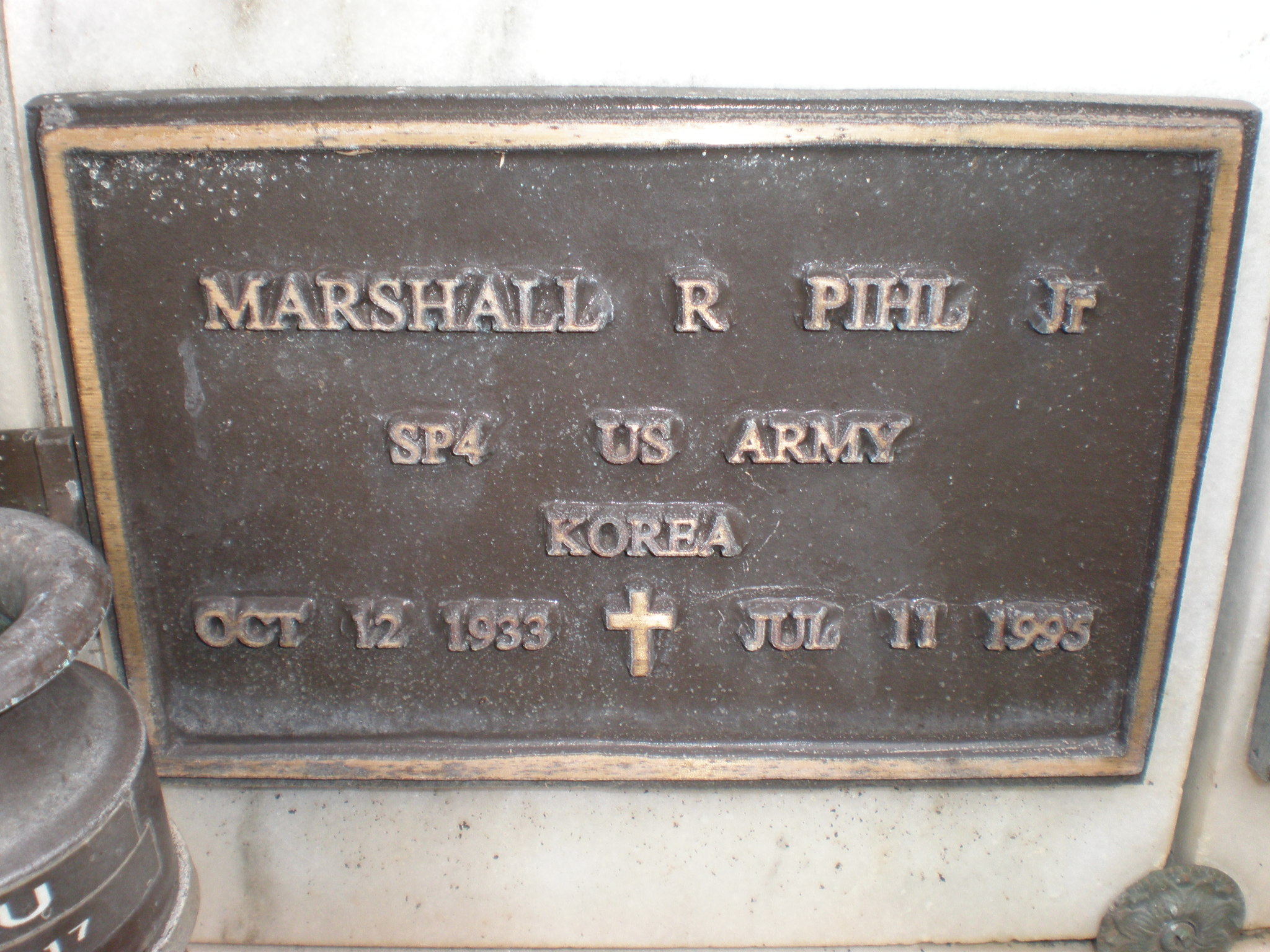
However, the Ivy League veteran I would most like to honor on this Veterans Day is Marshall R. Pihl (1933–1995), Harvard class of 1960, who learned Korean courtesy of the Army Language School and used his G.I. Bill funding to become a renowned scholar of Korean literature, especially the “performed literature” he described in his dissertation, later published as The Korean Singer of Tales (Harvard U. Press). Here’s the obituary posted to a Korean studies listserv in July 1995.

MARSHALL R. PIHL, renowned translator and leading scholar in the field of Korean literature, died at his home over the weekend of July 8. He was 61.

Since early spring his health had been deteriorating, at first gradually and then more and more rapidly. Nevertheless he diligently kept his appointments and continued his research. At least outwardly, he remained optimistic about recovery until the end.

After graduating from Harvard College in 1960, where he majored in Far Eastern languages, Marshall became the first Fulbright student grantee in Korea, receiving an M.A. in Korean language and literature from Seoul National University in 1965. He was the first Westerner to earn a graduate degree from a Korean university. He then entered the doctoral program at Harvard University, receiving his Ph.D. in 1974.

During another Fulbright year in Korea in 1970-71, Marshall was named the winner of the first annual Modern Korean Literature Translation Award, sponsored by the Korea Times. His first collection of translations, Listening to Korea, was published by Praeger in 1973. Later he produced The Good People: Korean Stories by Oh Young-su, published by Heinemann in 1985, and coedited (with Bruce and Ju-Chan Fulton) Land of Exile: Contemporary Korean Fiction, published by M. E. Sharpe/UNESCO in 1993. He also published many articles and translations in periodicals such as Korea Journal and Korean Studies and in collections such as Peter Lee’s Anthology of Korean Literature (1981) and Flowers of Fire (1986). But he was most proud of the beautifully produced work that originated as his dissertation, The Korean Singer of Tales, published by Harvard University’s Council on East Asian Studies in 1994.

Because he was a pioneer in a then-tiny field, Marshall was unable to secure a full-time academic position and was forced to combine teaching with administrative duties until he joined the Department of East Asian Languages and Literatures at the University of Hawaii in 1989. Although he was an exceptionally capable administrator, serving as associate director and then director of the Harvard University Summer School from 1977 to 1987, he was thrilled to be able to devote full-time to teaching and research in Hawaii.

His contributions were well recognized at UH, where he received tenure in 1992 and a promotion to full professor in 1995. His administrative skills were also highly valued by his colleagues on the executive committee of the Center for Korean Studies.

Marshall was not just a fine scholar, but also a dedicated teacher and an unfailingly generous, optimistic, and energetic mentor for junior colleagues everywhere. He attracted a growing number of graduate students into Korean literature, and always gave higher priority to their academic advancement than to his own projects. Even in the two months before his death he chaired one dissertation defense, two thesis defenses, and served as outside member on several more.

He had planned to devote his upcoming sabbatical to finishing several of his own projects, including translating and condensing Cho Dongil’s comprehensive history of Korean literature and coediting several textbooks in a series on Korean literature organized by the International Korean Literature Association, which he helped establish in 1992.

———-

Marshall was an extraordinarily powerful person. I never spoke with him without feeling infused with some of his energy and obvious love of life. —Jonathan Petty, University of California, Berkeley

Not only was he a fine scholar who brought an incredible amount to the field, but he was also simply an extraordinary human being—kind, helpful, and generous to those around him and blessed with a terrific sense of humor. His passing leaves not only a large vacuum in the field but a huge void in the hearts of those who knew him. —Stephen Epstein, Victoria University, Wellington

Marshall used to say that at the end of each duty day in Korea, regular soldiers might stack arms, but his fellow translator/interpreters would stack pencils. His ashes are interred in Punchbowl National Memorial Cemetery of the Pacific in Honolulu.

Marshall R. Pihl grave marker

Marshall R. Pihl grave marker

1 Comment

Filed under education, Korea, U.S., Vietnam, war

Baby Boomer Buddhism Going Bust

Friday’s Opinion Journal carried a column by Clark Strand, contributing editor to Tricycle: The Buddhist Review, on the declining numbers of American Buddhists.

A colleague recently took me to task for consulting Jews and Christians on how to keep American Buddhism alive. He didn’t agree with either premise–that Jews and Christians could offer advice to Buddhists, or that Buddhism was in any danger of decline. But he was wrong on both counts. American Buddhism, which swelled its ranks to accommodate the spiritual enthusiasms of baby boomers in the late 20th century, is now aging. One estimate puts the average age of Buddhist converts (about a third of the American Buddhist population) at upwards of 50. This means that the religion is almost certain to see its numbers reduced over the next generation as boomer Buddhists begin to die off without having passed their faith along to their children. And Jewish and Christian models offer the most logical solution for reversing that decline.

The basic problem is that non-Asian converts tend not to regard what they practice as a religion. From the beginning, Buddhism has been seen in its American incarnation not as an alternative religion, but as an alternative to religion. American converts have long held Buddhism apart from what they see as the inherent messiness of Western religious discourse on such issues as faith and belief, and from the violence that has so often accompanied it….

In the contemporary discourse on religion, it is striking how often Buddhism is privileged over Judaism, Christianity or Islam as a scientifically based or inherently peaceful version of religion. Note that the Dalai Lama (rather than the pope) was asked to provide the inaugural address at the annual meeting of the Society for Neuroscience in 2005, even though, like Catholicism, Tibetan Buddhism includes beliefs (think reincarnation) that are anathema to medical science. Likewise, though Japanese Buddhists melted their temple bells to make bombs during World War II, the idea of Buddhism as a peace-loving religion persists as an enduring fantasy in Western people’s minds. And yet, such fantasies are instructive nonetheless.

Though some of my more devout Buddhist associates may balk at the idea, these days I have increasingly come to see Buddhism in America as an elaborate thought experiment being conducted by society at large–from the serious practitioner who meditates twice daily to the person who remarks in passing, “Well, if I had to be something, I guess I’d be a Buddhist.” The object of that experiment is not to import some “authentic” version of Buddhism from Asia, as some believe, but to imagine a new model for religion altogether–one that is nondogmatic, practice-based and peaceful.

This certainly rings true with me. I flirted with Japanese Buddhism after abandoning the Christianity of my youth, but never became a serious practitioner as did some of my friends, including other missionary kids.

17 Comments

Filed under religion, U.S.

A Velvet Painting Maquiladora in Juárez

From Antonio’s Gun and Delfino’s Dream: True Tales of Mexican Migration, by Sam Quinones (U. New Mexico Press, 2007), pp. 128-130:

[Doyle] Harden and [Leon] Korol—a Georgia country boy and a blunt Chicago Jew—would become fast friends, business partners, and would transform the marketing of velvet painting in America.

“He changed my life in the velvets,” Harden said of Korol, who died in 2004 at the age of seventy-seven.

Harden had been sending a semi truck a week back to his Georgia warehouse. But Korol believed velvet had national potential. He was the first customer to buy an entire truckload of Harden velvets from Juarez. Within a month, he had ordered five trucks of paintings delivered to Chicago. He kept this up for years. Velvet paintings filled the cavernous warehouse at the Leon Korol Company in Chicago, exuding a smell of oil paint and fabric that years later Korol’s sons still remembered….

It was to meet this demand that, in 1972, Korol fronted the money with which Harden built a block-long velvet-painting factory on a Juárez vacant lot belonging to a Mexican customs commandant. The factory soon hummed with three shifts a day.

Harden’s velvet-painting factory is legendary among Juárez old-timers. It was really a cluster of about two dozen studios of different sizes—each with a master painter and team of assistants. Harden provided the materials and paid dollars for everything the master and his crew could churn out.

Harden tested the painters to see who could paint the best trees, or waterfalls, or clouds. Then he set up production lines. Each studio had a wooden shelf along which the artists would slide the paintings. One man would paint the clouds, slide the canvas to the next fellow, who’d paint the sun. The third guy would paint the mountains and slide it to the guy who’d paint the stream. And so it went until the painting was finished. A crew of framers cut the velvet, stapled it to frames, and fed blank canvases into the maw of it all.

An assembly line for handmade art, the factory was one of the first maquiladoras in a town now dominated by them. Each studio was designed so no painter used more than one color and thus avoided wasting time by switching or cleaning his brushes.

Each day, after reviewing sales orders, the master painters chose the subjects to be painted: a landscape, an eagle, a wolf, an Aztec warrior, a pachuco by his car. An assistant forged the master’s name on each painting. As soon as it was done, the artwork was in a truck and on its way to some far-off part of the United States, sometimes arriving still wet.

Two big rigs would leave Harden’s factory for the United States every day. Urged on by Leon Korol, who bought from no one else, Harden reached awesome heights in velvet production. A dozen or more competitors followed his lead into mass production. A man named Molina had a studio of twenty or more of Juárez’s best artists to whom he paid cash every day; it was accessible off a downtown back street with security guards vetting each person who wanted to enter. But no one equaled Harden’s volume.

In typical Quinones fashion, this chapter is a collection of interrelated stories about unusual people:

  • Edgar Leeteg (1904–1953), the weird kid from East St. Louis, Illinois, who moved with his mother to Tahiti, where he became the father of modern velvet painting
  • Aloha Barney Davis, who marketed Leeteg’s work in Hawai‘i, from which it spread to San Diego, then to Tijuana and other towns along the U.S.–Mexican border.
  • Chuy Morán, the hardscrabble artist who became the king of Juárez velvet painters and, for a time, a very wealthy man.
  • A.M. Shawar and other Palestinian emigrés in Edmonton, Alberta, who sold velvet paintings all over the Great White North, even flying them into isolated villages in the Canadian outback.
  • Hundreds of Scientology students in Florida who paid for their schooling by hawking velvet paintings during “velvet’s last hurrah” during the 1980s.

3 Comments

Filed under art, economics, Mexico, migration, U.S.

How Zacatecans Became Risk-takers

From Antonio’s Gun and Delfino’s Dream: True Tales of Mexican Migration, by Sam Quinones (U. New Mexico Press, 2007), pp. 42-45:

On a map, Zacatecas looks like an amoeba in the middle of Mexico. Its lines curve in and out of territories with the logic of a modern art painting. On the ground, the state is vast and beautifully rugged. In parts, mesquite trees pock forbidding deserts of beige dust. Elsewhere, the-desolation gives way to dirt the color of cayenne pepper. But whatever its color, the land of Zacatecas never could hold people to it.

The Zacatecan upper classes owned large tracts of land, much of which they’d inherited, but were averse to investing in anything more than their houses.

“There are very few classic entrepreneurs in Zacatecas, in the strict sense of people who, with their own resources, create jobs,” said Rodolfo Garcia, a professor of immigration and development studies at the University of Zacatecas. “In Mexico, the capitalist class has mostly grown due to the support and money of the government. The capitalist class in Zacatecas, more than in any other state, has grown up on public money.”

The extraction and export of raw materials began in the late 1800s, when mining ruled Zacatecas. The minerals from Zacatecas went elsewhere to be processed into something of greater value. When the mines gave out, they were replaced by ranching and agriculture but not by a new attitude toward risk. Zacatecas, the Mexican state that produces more beans and chiles than any other, still has few companies that process those products into, say, canned beans and canned chiles. Almost everything produced in Zacatecas leaves for places where it is transformed into something of greater profit.

This includes its people. Nothing has left Zacatecas like its people. Emigration to the United States began in the late 1800s, declined in the 1930s, then picked up a momentum in the 1940s that it hasn’t lost. No Mexican state has a greater percentage of its people in the United States than craggy, red Zacatecas.

The folks who left were the state’s real risk-takers. They risked their own capital—their lives—on the promise of a better return than Zacatecas offered. For most of them, the bet paid off. In time in the United States, they opened businesses, bought houses, and sent their kids to school….

Strangely, immigrants’ daring and risk-taking indirectly stymied what the state needed most—which was a daring, risk-taking state of mind. Instead of using immigrant dollars to jump-start an industrial economy, Zacatecas simply limped along, addicted to the dollar injections. Immigrants became the state’s primary foreign investors and job creators. They hired local folks to build lavish homes in the villages they’d left as paupers.

Then came the Mexican presidential election of 1988. The ruling PRI faced real competition for the first time in its history. Cuauhtémoc Cárdenas—a PRI apostate who had left the party—formed a movement that would become the left-wing Party of the Democratic Revolution (PRD). Sinaloan businessman Manuel Clouthier rejuvenated the National Action Party (PAN) by swiveling it away from right-wing social morality and toward the issues of corruption and efficient government services.

Cárdenas and Clouthier were the first Mexican presidential candidates to visit the United States and avidly court immigrants. The PRI and its candidate, Carlos Salinas de Gortari, beat back their challenge through massive vote fraud. But the 1988 election showed the PRI that immigrants up north were a dangerously uncoopted source of dissent. Salinas set up an office of Attention to Mexicans Abroad.

Zacatecas Gov. Genaro Borrego tried another idea. Every dollar immigrants put up for public works projects in their villages, he announced, the government would match. It started as “1 for 1” and quickly expanded to “2 for 1″—with money from the state and federal governments. Immigrants could stretch their dollars, and Zacatecan villages could get the schools, wells, and clinics they needed.

For decades, the PRI had used budgets to buy off union leaders, businessmen, academics, and neighborhood groups. Zacatecas’s “2 for 1” was the party’s first try at buying off immigrants in the United States, and it grew largely from the PRI’s 1988 election scare. Zacatecan immigrants were urged to form village clubs and raise money for projects back home.

But the PRI miscalculated. These immigrants were no longer the humble campesinos who went hat-in-hand to mayors across Mexico. They’d done well in the United States, and felt confident in their abilities. They blamed the PRI for having to leave their villages. They weren’t about to let the party push them around up in the United States, too.

The clubs they formed were not docile. On the contrary, as the party pushed, immigrants pushed back. They insisted on a say in how their money was spent. The PRI was adamantly secular, but when some clubs insisted that the money they put up be used to renovate village churches, the government relented.

Because of “2 for 1,” Zacatecans became the best-organized Mexican immigrants in the United States. By the time Andres Bermudez ran for mayor of Jerez, there were some 240 of these clubs in the United States. No other Mexican state had even half that number. They invested millions of dollars in public works. Their money built the necessities for their people back home that the government hadn’t provided. In time, immigrants nurtured a righteous sense of their economic importance to Zacatecas.

Yet they religiously avoided politics. Mexican politics had been the exclusive domain of lawyers, teachers, merchants. Every ranchero seemed to know some fool who’d gone into politics and lost everything, been jailed or killed, or gotten rich and turned on his friends. So while Zacatecan immigrant prosperity created a vast ranchero constituency in the United States with money, organization, and talent, it was oblivious to its own political potential. That’s how things remained until the late 1990s, when a lot began to change back home.

Leave a comment

Filed under economics, Mexico, migration, U.S.

China Diary, 1988: The Inscrutable West

In 1987–88, the Far Outliers, with their two-year-old daughter in tow, spent a year teaching English at a new community college in Zhongshan City, Guangdong Province, China. The following is one of a series of articles I wrote in 1988. I sent them to a Honolulu newspaper, but they were not interested. So now I offer them as a retrospective on coastal China twenty years before hosting its first Olympics. At the same time, I am scanning in a lot of our old China photos and uploading them to my Flickr account or to my WordPress blog to illustrate this series.

One of my Chinese students wrote:

“Play baseball must have two group and each one have nine person. They stand in the place and play the ball. One group is throw the ball to the other group. The other group must approach the ball and fielding the ball. Before the ball coming you must watch the ball because you must keep it.”

I corrected the grammar but didn’t worry about the ideas. It’s hard to explain baseball in ten minutes, even when you have a blackboard to work with.

You don’t have to understand baseball—or cricket or rugby or Aussie rules or American football—to master basic English. But when you teach English abroad, someone is bound to ask you what it means to strike out, throw someone a curve, or be out in left field.

I don’t feel too confident myself explaining cricket phrases like “sticky wicket,” and I’m even foggier about what the Hong Kong newscaster means when he says “Pakistan are 396 for seven in the third day of play” in a Commonwealth cricket tournament.

To our students in Zhongshan, the eating habits of English-speaking peoples are at least as peculiar as their sports—and more essential to understand, especially when many will go to work in the local visitor industry.

A few examples from our role-play in class illustrate:

Teacher: “I’ll take your chicken and pineapple salad.”
Student: “What kind of dressing would you like on it? We have oil, vinegar, French, Italian, Russian, and British.”

Eating raw vegetables tossed with dressing is a foreign notion in China. Lettuce, called “raw vegetable” (sheng cai), is abundant in the markets. But our students asked, “Have you ever eaten it raw?” We never did there.

Teacher: “I’ll take the French onion soup, the roast beef medium rare, and apple pie for dessert.”
Student: “And what kind of sandwich would you like?”

Our students figure a complete meal should include at least one item under each major section of the menu, just as a complete Cantonese meal might include a soup, a poultry dish, a seafood dish, a meat dish, and a vegetable dish. And they don’t usually measure the size of a meal by the number of helpings eaten. They count the number of dishes served.

Teacher: “I’d like a beverage with my meal. What do you have?”
Student: “Tea, Coke, Sprite, cognac, and brandy.”

A common sight in restaurants in Zhongshan, even at breakfast, is a bottle of liquor in the middle of the table. Having “wine” (usually translated jiu, meaning any kind of alcohol) with a meal is not a foreign idea, but the fine distinctions among the types of alcohol usually drunk before, during, or after a meal in the West require some explanation.

Typical American classroom culture is also hard for students in China to understand.

After hearing in a listening comprehension talk that young Alfred Hitchcock went to strict schools, one student asked, “What other kind is there?”

Chinese students are usually highly motivated and don’t expect the kind of song-and-dance routines that American teachers employ to try to keep their barely interested students from being disruptive or falling asleep. But Chinese students do doze off during long lectures, and most of their classes are long lectures.

In addition to passively listening, the students memorize and recite, read and translate. It takes a lot of work to get most of them to absorb and present information without memorizing it, to answer questions in their own words, or to participate in a seminar-type class.

As one Chinese essayist in China Daily observed, “stuffing students’ heads full of knowledge is by no means the best way” to educate them. The writer, obviously a radical revisionist, advocated less reliance on lectures and more reliance on seminars and directed research.

Still, the examination system in China has for centuries tested memorized knowledge, and classroom initiative has for centuries come from one source—the teacher—even if heads do nod from time to time.

UPDATE: Basketball has certainly become more scrutable in China in over the past two decades (via Language Hat).

1 Comment

Filed under anglosphere, baseball, China, U.S.