
Category Archives: U.S.

Finding Yankee Graves in the South, 1866

From This Republic of Suffering: Death and the American Civil War by Drew Gilpin Faust (Knopf, 2008), Kindle Loc. 3553-3591 (p. 225):

Locating the many graves scattered beyond actual battlefields—casualties from skirmishes, or wounded men who died on the march, or men who succumbed to disease—required Whitman to seek information from local citizens who might have seen or heard of buried soldiers or even assisted in their interments. “As a rule,” he later remembered, “no residence or person was to be passed without the inquiry. ‘Do you know, or have you heard of any graves of Union soldiers in this neighborhood?’” When he arrived in Oxford, Mississippi, Whitman called upon the town postmaster, a federal employee after all, who might be expected to be both knowledgeable and helpful to a Union official. Whitman received not assistance but a warning. The postmaster declared that he would not dare tell a Yankee soldier about Union graves, even if he knew of them. Since the postmaster had taken the loyalty oath to qualify for his position at the end of the war, all his friends, cultivated during nineteen years of residence in the town, had abandoned him. He had even been asked to cease attending his church. “I am informed,” Whitman wrote his commanding officer, “that a disposition has been shown in this vicinity to obliterate and destroy all traces of the graves union soldiers find scattered in the country.”

Farther south the Union dead seemed to be in even more distressing circumstances. Whitman discovered “immense numbers” of bodies in the area between Vicksburg and Natchez—perhaps, he thought, as many as forty thousand. These corpses were in every imaginable place and condition: buried on river embankments and then wholly or partially washed away (there were even reports of coffins floating like little boats down the Mississippi toward the sea), or abandoned in “ravines and jungles and dense cane brakes” and never buried at all. A farmer named Linn, who wanted to extend his cotton fields, had plowed up about thirty Union skeletons and then delivered the bones “in bulk” to the Vicksburg city cemetery. Not far away a Union graveyard had been leveled entirely to make way for a racecourse.

As Whitman pursued his explorations, three hundred black soldiers at the Stones River National Cemetery continued to collect and rebury Union bodies from the wide surrounding area at the rate of fifty to a hundred a day. Stones River represented a pioneering example of the comprehensive reburial effort that by the summer of 1866 had come to be seen as necessary across the South. It also represented the critical role that African Americans had come to play in honoring the Union dead. Almost invariably units of U.S. Colored Troops were assigned the disagreeable work of burial and reburial, and Whitman’s own exploration party included several soldiers from U.S. Colored regiments. Individual black civilians also proved critical to Whitman’s effort to locate corpses and graves.

“Justice to the race of freedmen,” Whitman reported to headquarters, demands “a tribute of grateful mention.” Rebuffed in his search for information by whites like the Mississippi postmaster, Whitman learned to turn to black southerners for help as he traversed the South in the spring and fall of 1866. “Most all the information gained” at one Georgia location, he reported to his journal, “was from negroes, who, as I was told … pay more attention to such matters than the white people.” There was a good deal more at issue here, Whitman soon recognized, than just attentiveness. Black southerners cared for the Union dead as a gesture of political assertiveness as well as a demonstration of gratitude and respect.

During the war African Americans had risked their lives burying Union soldiers and trying to preserve both their names and their graves. About two miles from Savannah, in a corner of “the Negro Cemetery,” lay seventy-seven “graves of colored soldiers” in four neat rows. All but three were identified, all in “very good condition,” and all marked with “good painted headboards.” This was the last resting place of the dead of a unit of U.S. Colored Troops, carefully buried and tended by the freedpeople of the area. Whitman encountered other sites where former slaves had interred Yankees and still watched over their graves. Behind an African Colored Church near Bowling Green, Kentucky, for example, 1,134 well-tended graves sheltered both black and white Union soldiers. A black carpenter nearby was able to provide the most useful information about the area because he had made coffins and helped to bury many of the Union dead himself.

Freedmen provided Whitman with assistance and information throughout his travels. Moses Coleman, “an intelligent negro,” sought Whitman out to tell him about the graves of nine Union soldiers who had been shot by Confederate cavalry after being taken prisoner: “one of whom he saw shot after being compelled to climb a tree.” A freedman eagerly offered the names and locations of two soldiers he had buried more than a year before; another former slave reported his employer’s desecration of soldiers’ graves and offered to identify thirty on his plantation that still remained undefiled.
Leave a comment

Filed under slavery, U.S., war

The Fourth Battle of Winchester, 1866

From This Republic of Suffering: Death and the American Civil War by Drew Gilpin Faust (Knopf, 2008), Kindle Loc. 3803-3814, 3829-3836 (pp. 241, 243):

The northern reburial movement was an official, even a professional effort, removed by both geography and bureaucracy from the lives of most northern citizens; it was the work—and expense—of the Quartermaster Corps, the U.S. Army, and the federal government. In the South care for the Confederate dead was of necessity the work of the people, at least the white people; it became a grass-roots undertaking that mobilized the white South in ways that extended well beyond the immediate purposes of bereavement and commemoration.

Winchester, in the northernmost part of Virginia, had been a site of almost unrelieved military activity, including three major Battles of Winchester, one each in 1862, 1863, and 1864; the town was said to have changed hands more than seventy times in the course of the war. The dead surrounded Winchester as they did Richmond, and women organized similarly to honor them. Fanny Downing, who assumed the presidency of the Ladies Association for the Fitting Up of Stonewall Jackson Cemetery, issued an “Address to the Women of the South” that echoed Richmond’s Mrs. William McFarland. “Let us remember,” her broadside cried, “that we belong to that sex which was last at the cross, first at the grave … Let us go now, hand in hand, to the graves of our country’s sons, and as we go let our energies be aroused and our hearts be thrilled by this thought: It is the least thing we can do for our soldiers.

On October 25, 1866, a crowd five thousand strong gathered to dedicate Winchester’s Stonewall Cemetery, graveyard for 2,494 Confederate soldiers who had been collected from a radius of fifteen miles around the town. Eight hundred twenty-nine of these bodies remained unknown and were buried together in a common mound surrounded by 1,679 named graves. General Turner Ashby, a dashing cavalry commander and local hero who had been killed in 1862, served as the ranking officer among the dead, as well as a focus of the day’s ceremonies. His old mammy was recruited to lay a wreath on his grave in a pointed celebration of the world for which the Confederacy had fought. The American flag flying in the adjoining national cemetery, where five thousand Union soldiers had already been interred, provoked a “good deal of rancor” from the crowd, and the members of the U.S. Burial Corps, caring for the Federal dead, were jeered and insulted. Twenty-five hundred Confederates on one side; five thousand Yankees on the other: perhaps this was the Fourth Battle of Winchester, the one in which the soldiers were already dead.

Just over fifty years ago, my family arrived in Winchester (on furlough from Japan) just in time for the Civil War Centennial, which sparked my interest not just in the Civil War, but in history of all kinds everywhere.

Leave a comment

Filed under military, Virginia, war

Wordcatcher Tales: Mourning Fabrics, 1860s

From This Republic of Suffering: Death and the American Civil War by Drew Gilpin Faust (Knopf, 2008), Kindle Loc. 2332-2384:

By convention, a mother mourned for a child for a year, a child mourned for a parent the same, a sister six months for a brother. A widow mourned for two and a half years, moving through prescribed stages and accoutrements of heavy, full, and half mourning, with gradually loosening requirements of dress and deportment. A widower, by contrast, was expected to mourn only for three months, simply by displaying black crape on his hat or armband. The work of mourning was largely allocated to women….

In the South, where 18 percent of white males of military age perished in the war, death was omnipresent, and fabrics and fashions were scarce…. In the North, where the death rate of men of military age was one-third that in the Confederacy, mourning was less universal, and the goods that made it possible proved more readily available….

At Besson & Son, Mourning Store, at 918 Chestnut Street in Philadelphia, one could find in July 1863—just in time for Gettysburg—a veritable taxonomy of mourning fabrics all but unrecognizable by twenty-first-century Americans:

  • Black Crape Grenadines [A thin gauzelike fabric of silk or wool, for women’s wear]
  • Black Balzerines [A light mixed fabric of cotton and wool for women’s dresses, commonly used for summer gowns before the introduction of barege]
  • Black Baryadere Bareges
  • Black Bareges [A sheer fabric woven of silk or cotton and wool, used for women’s apparel]
  • Black Barege Hernani [A grenadine dress fabric woven in small meshes of coarse threads of silk, cotton, or wool, and their intermixtures]
  • Silk Grenadines
  • Challies [a soft fabric of plain weave in wool, cotton, or other staple fiber]
  • Summer Bombazines [A fine twilled fabric of silk and worsted or cotton, often dyed black and used for mourning clothes]
  • Mousseline de Laines [wool] [A fine sheer fabric resembling muslin, originally made in Mosul, Iraq]
  • Tamises [A cloth made for straining liquids]
  • Mourning Silks, Lawns, Chintzes, Alpacas
  • Barege Shawls, Grenadine Veils, English Crapes

Leave a comment

Filed under economics, language, religion, U.S., war

Railroad Depot Architecture, 1830–1860

From A Most Magnificent Machine: America Adopts the Railroad, 1825-1862, by Craig Miner (U. Press of Kansas, 2010), p. 92:

Railroad depots came to dominate urban architecture, and their size brought much comment. The Boston & Maine depot in Boston, constructed in 1846, was 200 feet long and 80 feet wide. It had Corinthian columns, and on its upper story was the largest meeting hall in the city. Behind it was a freight depot 500 feet long and 50 feet wide. The Union depot at Troy, New York constructed in 1853, was 400 feet long and 150 feet wide. The distance from the top of the roof arch to the floor was 65 feet. The roof was made entirely of iron supported by twenty trusses.

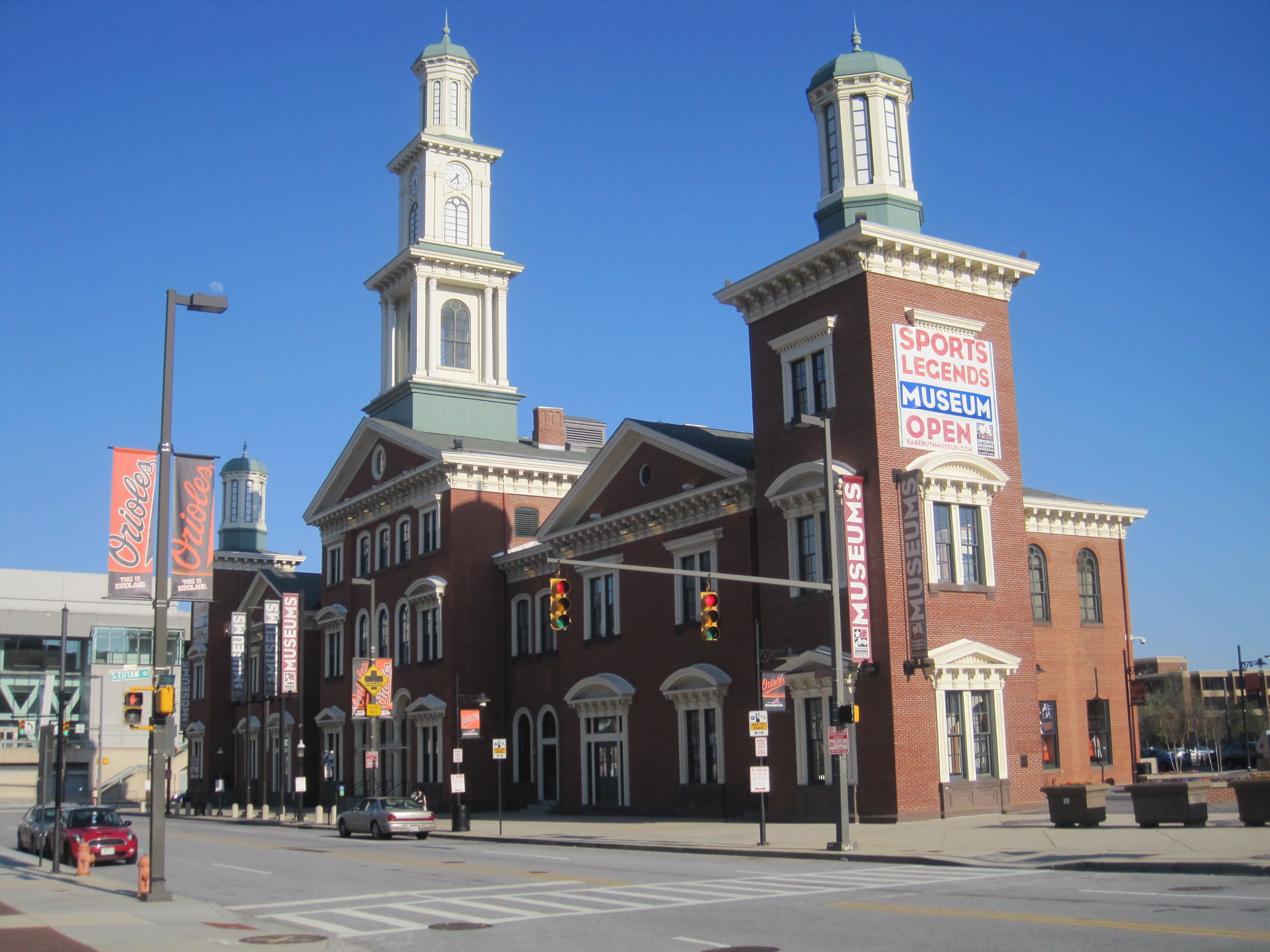
Former B&O Camden Station

Former Baltimore & Ohio Railroad's Camden Station, built in 1856, now the Babe Ruth/Sports Legends Museum next to Camden Yards

Time only increased the impressiveness of these structures. A reporter for the Chicago Daily Tribune visited the new buildings constructed by the Illinois Central Railroad along the lakeshore in 1854. The passenger depot at the foot of Water Street was all of stone. It was 500 feet long, 166 feet wide and 60 feet high to the top of its towers. Its windows were 16 feet high. The walls looked like they would “remain in all their strength when the final ‘wreck of matter and the crash of worlds’ shall come. The turntable there would hold eighteen locomotives.

The depots were the entry to a new world of travel, every aspect of which became a subject for travelogue comments. John Daggett riding the B&O in 1834, thought the beginning of his rail journey was its highlight:

One of the happiest effects of traveling on railroads is the freedom it gives you from the impertinence and impositions of porters, cartmen, et omne id genus, who infest common steamboat landings. A long and solitary row of carriages was standing on the shore awaiting our arrival; not a shout was heard, scarcely any thing was seen to move except the locomotive, and the arms of the man who caught the rope from our boat. The passengers were filed off along a planked walk to the carriages through one gangway, while their luggage, which had already been stowed safely away, was rolled on shore by another, in two light wagons; and almost without speaking a word, the seats were occupied, the wagons attached behind, the half-locomotive began to snort, and the whole retinue was on the way with as little ado and as little loss of time as I have been guilty of in telling the story.

Others, however, were not so impressed with the stressful experience of boarding a train. A Frenchman, Michel Chevalier, thought that the pandemonium at the railroad station reflected the nervousness and disorder of American society itself. The American, he wrote, was “devoured with a passion for locomotion” and could not stay still.

Leave a comment

Filed under industry, travel, U.S.

History of Naming U.S. War Dead

From This Republic of Suffering: Death and the American Civil War by Drew Gilpin Faust (Knopf, 2008), Kindle Loc. 1679-1700:

Men thrown by the hundreds into burial trenches; soldiers stripped of every identifying object before being abandoned on the field; bloated corpses hurried into hastily dug graves; nameless victims of dysentery or typhoid interred beside military hospitals; men blown to pieces by artillery shells; bodies hidden by woods or ravines, left to the depredations of hogs or wolves or time: the disposition of the Civil War dead made an accurate accounting of the fallen impossible. In the absence of arrangements for interring and recording overwhelming numbers, hundreds of thousands of men—more than 40 percent of deceased Yankees and a far greater proportion of Confederates—perished without names, identified only, as Walt Whitman put it, “by the significant word Unknown.”

To a twenty-first-century American, this seems unimaginable. The United States expends more than $100 million each year in the effort to find and identify the approximately 88,000 individuals still missing from World War II, Korea, and Vietnam. The obligation of the state to account for and return—either dead or alive—every soldier in its service is unquestioned. But these assumptions are of quite recent origin. There have been many revolutions in warfare in the last century and a half. Although perhaps less dramatic than transformations of military technology and organization, changing attitudes toward the dead and missing have profoundly altered the practices and experience of war—for soldiers and civilians alike. Only with the Korean War did the United States establish a policy of identifying and repatriating the remains of every dead soldier. Only with World War I did soldiers begin to wear official badges of identity—what came to be known as dog tags. Only with the Civil War did the United States create its system of national cemeteries and officially involve itself with honoring the military dead. It was the Civil War, as Walt Whitman observed, that made the designation “UNKNOWN” become “significant.”

The dead of the Mexican War received no official attention until 1850, two years after the conflict ended, when the federal government found and reinterred 750 soldiers in an American cemetery in Mexico City. These bodies represented only about 6 percent of the soldiers who had died, and not one body was identified. But with the Civil War, private and public belief and behavior gradually shifted. This was a war of mass citizens’ armies, not of professional, regular forces; it was a war in which the obligation of the citizen to the nation was expressed as a willingness to risk life itself. In its assault upon chattel slavery, the conflict fundamentally redefined the relationship between the individual and the nation. This affirmation of the right to selfhood and identity reflected beliefs about human worth that bore other implications, for the dead as well as the living.

Later in the chapter, Faust notes that military chaplains were frequently counted upon to keep track of the dead, but that neither the Union nor the Confederate military felt any obligation to inform the families of the dead.

Leave a comment

Filed under military, U.S., war

Hirohito, the Rare Decider

From the Editor’s Preface by Marius Jansen in Hirohito: The Shōwa Emperor in War and Peace, by Ikuhiko Hata (Global Oriental, 2007), pp. x-xiii:

The emperor’s personal thoughts and inclinations remain shrouded in considerable ambiguity. In the immediate post-surrender days when he broke precedent by responding to four questions posed by a New York Times reporter, he seemed to place responsibility for Japan’s failure to declare war before striking at Pearl Harbor on General Tōjō by saying that that had not been his intention. The suggestion that he was avoiding responsibility by placing it on his official advisers caused so much consternation that the Home Ministry tried to prevent publication of that response in Japan. Two days later, on 17 September 1945, when the emperor first visited General MacArthur, he took a different position by accepting full responsibility for everything that had been done in his name…. This accords with the testimony of the many diaries of court officials that have appeared in recent years. True, the Meiji Constitution of 1889 had given the emperor exclusive control as commander-in-chief of the armed forces, but those forces, too, were structured and bureaucratized…. On the whole, these bodies reported to the emperor, but did not request decisions from him. Actual military decisions had been reached at Liaison Conferences beteween [sic] the Imperial Army and Navy. Those in turn had to be validated by Imperial Conferences, but those were largely ritual; the emperor remained silent, and responses to occasional questions posed by the head of the Privy Council did not constitute real discussion.

Hirohito had accepted those limitations, as was expected of him. On three occasions he had emerged with clear-cut personal opinions. At the very inception of his reign he had been appalled by the indiscipline involved in the Kwantung Army‘s arrangement of the assassination of the Manchurian warlord Chang Tso-lin, and his sharp questioning of Prime Minister General Tanaka Giichi had led to the cabinet’s resignation. But soon afterwards, he recalled, complaints were making the rounds to the effect that unnamed senior statesmen and a palace cabal had brought the government down. Alarmed senior statesmen remonstrated with the young (he was twenty-six) emperor and stressed the restraint expected from a constitutional monarch. He, in turn, had resolved to keep a lower profile in the future.

On two later occasions, Hirohito had departed from this position. The first was in 1936, when young army rebels tried to force a change in government by murdering senior statesmen and surrounding the palace. The emperor’s role in suppressing this, the subject of Professor Hata‘s first chapter, could be explained by the fact that because of the absence of a prime minister, who had been thought to be murdered, it fell to him to govern. The other came in August 1945, when the cabinet was split on the manner of surrender and the prime minister turned to the emperor to ask him to decide.

We are left with puzzles that will probably never be resolved. Clearly, as Professor Hata and others have shown, Emperor Hirohito had immense power, but the condition of retaining it was judicious restraint in exercising it. His role in the normal procedures put in place by the Meiji Constitution made it unlikely that those powers would be tested. With the military, where his will was less explicitly restrained, lines of authority were also institutionalized in General Staff and command functions. It is clear that the military, and particularly the army, authorities frequently flouted his will. It is also true that his disapproval could blight a career, as seems to have been the case with Ishiwara Kanji, the key planner in the Manchurian Incident whose brash behaviour at a Palace function is recorded in the opening chapter. The summary of planning sessions before the occuption [sic] of French Indo-China, recorded in the papers of General Sugiyama Hajime, shows the emperor as an intelligent and worried participant, asking questions about the adequacy of the preparations and about the possible reaction of the democratic powers to that momentous step. But at other times, as with the reinforcement of Guadalcanal, Professor Hata shows that the emperor’s opinion carried little weight with even field-grade officers at headquarters. Yet, as was seen in 1936 and again in 1945, the possibility of his intervention was always there.

In his monologue Hirohito pleaded constitutional restraints as explanation for his failure to intervene in 1941. ‘In truth the (American) embargo on oil placed Japan in a dilemma’, he said, and made the military call for war while it was still possible. ‘Believing at the time that even if I opposed it, it would be pointless, I remained silent.’ And yet, ‘In hindsight, I probably would have tried to veto the decision for war if at the time I had foreseen the future’, but it would have been at the possible cost of coups and violence that would have made it impossible for him to act in the final crisis in 1945; Japan might have been even worse off than it was.

On the other hand, there is every reason to think that Hirohito shared in the national exultation for the initial victories as Japanese armies stormed through Asia. A flurry of rescripts and congratulatory statements greeted the news of Pearl Harbor, Singapore, the East Indies, Manila, Burma and the Coral Sea. In each case, the warriors were assured, Chin wa fukaku kashō su, ‘We are deeply gratified’ [朕は深く嘉賞す? Is kashō 嘉賞 ‘approve’ or 過賞 ‘overpraise’?]. There is also evidence that he remained optimistic of a military victory that would provide leverage for negotiation on surrender long after it was realistic to do so, and that the slowness of his move towards the position of the peace faction, made without advance signals of any sort, lengthened the conflict and the casualty lists.

Leave a comment

Filed under Japan, military, nationalism, U.S., war

Railroad vs. U.S. Army Jobs, 1854

From A Most Magnificent Machine: America Adopts the Railroad, 1825-1862, by Craig Miner (U. Press of Kansas, 2010), p. 188:

Similarly elaborate was a great excursion celebrating the completion of the Rock Island in 1854. Two trains of twelve cars each left Chicago loaded with 1,300 people to the cheers of a vast crowd. They proceeded through the prairie and stopped for people to gather wildflowers and grasses and to observe the substantial stone houses and gardens already established along the line. The prairie, a traveler on that train said, “was in its way as grand as the White Mountains, or Niagara Falls.” Arriving at Rock Island and the Mississippi to a cannonade, there was a banner at the depot reading- “The Mississippi and the Atlantic Shake Hands.” Drawn up to the wharf were six of the largest Mississippi River steamboats—War Eagle, Galena, Lady Franklin, Sparhawk, Golden Era, and Jenny Lind. Each had a band playing on the upper deck.

The “Conquests of Civilization” looked especially impressive that day comparing favorably with any military conquests of old. Wrote a man celebrating the excursion opening the Rock Island: “Our invasions, instead of desolating and laying waste the regions into which they are carried, spread fertility and abundance on their track, and they bring us back, instead of weeping captives to minister to our ostentation and pride, the fruits and riches of the earth, garnered from the most distant climes and kingdoms.” The Illinois Central Company was bigger than the U.S. Army. That army had 10,000 in 1854. The Illinois Central railroad employed 19,000 who earned a total in wages of nearly $4 million per year. In three years it would build 700 miles of railroad, whereas in thirty years the federal government had spent $200 million on the army “for which they have nothing to show but some old forts, guns, battered uniforms, and demoralized veterans.” Soon enough, in 1856, trains passed over the Mississippi on the great Rock Island Bridge, 1,581 feet long with a draw in the center. “Yes, the Mississippi is practically no more. It is spanned by the mighty artery of commerce and enterprise—the railroad.”

The uninhabited prairie might be sublime and a “solemn” sight, but seeing the plains of Illinois divided into farms was more exciting still The fields would “drop fatness” when in time “the old fogy sod, matted conservatism of centuries, is overturned by the revolutionists, the ploughshares, and penetrated by those radicals, the grain roots, and the wheat fields stretch out green and wavy as the seas.”

Leave a comment

Filed under industry, military, travel, U.S.

Railroads in the Antebellum South

From A Most Magnificent Machine: America Adopts the Railroad, 1825-1862, by Craig Miner (U. Press of Kansas, 2010), pp. 169-171:

In 1849, [Georgia] was ahead of all southern states in rail mileage and estimated to be ranked third or fourth among all states in the Union. When the Western & Atlantic was completed in 1850, the company was still seeking more state appropriations, and there were still those who thought it could be better managed by a private concern than by the state. But many thought its shortcomings were based on unrealistic public expectations. Compared to most, it was a successful railroad indeed. Wrote the Macon editor: “Great confidence seems to be felt in whatever Georgia lays her hand to. I have often heard it wondered how the citizens of Georgia had succeeded so in building railroads, keeping out of debt, and making their roads pay well.” The reason was that Georgia, as its governor noticed in his 1855 address, had a “definite system” and a “uniform principle” in granting railroad charters. It had supported railroads with state aid and management without going overboard in doing so.

Already the myth of southern backwardness was strong in the North. Amid the tensions of the 1850s, which would lead so soon to civil war, the South defended itself partly by pointing out how well it had done in railroad building. “It is fashionable,” wrote a man in Louisville, “for a certain class of people at the North to taunt the people of the South with a want of enterprise. It is regarded as necessary to establish the evils of slavery, that it shall be shown that it encourages indolence, and represses enterprise; and to illustrate the truth of the positions assumed, the superior progress of the free States in railroad building is cited as proof positive.” History proved that false. The South had built some of the first railroads and some of the best railroads in the United States.

It was also false that southern railroads ran well because northern men ran them or because they used northern supplies and equipment. There were southern ironworks and southern locomotive and car builders. The South argued that slave labor would be a great advantage in railroad building. Just as cities were buying slaves to do urban tasks, so railroads would in the future, and the institution of slavery would become less tied to plantations and the growing of cotton. Northerners were speculators, and eventually there would be proof that the more conservative way the South had proceeded in building railroads was best. It had largely avoided the “chaos of panic and bankruptcy” that characterized northern rail enterprises….

Southern railroads were slightly slower in schedule than northern railroads, but they were safer and more comfortable. The food “would be hard to boast of,” but it was tolerable. The pace at depots in the South was more relaxed, with none of the “running headlong, with coat tails flying,” typical of boarding a train in the North. The conductor boarded the passengers in a leisurely way. Then “the whistle gives a gentle toot, and gradually, as a duck swims against a current, the train moves, and nobody is in a perspiration; no one has lost his baggage, or torn his clothes; no one is left lamenting his hard fate in being a moment too late.” Once aboard a train in the South, the passenger found sociable fellows, and the black “servant” who carried water, apples, and oranges through the cars also distributed ice cream. It made travel by rail actually enjoyable.

Far from being a sideshow, railroad development in the South provided a viable alternative to the way things were practiced in the North. Its example gave a strong indication that there was more than one way of adapting to railroads. The technology did not itself dictate its appropriate uses by people and states.

1 Comment

Filed under economics, industry, slavery, travel, U.S.

Railroads and State Debt, 1839

From A Most Magnificent Machine: America Adopts the Railroad, 1825-1862, by Craig Miner (U. Press of Kansas, 2010), pp. 79-81:

The progress of the years preceding the 1837 Panic surely would resume, many wrote. Apparently insurmountable obstacles had been overcome. The “howling wilderness” was disappearing. “McAdamized highways, railroads and canals, have pervaded the country in every direction, giving free circulation to the products of mechanical skill, of art, and of labor, and animating the whole, immense, diversified country, with every sort of active business and intelligent enterprise.” That was no mean feat. No wonder, however, that types arose who tended to abuse the opportunity—people all too “shrewdly alive to their own interest.” There came a “universal mania” for wealth. “The old beaten track of plodding for our gains, was forsaken and contemned by the restless anxiety for change, and all seemed to engage in the alluring game of running hazards.” A long period of peace and prosperity emboldened them, as though the boom would never end. Yet there was wide consensus that the achievement was impressive. “We take the ground,” wrote a Baltimore man, “that the laborer who turns up a spadeful of earth in excavating a canal, or strikes a blow in constructing a railroad, becomes, by so doing, one of the builders up of a system, the benefits of which will endure so long as the continent on which we live shall endure.”

In the wake of the panic came a long and related crisis over state debts, a large proportion of which had been contracted in order to build railroads. The national debt was nonexistent; in fact there was often a surplus, but it was different with the states, which had borne the brunt of subsidizing rail finance. An Ohio editor estimated in 1839 that eighteen states had authorized public stock for canals and railroads amounting to $170 million, “which is as much a mortgage on our farms as was the national debt.” Interest ran about $12 million per year. It was ridiculous, the regional press thought, that Ohio had an agent in Europe to try to arrange more debt. The Ohio state legislature at its last session had, according to one critic, done more to “degrade the State abroad, and beggar its people at home, than the accumulated energy and labor of years can undo.”

Maybe it was not all bad, a New Yorker commented. Speculation had created 3,000 miles of railroad. “The parent may die, but the offspring will live to enlighten and bless.” A Massachusetts man argued that the Western Railroad there would be completed eventually and would be a good thing. Delays required credit, and credit required the payment of interest and the raising of taxes, but this was not “inconsistent with the business-like character of a business people.” The states received many indirect benefits from the railroads that did not show on their balance sheets proper.

To some that seemed cold comfort. People had been too extravagant in generally prosperous times, importing, for example, $41 million per year in foreign wines—half as much as was spent for railroad iron. Depressions came from overtrading. People seemed to have commenced business on too large a scale. There was a penchant for outright gambling. “Confidence has been destroyed; public and private faith and credit have been grossly abused, and foul deeds of iniquity have been committed.” Public business seemed to be influenced primarily by private business lobbies, and no producers appeared in proportion to the growth in borrowing. The credit of the states had been all too good. New York owed $23 million in 1839, Louisiana $23 million, Pennsylvania $27 million, Maryland $11 million, Massachusetts $4 million, Alabama $10 million, and Tennessee $7 million. And states were adding debt all the time. “Our credit is so good that it will ruin us, if we do not stop and think of the consequences of so severely testing it…. Are we not getting in jeopardy the dearest interests, the honor and independence of our country, and selling our glorious national birthright for a mess of pottage?”

Leave a comment

Filed under economics, industry, travel, U.S.

New Hampshire Skeptical of Railroads, 1840s

From A Most Magnificent Machine: America Adopts the Railroad, 1825-1862, by Craig Miner (U. Press of Kansas, 2010), pp. 119-120:

Why were railroads so great? Who had benefited? When the Eastern [Railroad from Massachusetts to Maine] was proposed, stated one letter to the editor, people along the projected route in Massachusetts and New Hampshire were “lunatic” on the subject. “One would suppose that there was no other road in existence, that indeed to them belonged the discovery of the power of steam, engines, Railroads, &c, and that their fame exceeded the fame of any and all ancient and modern cities. It was said that the old men of the city assembled at the depot in the morning, and really forgot to go to their meals.” Yet by 1841 most of the towns that had been courted had become minor way stations, hearing only the buzz of the engine on the way to Boston. It seemed a bad bargain altogether.

New Hampshire debated the right-of-way issue into the mid-1840s. Enterprise should have full scope, wrote the paper in Concord, but the point in dispute was the right of the legislature to empower a private corporation for private gain to take from a man his land against his will. In that regard the New Hampshire debate was much like the modern controversy over the proper uses of the eminent domain power, and here the state did not regard railroads as a true public use. The chief purpose of a railroad, the legislators thought, was to make money, not to serve the public. “If the constitution must be violated and the rights of individuals molested, it seems no good citizen can favor any project, which shall encroach upon the rights of freemen.” This led one commentator to write in dismay that he was certain that in the state’s “lamentable” stance toward railroads, it had “shut itself out from one of the most beneficial improvements of modern times.”

Inevitably, the state eventually had more or less its share of railroads, and it learned to do what was necessary to accommodate them politically and socially. But New Hampshire remained proud that it had not swallowed the whole package. An editor in Portsmouth noted that credit could not be separated from character: “Integrity, industry, virtue, and character it is that commands the capital which changes the sailor boy in his tarpaulin to the captain of the beautiful packet ship.” So at least it should be. New Hampshire retained its strict laws about individual liability and its narrow interpretation of eminent domain for some years.

The Albany Argus wrote in 1841, in the wake of the Panic of 1837, that “New Hampshire may well congratulate herself, that she has never embarked in any of the wild and visionary schemes of internal improvements, which have plunged other states into such an embarrassing and wretched state of want and indebtedness. She has escaped the bitterness of learning by experience the folly of a large community attempting to carry on public works with prudence, economy or even honesty.” Would that Pennsylvania and Indiana, burdened with state works not paying even their current expenses and repairs on state railroad systems, not to mention the debt service, had done the same. The manic policy of the rest of the country was, according to some in New Hampshire, the “high road to beggary.”

Boston thought such a policy was a “dreaded obstruction” to its enterprise. It was suspicious of presidential candidate Franklin Pierce just because he was from New Hampshire.

Leave a comment

Filed under economics, industry, travel, U.S.