The Far Outliers are near the beginning of a major road trip up the center of the U.S. Last night we arrived in Paducah, KY, from Murfreesboro, TN, taking the scenic route through the Land Between the Lakes National Recreation Area. My retired librarian brother, who was born in Japan but has long worked and retired in Paducah, took us to Paducah Beer Werks, which was hosting a Bluegrass Jam with two sets of musicians, Wheelhouse Rousters, a local troupe, and Kaihulu from Ambon, Indonesia. I fondly remembered their hometown from an academic junket in 1990, which I memorialized in one of my earliest blogposts. The two bands connected at a UNESCO Creative City event in South Korea, and Kaihulu came to connect Paducah with Ambon, each now designated a UNESCO Creative City. We had the chance to chat with some of the musicians, who were astounded to meet someone who had visited their hometown and remembered Pattimura University and other places in Ambon. A small world story.
Category Archives: travel
Early Chinese Telegraph Codes
From Kingdom of Characters: The Language Revolution That Made China Modern, by Jing Tsu (Riverhead Books, 2022), Kindle pp. 91-92, 106-108, 110-111, 123-124:
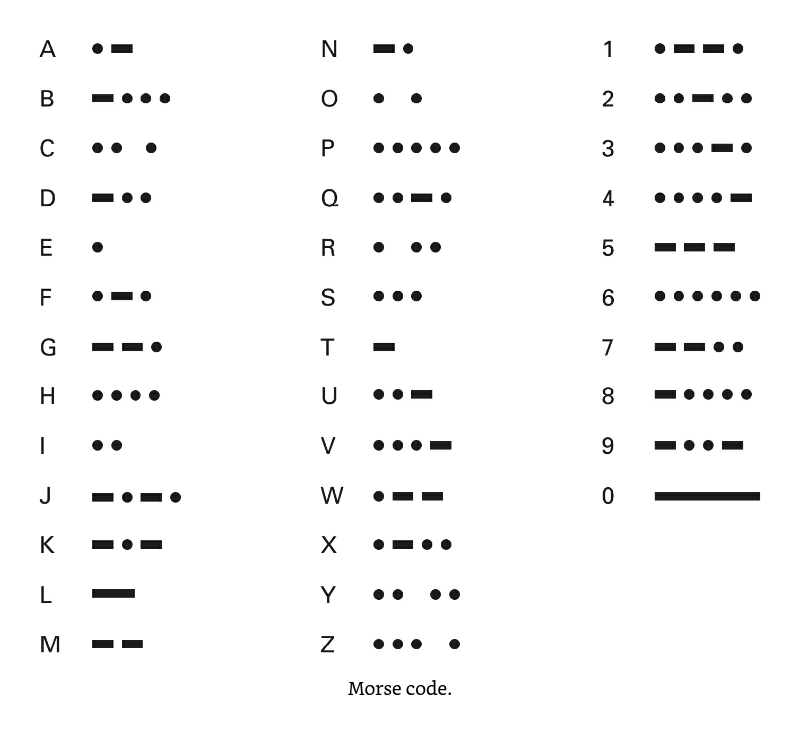
In Morse code, the basic symbols were dots and dashes. The system’s twenty-six combinations of dots and dashes, ranging from one to four symbols, were meant to accommodate the twenty-six letters of the alphabet, with another ten combinations of five symbols each for numbers zero to nine.
To send a message, a telegraph operator pressed an electric switch, in the form of a key: a short tap for a dot and a long one for a dash. The message was converted into an electric current that traveled along the wires and was reverse translated into letters and numbers on the receiving end. The sound of clicking patterns could become so familiar that an experienced telegrapher could tell what word was being coded from its distinct rhythm. Telegraph costs were determined by how long they took to transmit—each dot or space was a single unit, and a dash—three times as long as a dot—was three units. As Morse explained early on, his system was designed to be cost-efficient. The most frequently used letter in English, “e,” was also the least expensive: It was represented by a single dot. The high frequency of “e” holds true for most European languages, from Italian to Dutch. But Morse code clearly favored the American English alphabet. An English letter takes up somewhere between one and thirteen units. To add even a single diacritical mark to the letter “a”—as when making the French “à”—required ten more units. So there was already plenty to disagree about among Roman alphabet users.
The inequities of Morse code were on a different scale for the Chinese. International telegraphy recognized only the Roman alphabet letters and Arabic numerals used by the majority of its members, which meant that Chinese, too, had to be mediated via letters and numbers. Whereas English could be English, and Italian mostly Italian, Chinese had to be something other than itself. Every Chinese character was transmitted as a string of four to six numbers, each of which cost more than a letter. The assigned code for a Chinese character first had to be looked up in a codebook before being converted to the dots and dashes of Morse code. Coding and converting Chinese characters into an ordinary telegram of twenty-five words required at least half an hour, whereas a comparable message in English took only about two minutes. Untold opportunity costs accrued with every telegraph that was delayed when the operator had to pause to check a character against its assigned number in a codebook or had to take extra time to correct an error.
…
[Septime Auguste] Viguier possessed the confidence and skill set that Great Northern [Telegraph Company (大北電報公司 / 大北电报公司 Dàběi Diànbào Gōngsī)] was looking for. He had already worked on developing a code for Chinese telegraphy years earlier for the French government in support of their failed efforts to interest the Chinese Empire in their telegraph cables. He was well versed in early word-copying machines like the Caselli pantelegraph, a precursor to the modern-day fax machine. When the French project was shelved, Viguier ended up in Shanghai—ripe for the Danes’ recruitment. He was the best candidate but not well-liked. Colleagues immediately noted his preening and boastfulness—the French way, they sneered. Viguier later also had a nasty exchange with the managing director Suenson, and his relationship with the company soured over questions of compensation and credit. Nonetheless, Viguier was able to work quickly enough to build out the Danish professor’s incomplete scheme. By June 1870, he had the first version. In 1872, he delivered the final, standardized telegraphic code table for 6,899 characters in The New Book for the Telegraph (Dianbao xinshu).
…
Viguier came up with a tabular form of twenty rows and ten columns per page. He assigned an arbitrary four-digit code from 0001 to 9999 to each character, with empty spaces left for potentially 3,000 more codes to accommodate customized vocabulary for individual business purposes. Each page contained 200 square spaces for listing 200 characters and their numerical codes. The code only included a relatively small number of characters out of the 45,000 or so that were extant. The mass scaling of telegraphy meant that it was geared toward the common person and the common tongue, so restricting the number of characters was not only efficient but also practical.
…
But Viguier’s telegraphic code did not go unchallenged. Almost immediately, the Chinese tried to outdo and improve upon it. A quiet young Chinese translator who had been part of that diplomatic mission to Europe in 1868, Zhang Deyi, became the first Chinese to do so. Zhang noted the pain of having to send Chinese messages back to the Chinese office in China in “foreign letters” whenever more urgent service was required. He also saw how Western telegrams were more secure, as secret messages were sent in numbers. That inspired Zhang to construct his own Chinese telegraphic codebook by following a similar format.
While the published version of Viguier’s work was an important landmark, Zhang zeroed in on its sloppiness. Viguier’s numbering of characters did not make them terribly easy to use for the Chinese. The continuous numbers did not separate out characters into groups, which was how the Chinese were accustomed to searching for characters in a dictionary. He decided to trim down the format of Viguier’s system and do some reorganization to make its content clearer. Zhang’s own New Method of Telegraphy (Dianxin xinfa) was published two years after Viguier came up with a draft of his telegraphic code in 1873. It reordered the characters so that the numbers were less arbitrary. Zhang used the same 214 radicals, but reselected about 7,000 characters from the Kangxi Dictionary and assigned them numbers from 0001 to 8000.
…
Westerners like Viguier had mapped Chinese onto numbers. Then the Chinese themselves had tried to use numbers to remap the alphabet. They kept bending the stick back and forth. Wang [Jingchun] was increasingly of the mind that one could put the Western alphabet in service of Chinese Romanization more permanently. He turned to Bopomofo, the Chinese phonetic alphabet approved at the 1913 National Language Unification Conference in Beijing, and its idea of an auxiliary phonetic alphabet formed from different styles and parts of Chinese characters. Working from this basis, Wang designed a use for Roman letters that was Latin in name but readapted to signal the three linguistic properties of Chinese characters: the phonetic representation of sound, tone, and the radical.
To indicate sound in his New Phonetic System, Wang mapped the sounds of Bopomofo—represented by symbols ㄅ, ㄆ, ㄇ, ㄈ, etc.—onto alphabet letters that shared similar starting consonant sounds. So ㄅ, ㄆ, ㄇ, ㄈ would match the letters “b,” “p,” “m,” and “f.” To show tone, Wang picked five letters to represent the five tones used in traditional and medieval phonology: “B” stands for the level or even tone; “P” marks the second or rising tone; “X” represents the third tone, which falls first then rises; “C” is fourth or falling tone; and “R” denotes the fifth or neutral tone. The last property, the radical, takes up two letters—a consonant and a vowel. Wang used two letters to spell the pronunciation of the radical part of the character only; e.g., tu for 土, li for 力, ko for 口, etc., in a way that was not dissimilar to what Wang Zhao had done with the Mandarin Alphabet. With one letter for sound, another letter for tone, and two more for phoneticizing the radical’s spelling, this system yielded a four-letter code for every character. The Chinese character could then be transmitted via telegraphy without using numbers at all. Wang’s idea took after other Romanization systems of the time, which were developed not for telegraphy per se, but to address the broader question of literacy. He borrowed from that conversation, run by linguists and ethnographers, to design a solution for what he had seen in the diplomatic arena.
During the year the Far Outliers spent in China in 1987-88, we had occasion to send a telegram to fellow teachers who were spending winter holidays in their hometown of Jingdezhen, famous for its pottery. They had written most of the text of the telegram and all we had to do was add the day and time when our train would arrive. So before we boarded the train for Jingdezhen, I handed the text of the telegram to a clerk at the telegraph office who proceeded to rewrite the message in a series of 4 digits for each Chinese character. It was very short and she had probably memorized some of the most frequent codes for ‘arrive’, ‘depart’, and dates and times, but it still looked like a tedious chore.
This interesting chapter includes a very misleading table, shown below. It shows American Morse code (also called Railroad Morse) that was standardized in 1844 and used by American railroads as late as the 1970s. Also called Morse landline code, its variable spacing and variable lengths did not travel well through undersea cables. Central Europeans used a modified code, the Hamburg alphabet, that evolved into the International Morse Code standardized in 1865. Working in the 1870s, Viguier and Zhang almost certainly used the international standard, the one where ‘SOS’ is rendered by the familiar dit dit dit dah dah dah dit dit dit.

Filed under China, economics, Europe, language, nationalism, North America, publishing, travel
A Hermit Old Believer in the Taiga
From A Journey into Russia, by Jens Mühling (Armchair Traveller series; Haus, 2015), Kindle Loc. 4274ff:
When I think back on Agafya today, I hear her voice before I see her face. She speaks, but I do not hear any words, only an unmistakable melody. She seems to be singing. It sounds like a faint, unfinished song not intended for an audience.
For five days and four nights I heard her singing voice almost constantly. Each of its melodic variations impressed itself on me, even if I did not always understand the text. Sometimes I was not sure whether Agafya herself knew the text exactly. When she spoke, it often sounded as if her song drifted aimlessly and at random through fragments of memory and verses of scripture, through family tales and the life stories of people she had known.
…
While we walked along the river, the evening sun sank behind the mountains. The valley turned red before it paled. I was in a strange mental state, dead tired and wide awake at the same time, exhausted from the hike, electrified by our arrival. I could hardly feel the weight of my backpack anymore, everything seemed strangely light, as if the world in which I had landed was not quite real. Agafya walked in front of me, so close that I could make out the irregular seams in her dress, the dirt under her fingernails, the notches in her hatchet. I memorised every detail with the nervousness of a dreamer who knows that he may wake up at any moment.
I was only half listening when Lyonya told me the name of a smaller tributary which flowed into the Abakan just behind the fish trap: the Yerinat. We continued walking on its shore, until the dense forest suddenly opened up. A clearing wound its way up the mountainside. Three small wooden houses stood about halfway up. Above them I could make out the furrows of a potato field.
The oldest of the three huts was half-dilapidated. Agafya had lived in it until her father had died. The two other houses, which were visibly newer, had been built by Lyonya and his forestry colleagues. Agafya lived in the one on the left. Lyonya disappeared into the right one to unload our backpacks.
I unpacked the gifts I had brought along with me [from Abaza, Republic of Khakassia] the headscarf from Doctor Nazarov, the letter from Agafya’s cousins in Kilinsk, the jar with the home-pressed sunflower oil, a woollen blanket that I had bought as a gift and finally the letter from Galina, the linguist. Smiling, Agafya turned all the objects over in her hands, as if she was pondering their religious adequacy. In the end she put the headscarf, the blanket and the sunflower oil on a woodpile in front of her hut. Only the letters remained in her hands as she went inside.
A campfire was smouldering between the houses, with a pan full of fish roasting over the embers. While I was wondering who had put them on the fire, a very small man with a very long beard suddenly stood before me. He reached out his hand. ‘Alexei.’ The high voice did not fit his beard.
Alexei was a distant relative of Agafya’s. He visited her each year around this time. Usually he would stay a few weeks to help her with the winter preparations. He came from one of the Old Believer communities in the Altai Mountains. As it turned out, it was a neighbouring village of Kilinsk, the place where I had met Agafya’s cousins.
“Fundamentals of Safe Living” in Siberia
From A Journey into Russia, by Jens Mühling (Armchair Traveller series; Haus, 2015), Kindle Loc. 3404ff:
San Sanych was a teacher. At Abaza’s only school he taught a subject with the curious name ‘Fundamentals of Safe Living’. He instructed Russian students how to protect themselves against Russian threats: alcohol poisoning, terrorist attacks, sexually transmitted diseases, nuclear accidents, savage animals. To supplement his teacher’s salary, he leased the top floor of his house to tourists who came to Abaza for fishing or hunting. Occasionally he organised boat tours, mountain hikes and Taiga expeditions.
San Sanych’s actual name was Alexander Alexandrovich, but like many Alexander Alexandroviches, he used a shortened form of his first name and patronymic. San Sanych’s father had also been called San Sanych, just like his grandfather. Unfortunately, the family memory did not extend any further back, because the grandfather had died early – he had tried to save a church from being destroyed by the Bolsheviks, which the Bolsheviks had very much resented. The grandfather’s widowed wife, who had to make ends meet with an orphaned son, decided in her plight to become an agitator for atheism. Until the end of her life she taught students and collective farm workers that the god her husband had died for did not exist.
Lenin’s Siberian Exile
From A Journey into Russia, by Jens Mühling (Armchair Traveller series; Haus, 2015), Kindle Loc. 2435ff:
Moscow, 23 February 1897. At the Kursk train station a young man is waiting for the Trans-Siberian railroad. Ahead of him lies a two-month journey that will end in Shushenskoye. The train compartment is cramped, but not half as cramped as cell 193 of the Petersburg detention centre, from which the young man has just been released. For the crime of disseminating revolutionary literature, Vladimir Ulyanov is to serve the remaining three years of his sentence in Siberian exile.
Compared with the subsequent nightmare of the Soviet camps, the tsarist system of exile is relatively comfortable. Members of the upper classes – Ulyanov comes from a land-owning family – can organise their lives in Siberia more or less freely. The young man takes up residence in a medium-sized country house. He receives mail by the bundle from revolutionary comrades, and he sends back equally large bundles. He buys a hunting rifle and an Irish Setter named Shenka. His neighbours regularly see the two stalking through the surrounding woods. In summer he bathes twice a day in the Shush, in winter he impresses the small town residents with the elegant momentum of his ice skating. ‘When he would skate over the ice with his hands buried in his pockets,’ recalls an admiring witness, ‘nobody could catch up with him.’
On the side, the young man finds time to complete a book that is later adopted into the canon of the holy scriptures of the Soviet Union: The Development of Capitalism in Russia, published in 1899 under the pseudonym Vladimir Ilyich Lenin.
The skates hang on the wall as if Lenin had just hung them up to dry. A great man with small feet, I think involuntarily. It is a quiet day in the former home of the revolutionary. There are six of us: the tour guide, a Russian family and me. The hunting rifle hangs on the bedroom wall, above the two beds in which Lenin and his wife slept. Nadezhda Krupskaya was arrested shortly after Lenin’s departure. When they banished her to the West Siberian city of Ufa, she asked to be relocated with her betrothed. The authorities gave their consent, but, as Lenin wrote to his mother, ‘under a tragicomic condition: if we do not get married immediately, she has to return.’
The wedding ceremony took place in Shushenskoye, in a small church that was demolished after the Revolution. Apart from the church, every single stone in the city has been preserved, even if Lenin so much as walked past it. On his centennial birthday, in 1970, the entire historical town centre was freed of inhabitants and turned into a pilgrimage site. Millions of workers were then herded through their redeemer’s place of exile.
Today, with the stream of pilgrims having subsided, the museum has a discernible public relations crisis. Self-consciously they have renamed the site an ‘Open Air Museum for Siberian Village Culture at the Turn of the Century.’ It is a curious place: a pilgrimage site which hides its saint so that the absence of pilgrims is not as noticeable.
Filed under migration, nationalism, philosophy, publishing, Russia, travel, USSR
Growth of Trans-Siberian Travel
From A Journey into Russia, by Jens Mühling (Armchair Traveller series; Haus, 2015), Kindle Loc. 2435ff:
The glamorous luxury cars which Parisian society strolled through at the [World Exhibition of 1900] were never used in Trans-Siberian reality. Far simpler models commuted between Moscow and Vladivostok when the line was completed in 1904. The first symbolic cut of the spade had been performed 13 years earlier on the pacific coast by a young boy named Nicholas, who did not realise that he was digging his own grave – three decades later Tsar Nicholas II rolled to Yekaterinburg in a Trans-Siberian carriage, towards his execution.
Before the line was put into operation, Siberia was linked with the Russian west only by a rough, unpaved dirt road which was barely accessible for the major part of the year – in the winter snow hampered the journey; in the spring, mud; in the summer, dust. The relationship between the two parts of the country was loose, geographically and mentally. Even in the travel notes of Chekhov, who crossed the Eurasian landmass in a horse-drawn wagon shortly before the construction of the railway line, the inhabitants of Siberia spoke of Russia as if it were another, distant country. The endless trip over the Siberian tract must have made it feel like such.
Despite all the hardships, however, the road was hopelessly congested, even during Chekhov’s time. Year after year, since serfdom had been abolished in 1861, a stream of land-seeking farmers flowed into the vast expanses of Siberia. On horse-drawn carts people transported their entire belongings eastward, for 1,000s of kilometres. It happened that at their final destination they bumped into former neighbours, who had fled from serfdom years before to seek their fortunes in Siberia. For centuries the sparsely populated areas east of the Ural Mountains had attracted people who wanted to evade the state’s reach. Runaway serfs hid in Siberia, wanted criminals, escaped convicts, deflowered girls, dishonoured men, illegitimate children. The Old Believers were the most famous, but not the only community of sectarians who awaited the apocalypse deep in the wilderness. They shared their exile with all those outlaws, exiles and madmen who the state itself transported east so they would not cause any more damage in the Russian heartland.
Just a little earlier, there had not even been a road to Siberia. When the first bands of Cossacks crossed the Urals in the 16th century, they dragged dismantled rowing boats over the mountains. Siberia was conquered by water. The Cossacks used the branched river system that traverses the entire land mass between Moscow and the Pacific. From the Volga they worked their way forward to the Kama, from the Irtysh to the Ob, from the Yenisey to the Angara, from the Lena to the Amur. Piece by piece they wrested the country from the Tatar tribes who had dominated it since the collapse of the Mongol empire. The Tatars called their realm Sibir: ‘sleeping country’. The Cossacks, who adopted the Turkish word, woke Siberia with violence. When they reached the Pacific in 1639, not even 60 years after the beginning of the campaign, they had moved Russia’s border more than 5,000 kilometres to the east. Each year they had annexed an area the size of Great Britain to the already huge tsarist empire.
Siberia’s proportions are somewhat terrifying.
The Moscow Express in May
From A Journey into Russia, by Jens Mühling (Armchair Traveller series; Haus, 2015), Kindle Loc. 2251ff:
I took the express train back to Moscow. Not because I was in a hurry, but because it is the only real express train in the entire country, the sole long-distance connection where you don’t book a bed, but a seat.
The journey felt like a trip into the future. Everything that usually makes up a Russian train ride had been eliminated: the motherly conductresses, the on-board samovar, the clothes-changing rituals, the physical proximity, the carry-on food, the feuding families, the drunken soldiers, the rumbling heartbeat of the wheels. Even the typical odour was missing, that mix of engine oil and onions and bedclothes. The air strongly smelled of nothing at all. Solitary cappuccino-drinkers and laptop-typers filled the soundproofed compartments. My seatmate discreetly moved her elbow away as I sat down. Without looking up from her computer she replied to my greeting, then grew silent, like the rest of the carriage. There was the same awkwardly maintained anonymity that I was familiar with from the commuter trains in Western Europe. Twenty more years, I thought, maybe 30, then all of Russia will look like this.
For most of the four-hour trip I just stared out of the window, glad to live in the present. The country that flew by outside looked as if it was in a hurry.
Halfway along the route someone tapped me on the shoulder. I turned around, but there was nobody there. When I turned back around the face of my seatmate was chalk-white. With a hysterical finger she pointed to my shoulder and shouted a word I did not understand: ‘Maiskizhuk! Maiskizhuk!’ I fumbled with my shirt. A huge insect flew off and disappeared through the open compartment door. My neighbour sighed with relief.
Back in Moscow, in Vanya’s apartment, I consulted the dictionary. I was leafing through it when a scratching sound distracted me. Irritated, I raised my head. Directly beside my face a fat May beetle was crawling over the window pane.
Who Gets Free Train Rides in Moscow
From A Journey into Russia, by Jens Mühling (Armchair Traveller series; Haus, 2015), Kindle Loc. 1585ff:
While I waited for the elektrichka back to the city centre, I read the announcements on the platform. My eyes were caught by a lit glass box with a notice inside: ‘Categories of citizens entitled to free and discounted transport on suburban trains.’ I read the list, read it again, read it a third time. What was hanging there under a flickering neon light was a compressed history of the Soviet Union.
– Heroes of the Soviet Union (free)
– Heroes of Socialist Labour (free)
– Participants of the Great Patriotic War (free)
– Family members of deceased participants of the Great Patriotic War (free)
– Former underage inmates of concentration camps, ghettos and other places of forced detention, with or without disability status (free)
– Persons awarded decorations and medals of the USSR for self-sacrificing work behind the frontlines between 22 June 1941 and 9 May 1945 (50% discount)
– Persons awarded the distinction ‘Residents of besieged Leningrad’ (free)
– Persons exposed to radiation as a consequence of the disaster at the Chernobyl Nuclear Power Plant (free)
– Rehabilitated victims of political repression (100% discount)For a long time I thought about the riddle that seemed to link the first category with the last: Soviet heroes rode the elektrichka free of charge, Soviet victims with a 100 per cent discount. I could not make sense of this nonsensical difference.
Reactions to Moscow Subway Bombing
From A Journey into Russia, by Jens Mühling (Armchair Traveller series; Haus, 2015), Kindle Loc. 1330ff:
When I woke up the next morning, I began to write down the experiences of the previous day. I stayed in the apartment the entire day. In the evening Vanya came home.
‘Damn traffic jams,’ he cursed. ‘I sat in the taxi for three hours.’
‘Why didn’t you take the subway?’
Surprised, he looked at me. ‘You don’t know?’
‘What don’t I know?’
‘A terrorist attack. Two bombs, this morning, in the underground; 36 people have died.’
Without knowing exactly why, I set out for the city centre. In the meantime, the subway had started running again, but the cars were as good as empty. The few passengers exchanged nervous glances. Shortly before the train reached the Ring Line, a dark-skinned woman boarded, apparently from the Caucasus. Two Russians, a man and a woman, left the car immediately.
At the station Park Kultury, where one of the two bombs had exploded, a silent crowd had gathered. All traces of the attack had been eliminated; there was nothing to see. The people were staring at a shrine of flowers and other offerings which had accrued spontaneously in the middle of the platform. No one spoke. Only a bearded man with an opened liturgical book in his hands whispered a requiem. Like all the others I stared silently at the shrine, where new offerings continued to be added. A pot of crocuses. A ten rouble note. Two icons of the Virgin Mother, one made of cardboard, the other of wood. Eighteen white tea lights, nine yellow icon candles, three red grave lanterns. A lighter, a box of matches, six chocolate eggs, two Snickers bars. A handwritten note: Vy zhivy – ‘You are alive’. Roses, carnations, asters, tulips, gerbera, pussy willows, fir sprigs.
Just as I was getting ready to go, a man walked up to the shrine. He was the type of man I characterise in my personal Moscow typology as a perestroika rocker: not young anymore, long hair, black leather jacket, very oppositional facial expression. He took two bottles of vodka and a stack of plastic cups out of his army backpack, placed them down with the other offerings to the dead, turned around and left. Mechanically, I counted the cups: 36, one for each.
Filed under nationalism, religion, Russia, travel
Rebuilding the Crimean Bridge
From Troubled Water: A Journey Around the Black Sea, by Jens Mühling (Armchair Traveller series; Haus, 2022), Kindle pp. 31-32:
Paradoxically, the two [Armenian] Hotel Fortuna employees were the most miserable people I came across in Taman. Everyone else in the small town was in high spirits; I met barely anyone during my three-day stay who did not rejoice in the bridgebuilding. Those who had found work on the huge building site, or who were hoping to make a living from tourists from every corner of Russia who would soon pass through their town on their way to Crimea, rejoiced. Those who had relatives on the peninsula rejoiced that they would no longer have to take the sluggish, chronically overloaded ferry to visit them in the summer. The director of the local history museum rejoiced because her display cases were now full to bursting with archaeological artefacts – Cimmerian horse harnesses, Roman drinking vessels, Genoan coins – found while the bridge’s groundworks were laid. Last but not least, the joy of Taman’s residents was shared by the 2,500 entrants into a nationwide poetry competition that the office responsible for the bridge’s construction had recently launched to encourage patriotic eulogies of their feat. The victor had not yet been chosen when I was there, but here is a sample of what I read:
Crimea and Russia
Forever inseparable
Wedded by a bridge
That looks like a templeThe bridge was indeed something of an unexpected windfall for Taman. The town, with a population of 10,000, had hitherto wallowed in such oblivion, even by Russian standards, that its old name of Turkish origin, Tmutarakan, had become a national byword for any godforsaken provincial backwater – a kind of Russian Hicksville. Soon though, thanks to the bridge, Taman would no longer be a dead end on the tip of a promontory but Russia’s last stop before Crimea.
There was as yet little sign of this earth-shaking change. The bridge was a building site, the holiday season had not yet begun, and Taman seemed to be only just stirring from hibernation. The local museum was open but deserted, the model Cossack village on the edge of town still closed. A Soviet tank on blocks in the market square stood as a memorial to the Great Patriotic War, and its aerial counterpart, a fighter plane, greeted you on the road into town. Both of them were mounted on concrete pedestals with the constantly cited – and constantly wrong – dates carved into them: 1941–1945. As everywhere else in the former Soviet Union, the hushedup war years of 1939 and 1940 – when Stalin was still making common cause with Hitler to carve up Central Europe – were missing.