Category Archives: Southeast Asia

Lind on the Continuity of Antiwar Arguments

IN ADDITION to examining the Vietnam War from a post-Cold War perspective, one of the purposes of this book is to set the historical record straight. I address the major myths about Vietnam disseminated by the radical left and liberal left at the time of the war and repeated for three decades afterward….

To a remarkable extent, anti-Vietnam War activists recycled both Marxist and isolationist propaganda from previous American antiwar movements. For example, much of the anti-Diem and pro-Ho Chi Minh propaganda echoed the left’s vilification of China’s Chiang Kai-shek and South Korea’s Syngman Rhee and its idealization of Mao Zedong; only the names of individuals and countries were changed. Various “missed opportunity” myths about U.S.-Vietnam relations were first spread in the context of relations between the United States and communist China in the 1940s. The influence of the generations-old isolationist tradition in the United States is clear in the arguments that Johnson and Nixon were treacherous tyrants whose foreign wars endangered the U.S. Constitution–arguments almost identical to those made against previous wartime presidents, including Polk, Wilson, Roosevelt, and Truman. The ease with which Francis Ford Coppola could turn Joseph Conrad’s Heart of Darkness, a parable about European imperialism in Africa, into the movie Apocalypse Now illustrates the extent to which much anti-Vietnam War literature and art has been generic antiwar propaganda that could be illustrated by imagery from any war in any country in any period.

In the section of this book dealing with domestic politics, I demonstrate the extraordinary continuities between the anti-Vietnam-War movement and other antiwar movements–both earlier ones, like the movements opposing U.S. intervention in World Wars I and II, and subsequent ones, like the nuclear freeze campaign and the opposition to the Gulf War. Most remarkable of all is the continuity in regional attitudes toward U.S. foreign policy. The Democratic party’s abandonment of the Cold War liberalism of Truman, Kennedy, and Johnson for the neoisolationism symbolized by George McGovern and Frank Church can be explained almost entirely in terms of the shift in the party’s regional base from the promilitary, interventionist South to Greater New England, the region of the United States associated throughout American history with suspicion of the military and hostility to American wars.

LET THERE BE no doubt: There will be “Vietnams” in America’s future, defined either as wars in which the goal of the United States is to prove its military credibility to enemies and allies, rather than to defend U.S. territory, or as wars in which the enemy refuses to use tactics that permit the U.S. military to benefit from its advantage in high-tech conventional warfare. The war in Kosovo fits both of these definitions. Preparing for the credibility wars and the unconventional wars of the twenty-first century will require both leaders and publics in the United States and allied countries to understand what the United States did wrong in Vietnam–and, no less important, to acknowledge what the United States did right.

SOURCE: Vietnam, the Necessary War: A Reinterpretation of America’s Most Disastrous Military Conflict, by Michael Lind (Simon & Schuster, 1999), pp. xvi-xviii

This political tract aimed to drive a stake through the ghost of Vietnam in order to justify and guide a centrist Democratic U.S. administration’s intervention in the Balkans (and possibly elsewhere). It’s doubly provocative in hindsight, but its polemical tone gets a bit tiresome. After one more excerpt debunking the mythical Uncle Ho, I’ll give Lind a rest.

Leave a comment

Filed under China, Vietnam

Boxing Day Tsunami, Six Months Later

Macam-macam offers a wide-ranging overview on the state of recovery efforts throughout the worst-affected areas.

Leave a comment

Filed under Indonesia

Lind on U.S. Military Failures during the Cold War

In hindsight, the record of the Kennedy and Johnson administrations compares favorably with that of the Pentagon. The constraints imposed on theater operations by the Johnson administration did not cause the war to be lost–and those constraints may well have averted a second Sino-American war in little more than a decade. The argument that Kennedy and Johnson were wrong to ask the U.S. military to wage a difficult and ambiguous war of counterinsurgency in a peripheral country is unpersuasive. The Cold War was going to be fought under difficult conditions, in places like Vietnam, or it was going to be forfeited by the United States….

Unfortunately, the military’s response to pressure from the Kennedy and Johnson administrations to master the complexities of counterinsurgency was to dismiss it as a fad. General Lyman L. Lemnitzer, chairman of the Joint Chiefs of Staff in 1960-61, thought that the Kennedy administration was “oversold” on unconventional warfare. General George Decker, army chief of staff in 1960-62, claimed that “any good soldier can handle guerrillas.” Even General Maxwell Taylor, who as chairman of the Joint Chiefs of Staff from 1961-64 championed flexible response, claimed that “Any well-trained organization can shift the tempo to that which might be required in this kind of situation.” John A. Nagl, a U.S. Army captain and professor at West Point, suggests that “it was the organizational culture of the British army that allowed it to learn counterinsurgency principles effectively during the Malayan emergency, whereas the organizational culture of the U.S. Army blocked organizational learning during–and after–the Vietnam War.” During the conflict in Indochina, one anonymous U.S. army officer was quoted as saying, “I’m not going to destroy the traditions and doctrine of the United States Army just to win this lousy war.”…

Throughout the Cold War, the U.S. military prepared to fight Field Marshal Rommel and Admiral Yamamato, when it should have been preparing itself in addition to fight opponents like Nicaragua’s Sandino and Haiti’s Charlemagne. Under the “the buck stops here” principle, President Johnson must be held ultimately responsible for the disaster in Vietnam between 1965 and 1968. On the other hand, it is not the responsibility of civilian politicians in a democracy to instruct military professionals in the rudiments of their art. An argument in extenuation of the failures in Vietnam of Presidents Kennedy and Johnson and Nixon appears more plausible when one considers the impressive string of military failures in the last quarter of the twentieth century under a succession of very different presidents: Desert One in Iran; the bombing of the U.S. marines barracks in Beirut; the bungled invasion of Grenada; the botched invasion of Panama; the debacle in Somalia. If not for the Kosovo War, which failed to prevent the expulsion of most Albanian Kosovars, and the Gulf War, which left Saddam in power, despite a later renewal of the air war under President Clinton, the U.S. military would have little to show since the Korean War except for a string of disasters or botched successes–all of which, the Pentagon’s apologists would have us believe, represent failures of presidential conception and direction rather than of military implementation. Generals Colin Powell and Norman Schwarzkopf won the Gulf War, but Admiral Sharp and General Westmoreland did not lose the Vietnam War. The point is not to impugn the integrity of America’s soldiers as individuals, but to wonder how the military leadership can ever be held accountable if an alibi for military failures can always be had by blaming civilian political leaders….

In the final analysis, however, the American public’s support for a sound grand strategy of global military containment of the communist bloc by means of flexible response collapsed for most of the 1970s because the U.S. military in Vietnam was too inflexible in its response to the enemy’s tactics.

SOURCE: Vietnam, the Necessary War: A Reinterpretation of America’s Most Disastrous Military Conflict, by Michael Lind (Simon & Schuster, 1999), pp. 102-105

Leave a comment

Filed under Iran, military, U.S., Vietnam

Lind on Nixon’s Strategic and Tactical Failures

Nixon’s dramatic opening to China marked the beginning of an informal Sino-American alliance against the Soviet Union that would last until the end of the Cold War. Nevertheless, Mao’s regime continued to compete with Moscow for influence in Indochina by supplying the anti-American forces until the bitter end in 1975. Nor did Nixon’s divide-and-rule strategy toward the two communist giants succeed in reducing Soviet material or diplomatic support for North Vietnam. The Soviets were not willing to allow Soviet-American tensions over Vietnam to disrupt their negotiations over other issues, such as ratifying the status quo in Europe and limiting the arms race (to the advantage of the Soviet Union, which had a comparative advantage in conventional military forces in Eastern Europe). But neither did the Soviets see fit to reduce the stream of supplies to North Vietnam, or to make a serious effort to pressure Hanoi into ending tbe war. Moscow was able to have it both ways. It could engage in global detente (defined as American acceptance of the equality of the Soviet empire as a military and diplomatic superpower) even as it helped Hanoi bleed the United States in Southeast Asia.

In addition to failing to separate Hanoi from its Soviet and Chinese patrons, the Nixon-Kissinger policy gravely weakened the ability of the United States to wage the ideological war that was an essential component of the containment strategy. Even if he had received more in return, Nixon’s dining and drinking and sailing with the totalitarian rulers of the Soviet empire and the Chinese dictatorship tended to undermine the claim that there was a moral difference between the two sides in the Cold War. Kissinger’s allusions to nineteenth-century European Realpolitik had a similar effect.

Nixon’s policy toward the Soviet Union and China, then, conceded too much in the ideological war, while producing few benefits in the Vietnam War. Nixon’s tactics were as flawed as his strategy. Nixon hoped that airpower alone would be sufficient to ensure the survival of South Vietnam, once U.S. combat troops had been completely withdrawn. The Watergate scandal and the crisis that ended in Nixon’s resignation and his replacement by the unelected Gerald Ford made a dead letter of Nixon’s secret written assurances to South Vietnam’s president Thieu that the United States would respond with air strikes to North Vietnamese violations of the Paris peace accords. Even without the congressional cutoff of U.S. military involvement in Indochina, it seems unlikely that any endgame that did not lead to an indefinite Korean-style commitment of U.S. forces to Indochina probably would have doomed South Vietnam along with Laos and Cambodia.

Nixon’s Vietnam policy, then, was a resounding failure in every way. Worst of all, in pursuing an unworkable plan, Nixon added an additional twenty-four thousand to the American death toll in the Vietnam War. After all of those additional sacrifices, the United States abandoned Indochina anyway. The difference between allowing Indochina to fall in 1970 and allowing it to fall in 1975 may have been the difference between the loss of public support for one Cold War intervention and a public backlash against the Cold War as a whole….

The American public turned against the Vietnam War not because it was persuaded by the radical and liberal left that it was unjust, but out of sensitivity to its rising costs. According to polling data, there was higher public support for the Vietnam War than there had been for the Korean War when comparable numbers of casualties had been reached. In both Asian proxy wars support declined as body counts rose. In 1965, only 25 percent of the American public thought that it was a mistake to send troops to Vietnam. The number rose to 31 percent in November 1966 and to 46 percent in October 1967. By June 1968, more than 50 percent agreed that dispatching troops to Indochina had been a mistake. In the next few years, opposition to the Vietnam War metastasized into opposition to Cold War intervention anywhere. According to one poll, in 1975 a majority of Americans surveyed opposed sending U.S. troops to defend any ally from invasion–with the sole exception of Canada.

SOURCE: Vietnam, the Necessary War: A Reinterpretation of America’s Most Disastrous Military Conflict, by Michael Lind (Simon & Schuster, 1999), pp. 135-138

Leave a comment

Filed under China, Vietnam

Lind on Regional Divisions in the Cold War

The pattern of northern isolationism and southern interventionism continued into the Cold War. Ohio’s [Republican] senator Robert A. Taft voted against both the Marshall Plan and NATO. The legacy of Greater New England isolationism explains the curious fact that William Langer, a progressive Republican senator from North Dakota, opposed the censure of Wisconsin senator Joseph McCarthy–and the fact that McCarthy was admired by Robert La Follette‘s son Philip. Although McCarthy’s demagogy is usually attributed to his Irish Catholic background, his hatred and suspicion of U.S. national security agencies resonated with many left-of-center progressive isolationists in Wisconsin and surrounding states. Indeed, it is no accident that the same region produced both Wisconsin senator Joseph McCarthy, determined to expose alleged communist subversion of American national security agencies in the 1950s, and Idaho senator Frank Church, determined to expose the immorality of the CIA in the 1970s. Both McCarthy and Church must be placed in the context of two centuries of Greater New England opposition to standing armies and the national security state. Nor is it an accident that it was the Wisconsinian McCarthy’s attack on the Virginia-bred General George Marshall and the largely southern U.S. Army that finally led to his downfall at the hands of the southern-dominated U.S. Congress.

The regional continuities in American foreign policy during the Cold War are clear in spite of the political realignment of 1964-94, in which the two parties exchanged their constituencies. As the right-wing Goldwater movement, based in the South and the West, became more powerful in the GOP, growing numbers of progressive and liberal Republicans from New England and Yankee states such as Ohio, Michigan, Wisconsin, the Dakotas, and Oregon joined the Democratic party. At the same time, blacks deserted the party of Lincoln and joined their traditional northern Protestant and Jewish white allies in the Democratic coalition….

In taking over the Democratic party, left-liberals and radical activists–many of whom came from progressive Republican or Marxist backgrounds–delegitimated the older elements in the party by demonizing them. America’s soldiers, far more likely to be southerners than northerners, were “baby-killers” and “Nazis”; northeastern police, far more likely to be Irish-American, Polish-American, or Italian-American Catholics than Yankee or German- or Scandinavian-American Protestants, Jews, or blacks, were denounced as “pigs” and “fascists.” Pro-Cold War labor leaders, disproproportionately Irish Catholic, were “labor fascists.” In the 1960s and 1970s the institutions in which the northern Protestant/Jewish left-liberal alliance was overrepresented–the press, universities, and the federal courts–were identified by the media and Hollywood with liberty and justice, while the institutions that the southern white/northern Catholic New Deal Democrats dominated–the urban political machines, the U.S. military, the police, the U.S. Congress, and the state legislatures–were vilified as tyrannical and corrupt. The battles within the Democratic party during the Vietnam era were only superficially about ideology. They were really about regional subculture, ethnicity, and race.

SOURCE: Vietnam, the Necessary War: A Reinterpretation of America’s Most Disastrous Military Conflict, by Michael Lind (Simon & Schuster, 1999), pp. 116-118

Leave a comment

Filed under Vietnam

The Effect and Scent of Durian

The Cambodia Weblog Santepheap reports on the sights and smells of the local durian capital.

On the subject of smells, Kampot is home to the finest durian plantations in the whole of Cambodia and is therefore the perfect place to sample the fruit of Durio zibenthinus.

Durian does tend to polarize opinion. The white and creamy goo that surrounds the tree seeds inside this rugger ball sized plant is much beloved of locals who consider the flavor to be indescribably good and who appreciate the fruit’s acclaimed aphrodisiac qualities; ‘As the durians fall down, the sarongs fly up,’ the local saying goes.

The author Anthony Burgess had a wholly different take on durian however, ‘It’s like eating a magnificent raspberry blancmange in a foul public toilet,’ he is reputed to have said.

Leave a comment

Filed under Cambodia

Lind on Vietnam as an Ideological Symbol

After the Vietnam War ended in 1975, it took on a second life as a symbol in American politics. For the radical left, the war was a symbol of the depravity of the United States and the evils of “capitalist imperialism.” For the neoisolationists and “realists” of the liberal left, the U.S. war in Indochina was a tragic and unnecessary mistake, brought about by American arrogance and an exaggerated fear of the threat posed to U.S. interests by the Soviet Union and communist China. Conservatives, too, had their orthodox view of the conflict. Conservatives joined many military officers in arguing that the United States could have achieved a quick and decisive victory in Indochina, if only the pusillanimous civilian policymakers of the Kennedy and Johnson administrations had not “tied the hands” of the U.S. military and “denied it permission to win.”

One point of view has been missing from the debate over the Vietnam War. The political faction known as liberal anticommunists or Cold War liberals, identified with the Truman, Kennedy, and Johnson administrations, ceased to exist as a force in American politics in the 1970s, more as a result of partisan realignment than of the Vietnam War. One group of former Cold War liberal policymakers and thinkers sought to ingratiate themselves with the antiwar leftists and liberals who were ascendant in the Democratic party after 1968. Among these were the late McGeorge Bundy and his brother William (who, as part of his campaign to rehabilitate himself, recently wrote a harsh and unfair book criticizing Nixon’s and Kissinger’s handling of the war that the Bundys had helped to begin). Former defense secretary Robert McNamara not only recanted his support for the war in his book In Retrospect but endured the abuse of functionaries of the Vietnamese dictatorship during a humiliating pilgrimage to Vietnam in 1997. Another group of former Cold War liberals joined forces with anti-Soviet conservatives, maintaining their support for the Cold War while jettisoning their prolabor liberalism in domestic politics. The number of unreconstructed Cold War liberals thus dwindled in the 1970s and 1980s, making it easy for radical leftists, left-liberals, and conservatives, in their discussions of the Vietnam War and U.S. foreign policy in the 1960s, to caricature and vilify Presidents Kennedy and Johnson and their advisers with no fear of rebuttal.

Almost everything written by Americans about the Vietnam War in the past quarter century has conformed to one of the three scripts of radical leftism, anti-Cold War liberalism, or conservatism. Each of these three partisan schools has drawn attention to evidence that appeared to support its preconceptions, while ignoring evidence that contradicted them. These ritualized debates might have continued for another generation or two. But two historic developments have now [in 1999] made it possible to transcend the thirty-year-old debates about the Vietnam War.

The first development is the end of the Cold War and its aftermath, including the global collapse of communism and the realignment of world politics around the United States as the hegemonic military power. Only now is it possible to view the Cold War as a whole and to evaluate the U.S. strategy of global containment that led to the U.S. wars in defense of South Korea and South Vietnam, as well as the U.S. protectorate over Taiwan–“the three fronts,” according to Mao Zedong, where the communist bloc met the American bloc in East Asia.

The second development is the demise of the radical left in North America and Western Europe as a political force (leftism survives only in pockets in the academy and the press). [This obituary seems a little premature!] In the 1960s and 1970s, the ascendancy of the radical left in the liberal and social democratic parties of the West–the Democrats in the United States, the British Labor Party, and the German Social Democrats–caused western electorates to turn to conservative, anticommunist parties under the leadership of Ronald Reagan, Margaret Thatcher, and Helmut Kohl. The economic difficulties of Swedish social democracy, coming soon after the collapse of the Soviet Union, have discredited western as well as eastern Marxism and permitted the emergence of a new, more moderate center-left, variously described as “the Third Way” or “the New Center” and symbolized by President Bill Clinton and British prime minister Tony Blair. As recently as the Gulf War, which the overwhelming majority of Democrats in Congress voted against, foreign policy debates in the United States pitted anti-American leftists and isolationist liberals against interventionist conservatives. But the subsequent U.S.-led NATO war in the Balkans, supported by many liberals and opposed by a number of conservatives, has helped to rehabilitate the legitimacy of military intervention for many left-of-center Americans.

These developments in global politics and western politics have made it possible to write this book, which could not have been written in the 1970s or 1980s. In this book, I examine the Vietnam War in light of the end of the Cold War, from a centrist perspective more sympathetic to American, Cold War policymakers than that of their critics on the left and the right.

SOURCE: Vietnam, the Necessary War: A Reinterpretation of America’s Most Disastrous Military Conflict, by Michael Lind (Simon & Schuster, 1999), pp. xii-xiv (reviewed in the NYT here and here)

Lind is the author of The Radical Center: The Future of American Politics (with Ted Halstead) (2001, reviewed here); Hamilton’s Republic: Readings in the American Democratic Nationalist Tradition (1997); Up from Conservatism: Why the Right is Wrong for America (1996); and The Next American Nation: The New Nationalism and the Fourth American Revolution (1995). I’m far less comfortable with Lind’s nationalism than I am with his anticommunism.

Finally, Lind is decidedly not for the latest U.S. intervention in Iraq.

Leave a comment

Filed under China, Korea, Vietnam

Two Dilemmas: Kosovo in 1999, Vietnam in 1965

When bombing initially failed to change the enemy’s policy, the pressures on the president to commit ground troops increased. The president, a politician more interested in the mechanics of domestic reform than in foreign policy, pondered his options. To back off at this point would result in devastating humiliation for the United States, with consequences around the world that could not be foreseen but which might well be severe. To escalate the war by introducing ground troops would be to risk a bloody debacle and a political backlash. Every choice presented the possibility of disaster.

THIS IS A description of the situation that confronted President Bill Clinton in the spring of 1999, after the United States and its NATO allies began bombing Serbia with the goal of forcing Yugoslav dictator Slobodan Milosevic to agree to autonomy for the Albanian ethnic majority in the Yugoslav province of Kosovo. It is also a description of the dilemma of President Lyndon Johnson in the spring and summer of 1965, when the failure of U.S. bombing raids against North Vietnam to dissuade Ho Chi Minh’s communist dictatorship from its low-level war against South Vietnam had become apparent. In each case, what was at stake for the United States was its credibility as the dominant global military power and the survival of a regional alliance–NATO in the case of the Balkan war, the Southeast Asia Treaty Organization (SEATO) in the case of the conflict in Indochina. (In fact, SEATO did dissolve, when the United States abandoned Indochina to communist conquest between 1973 and 1975.)

Both Slobodan Milosevic and Ho Chi Minh were communist dictators who manipulated the nationalism of their subjects–Milosevic in the service of his dream of a Greater Serbia dominating the former Yugoslav federation, Ho in the service of the dream of a united Vietnam dominating all of Indochina. Both Milosevic and Ho promoted their goals by supporting guerrilla terror campaigns in other countries. Milosevic armed, supplied, and directed Serb paramilitary units engaged in mass murder and ethnic cleansing in Bosnia, Kosovo, and other parts of the former Yugoslavia; Ho armed, supplied, and directed Viet Cong guerrillas in South Vietnam, Laos, and Cambodia who waged war against South Vietnamese military and police forces and murdered tens of thousands of South Vietnamese officials and civilians. In both cases, the low-intensity wars launched by the communist-nationalist dictators produced tidal waves of refugees. Hundreds of thousands of non-Serbs were forced from their homes in different parts of the former Yugoslavia by Serbian ethnic cleansing. Nearly a million residents of North Vietnam fled Ho Chi Minh’s rule in the 1950s, and following the communist conquest of South Vietnam in the 1970s more than two million others risked their lives in fleeing the country. Of the two communist-nationalist leaders, Milosevic was the less tyrannical; his Serbian regime was far less repressive than the government of Ho Chi Minh. The latter was a strict Stalinist dictatorship that tolerated no political or intellectual dissent and executed more than ten thousand North Vietnamese villagers in cold blood in a few months because they were landlords or prosperous peasants and thus “class enemies,” according to Marxist-Leninist dogma.

Despite these similarities, the U.S. wars in the Balkan and Indochinese peninsulas differed in one fundamental respect. The Yugoslav War was not a proxy war among great powers. Although Russia protested the NATO war against the Serbs and supplied some limited assistance to the Milosevic regime, postcommunist Russia, truncated, impoverished, and weak in the aftermath of the Soviet collapse, did not commit itself to defeating American policy in the Balkans. The situation was radically different in the 1960s. The Vietnam War was a proxy war between the United States, the Soviet Union–then growing rapidly in military power, confidence, and prestige–and communist China. Despite their rivalry for leadership of the communist bloc of nations, the Soviets and the Chinese collaborated to support North Vietnam’s effort to destroy South Vietnam, to promote communist revolutions in Indochina and, if possible, Thailand, and to humiliate the United States. In the 1990s, Serbia was a third-rate military power lacking great-power patrons. In the 1960s, North Vietnam was protected from an American invasion, and equipped with state-of-the-art weapons and air defenses, by the Soviet Union and China, the latter of which sent hundreds of thousands of troops to support Ho Chi Minh’s war effort between 1965 and 1968. By the late 1970s, the Vietnamese communists, after annexing South Vietnam, occupying Cambodia, and breaking with and defeating China in a border war, possessed the third largest army in the world and ruled the most important satellite region of the Soviet empire outside Eastern Europe. At the time of the Vietnam War, the United States was engaged in a desperate worldwide struggle with two of the three most powerful and murderous totalitarian states in history; in 1999, the United States faced no significant challenge to its global primacy by another great power or coalition.

The American wars in defense of Kosovo and South Vietnam, then, differed chiefly in this respect: More–far more–was at stake in Vietnam.

SOURCE: Vietnam, the Necessary War: A Reinterpretation of America’s Most Disastrous Military Conflict, by Michael Lind (Simon & Schuster, 1999), pp. x-xii

“[This] is a necessary book.” –Dan Rather, CBS News

I’m going to excerpt more from this book. It challenges almost every aspect of my received wisdom about the War in Vietnam during the 1960s and 1970s, during which time I spent 996 days in the U.S. Army–all safely Stateside. A degree of survivor guilt impels me to explore another viewpoint about why so many Americans of my generation–and far, far more Vietnamese of all ages–ended up either killed or disabled by that godforsaken conflict.

Leave a comment

Filed under Vietnam

Growth of Papuan Nationalism, 1961-2004

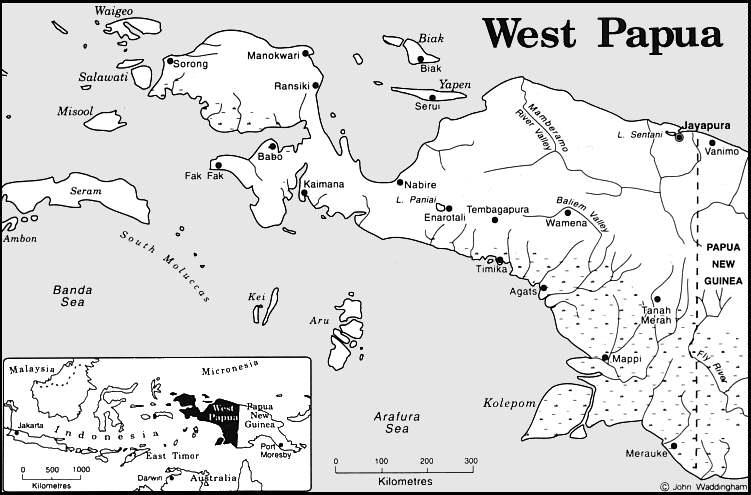
Honolulu-based East-West Center has issued a policy study that is of particular interest to me, for its focus both on Papua and on the construction of national identity.

Pan-Papuan identity is much more widespread and the commitment to a Papuan nation much stronger in 2004 than it was in 1963, when Indonesia thought it was liberating the Papuans from the yoke of Dutch colonialism. Rather than feeling liberated from colonial rule, Papuans have felt subjugated, marginalized from the processes of economic development, and threatened by the mass influx of Indonesian settlers. They have also developed a sense of common Papuan ethnicity in opposition to Indonesian dominance of the local economy and administration, an identity that, ironically, has spread in part as a result of the increasing reach of Indonesian administration. These pan-Papuan views have become the cultural and ethnic currency of a common Papuan struggle against Indonesian rule. Yet the sharp ethnic distinctions Papuans make between themselves and Indonesians reflect the various and complex relationships Papuans have had with the latter.

Despite the sharp distinctions they draw between themselves and Indonesians, the Papuans are themselves diverse. Papuan society is a mosaic of over three hundred small, local, and often isolated ethno-linguistic groups, whose contacts with each other and with non-Papuans has varied significantly. The evolution of Papuan nationalism has therefore gone hand in hand with the creation of a pan-Papuan identity. The first generation to begin thinking of themselves as Papuans were the graduates of the mission schools and colleges established by the Dutch to train officials, police, and teachers after the Pacific War. The study examines two regions to illustrate something of Papua’s ethnic and religious diversity as well as the different ways in which regions have interacted with the world outside Papua. These two regions, Fakfak [on the lower beak of the Bird’s Head] and Serui [on Yapen Island], had displayed some of the strongest pro-Indonesian sentiment prior to 1961. Today, the choice between Papuan and Indonesian identity is a hotly contested issue in Fakfak, while Serui has become anti-Indonesian. The analysis in these case studies sheds additional light on the ways Papuans have negotiated their ways through choices of identity and political orientation.

SOURCE: Constructing Papuan Nationalism: History, Ethnicity, and Adaptation, by Richard Chauvel.

Leave a comment

Filed under Indonesia

Vaclav Havel Sends Birthday Wishes to Aung San Suu Kyi

Former political prisoner and Czech president Vaclav Havel uses the Washington Post to send a birthday message to Burma’s Aung San Suu Kyi, who turns 60 next Sunday.

I hope that the European Union will draw a lesson from [its failure to improve human rights in Cuba] — for example, when it again negotiates lifting the arms embargo on China. It makes sense to keep up the pressure on the military junta in Burma, which considers all the justifiable calls to free Aung San Suu Kyi and other political prisoners, as well as calls to begin democratic reforms, to be unjustifiable interference in the country’s internal affairs.

Even a decade and a half after the fall of communism there, the citizens of Central and Eastern Europe still vividly remember that their communist rulers made the same arguments. Abuses of human rights and freedoms have never been and will never be solely internal affairs of any country. As someone who years ago experienced firsthand the arbitrary rule of a dictatorial regime but then lived to see better times — to a large extent because of the international solidarity extended to us — I appeal to all those who have the opportunity to act against such arbitrary acts to express their solidarity with people who to this day live in a state of “unfreedom.”

This is also why — together with my friends His Holiness the Dalai Lama, Prince El Hassan bin Talal of Jordan, former presidents Richard von Weizsaecker of Germany and Frederik W. de Klerk of South Africa, and others — I founded the Shared Concern Initiative. The first public manifestation of this initiative was an open letter in support of Aung San Suu Kyi. This is why I welcomed it when the Association of Southeast Asian Nations moved beyond its “non-interference” policy and began publicly debating whether Burma should assume the chairmanship of that organization. This is why I support U.S. sanctions against the Burmese regime and why I find it easy to identify with resolutions by U.S. legislators. This is also why I appeal to the European Union to learn from its Cuban fiasco and step up the pressure on the Burmese regime both within the framework of the United Nations and in other international forums — and to do it in clear and comprehensible terms.

The current situation in Burma is bad. Since 1990 the ruling State Council for Peace and Development has repeatedly promised that it would take steps leading to gradual democratization of the regime. Not a single one of these promises has been even partially fulfilled.

But I am still an optimist. After all, I come from a country where, as late as mid-1989, while all around us totalitarian icebergs were cracking and thawing, the stupid, repressive regime remained strong. I, together with other people of a similar mind-set, was in prison. Yet, by the end of that same year I was elected the president of a free Czechoslovakia.

Seemingly unshakable totalitarian monoliths are in fact sometimes as cohesive as proverbial houses of cards, and fall just as quickly. Continuing democratization of the whole region, together with growing dissent inside the country, must eventually have a positive effect. As Aung San Suu Kyi celebrates her 60th birthday, I wish for her that those changes will happen as soon as possible, and that my silly idea — to hand her a rose — becomes a simple and easy thing to do.

Leave a comment

Filed under Burma, democracy