Category Archives: Indonesia

Improvements in Religious Freedom in Indonesia

The U.S. State Department’s International Religious Freedom Report 2005, introduces its section on improvements in religious freedom in Indonesia with the following summary.

NGOs in the country made some progress in improving respect for religious freedom, particularly in the conflict zones of Central Sulawesi and the Moluccas. NGOs worked closely with religious leaders and the local community to promote mutual respect and cooperation. Conflict resolution efforts in former conflict areas of Central Sulawesi and the Moluccas continued to progress during the period covered by this report. Religious leaders and their followers visited each other’s religious holiday celebrations and often consulted with each other. Sporadic violence incidents in both areas during the period covered by this report failed to spark broader conflict as it had done in years past.

In December, 2004, a 2-day International Dialogue on Interfaith Cooperation, organized jointly with Muhammadiyah, was co-sponsored in Yogyakarta by the Government and the Government of Australia. The President Susilo Bambang Yudhoyono opened the dialogue with remarks that terrorism must be regarded as the enemy of all religions and that tolerance building was critical. Major faith leaders from Australia, New Zealand, Papua New Guinea, and East Timor participated in the Dialogue.

In a national celebration of the Chinese New Year, the President stated that the Constitution guarantees freedom of religion, including Confucianism, and followers should not hesitate to practice their beliefs. The New Year, which took place in February 2005, was celebrated without incident.

Local police displayed significantly more willingness during the period covered by this report to indict security forces allegedly involved in religious violence. In January 2005, local police arrested a senior police officer for his alleged role in the December 2004 church bombings in Palu. Local police also became more active in making arrests of those allegedly involved in violent incidents. A day after the shooting of a Palu clergywoman in July 2004, the Police Chief held a closed door meeting with local religious leaders and promised that the police would guarantee security for both Christians and Muslims. Since that time, local police have protected local churches and other prayer houses during religious services.

Local courts also began, for the first time, to try some cases of those allegedly responsible for violence in Ambon. Beginning in July 2004, local courts began to prosecute a rash of cases, including 17 trials of predominantly Christian separatists in connection with the April 2004 violence.

The Government has taken more steps to prosecute perpetrators involved in Maluku and Sulawesi conflict. On August 28, 2004, 12 Muslim militants were sentenced for their involvement in the Morowali attack in Central Sulawesi in 2003.

The news is not all good, of course. The same report also contains much longer sections on the legal/policy framework and restrictions on religious freedom, plus shorter sections on abuses of religious freedom, forced religious conversion, and abuses by terrorist organizations.

Leave a comment

Filed under Indonesia

Effects of Medieval Climate Change

In south central England, … the century from 1180 to 1280 had been the medieval golden age because of favorable climatic conditions. The climate of the northern hemisphere, including England, experiences alternating cycles of warming and cooling. A warming trend had set in during the early twelfth century and it reached its height in the century after 1180. It was a time of long, warm summers and moderate winters. There always seemed to be enough rain to make the cereal crops sprout fervently. There were no crop failures or famines….

The downside of good weather and sharply rising population was an unprecedented boom in agricultural real estate. The thirteenth century in England was a time of land hunger…. Millions of acres were deforested and settled with peasant villages….

Climatic cycling continued to drive social and economic change. Around 1280 the warming trend began to run down. A new weather cycle unevenly but visibly intruded into rural England. Summers became cooler and shorter, the long autumns ideal for bringing in the lush crops truncated. Winters became longer and more harsh. The cooler period was to last until the late fifteenth century, when it would be followed by another warm century and then the “little ice age” of the seventeenth century, when people actually skated on the frozen Thames–not something you would want to try today.

In the summers of 1316 and 1317 rural disaster struck. The sun did not shine. There were widespread crop failures. There was famine and death from hunger. These terrible years had a special cause. Huge volcanic eruptions in Indonesia threw continent-sized clouds of ashes into the atmosphere and by 1316 this cloud of unbeing had reached England. Even when the sun shone again and the famine subsided, there were adverse weather conditions–too much rain–for good cereal harvests. The price of grain escalated. The stomachs of the peasants were no longer full….

It may be speculated that the Great Famine and global cooling of the early fourteenth century and the deterioration in the diet of the common people that resulted had some adverse impact on public health. Undernourished bodies were more easily prey to the Black Death.

SOURCE: In the Wake of the Plague: The Black Death & the World It Made, by Norman F. Cantor (Harper Perennial, 2002), pp. 67-68, 74-75

Leave a comment

Filed under Europe, Indonesia

A Kiwi Officer in Borneo, 1965

The website of the Royal New Zealand Artillery Old Comrades Association contains a lot of military memoirs from the days when New Zealand had more of a military than it does now. Here’s a tale recorded in April 2001 by former Captain John Masters MC from his days on the border of Malaysia and Indonesia.

It was 1965 in the jungles of Borneo. In the tropical rain forest we lived in a constant sauna. The temperature was the same at 2 in the morning as it was at 2 in the afternoon.

As a young subaltern, my first independent command on active service was small, but we were certain we were elite. Well, after all, we were Royal Horse Artillery.

My single gun crew were all Glaswegians. The Sergeant was a big taciturn Kentishman. I had a battery surveyor, a signaller and a gleaming, well-oiled 105mm howitzer which we made no effort to camouflage. We fired it regularly in support of C Coy, 3 RAR with whom we co-habitated on a little ridge a few feet above the mangrove swamp, and we believed in advertising our presence. Thus we spent three months, never more than fifty miles from the Equator, and never more than fifty feet above sea level.

After seven weeks of this untroubled existence (stress-free because we were forty miles across untracked virgin forest from Battery HQ, and the BSM) we were to be visited in our base by the Director Royal Artillery. He was a wonderful old fellow out from London to visit the only Regiment in the British Army, which was on active service that year. We assembled in our immaculate gun-pit, stripped to the waist and in our Hats, floppy, but with polished brass and our boots gleaming.

My last briefing to the troops, as the General’s helicopter landed, was to tell them to speak when spoken to. “Don’t hesitate to say what you think if he asks you a question.” I was well aware, of course, that Sergeant Smithers had already threatened dire things if anybody moved a muscle.

The dear old chap was overweight and drenched with sweat, but he carefully inspected us all, had a word to each, and then stood us at ease. He then asked if there was anything he could do for us.

Gunner Wilson, the layer, was from the Gorbals. Even after many weeks he was still blue-white in colour. Somewhat flat-chested and with a rather prominent adams apple, he did not look too capable of much initiative in such circumstances. He was however, as I was well aware, the Regimental featherweight champion. I had seen him very effectively deal with a well-muscled Australian who took him at face value, in two rounds.

Well, Gunner Wilson immediately snapped to attention, cleared his throat, and, looking fixedly into the middle distance, belted out, “Sir, when our beer comes in it is too hot.” Sgt. Smithers seemed to lose two inches in height, his jaw muscles slackened into rictus, and his eyes rolled to heaven.

The DRA blanched, but only slightly. He wasn’t a General for nothing. He knew he could do nothing for Gunner Wilson, but, with only the barest pause, he came up with a response none of us ever forgot. Reaching back to his subaltern days on the Indian sub-continent, he said, “Well, I remember, when we had that problem we would hang the bottles in the trees, and the breeze would blow, and cool our beer.”

There was a frisson that rippled through the little group in the gun-pit. An eyelid flickered, a face muscle twitched, but they were British, by God. Unlike any bunch of Kiwis who would have fallen about laughing, they held themselves erect until the General’s helicopter lifted off. Then they fell about.

For the rest of our tour, the answer to any question, or the reaction to any complaint was “Just hang it in the trees, and the breeze will blow, and the beer will be cool.” I loved the Brits.

via Japundit, by a very circuitous route

Leave a comment

Filed under Indonesia

The Inspirational Abdul Rasul Sayyaf

In 1992-96, Abdul Rasul Sayyaf was a “factional leader who controlled interior ministry, whose soldiers committed atrocities, operated training camps and welcomed Osama bin Laden to Afghanistan from Sudan” under the U.S.-supported Mujahedeen warlord government that drove the Soviets out of Afghanistan.

Nowadays, the same Abdul Rasul Sayyaf serves as a key advisor to Afghan President Hamid Karzai.

One August day in 2004, when I was having breakfast with Hamid Karzai on the lush green lawns of the presidential palace in Kabul, he described Sayyaf as an ideologue in a way that sounded complimentary. But Sayyaf is a vicious man, whose followers have carried out unspeakable atrocities and horrific massacres of Afghanistan’s ethnic Hazaras.

Abdul Rasul Sayyaf inspires violence in others: Abu Sayyaf, a Philippine terrorist organization, was named for him by its founder, Abdurajak Janjalani. Janjalani was a disciple and a student of Sayyaf’s who received military training from him. The Indonesian Mohammed Nasir Bin Abbas, alias Solaiman, who was arrested in Indonesia in April 2003, was trained under Sayyaf between 1987 and 1991. Bin Abbas used the terrorist training he received from Sayyaf to set up Camp Hodeibia in the Philippines, according to Maria Ressa’s account in Seeds of Terror (New York: 2003). This camp was later taken over by Umar Patek, an Indonesian who has been implicated in the 2002 bombing on the resort island of Bali in which more than 200 people were killed.

SOURCE: I is for Infidel: From Holy War to Holy Terror: 18 Years Inside Afghanistan, by Kathy Gannon (PublicAffairs, 2005), pp. ix-x, xv

Leave a comment

Filed under Afghanistan, Indonesia

Attitudes Toward Separatism in China and Canada

The sample issue of Singapore University Press’s new China: An International Journal, now in Project Muse, has an interesting article by Wayne Bert about different attitudes toward separatism in China and Canada. Here’s the conclusion (minus footnotes).

The level of modernisation, commitment to democracy and particular historical and cultural experiences can explain the divergent Chinese and Canadian attitudes on separatist territories. Whereas Canada has acclimatised to living next to its superpower neighbour, absorbed the values of a virtual state and discarded the traditional expectations of the importance of territory, China is a rising power with an acute sense of grievance from the way it has been treated historically, or at least the way it perceives it has been treated. This strong inferiority complex has stimulated an intense desire to do something about what many Chinese believe is their misfortune, to occupy an international position that conforms to traditional power politics and emphasises the value of territory. Canada’s attitude is reinforced by its commitment to democracy and interdependence, and to the granting of the wishes of the people of Quebec, whatever they may be. The Chinese, on the contrary, lacking both a commitment to democracy and self-determination or the status of a developed state, view Taiwan not as an area containing a population that should have some say in how they are governed, but as a geopolitical object to be manipulated to maximise the glories of a greater China. The gulf between the norms and conventions regarding democracy and self-determination held respectively by the West and China show few signs of disappearing. The figurative combat over Taiwan will continue, since each side in the dispute “has reached its bottom line” and is not interested in serious negotiation. If the conflict can be kept rhetorical rather than military, it will be a major accomplishment. Meanwhile, the Canadians will eventually reconcile their differences, either in the short- or long-run, either raucously, or quietly, but almost certainly, peacefully.

The slavish Chinese commitment to the very Western concept of sovereignty fits well with a realist’s definition of the international system, albeit a system more closely aligned with the 19th century than with the 20th. The Chinese view of the world, however, is one that very slowly, but surely, is being replaced by a view more akin to the world of interdependence and industrialised democracies. While Canada may represent an extreme view on the question of secession, even in the West, it is one that is gaining ground as the culture and objectives of the virtual state become increasingly dominant. Other Western countries still have their minorities and groups demanding independence, but increasingly it is being realised in the developed world, that some kind of concessions must be made for either autonomy or secession in democracies. It is the developed world that is transforming the international system, which in turn puts pressure on other states and institutions to adopt more modern attitudes and structures. Even Indonesia, a relatively poor and fledgling democracy, has taken big strides in that direction since 1998 even in the face of nationalist counter-pressures. It has wisely granted independence to East Timor and offered greater autonomy to regions. In its pre-democratic period, it had long resisted compromise on East Timor.

So far there is little evidence, however, that the Chinese intend to follow suit. Their stance on Taiwan continues to be intractable, in the face of plenty of evidence that the majority of the Taiwanese have little interest in de facto, or even de jure, joining the Mainland. The main hope for resolution of the Taiwan problem is the fashioning of some kind of face-saving deal that will allow China to claim Taiwan while guaranteeing the people there that this will have no effect on their lives. The prospects of effecting such a feat will grow increasingly remote unless major changes take place in the PRC. Lacking such developments, the Strait of Taiwan will be volatile for years to come.

Leave a comment

Filed under China, Indonesia

Boxing Day Tsunami, Six Months Later

Macam-macam offers a wide-ranging overview on the state of recovery efforts throughout the worst-affected areas.

Leave a comment

Filed under Indonesia

Growth of Papuan Nationalism, 1961-2004

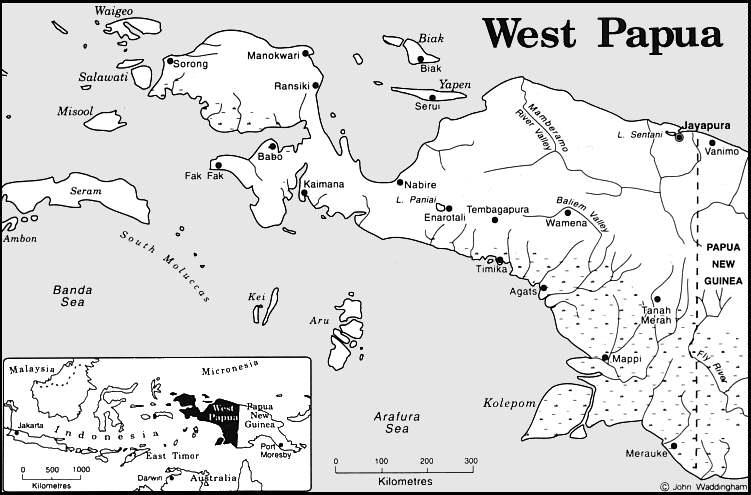
Honolulu-based East-West Center has issued a policy study that is of particular interest to me, for its focus both on Papua and on the construction of national identity.

Pan-Papuan identity is much more widespread and the commitment to a Papuan nation much stronger in 2004 than it was in 1963, when Indonesia thought it was liberating the Papuans from the yoke of Dutch colonialism. Rather than feeling liberated from colonial rule, Papuans have felt subjugated, marginalized from the processes of economic development, and threatened by the mass influx of Indonesian settlers. They have also developed a sense of common Papuan ethnicity in opposition to Indonesian dominance of the local economy and administration, an identity that, ironically, has spread in part as a result of the increasing reach of Indonesian administration. These pan-Papuan views have become the cultural and ethnic currency of a common Papuan struggle against Indonesian rule. Yet the sharp ethnic distinctions Papuans make between themselves and Indonesians reflect the various and complex relationships Papuans have had with the latter.

Despite the sharp distinctions they draw between themselves and Indonesians, the Papuans are themselves diverse. Papuan society is a mosaic of over three hundred small, local, and often isolated ethno-linguistic groups, whose contacts with each other and with non-Papuans has varied significantly. The evolution of Papuan nationalism has therefore gone hand in hand with the creation of a pan-Papuan identity. The first generation to begin thinking of themselves as Papuans were the graduates of the mission schools and colleges established by the Dutch to train officials, police, and teachers after the Pacific War. The study examines two regions to illustrate something of Papua’s ethnic and religious diversity as well as the different ways in which regions have interacted with the world outside Papua. These two regions, Fakfak [on the lower beak of the Bird’s Head] and Serui [on Yapen Island], had displayed some of the strongest pro-Indonesian sentiment prior to 1961. Today, the choice between Papuan and Indonesian identity is a hotly contested issue in Fakfak, while Serui has become anti-Indonesian. The analysis in these case studies sheds additional light on the ways Papuans have negotiated their ways through choices of identity and political orientation.

SOURCE: Constructing Papuan Nationalism: History, Ethnicity, and Adaptation, by Richard Chauvel.

Leave a comment

Filed under Indonesia

New Bombings in Central Sulawesi, Indonesia

Macam-Macam comments on a new round of bombings in the largely Christian town of Tentana on Lake Poso in Central Sulawesi Province, Indonesia.

Indonesia’s aspirations to political stability received a body blow as two bombs ripped through a busy Saturday morning market in the town of Tentana, central Sulawesi, killing at least 19 people and wounding many others. This part of Sulawesi island has been recovering slowly from major inter-communal violence in 2000. Whether these attacks mark the start of a new phase of hostilities remains to be seen.

Sulawesi is unique among Indonesia’s major islands in that Muslims and Christians are more or less evenly numbered, though their distribution is highly uneven. The south is predominantly Muslim, the north predominantly Christian, and the centre, a chequerboard of Muslim and Christian groups and communities.

PreventConflict.org provides more background.

The trigger of the conflict emerged in the shadow of Suharto’s resignation as Indonesia’s President in 1998. As a matter of social convention, the custom in Poso over the past many years was for the bupati (local governor) to alternate between Christian and Muslim office-holders. In this way, the special favors that naturally sprang from political office were somewhat diffused between the two communities. Apparently seizing the transitional tone of the day, then-bupati Arif Patanga, a Muslim, proposed that one of his family members succeed him instead of a Christian.

At around the same time, in what is referred to as the first stage in the Poso conflict, Muslims launched an attack on Christians in Poso, following a brawl between a Christian and Muslim youth. Muslims began to burn down churches and Christian homes, culminating in the second phase of the Poso conflict in April 2000 in which hundreds of Christian homes were destroyed, and many were killed.

The third phase began in May 2000, when the retaliation began in earnest as Christian “ninjas” terrorized and tortured Poso Muslims. Calling themselves “Black Bat” raiders, the Christians attacked Muslim villages. Illustrative is the case of Sintuwulemba, a Muslim village in which a large percentage of the men disappeared or were killed. It is estimated that 300 people were killed although authorities have claimed that it is difficult to produce definitive numbers of the deaths, as the bodies of many victims have supposedly floated out to sea under cover of darkness by way of the Poso River.

In August 2000, the governors of the four Sulawesi provinces declared a truce in the Christian stronghold of Tentena, Pamona Utara subdistrict. Then, in April 2000 the Palu local district court ruled that three Christians who had been accused of involvement in the previous year’s violence would be put to death. Many Christians felt that the death sentence was unjust and biased, considering that no Muslims had been tried for violence that occurred in the first two phases of the conflict. Following the sentencing, there was a resurgence of violence in Central Sulawesi.

In late November 2001, the Muslim-Christian fighting flared up once again, spurred on by the introduction of thousands of Laskar Jihad members in Poso, armed Muslim gangs attacked and burned Christian villages around Poso. An estimated 15,000 Christians had fled from the attacks by early December.

Leave a comment

Filed under Indonesia

April Drought Brings May Riots

What is it about May that brings out not just rutting, but rebellion, the latter so often followed by brutal crackdowns? Here’s a small sample:

Uzbekistan seems initially to have got short shrift from Western media, in their obsession with the role of one of their own (Newsweek) in the other two “Stans.” Bloggers were beating them to the punch: especially Registan, my first stop for news and analysis of Central Asia (and the very first blog to link to my own), Gateway Pundit, and Winds of Change.

UPDATE: On 18 May, the Marmot began daily recaps of key events that fateful day in Kwangju 25 years ago.

Leave a comment

Filed under Afghanistan, Indonesia

Tokugawa vs. Maya Forest Policy

The Spring 2005 issue of New Perspectives Quarterly has an interview with Jared Diamond, author of Collapse: How Societies Choose to Fail or Succeed.

NPQ | You have looked over the history of civilizations and come up with a framework for analyzing why some collapsed while others prevailed. You cite four common challenges of past societies-climate change, self-inflicted environmental damage, changes in trading partners and enemies-and then look at how the response to those challenges led to success or failure.

You point out, for example, how the Maya failed and the 17th-century Tokugawa Shoguns in Japan succeeded. Having overexploited their territory, the Maya collapsed because the ruling caste, which extracted wealth from the commoners, was insulated from the effects of deforestation and soil erosion and thus failed to act.

Conversely, the shoguns of 17th-century Tokugawa Japan recognized the danger of deforestation to the long-term peace and prosperity of their successors and imposed heavy regulations on farmers, managed the harvest of trees and pushed new, lighter and more efficient construction techniques. Today, even though Japan is the most densely populated country of the developed world, it remains 70 percent forested….

DIAMOND | The problem is that all the challenges are interrelated. If we solve problems such as invasive species or toxic pollution, but not the shortage of fresh water, collapse still beckons. All the challenges need to be addressed simultaneously because they add up to an unsustainable course.

But, let’s take just two challenges: deforestation and fresh water.

At the rate at which we are going now, the world’s tropical rainforests–except the largest ones in Congo and Amazon Basin–will be completely felled within the next decade. In the Philippines and the Solomon Islands, they will be gone within the next five years.

Most economies in these areas, of course, are heavily dependent on those forests. In places like Indonesia, which is the world’s fourth most populous country, or in the Philippines with 80 million people tightly connected to the US, there are already civil wars, in part based on environmental factors and fights over resources. China and Japan already get most of their timber from those countries.

Further, this is not to mention places in Africa like Gabon or Cameroon that are similarly on the verge of deforestation.

Historically, deforestation makes people poor and leads to conflict. We are bound to see that again.

Seventy percent of the earth’s fresh water is already being utilized by people for drinking, industry and agriculture. The remaining 30 percent is in places like Iceland and Northwest Australia, which are hard to get to. What happens when we use up even that last 30 percent? Why not desalinization of sea water? Okay, but that requires fossil fuel energy to operate the plants, and that creates other problems.

We’ve already seen countries come close to fighting over water, such as Turkey and Syria or Hungary and the Czech Republic. Water is a time bomb set to go off within decades, not centuries…

NPQ | This suggests that the Communist remnants of central planning in China might be better able to respond to the environmental challenge of unsustainability than consumer democracy.

If Japan had a consumer democracy in the 17th century instead of the Tokugawa Shogunate, perhaps it would not have been able to stem deforestation and collapse?

DIAMOND | Maybe, but I don’t think so. The historical record, at least, shows no general case for either democracy or dictatorship in terms of curbing environmental damage. The Tokugawa Shoguns made a good decision; the ruling kings of the Maya failed to take action.

via RealClearPolitics

Several years ago, I heard Jared Diamond talk about protecting bird habitats on the island of New Guinea. He described how easy it was to set up a vast sanctuary on the Indonesian side of the island (West Papua), where a powerful and ruthless government simply decreed that the sanctuary was off-limits and also prohibited villagers from owning firearms that threatened both the bird populations and government control. The weakness of the central government in Papua New Guinea, by contrast, allowed villagers to possess firearms that nearly destroyed bird populations within the radius of many villages. The highly contentiousness nature of local land ownership also prevented the central government from setting aside large nature preserves. At the same time, litigious landlords in PNG forced the oil companies to be very, very careful not to disrupt village land resources, so that big-oil extraction sites in PNG were often the most effective nature preserves in the state. (The same can hardly be said for the mining industry in either PNG or West Papua.)

Leave a comment

Filed under Indonesia