Category Archives: Pacific

Morobe Field Diary, July 1976: Going Fishing

Yesterday was rainy so I decided to accompany the fishermen. My biking poncho kept me warm and dry for the most part and the clouds kept the sun off. But the wind and rain made it a lousy day for fishing. In the afternoon it cleared up some and, while I stayed aboard the [M.V.] Sago, some people came up with respectable catches. One fellow had a big fish (probably 5 lbs) bitten off at the gills by a shark as he was pulling it up. Another fellow caught a small shark and I saw another small one in the water (small = 2-3′). I had no desire to swim in those waters.

We fished around the islands offshore where the water is deep and most of the catch was (I think) red snapper (or red emperor] or various snappers [or sea perch, Lutjanus spp.] with sea bass [or rock cod, Epinephelus spp.] (called ‘big mouth’ in Tok Pisin) making up most of the remainder. The fishermen are paid 10 toea [= 0.10 K(ina)] a pound; the Sago sells them in town for 30 toea a pound and the retailer sells the fish (fresh or frozen depending on how long after the boat gets in you buy it) for 75 toea/lb. Makes American dairy marketing look pretty decent. The boat’s crew cleans and weighs the fish and must be paid and then there’s the gasoline and boat upkeep. Some men worked all day yesterday for 40 toea. The maximum earned was about K1.40 and the minimum 0 toea. Evidently a good day’s fishing would yield about K1.00 in cash per person. So a good steady fisherman (which few are) could earn about K4-5/wk at most.

Today I stayed here because it looked to be too sunny early this morning when all went out to the island where many left their canoes yesterday. And sure enough it’s a scorcher. Good for airing out the things left in my room when I was stuck in Lae.

Since the kaunsil had a lousy day fishing I suspected he might break open the case of beer I brought him last nite and he did and he & I and his son drank about a 6 pack, each getting pleasantly tipsy and storytelling. A wilder party was going on kitty-cornered from us: singing, laughing, music inside and a lot of beer bottles lying on the beach later. We put our beer on the ice in the Sago first so it was quite good.

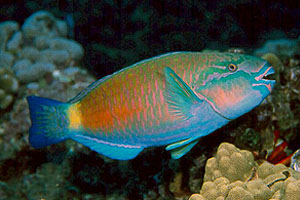
I’ve gotten fascinated by the little Fishes of Hawaii book that I brought with me (by Gar Goodson). Apparently a large number of fish [especially wrasse and parrotfish] go thru color & sex changes that at first had scientists fooled into giving them 360 species names (in parrotfishes for instance) when there were no more than 80 or so going through their changes.

Leave a comment

Filed under Papua New Guinea

Morobe Field Diary, June 1976: Fieldworker’s Frustration

Before setting out for Karsimbo I felt the first severe case of fieldworker’s frustration. I was tired of being unignored, or scaring kids, of being hailed for doing the least bit of work. And though my reports and dictionaries were proceeding well I realized my speaking/hearing ability was a disappointment to both me and the rest of the village. Partly it was the necessary swing back from total communication and little work to lots of work and little communication. I didn’t take my work to Karsimbo and spent more time communicating and doing things I could describe to people in the village that they didn’t already know about beforehand. I talked about my solo walk up the mountain to see if I could see Kui. I ended up seeing Salamaua Peninsula and the mountain ranges behind Lae (or at least their clouds) but not Kui because the angle wasn’t right. And I didn’t get lost (as I had been warned I might). I followed the huge caterpillar swaths [logging roads] and only turned back when the road I was following was overgrown too much and I heard a not unsizeable creature ‘break bresh’. I came down the mountain feeling quite invigorated and rehearsing my description of my excursion, finding, a little to my surprise, that I could say about all I wanted to say.

Back at camp my hosts had gone en masse to bring back a pig a guy with us had killed and so I went over to another group who had just finished fighting saksak [pounding sago] and told [them] I had climbed the mountain, not seen Kui but seen Salamaua, heard plenty of hornbills and not got lost, all in Binga N. and in return was offered betelnut, talked about a bit and informed that now I had heard Binga N. finish. It was just the sort of success I needed to bolster my spirits and encourage my teachers.

I came back to Siboma telling stories of the two pigs that guy killed–one with a spear made from a speargun–and of beating kundu [sago], which is not waitman’s work.

The last day there they forced me not to help with a third sago palm they were helping someone else do but on the way back I got the big paddle [not the kid’s paddle they gave me on the way there] and paddled like a maniac to dispel my lethargy. I sat in the front where I would affect the steering less and just did most of the power stroking while my mama (‘father’) and awa (‘mother’) took turns keeping the canoe on course and paddling. Part of the fun of this kind of fieldwork is getting to readolesce all over again as well as play with kids on their level–all for science of course. So my brief dumps down in which I found myself last weekend are dispelled and I’ve set aside my dictionary work for a while to start talking more. This weekend I’m in good spirits–partly because I’m heading into Lae for a day or two. And when I get back with my new supplies I will be able to go visiting with more grace (i.e. goods) and confidence. And people are beginning to talk to me in B.N. off the bat now after I began to start every communication in B.N. leaving Tok Pisin for the reserves.

I torture the kaunsil with thoughts of the cold beer waiting for me at the other end of my boat ride. I plan to bring back a case, along with a thousand other items.

Leave a comment

Filed under Papua New Guinea

Morobe Field Diary, June 1976: Sago Work

I’m just back from a trip to the former Numbami village of Karsimbo for the purpose of getting a breath of fresh air (kisim nupela win) and getting sago starch (paitim saksak). I had a chance to observe the process of producing edible sago from start to finish so I’ll attempt a description.

First a suitable tree [Metoxylon sagu] is selected. One near a stream is best so the pulp won’t have to be carried far to wash. A man chops down the tree, which is a thorny son of bitch and the kaunsil borrowed my zori [rubber slippers] to do the job. Then the outer bark is removed with an axe or, less effectively, with a bushknife (busnaip). The men usually do such work but women may participate. It’s a matter of practicality, not custom. The inner bark is then stripped in slats with the aid of a siala, a large digging stick used also for making holes to plant taro in the garden–a smaller version is stuck in the ground and used to husk coconuts.

The strips of inner bark are then used to catch the pulp. This leaves the pinkish white inner fibery trunk of the tree ready and waiting submissively for you to hammer the crap out of it with a wanginda, a tool with an adze-like handle and a head of anything from a flat, sharp-edged stone to any old shell casing or length of pipe. The handles vary from child- to man-sized thicknesses. Pounding is not limited to one sex or the other and is the most tiring of the chores associated with kundu/saksak/sago palm. Being unskilled immigrant labor my job is mostly pounding which I do rather effectively after my first attempt in which I broke the head (a huge nut of iron) off one wanginda and blistered my hands badly. It requires some skill to combine chopping a piece off the log and smashing the stuff previously chipped off to a fine enough consistency to yield plenty of powder, kundu ano or ‘true sago’ [or ‘sago essence’], when washed. This time I was permitted to do a third of one medium-sized tree and half of a small one (12-14″ diam. 10-12′ long).

Meanwhile a man constructs a washing machine [or chute] of a section of the outermost covering [of a sago branch] something like a [huge] stick of celery. In the wide mouth of it, he arranges the coconut webbing to filter the fiber out of the powder as he pours water thru it and turns it and squeezes it. The orange colored water runs down the celerylike [stalk] to a hole thru which it drains into a mat of the leathery husk [sheath] of some tree–people in Yap used something similar to sit on when meeting out in the open and theirs was from the areca palm. The coconut tree webbing and the mat, called yáwanji > yáunji, are the only parts of the washing machine to be reused. The hole is plugged with green fiber that both blocks the water from escaping down the rest of the open tube and conducts it down into the mat. [See more images of sago pounding and washing (scroll down).]

The washed pulp (ulasa) is built up around the edges of the mat for support as it gets fuller. When a lot of sago is a-beating several washers are set up. Only men wash and only women (& children) carry the pulp from tree to washer. When all is washed (-lomosa) the powder, kundu ano, will have settled to the bottom in a heavy pasty mass and the water is then drained off (-lapa tina tomu) [‘beat water apart’] and the paste scraped off and shaped into large rectanguloid lumps. Green sago fronds are then laid on the ground and the lumps burnt on top of them with dry fronds (damu meaning both ‘torch’ and ‘dry frond’ the two being one). The burnt skin of the lumps (baloga) is sweet and considered a treat. The mat is carefully scraped of all the powder, odd bits being dumped in a pan for the dogs. After that the lumps are carried back with the coconut webbing (gogowa–sorry, this is the tube, nuta is the webbing, the laplap (lavalava) bilong kokonas). Bihain [= later] the kaunsil agrees to put the whole thing on tape for me in Binga Numbami; he practiced a bit just now and I could follow most of it fairly well, having seen it all and catching the right cues here and there.

Leave a comment

Filed under Papua New Guinea

Morobe Field Diary, June 1976: Naive Ethnomusicology

It’s Sunday and Friday nite I was expecting to get into town (or leave for town, which means getting in Saturday morning). A bunch of people from the Kui, Siboma and Paiawa church circuit [or parish?] have to go build a house for a big church meeting in September of the Lae or Morobe Parish [or circuit?] so they will use the [M.V.] Sago to carry all and drop them on the way to town, do their business (and me do mine) and pick them up on the way back. So I’m writing letters like mad to mail when I get into town.

The church service reminded me to write something about the music. All songs are in Yabêm and the words are in a hymnal without the notes, only marks indicating repetition [where to repeat]. Some of the songs are translations from German standards and are immediately recognizable from their steady beat, be it fast or slow (usually quite plodding), as it proceeds, Westernly from bar to bar. The others are local compositions with the author’s name and place at the bottom and these are recognizable by a rhythm that goes from crescendo to crescendo. They usually build up slowly on the men’s voices which carry the low tones [pitch] and gradually pick up the women who usually trail a bit behind the men and carry the crescendo to its peak in high tones [pitch] and at a much greater amplitude since all voices are contributing. The men then beat the women to the beginning of the next cycle, the song often carried by just one person at first then by more and more till the next crescendo peak. So one is a bar and staff rhythm, the other a crescendo to crescendo rhythm. Thus endeth my first attempt at ethnomusicology.

UPDATE: Recommended reading for specialists: Mission and Music: Jabêm Traditional Music and the Development of Lutheran Hymnody, by Heinrich Zahn [1880-1944]. Translated by Philip W. Holzknecht. Edited by Don Niles. Boroko: Institute of Papua New Guinea Studies, 1996.

“This entire work is a fitting tribute to one of the little-recognized–but hardly “unsung”–heroes in the development of Jabêm music and literature.” –Oceanic Linguistics 36 (December 1996) (Read full review)

“[Zahn’s] feeling for context almost makes him a contemporary of the sociologically oriented ethnomusicologists of today such as for example Thomas Turino.” –Oceania Newsletter 21 (September 1998) (Read full review)

Leave a comment

Filed under Papua New Guinea

Morobe Field Diary, May 1976: An Injured Child

The other day some women came back from their garden with a [c. 3-year-old] kid who had sliced off the top joint of his ring finger. It took some discussion before they asked me for medicine and bandage. I had only some of those sterile gauze pads and bandaids along with disinfectants but nothing to stop the bleeding and felt pretty useless but it turned out they decided to put kambang, the [slaked] lime chewed with betel nut, on as a disinfectant and I have an ample supply of that. I measured some out on my knife blade and put it on the cotton and one guy tied up the bandage. When they took the original bandage off blood shot out of the finger. They said later that the kambang would act as a poultice and when it went to work that nite the kid would not feel in the best of spirits. A doctor came or they took the kid to the doctor in the next village and he gave a penicillin shot and rebandaged the wound and yesterday the guy who did most of the original doctoring came to get my disinfectant powder and some bandaids so the wound seems to be healing all right. Since then I have been of slitely more use in dispensing aspirins, one cold tablet, and bandaids. Next time in town I plan to get more aspirins and some stomach marasin for me. My host’s wife gets migraines.

Leave a comment

Filed under Papua New Guinea

Morobe Field Diary, May 1976: Sociolinguistic Notes, Kui Church Meeting

The meeting started out mostly in Tok Pisin and was conducted in parliamentary procedure of a most genuine and impressive kind. No holds barred discussions took place, which the two secretaries (called cuscus after a local animal [phalanger, opossum]) duly recorded in Tok Pisin. But as the meeting wore on, Yabem became more prominent perhaps because the older people are more comfortable in it and they did most of the talking. My presence did not seem to hinder the discussions in the least. Younger men would listen to Yabem and reply in Tok Pisin. The Sunday service was conducted similarly: Hymns & prayers in Yabem were followed by a sermon and scripture reading from the Nupela Testamen. There followed an ordination ceremony in Yabem. Ceremony tends to be Yabem because a prayer book or whatever it’s called has been translated into Yabem. Still, Tok Pisin seems to be slowly taking over from Yabem.

An Australian Lutheran missionary came on the afternoon of the Saturday meeting and I got to see the small singsing cooked up for him. The ship was met at the dock and after unloading the passengers headed off for the meeting ground. They were soon accosted by a guy with a padded out stomach and a construction helmet who looked as severe as possible and asked where they thot they were going. They gave some reply and he turned to the coconut frond fence they had erected for the occasion and called out his troops: about half a dozen men and an equal number of women adorned variously with grass skirts, body paint (ochre legs, black & white-face) and some towels the women carried as they danced. The men blew conch shells and beat a drum while they chanted and made threatening motions–one with a tomahawk–and threw coconut frond ribs at the visitors & crowd.

I tagged along with the spectators, who explained to me the setup beforehand and told of cases where some kids had been scared by the display into crying. They, however, were well aware it was all by way of giaman (roughly ‘deception’) and were as touristy as I was about it all.

The dancers were singing a Siboma singsing which the Sibomas asserted they had done rather poorly. People are familiar with singsings from a variety of places and like the local string band numbers as well as Western music and singsing music. Unlike Micronesia, which seems to lean toward Western stuff as far as I can tell. Well, maybe Yap just didn’t have a lot of intermediary music olsem stringband stuff here.

The boat carrying the missionary and 2 dozen others came into the dock head on and nearly knocked down the newly repaired thing altogether. It is an old leaky boat unlike the sound, sturdy little [M.V.] Sago which the Sibomas commissioned and had built recently.

It wasn’t till after the service Sunday that I talked with the missionary tho I saw him off and on from a distance. In Micronesia whites living in the village tend to be mistaken for Piskor; here they are taken to be SIL Bible translators. Both perform a similar function in fostering democratization and racial equality. [Several people mentioned that the missionaries, unlike the Australian administrators, would eat from the same food.] Melanesians are rather capitalist & democratic but racial equality needs considerable more work.

The ‘informant’ situation couldn’t be better. The kaunsil puts me to work. People never leave me alone when I’m working; they all come around eager to help and I’ve so far spent too much time getting & putting on paper & not enough assimilating and organizing. I’ve really got to work out a felicitous medium ground arrangement without alienating people. For only a week & a day here I feel like I’ve made phenomenal progress. The trip to Kui allowed me to stop assimilating onto paper and start communicating in it more.

Today I did my big book of seashells, with interesting results. Dictionary work is more fun than grammatical when your informants are not top grade. Together they make a good combination. And being put to work rounds things out nicely. Being able to relax by myself is all I need more of. And I think I’m slowly working that out.

The kaunsil & family are really top grade teachers (he was a schoolteacher for a while–a long while–and has ‘bossed’ (taken care of, taken responsibility for) a number of whites). [His lead dog was raised by whites and knew how to sekan (‘shake hands’)–and to eat ship biscuits.]

Leave a comment

Filed under Papua New Guinea

Morobe Field Diary, May 1976 Trip to Kui

The [M.V.] Sago pulled 4 canoes to Kui, 2-1/2 coves away toward Lae just inland from Lasanga Island. The ride took about an hour and cost the kaunsil, his wife & canoe & me 70 toea [100 toea = 1 kina]. The occasion was a meeting of the Malalo Paris of the Lutheran church here.

The first time I saw Kui was in the middle of the nite and I could only see a few houses, a broken down wharf and a lamp or two. This time it looked quite splendid indeed. It stretches along a cove twice as wide as Siboma’s and deep-watery and waitsan-dy [Tok Pisin waitsan ‘sand’] with a large school ground in the middle. There are really three subvillages: the main one Kela who came to Kui to go to church from Buso. Apparently Siboma had the only church but it was a bit of a long way so they split the difference and started a settlement and later a school at Kui. The school is Standard 1-6 and serves Paiawa, Siboma & Buso and of course Kui. The kaunsil has 2 sons and 2 daughters there.

The trip back was exactly what I hoped for and dreaded. We paddled, the kaunsil, his wife & me. When we set out at 8:00 (so the school kids could help us pull the canoe down to the water) I envisioned an all day affair with possibly a siesta midway and a hot sun (aye, that it was). And I only had my lotion, not my sunscreen. But my hat protected my face, a towel covered my knees and my feet were in the canoe so only my arms got really cooked. Oh, it felt good tho to paddle like a machine. I conked out when I got back but am none the worse for wear and am on my way toward getting some useful callouses on my hands. They had to force me to rest sometimes but we did the trip in 2 hours with two rest periods when I wasn’t pulling so my arms are cooked but not blistered.

The water was clear down deep and the coral formations beat the Honolulu Glass Bottom Boat ride. Very small bright blue fish abound here, lots of others come and go. We wrestled with a [large] clam a bit on the way but let it go. The kaunsil had his shotgun ready but the birds seemed to be on to him, so no bird meat.

Leave a comment

Filed under Papua New Guinea

Morobe Field Diary, April 1976

The boat ride to Siboma [in Morobe Province, Papua New Guinea] took 10 hours [from Lae]. Darkness came about Salamaua. Shortly after leaving we could see Lasanga Island that lies off Siboma a ways. There was a half moon and all nite the coast was visible. During the day villages were marked by smoke, at nite by lites. The lite of a single lamp can be seen a long way off. And on the boat you could barely hear the person next to you for the sound of the [Yanmar two-cylinder diesel] engine. When the engine stopped everything sounded a bit faraway well into the next morning.

We got in in the middle of the nite and not a lite was shining. I left most of my stuff aboard and went straight off to the kaunsil’s house to sleep. He has a couple of rooms facing the sea. He took off to go hunting for pig soon after we got in so I stayed around the next day so I would be here when he got back.

About the time I got up the boat was leaving for the fishing grounds pulling about a dozen outrigger canoes all lined up behind. It puttputted out and got back about dark pulling the canoes back in. Mostly women and children were left behind along with some old men who kindly taught me stuff.

Siboma lies in a cove with mountains surrounding it. There is a narrow stretch of sand with about 3 dozen houses strung out along [it]. The timber company that bought their timber cleared land for a new village on the other side of the cove but only one incomplete house is there now.

There is a pleasant little stream, nice and chilly, to wash in a little ways out of the village. The women’s W.C. stands near my end of the village and the men’s all the way (100 yds?) at the other end.

Plenty of dogs and chickens abound but no cats and, strangest of all, no pigs. The past kaunsil said to get rid of the ones in the village for sanitary reasons. Though they may keep some down the coast a bit they mostly have to get them in town or hunt for wailpik like the kaunsil does with his shotgun the size of Dan’l Boone’s long rifle.

There really are no mosquitoes, it’s amazing; and the compensating sandflies don’t bother me as much as they seemed to bother [the fieldworker who arranged my stay].

Yesterday, my second full day in the village I had a mild case of diarrhea that affected my appetite and worried my hosts a bit. But this morning I made up for it some by polishing off a whole fish and a huge plate of rice.

There is one crazy (‘longlong’) man here who wanders around covered by a blanket and one mute I share a room with. Neither does anything all day but each is apparently provided for. Some of the women are from other places but they have learned [the village language].

Today the kaunsil called everyone together and apportioned the work: who’s to fish, who’s to cut sago, who’s to split it, who’s to wash it, etc. The sun has withered many of the gardens so people are turning to sago, which is hard work, for their starch. It’s good I came equipped with 25 kilos of rice. There are no gardens near the village [not entirely true, as I later found], only some stands of sago and coconut. The women all have to take outriggers to work in their gardens [on the hillsides above the cove].

None of the smaller outriggers are equipped with sails but they are a joy to paddle. There are about three big canoes with masts and a couple more in the making. [In July, I counted 28 canoes in Siboma’s cove.]

Leave a comment

Filed under Papua New Guinea

Micronesia: Clean Gov’t, Corrupt Gov’t Tied at 1-1

Anticorruption forces have managed to convince the Congress of the Federated States of Micronesia not to pass Resolution 13-76, a blanket amnesty for both indicted and unindicted officials accused of corruption.

According to an FSM Congress press release, the measure seeks to “forgive all those who wronged the FSM government” since the beginning of the Compacts of Free Association, a treaty with the United States, from Nov. 3, 1986, to Nov. 3, 2002, who “are not yet convicted.”

However, the forces of corruption prevailed earlier, with Resolution 13-69, which discontinued the services of retired judge Richard E. Benson, who had been appointed by the FSM Supreme Court as a Special Justice on a corruption case involving congressmen from Chuuk [Truk] state. (A total of 14 defendants have been named, and as much as $25 million is said to have gone missing.)

FSM President Joseph J. Urusemal has filed a Writ of Prohibition with the FSM Supreme Court seeking to prevent the enforcement of the Benson resolution, on the grounds that it violates constitutional separation of powers. Justice Benson had previously served on the FSM Supreme Court.

Leave a comment

Filed under Micronesia

The German Pacific "Gutpela Taim Bipo"

Germany acquired its colonial empire in the Pacific beginning in the 1880s and lost it abruptly in 1914. Conventional wisdom usually assumes that one colonial administration was as bad as another and that colonial transitions usually made little difference to the indigenous population. However, the new military administrators who took over from the Germans in Micronesia, Samoa, and New Guinea ran so roughshod over their new territories that the inhabitants of all three regions soon began to look back on German times as the good old days–at least according to a meticulously researched revisionist history of that transition entitled The Neglected War: The German South Pacific and the Influence of World War I, by Hermann Joseph Hiery (U. Hawai‘i Press, 1995).

While Germany’s African colonies were governed by aristocrats, often with the aid of sizable contingents of Schutztruppe (colonial troops), the farflung Pacific colonies were governed by administrators drawn from the middle class, with the aid of tiny police forces.

In New Guinea they replaced the “Perpetuum Bellum Melanesicum” with a Pax Germanica, which attracted more and more unpacified Melanesians. But they also generally let Melanesian villagers settle their own disputes in traditional ways, often by compensation for damages rather than by the trial and conviction of offenders before German courts. This was in marked contrast to the later Australian administration, under whom flogging, the pillory (“Field Punishment No. 1”), and public executions became not only far more common, but far more arbitrarily applied. The Australians also began to dispossess indigenous plantation owners and to impose new restrictions on native dress and education. (For instance, New Guineans were prohibited from speaking proper English and from wearing nonnative garments on the upper half of their bodies.)

In Micronesia, the laissez-faire attitude of the German administration gave way to the much more hands-on approach of the Japanese, who modernized the island economies with unprecedented force and speed. By 1921, the value of exports from Micronesia had already exceeded the value of imports. (And by 1940, the population of Micronesia was over 50% of foreign origin.) The islanders were forced to assimilate to Japanese norms in every respect.

Perhaps the most incompetent new administrator, however, was Col. Robert Logan, New Zealand’s military governor of German Samoa. Whereas Wilhelmine Germany and oligarchical Samoa had shared basic values about social hierarchies and ritual forms of behavior, “the Samoans perceived the ‘democratically’ undifferentiated behavior of New Zealanders as an insult and expression of open disregard for Samoan mores” (p. 250). During the war years, New Zealand bled dry the Samoan treasury, and the fiercely anti-Chinese and anti-American Logan also issued discriminatory edicts against their representatives in Samoa. Worst of all, Logan allowed an influenza-infected ship from New Zealand, the Talune, to dock in 1918, then stubbornly refused either to implement strict quarantines, as the American administrator had done in eastern Samoa, or to accept American medical aid. “Rarely would anti-American prejudice have more disastrous consequences than in Samoa under New Zealand occupation” (p. 174). As a result, about 20% of the population of western Samoa died, while eastern (American) Samoa escaped virtually unscathed. (New Zealand Prime Minister Helen Clark issued an apology to Samoa in 2002.)

Among the many other gems Hiery’s archival research unearths is a dispirited quote from Woodrow Wilson recorded in the minutes of a meeting at Versailles on 28 January 1919: “the question of deciding the disposal of the German colonies was not vital to the world in any respect.” He seems to have anticipated by exactly half a century Henry Kissinger’s alleged comment about Micronesia in 1969: “There are only 90,000 people out there. Who gives a damn?”

1 Comment

Filed under Germany, Japan, Micronesia, New Zealand, Papua New Guinea, Polynesia