Yesterday, Friday the 13th, was no worse than the rest of the days of August, which is month of 31 Fridays the 13th by reckoning of the people along this coast. Em taim nogut: planti sik i kamap, solwara i sulukim nambis, pik i kaikai man, pis i siutim man, bikpela ren i kam wasim bris, kano i go lus, kainkain samting nogut [‘It’s a bad time: many illnesses arise, the sea erodes the beach, a pig bites a man, a fish stings a man, a big rain washes out a bridge, a canoe drifts loose, every kind of bad thing’]. And it’s all true. A fever is going around and has found me among its many victims. It really laid me low and I still haven’t fully recovered. I would advise anyone else doing fieldwork along the coast south of Lae to spend August in Lae or Ukarumpa or something. The SILers working on Kaiwa told me in July they planned to stay in Ukarumpa until September to avoid these hazards.
Category Archives: Pacific
Morobe Field Diary, August 1976: A Month of Fridays the 13th
Filed under Papua New Guinea
Morobe Field Diary, August 1976: Traders, Workers, and Dogs
Last nite the [M.V.] Suena Dubu, a ship belonging to the people around Morobe Patrol Post down the coast a ways, came in and offered goods for sale, a floating store. Seems a German business advisor had his girlfriend (who spoke little English) come to visit and conceived of this business venture as an excuse for getting her (& him) around to see the real New Guinea. I bought tobacco & crackers [ship biscuits] which I was running short of and exchanged a few words with the German man, in about half Tok Pisin, half Tok Inglis, and generally milled around with the other villagers when the two & a few of their (PNGean) crew came ashore to buy a few things. That nite I put on Bach’s Brandenburg Concertos 4, 5, & 6 and let it drift out over the water for them but I’m not sure it was loud enough. They slept aboard the boat, did some business in the morning and chugged out a few hours ago.
The line between me and everyone else in the village expands to include me in the presence of outsiders.
This morning there was a demonstration (one sign) by the fishermen in the village demanding 20 toea/lb for their fish (a 100% raise over the present 10t/lb). They enjoyed themselves.
After most of the week hibernating working on my dictionary, I was getting sore sitting down so much and quite irritated at being interrupted. Part of the irritation was from the fact that I had nothing to share with people verbally. But by Thursday I had pretty much caught up and had about had it so when a younger guy was getting people to beat sago I volunteered. It was the tree of the kolapa (young, i.e., unmarried, man) and mostly it was kolapas who did the work though three ewekapas (young women) helped with the carrying of the pulp to the washers. I raised my blisters again just when my last crop was peeling off and managed to break all but one so my hands are usable if a bit sore today.
Today I accompanied the kaunsil’s family to the garden (the second time I’ve been there). It was just what I needed to stretch my legs, change my scenery and snatch some real peace & quiet. We walked all the way up and over the top of the ridge which I estimate to be about 200 meters above sea level and follows a slope of about 50-60 degrees. The kaunsil is cutting a new canoe just over the top of the ridge. Getting it down to the water is going to be real fun. Getting ourselves down in the rain today was treacherous enough.
I finished Hyman’s phonology text except for the chapter on generative formalisms. I’m well pleased to have brot it with me. But I got hungry for fiction so I dug out an abridged Don Quixote (432 pp.) and have been enjoying it immensely.
The kaunsil’s prize hunting dog that is well behaved and can shake hands (having been raised by a European) as well as leap over wild pigs contracted mange that threatened to destroy his beautiful yellowish-brown coat. I went to town and got some medicine but no one has gotten around to putting it on and the hair continues to drop off, scabs rise and even the hair remaining has lost its luster. And sympathy has begun to turn to disgust–so strange are human emotions. Saving a dog’s skins is just not high on the list of priorities, most of which are subsistence level–repairing the old canoes that were on the verge of falling to pieces, finishing the veranda on my house, cutting the new canoe, gathering food from the garden and preparing it.
Several people have mentioned I’m getting fat! It shouldn’t be surprising but for my usual inability to do so. It does seem like I’ve put on a pound or two. I bet if I shaved people would think I was emaciated.
Filed under Papua New Guinea
Sandline Wrap-up in Papua New Guinea
The Head Heeb does a wrap-up on the Sandline scandal in Papua New Guinea.
The last echoes of the Sandline crisis were heard today in a Papua New Guinea courtroom with the acquittal of Jerry Singirok on charges of sedition….
The government may also have thought it was time to bring the matter to a close; despite having almost seven years to prepare their case, they only presented one witness.
Filed under Papua New Guinea
Anniversary of "Bravo" H-Bomb Test on Bikini
March 1st is also the 50th anniversary of the H-bomb “Bravo blast” on Bikini in the Marshall Islands, where the U.S. conducted 67 nuclear tests between 1946 and 1958. The Bravo test was a horrendous mistake.
By missing an important fusion reaction, the Los Alamos scientists had grossly underestimated the size of the explosion. They thought it would yield the equivalent of 5 million tons of TNT, but, in fact, ‘Bravo’ yielded 15 megatons — making it more than a thousand times bigger than the bomb dropped on Hiroshima.
Bikini and Rongelap (100 miles to its east) are still uninhabitable.
Filed under Micronesia, U.S., war
Morobe Field Diary, August 1976: Back in the Village
I couldn’t get much done yesterday because of the steady flow of lousy informants to my ‘office’. But I was given plenty of betel nut and chewed till my teeth are sore. And in the evening I did a good bit of talking in Binga Numbami that goes to show that ‘dry spells’ are often nothing but assimilation and absorption periods. I was feeling particularly dry after my weekend in Lae (actually midweek).
The Sande today started out with Yabem liturgy, including two German > Yabem hymns; Tok Pisin scripture and sermon; followed by a translation in Binga N. spoken mostly facing the women. The men were scattered all about in a widely strewn circle, the women bunched all up next to and under a house. Gilami, the speaker, feels the message is important enough to be translated on most occasions and he is a good talker though a little inclined to righteousness (ah, a kindred soul).
Filed under Papua New Guinea
Morobe Field Diary, July 1976: A Grueling Boat Trip
Travelling aboard the [M.V.] Sago is always an adventure. The last trip back from Lae on July 28 took me 24 hours almost. After 3 trips down to check on the ship I found it was to leave the next morning. So in order to not be left behind as I was before I put some cargo aboard and got up at six (without an alarm) the morning of departure to insure they wouldn’t get impatient & take off. J. was prevailed upon to drive me down by 7 am. I got there and rain was falling steadily and no one was about. I waded out to where the Sago was tied up and found the Captain just getting up. Orait, by 9:30 I had decided to eat breakfast at a small haus kaikai [‘house eat’ = ‘restaurant’]. When I came back we were ready to go.
The boat put in at Buansing and we passed its neighboring enemy Laukanu (Bazela). The Sago had just been chartered to carry a Kaiwa corpse back to his village Buansing and we had to send talk to the village. Buansing is Yuwala-(Kaiwa-)speaking and its neighbor Bazela (Laukanu) is Kela-speaking. The kiap (local gov’t official) insists upon a single kaunsil [village head] for both villages and since Bazela is more prominent & the Kelas’ claim to the area is officially recognized over that of the Kaiwas’ [who used to live inland, but most likely moved there from the coast much earlier], the former get the kaunsil. Bazela also has tin roofs while Buansing has none. I think a lumber company operates nearby and employs people from both villages so both have some board houses. I believe those were the two villages embroiled in a big fracas a while back, brought on by a combination of simmering animosities and alcohol.
As we pulled out of Buansing bay we could see a storm brewing out in the (Huon) Gulf. We were halfway out when the engine sputtered & died–out of gas. The fuel line has been leaking buckets or they forgot to fill up in town; I’m not sure which. It took a while to bandage the fuel line and refill. By the time we got underway again the rain & wind was upon us. We should have put in at Buansing until it passed but instead had a real rodeo ride till we reached the lee of Lababia Island off the next (Kela) village [Salus] down the coast, the one from which the original Kela apparently spread in both directions [up and down the coast].
Since I had a poncho and the ‘cabin’ was crowded I sat up on deck with my back to the wind which was coming from slitely off the port bow. Another guy was sitting next to me and in spite of my poncho I wasn’t much drier than he was. I held on for dear life until my hands were aching. Since the wind & waves were coming from the sea and we were running parallel to the coast we got broadsided or nearly so a number of times and lost several pieces of cargo overboard. The little Sago rolled, pitched & yawed to beat all. I was just as happy not to be trapped inside in case it capsized.
When we finally made it to the island we didn’t have a boat to go ashore in so we untied the liferaft and several people finally put together a bamboo raft after failing to find a canoe on the [uninhabited] island. Those few that made the slow trip to shore 2 at a time played Swiss Family Robinson while the rest of us stayed aboard debating whether to put in for the nite and risk the boat drifting onto the coral that was all about or to head out and risk another squall. We must have stayed about from dusk to midnite, no one aboard having room to sleep except some of the kids.
Finally we left and went to Kuwi and put off the parish pastor & his family. He had sat on top of the liferaft clutching his kid, a nearly useless umbrella and the raft all during the squall, shivering all the while.
We got back to Siboma a few hours before dawn. The Paiawa passengers were delivered to Paiawa that morning.
Filed under Papua New Guinea
Morobe Field Diary, July 1976: Village Party
Last Friday, Daniel/Sigo paddled in at dusk, beached his canoe and calmly lifted a 6 ft, 50 lb or so sailfish out of the hull. He caught it on a handline and he siad it jumped and jumped and pulled the canoe a ways before giving out. It filled the whole front end of the hull. The whole village came down to admire; they cut it up after dark on the bed of the canoe by lamplite; and I had a piece the next morning for breakfast. It was a catch any Kona Coast cabin cruiser fisherman would be proud of. Makes me think Hemingway’s The Old Man and the Sea was a bit overdramatized.
Some of the fish was saved for a wedding party the whole village waited for from Fri to Sun nite when the overdue [M.V.] Sago came back from town with 10-12 cases of beer. The party got started about midmorning Monday. I drank a beer or two with the crowd at my end of the village, mosied off with the kaunsil to the far end where one guy had a bar going selling gin at 20 toea a capful along with enough Coke to barely color it. He made his 6K [= Kina] overhead and 4K profit. I was treated to a double shot and quickly retreated to beer only (about 4).
Well on my way to oblivion and having turned my skin black (or so many people assured me), treated others to gin and cigarettes, and tried my best to refute notions of how civilized the drinking habits of whites were, I careened back to my own end of the village with the intention of napping a few hours of the afternoon in preparation for the evening session.
But upon my return I was offered a COLD beer (thanks to some of the boat’s crew having snitched a bit of the block ice for keeping the fish catch fresh) and perhaps another. Some people got out handdrums and started a rather loose ‘singsing‘ which I was urged to join and which, after some hesitation, I did join.
I must have performed about 1.5 hours, beating on the end of any empty plastic jug along with the other men and one or two females who danced on the periphery from time to time. The kaunsil’s wife then called me for tea; her husband was already done for. I drank tea with biskits and went to my house, lay down without making the bed and was out for the rest of the evening, missing the nitetime guitar playing and dancing Western style and never really paying respects to the couple (a local woman and a Wain man–an area inland of Lae).
I awoke about the time everyone was going to sleep (probably about 2-3 am) and had a sleepless nite after taking two aspirins, two antacid tablets and making my bed. The next morning the whole village was pretty subdued and I sat at my desk the whole day finishing a paperback Adventures of Sherlock Holmes that had enthralled me for two days.
My mother sent pictures of the family which I showed around and cited kinship terms for. That is the magic trick for getting onto the mess of kinship terminology. Later in the evening I drew out the triangle and circle and line chart of all my relatives and now I feel I’ve pretty well got the meaning of each term down but finding out who’s whose what is quite another matter, especially since the names of the in-laws are tabu. But I’m working on it.
Indications are that the Numbami used to be matrilineal but due to European influence (possibly local non-Austronesian influence as well) have begun to reckon by fathers rather than by mother’s brothers. The kaunsil said the party was rubbish and that when we threw one there would be enough booze for the women to ‘spark’ as well.
Filed under Papua New Guinea
Morobe Field Diary, July 1976: Village History
In the beginning the Numbami inhabited the ‘inside’ (leeward) of Awayagi Island (toward Morobe) and Ulingi Point (across the present cove from Awayagi toward Kuwi). All Sibomas will cite these as their asples [‘seat-place’ = homeland]. When they were living there is not clear. It is not within the living memory of any Siboma and preceded time of contact with records-keeping Europeans. I estimate 1850 or so.
At this time they were in the path of raiders from Morobe in the south and Lababia in the north. The Siboma court against Paiawa hinged on testimony from Morobe that Siboma were who they ran into when they came north. Paiawa at that time were ‘man bilong bus’ [inlanders] and did not live on the sea. Even now the [non-Austronesian] Paiawa are regarded as close relatives (thru intermarriage) but rather of the country-cousin variety. To the north the Kela were at Lababia though they apparently traded widely and that place was the site of a (yearly?) pig festival, called bada by Siboma & possibled related to their verb -bada ‘to distibute’, and called a sam by I don’t know who [Jabêm-speakers]. Sam is what the yearly church meeting to be held in Kela this September is called.
To escape the raids the Numbami moved up in the hills above Karsimbo River and apparently were as mixed up with the Bapi people, all mountain people, as they are with the Paiawa now. Probably moreso; the ‘two’ groups were described as being really one by S., and the old kaunsil, who must have been born about the turn of the century or about a little before contact, says he is really a Bapi man. Since they had to have some time to get this mixed up with the Bapi (non-Austronesians like the Paiawa) they must have left Ulingi and Awayagi around 1850. When some Europeans came to this village, called Yawale, the Bapi refused to carry for them and apparently were massacred in retaliation. They fled farther up into the mountains (they now live on the Waria River) and the Sibomas came down to Karsimbo where they were living at the time the mission contacted them and (presumably) named their harbor Braunschweig Harbor. Karsimbo is a good defensible, deep-bayed place.
Apparently due to mission influence or maybe just the cessation of fighting they moved to their present location at the Sayama River (or creek really) in the shallow harbor situated between their old Ulingi Point and Awayagi Island. Apparently these old villages were abandoned so long ago that the old tall coconut trees have fallen down or broken. Now only young trees show where the old villages used to be. Karsimbo is still marked by tall old trees and still has a habitable shoreline whereas Ulingi (and probably Awayagi as well) have lost theirs.
The story with the Buso [up the coast toward Lae] and Kuwi (which also probly matches the court record) is apparently that at some time in the past a dysentery epidemic hit Lababia and everyone fled to their kinsmen all over the Huon Gulf (which may speak for how widely they traded since trade was mostly between kin). A Siboma man asked the Sibomas if he could settle some of his kinsmen at Kuwi (Ya to the Sibomas). Another group apparently established themselves at Buso (two coves up toward Lababia) independently at around that time. Well, later the Kela and allies–mainly, I take it, Kuwi, Buso and Lababia (all Kela wantoks [speakers of the same language])–planned a great raid on the Sibomas living at either Karsimbo or Yawale. They snuck up, surrounded the village during the nite and, at dawn, attacked the unprepared Numbami, reducing their number considerably. A while later the Siboma undertook a similar counterattack against Buso (or Kuwi?) and only desisted from slaughtering them all because they had a relative in the bunch. So, according to S., they killed one Buso for every Siboma dead in the darlier attack and called it even. Whether good sense or colonial rule put an end to that feud I don’t know but it seems to have ended there.
The [Austronesian] Kaiwa were perhaps earlier pushed back by the Kelas and now considerable bitterness and fighting mars the relations between the two language groups. But S. thinks the Kaiwa, like the Paiawa, were earlier man bilong antap long bus [‘people from up in the bush’] and that it was only with Kela evangelizing that they came to the coast.
A final point: the money paid by South Pac. Timber to the Sibomas was split 3 ways among the Paiawa, Bapi and Siboma–I think on a 3:3:4 (or 2:2:6?) basis.
P.S. No one knows how and why the name Siboma came to be applied to the Numbami.
SOURCES: Sawangga Aliau, kaunsil, and ‘Abu Bamo’ [‘grandfather big’], former kaunsil, both of whom were involved in successful land claim court cases involving Siboma claims against Paiawa on the one hand and Kuwi (and Buso?) on the other.
Filed under Papua New Guinea
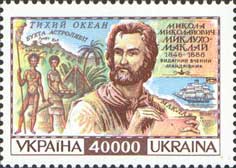
Early Russian Ethnographer in New Guinea
AnthroBase contains the following profile of an ethnographer who beat Malinowski to New Guinea by several decades.
Miklukho-Maklai, Nikolai Nikolaevich (1846-1888)
Russian anthropologist and explorer, acknowledged as the father of Russian ethnography. In 1871-72, Miklukho-Maklai did 15 months of continuous fieldwork on the Northern coast of New Guinea [in present-day Madang Province], where he pioneered methods that would only gain wide acceptance 40-50 years later, after Malinowski’s fieldwork. Throughout his life, Miklukho-Maklai identified strongly with the people he studied, and he several times spoke out in their defence against colonialist powers. He laid the groundwork of the rich tradition of 19th century Russian ethnography, which continued well into Soviet times–until it was destroyed in Stalin’s purges in the 1930s-50s.
Filed under Papua New Guinea, Russia, scholarship
Syncretism vs. Hybridity vs. Creolization
The November 2003 issue of The Journal of Asian Studies (vol. 62, no. 4) contains a review by Tom Havens of the book, The Age of Creolization in the Pacific: In Search of Emerging Cultures and Shared Values in the Japan-America Borderlands, edited by Takeshi Matsuda (Hiroshima: Keisuisha, 2001). The book offers an interesting application of the notion of creolization. The following extract is from the review, which quotes from two chapters by David Blake Willis.
Long ago, the discourse on Japan’s relations with the West emphasized cultural assimilation or syncretism. In the 1950s, Katô Shûichi recast the interaction as hybridity–still a powerful concept in literary and cultural criticism, although Willis believes Katô’s formulation continues “to privilege a Japanese essence” (p. 6). As anthropologists and world historians use the term, “creolization” is a dynamic, interactive process based on “more even-handed horizontal relations” than in the somewhat static notion of hybridity. Creolization involves “a leveling and a borrowing that is two-way,” creating “a new shared culture” that is “open-ended, eclectic, flexible, and mobile” (p. 6). Creolization facilitates transnational and transcultural (rather than international or intercultural) synergies, thus de-emphasizing states and national communities as units of analysis. Simultaneous multiple processes of creolization in various world regions today show that, “the globalization of culture is not the same as its homogenization” (p. 23)….
Willis offers an empirical chapter on the transcultural experiences of creole “JAmericans” educated at CA [my alma mater!], a well-known international school in Kobe barely masked as “Columbia Academy.” He argues that cultural, not necessarily genetic, hybridity often leads to true creolization, concluding hopefully that “Pacific Creoles are the cross-fertilizing currents of new directions, the lubrication for the global cultural landscape” (p. 195).
EXEGESIS: Assimilation models imply you either remain who you are beneath the layers of outside influences (good, unless you were bad to begin with), or you lose your soul and become someone else (bad, unless you were bad to begin with). Hybridity models allow “in-betweeners” and “half-castes” but also imply the existence of purity at the cultural poles. For most people, I suspect (not me! not me!), purebreds are willy-nilly superior to mongrels, whether we’re talking dogs, or cultures, or cultures gone to the dogs. Creolization models acknowledge the creation of uniquely new structures, with their own internal consistencies, arising out of a mixture of cultural (or linguistic) components, but shaped both by universal patterns and by new functions that none of the old structures adequately served.
Filed under Japan, Pacific, scholarship, U.S.


 Far Outliers