Category Archives: Pacific

Yap’s Role in the Saipan Campaign, June 1944

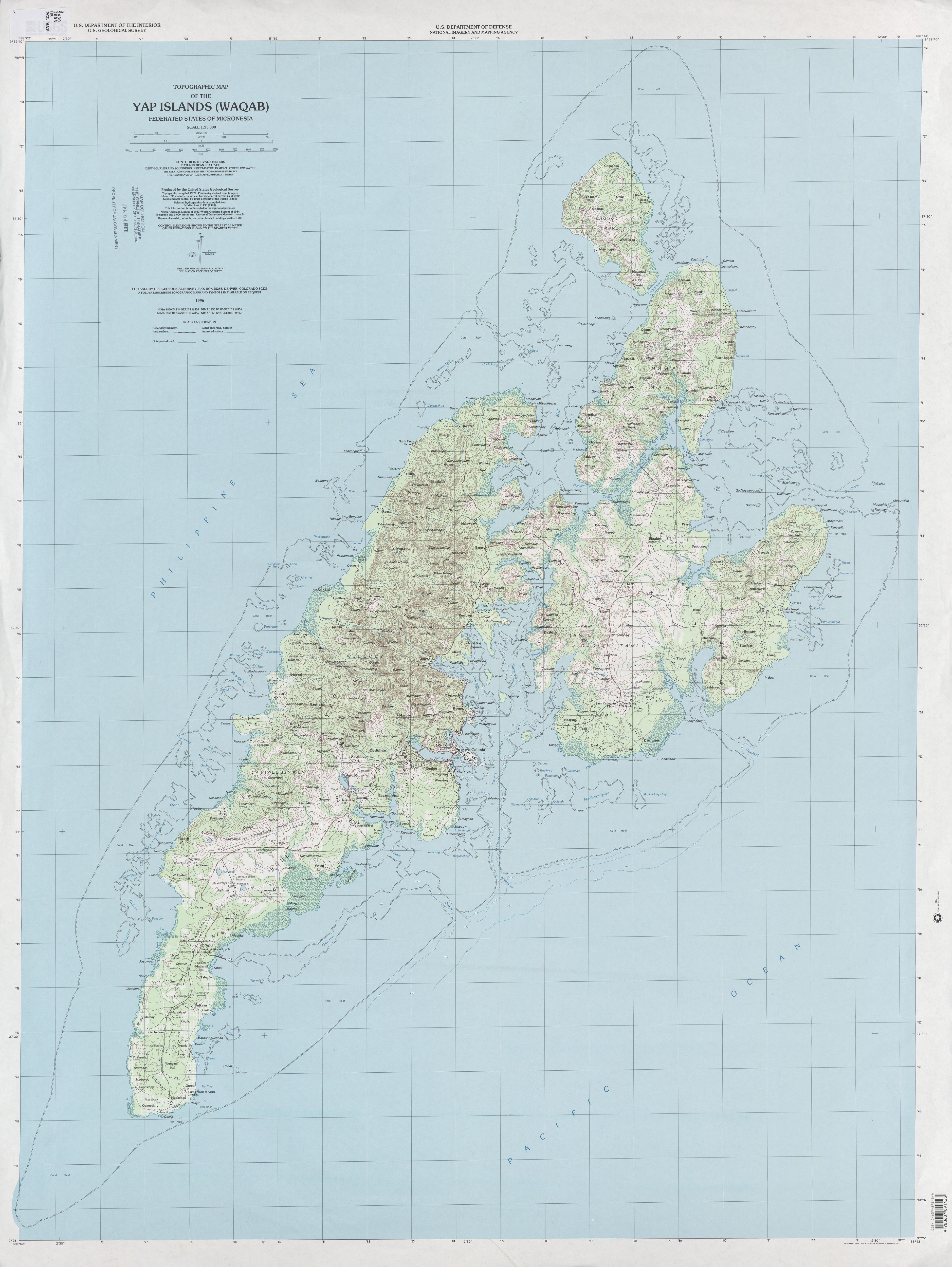
When I was looking up stuff about Yap, Micronesia, for a recent post, I came across a very informative website, with both photographs courtesy of the Micronesian Seminar and the National Archives—and even video—about the bombing of Yap during the Pacific War, about which I heard many stories during my time there in 1974. I have corrected obvious spelling errors in the following extract.

At dawn, on the 15th of June 1944, American amphibious forces swept into Saipan to begin the hard ground fighting that was to bring the Japanese homeland within range of our Superfortresses. For more than two weeks prior to the landings, Thirteenth Air Force Liberators, based on Los Negros, had been pounding Truk to neutralize the strategic Japanese base and to prevent the enemy from reinforcing Saipan by air.

A large Japanese task force, estimated at 40 ships or more, was sighted some distance north of Yap Island, on the 19th of June 1944. Carrier planes from this task force lashed out at the powerful units of the United States Pacific Fleet which were then supporting Allied ground forces on Saipan. The conflict that followed was the first major battle between elements of the Japanese and United States fleets in nearly two years. As at Midway, two years earlier, all of the offensive action was by carrier-based aircraft. By the time the Japanese fleet broke off the engagement, U.S. Task Force “58” had destroyed nearly 400 enemy aircraft and had sunk or damaged 14 Japanese ships.

Liberators of the Thirteenth Air Force were called upon to reach out more than 1,000 statute miles from their Los Negros base to hit Japanese warships that might seek refuge or fuel in Yap Harbor. On 22 June, 33 Liberators were over Yap in the longest mass mission the Thirteenth had yet flown. Trained eyes peered down on the harbor far below. There were no warships to be seen. The heavies wheeled and made their run on the secondary target, Yap Airdrome. Their 33-ton bomb load struck the runway and the dispersal areas with devastating effect.


View a large Yap Area Map

The Japanese were caught completely by surprise; not a single one of the more than 40 planes on the ground was able to take off and fly into the air. Nineteen enemy planes were definitely destroyed, and 15 were damaged; the runway was cratered and rendered unserviceable.

For six consecutive days after the raid of the 22nd of June, the Liberators blasted Yap, keeping the runway unserviceable and preventing its use in ferrying planes from the Philippines to the Marianas to aid the hard-pressed defenders of Saipan.

Leave a comment

Filed under Japan, Micronesia, U.S., war

English as an Indigenous Pacific Island Language

From English on the Bonin (Ogasawara) Islands, by Daniel Long (Duke U. Press, 2007; Publication of the American Dialect Society, no. 91; Supplement to American Speech, vol. 81), pp. 3, 9-10:

IT IS A LITTLE KNOWN LINGUISTIC FACT that among a group of Western Pacific islands English is maintained as a community language of the indigenous population. These are the Bonin Islands. Today, these islands (also called Ogasawara Islands) are part of Japan and their population, Japanese citizens, but the English language has survived there, as both a tool of communication and a marker of their unique identity. This book attempts to provide an outline of the English of the Bonin Islands in its various forms and incarnations from 1830 to the present….

The Bonin Islands appear to have lain completely uninhabited until Pacific Islander women and European and American men of widely varying linguistic backgrounds began to settle there in the early 1800s (see sections 2.1 and 2.2). Evidence from a variety of sources indicates that a Pidgin English (with a substratum formed from the other settlers’ native languages) developed as the community’s common tongue. Later the children born and raised in this language environment are thought to have acquired this as their native language (i.e., creoloidization occurred).

In the 1860s and 1870s, Japan laid claim to the islands and they experienced a huge influx of Japanese settlers. The Japanese established the first-ever schools on the islands, initiating bilingual (English and Japanese) education. Increasingly intense bilingualism initiated the processes of SYNTACTIC CONVERGENCE, leading to the development of a second contact language (a Mixed Language) comprised of a Japanese substratum and a lexicon supplied by the earlier English-based creoloid.

After World War II, the linguistic situation on the islands took another sharp turn when the U.S. Navy took control, allowing only those islanders of “Western” ancestry to live on the islands and subsequently establishing a school conducted in English. This period of American occupation and absolute isolation from Japanese ended abruptly in 1968 when the islands were returned to Japanese rule and the displaced Japanese islanders (living then in mainland Japan for a quarter century) were allowed to return home. The Ogasawara Mixed Language and Ogasawara Creoloid English have long coexisted with Japanese and English acrolects, but increasing mobility and improved communication technology seem to be accelerating decreoloidization and (dare I say) “de-mixed-language-ization.”

In the 170-year linguistic history of the Bonin Islands, the dominant language has shifted from English (from 1830) to Japanese (1876), back to English (1946), and back again to Japanese (1968).

1 Comment

Filed under Japan, language, Pacific, U.S.

Wordcatcher Tales: Huarachudo, Ejido, Municipio, Piloncillo

From True Tales from Another Mexico: The Lynch Mob, the Popsicle Kings, Chalino, and the Bronx, by Sam Quinones (U. New Mexico Press, 2001), pp. 206-210:

The municipio of Turicato [in the State of Michoacán] has always divided along these town-rural lines. The hill folks resented the power, money, and education, relatively speaking, of the people in town. The city folk feared the hillbillies but saw no reason to extend power, or municipal services, to people they considered ignorant and barbaric. In these years the Barajas family—a family of local merchants—dominated Turicato politics….

In this atmosphere “Los Villa,” as the Villaseñor family was known, emerged first as rebels. They took up the cause of the “huarachudos,” the “sandal wearers”—whom they rallied to their cause against the city folk…. The Villaseñores were huarachudos themselves. They were sixteen children whose father, Tomás, had been born a peon on the hacienda San Rafael. In the 1930s President Lázaro Cárdenas ordered a section of the hacienda transformed into a communal farm—an ejido—owned by those who had worked it as peons….

The Villaseñor piloncillo operation also grew. Piloncillo is a small cone of brown sugar about an inch in diameter, processed by a simple mill. It is used to sweeten coffee, in household cooking, or by the soft-drink industry. In the 1990s, piloncillo has all but vanished as a product from the Turicato region. But in the 1970s and 1980s, many sugar cane growers were producing piloncillo. In the Turicato region in the 1970s and 1980s, owning a piloncillo mill was the difference between a life of comfort and one of hopeless poverty….

The emergence of a hillbilly family brought with it the kind of abuses that town residents had feared all along. “What happens is they form into groups,” says Trigo. “There’s one who’s a leader, and around him form people who like to fight and look for trouble. They like to walk into a cantina and throw everybody out. They figure that’s a real achievement. This grows; the group gets larger. Then it becomes, ‘Let’s take over this land.’”…

Yet the Villaseñor family never did fully dominate local politics. They proved in the end to be poor politicians. Their frequent warring—“their bellicose nature” as one man put it—earned them many enemies. By 1989 a significant part of the municipio nurtured in dark silence a pure and vital hatred of the Villaseñores, and among them were many of the same poor peasants—the huarachudos—that the family once rallied to its side….

In 1994 the military put a roadblock between Turicato and Puruarán and set about arresting or killing off the bandit gangs. Others saw that the military meant business and laid down their guns. So five years after the Nueva Jerusalén vote threw Turicato into a civil war, a version of peace came to the municipio.

The chapter from which these excerpts come is a well-told tale, but one sadly familiar in its broad outlines: ambitious évolués (sponsored by distant elites, in this case the PRI) lead others among the oppressed to overthrow and replace an oppressive elite, only to impose a new kind of thugocracy at least as violent and oppressive as the old one. Sort of a Zimbabwe in microcosm. (Zimbabwe, whose independence I long ago celebrated at a big gathering of African students in Honolulu.)

But I want to comment on just two of the four words italicized in the extract.

The Spanish term municipio may have survived in the form of an English calque more than a century after the Spanish ceded Micronesia to the Germans. Each of the Federated States (formerly Districts) of Micronesia is divided into what are now called municipalities, a term that no subsequent German, Japanese, or American administrator would likely have come up with, although the Americans are credited with introducing the term by the anthropologist Lingenfelter, who worked in Yap during the early postwar years. If so, U.S. Navy administrators probably calqued on the basis of usage in the Philippines. Micronesian municipalities have never been centered around a town and its hinterland. Instead, they seem to be more like alliances of contiguous villages.

I’m old enough to have purchased a pair of Mexican huarache sandals in the 1970s, when I was a grad student in Hawai‘i. The dye made my feet break out, so I stayed with rubber slippers (zori). (I hardly owned a pair of shoes all through grad school.) The relation between Spanish huarache ‘sandal’ and huarachudo ‘sandaled’ is parallel to that between English beard and bearded. Spanish and English are both related languages. But the same parallel can be observed between, for example, Chamorro sapatos ‘shoes’ (from Spanish) and sinapatos ‘shod, wearing shoes’, or Chamorro relós ‘wristwatch’ (also from Spanish) and rinelós ‘wearing a wristwatch’. Among its myriad functions, the -in- infix in Philippine languages can form adjectives out of nouns in a manner similar to that of participial affixes in Spanish and English.

UPDATE: The Micronesian Seminar‘s Francis X. Hezel, S.J., weighs in on the antecedents of the term municipality in Micronesia.

The term as used in Micronesia after the war has no direct relationship to the Spanish colonial period in these islands. The Spanish weren’t here long enough and they weren’t influential enough to have the term stick. There are very few Spanish loan words that have made their way into the island languages. Actually, islanders used the Japanese term kumi to describe a segment of the island, even well after the war. Muncipality came into the languages through the English term, via the Navy.

The usage of Japanese kumi ‘club, association, gang’ is very interesting, and seems a much more appropriate term for the traditional political alliances before they were recast by the U.S. Navy as local-government structures. The Yapese dictionary translates municipality into Yapese nuug ‘net’ (presumably meaning ‘network’ of political alliances). Other Micronesian dictionaries I’ve consulted don’t list municipality in the English finder list. So it seems U.S. Navy administrators were influenced by Spanish local-government terminology already long-established in the Philippines.

The U.S. Census Bureau glossary does not list the term municipality at all, but it does list and gloss municipio as: “Primary legal divisions of Puerto Rico. These are treated as county equivalents.” The Wikipedia entry for Municipalities of the Philippines begins thus: “A municipality (bayan, sometimes munisipyo, in Tagalog) is a local government unit in the Philippines. Municipalities are also called towns (which is actually a better translation of bayan).”

SHARP DETOUR: My wife and I taught University of Hawai‘i extension courses on Yap, Micronesia, in the summer of 1983, just before heading off to spend a year in Romania on a Fulbright research grant. In fact, she was still there when I got the word that my nearly forgotten application from a year earlier had been approved and that the orientation in Washington, D.C., would begin before she got back to Honolulu. Trying to place a telephone call through to Yap was not easy in those days.

Anyway, for my introductory linguistics course on Yap I used the first edition of Peter Trudgill’s little Penguin paperback Sociolinguistics: An Introduction to Language and Society. Even the main islands of Yap have a good deal of regional variation in pronunciation and word choice, and the outer islands speak dialects of the far-flung Trukic language continuum, only distantly related to Yapese. The variety of Yapese spoken in the major municipality (Rull) closest to Colonia—the capital and only urban center—provided the basis for the standard orthography, but the pilot school for testing Yapese language curriculum materials (with bilingual education funding from the U.S. DOE) was located in the major municipality (Tomil) with the most divergent pronunciation. The three major municipalities were those chiefly alliances (called kumi in Japanese) dominant at the time the Germans took control: Gagil, Tomil, and Rull.

My wife and I first met while we were both assigned to that school in the fall of 1974—she as a new Peace Corps teacher for two years, me as a visiting linguist for one semester—and we both learned our Yapese in that very rural municipality. (Mine faded much more quickly than hers.) So we were quite aware of regional variation and of the principal shibboleths of Tomil dialect, chief among them being the pronunciation of standard /ae/ as /ee/, as in the pronoun gaeg vs. geeg ‘me’ or the plural marker on verbs -gaed vs. -geed, both high-frequency items.

For my introduction to linguistics course in 1983, I decided that the most important things I should focus on were the respective relationships between writing and pronunciation, on the one hand, and between dialects and standard languages, on the other. One of my assignments was for my students to assemble a list of common words for which there were regional variants, then track down the boundaries between those variants (the isoglosses). The most interesting findings involved variants whose isoglosses failed to align with the existing boundaries between municipalities, perhaps revealing earlier linguistic and political fault lines.

1 Comment

Filed under language, Mexico, Micronesia, Philippines, U.S.

Missing Date in Philippines History: 31 December 1844

From A History of the International Date Line:

European explorers who approached the Pacific Ocean by sailing to the east such as the Portuguese, and in their wake the Dutch, the English and the French, naturally kept their ship’s journals and diaries according to the day count of their home land and this was of course also adopted by the colonists who settled along the Asian perimeter of the Pacific Ocean.

However, the colonisation of the Pacific Ocean by the Spanish occurred from the opposite direction and more specifically from the Spanish possessions in America. The Philippine archipelago was discovered in March 1521 by Ferdinand Magellan and Spanish dominion over the islands was first firmly established in 1565 by Miguel López de Legazpi (c. 1510 – 1572), the conquistador and first Spanish governor general of the Philippines….

Most of the shipping from the Philippines to Spain went over the Pacific Ocean to the Mexican port of Acapulco, was transported over land to the port of Veracruz, and then shipped to Spain. In order that the Spanish ships crossing the Pacific Ocean between the Philippines and the Spanish Americas would not have to adjust the dates in their journals whenever they sighted land, the Philippines observed the same day count as that of the Spanish Americas….

During the early 1840s the commercial interests of the Philippine Islands turned more and more away from the Spanish Americas (which for a large part had severed their relations with the motherland Spain) and trading with the Chinese mainland (engendered by the ignominious but lucrative ‘Opium Wars’), the Malay peninsula, the Dutch East Indies and Australia became increasingly important.

In order to facilitate communication and trading with its western and southern neighbours, the secular and religious authorities of the Philippines agreed that it would be advantageous to abolish the American day reckoning and adopt the Asian day reckoning.

This was achieved in 1844 when Narciso Claveria, the governor general of the Philippines, issued a proclamation announcing that Monday, 30 December 1844, was to be immediately followed by Wednesday, 1 January 1845.

The 1867 conversion from Russian to American time in Alaska was much more complicated.

5 Comments

Filed under Mexico, Pacific, Philippines, Spain

Wordcatcher Tales: Dawasi, Kousapw, Sakau

Three words from the Micronesian language Pohnpeian (aka Ponapean) that surfaced in my background reading about the church shootings in Neosho, Missouri, tell stories of distant connections across time and space.

Dawasi – When I first heard about the Neosho church shooting, I assumed the Micronesians involved were from the Marshall Islands, because I know that many Marshallese work for Tyson Foods in nearby Springdale, Arkansas. But one key term (which I’ve italicized) in the following passage cited in a posting on the Marshallese YokweOnline network hinted that the Micronesians involved were from the state of Pohnpei, not the Marshalls. (They were actually from the outer islands of Pingelap, not the main island of Pohnpei.)

Kernel [Rehobson] owns a retail store that is a gathering place for Micronesians from dozens of miles around since he stocks his store with the type of down-home items that are so difficult to find in the US: the large plastic combs that women wear in their hair, zoris, dawasi and brushes for showers, and island-style skirts with embroidered hems.

Dawasiscrub brush’ (made of coir bristle) is the official Pohnpeian spelling for a word borrowed from Japanese before the Pacific War. The same word was borrowed by Palauans, who spell it tauas(i). In current Japanese, tawashi (束子) can refer to scouring pads made of acrylic yarn, but the bristle brush variety is such a Japanese cultural icon that tiny replicas dangle from cellphones and backpacks.

The passage above cited on YokweOnline comes from the article on Micronesians Abroad by Francis X. Hezel, S.J., and Eugenia Samuel, that I blogged about earlier. The two words italicized in the next passage from the same article tell of very different connections.

Our team intended to visit Kansas City, home of a growing Micronesian community, largely Pohnpeian, that sprang from students who attended Park College during the 1970s and 1980s. Small colleges, once well attended by Micronesian students, have frequently served as the seedbeds for migrant communities in the US, accounting in part for the seemingly odd locations of Micronesian strongholds. Kansas City is said to have been constituted a kousap by a Pohnpeian chief not long ago when he paid a visit to his compatriots who had settled in that city. He was feted with sakau—the type made from powder rather than pounded—and left a week or two later with several thousand dollars, which had been collected as tribute from Pohnpeians who are now living 8,000 miles from their own island.

Kousapw – The kousapw (sapw means ‘land’) is a Pohnpeian land unit—translated ‘section’ below—intermediate between a farmstead and a district (or “municipality”). According to Douglas Oliver’s (1988) Oceania: The Native Cultures of Australia and the Pacific Islands, p. 983:

Most sections extended from coast to island center, and consisted of from fifteen to thirty-eight farmsteads. Each section had a meeting house of its own, and was headed by an official known as a kaun or soumas, who was usually the senior male member of the section’s senior sub-clan. The section functioned mainly as an administrative subdivision of the district.

This raises several questions. (1) There seem to be many old cultural connections between chiefly high-island Polynesians (possibly from Samoa) and Pohnpei. Is it just coincidence that the kousapw in Pohnpei usually runs from seashore to mountaintop, like the ahupua‘a of Hawai‘i (and presumably other large islands in Polynesia)? (2) Which of the major districts on the island of Pohnpei was the Kansas City kousapw assigned to? (3) Does this mean we now have a third Kansas City to contend with: one in Missouri, one in Kansas, and one in Pohnpei?

Sakau – One strong indication of old Polynesian influence on Pohnpei is the cultivation and use of Piper methysticum, known in Pohnpei as sakau, in Hawaiian as ‘awa, and in Samoan as ‘ava. In fact, the Pohnpeian word sakau derives by regular sound correspondences from the earlier Polynesian article+noun combination *te kawa.

4 Comments

Filed under Japan, language, Micronesia, Polynesia, U.S.

Micronesian Emigration Rising

The Micronesian Seminar regularly publishes articles on issues facing Micronesians under a series called Micronesian Counselor. The latest in the series is on HIV/AIDS in Micronesia. In December 2006 MicSem published an article on Micronesians Abroad by Francis X. Hezel, S.J., and Eugenia Samuel. Here’s just the introduction.

Today there are over 30,000 FSM citizens and 20,000 Marshallese living in the United States and its territories. Add to that possibly another 10,000 Palauans, and you have a total of 60,000 Micronesians living away from home. These are not students, young people away for a short time, or islanders who are doing a brief stint with the military. These are people-young and old, fluent English-speakers and those who know no more than a few words of the language-who have chosen to take up residence abroad.

Emigration is not an entirely new phenomenon. Palauans have been leaving home since the late 1940s. Already in 1953, there were a hundred Palauans on Guam with their own Palau Association. As their numbers grew in subsequent years, they would meet in a Palauan bai and worship in a local language Protestant church. From the early 1970s, as hundreds of Micronesian students began heading for college in the US, thanks to the extension of the Pell Grant, emigration from Palau stepped up to about 250 a year. These were not young men and women on their way to college for a few years before returning home; they were people with a one-way ticket out. By the late 1970s, individuals from other parts of Micronesia as well were dribbling into Guam and the US with the intention of staying. The 1980 US Census recorded several hundred people from what was then coming to be known as FSM, most of them Outer Island Yapese, living in the US. These mostly educated, young people were loathe to return to their atolls where there was no wage employment, but reluctant to settle in Yap where they lacked status and land.

Then, in 1986 with the formal implementation of the Compact of Free Association in FSM and the Republic of the Marshalls, Micronesians were granted the right to live and work in the US for an unlimited period. The ensuing emigration was limited at first: the emigration from FSM was only about one percent a year, half of what it is today, and the early migrants were heavily Chuukese. The main destinations in those early years were Guam and Saipan. As both places suffered from a recession in the early 1990s and new jobs became scarce, more and more Micronesians headed for Hawaii. The migrant outflow increased sharply in the mid-1990s as the effects of the stepdown in Compact funding for FSM and RMI were felt and as the government reforms, initiated by Asian Development Bank, lopped jobs from the public sector.

Today we are witnessing an emigration comparable to those that other Pacific islands—Tonga, Samoa, the Cook Islands and Guam—have been experiencing for years. A decade or two ago, writers took delight in pointing out that the emigration population of, say, Samoans in California was half the size of its resident population, or that the Guamanians on the West Coast outnumbered those on their home island. Now Micronesia is rapidly moving in the same direction. With 2,000 FSM citizens, 1,000 Marshallese, and a couple hundred Palauans leaving home each year to live abroad, one out of every four Micronesians is now living in the US or its territories. If migration continues at this same pace, we can expect that the number of emigrants will be about half the size of the resident population just ten years from now.

1 Comment

Filed under Micronesia, U.S.

Some Micronesian Immigrant Success Stories

The article on Micronesians Abroad by Francis X. Hezel, S.J., and Eugenia Samuel, published in December 2006 on the Micronesian Seminar‘s very informative website, profiles several successful Micronesian immigrants in the various enclaves of such immigrants that the authors visited. Among those profiled was the most prominent of the recent church shooting victims in Neosho, Missouri: Kernel Rehobson. Here are some excerpts from each of the communities visited.

Hawai‘i

The Honolulu press has given considerable attention to the problem of homeless Micronesians. We found that a good many Micronesians are on welfare and quite a few have declared themselves homeless, partly because being listed as homeless gives people a leg up on finding affordable housing in a state where even the smallest unit is prohibitively expensive at market prices…. But that’s far less than half the story. Many Micronesians we talked to were angry at the “newcomers” for abusing the system and destroying the good reputation they had worked so hard to build up….

To their credit, many of the Micronesians we met were doing far better than just getting by. Serlino Harper, a young Chuukese, came to Hawaii more than ten years ago and lived with his older brother for a while before striking out on his own. His first job was as an employee at McKinley’s Car Wash. Today he is the supervisor of the car wash, which employs more than a dozen other Chuukese, and he lives in a small studio apartment with his pet cat. Xavier Fethal from Ulithi, married and with a family of six, has a good job selling medical supplies to hotels and still finds the time to play guitar in a local band and maintain a steady involvement in community activities. Bruce Musrasrik, born in Pohnpei but a resident of Honolulu for several years, manages one of the hotels in Waikiki. Then, too, there is Lubuw Falenruw, a Yapese, one of the most publicized success stories of Micronesians in Hawaii. He is owner of a computer graphics company that employs some 20 people, nets millions each year, and is famous throughout the state for its innovative displays.

Southern California

Our next stop was San Diego, where we spent more time with many of those we had met at the gathering in Pasadena. John Akapito, a Chuukese who has his master’s degree and teaches English to foreign students at National University, cut a fine figure in his suit and tie as we interviewed him in his private office on the campus. Like most other Micronesians in the San Diego area, John has close ties with the Micronesian Outreach Ministry based in Pasadena. Sabino Asor, former FSM congressman from Chuuk, is also in San Diego; he currently works in the service department of a car dealership, but aspires to getting into the real estate business before long. His spacious four-bedroom house with garage was rather typical of the homes occupied by Micronesians with large families. At the farewell party they threw for us the evening we left, we met dozens of other islanders, including the offspring of half a dozen well known Chuukese families: Masataka Mori’s daughter, Susumu Aizawa’s niece, Mitaro Dannis’ nephew, Tosiwo Nakayama’s granddaughter, and three Narruhn women, among others.

As we chatted, it became clear that the children were much more fluent in English than in their local language, even if both parents were from the same island. At nearly all the social events we attended, the parents used their own language whenever they could, while the young generation spoke English. Young people seemed to have understood the local language when they were spoken to, and they have all learned songs and hymns in an island language, but they did not feel comfortable speaking it. Acculturation happens quickly in the US mainland, much more rapidly, I suspect, than in Hawaii or Guam.

Corsicana, Texas

Corsicana, an hour’s drive from Dallas, might seem an unlikely spot for a Micronesian community, but there are about 300 islanders living there. The origins of this community date back to the late 1970s when dozens of young Micronesians were attending Navarro Community College….

One of the icons of the Corsicana community, by all accounts, is a Palauan woman by the name of Grace. Like so many others, she attended Navarro Community College and after graduation decided to stay. She is the manager of a Pizza Hut in the middle of town where she has worked for eighteen years. As part of her work, she supervises eight employees, half of whom are also Palauan. Her life has been a model of persistence in carrying out her responsibilities for her work and family. Others like her have worked their way up to the managerial level. She told us that she would hope to return home one day after her retirement, but for the present she has a good salary and a generous pension for her retirement. As much as she misses the laid-back pace of life at home, Grace plans to continue working in Corsicana as long as she can. After all, she reflects, there will always be time to enjoy the slow life in the islands after retirement.

Central Florida

This community—if it can be called that—is spread throughout an area that extends from Orlando to Tampa and Clearwater. This place differs from the other destinations we visited in that there are no senior founders of this community, “elders” who pull people together for gatherings and resolve community problems. Nearly all the Micronesians who settled in central Florida were brought out by recruiters to work at SeaWorld, Disney World, Busch Gardens, or one of the several nursing homes in the area. The community here, which is heavily Pohnpeian but with a few Mortlockese thrown into the mix, is composed mainly of young men and their starter families. We met no one who was there longer than ten years, and most have lived in central Florida for just five or six years. This group lacks the experienced leadership that has proven vital for binding together individuals in other migrant communities….

Some of the migrants have continued working in the theme parks. One young man operates the kiddie rollercoaster at SeaWorld while a Pohnpeian woman works the sky lift at Busch Gardens. Most, however, seem to hold jobs in food services, like the young lady from Pohnpei we found rolling cinnamon sticks in another part of the park. All seem to get along very well with their coworkers and enjoy the respect of their bosses.

A small Japanese restaurant called Kanpai employs seven Micronesians, one as hostess and six as chefs. When we went there for dinner one evening, we were treated to a virtuoso performance demonstrating what the Pohnpeian chefs could do with a knife, a hot grill, and bowls of vegetables and meat. The chefs came out, each in front of a grill surrounded by patrons, and did a juggling act with knives and food, as they chopped at lightning speed, swirled and twirled food on the grill faster than we could follow, and doffed their chef hats for the applause that followed their act.

Corner of Arkansas, Missouri, and Oklahoma

Neosho lies just a bit north of the Missouri-Arkansas border, no more than eighty miles from Springdale, Arkansas, the site of the large Tyson Chicken Factory and home to thousands of Marshallese immigrants. Another fifty miles west of Neosho, just across the state border, is Miami, Oklahoma, a town slightly larger than Neosho that has an island community of its own. We joined the 300 or so Micronesians to watch the baseball games and enjoy the mixed buffet, featuring island delicacies like banana pihlohlo along with such American standards as spareribs and chicken. Micronesians came from all over Missouri, some from northern Arkansas and Wichita, and even from as far away as Cincinnati and Corsicana, to attend. Most were Pohnpeians, but there were also a few Chuukese and Marshallese on hand. We were told that Cincinnati would, in turn, host the next Pohnpeian games, scheduled for September 11—a day celebrated on their home island as Liberation Day.

The person who organized the games—and who oversees most other activities that take place in Neosho—is a Pingelapese businessman by the name of Kernel Rehobson. Kernel owns a retail store that is a gathering place for Micronesians from dozens of miles around since he stocks his store with the type of down-home items that are so difficult to find in the US: the large plastic combs that women wear in their hair, zoris, dawasi and brushes for showers, and island-style skirts with embroidered hems. Kernel says that he had his troubles when he first settled in Neosho; people mistook him for a Mexican and kept asking for his papers when he tried to enroll his kids in school or gain access to any social services. He started out working for K-Mart as a warehouseman, worked his way up to manager, and later quit to begin his own business. Kernel also serves as pastor to the Pingelapese community in the church that they share with the Neosho Protestant congregation. Anyone from the islands who needs help of any sort-a social security number, a driver’s license, a job-always comes to Kernel first.

Portland, Oregon

The Willamette Valley between Portland and Salem has for at least twenty years been one of the favorite destinations of Micronesian migrants. The area represents one of the greatest concentrations of islanders anywhere in the continental US; and if the area is expanded to include the southern part of Washington and eastern Oregon, the Micronesian population probably numbers a few thousand….

In Oregon, as in other places, Protestants are able to attend Sunday services in their own language, while Catholics must assimilate into local parishes as best they can. Thus, Dio and his family attend mass at St. Lourdes with its international community, afterwards meeting Hispanics, Samoans, Asians and others over coffee and pastries. Chuukese Protestants generally meet on Sunday mornings at a large church in Aurora, an hour’s drive from Portland, where Mitaro Dannis and a few other ministers preach in Chuukese and discuss with their congregation the importance of raising funds so that they can build a church of their own.

Elsewhere in Portland Ken Henry in his late forties and Lisa Uehara in her late twenties, work for William C. Earhart Company, a business that helps administer employee benefit plans. Ken, a Pohnpeian married to an American woman, is an accountant, while Lisa, a Chuukese from Weno, is a receptionist. Lisa, her Chuukese husband and their nine children live in a very nice three-bedroom house that they own. Lisa’s sister and her family are conveniently settled right next door in a similar house of their own. Next to the children’s swings and slides in the back yard there is an earth oven that the two families use to bake pork and breadfruit on special occasions.

4 Comments

Filed under Micronesia, U.S.

Caleb Crain on the End of American Whaling

The 23 July 2007 edition of The New Yorker contains an article by Caleb Crain on the demise of American whaling entitled There She Blew. Here’s how it ends.

There are two ways to explain the end of American whaling.

First, history. During the Civil War, the North bought up aging whaleships, loaded them with stone, and sank them in Charleston Harbor in an attempt to block it. The South, meanwhile, purchased warships from Britain and set about catching and burning Union whalers. In all, Dolin reckons, more than eighty whaleships perished in the Civil War. Then, in 1871, pack ice descended on the northern coast of Alaska sooner than expected, pinning a fleet of whalers and cracking their hulls like so many eggshells. In this and a similar disaster five years later, forty-five more whaleships were lost. A new and far more destructive era of global whaling was about to begin—in the eighteen-sixties, a Norwegian named Svend Foyn devised a radically more efficient way to kill whales, by firing explosive-tipped harpoons from a cannon mounted on a steam-powered, iron-hulled schooner—but the American industry was too demoralized to participate.

Second, economics. If all had been well with whaling’s profit margins, the Civil War’s blow would have glanced like a blunt iron off a sperm whale’s snout. But for a long time beef tallow had been selling cheaper than spermaceti as an ingredient in candles, and lard oil had been underselling whale oil as a fuel for lamps. From the eighteen-forties on, more and more cities lit their streets with coal-derived gas, and a Canadian discovered how to extract from coal an oil called kerosene, which burned brighter and cleaner than whale oil. By the time crude petroleum was found underground in western Pennsylvania, in 1859, the whaling industry was already in retreat. Petroleum doomed it. In a single day, an oil well pumped as many barrels as a whaleship might collect in a three-year voyage. As sales shrank, the owners of whaleships cut costs by offering smaller lays, and the rate of literacy and the level of experience of the whaling workforce dropped, dragging productivity down with it. Davis, Gallman, and Gleiter surmise that the fashion for wasp waists in the late nineteenth century added about fifteen years to the dying industry’s life, by bidding up the price of baleen for corsets, but it was only a temporary reprieve….

But the economists tell us that whales are innocent of having damaged the whaling industry by becoming scarce, and nineteenth-century whalers had to keep searching for new grounds because whales in much-hunted areas grew more canny. Americans never caught enough sperm whales to throw them out of equilibrium. They did harm the populations of grays and bowheads, it seems, and maybe of right whales, too, but too late to have contributed to the decline of American whaling.

With Foyn’s new technology, the Norwegians hunted bigger and faster whales than the ones that man power and sail power had been able to handle; requiring new fleets, it was tantamount to a whole new industry. There was no reason to think that America would be good at it, especially since American labor cost more than Norwegian labor, so New Bedford’s millionaires quietly shifted their capital to railroads, petroleum refining, and textiles.

Whaling in the United States survived as a conscious antique, but only for a few decades. In 1914, the newspaper of the whaling industry shut down for lack of readers. Like “a staunch old whaling bark,” the editors wrote, the “Journal is to be hauled out on the beach.” As it happens, Melville dropped hints from time to time that the making of literature was like whaling. It, too, was a craft that lingered into the industrial age. It, too, expressed by a somewhat violent process the essence that a living creature collected in its head. In “Moby-Dick,” Ishmael even claims that, while working at his desk, he once saw in a mirror “a certain semi-visible steam” rising from his own head, like a whale’s spout. Perhaps writing, then, is the career to run away to—so long as you don’t mind figuring as both whaler and whale.

via Arts & Letters Daily

Leave a comment

Filed under industry, Pacific, U.S.

Japanese and Other Loanwords in Palauan

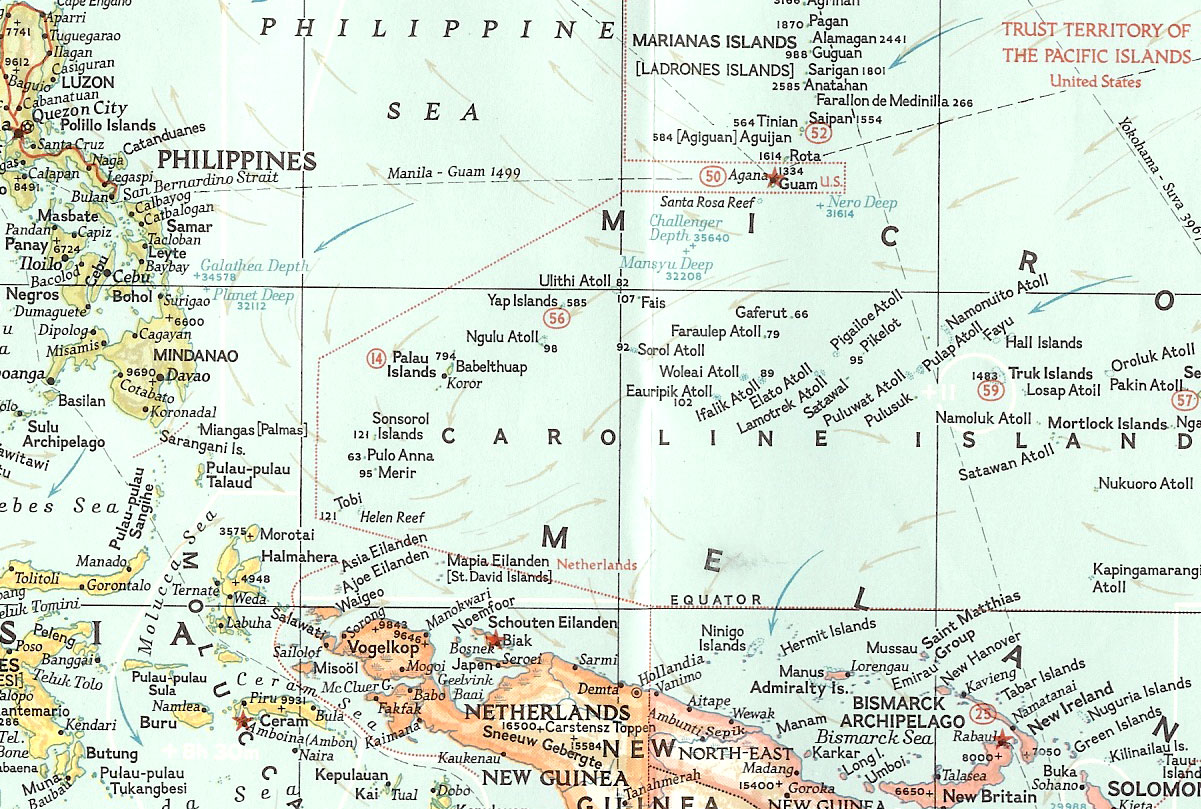
I got a little carried away this weekend extracting Japanese, English, German, and Spanish loanwords from the New Palauan–English Dictionary, ed. by Lewis S. Josephs (U. Hawaii Press, 1990). The nature of the words borrowed from each language tells a lot about the nature of the interactions between Palauans and their successive colonizers: Spain until 1899, Germany until 1914, Japan until 1945, and the U.S. after that. By 1940, there were 3 Japanese colonists (including Okinawans, Koreans, and Taiwanese) in the islands for each indigenous Palauan.

The current Palauan orthography originated under the Germans, but has continued to evolve since then. There are only five vowel symbols, i u e o a, but e represents the eh sound when stressed and the uh sound (schwa) when unstressed. Vowel length is indicated by doubling the vowel. Palatal and velar glides are written with the vowel symbols i and u.

Consonants show much greater variation. The obstruents /b/ and /d/ are basically voiced, but are devoiced next to other consonants or in word-final position. The obstruents /t/ and /k/ and are basically voiceless, and are strongly aspirated in word-final position. Glottal stop is written with a ch. The fricative /s/ is slightly palatalized (in the direction of sh). There are only two orthographic nasals, bilabial m and velar ng, but ng is pronounced [n] before the dental consonants t, d, s, and r. The flap /r/ and lateral /l/ can each be doubled, and the /l/ corresponds to /n/ in other related and unrelated languages. The consonants h and z are only found in loanwords.

The underlying morphology of Palauan is very complex, but looks a lot like that of Philippine and other western Austronesian languages once you correct for a lot of strange behavior on the part of the nasals (like infixed -l- and the me- prefixes that end up as o- on certain stems). Perhaps I’ll provide a few glimpses in a future blogpost.

babier ‘paper, letter, book’ (G)
badre ‘priest’ (S)
baeb ‘pipe’ (E)
baias ‘bias or slant (in sewing)’ (E)
baiking ‘disease, germs’ (J)
baket ‘bucket, pail’ (E)
bakudang ‘dynamite; bomb; explosion; air raid; bombardment’ (J)
bakuhats ‘explode’ (J)
bakutsi ‘gambling; card game’ (J)
balas ‘ballast’ (E)
bambuu ‘bamboo’ (E)
bando ‘belt’ (J)
bangd ‘bounce; rebound; suspension (of car)’ (E)
bangd ‘musical band; orchestra’ (E)
bangderang ‘flag, banner’ (S)
bangk ‘bank; safe; strongbox’ (E)
bangk ‘get punctured, blow out’ (J)
bangkeik ‘pancake’ (E)
bar ‘crowbar; coconut husking spike’ (E)
bar ‘bar, tavern’ (E)
bara ‘rose’ (J)
barb ‘valve’ (E)
barikang ‘hair clipper’ (J)
baror ‘table lamp’ (S)
barrill ‘wooden barrel’ (S)
bas ‘bus’ (E)
bas ‘bass (in singing)’ (E)
basio ‘place’ (J)
basket ‘basket’ (E)
Baskua ‘Easter’ (S)
bastaor ‘bath towel’ (J)
bastor ‘pastor’ (E)
bat ‘bat’ (E)
bata ‘butter’ (J)
baterflai ‘fickle’ (E)
batrol ‘patrol; guardian; supervisor’ (S)
batteri ‘battery’ (E, J)
beek ‘bake’ (E)
bek ‘sack, bag’ (E)
bengngos ‘lawyer’ (J)
benia ‘plywood’ (J)
benster ‘window’ (G)
bento ‘food eaten away from home’ (J)
bentobako ‘lunchbox’ (J)
benzio ‘toilet’ (J)
berangdang ‘veranda’ (E)
beragu ‘spark plug’ (J fr E)
berib ‘letter’ (G)
bet ‘bed’ (E)
biang ‘beer’ (E?)
bib ‘bib’ (E)
Biblia ‘Bible’ (S)
bid ‘auction, bidding’ (E)
bilt ‘holy picture’ (G)
bings ‘beans’ (E)
bioing ‘hospital’ (J)
bioingseng ‘hospital ship’ (J)
birhen ‘virgin’ (S)
Biskor ‘Peace Corps’ (E)
bisob ‘bishop’ (E)
bistong ‘piston’ (E)
blaks ‘cement blocks’ (E)
blangtalos ‘plaintain (bark used for cord)’
blasbabier ‘sandpaper’ (G)
blauang ‘flour’ (E)
blok ‘pulley’ (G)
bloridang ‘pomade’ (S brandname?)
boi ‘servant’ (J)
boi ‘buoy; property marker’ (E)
bokket ‘pocket’ (E)
boks ‘large wooden tray with legs’ (J?)
bokso ‘elephant grass (used as animal feed)’ (J)
bokungo ‘storage pit, air-raid shelter’ (J)
bomado ‘pomade’ (J)
bomb/bomk ‘pump; small boat engine’ (E)
bongd ‘pound’ (E)
bongkura ‘dull or slow-witted’ (J)
bor ‘ball (in baseball)’ (J fr E)
borhua ‘walk (in baseball)’ (J fr E)
boruu ‘(head) completely shaved’ (J)
bos ‘(motorless) boat’ (E)
bos ‘boss’ (E)
bost ‘post-office’ (E, G)
Bostol ‘apostle’
botang ‘button; flower similar to peony’ (J)
boteto ‘potato’ (E)
bozu ‘(head) completely shaved’ (J)
bresengt ‘present’ (E)
bud ‘booth’ (E)
budo ‘Panama cherry; capulin’ (J)
buk ‘book’ (E)
bul ‘(swimming) pool; pool (game), billiards’ (E)
bulis ‘police’ (E)
bumpo ‘grammar’ (J)
bung ‘minute’ (J)
bungsu ‘fraction’ (J)
buraia ‘pliers’ (E)
burek ‘brake’ (E)
burgatorio ‘purgatory’ (S)
bus ‘puss, cat’ (E)
bussonge ‘red hibiscus’ (J)
butabutabuta ‘way of calling pigs’ (J)
butiliang ‘bottle; glass’ (S)
buts ‘boots’ (E)

chabarer ‘get angry, get violent’ (J)
chabunai ‘dangerous’ (J)
chaburabang ‘fried bean paste bun’ (J)
chaburasasi ‘oil-can (with long spout)’ (J)
chaiamar ‘apologize to’ (J)
chaikodetsiu ‘tie [breaker] in game of ziangkempo’ (J)
chainoko ‘half-caste child’ (J)
chais ‘ice’ (E, J)
chaiskeeki ‘popsicle’ (J)
chaiskurim ‘ice cream’ (E, J)
chakimer ‘surrender; give up’ (J)
chaltar ‘altar’ (E)
chamatter ‘plenty; more than enough’ (J)
chambang ‘baked bean paste bun’ (J)
chambelangs ‘ambulance’ (E)
chameiu ‘wheat gluten?, coconut syrup?’ (J)
chami ‘screen’ (J)
chamonia ‘ammonia’ (E)
chanakangari ‘button hole’ (J)
changar ‘(salary) increase; (person) get excited or nervous; promote’ (J)
changari ‘rise; increase’ (J)
changhel ‘angel’ (S)
changko ‘bean paste’ (J)
changtena ‘antenna’ (E)
chansing ‘feel relaxed, at ease’ (J)
chanzang ‘add; do sums’ (J)
chanzeng ‘[safety] razor blade’ (J)
charai ‘strict or harsh sounding’ (J)
charuminium ‘aluminum’ (J)
chas ‘ace (in cards)’ (E)
chasagao ‘morning glory’ (J)
chasbering ‘aspirin’ (E, J)
chasiba ‘scaffolding’ (J)
chasuart ‘asphalt’ (J)
chatter ‘appropriate, suitable’ (J)
chauanai ‘inappropriate, unsuitable’ (J)
chausbengdik ‘know thoroughly; memorize’ (G)
chautomatik ‘automatic’ (E)
chauts ‘out (in baseball)’ (E)
chazi ‘flavor, taste’ (J)
chazinomoto ‘flavor enhancer; MSG’ (J)
chea ‘air (for tire)’ (J fr E)
cheisei ‘sanitation (inspection); hygiene’ (J)
chi ‘stomach’ (J)
chihukuro ‘(pouch of) stomach’ (J)
chikes ‘place for storing live bait or fish in boat’ (J)
chimi ‘meaning; implication (of one’s words)’ (J)
chiro ‘color’ (J)
chirochiro ‘many-colored; fathered by different men’ (J)
chomotenangio ‘territory outside of Japanese Pacific mandate’ (vs. utsinangio) (J)
chos ‘holding tight (when dancing); making a play for; getting too close’ (J)
chosarai ‘girls’ game juggling cloth balls filled with seeds’
chotemba ‘flirtatious; loose or fast (woman)’ (J)
choto ‘noise or sound (usu. mechanical)’ (J)
chotobai ‘motorcycle’ (J)
chuki ‘life-preserver’ (J)
chundo ‘physical exercise’ (J)
chundongutsu ‘athletic shoes’ (J)
chuntens ‘driver’ (J)
churi ‘muskmelon’ (J)
chusangi ‘rabbit’ (J)
chuts(i)us ‘take (photo)’ (J)

dai ‘platform; support’ (J)
daia ‘diamond suit (in cards)’ (J)
daikong ‘radish; turnip’ (J)
daiksang ‘carpenter’ (J)
dainamait ‘dynamite’ (E)
dainamo ‘generator’ (J)
daigak ‘university’ (J)
daitai ‘general; fine; all right; okay’ (J)
daiziob ‘fine; all right; okay’ (J)
dangs ‘dance’ (E)
datsio ‘disease of testicles aggravated by the cold’ (J)
dempo ‘telegram’ (J)
dengki ‘electricity’ (J)
dengkibasira ‘telephone pole’ (J)
dengkibu ‘power plant’ (J)
dengkiskongi ‘electric phonograph’ (J)
dengu ‘dengue fever; rheumatism’ (J)
dengua ‘telephone’ (J)
deser ‘diesel’ (G)
diab(e)long ‘devil; Satan’ (S)
diakon ‘deacon’ (S)
Dios ‘God’ (S)
Dois ‘Germany’ (J)
dokurits ‘independent; capable of taking care of oneself’ (J)
donats ‘doughnut’ (E)
dongu ‘tool’ (J)
doraib ‘drive around (in car)’ (E)
dorobo ‘robber; thief’ (J)
dosei ‘anyway; at any rate; after all’ (J)
dotei ‘rampart; terrace’ (J)

haburasi ‘tootbrush’ (J)
hadaka ‘bare-breasted; nude; naked’ (J)
hadasi ‘bare-footed’ (J)
haibio ‘tuberculosis; tubercular’ (J)
haisara/haizara ‘ashtray’ (J)
haisia ‘dentist’ (J)
haitsio ‘cabinet’ (J)
hake ‘paintbrush’ (J)
hall ‘Halt! Stop!’ (G)
hambung ‘half; half-witted’ (J)
hanabi ‘fireworks; firecracker’ (J)
hanahuda ‘Japanese card game’ (J)
hang ‘hamlet; part of town’ (J)
hangkats ‘handkerchief’ (J)
hansubong ‘(walking) shorts’ (J)
hantai ‘opposite; opposed or disagreeing’ (J)
harau ‘pay’ (J)
hasi ‘chopsticks’ (J)
hatoba ‘pier; dock’ (J)
hats ‘bee; wasp’ (J)
heya ‘room’ (J)
hanzi ‘answer’ (J)
hermet ‘helmet’ (E)
Hesus ‘Jesus’ (S)
himbiokai ‘fair; exhibition’ (J)
himits ‘secret’ (J)
hokori ‘dust’ (J)
homrang ‘home run (in baseball)’ (J fr E)
hong ‘book’ (J)
honto ‘Babeldaob (main island of Palau)’ (J)
hos ‘hose (of automobile)’ (E)
hosengka ‘garden balsam’ (J)
hotai ‘bandage’ (J)
hoter ‘hotel’ (J fr E?)
huda ‘identification or name tag’ (J)
Hu(i)ribing ‘Philippines’ (J)
Hurans ‘France’ (J)
huseng ‘balloon; condom’ (J)
huto ‘envelope’ (J)
hutsu ‘common; usual; ordinary’ (J)

iakiu ‘baseball’ (J)
iaksok ‘promise’ (J)
iama ‘raise hairdo at front of hair’ (J)
ianagi ‘Formosa koa tree; willow’ (J)
iasai ‘vegetable’ (J)
iasaibune ‘vegetable boat’ (J)
iasui ‘cheap’ (J)
iasumba ‘resting place’ (J)
iings ‘inch’ (E)
iings ‘hinge’ (E)
ikelesia ‘church’ (S)
Ingklis ‘England’ (E, J?)
iorosku ‘regards; greetings’ (J)
iosiharu ‘spring (season)’ (J)
iosiuki ‘winter’ (J)
iotei ‘schedule; plan’ (J)
iotsieng ‘kindergarten’ (J)
iudoraib ‘rent-a-car; U-drive car; loose woman’ (E)

kab ‘curve; curve-ball’ (J fr E)
kaba ‘armor; protective covering’ (J)
kabaiaki ‘broiled canned fish’ (J)
kabitel ‘captain’ (G)
kabur ‘flip someone over one’s shoulder (when wrestling)’ (J)
kadenia ‘gardenia; carnation’ (E)
kaer ‘return’ (J)
kahol ‘wooden box; coffin’ (S)
kai ‘shell’ (J)
kaisia ‘company; business’ (J)
kamang ‘sickle; twisted, crippled’ (J)
kambalang ‘bell’ (S)
kanadarai ‘large basin’ (J)
kanaria ‘gonorrhea’ (E)
kangdalang ‘candle’ (S)
kangkei ‘relationship; connection’ (J)
kangkeister ‘related to; connected with’ (J)
kangkodang ‘tourist’ (J)
kangngob ‘nurse’ (J)
kanibisket ‘Crab biscuit’ (J brandname)
kansok ‘meteorological survey’ (J)
kansume/kanzume ‘canned goods’ (J)
kantang ‘simple; plain’ (J)
karas ‘glass’ (J fr E)
kardina ‘cardinal’ (E)
kare ‘curry’ (J fr E)
kas ‘gas; gasoline’ (E)
kasinoma ‘cancer’ (E)
kasorin ‘gasoline’ (J)
kastera ‘yellow pound cake’ (J)
kat ‘playing cards’ (E)
kata ‘shape; form; body form; frame for weaving’ (J)
katangami ‘sewing pattern’ (J)
katai ‘stubborn, inflexible or unyielding’ (J)
kataki ‘revenge’ (J)
katate ‘dextrous; needing only one hand to do things’ (J)
katatsumuri ‘African (land) snail’ (J)
kateng ‘curtain’ (E)
katolik ‘Catholic’ (S)
kats ‘winner; win’ (J)
katsudo ‘movie’ (J)
katsudokang ‘movie theater’ (J)
katsuo ‘bonito’ (J)
katsuobusi ‘dried bonito meat’ (J)
katsuoseng ‘bonito-fishing boat’ (J)
kaua ‘leather’ (J)
kauar ‘change’ (J)
keik ‘cake’ (E)
keikak ‘(economic or political) plan’ (J)
keis ‘court or legal case’ (E)
keisang ‘calculate’ (J)
keizai ‘economics’ (J)
kelebus ‘jail, prison’ (S)
kembei ‘police’ (J)
kengri ‘right; privilege’ (J)
kensa ‘inspection; medical examination’ (J)
kerebou ‘cow; carabao; water-buffalo; beef; corned beef’ (S fr Philippines)
kerisil ‘kerosene’ (G)
keristiano ‘Christian’ (S)
kerus ‘cross; crucifix’ (S)
kes ‘erase; obliterate’ (J)
keskomu ‘pencil eraser’ (J)
kets ‘stingy’ (J)
kia ‘gear’ (E)
kiab ‘carburetor’ (J fr E)
kiabets ‘head cabbage’ (J fr E)
kiande ‘candy’ (J fr E?)
kil/kir ‘keel’ (E)
kilo ‘kilogram’ (G?)
kimots ‘feeling’ (J)
king ‘king (also in cards)’ (E)
kigatsakani ‘be unaware of; miss import or implication’ (J)
kigatsku ‘notice; be aware of; understand import or implication’ (J)
kingko ‘safe; strongbox’ (J)
kintama ‘testicles; exclamation uttered when batter strikes out’ (J)
kirioke ‘projecting eave of roof’ (J)
kiro ‘kilogram’ (J)
kisets ‘faint; lose consciousness’ (J)
kisu ‘scar’ (J)
kita ‘guitar’ (E)
kiter ‘effective or strong (words, medicine); convincing (argument); in working order’ (J)
kitsingai ‘crazy; obsessed with’
kitte ‘postage stamp’ (J)
kiubio ‘heart attack’ (J)
klab ‘club; association’ (E)
klas ‘class; classroom’ (E)
klas ‘drinking glass; eyeglass; diving glass’ (E)
klok ‘clock, watch’ (E)
kobito ‘midget; dwarf’ (J)
kohi ‘coffee’ (J)
koi ‘thick or strong (liquid); dark in color’ (J)
koibito ‘sweetheart’ (J)
kokubang ‘blackboard’ (J)
kolt ‘gold’ (E)
komakai ‘stingy; detailed; thorough; accurate’ (J)
komatter ‘inconvenienced or in trouble or hard-pressed financially’ (J)
kombalii ‘company; helpers in preparing food; food so prepared’ (E)
kombas ‘compass’ (E)
komeng ‘sorry; excuse me’ (J)
komi ‘trash, garbage’ (J)
komibako ‘trash can’ (J)
komisteba ‘trash dump’ (J)
komu ‘rubber’ (J)
komunion ‘Holy Communion’ (S)
komunoki ‘India rubber tree; banyan tree’ (J)
komuteib ‘elastic band for clothing’ (J)
kona ‘powdered soap; detergent’ (J)
Kongkong ‘Hong Kong’ (J)
kongro ‘kerosene stove’ (J)
korira ‘gorilla’ (J)
korona ‘crown’ (S)
kort ‘court of law’ (E)
kosi ‘buttocks; hips’ (J)
kosio ‘out of order; broken; get stuck; stop working; have a fit’ (J)
kosui ‘perfume’ (J)
kotai ‘answer (to math problem); (written) solution’ (J)
kotsiosensei ‘high school teacher’ (J)
koziak ‘bald-headed person’ (E name)
kozukai ‘spending money; pocket money’ (J)
Kristo ‘Christ’ (S)
Kristus ‘Christ’ (G)
ksai ‘bad-smelling’ (J)
ksari ‘neck chain (for holding keys, medal, etc.)’ (J)
kuabang ‘guava’ (S)
kudamono ‘passion flower; grandilla’ (J)
kukobokang ‘aircraft carrier’ (J)
kuma ‘bear’ (J)
kumade ‘rake’ (J)
kumi ‘rubber; elastic’ (G)
kumi ‘group; association’ (J)
kungreng ‘military training’ (J)
kurangd ‘playground’ (E)
kureiong ‘crayon’ (E)
Kurismas ‘Christmas’ (J, E)
kurob ‘baseball glove’ (J fr E)
kusarang ‘spoon’ (S)
kutsibeni ‘lipstick’ (J)
kuzira ‘whale’ (J)

mado ‘window’ (J)
mael ‘mile’ (E)
mahobing ‘thermos’ (J)
mahongani ‘mahogany’ (J, E?)
mahura ‘muffler; scarf’ (J)
maikake ‘apron’ (J)
Maikronesia ‘Micronesia’ (E)
maingami ‘bangs’ (J)
mais ‘corn [maize]’ (S)
mak ‘fifty cents’ (G)
make ‘loser; loss’ (J)
makit ‘(produce) market’ (E)
mame ‘beans’ (J)
manaita ‘cutting board; chopping block’ (J)
mang ‘ten thousand’ (J)
mangnga ‘cartoon’ (J)
mangtang ‘black cloth’ (S)
mangtekang ‘lard’ (S)
manguro ‘yellowfin tuna’ (J)
manneng ‘fountain pen’ (J)
Marialas ‘Marianas’ (S)
Marsial ‘Marshall Islands’ (E)
mases ‘matches’ (E)
masku ‘mask; sanitary mask’ (J fr E)
mastang ‘master; leader’ (E)
matsi ‘capital; main town’ (J)
mauar ‘turn’ (J)
mauas ‘turn (something)’ (J)
mazegohang ‘rice mixed with vegetables, meat, etc.’ (J)
mazui ‘bad-tasting; unskilled or unsuccessful (in persuasion)’ (J)
mihong ‘sample; example’ (J)
milk ‘milk’ (E)
minatobasi ‘harbor bridge between Koror and Ngemelachel’ (J)
misang ‘Mass’ (S)
mitsumata ‘three-pronged farming implement’ (J)
miuzium ‘museum’ (E)
mokar ‘gain profit from’ (J)
mongk ‘complaint; criticism’ (J)
motsio ‘appendicitis’ (J)
musiba ‘cavity; rotted tooth’ (J)
musing ‘cooperative enterprise’ (J)

nakas ‘sink’ (J)
namari ‘lead weight; molded lead’ (J)
namer ‘challenge; hold in contempt; make a fool of’ (J)
nangiosakura ‘flame tree’ (J)
nappa ‘long cabbage’ (J)
nas ‘eggplant’ (J)
neibi ‘navy’ (E)
nengi ‘green onion’ (J)
nenneng ‘sleep’ (J baby talk)
nezi ‘screw’ (J)
nezimauas ‘screwdriver’ (J)
nikibi ‘pimple; acne’ (J)
niku ‘meat (esp. beef)’ (J)
nimots ‘baggage; luggage’ (J)
ningio ‘doll’ (J)
ninzin ‘sweet potato with orange flesh’ (J)
nitske ‘fish simmered with sugar and vegetables’ (J)
niziu ‘twenty’
nori ‘glue; paste; starch’
nurs ‘nurse’ (E)

oiakodomburi ‘chicken and eggs with rice’ (J)
okane ‘money’ (J)
okasi ‘candy; sweets’ (J)
oni ‘demon; “it” in games of tag’ (J)
osbitar ‘hospital’ (E)
osime ‘diaper’ (J)
osimekaba ‘diaper cover’ (J)
otsir ‘fail (a test)’ (J)
otsuri ‘change (from purchase); benefit; recompense; advantage’ (J)
otsuringanai ‘having no benefit’ (J)
ouasi ‘walk or go on foot’ (J)

raiskare ‘rice curry’ (J)
rakket ‘racquet’ (E)
rami ‘rummy’ (E)
ranningngu ‘tank-top’ (J fr E)
razieta ‘radiator’ (E, J)
razio ‘radio’ (J, E)
rekodo ‘phonograph record’ (J)
rimbio ‘venereal disease’ (J)
ringngo ‘apple’ (J)
roba ‘donkey; ass’ (J)
rosario ‘rosary’ (S)
Rosia ‘Russia’ (J)
rot ‘piston rod’ (E)
rrat ‘bicycle’ (G)
rrom ‘liquor; alcoholic drink’ (E)
rum ‘room’ (E)

sabis ‘bonus; special service; tip’ (J)
sabisi ‘lonely’ (J)
sablei ‘long knife; machete’ (S)
sabtbol/sobtbol ‘softball’ (E)
saidang ‘cider; soft-drink’ (J)
saing ‘sign’ (E)
saingo ‘last time; end (of relationship)’ (J)
saireng ‘siren’ (J)
sak ‘unit of measure; foot’ (J)
salad ‘salad’ (E)
saladaoil ‘salad oil’ (J, E)
sambas ‘dock with piers’ (J)
samui ‘cold’ (J)
sandei ‘week; Sunday’ (E)
sandits ‘arithmetic’ (J)
sangdiang ‘type of watermelon’ (S)
sangkak ‘triangle’ (J)
sangklas ‘sunglasses’ (E)
sangta ‘female saint’ (S)
sangto ‘male saint’ (S)
sao ‘pole for fishing or support’ (J)
sar ‘salt’ (S)
sarmetsir ‘liniment’ (J brandname)
sarumata ‘panties, underpants’ (J)
sasimi ‘sashimi; raw fish’ (J)
Satan ‘Satan’ (S)
sausab ‘soursop (tree or fruit)’ (E)
sbiido ‘speed (up)’ (J)
sbots ‘sports’ (J)
seb ‘safe (in baseball)’ (J fr E)
sebadong ‘Saturday’ (S)
Sebangiol ‘Spain’ (S)
sebel ‘shovel’ (E)
sebulias ‘green onion’ (S)
seikats ‘life’ (J)
seiko ‘succeed; prosper’ (J)
seinendang ‘youth group’ (J)
seizi ‘politics’ (J)
sembuki ‘electric fan’ (J)
semmong ‘expert; specialist’ (J)
seng ‘insulated wire; electrical wire; cable’ (J)
sengk ‘money gift’ (G)
sengkio ‘election’ (J)
sengko/katorisengko ‘mosquito coil’ (J)
sensei ‘teacher’ (J)
serangk ‘bookcase; cupboard; shelf’ (G)
seraub ‘screw’ (G)
Siabal ‘Japan’ (E)
siasing ‘photo’ (J)
siasingki ‘camera’ (J)
siats ‘shirt’ (J)
sib ‘sheep’ (E)
sidosia ‘car; automobile’ (J)
sikang ‘hour’ (J)
sikar ‘cigar’ (E)
simang ‘vain; boastful’ (J)
simpai ‘worry’ (J)
simbung ‘newspaper’ (J)
simer ‘strangle; choke; close; turn off’ (J)
Sina ‘China’ (J)
singyo ‘trust’ reputation’ (J)
sintsiu ‘brass, copper’ (J)
sinzo ‘heart (= internal organ)’ (J)
siobai ‘business’ (J)
siobang ‘loaf of bread’ (J)
siokumins ‘farm colony’ (J)
sionga ‘ginger’ (J)
sioning ‘witness’ (J)
sioningdai ‘witness stand’ (J)
siorai ‘future’ (J)
siraber ‘investigate or interrogate (someone)’ (J)
sirangkao ‘face feigning ignorance; innocent face’ (J)
sisiu ‘embroidery’ (J)
sister ‘nun; sister’ (E)
sits ‘(linen) sheet’ (J)
siukang ‘custom; (bad) habit; idiosyncrasy’ (J)
skak ‘square’ (J)
skamaer ‘confront; face; corner; catch; get hold of’ (J)
skareter ‘tired’ (J)
skarister ‘serious, conservative or self-controlled or strait-laced or not easily swayed’ (J)
skato ‘skirt’ (J)
skemono ‘pickles; condiments’ (J)
skeng ‘test; examination’ (J)
skidas ‘drawer (of desk, table, etc.)’ (J)
skoki ‘airplane’ (J)
skongki ‘(manual) phonograph’ (J)
skozio ‘airport’ (J)
skuul ‘school’ (E)
slibs ‘necktie’ (G)
sobdringk ‘soft drink’ (E)
sodang ‘discussion’ (J)
soko ‘storage area; shed’ (J)
soldau ‘soldier’ (S)
song ‘take a loss; waste time’ (J)
songngai ‘(financial) loss’ (J)
sorobang ‘abacus’ (J)
sos ‘sauce; soy sauce’ (E)
sotets ‘cycad [palm]’ (J)
sotsungiosei ‘graduate’ (J)
sotsungioski ‘graduation ceremony’ (J)
stamb ‘rubber stamp; seal’ (E)
stangi ‘underwear’ (J)
statmota ‘(engine) starter’ (E)
stengles ‘stainless’ (E)
stereo ‘stereo’ (E)
stoang ‘store’ (E)
stob ‘stove’ (E)
stob ‘stop’ (E)
sub ‘soup’ (E)
sudare ‘rolling bamboo curtain’ (J)
suester ‘nun; sister’ (G)
sukal ‘sugar’ (S)
suklatei ‘chocolate’ (S)
sumi ‘charcoal’ (J)
sumitsubo ‘carpenter’s tool for marking lumber’ (J)
sung ‘unit of measure (close to inch)’ (J)

tabasko ‘tabasco’ (E)
taber ‘blackboard’ (G)
tabi ‘canvas shoe’ (J)
tada ‘free of charge’ (J)
taem ‘time; occasion’ (E)
taia ‘tire’ (J fr E)
taib ‘typewriter’ (E)
Taiheio ‘Pacific Ocean’ (J)
taiko ‘drum’ (J)
Taiuang ‘Taiwan’ (J)
takai ‘expensive; high status’ (J)
taki ‘waterfall’ (J)
tama ‘marble; fried dough ball; ball bearing’ (J)
tamanengi ‘onion; shaved head’ (J)
tamango ‘egg’ (J)
tamangodomburi ‘rice topped with egg’ (J)
tamangongata ‘egg-shaped’ (J)
tamangoudong ‘noodles topped with egg’ (J)
tana ‘shelf’ (J)
tane ‘seed’ (J)
tangk ‘water tank or drum’ (E)
tansiobi/tanziobi ‘birthday’ (J)
taor ‘towel’ (J)
taorer ‘faint; collapse’ (J)
tarai ‘large basin’ (J)
tatami ‘tatami’ (J)
tatemai ‘action of building frame of house’ (J)
tauas(i) ‘scrubbing brush’ (J)
te ‘ability; skill; style’ (J)
tebel ‘table; desk; chair’ (E)
teb(u)kuro ‘glove; mitten’ (J)
teng ‘grade; point; score’ (J)
tengki ‘weather’ (J)
tengus ‘cat-gut; plastic fishing line’ (J)
tenis ‘tennis’ (E, J?)
tenor ‘tenor’ (E)
tento ‘tent’ (J fr E)
tenzio ‘ceiling’ (J)
teppo ‘hand of cards in hanahuda’ (J)
tibi ‘television’ (E)
todai ‘lighthouse’ (J)
tokas ‘make (something) melt’ (J)
toker ‘melt; die of embarrassment’ (J)
tokoia ‘barber’ (J)
toktang ‘doctor’ (E)
tokuni ‘especially; particularly’ (J)
tomato ‘tomato’ (J fr E?)
tongang ‘squash’ (J)
torak ‘truck’ (J fr E)
torangk ‘trunk; suitcase’ (E)
toseng ‘ferry-boat’ (J)
Trinidad ‘Holy Trinity’ (S)
trombetang ‘trumpet; bugle’ (S)
tsesa ‘chaser; snack to accompany beer’ (E)
tsiok ‘chalk’ (E)
tsiokkolet ‘chocolate’ (E)
tsios ‘condition’ (J)
tsitsibando ‘brassiere’ (J)
tsiub(u) ‘inner tube’ (J fr E)
tsiui ‘be careful; warn (someone)’ (J)
tsizim ‘shrink’ (J)
tsubame ‘barn swallow’ (J)
tsuingam ‘chewing gum’ (E)
tsunami ‘tidal wave’ (J)
tsurubasi ‘pick-axe’ (J)
turm ‘church tower; steeple’ (G)

uaia ‘wire’ (E)
uaks ‘wax’ (E)
uata ‘cotton’ (J)
uatasibune ‘ferry-boat’ (J)

zeitak/seitak ‘luxurious; high-class; select’ (J)
ziabong ‘pomelo; shaddock’ (J)
ziakki ‘jack (for car)’ (J fr E)
ziangkempo ‘game [paper-scissors-rock]’ (J)
zibiki ‘dictionary’ (J)
ziteng ‘dictionary’ (J)
ziu ‘gun; rifle’ (J)
ziu ‘freedom (to do as one wishes)’ (J)
zori ‘rubber slippers’ (J)
zubong/subong ‘trousers’ (J)
zunga/sunga ‘picture; drawing’ (J)
zurui/surui ‘sly; sneaky; shrewd’ (J)

17 Comments

Filed under Germany, Japan, language, Micronesia, Spain, U.S.

Japanese Loanwords in Pohnpeian

During the period of Japanese rule (1914–1945) the islands of the Marianas, Palau/Belau and Ponape/Pohnpei were the most intensely colonized areas of Micronesia. By 1938, about nine out of ten people in the Marianas were Japanese colonists (many of them from Okinawa or Korea), and the same was true for about two out of three in Palau and about one out of three in Ponape. As a result, Pohnpeian adopted many words from Japanese, some of which are have fallen out of use or been replaced by words from English as the prewar and wartime generation passes from the scene.

The following lists are presented in my rendition of the current standard Pohnpeian spelling. My linguistic source cites the same forms in a phonemic transcription, but I want to give my readers a feel for the workings of one of the most successful orthographies in Micronesia.

Standard Pohnpeian distinguishes 7 vowels, but only 5 are needed for the Japanese loans, and vowel length is indicated by a trailing h. (The language has no glottal consonants, neither h nor glottal stop.) Palatal glides are written with i, but labiovelar glides are written with w. Pohnpeian makes no distinction between voiced and voiceless obstruents, which are written p, d, t, s, k. Note that d is a dental stop and t is a laminal stop (which sounds a bit like ty to me).

Domestic articles

  • aisara ‘ashtray’
  • asi ‘chopsticks’
  • dama ‘lightbulb’
  • dawasi ‘Japanese brush’
  • dompwuri ‘bowl’
  • kadorsingko ‘mosquito coil’
  • kama ‘sickle’ or ‘pot’
  • manaida ‘cutting board’
  • parikang ‘hair clipper’
  • samusi ‘rice paddle’
  • sarasi ‘bleach’

Food items

  • aiskehki ‘popsicle’
  • ansu ‘star fruit tree’
  • dakuwang ‘pickled radish’
  • kasuwo ‘skipjack tuna’
  • kiarameru ‘caramel’
  • kiuhri ‘cucumber’
  • pihru ‘beer’
  • ramen ‘noodle soup’
  • ramwune ‘marble’
  • samma ‘mackeral’
  • sasimi ‘sashimi’
  • saida ‘soda’
  • soiu ‘soy sauce’
  • sukiaki ‘sukiyaki’

Game/Sports terms

  • anaire ‘marble game’ (sometimes araine)
  • apadopi ‘long jump’
  • damaski ‘pool, billiards’
  • deng ‘score’
  • iakiu ‘baseball’
  • iakumehda ‘hundred meter dash’
  • iohidong ‘ready, set, go’
  • iranai ‘to pass in a card game’
  • kesso ‘to run or swim the final lap in a race’
  • kurop ‘baseball glove’
  • lepdo ‘left field’
  • masuku ‘catcher’s mask’
  • pahsdo ‘first base’
  • rensuh ‘to practice for an athletic event’
  • sahdo ‘third base’
  • sakura ‘hanafuda card game’
  • sandangdopi ‘hop-skip-jump’
  • sansing ‘to strike out [in baseball]’
  • sensuh ‘athlete’
  • suhdo ‘judo’

Personal articles

  • angkasi ‘handkerchief’
  • asmaki ‘headband’
  • kamidome ‘barrette’
  • kapang ‘bag’
  • pwundosi ‘loincloth’
  • sarmada ‘underwear’ (now women’s vs. pirihp ‘men’s underwear’)
  • sohri ‘thongs’ [‘rubber slippers’]
  • depwukuro ‘gloves’

Others

  • aikiu ‘to ration’
  • amimono ‘knitted object’
  • anapi ‘fire cracker’
  • apwunai ‘watch out!’
  • adasi ‘to go barefoot’
  • iddai, eddai, edai ‘ouch!’
  • daidowa ‘World War II, old times’
  • dekking ‘concrete reinforcing bar’
  • dempoh ‘telegram’
  • dengki ‘electricity, light’
  • denso ‘ceiling’
  • dendenmwosi ‘large land snail’
  • dopas ‘quickly, fast, speedy’
  • kairu ‘frog’
  • kakko ‘showing off’
  • kampio ‘to care for an invalid in the hospital’
  • kasdo ‘movie’
  • kenkang ‘porch’
  • kisingai ‘crazy, mad’
  • koiasi ‘fertilizer’
  • kona ‘toothpaste’
  • kukusuh ‘air gun’
  • kuruma ‘cart’
  • makunai ‘unskillful, not tasty’
  • mangnga ‘cartoon, character’
  • mai ‘skillful, good’
  • mwohso ‘appendicitis’
  • ompwu ‘to be carried on another’s back’
  • pariki ‘to go fast’
  • paiking ‘infection’
  • pangku ‘flat tire, broken slipper’
  • pampei ‘security guard’
  • pwohsdo ‘post office’
  • pwuhseng ‘balloon’
  • pwuraia ‘pliers’
  • rakudai ‘failure’
  • sahpis ‘service’
  • sidohsa ‘automobile’
  • sirangkawe ‘to ignore’
  • sohko ‘warehouse’
  • suhmwong ‘to order’

Archaic terms

  • dampwo ‘rice paddy’
  • dane ‘seed’
  • dengwa ‘telephone’
  • deriuhdang ‘hand grenade’
  • impiokai ‘agricultural fair’
  • kansohpa ‘copra drying shed’
  • kikansu ‘machine gun’
  • kinsipakudang ‘atomic bomb’
  • osime ‘diaper’
  • passai ‘to cut grass’
  • pwohkungko ‘air-raid shelter’
  • sendohki ‘fighter plane’
  • simpung ‘newspaper’
  • skohso ‘airport’
  • windeng ‘to drive’

SOURCES: Kimi Miyagi. 2000. Japanese loanwords in Pohnpeian: Adaptation and attrition. Japanese Linguistics 7:114–132. Mark R. Peattie. 1988. Nan’yō: The Rise and Fall of the Japanese in Micronesia, 1885–1945. Pacific Islands Monograph Series, No. 4. Honolulu: University of Hawai‘i Press.

1 Comment

Filed under Japan, language, Micronesia, U.S., war