
Category Archives: Micronesia

Saipan Impressions: Chamorro and Carolinian

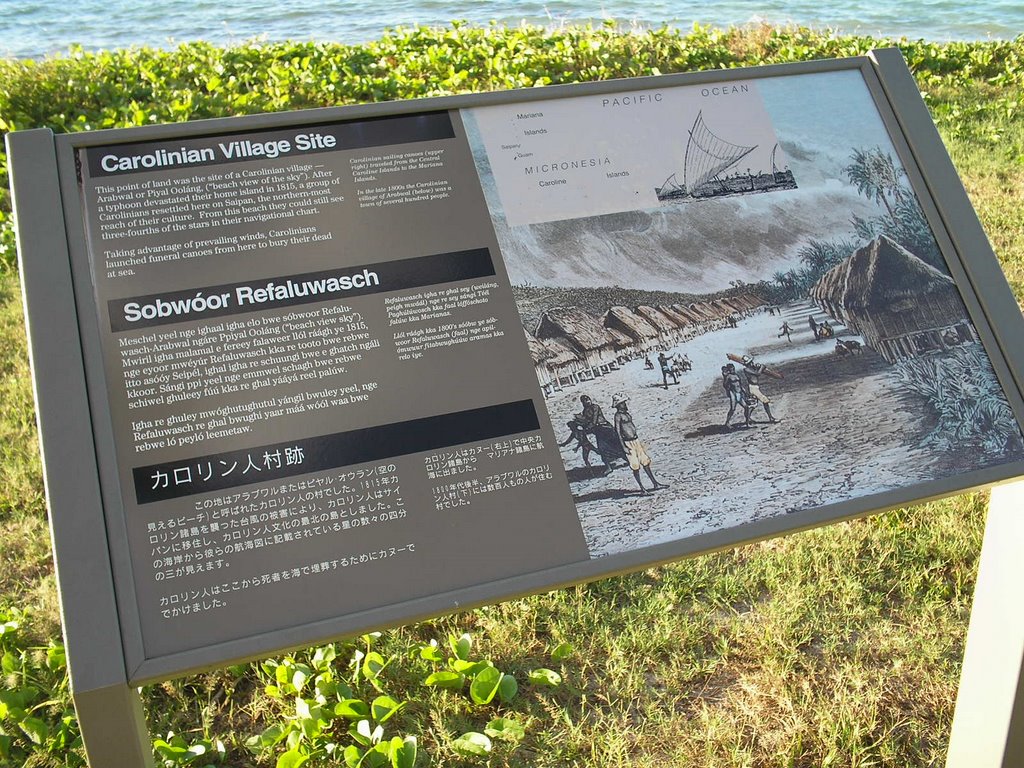
Carolinian village marker, GarapanWhen I went to Saipan I didn’t expect to encounter either of its two indigenous languages: Chamorro and Saipanese Carolinian. And indeed I saw next to nothing written in either language. Nothing in Chamorro but the greeting “Hafa Adai” (on every license plate), and nothing in Carolinian except a plaque (pictured here) in the American Memorial Park that marked the site of the old Carolinian village at Garapan.

But then I found KCNM-FM 101.1 on my rent-a-car radio and stayed tuned to it whenever I was driving. It played a wonderful assortment of contemporary Micronesian music, from Palauan enka to Chuukese country to Gilbertese gospel, which can all be sampled on Jane Resture‘s Micronesian Music Radio on Live365.com.

The music was interrupted periodically by NPR news in English and occasional announcements or classified ads in Chamorro, with prices quoted in English and telephone numbers in Chamorro. The Chamorro number system is now based on Spanish: unu, dos, tres, kuatro, sinko, sais, siette, ocho, nuebi, dies. (According to Wikipedia, the basic set of old Chamorro numbers was hacha, hugua, tulu, fatfat, lima, gunum, fiti, gualu, sigua, manot/fulu—far more Philippine-looking.)

Chamorros and Carolinians on Saipan are fighting an uphill battle to preserve their ancestral languages (and many have already surrendered). The resident population of the Northern Marianas is about 35% Filipino, 20% Chamorro, 10% Chinese, 10% Korean, 5% “Anglo”, with smaller numbers of Japanese, Palauans, and other Micronesians. Most of the retail clerks and wait help I encountered spoke Filipino and Filipino-accented English to each other. Most of the tourists I encountered spoke Japanese, Korean, or Chinese. The signage around Chalan Kanoa, which used to be the main Micronesian barrio when the U.S. Navy controlled most of the island, is now overwhelmingly Chinese and Korean, with some Japanese—and English, of course, one of the official languages of the Commonwealth of the Northern Marianas.

The most ubiquitous signs in Saipan say Poker. Many such signs are lit up round the clock. Almost every little country store has a Poker sign over one door, often next to one above the store entrance that says Food Stamps Accepted.

On 18 March 2005, the Saipan Tribune published three essays from a “contest held by the Department of Community and Cultural Affairs’ Chamorro/Carolinian Policy Commission to promote indigenous languages in the Commonwealth.” Let’s examine a few sentences of each.

Carolinian

Meta e welepakk sibwe kkepasal Refaluwasch rel?

Mwaliyasch Refalawasch nge eghi prisisu sibwe ghuleey bwe iyel yaasch IDENTITY me kkosch me eew malawasch ghisch aramasal Seipel. Sibwe abwaari me amalawa mwaliyasch leel olighat, fatattaral iimw, gangisch nge mwetelo mmwal nge sibwe kki yaali schagh.

When I took linguistic field methods back in grad school, our class worked with a speaker of Saipan Carolinian, which was not well described at the time, although a lot was known about closely related Trukese (now Chuukese). I’ve studied quite a few Austronesian languages, but you really need to be familiar with the Micronesian subgroup of Austronesian before this starts to look very familiar. Nevertheless, here are a few items that strike me.

Ethnonym: The Saipan Carolinian name for themselves is Refaluwasch. The name Carolinian is derived from the Caroline Islands, where the ancestors of today’s Saipan Carolinians came from, probably starting around the 1700s, after the Northern Marianas had been almost entirely depopulated.

Unusual sounds: I believe the Germanic looking sch indicates a retroflex affricate that sounds a bit like Yapese ch or Kosraean sr. The double consonants in word-initial position are a bit unusual and take some getting used to for English speakers who ignore the medial double nn in Japanese konnichi-wa.

Dialects: The Trukic languages form one long dialect chain, where speakers on neighboring islands can understand each other fine, but speakers from farther apart have increasing difficulty. There is no contrast between l and n in most of the dialects. Where this speaker writes aramasal Seipel ‘people of Saipan’, a speaker of a different dialect might write aramasan Seipen. Similarly, the town of Tanapag, settled by a different group of Carolinians, also goes by the name of Tallabwog.

Chamorro

Hafa Na Prisisu Na Ta Praktika I Fino’ Chamorro?

Kumu uniku yu’ na pagton [sic] palao’an gi familia yan todu I dos saina-hu Chamorro, gi anai pa’go mafañagu yu’, hu hungok I sunidon Chamorro despues enao mo’na I fina’na’guen nana-hu yan tata-hu. Este I lengguahen Chamorro impottante na ta tungo’ sa’ I mismo lengguahi-ta dumiklaklara hafa nasion-ta na rasan taotao….

Pot uttimo, prefekto yu’ na patgon Chamorro ya ti bai hu sedi na bai hu maleffa osino bai hu na’ fo’na I otro lengguahi ki I mismo lengguahi-hu Chamorro.

A Spanish reader’s reaction to written Chamorro must be very similar to a Chinese reader’s reaction to written Japanese. The huge number of familiar borrowings let you know the subject matter, but the foreign grammatical framework remains opaque. You know what they’re talking about, but not what they’re saying.

Ethnonym: Many Chamorros prefer to call themselves Chamoru, perhaps especially Guamanian Chamorros, whose orthographic standards (at least at Unibetsidåt Guahan) seem to differ somewhat from those in Saipan.

Unusual sounds: Chamorro ch is pronounced like [ts] (and some capitalize both members of the digraph: CHamoru, like Dutch IJssel); while y is pronounced like [dz]. The apostrophe marks a glottal stop. Spanish syllable-final -r regularly becomes -t and syllable-final -l assimilates to the following consonant.

Grammar: One of my term papers in grad school was an analysis of the historical morphology of Chamorro and Palauan, both of which look more Philippine-like as you go farther back. And both are verb-initial to a significant degree. (So is Yapese, but it’s not very closely related to any other Austronesian language.) But Palauan morphology is far more opaque: with Philippine -in- showing up as -l- and -um- showing up as -o- in some environments. Chamorro is more straightforward. The Spanish loanword diklara, for instance, is both infixed and reduplicated in d-um-iklaklara. Compare Tagalog bili ‘buy’ and one of its inflected forms, b-um-ibili.
Leave a comment

Filed under language, Micronesia, Pacific

Saipan Impressions: Three Meals

No one goes to Saipan or Guam for the cuisine, but I did want to try something localized and not the standard American, Chinese, Japanese, or Korean fare near the major hotels. I had a bit of success, but it wasn’t easy. And I only had three meals to worry about.

Breakfast on the way back to the airport included the obligatory Spam: a Spam & egg sandwich combo (with coffee and donut) at Winchell’s, a U.S. West Coast chain whose menu may have been adapted to Saipan tastes. But I hadn’t expected the huge dollop of mayonnaise that dripped off at every bite (with a little help from me).

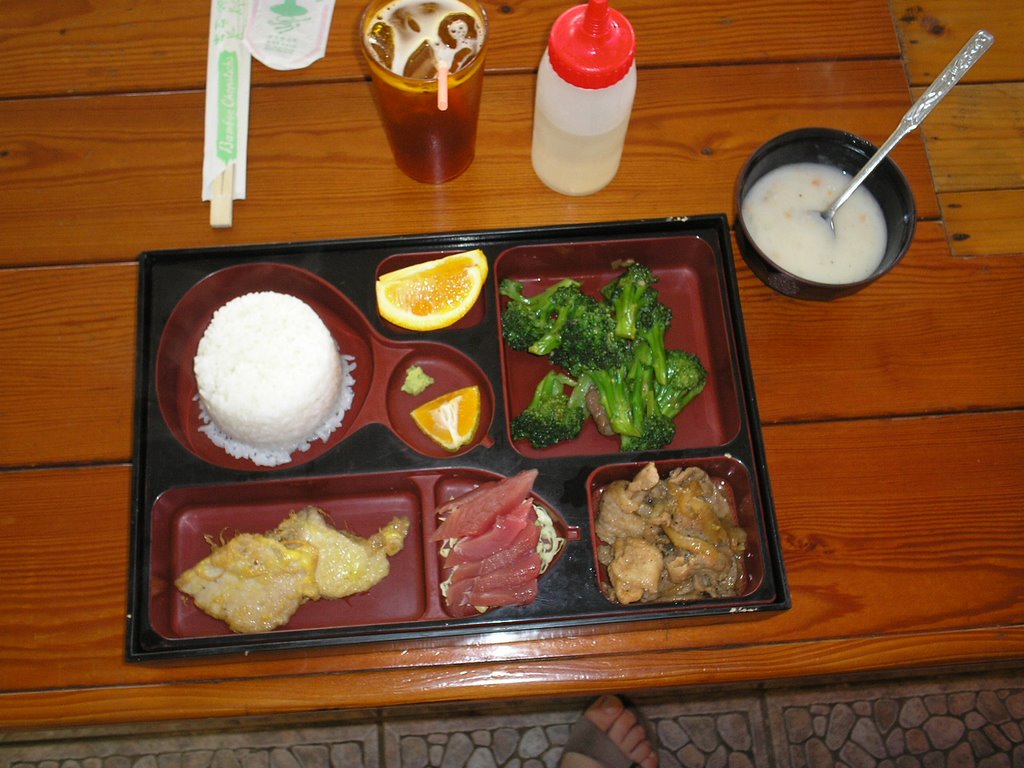
My first meal on Saipan was delayed until I returned from a drive to see the sights at the north end of the island, since there was almost nowhere to eat on that stretch of road. So I turned off into the port area on the way back and found the dowdy Seaman’s Restaurant at the end of a pier past a shipwreck listing in the shallows. It was 11 a.m. and I was the only customer—but a hungry one. The Chinese-run restaurant offered a $5 bento with Saipanese characteristics (pictured above). New England clam chowder substituted for miso soup, served with a Korean soup spoon. The rice and sashimi (with wasabi) were Japanese, the beef broccoli Chinese, and the fish jun vaguely Korean (with a wedge of local citrus to squeeze onto it), while the stewed chicken and onion looked like Philippine adobo, but with little pepper and garlic and even less vinegar or bay leaf. The ice tea was served with a squeeze bottle of sugar water, not packets of sugar or sugar substitute. Two orange slices served as a Chinese final course. It was just the sort of motley Pacific Island cuisine I was looking for.

After driving all over the island most of the day, I decided to see if any place looked promising within walking distance near the hotel. Moby Dick answered the call. A chalkboard listed fish kelaguen, a Chamorro dish of soft chunks of boneless raw fish “cooked” in lemon juice and tossed with slices of green and round onion, and sweet and spicy peppers. It was wonderful—and big enough to serve as an appetizer for two people. But I couldn’t resist ordering the local bottomfish catch of the day, either opakapaka or mafuti. I hadn’t heard of mafuti. When I asked what kind of fish it was, the Filipina waitress didn’t know any other name for it but brought it over to show me. I didn’t recognize it, but ordered it grilled. The whole fish came back to me a little bit overcooked, but I demolished most of it anyway. A Tagalog-speaking waiter later explained that “maputi” got its name from being a white fish. Tagalog for ‘white’ is indeed puti, but the fishname appears to be Chamorro, where the word for ‘white’ is a’paka’. So I don’t know what the story is. (More on Chamorro language later.)

Leave a comment

Filed under Micronesia, Pacific

Algeria: Recycling Terms from the Last War

Beginning in Algeria in July 1993 there were forests burning once again in the Aurès, Algiers was still living under a curfew, terrorist attacks attributed to Islamists were striking police officers and intellectuals, and hundreds of “suspects” remained in detention, sometimes without trial. The Algerian press had begun to mention the “sweep operations,” and the French press added reports from “the underground.” “Terrorism” and “torture” made their reappearance in the vocabulary of all the triumphant communiques, announcing, on the one hand, the “eradication” of the “last armed groups,” and, on the other, “the imminent victory of the Muslim people.” A strange sensation has developed that this is a remake of the war of independence [1954-62]: an impression of déjà vu or “déja entendu.”

Forty years later, the vocabulary is unifying, consolidating the two eras, making them look alike. Has the country, then, entered a second–and identical–Algerian war?

Nothing is less certain. In the first place, in history, formal analogies have but little pertinence if they confine themselves to highlighting the similarity between certain forms, in this case the resurgence of terrible forms of violence. And, in the second place, the Algeria of the 1990s has only a very distant relation to that of 1962.

The country today is highly urbanized; the rural areas no longer play the same role; more than 60 percent of the population is under thirty; and the rate of schooling is very high. The differences could be multiplied, with, at the center, the end of the colonial system, the massive departure of pieds noirs [French colonists], and the political operation of an independent state. It may therefore seem absurd to assert that the same scenario is being repeated. Yet the protagonists in the confrontation–the followers of the ISF [Islamic Salvation Front], the “democrats,” the army–have intentionally adopted the terms inherited from the past of the Algerian War. And that is what is truly of interest–Islamists speaking of “the valorous mujahideen,” wanting to hunt down “the new pieds noirs” who have appropriated the revolution; “democrats” calling the ISF militants harkis [Muslim colonial auxiliaries] who want to crush the Algerian nation. Some circles within the regime have launched campaigns against the “secular assimilationists,” as during the time of the colonial system, when a lost identity had to be reestablished. And all the camps mention a shadowy “party of France(Hizb França) supposedly destabilizing Algeria.

This mimicry is striking. The memory of the war of independence operates as a factor in the assignment of the roles to be played. The contemporary actors dress in theoretical garments borrowed from the past. But, if they do not realize the novelty of the present, and if they subjectively replay the old situation, it is because they remain under the automatist influence of a memory fabricated forty years ago.

SOURCE: Algeria, 1830-2000: A Short History, by Benjamin Stora (Cornell U. Press, 2001), pp. 232-233

For a more hopeful follow-up, see this OxDem Report from April 2004.

Leave a comment

Filed under Mediterranean, Micronesia, religion, war

Yapese Spelling Reform: "That Damn Q!"

Like Marshallese speakers at the eastern end of Micronesia, Yapese speakers at the western end seem to be resistant to spelling reforms designed by outside linguists.

The most recent Yapese Bible orthography makes do with only 5 vowels, but writes all the consonants. However, it spells glottal stop inconsistently. A glottal stop is implicit between any two adjacent vowels in a word, as in gaar ‘to say’, which has two syllables with a glottal stop in between. People used to use the same device to indicate final glottals, as in pii ‘to give’, but the most recent Bible orthography now writes the final glottal with an apostrophe, thus pi’. Except on a handful of grammatical forms, like u ‘at’, i ‘he, she, it’, glottal stops are predictable on words written with initial vowels, just as they are in English or German, so the Bible orthography doesn’t write them at all.

In the new orthography, however, the glottal stop is everywhere spelled with a q, and resistance to the new orthography centers on “that damn q” in new spellings like Waqab ‘Yap’, girdiiq ‘people’, qarcheaq ‘bird, bat’, and even Qapriil ‘April’ and Qaawguust ‘August’. (Imagine German Qach, du lieber Qaugustine!)

The decision to use q in place of the apostrophe for glottal stop was motivated by the fact that the apostrophe was already used to indicate a glottalized release on consonants. Yapese, like Navajo, has a whole series of glottalized consonants in addition to plain equivalents in initial, medial, and final position within the word, thus:

p, t, k vs. p’, t’, k’

m, n, ng vs. m’, n’, ng’

f, th, vs. f’, th’

l, y, w vs. l’, y’, w’

So, in theory, it is possible that rung’ag ‘to hear’ might be ambiguous between rung+’ag and the nonexistent forms *ru+ng’ag or *rung’+ag. In practice, this seems to be an awfully weak justification for introducing “that damn q.

Writing more vowel distinctions, on the other hand, seems well motivated. Yapese distinguishes among 8 long vowels, with a further possibility of 8 short vowels–although length is partially predictable from the position of the vowel in the word. All eight long vowels show up in the following minimal octet, so convenient for linguistic analysis: miil ‘to run’, meel ‘sail rope’, meal [æ] ‘rotten’, mael [a] ‘war’, maal [a] ‘taro type’, mool ‘to sleep’, moel ‘adze handle’, muul ‘to fall’. Using digraphs to write vowels, of course, precludes the old reliance on adjacent vowels to indicate glottal stop.

Examples of the old and new renditions of the most common greeting exchange follows.

  • ‘Where are you going?’

    Old: Ngam man ngan

    New: Nga mu maen ngaan
  • ‘I’m (just) going over there’

    Old: Nggu wan ngaram

    New: Ngu gu waen nga raam

The Pacific Area Language Materials website gives a sample of what the Japanese story Momotaro looks like in the new orthography. Look at all those paragraphs beginning with Q, especially on Qeree ‘and then’, which in the Bible is written Ere.

Once again, a socially optimal orthography in actual use can get by with even fewer alphabetic distinctions than a linguist might desire for the purpose of distinguishing each word in isolation from the sentential, semantic, and social context in which those words are normally used. A simpler, underspecified writing system would allow more Yapese to write their own language without having to run everything by someone with sufficient linguistic training to understand the New Orthography. It would take literacy out of the hands of experts and give it back to the people who need it most.

SOURCES: John Thayer Jensen, Yapese Reference Grammar (Hawai‘i, 1977; out of print) and Yapese-English Dictionary (Hawai‘i, 1977; out of print); Thin Rok Got nib Thothup [‘Word of God that’s Holy’ = the Bible].

3 Comments

Filed under language, Micronesia

Marshallese Spelling Reforms

The public renunciation by several media giants of spelling reforms promulgated in Germany less than a decade ago has generated some discussion in the blogosphere, notably on Rainy Day, Crooked Timber, and a Fistful of Euros, the last two with wide-ranging comment threads.

To take the discussion a little farther afield, I’d like to add a glimpse of what teachers and writers of two Micronesian languages are up against. In Marshallese and Yapese, spelling reforms promulgated in the early 1970s have yet to take hold. (I use “promulgated” to mean ‘imposed by specialists whose expertise is unimpeachable, but whose vision is clouded by thoroughly impractical ideals’.)

In both cases, the new orthographies suffer from two major drawbacks. (1) The only major literature written in each language has been the Bible. One tampers with holy scripture at one’s peril. Just witness how many Christians still stick to the King James Bible or to Latin liturgy. (2) Linguistic experts were overzealously committed to the “one phoneme, one symbol” principle of orthography design. Among all the languages I’ve dabbled in, Marshallese, Yapese, and possibly Nauruan seem the most resistant to any orthography that places that principle above all others.

Here’s a bit of a glimpse at Marshallese. Yapese will follow in another post.

Marshallese can be analyzed as having only four vowel phonemes that differ by height, but whose roundness (oh-ness vs. eh-ness) or backness (uh-ness vs. eh-ness) depend on their neighboring consonants. For instance, the vowel phoneme /e/ can sound like eh (open e), uh (schwa), or oh (o). In the textbook Spoken Marshallese (1969) the vowels are written i, e, a, & (yes, ampersand, but it was later replaced with an ę). The linguist Mark Hale refers to these four phonemes as cup of coffee, telephone, yinyang, and soccer ball, presumably because each word or phrase contains the varying sound values of the respective abstract phoneme.

Marshallese consonants distinguish only three main positions of articulation: lips (p, m), tongue tip (t, n), and tongue back (k, ng). Voicing (t vs. d, p vs. b) is not distinctive, but three secondary articulations are: “light”/palatal (py, my, ly), “heavy”/velar (p, m, l), and rounding (kw, ngw, lw). The parenthetical examples are not orthographic, but only intended to hint at pronunciation differences. One solution is to write the “heavy” consonants as if they were voiced: b, d, g vs. p, t, k, but that doesn’t help with the nasals: m, n, ng (the latter also written g).

The “light” consonants front the neighboring vowels (e > eh), the “heavy” consonants back them (e > uh), and the round consonants round them (e > oh). Two different consonant types on either side can pull the vowel in two different directions, creating dipththongs.

Examples of “improvements” in the 1969 textbook orthography:

  • ‘Hello’

    Old: Yokwe yok

    New: Yi’yaqey y&q
  • ‘I’m going to Ailinglaplap / Jaluit’

    Old: Ij etal ñan Ailinglaplap / Jaluit

    New: Yij yetal gan Hay&l&gļapļap / Jalw&j

Since Marshallese makes too many distinctions for the standard keyboard, a linguistically optimal solution to facilitate literacy in Marshallese could go in either of two directions. The first direction seems by and large to prevail.

  • Write more vowels than strictly necessary in order to keep them less abstract and because vowel diacritics are easier to keyboard, while relying on the neighboring vowels to show some of the consonant distinctions. This allows people to write with lower levels of linguistic or computer literacy.
  • Write only the minimal (four) vowel distinctions, and add diacritics to distinguish all the consonants in order to show the full beauty of the underlying phonological system. This requires higher standards of linguistic and computer literacy before people can write their own language.

I would suggest that a socially optimal orthography might get by with even fewer alphabetic distinctions. People could write fewer vowels and consonants than would be optimal in isolation, while relying instead on sentential, semantic, or social context to reduce ambiguity. But this approach would make linguists feel rather less useful.

A revised Marshallese Bible was published in 2002. I’m not sure which of the several previous orthographic practices it relies on. Marshallese editions of (portions of) the Bible go back to the the 1860s, after the first missionaries had arrived, some of them from Hawai‘i.

Sample PDFs of Marshallese materials in a vowel-rich, consonant-poor orthography are accessible from the Pacific Area Language Materials website.

SOURCES: Heather Willson, A Brief Introduction to Marshallese Phonology (PDF, UCLA); Byron Bender, Spoken Marshallese (Hawai‘i, 1969); R.W.P. Brasington, Epenthesis and deletion in loan phonology (PDF, U. Reading, 1981).

UPDATE: David at Rishon-Rishon examines the question of “social optimality” at greater length, with evidence from Russian and Hebrew, noting that Russian writes consonantal palatalization on the vowels, while Hebrew writes velarization on the consonants.

1 Comment

Filed under language, Micronesia

Micronesian Diary: Meeting House and Eating Turtle, Yap

On 30 January 1999, archaeologist Felicia Beardsley visited a meeting house on the southern tip of Yap, Micronesia, where she ate sea turtle. Her Micronesian Diary entries focus on food as much as archaeology. I like that.

Anoth is at the south end of the island, the south tip. It is a coastal village, and we had been invited to the open house held in honor of the completion of rebuilding their traditional pebaey, or meeting house. The pebaey is right on the coastal flat — well, the entire village is — and immediately on the shore’s edge (not more than 50 meters from the pebaey) is the faluw, the men’s house. The only thing left of the faluw, however, is its foundation. It is a coral foundation, which is gradually eroding into the sea. In effect, the faluw foundation is an archaeological site.

Actually, a very large number of traditional dwellings in Yap were turned into similar archaeological sites by Typhoon Sudal in April 2004. Many people are still living in tents.

In these villages, the pebaey and faluw are used, reused, and rebuilt over time. Their locations generally do not change, so the same structure (or rather foundation) supports several generations of superstructures, all of which follow the same construction plan, with variation only in the decorative elements such as the plaiting in the walls and so on. Both structures are six-sided, and the only difference between the two is that the faluw is closed-walled, and the pebaey is not. That is because the faluw is (or was) used as a dwelling place for young men, where they would learn the skills that would carry them through life, including (but not limited to) fishing, the manufacture of all the tools necessary for fishing, fighting, dancing, oral histories, and of course, sexual skills. Each faluw used to house several girls who were obtained (kidnapped, purchased) from other villages. By contrast, the pebaey is a meeting house, or community house. It did not have need for walls, as it was not a place for permanent dwelling….

Teresa and I were the only girls at the open house; I was told the community had made a conscious decision not to include the women of the community. The festivities included roasting a sea turtle, which I was obliged to try. It really isn’t that bad, and tastes quite good when you eat the meat with the fat. But, as one of the chiefs pointed out, it is not something I am accustomed to eat, so it was of course understandable when I handed what was left on my plate over to someone else.

One of the most valuable phrases any fieldworker or traveller needs to learn is how to say in the local language, “I’m not accustomed to that yet.”

Then he went on to describe the preparation of the turtle, step-by-step, including how its shell is opened when it is basically half-cooked. There are times, he said, when the heart is still beating at this point. This is when the meat and fat is distributed, and several of the organs are removed. After this, the blood of the turtle continues to cook in its shell; it is this cooked blood that this particular chief prefers. Many others at the site also told me they prefer the cooked turtle blood, and could hardly wait until it was done. This same chief has a son whom Teresa was obliged to watch throughout the course of the day. She did a good job, keeping them both out of trouble and out of harm’s way. I think she welcomed this “job” because it kept her occupied….

I also had an opportunity to chat with the chief. What I found interesting is that chiefs like him are raised as chiefs from the time they take their first steps, and that is what he is doing with his son too. He said that he has seen so many changes in the traditions of Yap. Today, he said (and he seemed a little concerned about it), there are people who aren’t chiefs but who want to be. So, sometimes, he said, he just steps back and says, go ahead. Then watches. He said they don’t know how to do it, and they get frustrated and give it up.

The caste system in Yap has driven many talented commoners–and outcastes–to seek their fortunes overseas, many in the U.S. military. (Yapese have served in Bosnia, Afghanistan, and Iraq.) But it also seems to have contributed to a healthier fiscal and cultural cautiousness than in some of the other Micronesian states.

Leave a comment

Filed under Micronesia

Micronesian Diary: Yam Feast in Kitti, Pohnpei

I’ve only just discovered archaeologist Felicia Beardsley’s Micronesian Diary, an illustrated diary of her visits to various parts of Micronesia in 1998-99. Here are excerpts from what she has to say about a yam feast in Kitti Municipality on Pohnpei.

We are supposed to attend and document a traditional feast — the ritual presentation of the yam (and opening of yam season) to the Nahnmwarki [high chief] by one of the villages in Kitti Municipality. That should be interesting….

We arrived to find huge yams hanging from the rafters of the nas [ceremonial house], as well as lined up outside on large racks made especially for such things. In one location outside the nas, there are piles of kava plants (for sakau [= Samoan te kava]) and sugar cane. These were collected by the four sections of the village — sort of a competition. And just outside the nas, an um (earth oven) was well underway — the wood was burning, stones had been piled high and were beginning to be heated. Those stones in the middle of the pile looked as if they were already starting to glow red with heat….

Then, just in front of the um and nas, a line of pigs stretched out on banana leaves. The pigs are killed on-site. Apparently, each village section was also responsible for supplying a pig or pigs (their choice). Someone also laid out a carabao. I am told that in the ranking of animal offerings, dog is the highest ranked, then pigs. Carabao are extras, with no rank. This was the first carabao I had actually seen here, and it was dead. It was almost immediately cut up into little pieces, with a leg offering given to the Nahnmwarki. The pigs are thrown onto the top of the um to burn off the hair, then they are opened up, cleaned and thrown back onto the banana leaves splayed. They and the pieces of carabao are covered up to keep the flies and dogs off of them. There are plenty of dogs wandering around, trying to lick up the blood from these animals….

The food is distributed to everyone; then comes a presentation of fabric and sugar cane. Yams are called (by title) for the um and pigs are placed on the um. These are then presented to the Nahnmwarki. The pigs are cut up, with the pieces distributed to various title holders. Next, the carabao. (We were given a piece of carabao; I gave it to Rosenda. She has a bigger family; besides, I know Teresa [her daughter] would not eat any of it because she saw the animal killed.) …

Finally, the last event of the day: Sakau pounding. All the stones in the nas (there are supposed to be six) are prepared. They are set up on tires and/or coconut husks. The kava is prepared, and the pounding begins. It is quite rhythmic, and in sync. One wonders if there is someone directing the pace of pounding. The whole sound echoes throughout the nas. One stone is pounded by all women; and their companions are dancing and singing, whooping and hollering to the rhythm of the stones. Sakau is traditionally pounded by men, who work with their shirts off. So, when these women were in the process of preparing their stone, one of the men involved in the event told them they had to take their shirts off just like the men because that is the way it is done. They didn’t, and gave him such a scolding that he walked off and left them alone.

Leave a comment

Filed under Micronesia

The Ngatik Massacre, July 1837

In July 1837, a ship sailed into Ngatik atoll near Pohnpei on a nefarious mission.

The ship was the trading cutter Lambton, out of Sydney, Australia, manned by the classic motley crew of runaways, villains, adventurers, and entrepreneurs–the sort who abounded in the European population of the Pacific in the early nineteenth century. Any of those words could describe the Lambton’s master, C. H. Hart. Hart had roamed the Western Pacific for years, making his way by a mix of fair trade and sly schemes. Hart traded Islanders beads and knives, guns and ammunition, tobacco, cloth, and rum, driving a hard bargain for the bêche-de-mer, pearl shell, and tortoiseshell that he loaded aboard the Lambton. Bêche-de-mer, sea cucumber, went to China for soup. The Chinese paid well for it, but it had to be boiled and cured in a foul, messy job. Collecting pearl shell, like processing bêche-de-mer, was labor intensive…. Tortoiseshell, from hawksbill turtles–that was the stuff. It was made into ladies’ combs and mirrors, decorated boxes, and knickknacks. The Victorian world, Far East and West, was wild for it, and hawksbill turtles were being decimated to fill the demand.

It took time and hard work to find the turtles, though they were easy enough to kill once you located them. But what Hart had, or thought he had, on the atoll called by its inhabitants Sapwuahfik (but by Hart “Ngatik,” and on navigational charts by a dozen other names) was a hoard of tortoiseshell without the trouble of work–except the work of taking it from the island’s people, who would, no doubt, object. They had objected when Hart’s crew first found the treasure trove of shell, more than a year earlier. Two of the Lambton’s men had gone inland and discovered a cache of turtle shell, but the Islanders would not sell and resisted theft. In fact, a group of men chased the sailors down to the beach, and the crew escaped by quick oar strokes. The Lambton returned to island trading and a trip to New South Wales, but Hart did not forget the shell, nor the close call he and his crew had experienced. Greed and revenge took root, and in Hart’s mind he marked Sapwuahfik for a return trip.

The Lambton sailed to the region again in mid-1836, arriving at Pohnpei Island in August, just after a group of whalers from the ship Falcon had been killed following an altercation with Pohnpei men. The Europeans in the area, Hart among the leaders, joined forces to take revenge, culminating in the murder of a Pohnpei nobleman. (By involving himself with these events, Hart made sure that his name went down on the list of persons to be investigated two years later by a British warship, HMS Larne, under Commander P. L. Blake. Blake was a thorough and principled investigator, cautious but relentless in his pursuit of evidence of criminal activity. Because of Blake we have a historical record of Hart’s crimes.)

After the Falcon incident, Hart went back to business, sailing between Guam, Manila, and Pohnpei. Then, on the last days of June or the first days of July 1837, he made ready for his return to Sapwuahfik–where, he said, he wished to “trade quietly” with the natives–by making cartridges and taking on extra hands from Pohnpei.

When he arrived at the atoll, Hart tried to land where he had landed before, but this time he was met with hostility. Sapwuahfik men beckoned them ashore, indicating their intentions with a display of their own weapons. The people of Sapwuahfik had known from divination when the ship would return; they had been watching, and when they saw it appear on the horizon, they prepared for war, readying clubs and slings.

Hart thought better of an immediate landing, taking the crew to spend the night on another islet of the atoll. The next day he loaded them into the ship’s boats for a straightforward assault. Despite the defenders’ preparations, the battle turned against them. In two days of fighting, every Sapwuahfik man but one was killed or fled by canoe. Though one woman was accidentally wounded, the invaders did not make targets of women and children.

Soon after the Lambton sailed from the atoll–which, now that the native voices were stilled, would be called Ngatik for more than a century–it returned to leave a group of Pohnpeians and a European in charge of what Hart saw as his conquered domain. The plan was to operate Ngatik as a business, producing tortoiseshell. They would bring in more settlers, marry the widows and girls of old Sapwuahfik, and see how much money they could make in this pretty place. So survivors and murderers began a curious interaction that would eventually produce a new population and a unique culture [and language]. Sapwuahfik’s history had come to an end. The story of Ngatik had just begun.

SOURCE: The Ngatik Massacre: History and Identity on a Micronesian Atoll, by Lin Poyer (Smithsonian, 1993), pp. 1-3

4 Comments

Filed under Micronesia

Ngatik Men’s Creole and Its Legacy

One result of the massacre of all the men on Ngatik atoll in 1837 and their replacement by their killers from aboard the cutter Lambton was the creation of an unusual language, Ngatik Men’s Creole, described in Ethnologue as:

A creolized language from the Sapuahfik dialect of Ponapean and English whose genesis is the direct result of a massacre in 1837 of adult males on Ngatik by British traders. Spoken by adult males who are also native bilinguals of the Sapuahfik dialect of Ponapean. Adult male speakers. Women and children understand it.

Most Pacific creoles are built out of words from the colonial languages (chiefly English or French) in a grammatical framework based on local languages. Ngatik Men’s Creole is the reverse: The nouns, verbs, and adjectives are mostly of Pohnpeic origin, but the pronouns, prepositions, and such are mostly from English. It appears as if the foreign men started by speaking (some Pacific maritime variety of) English to each other, but gradually replaced the English content words as they became bilingual in the language of their wives.

Partly for linguistic reasons, the people of Ngatik later came to identify strongly with Americans. Among the nonlinguistic reasons is the relative egalitarianism of Americans compared to the more explicitly (but fluidly) hierarchical orientation of Pohnpeians.

Sapwuahfik people explicitly compare their perceived egalitarianism to American ways, and mehn Pohnpei share the recognition of American style as egalitarian….

Sapwuahfik’s sense of having special ties with Americans is founded on a number of historical incidents, beginning with uncertainty about Hart’s nationality, which for some people has become the determination that he was American (from the documents, he appears to have been a British citizen; the Lambton was registered in Sydney, Australia). (One man joked to me about filing a claim for damages against the United States on account of the massacre.) Sapwuahfik’s history of affiliation with Americans can be traced through stories about the immediate postmassacre period (when several memorable Anglophones, some American, lived there), the American missionary era, World War II (when the U.S. military visited and bestowed gifts on the atoll) and the post-1960 era of U.S. economic generosity. Anecdotes of World War II include personal encounters with flyers and soldiers that emphasize the bravery, friendliness, and generosity of the Americans. Because they alone spoke English, Sapwuahfik men on Pohnpei acted as interpreters and assistants to incoming U.S. troops.

Today it is the people of Pohnpei, and to an extent other Micronesians in the Eastern Carolines, who have greatest access to and familiarity with American ways. Yet Sapwuahfik people retain a sense of identification with Americans. In their view of the past, they moved from a state of darkness through the trial of the massacre onto a path of increasing enlightenment, which today is consonant with the general shift in Micronesia toward political democracy and decreasing emphasis on traditional rank as a source of power. The construction of history is thus strengthened by American ideals of democracy and social equality, in which mehn Sapwuahfik see themselves as more like Americans than are their Eastern Carolines neighbors.

A second symbolic elaboration of Sapwuahfik identity is as sincere Christians, in distinction from neighbors who are thought to use sorcery. Concern about possible magical harm pervades discussions about illness or misfortune, and caution about sorcery dangers accompanies Sapwuahfik visitors to Pohnpei. Throughout much of the Pacific and elsewhere, it is “others” who employ magic, and “we” who are true Christians. The Sapwuahfik claim partakes of this general phenomenon. Yet beyond this, the notion of Sapwuahfik virtue (like the assertion of egalitarian socioeconomic relations) is supported by a historical argument: atoll people rejected pagan ways as a result of the massacre and are now firmly committed to increasing “enlightenment” in both religious and political terms. God’s mercy on the island after the terrible punishment of the massacre is a reward for their faithfulness to his religion. Sapwuahfik’s claim of special divine protection rests on uniquely local indicators–people point out that Sapwuahfik does not suffer from typhoons or food scarcity, as other islands do, and that it was preserved from bombing in World War II.

Egalitarian and religious considerations are thus potent markers, affirming the forward-looking, allied-with-power, “enlightened” qualities of Sapwuahfik culture.

SOURCE: The Ngatik Massacre: History and Identity on a Micronesian Atoll, by Lin Poyer (Smithsonian I. Press, 1993), pp. 232-234

1 Comment

Filed under language, Micronesia

Spicy SPAM Balls Wins Guam Cook-off

Guam’s Pacific Daily News reports:

Ben Torres modified a local favorite dish to win the fourth annual SPAM Cook-off Islandstyle last weekend.

The 53-year-old Barrigada resident’s “Spicy SPAM Balls,” which is made up of ingredients used in fried rice, rolled into a ball and quick fried, bested the dishes of five other finalists. With the win, Torres received $1,000 in cash and a trip for two to Austin, Minn., the SPAM capital of the world.

The SPAM Museum is worth seeing, Ben. But bring your own food.

SPAM played a crucial role in World War II, and not just in the Pacific Islands.

As America entered World War II, SPAM luncheon meat played a crucial role overseas. With Allied forces fighting to liberate Europe, Hormel Foods provided 15 million cans of food to troops each week. SPAM immediately became a constant part of a soldiers’ diets, and earned much praise for feeding the starving British and Soviet armies as well as civilians….

  • SPAM was used as a B-ration – to be served in rotation with other meats behind the lines overseas and at camps and bases in the States. However, many times GIs were eating it two or three times a day….
  • Soviet Union leader Nikita Khrushchev wrote, “Without SPAM we wouldn’t have been able to feed our army.”
  • Margaret Thatcher, then a teenager, vividly remembered opening a tin of SPAM on Boxing Day (an English holiday observed the day after Christmas). She stated, “We had some lettuce and tomatoes and peaches, so it was SPAM and salad.”

Leave a comment

Filed under Micronesia, U.S.