Category Archives: North America

Three Major Native Rebellions, 17th c.

From Indigenous Continent: The Epic Contest for North America, by Pekka Hämäläinen (Liveright, 2022), Kindle pp. 189-190:

THE NEARLY SIMULTANEOUS Indigenous rebellions against European imperial ambitions in all regions of North America at the end of the seventeenth century brought English, French, and Spanish colonists near their breaking points. Shockingly, Native Americans had rolled colonialism back in different corners of the continent, forcing colonists to retreat, recalibrate their ambitions, and reconsider their ingrained ideas about Native peoples. The Europeans suffered a crisis of self-confidence. Traumatized New Englanders, consumed by Indian wars [King Phillip’s War], believed that their god was displeased with them. They turned against one other, denouncing neighbors, relatives, and those who were generally suspect as witches [Salem witch trials]. Virginians, unable to decide what to do or how to live with their Native neighbors, fell into a civil war [Bacon’s Rebellion] that nearly pulled the colony to pieces. New France, once the most promising of the colonial ventures, found its expansive sphere of influence in the interior dramatically reduced in the shadow of the ascending Five Nations League. In New Mexico, Spanish colonists entered into a tense, postrebellion [Pueblo Revolt] accommodation with the Pueblos—an imperial retreat that instilled a softer edge on Spanish colonial rule.

What explains this simultaneity? It may have been pure coincidence, but perhaps something more structural was at play. By the time the rebellions erupted, the Wampanoags, Nipmucs, Susquehannocks, and Pueblos had withstood colonial abuse for two to three generations. Among them were Indians who had seen the beginning of colonial conquest, the seizure of Indigenous lands, and the marginalization of their people in their homelands. They had lived with colonialism most of their lives, and they could see that things were getting worse, not better, with time. As Indigenous elders recounted their nations’ histories, a subversive undercurrent may have crept into their stories, finding expression in disgust, hatred, and, eventually, cleansing violence. The elders may have warned that the opportunity to reverse the historical momentum was closing rapidly.

Leave a comment

Filed under Britain, France, migration, military, nationalism, North America, religion, slavery, Spain, war

An Iroquoian Empire, c. 1680

From Indigenous Continent: The Epic Contest for North America, by Pekka Hämäläinen (Liveright, 2022), Kindle pp. 123-125:

AROUND 1680, ABOUT FIFTY YEARS after the terrible smallpox epidemic that cut their numbers by half, the Five Nations were at the height of their power; they were now the domineering nation in the great interior. The French feared them, the English respected them as allies, and the Dutch no longer had a colony in North America. The Iroquois seemed to be everywhere. Their fleet-footed war parties ranged across the Great Lakes, seeking captives, pelts, and spiritual and emotional healing. Their world had expanded explosively, covering a massive domain. They seized pelts and captives from the Ottawa Valley to the western limits of the pays d’en haut, which the French still claimed—feebly now—as part of their empire.

With most English colonies now in their orbit, the Five Nations moved to draw their Native neighbors within their sphere of influence. Weakened Susquehannocks, Piscataways, and others sought refuge in Iroquoia against Maryland and Virginia, and soon Iroquois-Susquehannock war parties set out to “scour the heads” of the Potomac, James, and Roanoke Rivers to bring their Native tributaries into Iroquoia. The Iroquois also took in “Christian Indians” from Massachusetts and refused to return them—now their “flesh and blood”—to New England when asked. In the West, the Iroquois raided the French-allied Illinis, Miamis, and Odawas, taking hundreds of captives and shattering France’s commercial networks in the interior. When the Miamis offered three thousand beaver pelts in exchange for their relatives, the Iroquois took the furs but refused to release the captives. Iroquois sachems thought it politic to inform the governor of New France—Louis de Buade, comte de Frontenac—that “they would not eat his children.”

As Iroquois ambitions swelled, the confederacy became entangled in complex foreign political arrangements with the surrounding colonial powers. Since the mid-seventeenth century, New France had posed the most serious challenge to the Five Nations’ ambitions and sovereignty. Tracy’s invasion of Iroquoia in 1666 appeared to have locked the Iroquois into the French orbit by opening their towns to Jesuit black robes. The Five Nations had suffered enormous losses in their relentless beaver and mourning wars, leaving them uncertain of their spiritual virtue and political primacy. Many seemed to have become stout Francophiles who embraced the Christian god, accepted Onontio as their father, and opened their settlements to French merchants.

Against this backdrop, the Five Nations’ Covenant Chain with New York in the 1670s might appear to signal a splintering of the Iroquois League into rival factions. The sudden Jesuit ascendancy among the Saint Lawrence Iroquois seemed like a capitulation to a colonial power, and it fueled virulent anti-French sentiments within the league. The pro-English bloc of the Iroquois was emboldened to steer the league into a tighter alliance with the increasingly powerful New York. All this did not mean, however, that the Five Nations were divided or in conflict. On the contrary, the Francophile and Anglophile blocs together enabled the Iroquois League to keep North America’s two most powerful empires in a state of uncertainty, nurture commercial and political relations with both, and draw major concessions from each.

Suddenly, New France was besieged by a newly ascending Five Nations. France’s North American empire did not exist outside of its web of Indian alliances, and the Five Nations were at once usurping that web and tearing it apart. Captives poured into Iroquoia—a single raid yielded eight hundred Illini captives—and the number of Iroquois villages increased from fifteen in 1666 to twenty-four in 1680, while the area covered by their settlements increased from roughly seven thousand square miles to forty-five thousand. Iroquois war parties looted French vessels and demanded tributary goods at Fort Frontenac, while selling the bulk of their pelts to Albany. New France suffered a twenty-five percent drop in its fur revenue. Governor Frontenac kept postponing direct talks with the Iroquois. He had a good reason: they had threatened to boil and eat him.

There had never been anything like the Five Nations League in North America. No other Indigenous nation or confederacy had ever reached so far, conducted such an ambitious foreign policy, or commanded such fear and respect. The Five Nations blended diplomacy, intimidation, and violence as the circumstances dictated, creating a measured instability that only they could navigate. Their guiding principle was to avoid becoming attached to any single colony, which would restrict their options and risk exposure to external manipulation. French officials believed that the Iroquois strove to become “the sole masters of commerce.” Such an idea was not far-fetched. Having observed how the Five Nations “completely ruined” several Native nations, the French knew they were defenseless. An Iroquois empire was consolidating in the interior.

Leave a comment

Filed under Britain, economics, France, migration, military, nationalism, North America, religion, war

French Yield to Mohawks, 1622

From Indigenous Continent: The Epic Contest for North America, by Pekka Hämäläinen (Liveright, 2022), Kindle pp. 92-94:

In 1622, desperate to put an end to the violence that disrupted the fur trade, the raison d’être of New France, Champlain yielded to Mohawk demands. The Dutch came to their own conclusions about Mohawk power around the same time, retreating from closer interactions; and Champlain, spotting an opening, extended a peace proposal to the Indian nation. The Mohawks accepted a treaty, which freed them to focus on their Native rivals. They attacked Montagnais towns in the Saint Lawrence Valley, securing the northern and western flanks of Iroquoia, the Iroquois homeland. In the south and east, Mohawks, the “Keepers of the Eastern Door,” moved to discipline the Dutch, who, placing profits before politics, had opened Fort Orange to Mahicans. By 1628, the Mahicans and the Dutch had seen enough. The Mahicans agreed to pay the Mohawks an annual tribute in wampum, and the Dutch resigned to placate the Iroquois League with goods. Mohawk sachems now controlled who was allowed to trade at the fort—whose guns, lead, and powder could make and unmake Indigenous regimes in the Northeast.

France’s support for its Native allies was not altruism; it was secured by a generous trade in beaver pelts and through the social alchemy of sharing. “The Beaver does everything perfectly well,” a Montagnais hunter declared, “making sport” of French traders. “It makes kettles, hatchets, swords, knives, bread; and, in short, it makes everything.” It is only a slight exaggeration to say that the beaver also made New France itself. In 1627 the colony was home to mere eighty-five people, yet its charter granted it all of North America, from Florida to the Arctic Circle. To prop up the colony, Cardinal Richelieu, the chief minister of King Louis XIII, established the Company of One Hundred Associates to facilitate immigration. Expectations were still modest. The company had to bring in fifteen hundred French “of both sexes” during the first ten years, or face heavy sanctions. It was clear that collaboration with the Indians through the beaver pelt trade would remain New France’s lifeline.

However, New France was also a religious and moral project that mobilized French officials, missionaries, and soldiers to make a concerted effort to enforce acceptable behavior. Marriage customs, especially polygyny, became a source of contention between Jesuits and Indians. For Native men, having multiple wives was essential as a mark of status, as well as insurance that they would produce more children who would contribute to the household’s prosperity and reputation. When French missionaries challenged Indigenous marriage arrangements, both Native women and men fought back fiercely. But large numbers of women—especially captured secondary wives—also sought relief from the grueling labor and lack of autonomy under authoritative and abusive husbands. For them and others, missionaries and Christianity could be useful: they could offer a different life.

In the early 1630s, New France, already inseparable from its network of Indian allies, encompassed an expanding domain around the Saint Lawrence Valley. French traders were reaching out to the Indians for their furs, and Jesuit friars were reaching out for their souls, entrenching the French in North America. In 1631, Champlain wrote a booklet on French and English colonization in the New World, stating that the English “do not deny us all New France and cannot question what the whole world has admitted.”

By the mid-seventeenth century, the colonies in Maine that had been founded by European powers were confined to the Atlantic coast below the Penobscot River, and most of those colonies were small and vulnerable. European maps were remarkably accurate when depicting coasts and rivers, but the rest of the continent remained terra incognita. The English, French, and Dutch colonies had not become launchpads for territorial expansion, and only the French had a plan for colonization—a plan that emphasized coexistence. All colonial powers simply struggled to survive. Rather than looking to the west for conquests, they looked to the east, toward their mother countries, for goods, weapons, and soldiers to keep them safe. The settlements were more footholds than full-fledged colonies. It is telling that the out-of-the-way Great Fishery was still the most lucrative of the European schemes, and it was a business venture, not a colony.

The Spanish Empire had instigated an early European surge consisting largely of ruthless pillaging, which was lucrative but not sustainable. It had not led to permanent possessions in North America. By 1600, the Spanish were seriously questioning their methods. More than a century of colonialism had merely scratched the surface of the Indigenous continent.

Leave a comment

Filed under Britain, Canada, economics, France, migration, military, nationalism, Netherlands, North America, religion, Spain

The Fox of the Mohegans

From Indigenous Continent: The Epic Contest for North America, by Pekka Hämäläinen (Liveright, 2022), Kindle pp. 86-87:

THE MOHEGAN SACHEM UNCAS SEEMED TO BE everywhere, shaping every major development in the borderlands between the colonists and the Indians. In 1626, at the age of thirty-six, he had forged a MoheganPequot alliance by marrying the daughter of Tatobem, the great sachem of the Pequots. Uncas accepted a subordinate role under the senior sachem, only to immediately challenge Pequot authority when Tatobem died in 1633. Uncas persuaded the Narragansetts to join him but struggled to challenge the supremacy of the Pequots, who had drawn the Dutch into their orbit. The Pequots banished Uncas to live among the Narragansetts. Stripped of followers, Uncas seemed to have exhausted his options. The Mohegan territory was shrinking rapidly, and he had but a handful of followers.

But then Uncas spotted an opening in the form of the new English colony of Connecticut. He approached the newcomers and established ties with the leading Puritans. He warned the colonists of an imminent Mohegan attack and earned their trust. When the English moved against the Pequots, Uncas supported the colonists, having become alienated from the haughty Pequots. When the Pequots were crushed, he adopted several survivors as newly born Mohegans. He was one of the crucial signers of the 1638 Treaty of Hartford, which dispossessed all the Indians who were not party to it. He promised to live in peace with the English; in return, the remaining Pequots would be divided between the Mohegans and the Narragansetts. It was at once revenge and an attempt at ethnic erasure. The treaty’s clause that the Pequots “shall no more be called Pequots but Narragansetts and Mohegans” was as much Uncas’s doing as it was that of the colonists. Acutely aware of their weakness in the midst of powerful Indigenous confederacies, the English expected the Mohegans and Narragansetts to punish the Pequots and “as soon as they can either bring the Chief Sachem of our late Enemies the Pequots that had the chief hand in killing the English to the said English or take off their heads.” When peace came, the English held more than three hundred Pequots captives. They carried many of them to the colony of Providence Island, near the Spanish-controlled Mosquito Island, trading them for African slaves. New Englanders did not want Pequots nearby.

With the Pequots utterly defeated, the Mohegans emerged as a major regional power. While maneuvering to marginalize the leading Narragansett sachem, Miantonomi, Uncas directed the English—apparently through misinformation—to move against the Narragansetts. In the mid-1640s, the English began to encroach on Narragansett lands. Uncas captured Miantonomi and turned him over to the English. The colonists sentenced the sachem to death and asked Uncas to execute the order. With a Puritan delegation witnessing, Uncas’s brother Wawequa sank a tomahawk in the sachem’s skull. The Narragansetts soon signed a peace treaty with the Connecticut Colony.

Uncas’s opportunistic diplomatic maneuvering and his ability to create and break alliances placed the colonists at a significant disadvantage in the contest for position and power. Uncas and his Mohegans endured endless colonial challenges, large and small—not just surviving as a people but controlling the world around them. Huddling in their small colonial enclaves, the English and Dutch were insular and powerless in comparison, managing little more than glimpses of the Indigenous politics that determined events and outcomes. The English thought they could regulate matters of war and peace in the New World, but more often than not, Indians steered them into fighting and financing Indian wars and facilitating truces and treaties with goods and gifts when the fighting stopped. The colonists—whether Spanish, French, English, or Dutch—could be arrogant and brutal, but the Indians had learned how to exploit them for their own purposes. Properly managed and manipulated, they could be useful.

Leave a comment

Filed under Britain, economics, language, migration, military, nationalism, Netherlands, North America, war

Heydey of Dutch Wampum Trade

From Indigenous Continent: The Epic Contest for North America, by Pekka Hämäläinen (Liveright, 2022), Kindle pp. 74-76:

IMPERIAL RIVALRIES among the European powers exacerbated the tense situation in New England. More quietly than the Spanish, French, and English, the Dutch had entered the contest for North America in 1609, when Henry Hudson, having failed to find a sea route to China through North America, came to a river that still bears his name. When Dutch merchants arrived in the Hudson Valley in the 1610s, they realized it was a place of vast advantages. The Hudson was navigable for 160 miles into the interior, allowing access to bustling Native markets along the Saint Lawrence Valley and in the Great Lakes. Uninterested in converting and “civilizing” the Indians, the business-minded Dutch treated Indians as customers and trading partners.

The Dutch Indian policy was persistently practical. Dutch merchants quickly determined where the power lay and acted accordingly, forging close ties with the Mahican Nation, which dominated the interior trade. The Dutch built Fort Nassau in 1614 on the Hudson and, through the Mahicans, sold guns, powder, and iron tools across an enormous hinterland. In return, Fort Nassau was flooded with beaver pelts, North America’s most coveted commodity, making a fortune for the Dutch. The fort had only about four dozen employees, half of them traders and the other half soldiers. This kind of light colonialism was not exactly by design—Dutch imperial ambitions in Asia drew most of the available resources—but the relative modesty of their operations in North America would serve the Dutch well.

Dutch commercial prowess alarmed the English, triggering an unexpected imperial contest centered on processed clamshells. Clamshells were the raw material for wampum beads, which were sacred to many eastern Indians. They painted them with various colors and strung them into belts that were used in religious ceremonies, to proclaim social status, to stabilize border relations, and as mnemonic devices in relating traditional stories. Wampum also served as currency, and there the entrepreneurial Dutch merchants spotted an opportunity. They began to supply the coastal Indians with metal lathes that enabled them to manufacture wampum on an industrial scale. Native women could produce five to ten feet of wampum belt a day, and soon some three million monetized wampum beads were circulating in the Northeast, fueling an expanding exchange economy. Europeans had accepted a currency that a moment earlier meant next to nothing to them.

Struggling to enter into the lucrative wampum trade and to pay their European debts—building colonies was extremely expensive—the still fragile Puritan colonies approached the Wabanakis, who were expert mariners and trappers equally capable of producing great quantities of prime beaver pelts, swordfish, cod, or right whales. Living far to the north of the main clamshell-farming area, Wabanakis were eager for access to wampum; the Puritans began to demand it from their Native neighbors to buy Wabanaki furs. Their methods were harsh, ranging from naked extortion to thinly disguised tribute payments. New Englanders and the Dutch began using wampum belts as currency in their internal trade. In 1637, the Massachusetts General Court declared wampum legal tender, exchangeable for shillings and pennies. Weetamoo, a saunkskwa—female sachem—of the Pocasset people of the Wampanoag Confederacy, relied almost exclusively on wampum in her expansive diplomacy with colonists. It was a precarious dynamic, and the Wabanakis began to carefully consider the extent to which they should engage with the Indians in the interior. For them the interior was a terrifying place where the contest over territory unbalanced the world. The amphibious Mi’kmaqs, not the English, were their most dangerous neighbors. Mi’kmaqs traded with Europeans, accumulating guns and powder and projecting their power deep into the interior and far out into the sea, securing a near monopoly on fisheries and other maritime resources around the Saint Lawrence Bay. They became the foremost maritime power along the Northeast Coast. In their slipstream, the Wabanakis extended their operations in the Saint Lawrence Valley and New France, unnerving New England traders and officials.

Leave a comment

Filed under Britain, economics, France, labor, migration, nationalism, Netherlands, North America, Spain

Little Ice Age Effects in North America

From Indigenous Continent: The Epic Contest for North America, by Pekka Hämäläinen (Liveright, 2022), Kindle pp. 21-23:

IF THE LITTLE ICE AGE posed daunting challenges to North America’s agricultural societies, it was a boon for the continent’s hunters. The cool and wet conditions favored buffalo and grama grasses, the bison’s preferred forage, and the springs were wet, supporting crucial early growth of grass after the winter’s deprivations. Now the sole surviving species of megafauna, the supremely adaptable and prolific bison faced no serious competitors, and the herds expanded their range all the way from the Rocky Mountain foothills to hundreds of miles east of the Mississippi River, and from the subarctic to the Gulf of Mexico. And where bison herds thinned out, thriving deer herds took over, their domain covering much of the eastern half of the continent.

The majority of North American Indians became generalists who farmed, hunted, and gathered to sustain themselves. Instead of striving to maximize agricultural output—an aspiration that had animated Ancestral Puebloans, Cahokians, and other early farming societies—they sought stability, security, and solidarity. Instead of priestly rulers, they preferred leaders whose principal obligation was to maintain consensus and support participatory political systems. Power flowed through the leaders, not from them. Most North Americans lived in villages rather than cities. Ancestral Pawnees, Arikaras, Mandans, and Hidatsas were typical. They settled along the upper Missouri Valley, where capillary action drew groundwater to the surface. They lived in dome-shaped earth-lodge villages that housed hundreds rather than thousands. They were horticulturists and built fortifications only rarely. This sweeping retreat from hierarchies, elite dominance, and large-scale urbanization may have turned North America—along with Australia—into the world’s most egalitarian continent at the time.

The collective mindset that prevailed, reflecting broad-based and carefully balanced economies, also distinguished North America’s Indigenous peoples. The continental grasslands—the Great Plains—were teeming with tens of millions of buffalo. Huge herds blackened the flat plains to the horizon, pulling humans in. The Shoshones moved east from the Great Basin, the Blackfoot came from the northeast, and the Crows, Omahas, Poncas, and Kansas abandoned their villages and fields along the Missouri Valley. The Kiowas migrated south from the upper Yellowstone Valley and forged an alliance with the resident Apaches. Former farmers did not give up tilling, but all of them now hunted bison, surrounding them in large communal hunts and felling them with spears and arrows, chasing them into concealed corrals in riverbeds, or driving them over cliffs to their deaths. In the Black Hills, hunters stampeded bison herds, driving the panicked animals into a corridor marked by stones that channeled the beasts toward a buffalo jump, a steep sinkhole where the high fall did the killing.

Leave a comment

Filed under Australia, democracy, economics, labor, Latin America, migration, North America, religion

Early Chinese Telegraph Codes

From Kingdom of Characters: The Language Revolution That Made China Modern, by Jing Tsu (Riverhead Books, 2022), Kindle pp. 91-92, 106-108, 110-111, 123-124:

In Morse code, the basic symbols were dots and dashes. The system’s twenty-six combinations of dots and dashes, ranging from one to four symbols, were meant to accommodate the twenty-six letters of the alphabet, with another ten combinations of five symbols each for numbers zero to nine.

To send a message, a telegraph operator pressed an electric switch, in the form of a key: a short tap for a dot and a long one for a dash. The message was converted into an electric current that traveled along the wires and was reverse translated into letters and numbers on the receiving end. The sound of clicking patterns could become so familiar that an experienced telegrapher could tell what word was being coded from its distinct rhythm. Telegraph costs were determined by how long they took to transmit—each dot or space was a single unit, and a dash—three times as long as a dot—was three units. As Morse explained early on, his system was designed to be cost-efficient. The most frequently used letter in English, “e,” was also the least expensive: It was represented by a single dot. The high frequency of “e” holds true for most European languages, from Italian to Dutch. But Morse code clearly favored the American English alphabet. An English letter takes up somewhere between one and thirteen units. To add even a single diacritical mark to the letter “a”—as when making the French “à”—required ten more units. So there was already plenty to disagree about among Roman alphabet users.

The inequities of Morse code were on a different scale for the Chinese. International telegraphy recognized only the Roman alphabet letters and Arabic numerals used by the majority of its members, which meant that Chinese, too, had to be mediated via letters and numbers. Whereas English could be English, and Italian mostly Italian, Chinese had to be something other than itself. Every Chinese character was transmitted as a string of four to six numbers, each of which cost more than a letter. The assigned code for a Chinese character first had to be looked up in a codebook before being converted to the dots and dashes of Morse code. Coding and converting Chinese characters into an ordinary telegram of twenty-five words required at least half an hour, whereas a comparable message in English took only about two minutes. Untold opportunity costs accrued with every telegraph that was delayed when the operator had to pause to check a character against its assigned number in a codebook or had to take extra time to correct an error.

[Septime Auguste] Viguier possessed the confidence and skill set that Great Northern [Telegraph Company (大北電報公司 / 大北电报公司 Dàběi Diànbào Gōngsī)] was looking for. He had already worked on developing a code for Chinese telegraphy years earlier for the French government in support of their failed efforts to interest the Chinese Empire in their telegraph cables. He was well versed in early word-copying machines like the Caselli pantelegraph, a precursor to the modern-day fax machine. When the French project was shelved, Viguier ended up in Shanghai—ripe for the Danes’ recruitment. He was the best candidate but not well-liked. Colleagues immediately noted his preening and boastfulness—the French way, they sneered. Viguier later also had a nasty exchange with the managing director Suenson, and his relationship with the company soured over questions of compensation and credit. Nonetheless, Viguier was able to work quickly enough to build out the Danish professor’s incomplete scheme. By June 1870, he had the first version. In 1872, he delivered the final, standardized telegraphic code table for 6,899 characters in The New Book for the Telegraph (Dianbao xinshu).

Viguier came up with a tabular form of twenty rows and ten columns per page. He assigned an arbitrary four-digit code from 0001 to 9999 to each character, with empty spaces left for potentially 3,000 more codes to accommodate customized vocabulary for individual business purposes. Each page contained 200 square spaces for listing 200 characters and their numerical codes. The code only included a relatively small number of characters out of the 45,000 or so that were extant. The mass scaling of telegraphy meant that it was geared toward the common person and the common tongue, so restricting the number of characters was not only efficient but also practical.

But Viguier’s telegraphic code did not go unchallenged. Almost immediately, the Chinese tried to outdo and improve upon it. A quiet young Chinese translator who had been part of that diplomatic mission to Europe in 1868, Zhang Deyi, became the first Chinese to do so. Zhang noted the pain of having to send Chinese messages back to the Chinese office in China in “foreign letters” whenever more urgent service was required. He also saw how Western telegrams were more secure, as secret messages were sent in numbers. That inspired Zhang to construct his own Chinese telegraphic codebook by following a similar format.

While the published version of Viguier’s work was an important landmark, Zhang zeroed in on its sloppiness. Viguier’s numbering of characters did not make them terribly easy to use for the Chinese. The continuous numbers did not separate out characters into groups, which was how the Chinese were accustomed to searching for characters in a dictionary. He decided to trim down the format of Viguier’s system and do some reorganization to make its content clearer. Zhang’s own New Method of Telegraphy (Dianxin xinfa) was published two years after Viguier came up with a draft of his telegraphic code in 1873. It reordered the characters so that the numbers were less arbitrary. Zhang used the same 214 radicals, but reselected about 7,000 characters from the Kangxi Dictionary and assigned them numbers from 0001 to 8000.

Westerners like Viguier had mapped Chinese onto numbers. Then the Chinese themselves had tried to use numbers to remap the alphabet. They kept bending the stick back and forth. Wang [Jingchun] was increasingly of the mind that one could put the Western alphabet in service of Chinese Romanization more permanently. He turned to Bopomofo, the Chinese phonetic alphabet approved at the 1913 National Language Unification Conference in Beijing, and its idea of an auxiliary phonetic alphabet formed from different styles and parts of Chinese characters. Working from this basis, Wang designed a use for Roman letters that was Latin in name but readapted to signal the three linguistic properties of Chinese characters: the phonetic representation of sound, tone, and the radical.

To indicate sound in his New Phonetic System, Wang mapped the sounds of Bopomofo—represented by symbols ㄅ, ㄆ, ㄇ, ㄈ, etc.—onto alphabet letters that shared similar starting consonant sounds. So ㄅ, ㄆ, ㄇ, ㄈ would match the letters “b,” “p,” “m,” and “f.” To show tone, Wang picked five letters to represent the five tones used in traditional and medieval phonology: “B” stands for the level or even tone; “P” marks the second or rising tone; “X” represents the third tone, which falls first then rises; “C” is fourth or falling tone; and “R” denotes the fifth or neutral tone. The last property, the radical, takes up two letters—a consonant and a vowel. Wang used two letters to spell the pronunciation of the radical part of the character only; e.g., tu for 土, li for 力, ko for 口, etc., in a way that was not dissimilar to what Wang Zhao had done with the Mandarin Alphabet. With one letter for sound, another letter for tone, and two more for phoneticizing the radical’s spelling, this system yielded a four-letter code for every character. The Chinese character could then be transmitted via telegraphy without using numbers at all. Wang’s idea took after other Romanization systems of the time, which were developed not for telegraphy per se, but to address the broader question of literacy. He borrowed from that conversation, run by linguists and ethnographers, to design a solution for what he had seen in the diplomatic arena.

During the year the Far Outliers spent in China in 1987-88, we had occasion to send a telegram to fellow teachers who were spending winter holidays in their hometown of Jingdezhen, famous for its pottery. They had written most of the text of the telegram and all we had to do was add the day and time when our train would arrive. So before we boarded the train for Jingdezhen, I handed the text of the telegram to a clerk at the telegraph office who proceeded to rewrite the message in a series of 4 digits for each Chinese character. It was very short and she had probably memorized some of the most frequent codes for ‘arrive’, ‘depart’, and dates and times, but it still looked like a tedious chore.

This interesting chapter includes a very misleading table, shown below. It shows American Morse code (also called Railroad Morse) that was standardized in 1844 and used by American railroads as late as the 1970s. Also called Morse landline code, its variable spacing and variable lengths did not travel well through undersea cables. Central Europeans used a modified code, the Hamburg alphabet, that evolved into the International Morse Code standardized in 1865. Working in the 1870s, Viguier and Zhang almost certainly used the international standard, the one where ‘SOS’ is rendered by the familiar dit dit dit dah dah dah dit dit dit.

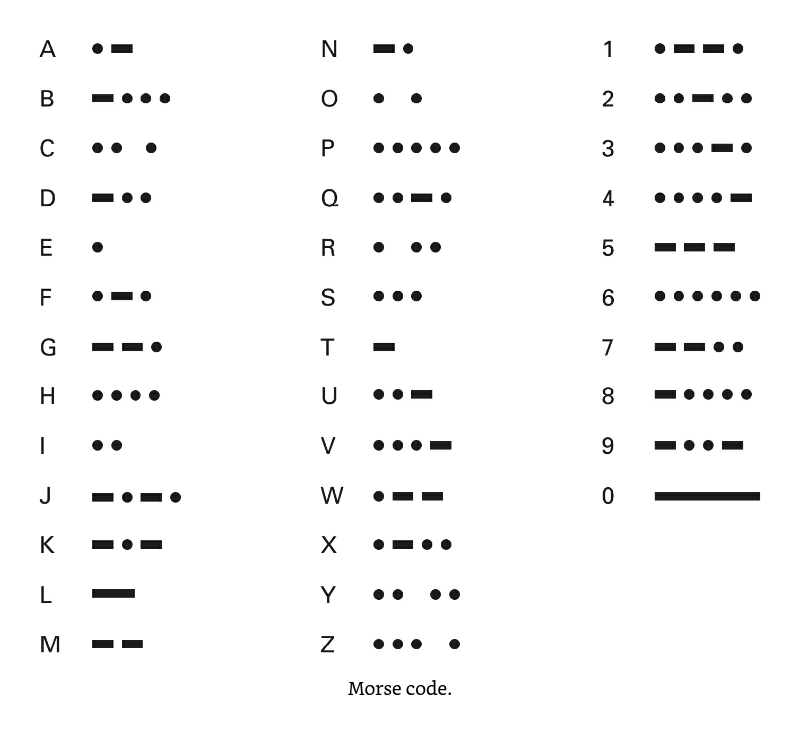
Erroneous Morse Code


Leave a comment

Filed under China, economics, Europe, language, nationalism, North America, publishing, travel

Effects of Cotton Gin and Indian Removal on Slavery

From Bitterly Divided: The South’s Inner Civil War, by David Williams (New Press, 2010), Kindle pp. 18-19:

Aside from the moral issues involved, most Americans of that era [c. 1800] saw slavery as an economic dead end. The institution thrived only in the tobacco fields of the Chesapeake region and the rice country of coastal Carolina and Georgia. As the nation expanded, slavery would become proportionally less important to the nation’s economy and would eventually die a natural death. But the development of an efficient cotton engine, or “gin,” in the eighteenth century’s last decade changed all that. The cotton gin became the vehicle by which slavery was carried across the Deep South. Not surprisingly, attitudes toward slavery changed with the institution’s growing economic importance.

That change did not occur overnight. Antislavery sentiment in the South remained open and active through the early 1830s. As of 1827, 106 of the country’s 130 abolitionist societies were in the South. To discourage the use of slave labor, some of those societies paid above-market prices for cotton produced without slave labor. North Carolina Quakers and Methodists repeatedly petitioned their state legislature for emancipation. In 1821, a leading Georgia newspaper insisted: “There is not a single editor in these States who dares advocate slavery as a principle.” Far from advocating slavery, Alabama editor James G. Birney started an abolitionist newspaper. In 1827, the Alabama legislature passed a law prohibiting the importation of slaves from other states, and at every session throughout the decade, members proposed legislation favoring gradual emancipation. As late as 1831, a proposal to end slavery was introduced in the Virginia state assembly.

But the early nineteenth century was also the era of Indian removal. In 1827, Georgia forced out its few remaining Creeks. Nine years later, Alabama did the same. The 1830s saw the Choctaws and Chickasaws driven out of Mississippi. And Georgia annexed Cherokee land following the 1829 discovery of gold there. In an effort that carried the hopes of all Indian nations with it, the Cherokees fought to keep their land through the court system. The United States Supreme Court finally responded in 1832 with its Worcester v. Georgia decision: by treaty obligation, by prior act of Congress, and by the Constitution itself, the Indians held legal title to their land. But President Andrew Jackson refused to enforce the ruling, and Congress declined to intervene. Georgia ignored the court order, and the Cherokees were driven westward on the Trail of Tears. A quarter of them died on that brutal forced march. In 1842, Florida’s Seminoles became the last of the southern nations to be violently relocated to land that they were promised would be theirs for “as long as grass grows or water runs.” At the time it was called Indian Territory. Today it is called Oklahoma.

Indian removal completed the transition in slaveholder attitudes begun a generation earlier. Slaveholders no longer viewed slavery as a temporary necessity but held it to be a positive good, divinely ordained, for the slaveholder, the slave, the nation, and the world. Though religion, racism, pride, and fear were all used to bolster slavery at home and justify it abroad, the driving force behind planters’ proslavery campaign was the same that caused their change of attitude in the first place—economic self-interest. Some planters, like Georgia’s Benjamin Harvey Hill, were candid enough to admit it: “In our early history the Southern statesmen were antislavery in feeling. So were Washington, Jefferson, Madison, Randolph, and many of that day who never studied the argument of the cotton gin, nor heard the eloquent productions of the great Mississippi Valley. Now our people not only see the justice of slavery, but its providence too.”31 It was cotton, along with tobacco, rice, and sugar, all cultivated by slave labor, that gave planters their economic power. And it was this power that gave planters the political strength with which to control the South’s lower classes and silence or exile slavery’s opponents.

Leave a comment

Filed under democracy, economics, labor, migration, nationalism, North America, slavery, U.S.

Lakota Hunting Grounds, 1870s

From Lakota America: A New History of Indigenous Power, by Pekka Hämäläinen (The Lamar Series in Western History; Yale U. Press, 2019), Kindle pp. 332-335:

The railroad did eventually come, ushering in U.S. troops and U.S. authority, but well before it came Lakotas. Raids into the Crow country and American settlements in the Gallatin Valley became a routine with Sitting Bull serving as a gravitational force…. Suddenly all American settlements “within the reach of the Sioux hunting-grounds” were in danger. The Carroll Trail, a crucial transportation line connecting Helena to the Missouri River, was in risk of being cut off. At times it seemed it was Crows who protected Americans against Lakotas rather than vice versa. Both settlers and soldiers saw the Crows as an extra “regiment of cavalry.”

But the Crows were Lakotas’ primary target, for they stood between them and the bison. Crows were at times forced to flee their reservation in the face of massive Lakota war parties seeking game, horses, mules, and cattle, and their powerless agent seemed to accept “the annual Sioux invasion” as a fact of life. Such was the Lakota pressure that Crow chiefs were rumored to be considering “an offensive and defensive alliance with the Sioux as against the whites.” There could be no such alliance, of course—the game was too scarce and the hatreds ran too deep—and Crows remained close allies of the United States. Before long, Lakotas occupied “the larger and most fertile portion of their reservation.”

Like Crows, Shoshones looked to Americans for protection against Lakotas and their allies. But unlike Crows, they managed to put distance between Lakotas and themselves. Decades of fighting over hunting rights had left them debilitated, and they had accepted a reservation in the lee of the Wind River Range, far to the southwest of the Lakota sphere of operations. Yet, even there, fear of Lakota attacks forced them to periodically flee. Eventually, they ceded a mineral-rich section of their reservation to secure the government’s goodwill and protection. This, in the minds of U.S. agents, was a sign of supreme wisdom: they “are among the most intelligent and best disposed of any Indians on the plains,” gushed the governor of the Wyoming Territory. “Wash-a-kie, their chief, is in all respects a superior Indian.” Their agents reported a growing consumption of government rations—beef, bacon, flour, and sugar—which indicated that Shoshones were giving up the hunt.

So were Utes. They had secured a large eighty-seven-thousand-square-mile reservation in the new Colorado Territory in 1861, but in 1868 they were compelled to accept a much-reduced domain. Five years later the government imposed another reduction, which broke Ute power. Lakota-Arapaho-Cheyenne war parties pushed deep into Ute territory, and growing numbers of Ute hunters began to frequent Denver, expecting to be fed, much to the exasperation of the city’s inhabitants and the territory’s Indian agents: “Even were they ever so well able to pay for hotel accommodations, they are not a desirable class of customers to the proprietors of any of our public-houses.” In the summer of 1873 Ute hunters wished to parade enemy scalps on the streets of Denver: they had killed three Lakota warriors while hunting along the Republican. The Indian agent banned the parade, and Utes celebrated their surprising victory outside the city for a week. It was clear that there would not be many more. Agents reported “improved industrial habits,” larger crops, and a growing willingness to live in houses.

Establishing control over shrinking bison herds was the paramount motive of Lakota warfare in the early 1870s, and it spawned a sprawling raiding hinterland that extended from the Canadian plains into the Rockies and deep into the American Southwest. Closer to home, Lakotas waged a sporadic raiding war against the Arikaras, Hidatsas, and Mandans who now shared a reservation along the Missouri and Little Missouri Rivers. Lakota war parties raided the reservation for horses and corn with growing confidence, sometimes coming with women and often informing their agents of their intentions and successes. Arikaras retaliated by raiding Lakotas at their Grand River and Cheyenne River Agencies, but their agent wanted to move them to Indian Territory, farther away from Lakotas. He was promptly rebuffed: “they fear that it is too warm for them. . . . Besides they love their own country; their dead are buried here; the Government probably would not redeem its promises better there than here.” For Arikaras the U.S. Indian policy was a demoralizing exercise in hypocrisy. “‘The hostile Sioux have all they want from the Government without removal from their country,’” their chiefs protested. “‘Why cannot the Rees [= Arikaras], who have been so friendly and faithful these many years?’” The Arikaras stayed put, their numbers slowly declining in the shadow of an overpowering Lakota-U.S. alliance.

As their rivals yielded ground, Lakotas emerged, in many ways, more powerful than ever. Never before had they ranged over more territory or reached so far. Their core area—their homeland—exceeded the Great Sioux Reservation by tens of thousands of square miles, and their hunting and raiding domain stretched from Lake Winnipeg in the north to the Republican Valley in the south and from the Missouri Valley in the east to the Continental Divide in the west. They had thousands of Indigenous allies on their orbit and diplomatic and commercial ties to Canada and Washington, D.C. They had several handsomely stocked government agencies at their disposal, and they went to war with cutting-edge military technology. Formidable, flexible, and ubiquitous, they commanded the attention of the U.S. government like no other Indigenous nation.

Leave a comment

Filed under economics, migration, military, nationalism, North America, U.S., war

U.S. Reconstruction: Southerners and Sioux

From Lakota America: A New History of Indigenous Power, by Pekka Hämäläinen (The Lamar Series in Western History; Yale U. Press, 2019), Kindle pp. 267-268:

The United States emerged from the catastrophic war not as a nation but as an empire. The rebelling states remained on maps as before the war, but in reality they were captive territories under military occupation and governance. Acting without any political precedent—how does a failed republican state reunite?—the federal government set out to reconstruct the South after its own image. This was the era of authoritative government agents tasked to impose industrial capitalism, yeoman farming, democracy, and Christian civilization on a vast canvas. “We are to have the charge of this continent,” declared the Reverend Henry Ward Beecher. “This continent is to be from this time forth governed by Northern men, with Northern ideas, and with a Northern gospel.” It was a formula for a comprehensive reconstruction that would simultaneously target both the Southerners and Native Americans. There would two reconstructions, one focused on the rebuilding and reforming the South, the other on pacifying the Indigenous West.

The reconstruction of Indigenous America had to start with the rebellious Lakotas and their allies, and the first challenge was to agree how to achieve it. Several generals insisted that force alone would make Indians give up raiding and settle down, but many eastern politicians and philanthropists, sickened by the Sand Creek massacre, argued that moral education was the only justifiable course. Congress sided with the humanitarians and appointed, in March 1865, Senator James R. Doolittle, a staunch Baptist and patriot, to lead a joint special committee to investigate the state of Indian-white affairs in the West. It authorized commissions to negotiate new treaties with the plains tribes, including the Sioux. The Sioux commission was headed by Newton Edmunds, governor of the Dakota Territory, who was desperate to put an end to the Indian wars that hindered white settlement in his territory, blocking its path to statehood. Pressure came also from Nebraska to the south, where the construction of the Union Pacific Railroad was poised to start in Omaha, making Lakota appeasement a matter of national importance.

Repeatedly humbled by nomad warriors over the years, generals denounced the congressional version of the Indigenous reconstruction as lily-livered and misguided. Sully and Sibley wanted to keep the pressure on the Lakotas, and Pope, in charge of military operations in the Dakota Territory, was deeply cynical of the logic of offering new treaties to the plains tribes. How will they understand treaties and annuities he asked, if “the violation of former treaties and the murder of whites are to be thus compensated?” As he saw it, treaties actually boosted Lakota raids. “It is a common saying with the Sioux, that whenever they are poor, and need powder and lead, they have only to go down to the overland routes and murder a few white men, and they will have a treaty to supply their wants.” Pope was not entirely wrong. Since the opening of the Oregon Trail in the mid-1840s, Lakotas had tolerated overland traffic because it yielded resources, whether secured through trading, raiding, extortion, or, as Pope now claimed, through treaty goods.

Leave a comment

Filed under economics, migration, military, nationalism, North America, slavery, U.S., war