
Category Archives: Brazil

The Amazon’s Cinta Larga in 1914

ALTHOUGH ROOSEVELT and Rondon did not realize it, the Cinta Larga‘s strong independence was probably keeping the men of the expedition alive. Because the Indians did not have a traditional chief, they were forced to make all of their decisions by consensus. If it was time to move the village, for instance, they had to agree on the time and location of the move. When it came to dealing with the expedition, the Cinta Larga were divided. Some of them believed that they should remain invisible to the outsider. Others, however, argued that they should attack. These men had invaded their territory, and there was no reason to believe they did not mean the Indians harm. By attacking first, the Cinta Larga would have the upper hand. They would also be able to loot the expedition, which was carrying valuable provisions and tools—especially those made of metal.

War was not a rare event for the Cinta Larga. The most common cause was the death of one of their own, from an earlier attack or even from natural causes. The Cinta Larga believed that death was brought about by witchcraft. If a man became ill and died, the others in his village never blamed their healer, a man who used plants and religion to cure the sick. Instead, they looked around their own village, and if they did not find anyone suspicious, they assumed that someone from another village must have performed the dark magic. The only response was to avenge the death by attacking the offending village.

The Cinta Larga also occasionally went to war if the population of their own village had become so depleted by disease, murder, or both that they needed to steal women and children. Such attacks took place at night. The men would camp near their victims’ village, and then, after the sun had set, they would slip inside their communal hut. As the male members of the other village slept in their hammocks, the warriors would club them to death before rounding up as many women and children as they could find….

THE MOST striking fact about the Cinta Larga—and one that would have alarmed the men of the expedition had they known it—was that these Indians were cannibals. Unlike the type of cannibalism much of the world had come to know—among desperate explorers, marooned sailors, and victims of famine—the Cinta Larga’s consumption of human flesh was born not out of necessity but out of vengeance and an adherence to tribal traditions and ceremony. The tribe had very strict rules for cannibalism. They could eat another man only in celebration of a war victory, and that celebration had to take place in the early evening. The man who had done the killing could not grill the meat or distribute it, and children and adults with small children would not eat it. If they did, the Cinta Larga believed, they would go mad.

The most important rule of cannibalism within the tribe was that one Cinta Larga could not eat another. The tribe drew a clear distinction between its own members and the rest of mankind, which they considered to be “other”—and, thus, edible. An enemy killed during war, therefore, was ritually dismembered and eaten. While still on the battlefield, either in the enemy’s village or in the forest, the Cinta Larga would carve up the body just as they would a monkey that they had shot down from the canopy. First they would cut off and discard the man’s head and heart. Then they would section off the edible portions: the arms, legs, and a round of flesh over the stomach. They grilled this meat over an open fire and brought it home to their village for their wives to slice and cook with water in a ceramic pan.

SOURCE: The River of Doubt: Theodore Roosevelt’s Darkest Journey, by Candice Millard (Doubleday, 2005), pp. 228-231

Last year’s PBS Frontline/World feature entitled Jewel of the Amazon also features the Cinta Larga.
1 Comment

Filed under Brazil

The Model T’s Effect on the Amazon

Seringueiros [rubber tappers] were, by default, the true settlers of Brazil’s interior. When Henry Ford had introduced the Model T in 1908, the Amazon had been the world’s sole source of rubber. The wild popularity of these automobiles, and the seemingly insatiable demand for rubber that accompanied them, had ignited a frenzy in South America that rivaled the California gold rush. In The Sea and the Jungle, H. M. Tomlinson complained that the only thing Brazilians saw in their rich rain forests in 1910 was rubber. “It is blasphemous that in such a potentially opulent land the juice of one of its wild trees should be dwelt upon … as though it were the sole act of Providence,” he wrote. “The passengers on the river boats are rubber men, and the cargoes are rubber. All the talk is of rubber.” Two years before Roosevelt had set sail for South America, his friend the great American naturalist John Muir had been similarly astonished by the rubber lust that he had witnessed as he traveled through the Amazon. “Into this rubbery wilderness thousands of men, young and old, rush for fortunes,” he marveled, “half crazy, half merry, daring fevers, debilitating heat, and dangers of every sort.”

By the time Roosevelt reached the Amazon, the dangers were still there but the promise of riches had all but disappeared. The bottom had dropped out of the South American rubber boom in 1912, when the Amazon lost its lock on the market. Thirty-six years earlier, an Englishman named Henry Wickham had smuggled Hevea brasiliensis seeds, the most popular species of Amazonian rubber tree, out of Brazil. Those seeds had then been cultivated at Kew Gardens, and the British had eventually planted their predecessors in tropical Malaysia. There, far from their natural enemies, the trees could be planted in neat rows with no fear that a blight would destroy the entire crop, as it likely would have done in South America. Labor in Malaysia was also not only cheap but readily available, and much more easily controlled. So successful had been the transfer of rubber trees to the Far East that by 1913 Malaya and Ceylon were producing as much rubber as the Amazon.

SOURCE: The River of Doubt: Theodore Roosevelt’s Darkest Journey, by Candice Millard (Doubleday, 2005), pp. 317-318

Leave a comment

Filed under Brazil, industry, Malaysia, Sri Lanka, U.S.

Night Sounds on the River of Doubt

COMPOUNDING THE misery wrought by the rain was an overarching sense of isolation and uncertainty, a feeling that was magnified by strange noises that shattered the forest’s silence and set the men’s nerves on edge. That afternoon, as Roosevelt and the men in his dugout paddled quietly down the river, a long, deep shriek suddenly ripped through the jungle. It was the roar of a howler monkey, one of the loudest cries of any animal on earth. The sound, which can be heard from three miles away, is formed when the monkey forces air through its large, hollow hyoid bone, which sits between its lower jaw and voice box and anchors its tongue. The result is a deep, resonating howl that vibrates through the forest with strange, inhuman intensity, and echoes so pervasively that its location can be nearly impossible to identify.

Worse even than the noises they could recognize were those that none of them could explain. These strange sounds, which disappeared as quickly as they came and were a mystery even to those who knew the rain forest best, had made a strong impression on the British naturalist Henry Walter Bates fifty years earlier. “Often, even in the still hours of midday, a sudden crash will be heard resounding afar through the wilderness, as some great bough or entire tree falls to the ground,” the naturalist wrote. “There are, besides, many sounds which it is impossible to account for. I found the natives generally as much at a loss in this respect as myself. Sometimes a sound is heard like the clang of an iron bar against a hard, hollow tree, or a piercing cry rends the air; these are not repeated, and the succeeding silence tends to heighten the unpleasant impression which they make on the mind.”…

The Amazon’s sudden, inexplicable sounds were especially terrifying at night, when they were all in the pitch-black forest, with no way to see a potential attacker and no sure means of escape. While the jungle in daylight could sometimes appear completely devoid of inhabitants, the nightly cacophony left no doubt that the men of the expedition were not alone. Even for veteran outdoorsmen like George Cherrie, the setting of the sun came to mark an unnerving threshold between the relative familiarity of a long day on the river, and sleepless nights in the jungle, spent trying to imagine the source of the spine-chilling noises that echoed in the darkness around him. “Frequently at night, with my camp at the edge of the jungle,” he wrote, “I have lain in my hammock listening, my ears yearning for some familiar sound—every sense alert, nerves taut. Strange things have happened in the night.”

The screams, crashes, clangs, and cries of the long Amazon night were all the more disturbing because they often provoked apparent terror among the unseen inhabitants of the jungle themselves. In the fathomless canyons of tree trunks and the shrouds of black vines that surrounded the men at night, the hum and chatter of thousands of nocturnal creatures would snap into instant silence in response to a strange noise, leaving the men to wait in breathless apprehension of what might come next.

“Let there be the least break in the harmony of sound,” Cherrie observed, “and instantly there succeeds a deathlike silence, while all living things wait in dread for the inevitable shriek that follows the night prowler’s stealthy spring.”

SOURCE: The River of Doubt: Theodore Roosevelt’s Darkest Journey, by Candice Millard (Doubleday, 2005), pp. 156-158

Leave a comment

Filed under Brazil, travel

Water Colors in the Amazon Basin

Each of the Amazon’s thousands of tributaries starts at a high point—either in the Andes, the Brazilian Highlands, or the Guiana Highlands—and then steadily loses elevation and picks up speed until it begins to approach the Amazon Basin. Scientists have divided these tributaries into three broad categories—milky, black, and clear—in reference to the color that they take on while carving their way through three different types of terrain. Alfred Russel Wallace, British naturalist and friend of Henry Walter Bates and Charles Darwin, made the distinction widely known in the mid-nineteenth century when he published his Narrative of Travels on the Amazon and Rio Negro. Wallace noted the striking difference between the milky Amazon and the black waters of the Negro where they collide on the northern bank of the Amazon. Seen from above, the meeting of these two colossal rivers looks like black ink spilling over parchment paper. The visual effect is heightened because the Negro, which is warmer and thus lighter in weight, rides on top of the Amazon, and the rivers do not fully blend until they have traveled dozens of miles together downstream.

Milky rivers, such as the Amazon and the Madeira, generally have their origins in the west and are clouded by the heavy sediment load that they carry down from the youthful Andes. Blackwater rivers, on the other hand, usually come from the ancient Guiana Highlands in the north and so wash over nutrient-poor, sandy soils. Scoured by millions of years of hard rains, these soils cannot retain decomposing organic matter—mostly leaves—which, when swept into a river, literally stains the water black like tea.

Although during the rainy season the River of Doubt is nearly as black as the Negro and as murky as the Amazon, it is technically a clearwater river. Like the Amazon’s largest clearwater rivers, the Tapajos and the Xingu, it has its source in the Brazilian Highlands, and so it picks up very little sediment as it flows over ancient and highly eroded soil. Clearwater rivers are also less acidic than blackwater rivers. Some, most notably the Tapajos, are so clear that they look blue, perfectly mirroring the sky above them. But most, like the River of Doubt, mix with either blackwater or milky tributaries as they snake through the rain forest, and so look neither blue nor clear by the time they reach their mouth.

SOURCE: The River of Doubt: Theodore Roosevelt’s Darkest Journey, by Candice Millard (Doubleday, 2005), pp. 171-173

Leave a comment

Filed under Brazil, travel

The End of the Golden Age of Exploration

[Theodore] Roosevelt lived during the last days of the golden age of exploration, a time when men and women of science roamed the world, uncovering its geographical secrets at a breathtaking pace and giving rise to bitter international competitions. The year he was born, the earnest young explorer John Hanning Speke, traveling with the famed Orientalist Richard Burton, discovered the source of the White Nile. In 1909, the year that Roosevelt left the White House, Americans Robert Peary and Matthew Henson won the race to reach the North Pole … Just two years later, in late December 1911, Norwegian explorer Roald Amundsen became the first man to reach the South Pole. Robert Scott, a renowned explorer and British hero, made it to the pole a month later, only to find the Norwegian colors flapping in the polar wind where he had planned to plant the British flag. Shocked and dispirited, Scott and his men froze to death on their long, bitter journey back to their ship. Sir Ernest Shackleton and his men, in a legendary attempt to cross Antarctica, narrowly escaped the same fate two years later, the same year that Roosevelt would set off down the River of Doubt.

To [Henry Fairfield] Osborn, Roosevelt’s decision to descend this river seemed insane if not suicidal, and he ordered [Frank] Chapman to tell the former president that the American Museum of Natural History expected him to adhere to his original plan. However, when Chapman’s letter, with all the weight of the museum behind it, reached Brazil, it had less effect than a leaf falling in the rain forest. Having found the challenge he had been yearning for, Roosevelt was beyond the reach of Osborn’s persuasion. In a letter to Chapman, Roosevelt wrote, “Tell Osborn I have already lived and enjoyed as much of life as any nine other men I know; I have had my full share, and if it is necessary for me to leave my bones in South America, I am quite ready to do so.”

SOURCE: The River of Doubt: Theodore Roosevelt’s Darkest Journey, by Candice Millard (Doubleday, 2005), pp. 61-62

Leave a comment

Filed under Brazil, Paraguay, travel

Another Profile of Japan’s Brazilian Workers

Associated Press reporter Joseph Coleman recently talked to a few people in Oizumi, home of Japan’s largest Braziltown, in international Ota City in Gunma Prefecture just north of Tokyo, and just across the river from the recent Outlier haunt of Ashikaga City in Tochigi Prefecture. It’s no surprise that the children of the immigrant workers seem to be having trouble fitting into either culture.

A labor shortage during the economic boom of the late 1980s produced a change in visa laws to let in descendants of Japanese emigrants. But if officials figured the immigrants would blend easily back into Japanese society, they were disappointed.

Today, Japan’s 302,000 Brazilians are its third-largest foreign minority after Koreans and Chinese. Watanabe and the other foreigners of Oizumi are the human legacy of that policy.

Instead of a chain of schools to absorb the newcomers into Japan, the reverse seems to be happening.

In 1999 the Brazilian education company Pitagoras opened a school in Ota, a town neighboring Oizumi, to improve the foreign children’s Portuguese and prepare them for a possible return to Brazil. Japan now has six Pitagoras outlets.

Maria Lucia Graciano Franca, a teacher at the Ota school, said many of the workers’ children speak neither Portuguese nor Japanese well and have trouble fully adjusting to life in Brazil or Japan.

“They go back to Brazil, they stay for a while, and they come back here,” she said as children practiced dance moves for a school concert. “And the ones who stay in Japan follow the same route as their parents – they work in the factories.”

The grown-ups are torn too.

Leave a comment

Filed under Brazil, Japan, labor

A Visit to Japan’s "Little Brazil"

Recently, we set out from Ashikaga for 大泉 Ōizumi, Japan’s “Little Brazil” in neighboring Gunma Prefecture’s fanhandle to our southwest. At 太田 Ōta (‘Widefield’), we transferred to a 2-car, 2-stop, infrequent shuttle train running back toward the southeast to Higashi Koizumi (‘East Littlespring’). There we had to transfer to yet another 2-car, 2-stop, infrequent shuttle train running back southwest to the end of the track at Nishi Koizumi (‘West Littlespring’). The fare adjustment official at Ōta described Nishi Koizumi as the most bustling (にぎやか) of the three Littlesprings (East, Middle, and West) that make up Bigspring.

Well, wherever the bustle was, we didn’t see it. The tracks ended where the single platform ended at Nishi Koizumi. We walked straight south from the train station, crossed over a highway busy enough to warrant a pedestrian overpass, past a small fountain (maybe the ‘littlespring’ itself) that marked the beginning of a very long and pleasant walkway and bikepath (the Izumi 緑道 ‘Greenway’) shaded by a great variety of trees and bushes, most of them labeled, so that I repeatedly stopped to punch the katakana names into my little electronic dictionary to find the English equivalents.

To our right ran the kilometer-long fence punctuated by gated driveways enclosing a quiet but huge Sanyo electronics factory. To our left ran sleepy Hanamizuki-dori ‘Dogwood Avenue’, which hosted occasional trucks and vans making deliveries. Hardly anyone but a few stressed-out middle managers was making use of the jogging path. Across the road were a variety of smaller enterprises: a few stores, a few restaurants, and a preschool teacher-training school followed by Santa Clara (聖クララ) preschool.

The name of the school and the distant sounds of Portuguese rather than Japanese coming from its parking lot were among the few signs of the town’s large Brazilian population. Other clues were: a cardboard sign next the train ticket vending machine at the station that listed all the destinations in a Portuguese-friendly transcription; a small shop near the station that sold goods imported from Brazil, Peru, and Bolivia; and the Primavera Restaurant, which we noted for our return. It was nearing lunchtime.

Primavera was an interesting oasis, like a midwestern truck stop in many ways. The kitchen help spoke mostly Japanese, the customers spoke mostly Portuguese, and the menus and wait help were bilingual in Japanese and Portuguese. The music was mostly Country & Western in style, but with the lyrics in Portuguese. The featured buffet (バイキング [Viking] = smorgasbord) was discounted from ¥1600 to ¥1000 because it had run out of most of the grilled meats–and also the feijoada, I discovered after I ordered it. My wife went for just the salad bar portion. At the register, I asked the European-looking owner (in Japanese) how long he had been in Japan. He said 2 years this time, but 5 years in all. (Nikkei Brazilians can easily get work visas for 3-year stints.) His soft-spoken Japanese was even more limited than mine. He estimated the local population was at least 10% Brazilian, maybe 15%.

On our way back to the station, we stopped in at the small import shop, whose owner greeted all his customers with “Tudo bem?”–followed by “Konnichi wa!” if they looked Japanese. He looked to be Nikkei, and his Japanese was very fluent. He said he had been in Japan 7 years in all. He said the local population was 15% Latin American, with 10% from Brazil alone.

When we got back to the sleepy station, we found that we had a 45-minute wait until the next train, so we east headed down the line of shops beside the main highway (National Route 354), finding nothing at all. When we stopped to ask, we were directed to the Mos Burger, with its American southwestern decor, and sipped our tall ice coffees until it was time for the zigzag sequence of short train hops back home.

There are no doubt many North American equivalents of Nishi Koizumi, but it reminded me of the hidden charm and factory-sequestered bustle of an Austin, Minnesota–the Hormel company town that hosts the Spam Museum–especially if Austin had a little larger Hispanic population.

1 Comment

Filed under Brazil, Japan, labor, migration

A Visit to International Ota City

Ota City (太田) in Gunma Prefecture is just two train stops southwest from Ashikaga City on the private Tobu line. Ota English School‘s website brags that

Ota itself is quite an international town. The neighboring town [Ôizumi] has one of the largest Brazilian populations in Japan. Ota itself has one of the largest Asian communities outside of Tokyo. This means that, as well as all the usual non-Japanese restaurants (Italian, French, Chinese) there are many Indian, Pakistani and Brazilian restaurants a short walk or drive from the school.

Purdue University‘s The Exponent Online is rather more modest when it compares Ota City to Lafayette, Indiana.

The populations are almost the same, both cities were changed from agricultural centers to industrial centers, both cities are on a river, and for the most part, both are flat cities.

What moved a Purdue student reporter to compare Lafayette and Ota? Well, West Lafayette, Indiana, is home to Purdue’s main campus as well as to Subaru-Indiana Automotive, Inc. Fuji Heavy Industries and Subaru are among the largest employers in Ota, a commercial cluster development center dating back to the days of textiles and then military aircraft.

So, is Ota really as international a city as these websites suggest? The Far Outliers got a skewed impression when we set out to find a Brazilian restaurant to eat dinner at last Saturday evening. We headed south from Ota train station zigzagging between the two widest streets we could find, asking policemen, passers-by, shopkeepers, and even employees at the main post office (open on Saturdays) if they knew of any Brazilian restaurants in the city. No luck. Even those who took the trouble to look through the restaurant listings in the telephone book couldn’t find any Brazilian restaurant. A few people recommended we go instead to neighboring Ôizumi–Japan’s “Little Brazil.” (Been there. Done that. More later.)

We did find a few tiny Filipino restaurants (none yet open) scattered along one of the longest strips of seedy strip joints, hostess bars, and member clubs that I’ve seen in a while. (I’ve never been to Las Vegas.) It went on for at least a full kilometer. It was still early when we walked its length, encountering no more than a few bouncers loitering outside a few doorways. When we retraced a portion of the strip on our way back to the station later that night, there were a lot more drunken males and leggy females on the sidewalks. Judging from the streetside advertising, some portion of Ota City’s international Asian population would seem to be women from China and the Philippines. (A Japanese customer I was chatting with at a yakitori shop in Ashikaga last week demonstrated his few words of “French” by saying Magandang gabi! That’s Tagalog for ‘Good evening!’)

After the trail went cold in that direction, we headed back for the station on a main drag with more vehicle traffic. It was a much more family-oriented strip mall, with a huge shopping center, and plenty of parking, car dealers, tire shops, and the most amazing site entirely dedicated to weddings that I’ve yet seen, the Royal Chester Ota (for “The Brilliant European Wedding”). (Again, I’ve never been to Las Vegas.) We saw plenty of chain restaurants, but nothing representative of Ota City’s large foreign community.

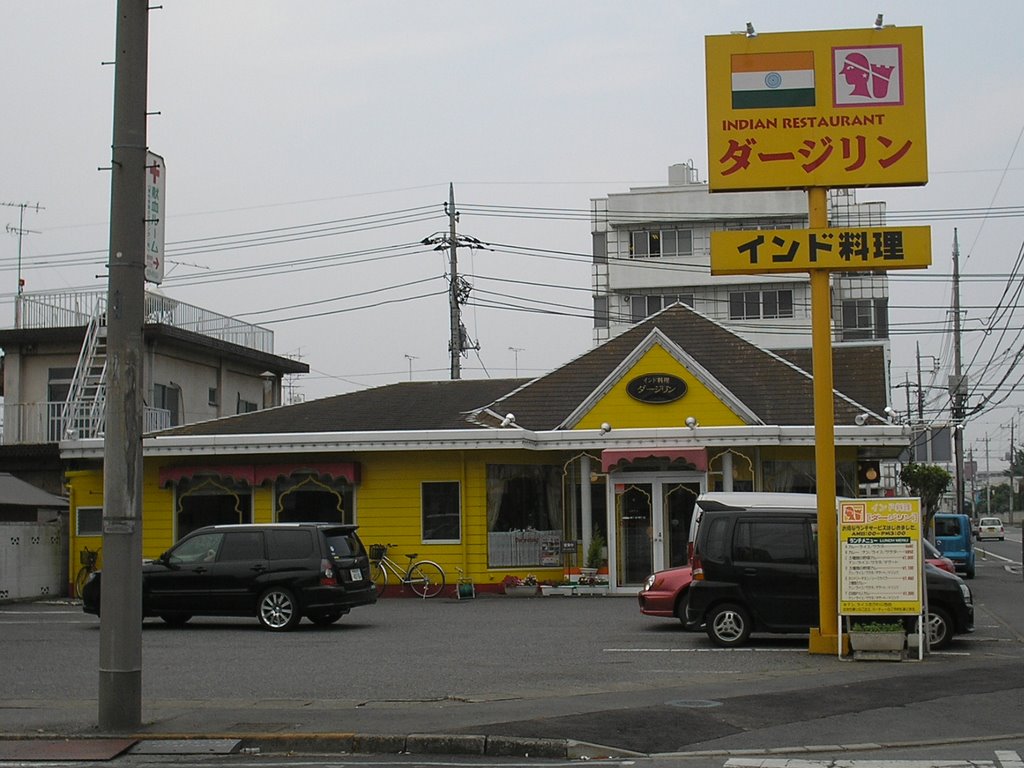
We couldn’t find a clue until a couple hours later when, after circling a few blocks north of the station, we asked at Rana, an “International, Halal” food store run by some Iranians. The only other customer was a Nepali who not only owned an Indian restaurant named Darjeeling, but offered to drive us there, and even to drive us back to the station if his place wasn’t too busy by the time we finished eating. We readily accepted, and had a wonderful meal of chicken tandoori, mutton masala, nan bread, and salad vegetables, washed down with a couple of beers unusual for Japan: Everest and Grolsch. The proprietor came to Japan ten years ago, and his restaurant has been successful enough for his elder brother to open a branch in Tokyo.

Except for a few words of English, he and I communicated entirely in Japanese, quite informally and comfortably. Neither of us had done enough formal study to command formal registers very well anyway. After dinner, we insisted on walking back to the train station, and he came out to the street to confirm his earlier directions and we parted in typical Japanese fashion, with bows and thank yous. On the way back, we passed the Civic Center, with a range of social support facilities for both citizens and foreigners, including an office that handled passports and visas.

The 1 May 2005 issue of Pakistan’s Dawn has more about unskilled foreign workers in Ota.

Kimio Matsudaira, an official at Hello Work, a public labour office in Ota city, Gumma prefecture, 60 kilometres north of Tokyo, said there is now a special programme to help and support foreigners working in the area. Ota has a population of about 200,000 people. The irony is that more than sixty per cent of its people are over 60 years of age, in a city where the economy is dependent on manufacturing. Without doubt, Ota really needs foreign workers badly. To support the city’s automobile and electronic industries, Ota is now host to more than 30,000 Japanese Latin Americans, descendants of Japanese who emigrated to South America in the early 20th century seeking a better future. In the late eighties Japan launched a policy of accepting third and fourth generation Japanese Latin Americans to support a labour shortage in its factories stemming from the bubble economy at that time. More recently, Asians, mostly from South-east Asia, have also arrived to work in factories, comprising a total of 45,000 registered workers in Ota city. Matsudaira said foreign workers are vital to the survival of Ota’s economy.

Leave a comment

Filed under Brazil, China, industry, Japan, migration

Part Chinese, Part European, Part Latino

MY GRANDMOTHER, my mother’s mother, was born in China. Her name was Lee Chung. She came to Peru in 1905 or 1906, at the age of 18 or 19, to work on the coffee plantation in the jungle of Peru. At that time many people came from Europe and Asia as the government was giving free land to immigrants willing to go to the eastern side of the Andes Mountains. She came with about twenty families, altogether more than a hundred people, from the same province in northern China. They lived together like a family because the government provided housing for people working in agriculture. But they were really not one family, and she was by herself. She told us that she had some brothers, and their families were living in China and Hong Kong. She did not have much education.

She married my grandfather, an Italian. It was funny because my grandfather from Italy did not speak Chinese. She did not speak Italian. But they communicated somehow. They got married in 1907 or 1908….

My grandmother never spoke Spanish. She only spoke Mandarin Chinese to us. When I was small, it was easier to communicate with her. Then when we grew up, we began to speak Spanish. She only spoke Chinese throughout her life, although she understood a lot of Spanish.

My mother speaks some Chinese because she lived with my grandmother all the time. My mother speaks Italian too. My Chinese was not good because I learned it by ear, listening to my grandmother. As a kid of six or seven, I would speak with whoever that was there. In Peru, it was mostly my grandmother. She lived to sixty-four or sixty-five years of age.

In Peru, there are still some old Chinese families that have been there for generations. And the Japanese too. We have many Asians in Peru, Argentina, Brazil, and Chile. In all these countries the Asians and their cultures are very strong. The Asian cultures are very respectable in South America. If you are part of an Asian culture, people respect you more because they think that you are more trustworthy. The Chinese who were born in South America act like Latinos in their manners. They look Asian but they speak Spanish. They are very integrated.

The last time there were Chinese immigrants to Peru was in 1968, I think. They stopped coming because the economic situation in the country was not good. Most Chinese went to Argentina and Venezuela. I have met a distant aunt in Venezuela. Most of the Chinese there came from Hong Kong, from around 1984 to about 1995. Venezuela is the only country you can pay for your residency and work. The people from Hong Kong learned Spanish very fast.

My uncle has been in Australia for forty years. He lives in Sydney now. He is the nephew of my grandmother. I met him several times in the U.S. He did not speak Spanish. We communicated in English, but sometimes he spoke to me in Chinese, and I had a hard time understanding him because I was out of practice and hadn’t spoken Chinese for a long time.

I see myself as part Chinese, part European, and part Latino. I feel that way always. I like Chinese culture, as I do European and Latino cultures. Chinese culture is part of my background. I went to the U.S. for my university education. I made friends with students from Hong Kong and Taiwan. We would get together and play soccer. We discussed about things, and we enjoyed ourselves. We talked about things in Peru and how the Chinese came to Peru. Some of the Latino students from South America who saw me then did not think that I was a Latino because I was always with the Asians. When I am with my friends from Hong Kong or Taiwan, I feel Chinese. I feel I am part of that group. I feel that I belong there.

SOURCE: “San Ramon the Coffee Town,” by Juan Miranda, in Being Chinese: Voices from the Diaspora, by Wei Djao (U. Arizona Press, 2003), pp. 131-134

Leave a comment

Filed under Brazil, China

Sumo in Brazil

On 28 January, the International Herald Tribune ran a NYT story about the increasing popularity of Japanese sumo in Brazil.

Until the mid-1990s, sumo wrestling in Brazil was almost exclusively practiced by Japanese immigrants and their offspring.

Today, however, about 70 percent of all sumo aficionados in the country are Brazilians with no Japanese blood, in large part because of efforts by the local association to popularize the sport.

By holding sumo matches in city squares and other public arenas, “we managed to teach a lot of people to appreciate our sport,” said Oscar Morio Tsuchiya, the vice president of the Brazilian Sumo Confederation.

The group has more than 2,000 members and organizes an annual national championship for amateur wrestlers….

Sumo was brought to Brazil almost a century ago by Japanese immigrants, who started flocking to the South American country in the early 1900s in search of work, initially on coffee plantations and eventually in agriculture in general.

With coffee sacks as mawashis, the traditional loincloths worn by sumo wrestlers, the first matches in Brazil were held to honor the emperor of Japan’s birthday.

And in 1914, the first official Brazilian sumo championship was celebrated in Guatapará, in the interior of the state of São Paulo.

“They did everything they could to cultivate Japanese culture because they intended to return to Japan someday, and practicing sumo was a big part of that, but very few ended up going back,” said Célia Oi, the executive director of the Museum of the History of Japanese Immigration to Brazil in São Paulo.

The same story appeared in the San Francisco Chronicle.

Women’s sumo also seems to be spreading in Brazil, but not everyone is happy about it.

1 Comment

Filed under Brazil, sumo