Category Archives: language

Japanese Loanwords in Yapese

Japan ruled the island of Yap from 1914 to 1945, introducing many new material goods and cultural practices, which have left a rich legacy of loanwords in the Yapese language. The following list is extracted from a dictionary that uses the new Yapese orthography, which I have undone in order to make it easier for people familiar with Japanese to recognize the source words, some of which are quite archaic (or even obsolete) in contemporary Japan.

  • baru ‘crowbar’
  • bata ‘batter (in baseball)’
  • baydok ‘syphilis’
  • beni ‘lipstick’
  • benikawa/binikawa ‘type of potato’
  • bokdang ‘bomb’
  • chikongki ‘record-player’
  • chiyoseng ‘Korea; Korean’
  • chiyusa ‘shot, injection, hypodermic needle’
  • chiyusa nag ‘to give a shot to someone’ (nag derives verbs, like Jp. suru)
  • chumong ‘order, in the sense of a requisition’
  • chungayri ‘to dive head first’
  • daykusang/daykisang ‘carpenter, builder’
  • dempo ‘telegram; to send a telegram’
  • denchi ‘battery’
  • dengki ‘electricity; flashlight; xray’
  • dengkibasra ‘utility pole, power pole’
  • dok ‘poison’
  • doma ‘checkers, chess; a game’
  • futong ‘mattress’
  • gengkang ‘covered, protruding entranceway to a building’
  • hang ‘seal, stamp’
  • hangngo ‘small Japanese pot’
  • hasra ‘utility pole, power pole’
  • hyakngo ‘type of potato’
  • isobing/usubing ‘type of half-gallon bottle’
  • jori ‘rubber sandals, slippers, zoris’
  • jubong ‘pants’
  • kabang ‘handbag, purse’
  • kachido ‘movie, cinema’
  • kama ‘sickle, scythe’
  • kamoch ‘car, automobile’
  • kangkiri ‘can opener’
  • kayak ‘gunpowder’
  • kayru ‘toad, frog’
  • kech ‘stingy’
  • kich ‘crazy’
  • kitanay ‘dirty’
  • komey ‘rice; type of yam’
  • koyeng ‘rest house on a hilltop’
  • kui ‘marker pole in sea’
  • kyuri ‘type of vine, cucumber’
  • mame ‘beans’
  • mangwa ‘cartoon’ [a spelling pronunciation?]
  • marutobi ‘hopscotch’
  • merikengko ‘[American wheat] flour’
  • mong ‘Japanese ornamental gate or archway’
  • nappa ‘cabbage’
  • nas ‘eggplant’
  • nawa ‘jumprope; to play jumprope’
  • negi ‘onion, green onion’
  • nejimawas ‘screwdriver’
  • nis ‘varnish’
  • niso ‘gallon bottle’
  • nori ‘glue, paste’
  • okas ‘candy, cookies’
  • okinawa ‘Okinawa; type of [sweet] potato’
  • osongach/isongach ‘Christmas’
  • otobay /atobay ‘motorscooter, motorcycle’
  • pachingko ‘slingshot’
  • panchu ‘underwear, pants’
  • ping ‘pin, hairpin, safety pin’
  • pistor ‘pistol, gun’
  • remong ‘lemon, lime, citrus’
  • rengnga ‘concrete block’
  • sakura ‘type of flowering tree; pink plumeria’
  • sarumata ‘underpants’
  • sarukang ‘swivel used to connect leader to fishline and to fishhook’
  • sasing ‘photograph, picture’
  • sasmi ‘raw fish, sashimi’
  • sayda ‘soda, soft drink’
  • semmengki ‘small washbasin’
  • seng ‘wire, line’
  • sensey ‘teacher; to teach’
  • sensey nag ‘to teach’ (nag derives verbs, like Jp. suru)
  • sentak ‘laundry; to do laundry’
  • sentaksekken ‘laundry soap’
  • sigobing ‘bottle about the size of a fifth gallon, the size of a shoyu bottle’
  • sikato ‘skirt’
  • sikidas ‘drawer’
  • sikojo/hikojo ‘airport’
  • sikoki/hikoki ‘airplane’
  • simeng/jimeng ‘to lay out the ground for a house foundation’
  • simi ‘charcoal’
  • sitangi ‘women’s underclothes’
  • supido ‘fast, speedy’
  • tama ‘marbles, the game of marbles; light bulb’
  • tamanegi ‘round, dry onion’
  • tamango ‘egg’
  • tanchyobi ‘birthday party, birthday celebration’
  • taray ‘large washtub’
  • tech ‘steel ball’
  • tempra uta ‘song in different languages mixed together’
  • teng ‘score, mark’
  • tesange ‘purse made of pandanus leaves’
  • togang ‘ash pumpkin’
  • totang ‘boat made out of folded sheet of roofing [tin]’
  • udong ‘noodles’
  • yakyu ‘baseball’
  • yasay ‘green vegetables’
  • yasmi ‘vacation, holiday, rest’
  • yeng ‘dollar’ (cf. piseta ‘quarter dollar’ via Span., mag ‘half dollar’ via Ger.)

SOURCE: Yapese–English Dictionary, by John Thayer Jensen with the assistance of John Baptist Iou, Raphael Defeg, Leo David Pugram (U. Hawai‘i Press, 1977)

To the list above I can add a few more from my own fieldwork in Yap: chichibando ‘brassiere’, hanafuda ‘hanafuda card game’, kanggof ‘nurse’, and kawanguchu ‘leather shoes’.

Leave a comment

Filed under Japan, language, Micronesia

New Religious Terms in Two Pacific Languages

How have local languages in the Pacific handled the new lexical requirements of foreign religious traditions? Much seems to depend on the language and sect of the first foreign evangelists.

The island of Yap in Micronesia was first evangelized by Spanish Catholics long before German Protestants arrived about 1898. Yapese is still largely Catholic, and religious loans are mostly from Spanish. Shinto seems to have left no lexical traces from the Japanese colonial era (1914–1945), but loanwords from Japanese remain well represented in the more profane contexts of the new clothing, containers, diseases, foods, tools, and means of transport introduced during those decades.

The following examples of Christian terms do considerable violence to the vowels of Yap’s new orthography, which would take too long to explain—and would also make the words look more Dutch than Spanish.

  • bibliya ‘Bible’ (Span.)
  • galasya ‘church’ (Span.)
  • kiristiyano ‘Christian’ (Span.)
  • komunyon ‘communion’ (Span.)
  • kuruth ‘cross, crucifix’ (Span.)
  • infiyarno ‘hell’ (Span.)
  • misa ‘(Catholic) mass’ (Span.)
  • padrey ‘priest’ (Span.)
  • rosaryo ‘rosary’ (Span.)
  • baynag ‘Christmas’ (Ger. Weihnacht)
  • næp’ ni-b thothup ‘Christmas Eve, Holy Night’ (lit. ‘night that’s holy’)

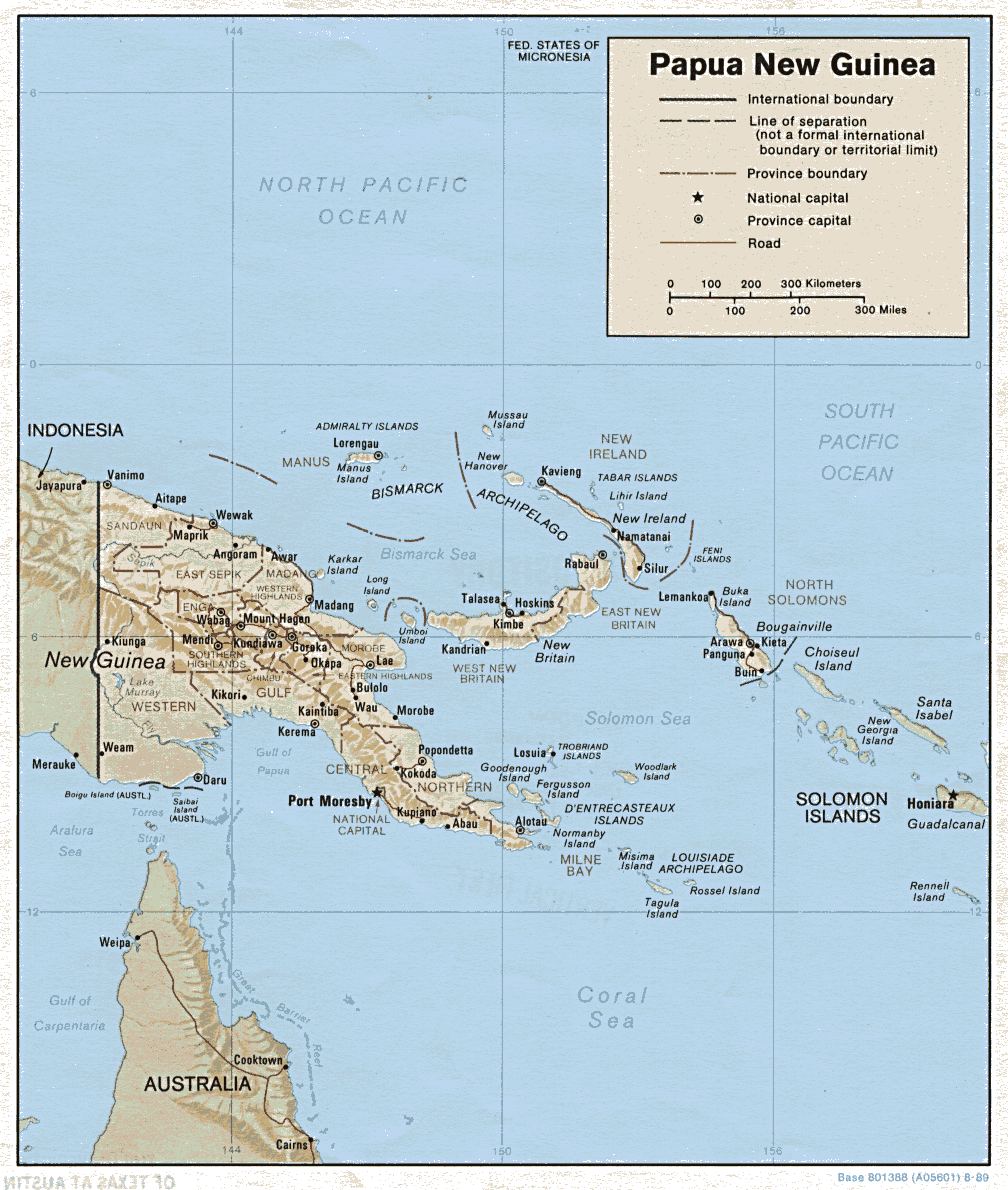
Morobe Province in Papua New Guinea was evangelized by German Lutheran missionaries beginning in 1886. The Germans adapted two local languages for evangelical and educational purposes, Jabêm for the Austronesian circuit along the coast and islands, and Kâte for the Papuan circuit in the interior of the Huon Peninsula. (Many, if not most, of the other interior languages of Morobe Province have since proven to be Austronesian, not Papuan.)

The German Lutheran strategy for communicating new Christian concepts was to adapt the local vernaculars rather than to introduce foreign words—not unlike the strategy of Martin Luther himself during the Protestant Reformation. The following examples are from Jabêm, in whose German-inspired orthography j represents a palatal glide (like English y), ŋ represents a velar nasal (like English -ng), and -c represents a glottal stop.

  • biŋsu ‘foreign missionary’ (also ‘admonition, commandment’)
  • biŋ gôliŋ ‘parable, proverb’ (lit. ‘talk steer’)
  • gôlôàc ‘congregation’ (also ‘clan, relatives, kinfolk’)
  • gêbêcauc dabuŋ ‘Christmas Eve’ (lit. ‘night holy/taboo’)
  • moasiŋ dabuŋ ‘holy communion’ (lit. ‘benefit/blessing holy’)
  • ŋalau dabuŋ ‘Holy Spirit’
  • kêdôŋwaga ‘teacher’ (lit. ‘3sg-teach-agent’)
  • sakiŋwaga ‘minister, servant’ (lit. ‘service-agent’)
  • jàeŋwaga ‘catechist, local missionary’ (lit. ‘message-agent’)

SOURCES: Yapese–English Dictionary, by John Thayer Jensen with the assistance of John Baptist Iou, Raphael Defeg, Leo David Pugram (U. Hawai‘i Press, 1977); Jabêm–English Dictionary, rev. by J. F. Streicher (Pacific Linguistics, 1982).

Leave a comment

Filed under Germany, language, Micronesia, Pacific, Papua New Guinea, religion, Spain

Teaching a Fishy English Lesson, Nhatrang, 1978

Jimmy and I attended the local elementary school, where our studies focused on math, literature, history, and science. All were taught from the Communist point of view. Miss San, who continued to teach my class, decided to hold a free tutorial session at her home every Sunday afternoon. Those were the only lectures in my experience that were not delivered with any political overtone.

Miss San lived in a two-story dwelling several blocks away from my street. She used her first floor as a fish-sauce factory, and three enormous earthenware jars were constantly at work there. Each container could hold two to three hundred pounds of fish, marinating in an equal amount of salt. She explained to us that making fish sauce was her main source of income. Teaching was just a recreational activity. The rancid smell of rotten fish was deadly, like the stench of tooth decay, only stronger. The odor permanently clung to her clothes, seeped into her hair, and like a miasma, spread to her surroundings. The adults, especially men, avoided her. They feared her eccentric nature. Children, however, were drawn to her warm personality, and no one found her more magnetic than I did.

As each Sunday afternoon approached, we eagerly wondered what surprise she had in store for us this week. Sitting on the floor in her rumpled bedroom among her scattered clothes, we waited for her appearance like the audience of a performing artist. One of Miss San’s favorite subjects was English. “The only way for us to grow as a nation is to learn from other countries’ technologies,” she often told us. “How can you learn their technologies? You can start by learning the universal language — English.”

She winked at us with a mischievous smile. “Today, let’s not learn from the textbook. Instead, let’s test our vocabularies, shall we? For the next hour, all of us must speak in English. I know this is a very difficult game, but we can try. Let’s have some fun together.”

We were trembling with excitement. Abandoning our language in a large group discussion such as this one was a forbidden act, yet it seemed so natural and harmless to us in that moment. As if she sensed our uncertainty, Miss San continued, “Let’s keep this our own little secret, children.”

She switched to English and the lesson began. “Duy went out last night,” she said, and I saw my friend sit up a little straighter. Pointing at a small girl in a ponytail, Miss San ordered, “Chi, please finish that thought.”

Chi pondered a few seconds and then said carefully, “Duy went out with a girl last night.”

There were some giggles among the students. The image of Duy with a girl was funny in any language. Miss San turned to me. “Kien, please?” she asked.

“Who was that girl? ” I formed a sentence quickly.

“Yes, that is a good question,” she said. “Tell us who that girl was, Duy.”

Duy stood up. Scratching his ears, he stuttered, searching the room for help. Someone whispered an answer, and he seized it as though he were drowning. “That girl was — was — was — my — mother,” he shouted. His voice cracked from the excitement. We fell into each other’s arms with laughter. Leaning against the wall, Miss San, too, was smiling. In the shadow of the room, I thought she was quite a beautiful lady, almost like a vision.

SOURCE: The Unwanted: A Memoir of Childhood, by Kien Nguyen (Back Bay, 2002), pp. 139-141

Miss San abruptly disappeared soon thereafter.

Leave a comment

Filed under education, language, Vietnam

Finding Burmese Speakers During WW2

On Language Log, Mark Liberman has been excerpting passages from J Milton Cowan‘s brief memoir, “American Linguistics in Peace and at War.”

It is difficult today to visualize some of the obstacles we had to overcome. To illustrate I will tell the Burmese story because it has multiple punch lines. In the lottery of languages William S. Cornyn drew the Burmese straw. This frightened him a bit but Leonard Bloomfield promised to hold his hand. Nobody knew where to find any native speakers of Burmese and the files of the Alien Registration Act were classified. The Department of Immigration and Naturalization said there were no Burmese legally in the country at the time. There were supposed to be some sailors who’d jumped ship in New York and San Francisco but they hadn’t caught up with them yet.

Mortimer sent me to the Pentagon to see a young fellow in G-2 (Military Intelligence), Major Dean Rusk, a name not so well-known in those days, but known to Mortimer. I described the non-existence of known Burmans and why we wanted some. He volunteered to see what could be done with the roster of Alien Registration. He phoned our offices the same afternoon, saying tht he had over a hundred names and he’d call back as soon as he could have them decoded. Next morning he phoned to say there was something funny, there were Abernathys, Browns, Davenports, Fitzgeralds and so on down through the Youngs. It turned out that the Roster listed those foreigners residing in the U.S. who had been born in Burma, regardless of their current nationality. These were the names of children born to business people and missionaries while living in Burma. There were only two names that sounded exotic enough to be possible Burmans.

Read the rest at Language Log

When I was a missionary kid in elementary school in Kyoto, I remember reading a biography of Adoniram Judson, a pioneering Christian missionary in Burma at a time when converts risked death sentences for changing their religion. Judson was no slouch as a linguist, either.

Leave a comment

Filed under Burma, language, U.S.

How Much Longer Will Spoken Manchu Last?

Manchu, one of the official languages of the Qing dynasty, seems to be going mute.

Meng [Shujing] is one of 18 residents of this isolated village in northeastern China, all older than 80, who, according to Chinese linguists and historians, are the last native speakers of Manchu.

Descendants of seminomadic tribesmen who conquered China in the 17th century, they are the last living link to a language that for more than two and a half centuries was the official voice of the Qing Dynasty, the final imperial house to rule from Beijing and one of the richest and most powerful empires the world has known.

With the passing of these villagers, Manchu will also die, experts say. All that will be left will be millions of documents and files in Chinese and foreign archives, along with inscriptions on monuments and important buildings in China, unintelligible to all but a handful of specialists.

“I think it is inevitable,” said Zhao Jinchun, an ethnic Manchu born in Sanjiazi who taught at the village primary school for more than two decades before becoming a government official in the city of Qiqihar, 50 kilometers, or 30 miles, to the south. “It is just a matter of time. The Manchu language will face the same fate as some other ethnic minority languages in China and be overwhelmed by the Chinese language and culture.”

(While most experts agree that Manchu is doomed, Xibo, a closely related language, is likely to survive a little longer. Xibo is spoken by about 30,000 descendants of members of an ethnic group allied to the Manchus who in the 18th century were sent to the newly conquered western region of Xinjiang. But it too is under relentless pressure from Chinese.)

The disappearance of Manchu will be part of a mass extinction that some experts forecast will lead to the loss of half of the world’s 6,800 languages by the end of the century. But few of these threatened languages have risen to prominence and then declined as rapidly as Manchu.

Leave a comment

Filed under China, language

Birth-order Names in Japan and Papua New Guinea

Most people familiar with Japan are aware of the Japanese birth-order naming system for males, whereby first sons are often called 一郎・太郎 Ichirō/Tarō; second sons 二郎・次郎 Jirō; third sons 三郎 Saburō, and so on. In theory, it would be possible to keep going up to at least the tenth son: 四郎, 五郎, 六郎,七郎, 八郎, 九郎, 十郎. However, I’m not sure how to pronounce the characters for fourth son, can’t find it in my dictionaries, and suspect that it would be an extremely unlucky name because Sino-Japanese shi ‘four’ sounds like shi ‘death’. (Japanese high-rises often lack a 4th floor, for the same reason that my high-rise condo in the U.S. lacks a 13th floor.) [See the correction below.]

Another thing I’m not so sure about is whether this system marks order of issue or order of survival. Back in the old days, many more children died very young. That might account for the naming of Admiral Tōgō Heihachirō, whose name (東郷 平八郎) suggests he might have been his mother’s eighth son, even though he had only three brothers as an adult. (My farm-raised father’s eldest brother and eldest sister also died very young, but he still ended up with five brothers and one sister.)

Birth-order naming systems are also very common in the coastal languages of the Huon Gulf of Papua New Guinea. The naming system in Numbami accommodates up to seven sons and six daughters, and without incorporating any numerals. The order-of-issue names for sons are Alisa, Alinga, Gae, Alu, Sele, Dei, Ase Mou; and for daughters are Kale, Aga, Aya, Damiya, Owiya, Ase Mou. Notice how the names for the seventh son and sixth daughter are the same? That’s because both translate as ‘name none’, or No-Name. My host mother during my fieldwork had seven sons and four daughters, all of whom survived thanks to postwar improvements in public health. The youngest son was called Ase Mou ‘name none’, or Ase ‘name’ for short. Of course, as the kids get older, they tend to go by their baptismal names (often of Biblical origin) or traditional names, depending partly on whether they remain in the village or move to town.

Another coastal language for which birth-order names have been recorded is Labu, which is the only surviving coastal member of the Markham subgroup, which stretches far inland up the Markham River valley. The Labu names for the first five sons are Aso, Amoa, Aŋgi, Aŋgu, Ôlôndi; and for the first five daughters are Ami, Hiya, Aya, Êta, Hênamu. (My source seems a little bit confused about the names farther down the line.) If you compare the Numbami names to the Labu names, only the names of the third daughter match. (However, I’m guessing that Labu Asôlô for both males and females toward the bottom of both lists is the etymological equivalent of Ase Mou ‘name none’, even though the current Labu word for ‘name’ is apaŋa.)

This is typical of the Huon Gulf Sprachbund: the structures match but the sounds often don’t. That facilitates translation, but not lexical retention. Fortunately, human memories can retain enormous amounts of lexical clutter; while human brains are much less efficient at quick translation between languages. (Human RAM far exceeds human CPU capacity. The rise of transformational grammar seems to have been predicated on the opposite assumption: People had to derive one semantically related structure from another; they couldn’t memorize both and then analogize between them.)

UPDATE: For Japanese kanji jocks (or kanji bandits), Matt of No-sword offers some interesting observations of how people have simplified characters by employing ditto marks (or means very similar). Sort of a calligraphic compression algorithm.

CORRECTION: (Slaps forehead.) Matt corrects me (and not for the first time). 四郎 Shirō is neither unlucky nor uncommon. Well, it’s less common than 三郎 Saburō but more common than 五郎 Gorō for the same reason that third sons are more common than fourth, and fourth more common than fifth. Instead of puttering around in my kanji dictionaries, I should have googled up likely names like Suzuki/Tanaka/Yamada Shirō.

Leave a comment

Filed under Japan, language, Papua New Guinea

Puttering About in My Sprachbundesgarten

I’ve been distracted a bit from blogging of late because of a burst of enthusiasm for enhancing Wikipedia’s coverage of Austronesian languages in Papua New Guinea. It’s my own little archival digitization project (as if this blog isn’t obscure enough for my tastes).

Thirty years ago, I did dissertation fieldwork in Morobe Province, PNG. My original goal was to describe just one previously undocumented language that appeared—on the basis of a few wordlists—to be rather conservative, so that my description could provide more and better data for broader-reaching historical and comparative work. However, I found that describing the synchronic grammar of one language in a fairly comprehensive manner was an extremely daunting task (especially the syntax in my verb-serializing language). Few linguists ever try anymore. Every component of any language you attempt to describe is sure to be surrounded by theoretical minefields and earthworks laid out by others. I didn’t have enough fire support, sappers, or élan to storm so many well-entrenched positions at once.

So I elected instead (stretching the military analogy) to deploy a long, thin skirmish line designed to probe the changing shapes of the Austronesian outposts along the coasts of New Guinea—in order to help dispel the “fog of yore,” so to speak. I undertook a historical and comparative study of word order and word-order change across all the Austronesian languages of the New Guinea mainland. The latter was not as difficult as it sounds because (a) only a few dozen of those eight score or so languages were adequately documented at the time, and (b) I could focus on just a few broad questions where data and theory seemed a better fit. The central issue was the extent to which the Austronesian languages have adapted their inherited SVO (Subject Verb Object) typology to the SOV typology that prevails among the demographically dominant Papuan languages on the mainland.

My fellow junior fieldworker on the project exercised more discipline, produced a thick and useful grammatical description of his language (before I finished), and went on to a thriving linguistic career. I attended his dissertation defense, where one professor with his own pet theory of syntax criticized him for being too eclectic in his use of theoretical tools of analysis—in short, for subordinating theory to description. I leapt to my friend’s defense, arguing that it would be a shame to waste the only comprehensive description ever likely to be published on a particular language just to serve the purposes of a particular fly-by-night theory. The professor replied in a huff that his theory had been under development for decades. I asked him how many centuries that language had remained undocumented.

The New Guinea mainland can be considered a sort of Sprachbund, where unrelated Papuan and Austronesian languages have converged toward common structures to varying degrees. For instance, the Austronesian languages of New Guinea are the only ones to display verb-final (SOV) word order, like most of the Papuan languages (and like Hindi, Japanese, or Turkish). Basic word order in Austronesian languages elsewhere, from Madagascar off the coast of Africa to Easter Island off the coast of South America, is either verb-medial (SVO) like Malay or Tok Pisin, or verb-initial (VSO) like most of the Philippine or Polynesian languages.

But the Austronesian languages around the coast of the Huon Gulf, where I did fieldwork, form their own sort of Sprachbund in microcosm, where languages at the borders of four small subgroups exhibit unusual traits more characteristic of their neighbors than their relatives. One of the most extreme examples is Labu (also known as Hapa), spoken in coastal swamps at the mouth of the Markham River, just across the river from the current city of Lae. The city, by the way, takes its name from a linguistic community by the name of Lahe, Lae, or Aribwatsa, whose speakers abandoned their language in favor of Bugawac, the dominant language along the north coast of the Huon Gulf and a crucial piece of the south coast near Salamaua.

Labu shares certain innovations with a larger group of Markham languages that stretch all the way up the Markham River valley. For instance, they regularly reflect Proto-Oceanic *t as a flap /r/ or /l/ and Proto-Huon Gulf *v as either /f/ or /h/. They also reduced their numeral system to ‘one’, ‘two’, and ‘hand’, but added a numeral classifier on the number ‘two’ (sa-lu, se-ruk, le-ruk, depending on the language). Other numbers are composites: ‘2+1’, ‘2+2’, ‘hand+1’, etc. Such severely reduced numeral systems are more typical of Papuan languages.

Labu speakers didn’t forsake their language for Bugawac, but they did remodel some of it on Bugawac lines. They recreated numerals for ‘3’ (si-di) and ‘4’ (sô-ha). So now they can count more like the other coastal languages: 1, 2, 3, 4, 5 (= ‘hand-part’), 5+1, 5+2, … 10 (= ‘hand-both’), … 20 (= ‘person-one’). However, for anything above 5, almost everyone switches to Tok Pisin numerals.

Strangest of all, Labu has acquired a distinctive low “tone” (register tone) on certain words, as in /u/ ‘rain’ vs. /ù/ ‘pot’. None of the other Markham languages exhibit such tone distinctions. Of all the Huon Gulf languages, only Bugawac, Yabêm, and possibly Kela distinguish words on the basis of tone, and its origin in those languages is fairly recent and derives from earlier obstruent voicing contrasts—low tone from /b,d,z,g/, high tone from /p,t,s,k/—with other segments being neutral for tone. Labu tones don’t always match the tones of cognate words in Bugawac or Yabêm, nor do they correlate well with earlier obstruent voicing contrasts, so it’s a bit of a mystery how Labu speakers adopted tonal distinctions.

2 Comments

Filed under language, Papua New Guinea

Kanak Language Academy

NOUMEA, February 27 (Oceania Flash) – New Caledonia’s government has officially appointed late last week its Vice-President, Déwé Gorodey, to the position of Chairman of the newly-created indigenous Kanak language academy.

The cabinet decision follows the inception, late January, by New Caledonia’s legislative assembly, the Congress, of the French territory’s first indigenous Kanak languages Academy.

The main aim of the Kanak languages Academy is to preserve New Caledonia’s rich cultural indigenous heritage of up to 40 indigenous known languages and dialects.

On the institutional level, the new academy’s other task is to “normalise, promote and develop” New Caledonia’s linguistic heritage….

The Kanak Language Academy (KLA) was a concept introduced back in 1998, as part of the autonomy Nouméa Accord that were signed by the French government, as well as pro-French and pro-independence parties.

The pact, which paves the way for a gradual transfer of powers from metropolitan France to local authorities and a possible referendum on independence between 2013 and 2018, also gave special recognition, for the first time, to the indigenous Kanak peoples.

“(Kanak) languages are an essential, but all too often forgotten component of the world’s cultural heritage in so far as they represent not only a means of communication, but also a unique perspective of the world”, New Caledonia’s government said.

New Caledonia’s Kanak indigenous languages are mostly classified as being part of the Austronesian family of human languages.

According to recent population data, it is also estimated that around 60,000 of the some 230,000 inhabitants of New Caledonia speak at least one of these indigenous languages.

See the Head Heeb for a characteristically thorough analysis of the political context and ramifications of the Kanak Academy.

Leave a comment

Filed under France, language, Pacific

What Distinguishes Coastal Peoples?

The December 2006 issue of the Journal of World History (Project Muse subscription required) starts off with an interesting article by Michael N. Pearson on littoral society.

Who are the people who live on or near the beach, those who inhabit the coastal zone, not just the beach? They have been called the shore folk, or sea nomads, or members of a littoral society. The place of port cities in littoral society is a matter of dispute. In terms of location they may qualify, though Ashin Das Gupta in his classic book on Surat made an important distinction. “To begin with there was coastal Gujarat, marshy, irregular, often broken by estuaries of the rivers and dotted with tidal flats which were submerged at high tide…. It was peopled by the truly maritime men who fished and who sailed the vessels on which trade depended. The coastal cities usually stood back a little.” On our other two criteria, occupation and culture, definition is more difficult, and things change over time. In premodern times port cities had more of a whiff of ozone about them than is the case today. The occupations of many of the inhabitants were intricately connected to the foreland and hinterland, thus making these people truly littoral. However, their economic functions and influences extended much further than their fellows on the coast, with much more extended forelands and hinterlands. Culturally, the port cities, where populations are more concentrated, are more exposed to external influences, such as élite norms from the inland, or the attentions of seafaring scholars and religious folk. Ibn Battuta traveled around the Indian Ocean, calling at port cities and being recognized for his scholarship. In return he tried to improve the quality of Islam in these places.

One way to separate out littoral from port city is to insist that littoral people live on the coast and seldom travel. Some people in the port cities—sailors, merchants—indeed go to sea and have important maritime experiences, but my concern is with fisherfolk, or people who tend the lighters that go out to meet the big ships. These folk live on shore, but work on the sea: they are very precisely littoral.

Greg Dening wrote, “Beaches are beginnings and endings. They are frontiers and boundaries of islands. For some life forms the division between land and sea is not abrupt but for human beings beaches divide the world between here and there, us and them, good and bad, familiar and strange”—an extravagant claim indeed, even if meant metaphorically. I would argue exactly the opposite, as does Jan Heesterman. He stressed that “The littoral forms a frontier zone that is not there to separate or enclose, but which rather finds its meaning in its permeability.” Braudel wrote evocatively about coastal society, stressing that it was as much land oriented as sea oriented. The life of the coast of the Mediterranean “is linked to the land, its poetry more than half-rural, its sailors may turn peasant with the seasons; it is the sea of vineyards and olive trees just as much as the sea of the long-oared galleys and the round-ships of merchants, and its history can no more be separated from that of the lands surrounding it than the clay can be separated from the hands of the potter who shapes it.”

Several modern scholars have described the shore folk of the Indian Ocean. John Middleton focused on the east African coast. “Part of the coast is the sea: the two cannot be separated. The Swahili are a maritime people and the stretches of lagoon, creek, and open sea beyond the reefs are as much part of their environment as are the coastlands. The sea, rivers, and lagoons are not merely stretches of water but highly productive food resources, divided into territories that are owned by families and protected by spirits just as are stretches of land. The Swahili use the sea as though it were a network of roads.” The very term “Swahili” means “shore folk,” those who live on the edge of the ocean. As Randall L. Pouwels has it, Swahili culture was “a child of its human and physical environment, being neither wholly ‘African’ nor ‘Arab,’ but distinctly ‘coastal,’ the whole being greater than the sum of its parts.”…

Certain languages achieved wide currency, this providing commonality around the shores of the Indian Ocean. In the earlier centuries it was Arabic. There are some five thousand words of Arabic influence in Malay, and more than that in Swahili, and about 80 percent of these are the same in Malay and Swahili, so that we have a “corpus of travelling Arabic words.” Later, a sort of nautical Portuguese and, today, some variant of English, have achieved a quasi-universal status.

Languages know no boundaries, and this also applies to coastal people. For most of history they knew little of political borders. Smuggling was an occupation, not a crime, as was the plunder of ships driven ashore. Dian Murray, an expert on piracy, wrote of a “water world,” where boundaries were indistinct, just like Villiers’s delta region. Robert Antony recently modified Murray slightly, writing of a water world of “shared social, economic, and cultural activities, and patterns that are not easily defined and delimited by ethnic and linguistic differences or by national boundaries.” He and Murray are concerned with the southern China coast, but their findings apply precisely to other coasts.

In a water world, coastal religion is also distinctive. Littoral people, living in a more cosmopolitan environment than those inland, are more likely to convert. In the case of the Indian Ocean, the cosmopolitan, international aspect of Islam has often been cited as a prime motivation for conversion, and while this applied most strongly in the port cities, it also was evident on the coasts between them. Coastal people especially found their indigenous beliefs, localized and very specific, to be inadequate as their world expanded. When they were exposed to a universal faith—Islam as exemplified by visitors from the north—the attraction was obvious, and the results can be seen all over the Indian Ocean world from the early modern period onward. There were and are widespread Islamic religious connections around the coasts. In Zanzibar one group uses a certificate of authenticity and authority issued in Indonesia. In Mayotte, off Madagascar, South Asian Islamic reformers are active. A devotional text in Indonesia was probably originally written in Arabic, either in the Middle East or in Indonesia itself, and is now available in Javanese and Acehinese. In Zanzibar Islamic books, including Qur’ans, come from Egypt, Iran, Saudi Arabia, India, and Pakistan.

Leave a comment

Filed under Africa, India, Indonesia, language, religion

Pamuk on Linguistic Cleansing in Istanbul

After a long period when no one of consequence came to Istanbul, and local journalists interviewed all foreigners who turned up at the Hilton Hotel, the Russian-American poet Joseph Brodsky published a long piece entitled “Flight from Byzantium” in The New Yorker.

Perhaps because he was still smarting from W. H. Auden’s brutal review of the book recounting his journey to Iceland, Brodsky began with a long list of reasons he’d come to Istanbul (by plane). At the time I was living far from the city and wanted to read only good things about it, so his mockery was crushing, yet I was glad when Brodsky wrote, “How dated everything is here! Not old, ancient, antique, or even old-fashioned, but dated!” He was right. When the empire fell, the new Republic, while certain of its purpose, was unsure of its identity; the only way forward, its founders thought, was to foster a new concept of Turkishness, and this meant a certain cordon sanitaire to shut it off from the rest of the world. It was the end of the grand polyglot multicultural Istanbul of the imperial age; the city stagnated, emptied itself out, and became a monotonous monolingual town in black and white.

The cosmopolitian Istanbul I knew as a child had disappeared by the time I reached adulthood. In 1852, Gautier, like many other travelers of the day, had remarked that in the streets of Istanbul you could hear Turkish, Greek, Armenian, Italian, French, and English (and, more than either of the last two languages, Ladino, the medieval Spanish of the Jews who’d come to Istanbul after the Inquisition). Noting that many people in this “tower of Babel” were fluent in several languages, Gautier seems, like so many of his compatriots, to be slightly ashamed to have no language other than his mother tongue.

After the founding of the Republic and the violent rise of Turkification, after the state imposed sanctions on minorities—measures that some might describe as the final stage of the city’s “conquest” and others as ethnic cleansing—most of these languages disappeared. I witnessed this cultural cleansing as a child, for whenever anyone spoke Greek or Armenian too loudly in the street (you seldom heard Kurds advertising themselves in public during this period), someone would cry out, “Citizens, please speak Turkish!”—echoing what signs everywhere were saying.

SOURCE: Istanbul: Memories and the City, by Orhan Pamuk (Vintage, 2006), pp. 238-239

Dumneazu blogger Zaelic comments:

True, but with holes in it. On my last trip to Istanbul I managed to find myself in several situations where other languages indigenous to Istanbul were openly used. Kurdish and Laz were not rare among my friends. On the street where we lived in Beyoglu (known as the Tomtom Kapitan neighborhood) Kurdish was never rare, Arabic was common and occaisionally I heard Romani. I found Ladino spoken both at the booksellers shops near Tunel, as well as on the Princess Island of Burgaz Ada. Also Greek on Burgaz Ada, as well as Pontic Greek among some Muslim Rumca-speaking friends from the Black Sea coast (who moved back to Istanbul after being raised speaking Rumca in Germany! They essentially had to learn Turkish in Turkey – in Essen they spoke Rumca as kids and thought it was Turkish! On the weekend ferry to Buyuk Ada – where the upper class Armenians of Istanbul have their weekend homes – I heard a lot of Armenian, something which my American friend who has resided in a strongly Armenian neighborhood of Istanbul for years (Samatya) says came as a great surprise to him. I wouldn’t say that Pamuk is wrong, but things have loosened up in the last five years… people are less afraid to be heard speaking languages in the streets that have often been confined to the kitchen.

For a skeptical take on either Pamuk’s Istanbul and his memories of Brodsky and Auden or the translation thereof, see House of Mirth, who notes that Auden, not Brodsky, was the author of the travelogue about Iceland.

Leave a comment

Filed under Armenia, language, Turkey