
Category Archives: language

Wordcatcher Tales: Bokeh, Shidare-zakura

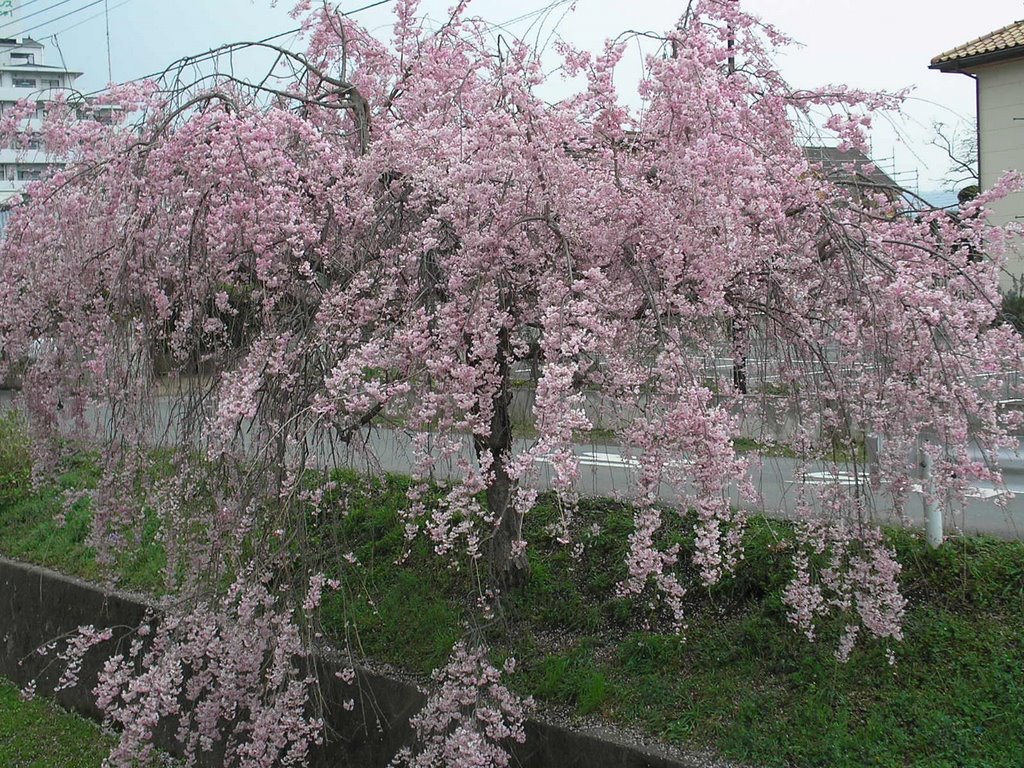
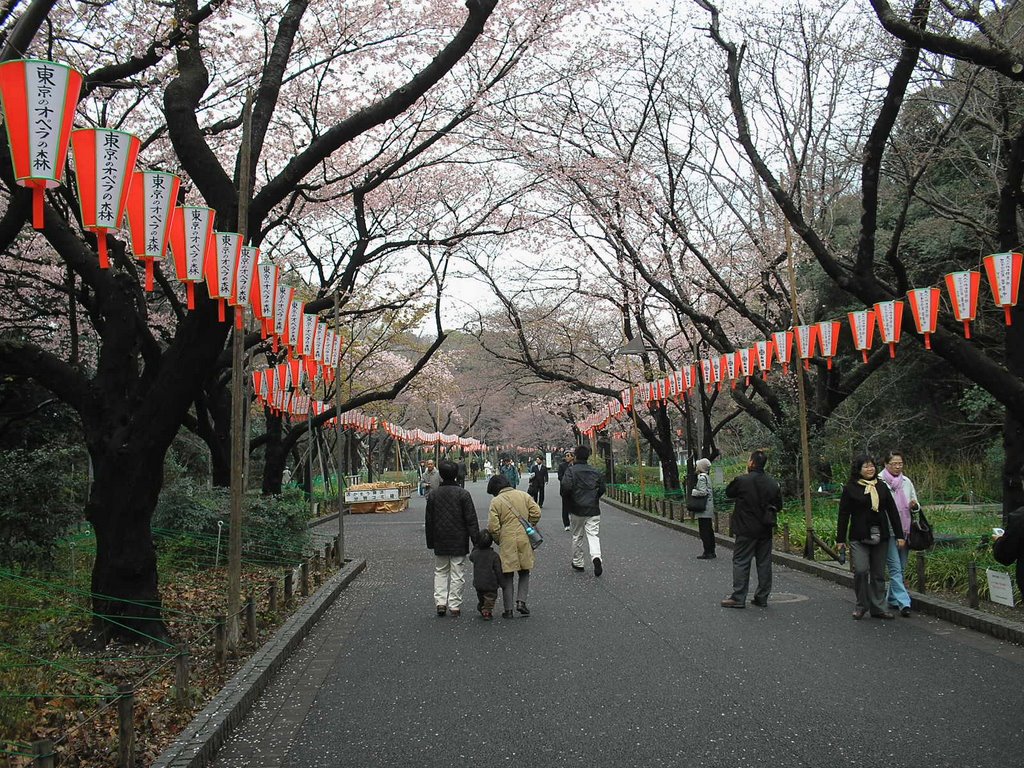
Yesterday the weather was clear and my wife was still on term break this week, so we took local trains through small towns and sometimes scenic countryside from Ashikaga to Oyama to Mito to visit the nationally famous Kairakuen (偕楽園 ‘shared pleasure park’), one of Japan’s three most beautiful landscape gardens. As the name implies, the park is open to the public; and the views are indeed spectacular. The blossoms on the 3,000 plum trees for which the park is most famous may have been a few weeks past their prime, but the cherry blossoms were in full bloom (満開, compare 満タン ‘full tank [of gas]) both in the park and across the broad expanse of Senba (千波 ‘thousand wave’) Lake and Park, which the Kairakuen hillside overlooks. Here are two verbal souvenirs from the trip.

Bokeh – This is an English technical term borrowed from Japanese, as I learned from Philbert Ono’s PhotoWords. The Photoxels Glossary of Digital Photography Terms defines it thus:

Boke (pronounced BOH-KEH), and increasingly referred to in print as “Bokeh” – Japanese word meaning “fuzzy” and referring to the out-of-focus (OOF) portions of a picture. A lens is said to have “good boke” if the OOF is pleasant and does not detract from the main subject. A lens with good boke produces out of focus smooth-edged highlights and reproduces an out of focus point of light as bright in the middle and progressively getting fainter with a fuzzy edge.

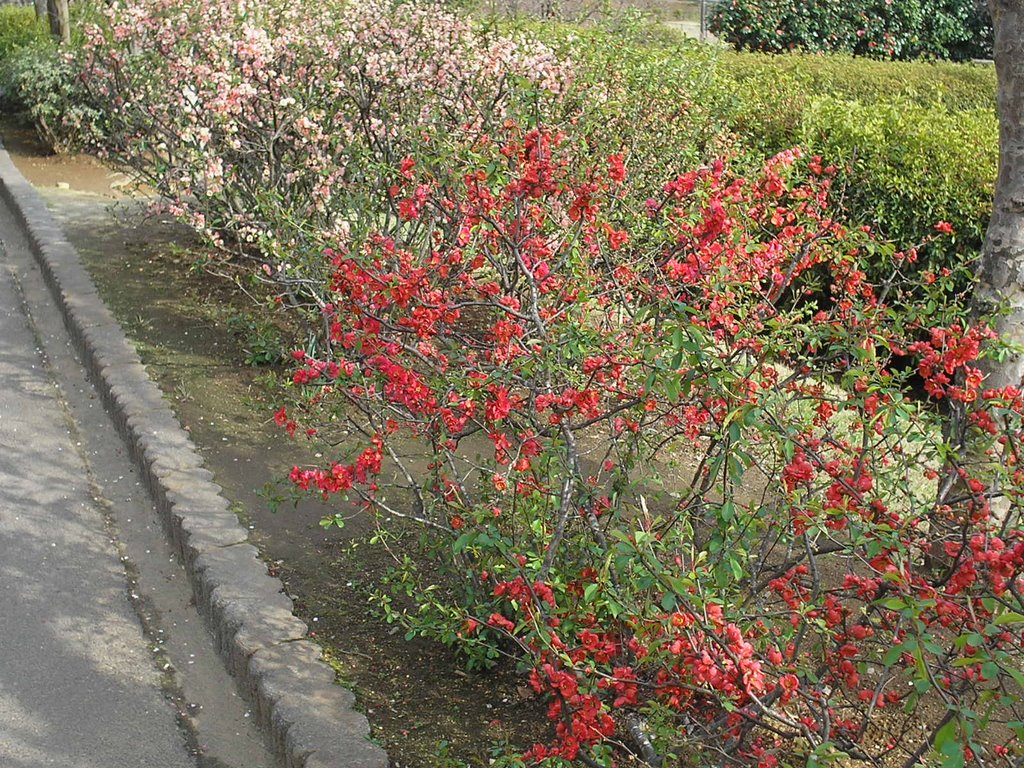
I’m not sure which Japanese boke this English borrowing comes from. Certainly not 木瓜 ‘Japanese quince, japonica’, which I was excited to find in full bloom, glistening like coral on the garden path down to Senba Lake. My best guess is 惚け/呆け, whose several meanings include ‘dull, dullheadedness’, as in 呆け色 boke iro ‘dull color’, from a verb 惚け/呆け meaning ‘grow senile; become mentally weak; fade, discolor’. The New Nelson kanji dictionary and Kenkyusha’s New Japanese–English Intermediate Dictionary, 5th ed. (in my Canon Wordtank), are not quite in synch on this, and neither of them mentions usage in photography. In any case, both my digital photographs and my digital words here are sure to provide plenty of evidence of boke.

Oddly enough, while English has borrowed a Japanese word for the out-of-focus part of a photo, Japanese appears to have borrowed a Dutch word for the in-focus spot: Japanese ピント pinto, from Dutch punt van focus or (focus)punt. (Dutch u is a front-rounded vowel—front like Italian i, round like Italian u—while Dutch oe renders the equivalent of English oo.)

枝垂れ桜 shidare-zakura ‘branch-drooping cherry tree’, Prunus pendula – Among the few types of cherry trees I can now reliably recognize are the branch-drooping ones. I’m also pretty good on 枝垂れ柳 shidare-yanagi ‘branch-drooping willow’. Yes, yes, I know that most people characterize both types as ‘weeping’, but that bit of poetic license completely bypasses the etymological briar patch that this prosaic pedant intends to poke his nose into.

Leaving out the tree itself, there are two pieces to the attribute 枝垂れ: 枝 shi ‘branch’, whose Japanese reading is eda, as in edamame ‘(soy)beans on the branch (or at least in their pods)’; and 垂れ tare ‘drippings, sauce, gravy, jus’. When it relates to apparel, 垂れ can also mean ‘hanging, curtain, lapel, flap, skirts of a coat’. So 垂れ tare covers the range of ‘drip, drop, droop, drape’ (which helped inspire one English linguist to coin the term phonaesthesia).

The Sino-Japanese phonetic element 支 shi of the two-part kanji 枝 itself means ‘branch’ in a lot of compounds, such as 支社 shisha ‘branch (company) office’; 支流 shiryuu ‘branch (flow), tributary’; 支族 shizoku ‘branch family, tribe’. To be more specific, one can rely on the semantic element 木 ki ‘tree’, which often relates to wood (either woody plants or items once made of wood), to disambiguate the 枝 shi that specifically means ‘tree branch’. Another contrast relies on the semantic element 肉 ‘meat’ (= 月 in combination), which usually relates to the body, so 肢 shi indicates ‘limbs of the body, arms and legs’.

Finally, 支 (in the shape of 枝) shi can be completely redundant. The New Nelson gives shidareru as an alternate reading for simple 垂れる tareru (vi and vt) ‘hang, droop, drop, lower, pull down; dangle; sag; drip, ooze, trickle’, so it’s perfectly okay to say 柳の枝が枝垂れている yanagi no eda ga shidareteiru ‘the branches of the willow are (branch-)drooping’. Webster’s Online Dictionary offers more—much more—on the semantics of droop in a wide range of languages. Turkish and Romanian are particularly rich.
Leave a comment

Filed under Japan, language

Wordcatcher Tales: Denchi

How many tales can be spun out of something as small and insignificant as a portable battery? Let’s see.

First, the word itself. In Japanese, ‘battery’ is rendered as 電池 denchi, lit. ‘electricity reservoir’. The second kanji also translates ‘pond’ and (small) ‘lake’, Japanese ike.

Second, where the word turns up. Denchi first lodged permanently in my mind while I was doing fieldwork in Yap, Micronesia, where (1) I was dependent on batteries for my flashlight and portable cassette-radio while living out in a village without electricity (at that time, anyway); and (2) people had managed to borrow a lot of Japanese vocabulary during three decades of Japanese rule (1914–1945), like sikoki ‘airplane’, and sikojo ‘airport’. Some of the more amusing borrowings are now archaic, if not obsolete, in Japanese, like sarumata ‘traditional Japanese men’s underwear’ (now used with reference to adult diapers) (Yapese didn’t need to borrow a word like fundoshi ‘loincloth’), chichibando ‘breast band’ (definitely a foreign concept in traditional Yap), and kachido ‘movie’ (< Japanese 活動大写真 katsudou daishashin ‘moving big picture’).

Third, how the items so labelled are subclassified. The relative sizes of the old familiar cylindrical dry-cell batteries are indicated numerically in Japanese, ranging from largest to smallest: 単1形 tan-ichi-gata (D cell), 単2形 tan-ni-gata (C cell), 単3形 tan-san-gata (AA cell), 単4形 tan-yon-gata (AAA cell). My electronic dictionary requires two 単4形, my digital camera requires two 単3形 (I forgot to bring my recharger), and our gas stove requires two 単1形. I’ve recently had to replace all three sets. At least I don’t have to carry two spares of the largest size around with me. (BTW, Philbert Ono’s Photowords is a great resource for translating photography-related vocabulary, including battery types, between English and Japanese.)

Finally, when I removed the Fujitsu 単1形 batteries from the stove and looked for the size designation, I first thought they were 単0形. After all, the midnight hour in Japanese is 0:00 reiji ‘zero o’clock’. But the characters surrounding the 0 were making a different claim: 水銀0使用 suigin zero shiyou ‘mercury zero use’. When I examined the other replacement batteries I had bought, they all made the same claim, no matter whether the brand was Maxell or Fujitsu (both made in Japan), or Konnoc (made in China). I hadn’t kept up on dry-cell battery technology. Fujitsu Magazine (July 1997) explains.

By using purified materials,a special zinc alloy powder,and a zinc-indium-bismuth-aluminum anode,and by establishing clean production lines,we have been able to develop an alkaline-manganese dry battery that has no mercury.The discharge rate of the battery was improved by remodeling the structure of the cathode.Moreover,by remodeling the anode disc,the battery has been made much safer.

Also,since 1996 we have been producing ferrite cores for the deflection yokes of cathode ray tubes using raw material recovered from spent dry batteries.

There are still a few other products from which mercury needs to be eliminated.

POSTSCRIPT: It’s good that Japan is trying to restrict mercury pollution, which caused Minamata disease. BTW, the Japanese (and general Sinitic) compound for the element mercury 水銀 suigin translates literally as ‘water silver’ rather than ‘quick (i.e., living) silver’. The planet Mercury is 水星 suisei ‘water-star’, and Wednesday is 水曜日 suiyoubi ‘water weekday’, which matches pretty well the Romance-language names for the same day of the week: Romanian miercuri, Spanish miércoles, Portuguese mercoles, French mercredi.

UPDATE: Reader Peter North adds a comment and query:

Sorry, I can’t resist reporting a new usage in Philippine English, not “Taglish” (since 2003). “Low Bat” describing a child lacking energy – needing food or sleep. Presumably derived from abbreviations on cell phone displays – you appreciate how widespread and central to life cell phones have become. Anyone seen this elsewhere?

Leave a comment

Filed under Japan, language

Fruitful English? Or a Dying Language?

This Fruitful English website tells you all you need to know about teaching English in Japan. (I found it by way of an ad at the top of my Gmail inbox.) It looks like an online 自動販売機 jidouhanbaiki ‘(automatic) vending machine’, with instructions entirely in Japanese. Selling One-Cup English. English classes in Japan explain the language; they don’t teach it. As if it were Hittite. Well, at least that won’t be a problem after the demise of English on March 31, 2058 (according to Language Hat).

Leave a comment

Filed under Japan, language

Wordcatcher Tales: Hata, Hi, Tateito, Yokoito

Ashikaga was once an important center for Japanese textile manufacturing, dating back to the days of silkworm-raising. In the early days of Japan’s industrial revolution, there were waterwheels (水車 mizuguruma) all over this piedmont town. Nowadays, the textile industry has left town, leaving behind a legacy of handicraft artisans, fine textile shops, and a few working pieces of machinery in a “play-learn” emporium (遊学館 yuugakkan), where you can learn how to weave a coaster on a small floor loom. (It costs ¥400 and usually takes 30-45 minutes.) Last week, while my visiting in-laws were trying their hands at weaving, I stood around translating, looking up words in my electronic dictionary, and listening to the two old timers who were demonstrating a braiding machine and a spinning machine that was plying thread from bobbins onto reels (clockwise on one side, counterclockwise on the other). They were excited to have an interested audience for a change.

One of the best things about doing fieldwork in a second language is that you often learn new things in the process, and also get a better command of vocabulary in your primary language. I learned a lot of English fish names a couple of decades ago when I elicited the local names for several hundred fish in a coastal language of New Guinea. Here are a few items of useful vocabulary from my 遊学館 experience.

hata, loom – The Chinese character with which Japanese hata is written also indicates all manner of new-fangled machinery, such as 洗濯機 sentakki ‘washing machine’, 飛行機 hikouki ‘flying machine (= airplane)’, and the Japanese ‘machine man’ superhero Kikaida. So now ‘loom’ can also be rendered as 織機 shokki ‘weaving machine’, and ‘power loom’ as 機械機 kikaibata (lit. ‘machine loom’). Worse yet, the same character also occurs in the famous Sinitic compound meaning ‘crisis’: 危機 kiki, danger + something not quite equal to opportunity—more like ‘wit, resource, device’.

hi, shuttle – In sharp contrast to 機 ‘loom’, the character for ‘shuttle’ is rare enough that my electronic dictionary ranks it last among the ten kanji pronounced hi and Microsoft’s Japanese-language input system doesn’t even offer it among its 42 ways to write the syllable hi. I had to go copy the character from unicode.org. In any case, most Japanese are quite familiar with the word adapted from English: シャトル shatoru, as in shatoru basu and supeesu shatoru.

縦糸 tateito, warp thread; 横糸 yokoito, weft thread – The terms that translate ‘warp’ and ‘weft’ render a whole range of similar oppositions: 縦引き鋸 tatebiki nokogiriripsaw‘ vs. 横切り yokogiricross-cut saw‘; 縦波 tatenami ‘longitudinal wave’ vs. 横波 yokonami ‘broadside wave, cross sea’; 縦揺れ tateyure ‘pitch (of a ship)’ vs. 横揺れ yokoyure ‘roll (or a ship)’; 縦書き tategaki ‘vertical writing’ vs. 横書き yokogaki ‘horizontal writing’. Finally, the highest rank in sumo is the 横綱 yokozuna (lit. ‘horizontal rope’), who is entitled to wear the ceremonial rope (綱 tsuna) across his waist.

Postscript: Weave : Weft :: Heave : Heft :: Leave : Left :: Bereave : Bereft. Can you think of any more English words that follow this pattern? Aha! Language Hat adds Cleave : Cleft.

Leave a comment

Filed under Japan, language

Wordcatcher Tales: Japonica


Today we have naming of parts. Yesterday,
We had daily cleaning. And tomorrow morning,
We shall have what to do after firing. But today,
Today we have naming of parts. Japonica
Glistens like coral in all of the neighboring gardens,
And today we have naming of parts.

What particular plant did Henry Reed intend to refer to in this poem? (I remember reading it in an English lit class during my freshman year at the University of Richmond in the spring of 1968—before I dropped out of ROTC, and then out of college altogether, ending up in the Army anyway.) I’m guessing either camellia or Japanese quince, both of which bloom in the spring.

My Canon Wordtank edition of Reader’s English–Japanese Dictionary lists three Japanese entries for English japonica, each telling its own story: ツバキ (camellia), ボケ (Japanese quince), and サルスベリ (crape myrtle).

椿 tsubaki, Camellia japonica – The cherry blossoms are getting all the attention in the Kanto (Greater Tokyo) area these days as they reach their peak, but the light pink to dark crimson camellias have been in full flower for a few weeks already. A great variety of cultivars of Camellia japonica are all over the place, often in hedges.

木瓜 boke, Chaenomeles speciosa – Japanese quince is also known as Chaenomeles japonica. The normal Sino-Japanese reading for the name of the plant should be mokka (< moku ‘tree’ + ka ‘melon’), the name owing something to its melonlike fruit. Another name for a flowering tree formed on the same pattern is 木蓮 or 木蘭 mokuren (lit. ‘tree lotus’ or ‘tree orchid’), Magnolia liliflora or lily magnolia. A slightly different variety of Magnolia, Magnolia kobus—from its Japanese name 辛夷 kobushi—is in full, brilliant white bloom these days.

百日紅 sarusuberi (lit. ‘monkey slide’), Lagerstroemina indica – The native Japanese name for crape myrtle describes its smooth (guavalike) trunk and stems, while the Chinese characters describe the flowers, but the two names bear no relation to each other beyond referring to the same plant. You can pronounce the name of the plant according to the characters as hyakunichikou (lit. ‘hundred day red’), but I’m not sure how many Japanese speakers would recognize it by that name on first hearing it. (I would have spelled the name in English as crepe myrtle, but the spelling crape myrtle generates a much larger number of hits on google.co.jp.)

2 Comments

Filed under Japan, language

Wordcatcher Tales: Shinobazu Ike

The other day, this Outlier took his in-laws down to Ueno station to pick up our 1-week JR rail passes and take a peek to see how the cherry blossoms were coming along at Ueno Park. The blossoms were just beginning to appear, and so were the snack and sake vendors.

One spot we lingered at was 不忍池 Shinobazu Ike, the name of which illustrates two troublesome aspects of Japanese attempts to write their own language using only Chinese characters.

The name of the pond is written in kanbun, a contorted method of rendering Japanese by means of Chinese syntax. The written Chinese characters, in order, translate as ‘not hide pond’, but the spoken Japanese, in morpheme order, translates as ‘hideth-not pond’. (The verb 忍ぶ shinobu has a range of meanings and, frankly, I’m not sure which one was intended by the placenamers.) The -zu ending is just a more formal and archaic version of the negative -nai. Wikipedia explains the contortions of kanbun rather succinctly, wherein Chinese sentences are read as Japanese in a sort of simultaneous translation (saving the verb to the end, and so forth).

The term 池 ike for the body of water is sometimes translated ‘lake’. As kids in Kyoto, we used to ride our bicycles up to a then rustic reservoir called Takaragaike ‘Treasure Lake’, now the site of a fancy international conference center. But the usual Japanese term for larger lakes is mizuumi, which is transparently composed of 水 mizu ‘(fresh)water’ + 海 umi ‘sea’ but written with a single Chinese character, 湖 (pronounced hu in Chinese and ko in Sino-Japanese, as in Biwa-ko ‘Lake Biwa’). A similar bit of Japanese morphology obscured by a single Chinese character is 雷 ‘thunder’ (Chinese lei, Sino-Japanese rai), which probably could have been rendered as 神鳴り kami-nari ‘god-sound’.

William Wetherall has a lot more on happenings around 不忍池 in a fascinating compilation on Bakumatsu and Early Meiji Newspapers. Here’s how he explains why he translates the 1868 experiment 江湖新聞 (Koko Shinbun, lit. ‘riverlake news’) as World News:

Though “koko” (C. jianghu), literally “rivers and lakes”, is nearly a dead word in Japanese today, it was a fairly common expression in the mid-19th century. It is the keyword in the title of the column that reported stories of social and human interest in Tokyo nichinichi shinbun in 1872. It was part of the title of a popular book in 1873. And it appeared in the inaugural issue of the news nishikie in 1874.

In references to classical China and Zen, “koko” it is pronounced “goko”. [With regard to] China, it refers to the world of the Yangzi river (Changjiang) and Dongting lake, and in certain Chinese folklore it alludes to the fighting spirit of outcasts who protect themselves with martial arts. As a Zen term, it signifies a place where monks and other practitioners gather from all quarters. If all roads lead to Rome, then the whole world is in Rome.

In the title of Koko shinbun, “koko” signifies the “world” or “society” one lives in — much like “sanga” (mountains and rivers) is a somewhat nostalgic reference to one’s country as a homeland. In this sense it is very close to its general usage in Chinese today to mean the wide (and sometimes an idealized) world.

Leave a comment

Filed under China, Japan, language

Wordcatcher Tales: Shiomori, Gibo, Atsumono

塩盛り shiomori ‘salt pile’ – The other night, as we were leaving our favorite local fish restaurant in Ashikaga, my recently arrived Minnesota in-laws noticed what looked like a small pile of snow beside the door as we left. It turned out to be salt, and there was a matching salt pile on the other side of the entranceway, so I went back in and asked the very friendly and talkative sushi chef (who trained 3 years in San Francisco and 1 on Maui) what the story was. There were no customers at the sushi bar at that moment, so he came outside in the chilly wind and told us the story. The salt has two functions. The most commonly recognized one is to purify the premises by keeping evil spirits out. But the more interesting one is to attract customers in. The latter function apparently goes back to the days when goods traveled by oxcart. The idea was to tempt the oxen to stop and lick the salt, whereupon the traveler might also decide to stop for food or rest. The salt piles were called 塩盛り shiomori ‘salt helpings’, a term which is otherwise chiefly found in restaurant menus for assorted salty dishes.

義母 gibo ‘mother-in-law’ – Earlier that same evening, I had introduced my visiting in-laws to the waitress in that same fish restaurant. Both she and the sushi chef are always happy to assuage my curiosity about obscure readings (obscure to me, anyway), especially of fish names and sake brands. After I had introduced my mother-in-law as my 義理の母 giri no haha, she referred to her by a shorter version, 義母 gibo. So I asked her what the shorter version is for younger sister-in-law, 義理の妹 giri no imouto. In comprehensive kanji dictionaries, you can find 義妹 gimai, but she had never heard that term. The only such shorter term she had heard was 義兄 gikei ‘elder brother-in-law’. The longer version is 義理の兄 giri no ani, and my New Nelson’s kanji dictionary lists the full range for siblings-in-law: including the combining terms 義姉妹 gishimai ‘elder and younger sisters-in-law’ and 義兄弟 gikyoudai ‘elder and younger brothers-in-law’. (The 義理 giri here is the same one used to mean ‘duty, honor, debt of gratitude’; and the shorter prefix 義 gi is also used to indicate artificial human components, as in 義歯 gishi ‘artificial tooth’ or 義眼 gigan ‘artificial eyeball’.)

紅き羹 akaki atsumono ‘vermilion broth’ – one of our two favorite coffee shops in Ashikaga is Café de Furukawa, an elegant place whose 12-page menu and guide to coffee history and brewing is titled 紅き羹 akaki atsumono, a purposely archaic and obscure phrase that I’ve translated ‘vermilion broth’. Both elements tell a story. The reading aka for 紅 is archaic in Japanese, and the pronunciation akaki for akai ‘red’ is both archaic and regional, I believe. Nowadays, akai ‘red’ in Japanese is written 赤, while 紅 is normally read beni ‘crimson, rouge, vermilion, lipstick’, as in 紅生姜 beni shouga ‘red pickled ginger’, 紅染め benizome ‘red-dyed cloth’, or 紅鮭 benizake ‘red salmon’. Chinese 紅 hong still means ‘red’ (and shows up in many given names of people born during China’s Cultural Revolution). Its Japanese rendition kou- shows up in many compounds such as 紅茶 koucha ‘red tea’ (= ‘black tea’ in English), 紅海 Koukai ‘Red Sea’, and 紅灯 koutoured lantern, red light (district)’. The much rarer character 羹 atsumono ‘hot soup, broth’ (literally ‘hot stuff’) has a much shorter story. It shows up in a Japanese proverb that matches English “Once bitten, twice shy”: 羹に懲りて膾を吹く Atsumono ni korite namasu o fuku ‘Learning from hot broth, you blow on cold pickles’.

UPDATE: Thanks to Language Hat reader Matt for catching a grammar error in my rendition of the coffee-shop title. I originally wrote 紅きの羹 for what is actually 紅き羹. I’ve made the correction in the text above. Another Language Hat commenter turns up a different explanation for the doorway 塩盛り in a fun Youtube video guide to eating sushi.

Leave a comment

Filed under Japan, language

Reconstructing Virginia Algonquian

Language Hat notes a NY Times story about the efforts to reconstruct the dead Algonquian language spoken by Powhatan and Pocahontas in order to lend an air of authenticity to the dialogue in the movie The New World.

This family of Indian tongues, in one respect, reminded linguists of the Romance languages. Each was distinctive but as closely related as Spanish is to Italian or Italian to Romanian. Comparisons with related languages revealed the common elements of grammar and sentence structure and many similarities in vocabulary.

A translation of the Bible into the language once spoken by Massachusetts Indians offered more insights into the grammar. The Munsee Delaware version spoken by coastal Indians from Delaware to New York, including those who sold Manhattan, may be dead, but its grammar and vocabulary are fairly well known to scholars.

“We have a big fat dictionary of Munsee Delaware,” said Dr. Rudes, who adapted some of those words when needed for Virginia Algonquian. Recordings of the last Munsee Delaware speakers, a century ago, were a valuable guide to pronunciations.

Another research tool was what is called Proto-Algonquian. It is the hypothetical ancestor common to all Algonquian speech, 4,000 words that scholars have compiled from the surviving tongues and documentation of the extinct ones.

The reconstruction involves educated guesses. Strachey set down words for walnut, shoes and two kinds of beast, “paukauns,” “mawhcasuns,” “aroughcoune” and “opposum.” In Proto-Algonquian, similar words are paka-ni (meaning large nut), maxkesen (shoe), la-le-ckani (raccoon) and wa-pa’oemwi (white dog).

From this, Dr. Rudes reconstructed the Virginia Algonquian words pakán, mahkusun, árehkan and wápahshum,” or pecan, moccasin, raccoon and opossum.

Leave a comment

Filed under language, North America, U.S.

Hear Four Sets of Anglospheric Accents

The University of Otago has mounted online samples of male and female speakers of four sample accents of English: New Zealand female and male, Australian female and male, North American female and male, and English female and male.

Part of their experiment involved asking people from other nations to evaluate the personality traits of the speakers along several dimensions based solely on their accents. The results are often surprising.

UPDATE: It’s interesting that, in virtually every country, the North American accents rank most highly in the categories of solidarity (especially the female) and often competence, but much lower in the categories of status and power. The North American accents are American, not Canadian, but very few of the evaluators are likely to have been able to tell the difference. If you want to sharpen your ear for American-Canadian differences, just listen to the Winter Olympics coverage on NBC. There seem to be several Canadian-American pairs of announcers.

Leave a comment

Filed under anglosphere, language

The Wrathful Dispersion Theory of Linguistic Evolution

I’ve been distracted by some old-fashioned print-publication-related onuses. (Yeah, that seems to be the English plural, although the Latin is onera. In banking, an on-us check is one drawn on the clearing bank’s own reserves and thus not passed on through to the Federal Reserve’s check-clearing system.) Anyway, that’s my excuse for neglecting to note an important new development in historical and comparative linguistics: Wrathful Dispersion Theory.

The opponents of Wrathful Dispersion maintain that it is really just Babelism, rechristened so that it might fly under the radar of those who insist that religion has no place in the state-funded classroom. Babelism was clearly rooted in the Judeo-Christian story of the Tower of Babel (Genesis 11: 1–9); it held that the whole array of modern languages was created by God at a single stroke, for the immediate purpose of disrupting humanity’s hubristic attempt to build a tower that would reach to heaven: “Let us go down,” God says to Himself, “and there confound their language, that they may not understand one another’s speech.” Wrathful Dispersion is couched in more cautiously neutral language; rather than tying linguistic diversity to a specific biblical event, it merely argues that the differences among modern languages are too perverse to have arisen spontaneously, and must therefore be the work of some wrathful (and powerful) disperser who deliberately set out to accomplish a confusion of tongues. When asked in court to speculate about the possible identity of the disperser, Michael Moringa, a prominent proponent of WD, demurred, saying that the theory makes no claims about the answer to that question, and that it certainly does not insist that the Disperser is the God of Genesis. Moringa has, however, elsewhere avowed a deep personal belief in the Christian God as the power responsible, as have other WD theorists. Indeed, there appear to be no atheists in the foxholes on the WD side of this war, and for that matter, no Jews or Muslims, either; the WD movement is composed almost exclusively of evangelical Protestants.

via Language Hat via Language Log

I’m sure the new Pope will clear this up for any doubting Thomists.

UPDATE: I hope it wasn’t necessary to include <clever parody> tags on the blockquote.

Leave a comment

Filed under language