Category Archives: language

Wordcatcher Tales: Kami-, Shimo-, -zen, -chu, -go

If you found yourself in Lower Slobovia and wanted to head for Upper Slobovia, in which direction would you head?

  1. upcountry
  2. upriver
  3. upstate
  4. upmarket
  5. up north (or up south down under?)
  6. to the capital city

In how many places outside Japan would the last answer be most likely? Anyone who regularly rides the long-distance trains in Japan knows that all trains bound for Tokyo are ascending trains (上り列車, noboriressha), while all trains heading away from Tokyo are descending trains (下り列車, kudariressha). That’s not too surprising for train systems in centralized states. Of greater interest is the fact that old placenames in Japan show the same alignment, as I discovered while deciphering a Japanese map from a few hundred years ago.

The names that most puzzled me were 上総 Kazusa ‘Upper Fusa’ in lower Chiba and 下総 Shimousa ‘Lower Fusa’ in upper Chiba (where my use of ‘lower’ means southern and ‘upper’ means northern), along with 上野 Kōzuke ‘Upper Keno’ for what is now Gunma and 下野 Shimotsuke ‘Lower Keno’ in what is now Tochigi. ‘Upper’ Gunma lies to the southwest of ‘Lower’ Tochigi. Neither riverflow nor terrain height will explain why one member of each of these pairs is ‘upper’ and the other is ‘lower’. Nor will orientation to Japan’s current capital, Tokyo (lit. ‘East Capital’).

The key to the answer fairly leapt out at me when I factored two more sets of old provinces into the equation.

  • The old provinces of 越前 Echizen ‘Near Echi’, 越中 Etchu ‘Middle Echi’, and 越後 Echigo ‘Far Echi’ run up the Japan Sea coast from southwest to northeast, corresponding to the current prefectures of Fukui, Toyama, and Niigata.
  • The old provinces of 備前 Bizen ‘Near Bi’, 備中 Bitchu ‘Middle Bi’, and 備後 Bingo ‘Far Bi’ run along the Inland Sea from east to west, corresponding to parts of the current prefectures of Okayama and Hiroshima.

In both cases, the provinces whose names end in -zen ‘before, in front, pre-‘ are closer to the old capital of Kyoto, while those whose names end in -go ‘behind, in back, post-‘ are farther from Kyoto. Kyushu also had three pairs of former provinces, where the half of each pair ending in -zen (Buzen, Chikuzen, Hizen) lay to the north (and thus nearer Honshu) of its counterpart ending in -go (Bungo, Chikugo, Higo).

LATER INSERT: These old placenames still turn up in modern contexts. The 上越新幹線 Jōetsu Shinkansen, the bullet train line that runs from Tokyo through Gunma to Niigata gets its name from the Sino-Japanese reading (jō) of the first character of 上野 Kōzuke ‘Upper Keno’ (now Gunma) and an alternate Sino-Japanese reading (etsu) of the first character of 越後 Echigo ‘Far Echi’ (now Niigata). Furthermore, a native Japanese reading of the latter character, 越 koshi, shows up in the name of perhaps the most famous cultivar of Japanese rice, Koshihikari (越光), which originated in Niigata (although Koshihikari is rarely written in kanji these days). Koshi was the older (7th century!) name for the province that was later divided into Near, Middle, and Far Echi, which were in turn eventually renamed as prefectures of Fukui, Toyama, and Niigata on Japan’s Hokuriku coast.

How many other placenames that can be rendered as Upper X and Lower X, or Near X and Far X, describe relative distance from capital cities? (Far Rockaway in Queens, NYC, was apparently named for its relation to what used to be East Rockaway, now part of Nassau County, NY, and not for its relation to NYC.)

UPDATE: The title of this post does not include the usage of nobori ‘ascending’ and kudari ‘descending’ for travel toward and away from the capital city, respectively. That usage I suspect is very, very common, as two commenters have pointed out. I’m interested in placenames, where Japanese usage is unique, at least in my experience. Lower Saxony is on the coast and lower in elevation than landlocked Saxony farther inland. Orientation to Berlin, or Vienna, or Rome is irrelevant. The Prussian province of Lower Silesia was actually closer to the Prussian capital, Berlin, than Upper Silesia. There are many towns on the slopes of the Carpathians in Romania named along the lines of Făgăraş de Sus and Făgăraş de Jos, but Sus means upslope and Jos means downslope, not closer or farther from Bucharest or Vienna or wherever the capital may have been at one time. In East Asia, Korea has many provinces split into North (-bukdo) and South (-namdo) parts—Hamgyong, Hwanghae, Pyongan, Chungcheong, Gyeongsang, Jeolla—none of which are distinguished relative to the position of the capital city. China, similarly, has several sets of matching province names—Guangxi, Guangdong; Hunan, Hubei; Henan, Hebei—but all of them are distinguished by cardinal positions relative to the globe, not relative to the capital city. So the question remains: In what other country or language would the equivalent of Upper Slobovia be closer to the capital than Lower Slobovia?

UPDATE 2: In the comments, Nathanael of Rhine River notes the conflict between the German usage of upper and lower to signal the highlands and lowlands of German-speaking lands and the (North) American tourist usage of upper and lower to distinguish northern and southern Germany, plus similar conflicts in usage that afflict those who equate ‘upper’ with ‘north’ and ‘lower’ with ‘south’ in reference to both the Nile and the Mississipi, which flow in opposite directions.

UPDATE 3: Well, this post prompted me to consult my hitherto underutilized electronic Super Daijirin and solve a few onomastic problems that have nagged at me for a long time. (And just in time, too, since I leave Japan tomorrow.) As noted above, Tochigi Prefecture used to be called 下野 Shimotsuke ‘Lower Keno’ while Gunma used to be called 上野 Kōzuke ‘Upper Keno’. It turns out there are several ways to write both province names. In fact, the Keno portion is rendered more accurately by adding the syllable for ke ‘hair’, as in 下毛野 ‘Lower Hair Field’ and 上毛野 ‘Upper Hair Field’. (I wonder if those names refer to the bearded wheat and barley that still dominate the agriculture of the region.)

Not only are there multiple ways to write each placename, there are also multiple ways to pronounce each kanji in the placename. Older placenames seem to have been pronounced in native Japanese form (like Koshi instead of Echi/Etsu for 越), but the kanji originally used to write them have contributed Sino-Japanese pronunciations to the same placenames, and the latter readings usually show up in abbreviations. So the old name of Gunma is alluded to in the 上 Jō- of 上越新幹線 Jōetsu Shinkansen, and a slightly longer version appears in the name of 上毛電鉄, Jōmō Electric Railway, which runs from the Gunma border city of Kiryū, which abuts Ashikaga City in Tochigi Prefecture, to Maebashi, the capital of Gunma Prefecture. Two local newspapers also conjure up the old placenames: Jōmō Shimbun (“Upper Hair News”?) in Gunma and Shimotsuke Shimbun (“Lower Field News”) in Tochigi.

Now, finally, the pièce de résistance: The JR line that runs through Ashikaga is known as the Ryōmō line. It runs between Oyama City in southeastern Tochigi, and Takasaki City in central Gunma. The Tōbu railway express train that runs through Ashikaga and terminates at Akagi in central Gunma is also called the Ryōmō. Ryōmō is written 両毛 ‘Both Hairs’, a strange name that doesn’t make much sense unless you know that it refers to the combination of regions formerly known as ‘Upper Hair’ (上毛, now Gunma) and ‘Lower Hair’ (下毛, now Tochigi). Weird, huh?
Leave a comment

Filed under Japan, language

Wordcatcher Tales: Dekoboko, Kappou

凸凹 dekoboko ‘unevenness, roughness, bumpiness’ – Today I went to my neighborhood barbershop, not so much because my hair was getting too long for the increasingly muggy weather, but because my beard was getting too scraggly. Well, instead of looking up ‘scraggly’ in my electronic dictionary, which would have returned 不揃い fuzoroi ‘uneven, not uniform, irregular, mismatched’, I looked up ‘uneven’ and found the wonderfully graphic 凸凹 dekoboko ‘unevenness, roughness, bumpiness, inequality’.

The barber seemed to understand fine what I meant when I characterized my beard as dekoboko. He might have had more difficulty processing the Sino-Japanese pronunciation of the combination, tatsuou, but someone who works with lenses might have found it more familiar, as 凸 also translates ‘convex’ and 凹 translates ‘concave’.

割烹 kappou ‘fine cuisine’ – To celebrate their 25th wedding anniversary, the Far Outliers treated themselves to an elegant dinner at nearby 割烹 懐石 蝶や Kappou Kaiseki Chou-ya ‘fine-cuisine tasting-menu butterfly-shop’. Wikipedia’s “tasting menu” is a good characterization of kaiseki, which has an interesting etymology in its own right, but I want to examine 割烹 kappou, which was new to me. At one level, it’s just a synonym of 料理 ryouri, but the respective etymological ingredients of the two words bring out different flavors.

While 料理 describes cooking in the abstract, as Ingredients Management, 割烹 describes cooking as concrete actions, Slicing and Simmering. You can see the ‘sword’ (刀) radical (刂) down the right side of 割 waru ‘divide, cut, halve; separate; split, rip; break, crack, smash; dilute’ (Sino-Japanese katsu), and the ‘fire’ (火) radical (灬) flickering under 烹 niru ‘boil, cook’ (Sino-Japanese hou). (The usual way to write niru ‘boil, cook’ is with 煮, Sino-Japanese sha.)

Perhaps it’s not too misleading to propose a rough analogy along the lines of 割烹 : 料理 :: cuisine : cooking. At first I suspected kappou was only used for fine Japanese cuisine, but then I found 中華割烹 Chuuka kappou ‘Chinese fine-cuisine’, to label a Chinese-style “tasting menu” approach (to judge from the images).

So here’s how our kaiseki meal progressed. We sampled two local brands of sake as we ate, both served in a small teapot of clear glass with gold trim. Our sake cups were also of glass. Mine had gold flakes on the bottom, and with twelve delicate, alternating green and white vertical lines. My wife’s was slightly smaller, made of cut glass of a purplish hue.

  1. Starter: tiny scallop on half shell, fresh ginger shoot (myoga), and a slice of chicken on fishcake
  2. Hashiarai: clear soup with noodles made of fish cake (surimi) in lacquer bowl
  3. Sashimi: slices of snapper (tai), scallop (hotate), and yellowfin tuna (maguro)
  4. Mushimono: I can remember the dish, but not what was on it!
  5. Nimono: simmered pork kakuni hidden under a scoop of rice in covered lacquer bowl
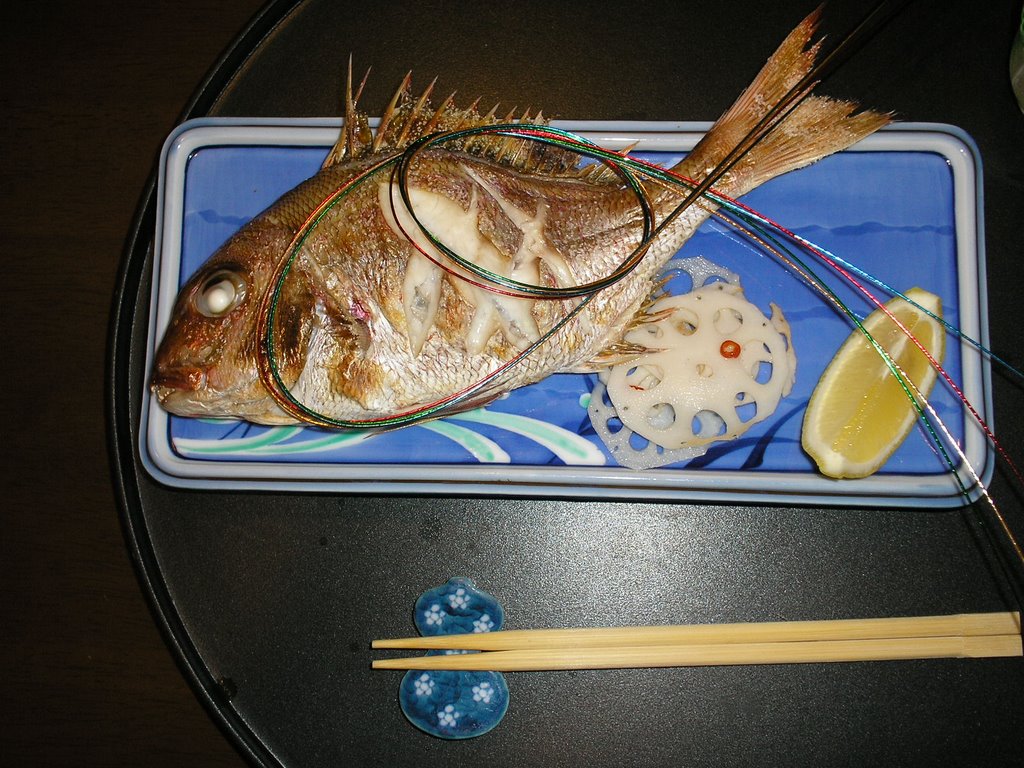
  6. Yakimono: whole celebratory red snapper (tai, implying mede-tai)
  7. Hassun: clear broth with daikon, shiitake, takenoko, broccoli, green fishcake, and shrimp
  8. Agemono: oily shrimpcake
  9. Sumono: vinegared tomato with sesame-flavored bean threads
  10. Udon: thin Akita noodles and thin chirashi nori
  11. Dessert: fresh local strawberry gelato bursting with flavor, paired with bitter green tea

Our rather unpretentious hostess didn’t describe each dish as she presented it, but was only too happy to answer my questions when I asked. Here‘s a photo gallery of a more elaborate kaiseki dinner.

Leave a comment

Filed under Japan, language

Wordcatcher Tales: Hanabishisou, Hotaru-Bukuro, Tade

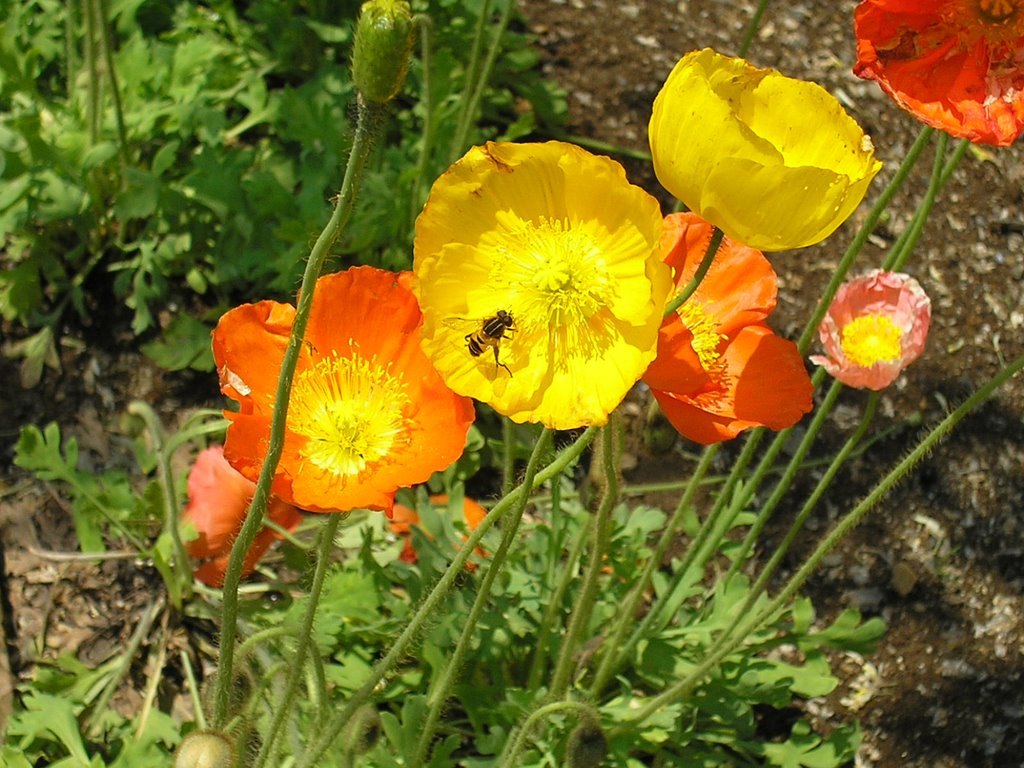
花菱草 hanabishisou ‘California poppy’ – The common, vulgar, lowly, ubiquitous (but not somniferous) California poppy has a most impressive moniker in Japanese: 花 hana ‘flower’ + 菱 hishi ‘water chestnut’ + 草 sou ‘grass’. Almost makes you want to ingest it.

蛍袋 hotaru-bukuro Campanula punctatacherry bells‘ – One flower that seems to bloom with the sprightly bluebells is what looks like its depressive cousin, the hotaru-bukuro ‘firefly sack’. One can win many points with dowager gardeners by learning this obscure plant name.

The specific cultivar ‘Cherry Bells’ was developed in Japan. It is really one of the most pleasing campanulas for tidiness of basal leaves & beauty & colorfulness of large longlasting pendulous flowers. The stems have an appealing flowing tilt which does not look floppy, but permits the “bells” to dangle naturally, so that staking is never required.

tade ‘smartweed, knotweed’ (Polygonum spp.) – At Uotami (‘Fish Nation’) izakaya in nearby Kiryu, Gunma Prefecture, over the weekend, the Far Outliers were served an unusual blue-hued dipping sauce for our tasty whole ayu (鮎) ‘sweetfish’ on a stick. The waitress said the sauce was made from tade, which The New Nelson defines oversimply as ‘smartweed’ (also known as ‘smartass’), a plant with a nasty reputation. But the blue hue turns out to offer a subtle hint. The Japanese variety, also known as dyer’s knotweed (Polygonum tinctorium), is one of several secondary herbal sources for indigo dye (Indigofera tinctoria), along with woad (Isatis tinctoria), a favorite of the Picts, who got their Latin name from their fondness for body-dye.

UPDATE: Matt of No-sword adds a tade-related proverb that I neglected to mention: 蓼喰う虫も好き好き Tade kuu mushi mo sukizuki ‘Even bugs who eat tade are quite fond of it’—corresponding to “There is no accounting for taste” or De gustibus non disputandem est. I wonder if the smell of tade, like other indigo dyes, is supposed to repel mosquitoes.

1 Comment

Filed under Japan, language

Wordcatcher Tales: Tanchou, Momonga, Kuroten

Among the things I’ll miss when I leave Japan at the end of this month are NHK nature shows. The photography is often spectacular, of course, but the spare and clear narrative style, with equally spare but clear captions on screen, are perfect for an obsessive language-learner who watches Japanese TV with denshi jisho in hand—and a mute button within easy reach if it’s a commercial channel. Here are three animal names I learned while watching a show about Hokkaido wildlife recently.

丹頂 tanchouJapanese crane, red-crested white crane’ – The 丹 is ‘red’ (as in cinnabar or vermilion), while the 頂 is ‘crest, peak, summit’, so the prosaic version of the name is ‘red crest’.

ももんが momonga ‘Eurasian flying squirrel’ – A rare, nocturnal creature of the far north whose image graces Estonian postage stamps. It’s possible to write the name much more obscurely in kanji, but I don’t see the point, and neither did NHK.

くろてん kuroten ‘sable’ – There are at least three kinds of てん (a native Japanese word that can also be written 貂): 黒てん kurotensable‘, 白てん shirotenermine‘, 松てん matsutenpine marten‘. (These flesh-and-blood creatures are not to be confused with the animé “Black AngelKuroten. Nor should ermines be confused with ferrets!)

1 Comment

Filed under Japan, language

Summer Forecast: Very Light Posting

Over the next few months, I’m going to have to concentrate on some high-priority projects with relatively tight deadlines, so posting will be very light to this blog. However, I will continue backfilling my Japan travelogue posts with photographs. On top of that, I recently opened an account on Flickr (under the name Joel in Japan) and will be loading as many photos each month as Flickr’s free bandwidth allocations will permit.

Japan Travel Compendium (now illustrated!)

Leave a comment

Filed under Hawai'i, language

Saipan Impressions: Chamorro and Carolinian

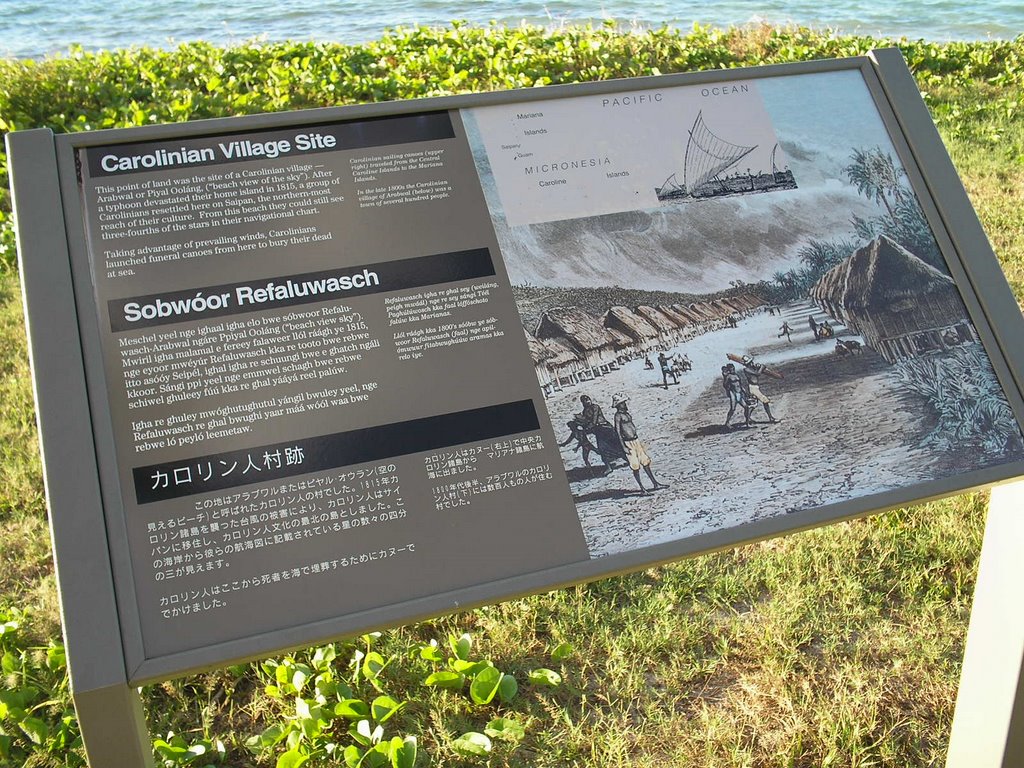
Carolinian village marker, GarapanWhen I went to Saipan I didn’t expect to encounter either of its two indigenous languages: Chamorro and Saipanese Carolinian. And indeed I saw next to nothing written in either language. Nothing in Chamorro but the greeting “Hafa Adai” (on every license plate), and nothing in Carolinian except a plaque (pictured here) in the American Memorial Park that marked the site of the old Carolinian village at Garapan.

But then I found KCNM-FM 101.1 on my rent-a-car radio and stayed tuned to it whenever I was driving. It played a wonderful assortment of contemporary Micronesian music, from Palauan enka to Chuukese country to Gilbertese gospel, which can all be sampled on Jane Resture‘s Micronesian Music Radio on Live365.com.

The music was interrupted periodically by NPR news in English and occasional announcements or classified ads in Chamorro, with prices quoted in English and telephone numbers in Chamorro. The Chamorro number system is now based on Spanish: unu, dos, tres, kuatro, sinko, sais, siette, ocho, nuebi, dies. (According to Wikipedia, the basic set of old Chamorro numbers was hacha, hugua, tulu, fatfat, lima, gunum, fiti, gualu, sigua, manot/fulu—far more Philippine-looking.)

Chamorros and Carolinians on Saipan are fighting an uphill battle to preserve their ancestral languages (and many have already surrendered). The resident population of the Northern Marianas is about 35% Filipino, 20% Chamorro, 10% Chinese, 10% Korean, 5% “Anglo”, with smaller numbers of Japanese, Palauans, and other Micronesians. Most of the retail clerks and wait help I encountered spoke Filipino and Filipino-accented English to each other. Most of the tourists I encountered spoke Japanese, Korean, or Chinese. The signage around Chalan Kanoa, which used to be the main Micronesian barrio when the U.S. Navy controlled most of the island, is now overwhelmingly Chinese and Korean, with some Japanese—and English, of course, one of the official languages of the Commonwealth of the Northern Marianas.

The most ubiquitous signs in Saipan say Poker. Many such signs are lit up round the clock. Almost every little country store has a Poker sign over one door, often next to one above the store entrance that says Food Stamps Accepted.

On 18 March 2005, the Saipan Tribune published three essays from a “contest held by the Department of Community and Cultural Affairs’ Chamorro/Carolinian Policy Commission to promote indigenous languages in the Commonwealth.” Let’s examine a few sentences of each.

Carolinian

Meta e welepakk sibwe kkepasal Refaluwasch rel?

Mwaliyasch Refalawasch nge eghi prisisu sibwe ghuleey bwe iyel yaasch IDENTITY me kkosch me eew malawasch ghisch aramasal Seipel. Sibwe abwaari me amalawa mwaliyasch leel olighat, fatattaral iimw, gangisch nge mwetelo mmwal nge sibwe kki yaali schagh.

When I took linguistic field methods back in grad school, our class worked with a speaker of Saipan Carolinian, which was not well described at the time, although a lot was known about closely related Trukese (now Chuukese). I’ve studied quite a few Austronesian languages, but you really need to be familiar with the Micronesian subgroup of Austronesian before this starts to look very familiar. Nevertheless, here are a few items that strike me.

Ethnonym: The Saipan Carolinian name for themselves is Refaluwasch. The name Carolinian is derived from the Caroline Islands, where the ancestors of today’s Saipan Carolinians came from, probably starting around the 1700s, after the Northern Marianas had been almost entirely depopulated.

Unusual sounds: I believe the Germanic looking sch indicates a retroflex affricate that sounds a bit like Yapese ch or Kosraean sr. The double consonants in word-initial position are a bit unusual and take some getting used to for English speakers who ignore the medial double nn in Japanese konnichi-wa.

Dialects: The Trukic languages form one long dialect chain, where speakers on neighboring islands can understand each other fine, but speakers from farther apart have increasing difficulty. There is no contrast between l and n in most of the dialects. Where this speaker writes aramasal Seipel ‘people of Saipan’, a speaker of a different dialect might write aramasan Seipen. Similarly, the town of Tanapag, settled by a different group of Carolinians, also goes by the name of Tallabwog.

Chamorro

Hafa Na Prisisu Na Ta Praktika I Fino’ Chamorro?

Kumu uniku yu’ na pagton [sic] palao’an gi familia yan todu I dos saina-hu Chamorro, gi anai pa’go mafañagu yu’, hu hungok I sunidon Chamorro despues enao mo’na I fina’na’guen nana-hu yan tata-hu. Este I lengguahen Chamorro impottante na ta tungo’ sa’ I mismo lengguahi-ta dumiklaklara hafa nasion-ta na rasan taotao….

Pot uttimo, prefekto yu’ na patgon Chamorro ya ti bai hu sedi na bai hu maleffa osino bai hu na’ fo’na I otro lengguahi ki I mismo lengguahi-hu Chamorro.

A Spanish reader’s reaction to written Chamorro must be very similar to a Chinese reader’s reaction to written Japanese. The huge number of familiar borrowings let you know the subject matter, but the foreign grammatical framework remains opaque. You know what they’re talking about, but not what they’re saying.

Ethnonym: Many Chamorros prefer to call themselves Chamoru, perhaps especially Guamanian Chamorros, whose orthographic standards (at least at Unibetsidåt Guahan) seem to differ somewhat from those in Saipan.

Unusual sounds: Chamorro ch is pronounced like [ts] (and some capitalize both members of the digraph: CHamoru, like Dutch IJssel); while y is pronounced like [dz]. The apostrophe marks a glottal stop. Spanish syllable-final -r regularly becomes -t and syllable-final -l assimilates to the following consonant.

Grammar: One of my term papers in grad school was an analysis of the historical morphology of Chamorro and Palauan, both of which look more Philippine-like as you go farther back. And both are verb-initial to a significant degree. (So is Yapese, but it’s not very closely related to any other Austronesian language.) But Palauan morphology is far more opaque: with Philippine -in- showing up as -l- and -um- showing up as -o- in some environments. Chamorro is more straightforward. The Spanish loanword diklara, for instance, is both infixed and reduplicated in d-um-iklaklara. Compare Tagalog bili ‘buy’ and one of its inflected forms, b-um-ibili.

Leave a comment

Filed under language, Micronesia, Pacific

Wordcatcher Tales: Imari, Potters, and Abduction

Recently the Far Outliers finally got around to visiting one of Ashikaga City’s principal tourist attractions, the Kurita Museum near the Flower Park, both of which lie in the outlying town of Tomita, one JR train stop to the east.

The beautiful Kurita Museum grounds house not only one of the finest and largest collections of Imari and Nabeshima porcelain (磁器 jiki) in the world, they also include exhibits of international archaeological finds and pottery-making techniques, a climbing kiln (登り窯 noborigama, as opposed to the single-chamber 穴釜 anagama), gift and snack shops, and an off-limits working potters’ village. The Sushi and Maple Syrup blogger has posted a lot of photos from a weekend visit to the Museum (and Ashikaga Gakko) last year.

伊萬里 (or 伊万里) Imari – My sources seem to indicate that Imari is one subset of Arita ware and Nabeshima is another. They were all manufactured in Arita (有田), in Saga Prefecture in northwest Kyushu. Imari is the port (near Hirado in neighboring Nagasaki Prefecture) from which export varieties were shipped, and Nabeshima (鍋島 ‘Pot Island’) is the name of the Saga domain lords who controlled production, guarded secrets, and commissioned works of the highest quality for their peers in Japan.

As porcelain grew in popularity, the Nabeshima Clan took steps to keep their production and decorating techniques a closely guarded secret. They were aided in this effort by the Tokugawa Shogunate and other feudal lords, who commissioned the Nabeshima Clan to make porcelain for only the elite classes — the sale of Nabeshima ware to commoners was actually forbidden, and the number of kilns and wheels was strictily limited by law.

無名陶工 Mumei toukou ‘Unnamed potters’ – The highest point on the grounds of the Kurita Museum is a memorial hall dedicated to all the unknown potters whose work Mr. Kurita so obviously cherishes. Unfortunately, Mr. Kurita’s flowery words of appreciation fail to note that the first of these potters were Korean, and that at least one went by the name Ri Sampei in Japanese (李参平, 1579-1655).

In the early 1600s, Nabeshima Naoshige, the feudal lord of the Sage [sic] Clan, brought a group of Korean potters to Japan, including the potter Risampei, who in 1616 discovered a superior white-stoned clay at Izumiyama (Izumi Mountain, Arita). Wares fired with this earth are called “hakuji” (white porcelain …). Some say this was the beginning of Arita Ware.

拉致 ratchi or rachi ‘abduction’ – This word is much in the Japanese news these days as the government and individual citizens seek to determine the fate of various young people thought to have been abducted by North Korea in order to teach Japanese to North Korean spies. After failing to find the word (under either pronunciation variant) in my electronic dictionary, I had to resort to looking up the individual characters. The first kanji (拉, Sino-Japanese ratsu) is used to indicate the sound Ra as an abbreviation for Raten ‘Latin’ (which is usually written in katakana when spelled in full). But 拉 also appears in the native Japanese verb 拉ぐ hishigu ‘crush, smash, overpower’ and in the Sino-Japanese verb 拉っする rassuru ‘drag along; kidnap’. The second kanji, whose Sino-Japanese reading is chi, is used to write 致す itasu ‘do; send; cause; render (assistance); exert (oneself)’, as in どう致しまして dou itashimashite ‘what have I done (to deserve thanks)?’ (= ‘Not at all / Don’t mention it’).

The Japanese arts website bleu et blanc provides a succinct account of the role of international supply and demand in the early history of Imari ware. (“Blue-and-white” is the English epithet for 染付け sometsuke porcelain. Literally, it means ‘dye added’ but the default coloring agent for porcelain was cobalt, just as the default dye for textiles was indigo, which I recently heard is also effective as an insect repellent.)

Porcelain was first fired in Hizen province of Northern Kyushu in the early 17th century by Korean potters, and most likely by the potter named Ri Sanpei, who was brought to Japan by Toyotomi Hideyoshi in his second invasion of Korea in 1597.

Early examples were somewhat primitive (but now highly prized) white or celadon toned wares, decorated with underglaze cobalt blue, until the 1640s when the first enamels were fired in red, green, blue, yellow, purple, and eventually gold; associated with the first enamels is the famous Sakaida Kakiemon (1596-1666). Before long Dutch traders aggressively sought to obtain Japanese porcelains, whose sources in China had been disrupted due to political turmoil [the fall of the Ming and rise of the Qing dynasties]; they quickly turned to Arita to provide for European demands. The first large order at Arita was placed by the VOC in 1653, and in a short time the area enjoyed prosperity as providers for the European elite, with export production reaching a peak in the 1680s, the beginning of Arita’s “golden age.”

While market demand continued for some time into the 18th century, Arita could not compete with China, who from a near cessation of operations in the 17th century, rebounded in the 18th century. The last official order from the VOC in 1759 was for three hundred pieces, and the VOC itself was dissolved in 1799.

Simultaneously, and more substantially, Arita provided for its own domestic market throughout its long history. Both style and form evolved parallel with artistic and cultural trends, and show the strong influence at different times of Japanese tea ceremony (chanoyu), Chinese ceramics, painting trends, and Chinese style tea ceremony (Sencha). Some of these domestic pieces were exported privately and incidentally to the West, however much of upper tier pieces were reserved for use by feudal lords and like members of society. Arita porcelains are remarkable for their rich variations in form, style and subjects.

POSTSCRIPT: To those who think I am suggesting a moral equivalence between contemporary North Korea and contemporary Japan, let me suggest a much better match, one between Kim Il Sung, would-be unifier of a fractured Korea, and Toyotomi Hideyoshi, successful unifier of a fractured Japan. That should irritate both Korean and Japanese nationalists.

Leave a comment

Filed under Japan, Korea, language

Wordcatcher Tales: Noborifuji, Shakunage, Tsurubara

This afternoon the Outliers paid another visit to the Ashikaga Flower Park. We waited until the peak season crowds had cleared and the price had dropped, thereby saving ¥600 each at the cost of missing the Park’s signature exhibit: the huge arbors of purple, white, and yellow blossoms hanging from massive wisteria trees (藤 fuji). But the great profusion of roses (バラ, bara), clematis (クレマチス, kuremachisu), and rhododendrons (シャクナゲ, shakunage) almost made up for it. And so did the chance to learn a little more about plants and their names—in English as well as Japanese.

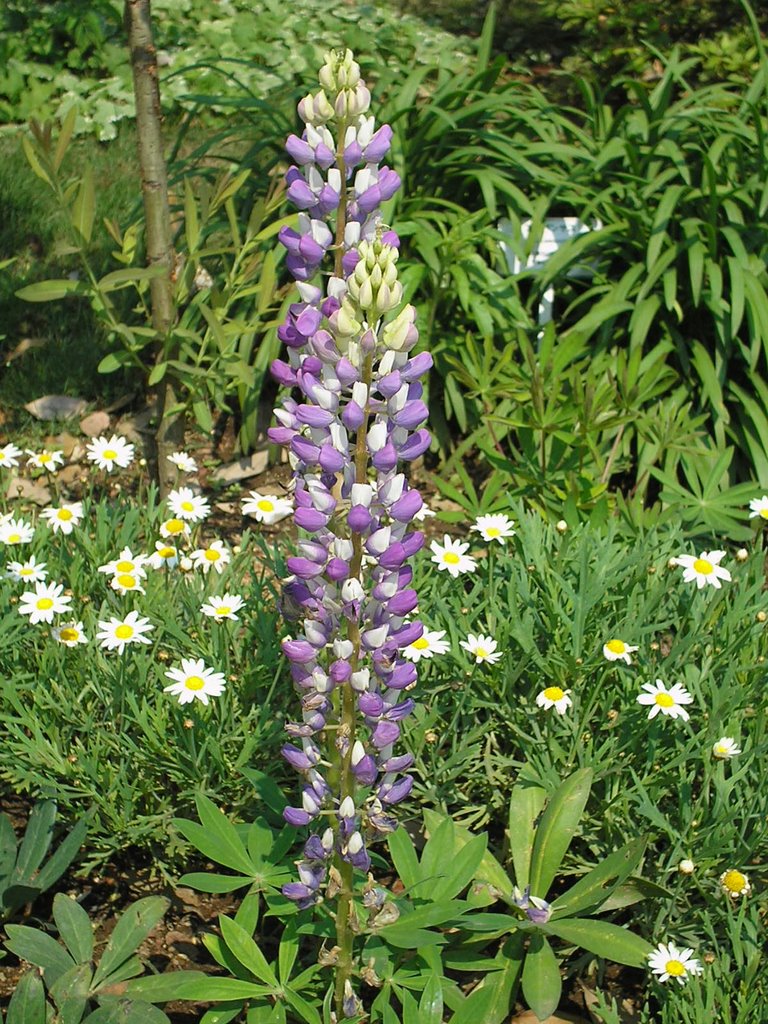
上り藤 noborifuji ‘ascending wisteria’ – Although we missed the hanging wisteria, we discovered another plant still in bloom whose nickname in Japanese is ‘ascending wisteria’: lupines, also called ルピナス, rupinasu (pictured above). I remember first reading about lupines while devouring a lot of Steinbeck during language school in Monterey, California, but had never really studied them up close, and had certainly never compared them to wisteria.

石楠花 shakunage ‘rhododendron’ – When I checked the labels and read their name in kanji, it took me a good while to figure out that what seemed to be seki+nan+ka ‘stone+camphor+flower’ was actually read shaku+na+ge and meant ‘rhododendron‘. That’s why plant identification labels in Japan usually render the names in katakana.

つるバラ tsurubara ‘rambling rose’ – When we first encountered a long hedgerow with trellises, the flowers didn’t look like roses, but a nearby label identified them as tsurubara カクテル (kakuteru, ‘cocktail’ probably meaning ‘hybrid’). The flowers looked a bit like John Cabot explorer roses, but with golden centers. They turned out to be just one of the varieties of rambling roses (or climbing roses) on display in the park.

Leave a comment

Filed under Japan, language

Wordcatcher Tales: Akagane, Shinsui, Kougai

Two Saturdays ago, the Outliers rode the full length of the Watarase Ravine/Valley Railway (渡良瀬渓谷鉄道) in order to hike to the headwaters of the Watarase River (渡良瀬川), which runs right past our apartment in Ashikaga on its way to join the Tone River (利根川) and eventually the Edo River (江戸川) above Tokyo. We had long been impressed by the combination of public parks, levees, and other flood control measures along the river, and were aware of the devastating floods caused by Typhoon Catherine in 1947 (followed by Ion in 1948 and Kitty in 1949). But we were blissfully unaware of the river’s earlier, manmade disasters.

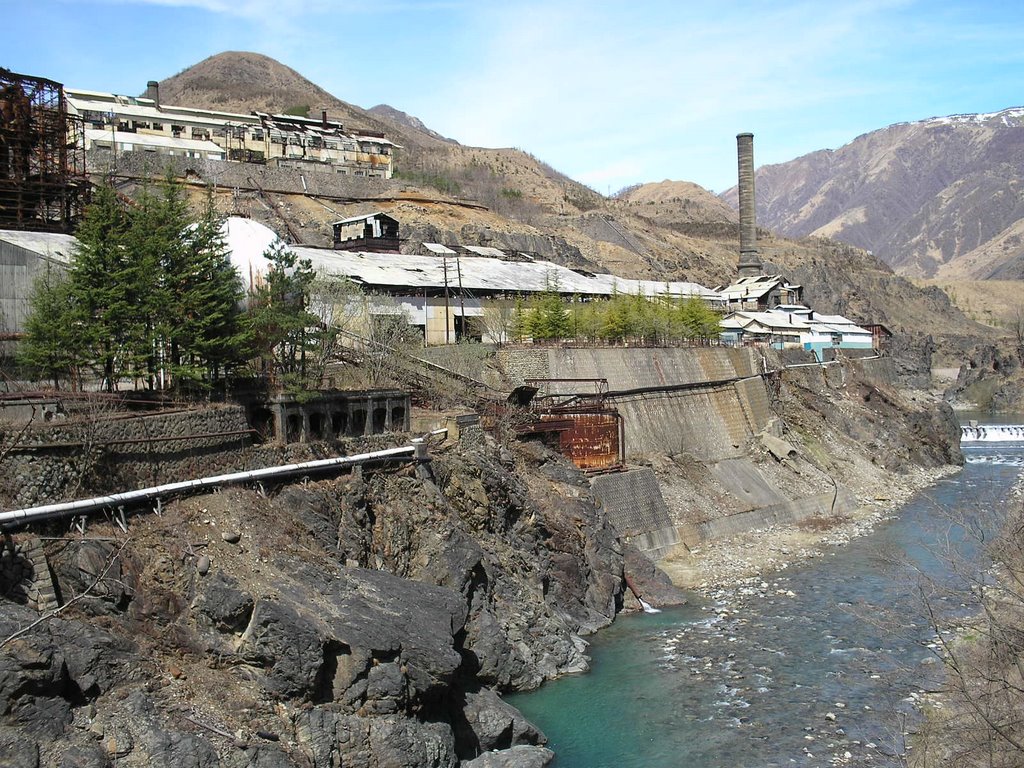
Our destination was the Akagane Water Control Park (銅親水公園 Akagane Shinsui Kouen)—billed as Japan’s “Grand Canyon”—about a one-hour walk from the end of the tracks, which start from Kiryuu (桐生 < kiri ‘paulownia’ + u birth’?) along the eastern edge of Gunma Prefecture, and end at Matou (間藤 ‘room wisteria’?) in the Ashio (足尾 ‘leg tail’) region of what was once Tochigi Prefecture’s wild west (its Butte, Montana, in fact), but has just been incorporated into Nikko City, renowned for its tourist industry, not for its copper mines.

First the tale of the words, then the tale of the tailings.

akagane (lit. ‘red metal’) ‘copper, bronze’ is more commonly read in its Sino-Japanese pronunciation dou, as in 銅山 douzan ‘copper lode (= mountain)’, 銅線 dousen ‘copper wire’, or 銅器時代 doukijidai ‘Bronze (Utensil) Age’. Nevertheless, tourist maps almost always either spell the name in hiragana or gloss the Chinese character with its native Japanese reading—in both cases: あかがね.

親水 shinsui (lit. ‘parent water’) would seem a pretty good match for English ‘headwaters’, but I couldn’t find the compound in my New Nelson kanji dictionary. Worse yet, my Canon Wordtank Daijirin defines it as ‘affinity (親和性 shinwasei) or intimacy (親しみ shitashimi) with water’, but then offers the prosaic 疎水 sosui ‘drainage canal’ as an alternate. A Japanese ecology word site gives a whole plethora of usage ranging from ‘water encounter’ to ‘drainage ditch’ to ‘water projects’.

公害 kougai (lit. ‘public damage’) ‘industrial pollution’ is a more historically justifiable head noun for this compound than 公園 kouen ‘public park’.

Kichiro Shoji and Masuro Sugai, two researchers at UN University in Japan, have published a detailed account of the rise and fall of the Ashio Copper Mine, parts of which are excerpted below to mark the 50th anniversary of the official recognition of Minamata mercury-poisoning disease, Japan’s worst case of postwar 公害.

In 1868, the newly established Meiji government of Japan made the modernization of the country by increasing military strength and expanding industrial production its first national priority. The government established a Department of Industry in 1870 and came to control all industries other than the military. On the basis of land taxes, this new department took the initiative in starting new industries, and looking after private enterprise until the department was disbanded in 1885. The work that the department had done was to introduce new technologies and machines from the advanced capitalist countries and also to invite technicians to Japan to provide new industrial production models and technologies.

Related industrial laws were established and, by 1877, mining, financed by private capital, had grown rapidly. Copper was especially important for the new government, because its exports brought in much-needed foreign money. The demand for copper overseas supported the copper industry in Japan. As table 1.1 indicates, most of the copper produced in Japan was exported. Copper earned 9.5 per cent of Japan’s export earnings in 1890 and through this Japan became established as a world-level copper producer. The earnings were used to purchase mining equipment, military weapons, and other industrial machinery. Copper played an important role in the development of Japan’s capitalism, and the main domestic copper producer was the Ashio copper mine.

The Ashio copper mine had been the property of the Tokugawa shogunate, and as such had produced 1,500 tons annually, which was the maximum possible output in the 1600s. However, this high output level had been dropping gradually. The mine was temporarily closed in 1800, but in 1871 it became a private operation, and finally in 1877 it came to be owned by Ichibei Furukawa. In 1881 a new but small lode of ore was discovered, followed by a much larger one in 1884, and, as indicated in table 1.2, copper production rose very rapidly as a result of these discoveries. In 1884, the production stood at 2,286 tons per year. Thus Ashio became the mine with the highest output in Japan, producing 68 per cent of the total output of Furukawa mines and 26 per cent of Japan’s production….

As indicated in figure 1.1, the discovery of the large copper ore lode caused all the trees surrounding it to die by the end of 1884. In August 1885. the use of a rock-crushing machine and a steam-operated pump in the Ani mine greatly increased production but led to massive fish kills in the Watarase River. In August 1890, when all modern technology systems had been installed, [a] flood occurred in the Watarase river basin, and 1,600 hectares of farmland and 28 towns and villages in Tochigi and Gunma prefectures were heavily damaged by the floodwater, which contained poisons from the Ashio mine.

In October 1890, Chugo Hayakawa led a movement against the mine and asked the prefectural hospital to do some tests for water-borne poisons. In December, the residents of Azuma Village, Tochigi Prefecture, appealed to the governor of the prefecture to call a halt to the mining operations at Ashio. This was the first of such appeals and of the movements against Ashio….

Essential to waging the Sino-Japanese War was an increase in iron and steel production. However, Japan’s smelting techniques were still immature. From 1896 to 1900, Japan could meet only about 50 per cent of its demand for iron, and one-twentieth of that for steel. As a result, it was absolutely essential that Japan import iron and steel. In this context, the importation of refining equipment, weapons, and other steel-fabricating machinery was greatly increased, and the foreign money earned by the copper-mine output played an important role in paying for these foreign goods….

In September 1896 a massive flood, larger than the one visited on the area in July of the same year, was caused by torrential rains, and the Watarase, the Tone, and the Edo overflowed their banks. One large city, five prefectures, twelve provinces, and 136 towns and villages over a total area of 46,723 hectares were damaged by the water-borne mine poisons. The loss sustained was about 23 million yen, which was eight times the annual income of the Ashio copper mine.

Because of the seriousness of the mine-related damage to the natural environment, [Tochigi Prefecture Diet member] Shozo Tanaka set up a mining damage office in the Unryu Temple of Watarase Village in Gunma Prefecture, and with other volunteers began to take action to end operations at the mine. He started by organizing people in the areas most heavily destroyed, suggesting to them that the farmlands in the flooded areas be exempted from national taxes.

This was the beginning of one of Japan’s first mass-based citizens’ movements….

The flood of 1898 did even worse damage to the surrounding areas because massive amounts of slag had been released from the sedimentation pond built by the mining company. In extreme anger and frustration, over 11,001) farmers started out for Tokyo 26 September for the third mass demonstration, with demands for reinforcement of the river banks, for the sparing of the poisoned areas from further insult and for a policy of support for the bankrupt local governments. They were confronted on the way by the police and military forces. However, some 2,500 succeeded in getting to Hogima Village, Minami Adachi Province, Tokyo.

Although Shozo Tanaka had been sick at the time, he went to meet the farmers and advised them to leave 50 representatives with him and go back to their villages. Tanaka pledged that if their demands were not met, he would fight to the death for their cause. In this manner Tanaka became the leader of the struggle against the copper mine and began to organize the farmers….

The Mainichi shimbun published a series of articles, written by women journalists, on the miseries brought about by the copper-mine poisonings. Related news articles on the struggles of the people were also printed, and the editorials took up the cause. On 30 November, Tameko Furukawa, the wife of Ichibei Furukawa, took her own life by drowning under the Kanda Bridge.

On the morning of 10 December 1901, when, after presiding at the opening of the sixteenth National Diet Upper House session, Emperor Meiji was going to his carriage, Tanaka came up to him, a written appeal in hand, shouting to him. By this action Tanaka had planned to bring the scandal of the mine poisonings into public view, hoping that one of the imperial guards would either kill or injure him. But in fact, the sergeant-at-arms fell from his horse, which had reared up in surprise, and Tanaka also stumbled and fell on his face, so he was neither killed nor injured. He was arrested on the spot and taken into custody by the police….

Tanaka’s appeal did not work as planned. but it astounded the public at large. Many people from different walks of life began to involve themselves in attempts to improve the terrible situation caused by the mine poisonings. On 27 December 1901, a trip to the poisoned areas was planned and about 800 students from 40 colleges, universities, and high schools joined it. They were deeply moved by the damage done to the environment, and so they organized movements designed to spread the news about the grim reality of the destruction and the need to help the farmers. This was the first of the numerous student movements that were to come.

Tomorrow Later, we’ll continue with more on the environmental effects of copper-mining.

Leave a comment

Filed under Japan, language

Wordcatcher Tales: Udo no Taiboku

うどの大木 udo no taiboku ‘all hat, no cattle’ – We tried out a new restaurant in Ashikaga the other night, after a long circuit to view the many lovely shidare-zakura ‘weeping cherry trees’ that line a long, curving, landscaped ditch that borders the city’s huge civic center athletic complex.

The seafood restaurant Yanagi-ya [柳屋 ‘willow shop’] turned out to be a haven for Hanshin Tiger and sumo fans in the area. It caught my eye last month when it advertised the sumo wrestler’s special chanko nabe on the first day of the Osaka Grand Sumo Tournament. Unfortunately, the chanko nabe season is over now that the weather has started to get warmer, but the various dishes we ordered were all nicely presented, and tasty to boot. Each glass of sake had the name of a sumo wrestler on it.

At one point, the waitress brought over a complimentary dish of tempura vegetables that looked like celery tops, but tasted less bitter than celery, more like asparagus. She identified it as うど, which my electronic dictionary identified only as ‘an udo (a plant of the ginseng family cultivated for its edible shoots)’. The University of Virginia Library’s Japanese Haiku Topical Dictionary page for spring plants is more helpful.

独活 【うど】 udo, udo [a wild asparagus-like plant, Aralia cordata, sometimes cultivated and noted for its edible young shoots] (late spring).
山独活 【やまうど】 yamaudo, mountain udo [a wild variety, noted for its pungency]
深山独活 【みやまうど】 miyama-udo, high-mountain udo [Aralia glabra, rare]
芽独活 【めうど】 meudo, sprouting udo / udo shoots

The Anime Companion Supplement U offers a different context.

udo うど or 独活 Aralia cordata. The leaves and stalks of this plant are eaten either raw or cooked. The flavor is similar to asparagus. The cultivated type is grown in the dark to blanch it. Wild udo is used in sansai ryôri (mountain vegetable cooking), as the flavor is stronger it must be blanched before it is used in dishes.
Anime:
Udo salad is one of the foods cherry mentions in the Urusei Yatsura TV series (Episode 36 story 59)
Maho buys udo from Tachikawa in MahoRomatic (ep.3) and pickles it.

Wikipedia includes udo in its surprisingly long list of English words of Japanese origin, defining it as ‘an edible plant found on the slopes of wooded embankments, also known as the Japanese Spikenard’.

Well, “Japanese spikenard” is not likely to be any more intelligible to most English speakers than the term “udo” itself, but here’s a derivative expression that has more familiar English parallels: うどの大木 udo no taiboku lit. ‘huge tree of udo’. (I had expected the pronunciation for 大木 to be daimoku but it seems to be taiboku in all contexts.) The Hoita Kokoro Center in Canada explains its meaning:

Just big man with nothing (lit. A huge udo tree) All bark and no bite or All hat and no cattle in English

Wikipedia explains further.

Despite its size, it is not a woody plant, as demonstrated in the popular saying Udo no taiboku (独活の大木), literally “great wood of udo”, meaning roughly useless as udo has a very soft stem.

1 Comment

Filed under Japan, language, sumo