
Category Archives: language

Bobkabata kabatabobbus et cetera

Scientists who name newly discovered species often name them after their mentors or colleagues, but some have more than a little bit of fun in the process. Take, for example, these two species of parasitic copepods:

Bobkabata kabatabobbus Hogans & Benz, 1990 (parasitic copepod) Named after parasitologist Bob Kabata [whose real given name is Zbigniew!].

Hoia hoi Avdeev & Kazatchenko, 1986 (parasitic copepod) Named after Ju-Shey Ho.

But sometimes they name new species after well-known figures of popular culture.

Funkotriplogynium iagobadius Seeman & Walter, 1997 (mite) from Iago, “James” and badius, “brown,” named after James Brown, the King of Funk.

Mastophora dizzydeani Eberhard, 1984 (spider) Named after a baseball player. The spider uses a sticky ball on the end of a thread to catch its prey.

Strigiphilus garylarsoni Clayton, ~1989 (owl louse) “I considered this an extreme honor. Besides, I knew no one was going to write and ask to name a new species of swan after me. You have to grab these opportunities when they come along.” – Gary Larson

Newly discovered species of dinosaurs seem to arouse extra large doses of taxonomic whimsy:

Dracorex hogwartsia Bakker et al. 2006 (pachycephalosaur dinosaur) Named for Hogwarts School of Harry Potter fame. The genus means “dragon king.” J. K. Rowling wrote, “I am absolutely thrilled to think that Hogwarts has made a small (claw?) mark upon the fascinating world of dinosaurs.” The skull is on display at the Children’s Museum of Indianapolis.

Drinker nisti Bakker et al., 1990 (ornithopod dinosaur) after the National Institute of Standards and Technology (of the U.S. Dept. of Commerce). “It’s the only dinosaur named after an arm of the federal government. Someday I’m going to name one after the I.R.S.” – Robert Bakker.

Qantassaurus Rich & Vickers-Rich, 1999 (Ornithopod dinosaur) Named after Qantas Airlines.

Quetzalcoatlus northropi Lawson, 1975 (Texas pterosaur) Named after an Aztec god and an aircraft designer. The pterosaur was as large as an ultra-light plane.

New strains of bacteria often seem to be discovered in labs, rather than in the field, and quite a few end up named after institutional acronyms.

Afipia (bacterium) after AFIP: Armed Force[s] Institute of Pathology.

Cedecea (bacterium) after CDC: Centers for Disease Control.

Desemzia (bacterium) after DSMZ: Deutsche Sammlung von Mikroorganismen und Zellkulturen.

These examples come to you courtesy of Mark Isaak, whose Curiosities of Biological Nomenclature is worth perusing at greater length—and multiple times.

And with that, I leave you to the fish genus Sayonara Jordan & Steele, 1906
Leave a comment

Filed under baseball, language, science

A Far Outlier Favorite Blogpost for the Year

I only recently discovered the fascinating blog Dumneazu, which follows threads of food, family, friends, and folklore wherever they lead across time and space, with plenty of photos from past and present. Its author is one of my favorite commenters on Language Hat. The Dumneazu blogpost on The Dwarf Jewish Theater of Maramures has got to be among the most far-outlying I’ve read all year. Here’s a taste.

There is an extensive wikipedia entry on the Ovitz Family. On arrival, the family members were selected by Dr. Jozef Mengele for genetic experiments. Thus it was that the Ovitz family, which in May 1944 arrived in Auschwitz together – seven dwarfs and the rest of their normal-sized family members – many of whom might have been murdered immediately had they arrived on their own, were not only spared the gas chambers, but were accorded special conditions which helped facilitate their survival. What’s more, they were able to convince the Nazis that their trusted family assistant and coachman Shimon Slomowitz, his wife and six children, as well as two additional neighbors from Rozavlea with no special connections to the family, were also relatives, and as such were allowed to join the Ovitz group. Incredibaly, the Ovitz’ were one of the only families to enter Auschwitz and survive intact, along with most of the other Maramures Jews whom they falsely claimed as relatives – thus attracting the protective umbrella of Mengele’s expermientation.

After the war, the Ovitz family settled in Haifa in the newly established state of Israel, where they called themselves the Seven Dwarfs of Auschwitz and began touring. Their bittersweet cabaret was an enormous success. When they retired they had enough money to buy two cinemas, a café and a large flat where they lived together. the last surviving member of the family troupe, Perla Ovitz, died in 2001 in Haifa after revealing her amazing story to Israeli journalists Koren and Negev. “If I was a healthy Jewish girl, one meter seventy tall, I would have been gassed like the hundreds of thousands of other Jews in my country. So if I ever wondered why I was born a dwarf, my answer would have to be that my handicap, my deformity, was God’s only way to keep me alive.”

I’m a little puzzled by the blogname Dumneazu. When you google it, Google asks whether you might have meant Dumnezeu, lit. ‘Lord God’. Perhaps it’s a dialectal variant.

Whatever it may be, it provides me a good excuse to disquire a bit about Romanian deferential pronouns. The nondeferential second person singular, of course, is the familiar tu. The polite second person singular is dumneavoastră (often abbreviated d-vă), lit. ‘your (plural) lordship’. The “officious” second person singular is dumneata (d-ta), lit. ‘your (singular) lordship’. (The officious second person is the one they taught us at the Defense Language Institute in Monterey—presumably suitable for interrogating people from a position of authority.) There’s even a set of polite third person equivalents: dumnealui (d-lui) ‘his lordship’ and dumneaei (d-ei) ‘her ladyship’.

UPDATE: The blogger himself clarifies the mystery in the comments:

The name Dumneazu is a dialect variant – it is actually the nickname of a friend of mine who is the lead fiddler – the primas – of a Gypsy band in Transylvania. Everybody in the band does exactly what he tells them to do, hence the nickname. In the Transylvanian dialect that they use in Maramures, and even stronger in Moldavia, the -e sounds often get elided into -ye sounds. Pe mine becomes pe minye, etc. In the Boyash (Rudari who speak Romanian, having lost Romani) gypsy dialect of Romanian spoken in Hungary and Croatia the interesting written (mostly used for song lyrics) form – mnye – is used.

Leave a comment

Filed under Israel, language, Romania

No-Sword on the Kanji of the Year

Matt the language blogger of No-sword offers some etymological insights into Japan’s Kanji of the Year, 命 inochi ‘life’. Here’s a snippet.

Probably the most interesting way 命 can be used is to write mikoto, which is the “highness” (as in “your”) that I mentioned above. “Highness” is, obviously, a gross translation that takes the cultural context out back and breaks its kneecaps; the word mikoto is from /mi/ (honorific) + /koto/ (“word”) and was first used to refer respectfully to what gods and emperors said, or did, or were — the distinction was not always clear-cut, as is often the case with gods and emperors*. In any case, that is why everyone who’s anyone in Japanese mythology has a name ending in -no-Mikoto.

Leave a comment

Filed under Japan, language

Wordcatcher Tales: Ha‘i, Puana

Listening the other night to the incomparable Auntie Genoa Keawe singing a Hawaiian song in a style often called female falsetto, I got curious about two things: the possible distinctive features of Hawaiian falsetto, and the exact meaning of a phrase that is ubiquitous in Hawaiian-language songs: Ha‘ina ‘ia mai ana ka puana. So I looked both of them up.

Ha‘i ‘break, snap’ – Honolulu Star-Bulletin music critic John Berger explains it in an April 2002 story headlined That LeAnn Rimes yodel translates to Hawaiian ha‘i.

First, about ha’i. The relevant translation relates to a style in which singers voice a break when moving between their lower register (“chest voice”) and upper register (“head voice”). Hawaiian falsetto singers use this technique to emphasize or add emotional intensity to a phrase or passage, whereas traditional European-American falsetto singers try to eliminate any hint of it.

“When I was studying musical theory (in college), my voice teacher and I spent five years trying to smooth that break out,” [Amy Hanaiali’i] Gilliom said.

Certain women, like LeAnn Rimes, sing ha’i, she said, singing a few bars of Rimes’ hit “Blue” to prove her point.

Keawe agreed. “I’ve heard that recording and I hear her singing, and she sings like us with the ha’i. You can sing ha’i in any language.”

Puana ‘refrain, theme, or keynote of a song’ – Puana is the key word in the phrase, Ha‘ina ‘ia mai ana ka puana. Pukui & Elbert’s Hawaiian Dictionary (1986) defines puana thus:

Attack or beginning of a song; in music, the tonic or keynote; to begin a song; summary refrain, as of a song, usually at or near the beginning of a song; theme of a song.

The whole phrase is rather awkwardly translated as

tell the summary refrain (this line followed by the refrain is at the end of many songs or precedes the name of the person in whose honor the song was composed).

Leave a comment

Filed under Hawai'i, language

New Favorite Nautical Term: Tumblehome

I recently scored for a pittance–I’d like to say two pieces of eight–a castaway copy of a gem of a book, The Encyclopedia of Ships, in which I’ve been browsing around during lunchtime at work. I’ve always been intrigued by ships and sea tales and nautical terminology, but this book taught me a lovely old English term not found in abbreviated dictionaries: tumblehome, a word that fairly tumbles off the tongue, as if invented by A. A. Milne or J.R.R. Tolkien. Does anyone know the French, Dutch, Portuguese, or Japanese equivalent? It describes the inward curve of a ship’s side above the waterline, at one time designed to make room for projections at deck level to clear the wharf, or to make boats easier to paddle, but also found in vessels like submarines designed to slice through the waves rather than ride over them. Its opposite is the V-shaped flare hull, like the bow of an aircraft carrier.

Another opposition of historical interest is that between clinker (or lapstrake) and carvel (or strip) planking in hulls, the former typical of northern Europe (like Viking ships), the latter spreading north from Iberia.

In the form that we would recognize it, [“carvel”] first appears in northern European languages to describe flush planking in the late 14th/early 15th century, at the same time that Iberian caravelas started visiting northern ports on a regular basis. When northern shipwrights started building ships with flush planks (c. 1430-1440) they referred to the new ships as “carvel-built” or just as “carvels” (or its equivalents). The Dutch “karviel-nagels” … are derived this way. In late medieval Dutch, “karviel” or “karveel” referred to boats built in this new way, and was the same word applied to ships coming from Portugal or Britanny with salt and wine. It may have entered English via the Dutch, but the origin is ultimately the small seagoing craft of the Iberian coast.

On the matter of clinker planking, it is almost always caulked, either with tarred animal hair or moss. In Nordic ships, the caulking (usually hair) is laid into a groove in the seam when the planks are assembled, while in cogs and other Low German craft, the caulking is driven into the interior side of the seam, above the nails (there is a relatively wide overlap).

One reason that clinker was abandoned for large vessels in favor of carvel was purely a matter of expense. Eliminating the thousands of clinker nails (rivets) reduced the expense considerably. Something like 20% of the material cost of a cog (which only had clinker sides) was in the iron for it, mostly clinker nails, according to building accounts from the Netherlands in the late 1200s. Wood could also be used more efficiently, as carvel construction did not depend on such high quality wood and it could be more efficiently sawn from the log into plank. Not to mention the savings in labor from not having to drill and drive all the clinker nails. In boatbuilding practice, fitting clinker planks is not appreciably harder or more time-consuming than it is in carvel construction – the total amount of contact surface is about the same – and most of the other tasks are about the same in terms of time and difficulty, but eliminating the rivets saves a great deal in material and labor cost. These savings were more dramatic in larger vessels, and so it is no surprise that carvel construction first took hold in big ships and then trickled down to smaller craft. In Norway, clinker continued in use in bigger vessels until the early 20th century, when it became clear that it was not compatible with diesel engine power (rivets don’t take the vibration so well).

Reader Aidan Kehoe notes that the French term for tumblehome is encabanement. Language Hat has further discussion.

1 Comment

Filed under language

Wordcatcher Tales: Poi-sute

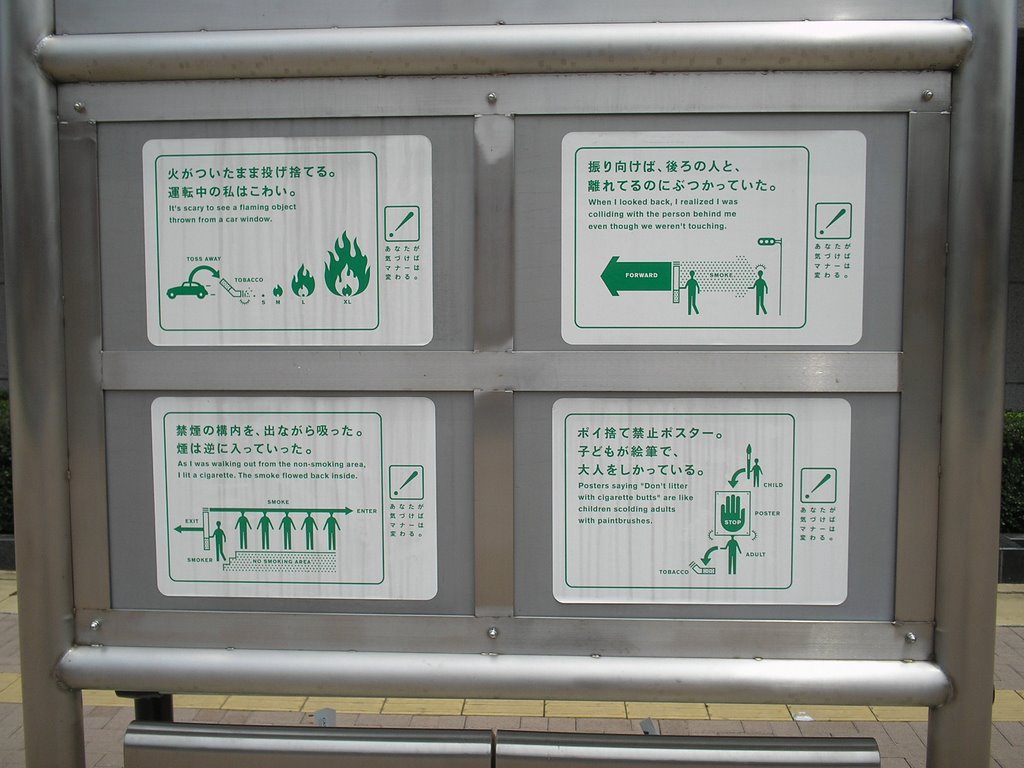
For all the sign-deciphering I did during my months in Japan earlier this year, I’m surprised how long it took me to notice “No littering” signs, which are often rendered in a katakana + kanji combination: ポイ捨て禁止 poi-sute kinshi ‘casual-discard forbidden’. The verb 捨てる suteru means ‘to throw away, discard’ as in the famous legend of Obasuteyama, a mountain where old women were left to die after outliving their usefulness. (I’m not sure if the men were left on a separate Ojisuteyama.) And ぽいと poi-to means ‘casually throwing or discarding something’ (according to my electronic Super Daijirin).

The photo above shows a set of four bilingual anti-smoking signs that can be found in many train stations in Japan. The English version of the sign on the bottom right says, Posters saying “Don’t litter with cigarette butts” are like children scolding adults with paintbrushes. It must be a Zen koan of an advanced type that exceeds my level of enlightenment, because I don’t quite get the point.

Leave a comment

Filed under Japan, language

Wordcatcher Tales: Nakayama > Zhongshan

In 1987–88, the Far Outliers spent a year teaching English at newly founded Sunwen College in Zhongshan City, Guangdong Province, China, about an hour by car north of Macao, which at that time was still a Portuguese colony. Our daughter, who was two at the time, learned to recognize the Chinese characters 中山市 (Zhongshanshi), which were ubiquitous on vehicles and signs around the city. (The photo shows her with the principal of her preschool, who was also the auntie of one of our students—otherwise they wouldn’t have taken her. They didn’t realize until too late that she was a year younger than the others in her class.)

We soon came to realize that hardly anyone in China recognized the Cantonese name Sun Yat-sen (孫逸仙), whose famous bearer is known throughout China as Sun Zhongshan (孙中山). The name of the college, Sunwen (孙文) was the same man’s “school name” (学名 xuémíng, informally 大名 dàmíng ‘big name’), the name he signed on official documents. The man had a lot of names.

What I didn’t realize until just recently was that the name by which he is known in China derives from the alias he used in Japan—and not vice versa—at least according to Wikipedia:

In 1897, Sun Yat-sen arrived in Japan, and when he went to a hotel he had to register his name. Desiring to remain hidden from Japanese authorities, his friend wrote down the Japanese family name Nakayama (中山) on the register for him, and Sun Yat-sen chose the given name Shō (樵).

Allegedly, on their way to the hotel they had passed by the Palace of Marquis Nakayama (family home of the Meiji Emperor’s mother) near Hibiya Park in central Tokyo, and so his friend chose the family name which they had seen hanging at the door of the palace.

For the most part of his stay in Japan, he was known as Nakayama Shō (中山樵). The kanji for Nakayama can be read in Chinese as Zhōngshān.

And now you can find universities, roads, and parks named for Zhongshan all over China and Taiwan (thanks to the imperialism of Japanese aliases, or the anti-imperialism of the alias holder, or something).

PS: Our daughter, whose first preschool was Zhongshan No. 2 Preschool (中山第二幼儿园) in Sun Yat-sen’s hometown, later graduated from Sun Yat-sen’s alma mater in Honolulu.

Leave a comment

Filed under China, Japan, language

Wordcatcher Tales: Kimoi, Muzui, Mendoi, Omoroi, Uzai

Over dinner recently, the Far Outliers were talking about ways to describe food with a visiting Japanese college student (the niece of old friends) here for a bit of English immersion. The only Japanese equivalent for gross or yucky that came readily to mind was kimochi warui ‘unpleasant feeling’, which she shortened to kimoi.

(“Kimochi warui” is how my feistiest niece’s kindergarten classmates in Japan described her blue Irish eyes. “Your blue eyes give me the willies!” She always fought back when teased or excluded—and still does to this day.)

When I googled “kimoi”, I found an interesting set of similar terms on the sci.lang.japan FAQ wiki.

  • kimochi warui ‘feeling bad/unpleasant’
  • muzukashii ‘difficult’
  • mendoo kusai ‘troublesome’ (lit. ‘stinking of trouble’)
  • omoshiroi ‘interesting, funny’ (written ‘whitefaced’)

I don’t think you can describe these shortenings in strictly mechanical terms, especially when you include the final member of the set: uzai for urusai ‘noisy, aggressive, bossy’. (“Urusai!” is what people yell at loud revellers to tell them to pipe down.) In the other cases, the shortening rule seems to be to keep just enough syllables (or moras) to turn the compound into what sounds like a one-word adjective ending in -i in the present tense and -katta in the past. I suspect omoroshiroi ‘interesting’ would have ended up omoi were it not for the inconvenient homophone omoi ‘heavy’.

Mezurashii (‘strange, curious’), ne?

UPDATE: Two commenters who are far more kuwashii than me on Japanese have suggested that uzai is most likely short for uzattai, not urusai. That makes the shortening look a little more regular.

Leave a comment

Filed under Japan, language

The Importance of Not Being Earnest

At the most basic level, an underlying rule in all English conversation is the proscription of ‘earnestness’. Although we may not have a monopoly on humour, or even on irony, the English are probably more acutely sensitive than any other nation to the distinction between ‘serious’ and ‘solemn’, between ‘sincerity’ and ‘earnestness’.

This distinction is crucial to any kind of understanding of Englishness. I cannot emphasize this strongly enough: if you are not able to grasp these subtle but vital differences, you will never understand the English – and even if you speak the language fluently, you will never feel or appear entirely at home in conversation with the English. Your English may be impeccable, but your behavioural ‘grammar’ will be full of glaring errors.

Once you have become sufficiently sensitized to these distinctions, the Importance of Not Being Earnest rule is really quite simple. Seriousness is acceptable, solemnity is prohibited. Sincerity is allowed, earnestness is strictly forbidden. Pomposity and self-importance are outlawed. Serious matters can be spoken of seriously, but one must never take oneself too seriously. The ability to laugh at ourselves, although it may be rooted in a form of arrogance, is one of the more endearing characteristics of the English. (At least, I hope I am right about this: if I have overestimated our ability to laugh at ourselves, this book will be rather unpopular.)

To take a deliberately extreme example, the kind of hand-on-heart, gushing earnestness and pompous, Bible-thumping solemnity favoured by almost all American politicians would never win a single vote in this country – we watch these speeches on our news programmes with a kind of smugly detached amusement, wondering how the cheering crowds can possibly be so credulous as to fall for this sort of nonsense. When we are not feeling smugly amused, we are cringing with vicarious embarrassment: how can these politicians bring themselves to utter such shamefully earnest platitudes, in such ludicrously solemn tones? We expect politicians to speak largely in platitudes, of course – ours are no different in this respect – it is the earnestness that makes us wince. The same goes for the gushy, tearful acceptance speeches of American actors at the Oscars and other awards ceremonies, to which English television viewers across the country all respond with the same finger-down-throat ‘I’m going to be sick’ gesture. You will rarely see English Oscar-winners indulging in these heart-on-sleeve displays – their speeches tend to be either short and dignified or self-deprecatingly humorous, and even so they nearly always manage to look uncomfortable and embarrassed. Any English thespian who dares to break these unwritten rules is ridiculed and dismissed as a ‘luvvie’.

And Americans, although among the easiest to scoff at, are by no means the only targets of our cynical censure. The sentimental patriotism of leaders and the portentous earnestness of writers, artists, actors, musicians, pundits and other public figures of all nations are treated with equal derision and disdain by the English, who can spot the slightest hint of self-importance at twenty paces, even on a grainy television picture and in a language we don’t understand. [Unless, of course, it’s ideologically appealing self-important revolutionary sentimentalism from the lesser regions of the former empire, about which we remain sincerely, but just short of earnestly, laden with guilt.–J.]

SOURCE: Watching the English: The Hidden Rules of English Behavior, by Kate Fox (Hodder, 2004), pp. 62-63

When I was a teenage thespian, I played the part of Lane the manservant (and understudied for Merriman the butler) in a high school production of The Importance of Being Earnest. The last exchange before Lane makes his final exit is much quoted.

ALGERNON: I hope to-morrow will be a fine day, Lane.

LANE: It never is, sir.

ALGERNON: Lane, you’re a perfect pessimist.

LANE: I do my best to give satisfaction, sir.

Leave a comment

Filed under England, language

The English Shipping Forecast Ritual

Our peculiar affection for our weather finds its most eloquent expression in our attitude towards a quintessentially English national institution: the Shipping Forecast. Browsing in a seaside bookshop recently, I came across an attractive large-format picture-book, with a seascape on the cover, entitled Rain Later, Good. It struck me that almost all English people would immediately recognize this odd, apparently meaningless or even contradictory phrase as part of the arcane, evocative and somehow deeply soothing meteorological mantra, broadcast immediately after the news on BBC Radio 4.

The Shipping Forecast is an off-shore weather forecast, with additional information about wind-strength and visibility, for the fishing vessels, pleasure craft and cargo ships in the seas around the British isles. None of the information is of the slightest use or relevance to the millions of non-seafarers who listen to it, but listen we do, religiously, mesmerized by the calm, cadenced, familiar recitation of lists of names of sea areas, followed by wind information, then weather, then visibility – but with the qualifying words (wind, weather, visibility) left out, so it sounds like this: ‘Viking, North Utsire, South Utsire, Fisher, Dogger, German Bight. Westerly or southwesterly three or four, increasing five in north later. Rain later. Good becoming moderate, occasionally poor. Faroes, Fair Isle, Cromarty, Forties, Forth. Northerly backing westerly three or four, increasing six later. Showers. Good.’ And so on, and on, in measured, unemotional tones, until all of the thirty-one sea areas have been covered – and millions of English listeners,* most of whom have no idea where any of these places are, or what the words and numbers mean, finally switch off their radios, feeling strangely comforted and even uplifted by what the poet Sean Street has called the Shipping Forecast’s ‘cold poetry of information’.

* Not just the nostalgic older generations: the Shipping Forecast has many young devotees, and references to the Shipping Forecast have recently turned up in the lyrics of pop songs. I met a 19-year-old barman recently with a dog named Cromarty, after one of the sea areas.

SOURCE: Watching the English: The Hidden Rules of English Behavior, by Kate Fox (Hodder, 2004), pp. 34-35 (For what it’s worth, George Walden in New Statesman hated the book.)

What better way for this American to mark July 4th than to take a light look at my heritage, which is mostly English – with all the reticence and clumsy ritual that implies – although the soothing weather incantation I grew up with was hare, tokidoki kumori ‘clear, occasionally overcast’.

Leave a comment

Filed under England, language