Category Archives: Korea

What the Marmot Did on His Summer Vacation

During August, the Marmot came out of his hole and visited the remnants of Japanese colonial architecture in Gunsan, Korea, adding enough photos and commentary to overload his host provider.

Meanwhile, the Mutant Frog Travelogue visited the foreigners’ cemetery in Hakodate, Japan, one of the first treaty ports opened to foreign trade after Commodore Perry broke a hole in the Tokugawa fence against the outside world.

Leave a comment

Filed under Korea

Wandering Russian Camera in North Korea

Russian photographer Peter Sobolev has posted a lengthy travelogue about North Korea, with commentary translated into English by Pavel Sokolov. You’ll have to go there to see the photos, but here is a sample of the commentary.

While Chinese tourists could be recognized by the large number of people in the groups, the Japanese are recognizable in the same way the Americans are in Russia – loud talking, gesticulation….

As a rule, about half the food is very spicy. I.e. it burns so much that it is impossible to eat. Especially prevalent are Kim-Chi – some kind of vegetables with spices. Naturally everyone eats with chopsticks. I used to think that wooden chopsticks were hard to eat with. Boy, was I wrong! : The wooden ones at least catch onto the food, as opposed to the metal ones. However, by the end of the trip I was able to use the metal ones quite well. Although I wasn’t holding them quite right (I couldn’t hold them the way the [tourguide] girls did). Then, forks are handed out as well.

The food hardest too eat is the local noodles. They are very long, sticky, and cooked to form some type of a clot. Before you eat it, you need to break up the clot with the chopsticks (which supposes being good with them). Even after that, when you try to pick up some of the noodles, the rest of them try to follow :)…

Machines typical for village – GAZ (probably made in Northern Korea, not in Russia) and a lorry – with gas generator.

This car works with firewood, but I have to underline, that it’s NOT a steam machine, but GAS-generator (Usual internal combustion engine, just re-made). It’s not gasoline, of course, so the max speed is about 20-30 km per hour.

The firewood (at the right) are prepared for lorry. They’re put by portions into the can (is seen in the back of a lorry) and slowly burn there.

We’ve seen such machines about five times in general….

The interesting fact – in Russia the local rivers usually have their names and the bridges have not. But here is the opposite situation.

There’s a name of bridge aon the stone and also a date when it was built (1974). And the river is nameless.

via the Marmot, who linked to another long Russian photo essay from the countryside, with commentary in Russian.

Leave a comment

Filed under Korea

Wordcatcher Tales: Imari, Potters, and Abduction

Recently the Far Outliers finally got around to visiting one of Ashikaga City’s principal tourist attractions, the Kurita Museum near the Flower Park, both of which lie in the outlying town of Tomita, one JR train stop to the east.

The beautiful Kurita Museum grounds house not only one of the finest and largest collections of Imari and Nabeshima porcelain (磁器 jiki) in the world, they also include exhibits of international archaeological finds and pottery-making techniques, a climbing kiln (登り窯 noborigama, as opposed to the single-chamber 穴釜 anagama), gift and snack shops, and an off-limits working potters’ village. The Sushi and Maple Syrup blogger has posted a lot of photos from a weekend visit to the Museum (and Ashikaga Gakko) last year.

伊萬里 (or 伊万里) Imari – My sources seem to indicate that Imari is one subset of Arita ware and Nabeshima is another. They were all manufactured in Arita (有田), in Saga Prefecture in northwest Kyushu. Imari is the port (near Hirado in neighboring Nagasaki Prefecture) from which export varieties were shipped, and Nabeshima (鍋島 ‘Pot Island’) is the name of the Saga domain lords who controlled production, guarded secrets, and commissioned works of the highest quality for their peers in Japan.

As porcelain grew in popularity, the Nabeshima Clan took steps to keep their production and decorating techniques a closely guarded secret. They were aided in this effort by the Tokugawa Shogunate and other feudal lords, who commissioned the Nabeshima Clan to make porcelain for only the elite classes — the sale of Nabeshima ware to commoners was actually forbidden, and the number of kilns and wheels was strictily limited by law.

無名陶工 Mumei toukou ‘Unnamed potters’ – The highest point on the grounds of the Kurita Museum is a memorial hall dedicated to all the unknown potters whose work Mr. Kurita so obviously cherishes. Unfortunately, Mr. Kurita’s flowery words of appreciation fail to note that the first of these potters were Korean, and that at least one went by the name Ri Sampei in Japanese (李参平, 1579-1655).

In the early 1600s, Nabeshima Naoshige, the feudal lord of the Sage [sic] Clan, brought a group of Korean potters to Japan, including the potter Risampei, who in 1616 discovered a superior white-stoned clay at Izumiyama (Izumi Mountain, Arita). Wares fired with this earth are called “hakuji” (white porcelain …). Some say this was the beginning of Arita Ware.

拉致 ratchi or rachi ‘abduction’ – This word is much in the Japanese news these days as the government and individual citizens seek to determine the fate of various young people thought to have been abducted by North Korea in order to teach Japanese to North Korean spies. After failing to find the word (under either pronunciation variant) in my electronic dictionary, I had to resort to looking up the individual characters. The first kanji (拉, Sino-Japanese ratsu) is used to indicate the sound Ra as an abbreviation for Raten ‘Latin’ (which is usually written in katakana when spelled in full). But 拉 also appears in the native Japanese verb 拉ぐ hishigu ‘crush, smash, overpower’ and in the Sino-Japanese verb 拉っする rassuru ‘drag along; kidnap’. The second kanji, whose Sino-Japanese reading is chi, is used to write 致す itasu ‘do; send; cause; render (assistance); exert (oneself)’, as in どう致しまして dou itashimashite ‘what have I done (to deserve thanks)?’ (= ‘Not at all / Don’t mention it’).

The Japanese arts website bleu et blanc provides a succinct account of the role of international supply and demand in the early history of Imari ware. (“Blue-and-white” is the English epithet for 染付け sometsuke porcelain. Literally, it means ‘dye added’ but the default coloring agent for porcelain was cobalt, just as the default dye for textiles was indigo, which I recently heard is also effective as an insect repellent.)

Porcelain was first fired in Hizen province of Northern Kyushu in the early 17th century by Korean potters, and most likely by the potter named Ri Sanpei, who was brought to Japan by Toyotomi Hideyoshi in his second invasion of Korea in 1597.

Early examples were somewhat primitive (but now highly prized) white or celadon toned wares, decorated with underglaze cobalt blue, until the 1640s when the first enamels were fired in red, green, blue, yellow, purple, and eventually gold; associated with the first enamels is the famous Sakaida Kakiemon (1596-1666). Before long Dutch traders aggressively sought to obtain Japanese porcelains, whose sources in China had been disrupted due to political turmoil [the fall of the Ming and rise of the Qing dynasties]; they quickly turned to Arita to provide for European demands. The first large order at Arita was placed by the VOC in 1653, and in a short time the area enjoyed prosperity as providers for the European elite, with export production reaching a peak in the 1680s, the beginning of Arita’s “golden age.”

While market demand continued for some time into the 18th century, Arita could not compete with China, who from a near cessation of operations in the 17th century, rebounded in the 18th century. The last official order from the VOC in 1759 was for three hundred pieces, and the VOC itself was dissolved in 1799.

Simultaneously, and more substantially, Arita provided for its own domestic market throughout its long history. Both style and form evolved parallel with artistic and cultural trends, and show the strong influence at different times of Japanese tea ceremony (chanoyu), Chinese ceramics, painting trends, and Chinese style tea ceremony (Sencha). Some of these domestic pieces were exported privately and incidentally to the West, however much of upper tier pieces were reserved for use by feudal lords and like members of society. Arita porcelains are remarkable for their rich variations in form, style and subjects.

POSTSCRIPT: To those who think I am suggesting a moral equivalence between contemporary North Korea and contemporary Japan, let me suggest a much better match, one between Kim Il Sung, would-be unifier of a fractured Korea, and Toyotomi Hideyoshi, successful unifier of a fractured Japan. That should irritate both Korean and Japanese nationalists.

Leave a comment

Filed under Japan, Korea, language

And in the Right Corner, Rikidozan, Representing …

Rikidozan was within striking distance of the top three ranks in all of sumo—sekiwake (junior champion), ozeki (champion), and yokozuna (grand champion)—ranks which were awarded by the Japan Sumo Association, the supreme governing body of the sport. But then Japan surrendered and the sport of the Emperor went into a tailspin….

As he started to feel the financial strain from his sport not turning a profit, Riki quit sumo and took a job in construction. His new employer was a tattooed yakuza gambler from the Sumiyoshi gang and sumo fan named Shinsaku Nita, who had special connection inside the [MacArthur’s] GHQ. Under Nita, Riki supervised construction projects at U.S. military camps, studied English in his spare time, and spent his evenings carousing on the Ginza, where one night he participated in a losing cabaret brawl that dramatically changed his life. His victorious opponent was a visiting Japanese-American Olympic weight lifting medalist and All-Hawaiian Body Building champion named Harold Sakata, who would later gain fame playing the steel-top-hat-flinging villain Oddjob in the James Bond movie Goldfinger.

In the wake of the altercation, the two men became friends and Sakata introduced Riki to a group of American professional wrestlers who were in Japan to promote growth of their “sport” in Japan. One thing led to another, and soon Rikidozan was training and wrestling in the States, where he proved to be more successful than anyone anticipated. Too unsophisticated to do anything more than fight all out, he combined karate chop attack with sumo thrusting techniques to compile a 295-5 record in a year’s worth of competition. Boxing Magazine ranked him in its annual list of the top ten pro wrestlers in the world.

Before departing for the United States in February 1952, Rikidozan had acquired Japanese citizenship and legally changed his name to Mitsuhiro Momota [from Kim Sin Rak]. The government family register now listed the Momotas of Nagasaki as his lawful parents and Omura his officially recognized birthplace. The move was necessary, in part, because his real country of birth was now known as the Communist People’s Republic of North Korea [sic] and was an avowed enemy of the United States. The only way he could get a visa to the United States was to have a Japanese passport. The only way he could get either one was to bury any trace of his true identity. But, as he discovered while wrestling in Honolulu, his first stop, there were other reasons to keep up the charade.

Billed as the “Japanese Tiger,” he found his every move cheered by an audience of almost exclusively Japanese-Americans, waving Rising Run flags and lustily yelling banzai.… For the man known as “Garlic Breath,” that must have indeed been hard to swallow. As were the taunts about Pearl harbor when he wrestled on the mainland, where the matches were racially charged in reverse. There, he found himself appearing alongside assorted Asians passing themselves off as Japanese with names like “Tojo” or “Mr. Moto,” wearing goatees and mustaches and exotic “Oriental” garb of red silk robes with high getas…. Demeaning as it may have been, the fans loved it and the economic lessons were obvious.

Thus, at the end of his U.S. hegira, Rikidozan returned to Japan and solicited support from Nita and others, including the ubiquitous [ultranationalist and head of the Japan Pro Wrestling Association Yoshio] Kodama, and launched his storybook career. It only worked, as Rikidozan well knew, because everyone viewed him as “Japanese.”…

The great Rikidozan deception reached its apogee in January 1963, when Rikidozan was sent to South Korea on a goodwill tour at the request of Kodama and the LDP to help break the ice that still existed between the ROK and Japan and thereby pave the way for the normalization treaty that so many interested parties wanted.

Despite intense anti-Japanese feelings in the ROK, where bitter memories of the long, brutal Japanese occupation and wartime atrocities remained, Rikidozan was a huge hero there. In fact, many Koreans had naturally assumed he was one of them because the Chinese ideographs for Rikidozan [力道山], although pronounced differently, represented the name of a mountain in Korea—a fact most people in Japan remained blissfully unaware of. (The name was subtle way by which Rikidozan could hang onto his identity.)

SOURCE: Tokyo Underworld: The Fast Times and Hard Life of an American Gangster in Japan, by Robert Whiting (Vintage, 2000), pp. 103-106

BTW, the names in this book are handled very sloppily. The index lists “Niita, Shinsaku, 104, 105” for what first appears as “Shinsasku Nita” on 104, and then “Nita” on 105 (and should have been “Shinsaku Nitta” and then “Nitta”). The index lists a trading company name as “Nishho Iwai, 182” for what first appears as “Nishho Iwai” on 182, then correctly as “Nissho Iwai” later in the same paragraph! In contrast, Jesse Kuhaulua‘s name is consistently misspelled both on p. 212 and in the index as Jesse Kualahula. I’m sure there are many more such errors in my copy, the 5th reprint of a new paperback edition published in 2000. I suppose Random House feels it’s good enough for the work of a journalist like Whiting.

UPDATE: Yikes. It gets worse. The index shows “Pyonyang, 107, 295” for what appears once on 107 as “Pyonyang” (where Rikidozan had an elder brother living at one time) and then appears once as “Pyonyang” at the top of 295, followed immediately by a coreferential “Pyongyang” in four successive sentences. The latter placename was apparently too obscure to rate its own spot in the index.

Leave a comment

Filed under Japan, Korea, sumo

Mound Tombs in Northern Japan

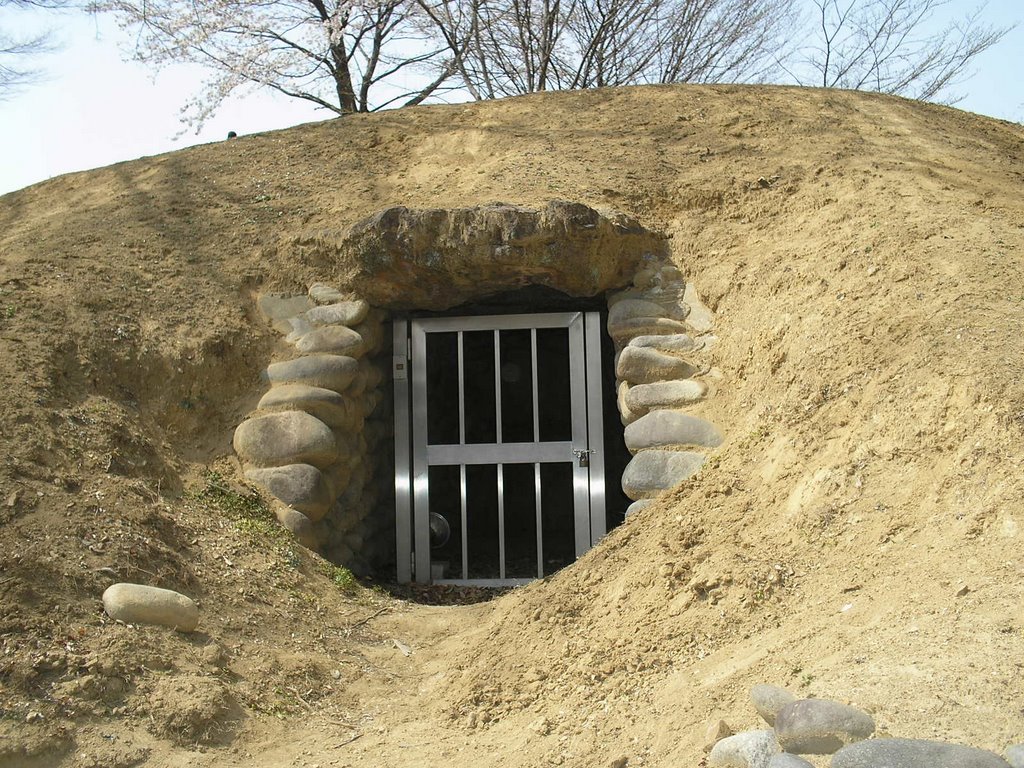
Before spending time in Ashikaga, I had not been aware how widespread in Japan were the mound tombs known as 古墳 kofun lit. ‘ancient grave’. When we walked over to Ashikaga Park to see the cherry blossoms there two weeks ago, we found that the hillside park includes 12 kofun, two of which have small, blocked-off, stone passageways facing east. (You would enter facing west.) I had always associated kofun with western Japan, where the largest imperial tombs were built, but an article on the Kofun Period (A.D. 300–700) by Sophia University archaeology professor Charles T. Keally set me straight.

  • The first excavation of a mound tomb in Japan was conducted my Mito (Tokugawa) Mitsukuni in 1692, the 5th year of the Genroku era. Mitsukuni (1628-1701) was the grandson of Tokugawa Ieyasu, founder of the Tokugawa Shogunate. The tomb he excavated is called the Samuraizuka Kofun, located in Ohtawara City, Tochigi Prefecture, just north of Tokyo. This excavation is considered the first academic, or scientific, excavation conducted in Japan.

Origins:
The origins of the Kofun Period mound tombs is clearly in the Yayoi Period, although ultimately continental influence might well be a factor, too. The most common Yayoi burials were in the ground in a square area delimited by a ditch or moat. The burial in the middle had a low mound over it. Toward the end of Yayoi, some of these ditches or moats became round. With higher mounds, these were the most common kofun tomb in the Kofun Period, but the burial was on top of the mound instead of under it. The square mounds, too, continued from Yayoi into Kofun, but these later ones also had the burial in the top of the mound instead of under it.

Forms:
The most distinctive mounds of the Kofun Period are the keyhole-shaped mounds, thought to be associated with the Imperial Family. This shape is uniquely Japanese and its origins are unknown. But Korean archaeologists recently have identified a few contemporary mound tombs in southeastern Korea that they say are also keyhole-shaped. Some people try to use these recent Korean finds to argue for a Korean origin of the keyhole-shaped mound tombs. But this fails to explain why this shape is rare in Korea and only recently recognized there through excavation, whereas this shape is common in Japan, obvious without excavation, and has been known for centuries….

Regions:
Mound tombs, especially the larger ones, tend to be located in clearly defined regions. Mound tombs are common in Kyushu only in the northwest, especially in the Chikugo River plain in Saga and southern Fukuoka prefectures. There is another such concentration of tombs in the eastern part of the Inland Sea in Okayama Prefecture on Honshu island and just across the water in Kagawa and Tokushima prefectures on Shikoku island. Similar concentrations are found in eastern Shimane Prefecture from Izumo to Matsue City on the Sea of Japan, in Nara and Kyoto prefectures, along the shores of Ise Bay from Nagoya to Ise, in Ishikawa Prefecture on the Sea of Japan, on the Kanto Plain in eastern Japan (especially in North Kanto), and on the Sendai Plain in northern Japan. There are smaller concentrations of tombs in Shizuoka Prefecture, and in the intermontane basins around Nagano, Yamagata and Kofu cities.

Archaeologists identify these concentrations with regional power centers, and they identify small clusters of tombs within these concentrations with the various clans known from later documents. In the north, keyhole-shaped mounds appeared in the Sendai Plain as early as the 5th century; the northern-most such tomb is in southern Iwate Prefecture. But most tombs in the northern regions are later. This northern region was the frontier with the Emishi barbarians who lived in northern Tohoku. Keyhole-shaped mound tombs are extremely rare in southern Kyushu, the home of the Hayato barbarians.

Ashikaga has always struck me as a city of Old Money, but I never thought it went back quite that far.

Leave a comment

Filed under Japan, Korea

Nature of Japanese Settlers in Korea

Andrei Lankov in The Korea Times profiles the early Japanese settlers in Korea.

Japanese newspapers and booklets made it clear that a move to Korea would be different from, say, migration to the United States (a very popular option in the Japan of the early 1900s). Those Japanese who moved to the United States could expect to find only low-level manual jobs. Those who chose Korea were to form the privileged colonial elite. As a book for prospective migrants frankly said: “In Korea one can carry on an independent enterprise with oneself as master, freely able to employ Koreans at low wages and tell them what to do”. A colonizer’s dream, indeed….

A majority of the Japanese migrants did not come from the privileged classes. For many a misfit adventures in a new colony looked like an attractive proposition. However, not all the newcomers were losers. In the 1900s and 1910s, Korea also was an attractive market for Japanese skilled labour. The Koreans provided cheap unskilled labour for a number of projects undertaken by the colonial administration, but they worked under supervision of the Japanese clerks and foremen. The number of Koreans who had modern technical skills was minimal, and the Japanese artisans and craftsmen enjoyed good wages. Around 1909, a shoemaker would earn on average 0.75 yen daily in Japan, but in Korea his average wage would be twice as high (about 1.4 yen) while the costs of living would be much less.

Most of those men were bachelors or moved to Korea without their families, so the country attracted a number of Japanese full and part-time prostitutes. In 1907 there were 4,253 women whose official occupation was politely described as ‘geishas’ or ‘waitresses’. Their arrival marked the introduction of the mass-oriented sex industry in Korea (for earlier Korean courtesans, known as kisaeng, did not perceive the sex-for-cash component as major part of their vocation ㅡ and their services, sexual or otherwise, were too expensive for the average commoner).

via The Marmot

Leave a comment

Filed under Korea

Bad Call Beats Japan in World Baseball Classic

New Japundit contributor Mike Plugh gives a rundown on the World Baseball Classic‘s badly umpired game between Japan and the U.S. in a post headlined If You Can’t Beat ’em, Cheat ’em.

Personally, I wouldn’t mind seeing Korea and Puerto Rico in the finals. Both are proven giant-killers.

UPDATE: Wow. Japan managed to defeat Korea pretty decisively in the semifinal. Canyon of Heroes has a good rundown. Now I have to root for Japan as the underdog against Cuba.

Leave a comment

Filed under Japan, Korea

Lee Seung-yeop Shows Up Ichiro in Baseball Classic

Ichiro’s trash-talking failed to intimidate South Korea in the first round of the World Baseball Classic.

Lee Seung-yeop hit a go-ahead, two-run homer in the eighth inning of a game that mattered little because both nations were assured of advancement….

Dae-Sung Koo, whose contract was sold last week by New York Mets to a South Korean club, pitched two scoreless innings of relief to get the victory as the South Koreans overcame a two-run deficit.

Chan Ho Park of the San Diego Padres pitched the ninth for the save. After he retired Suzuki for the final out, South Korean players ran on to the field and mobbed the pitcher.

South Korea (3-0) and Japan (2-1) will travel to Arizona for exhibition games against major league teams, then go to Anaheim, Calif., for the second round, to be played from March 12-16. Their second-round opponents will include the top two teams from Group B, which has the United States, Canada, Mexico and South Africa.

Lee, who holds the Asian record of 56 homers in a season, signed with the Yomiuri Giants in the offseason after spending the last two seasons with the Pacific League’s Chiba Lotte Marines. The game was played before a crowd of 40,353 in the Tokyo Dome, his new home ballpark.

via Lost Nomad, one of whose commenters adds more on the rivalry between Lee and Suzuki (Ichiro):

As a side note, the Korean 1st baseman who hit the game winning home run against Japan, sought a tryout with the Seattle Mariners in 2003. I believe this was the season after he set the Asian [home run] record. Keep in mind back then, the Mariners had 3 Japanese players and the majority ownership was the CEO of Nintendo. The Mariners never offered him the tryout.

He then went to Japan and signed with Lotte [managed by Bobby Valentine]; this past year Lotte winning the Japan’s version of the world series and having team high in [home runs]. How ironic.

Leave a comment

Filed under baseball, Japan, Korea

Shinto Shrines in Korea

From the Nakdong to the Yalu comes word that a few of the many Shinto shrines built by the Japanese in Korea are still intact.

I was researching a photo exhibit on the history of modern Korean architecture to be held at the Ilmin Museum of Art through April 16 when I came across a rather astonishing photograph of an intact Shinto shrine in Pohang. Having assumed, wrongly it would seem, that all of Korea’s Shinto shrines had been promptly destroyed upon Liberation, I was rather surprised to see some lived on, albeit in functions quite different from those for which they were intended.

As of June 1945, the Japanese had built over 1,000 Shinto shrines in Korea, including 77 jinja and two imperial jingu, including the massive Chosen-jingu, which the Japanese Government-General kindly plopped on the slopes of Namsan [in the middle of Seoul].

Leave a comment

Filed under Japan, Korea

Japanese Life in Changchun, Manchukuo, 1941

The grand Army Building on Changchun’s wide main street reflected the majestic appearance of the Japanese military, and the newly-completed Building of Justice displayed a degree of splendour unsurpassed even in their homeland. The area around the station resembled bustling Japanese streets, and the adjoining pleasure district of Yoshino was better even than similar areas at home. Department stores flourished and in the colourful streets one could find eating and drinking stalls and all sorts of entertainment. There was no better place to relax from the boredom of camp life and amuse themselves on a leisurely Sunday afternoon.

Nowhere outside Japan could one feel more proud of being a Japanese. In these grand buildings, power and prestige paired with a never-ending energy in the buoyant shopping streets full of Japanese. But as soon as one set foot in the squalid suburbs of the Manchurians, the poverty was appalling. Japan’s puppet state, Manchukuo, was still a long way from realising the North Asian slogan: “Harmony among the five families [Japan, China, Manchukuo, Taiwan, and Korea], the Kingly Way is paradise.”

SOURCE: Guns of February: Ordinary Japanese Soldiers’ Views of the Malayan Campaign & the Fall of Singapore 1941-42, by Henry Frei (Singapore U. Press, 2004), pp. 34-35

Leave a comment

Filed under China, Japan, Korea