Category Archives: Korea

Northeast Asian Maritime Trade Networks, 800-1000

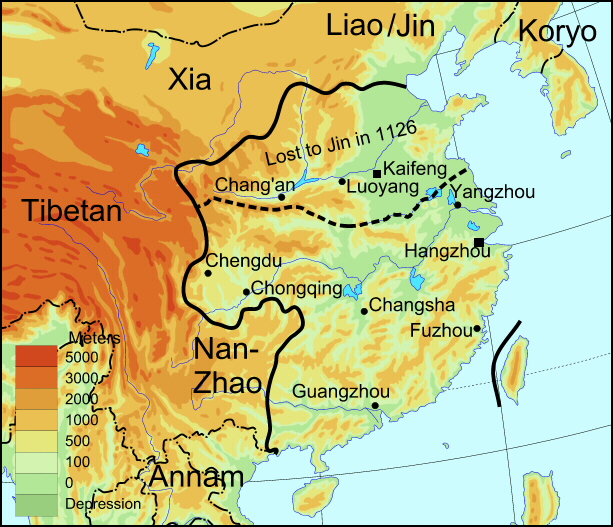
Maritime trade in East Asia began to flourish in the seventh and eighth centuries C.E. It was jump-started by Persian and Arab merchants, who traveled to and settled in ports as far from home as Guangzhou (Canton) in southern China. Later, commerce spread eastward and northward along the coast to Quanzhou, Fuzhou, Mingzhou (Ningbo), and finally Hangzhou, where merchants could gain access to the Chinese interior via the Grand Canal. Foreign trade thus became integrated to a certain extent with China’s domestic economy. Although pioneered by Arabs and Persians, this route soon fell under the domination of ethnic Chinese. Meanwhile, Korean merchants established their own trade networks connecting the west coast of Silla with Laizhou, Haizhou, and other ports in north China and entering the canal system through the mouth of the Huai River. In the early ninth century, semiautonomous communities of Korean traders were scattered along much of the north China littoral.

These northern routes were further extended to Japan under the direction of the Korean tycoon Chang Pogo. Chang himself is said to have visited Kyushu in 824 and met with the governor of Chikuzen, although the validity of this account has been questioned. In any case Chang, acting by authorization of the king of Silla, was in charge of maritime defenses at the Ch’ŏnghae garrison on Wan Island by the late 820s or early 830s. It is probably no coincidence that the first Japanese record of “Silla merchants” in Hakata dates from 831.

However, Korean domination of the Hakata trade was short-lived, to say the least. Merchants from Tang make their first known appearance in Hakata in 842, and soon thereafter they completely replace their counterparts from Silla. Chinese merchants bypassed the Korean coastal route entirely, traveling directly across the East China Sea from locations such as Fuzhou and Mingzhou. These same ports continued to supply the bulk of foreign merchants visiting Japan after the demise of Tang (in 907), when they fell under the control, respectively, of the Wu Yue kingdom and then (after 978) the Song empire.

SOURCE: Gateway to Japan: Hakata in War and Peace, 500–1300, by Bruce L. Batten (U. Hawai‘i Press, 2006), pp. 111-112

Leave a comment

Filed under Asia, China, Japan, Korea

Hakata: Japan’s First International Border, 663

The war of 663—known in Japanese as Hakusuki-no-e-no-tatakai [白村の江の戦い ‘Battle of the White Village River’] or the “Battle of the Paekchon River,” after the old name for the Kŭm River—has long attracted the attention of historians and laymen alike in Japan….

In Kyushu … the effects of the war were immense and long lasting…. It is no exaggeration to say that the events of the 660s and early 670s created an international boundary where none existed before. Prior to the war, there was no clear line between “us” and “them,” and traffic between the Korean Peninsula and Kyushu was relatively free (although never tremendously frequent, given the dangers and the distances involved). Within a decade after Japan’s defeat, such a line had come into existence (in the Korea Strait between Tsushima and Silla), and Japan had a fortified border with a single designated gateway. The gateway was Hakata, and the gatekeeper was Dazaifu, the command center south of the bay.

Of course, Yamato had long had a significant interest in northern Kyushu, and in particular Hakata, because of the area’s strategic location. The most sensible way to get from Yamato to the Korean Peninsula was to go down the Inland Sea, follow the northwest Kyushu coast to Hakata, and then cut across the Genkai Sea via the islands of Iki and Tsushima. To control Hakata was thus to control access to the continent—the key to hegemony in early Japan. This is why the Iwai “rebellion” posed such a threat in the 520s, and why the court moved so swiftly to put it down. After Iwai was killed, his son offered territory near Hakata to the court (in order, according to the chronicles, to save his own skin). Soon afterward, in 536, Yamato established a line of granaries (miyake, probably best understood as supply depots) up and down the Inland Sea. Much of Fukuoka Plain was also converted into a granary at this time. In 1984, remains of sixth-century storehouses and office buildings, presumably part of this “Nanotsu Miyake,” were uncovered by archaeologists working on a salvage operation near Japan Railways’ Hakata Station in Fukuoka.

SOURCE: Gateway to Japan: Hakata in War and Peace, 500–1300, by Bruce L. Batten (U. Hawai‘i Press, 2006), pp. 23-25

Leave a comment

Filed under China, Japan, Korea

The Tang Chinese Predecessors of Matthew C. Perry, 664

Once upon a time, residents of a fishing village in Japan watched with trepidation as a fleet of foreign warships appeared in the offing beyond their own little harbor. The main concern was their lives. What knew what strange creatures might be on board or what nefarious plans had brought them to Japan?…

The year was 1853 and the place was Uraga, situated near the tip of the Miura Peninsula at the mouth of Edo (now Tokyo) Bay.The foreign vessels were under the command of Matthew Calbraith Perry, an American naval officer charged by President Millard Fillmore to induce Japan to establish trade and diplomatic relations with the United States. (Not incidentally, Fillmore wanted Japan to open its ports to American whaling vessels, whaling being one of the great American industries of the era.)…

What few people realize is that Perry’s arrival was not the first time that such a scenario had played out upon Japanese soil. The events of 1853 were a close replay of an equally momentous occasion some twelve hundred years earlier. The year was 664, and the location was Tsushima, a mountainous isle (actually, two isles separated by a narrow strait) about 50 kilometers south of the Korean port of Pusan and 150 kilometers west of Hakata on the Kyushu mainland.

On that earlier occasion, the visitors had been Chinese, not American. Their large junks, bearing flags of the Tang empire, had first been sighted on an early summer’s day in the fourth month of the Japanese lunar calendar. The ships were slowly approaching Tsushima across the Korea Strait from the general direction of Paekche, a kingdom on the west side of the Korean Peninsula. They seemed to be making directly for the village—or more precisely, for the small harbor below, where the villagers’ fishing ships lay at anchor. Those watching the approach were worried—and with good reason….

Only the previous year—663 by the Western calendar …—a vast fleet had come from Hakata on its way to “rescue Paekche,” so they said. Woe be to them! Not long afterward, some of the tattered remnants of Yamato’s once-proud navy limped back to Tsushima. Few of the war veterans tarried long; they seemed afraid of who might follow in their wake. The same was true of the many refugees from Paekche—some of them members of the royal family—who accompanied the Japanese survivors. Before long, almost all the new arrivals had departed for the Kyushu mainland, or for Yamato.

SOURCE: Gateway to Japan: Hakata in War and Peace, 500–1300, by Bruce L. Batten (U. Hawai‘i Press, 2006), pp. 11-14

Leave a comment

Filed under China, Japan, Korea, U.S.

How Korea Became Illegal in 1907

In the summer of 1907, the world declared Korea illegal. The previous autumn, Emperor Kojong of Korea sent three representatives on his behalf to the Second International Conference on Peace at The Hague. Their mission was to register the emperor’s protest against Japan’s 1905 protectorate agreement over Korea. According to the well-known account of their travels overland to Europe, Yi Sangsol, Yi Jun, and Yi Uijong reached the Netherlands in late June 1907, during the second week of the conference. They carried a letter from their emperor detailing the invalidity of the protectorate and demanding international condemnation of Japan. Although the three young men appealed to diplomats from countries that had long-standing relations with Korea, none except the Russian envoy gave them more than a passing notice. Not coincidentally, of course, Japan’s shocking military victory against Russia two years earlier made St. Petersburg eager to support any protest of Japan.

On arriving at The Hague, the Korean emissaries confronted a belief system to which even the Russians had acquiesced. According to the terms of international law—the same ones used to script the conference at The Hague and legitimate the participant states—the Koreans could not legally attend the forum. The Portsmouth Treaty of 1905 secured peace between Japan and Russia, granted Japan the privilege to “protect its interests in Korea,” and garnered a Nobel Peace Prize for President Theodore Roosevelt, who orchestrated the negotiations. Shortly thereafter, the Second Japan–Korea Agreement named Korea a Japanese protectorate and gave international legal precedent to Japan’s control over Korea’s foreign affairs. As a result, the Koreans could not conduct their own foreign relations. Instead, all of Korea’s foreign affairs would be conducted by Tokyo. According to international law, without Japan, Korea no longer existed in relation to the rest of the world.

At The Hague, the Koreans’ appeal was collectively shunned by the delegates sent from the forty-three countries discussing world peace. The Koreans’ attempt to protest—to tell their story—interfered with the world order that the delegates sought to legitimate. According to anthropologist Michel-Rolph Trouillot, some historical moments run so deeply against prevailing ideologies that they are “unthinkable.” In these situations, Trouillot notes, “worldview wins over the facts.”

Because the Korean envoys demanded rectification in the very terms that oppressed them, they were unable to bring the international community to recognize Korea as an independent country. As a result, their story was “unthinkable” to the organizers of the conference. Conversely, recognition of the Koreans’ claims to independence would have dismantled the worldview that not only determined Korea’s dependence on Japan but also legitimated the conference’s claim to define the meaning of international peace. In practice, of course, this definition of peace meant that certain countries legally controlled and colonized others.

SOURCE: Japan’s Colonization of Korea: Discourse and Power, by Alexis Dudden (U. Hawai‘i Press, 2005), pp. 7-8

Leave a comment

Filed under Europe, Japan, Korea, Russia, U.S.

On Cultural Explanations for Lightning Strikes

I think what depresses me most about the state of the world is not so much what happens—so much of which is out of any free society’s control—as what the Politically Voiced make of what happens after the fact: the international news media, political leaders, and the blogosphere. Lightning cannot strike in the forest without someone being vilified for letting it happen—or conspiring to make it happen. What a world of Tuesday-morning totalitarians the Voiced have become.

Of course I’ve been following the unfolding of events at Virginia Tech, as have people in India, Kenya, Moldova, Peru, Romania, the UAE, and elsewhere around the world. This hits close to home for me for several reasons. My maternal roots go back to Southwest Virginia and the Shenandoah Valley. My maternal grandmother died at Lewis-Gale Hospital in Salem, and my mother died at Roanoke Memorial Hospital—neither of them from gunshot wounds. My mother is buried on a hillside south of Roanoke overlooking her beloved Blue Ridge Mountains. After resigning from the mission field, my father served as chaplain of Virginia Baptist Children’s Home in Salem, and later as pastor or interim/supply pastor for just about every other little Baptist church between Lynchburg and South Boston, Va. And some old family friends from Honolulu (orginally from Sri Lanka) sent both their daughters to Virginia Tech after they moved to Fairfax, Va.

My heart goes out to all the victims of the shooting and their families and friends, including to the parents and elder sister of the shooter. Cho Seung-hui graduated from high school the same year as my own daughter.

The South Korean government, for what I hope to be invalid reasons, seems to expect the U.S. government to exploit the shooting for xenophobic purposes, just as the ROK government, media, and Netizens exploit every crime committed by foreigners in Korea. I don’t understand why this should have any effect on Korean–American relations, or why the shooter should be considered representative of Koreans in general—or Americans in general, or immigrants in general, for that matter. Should the ROK foreign minister resign? The ROK interior minister did so in the wake of the worst spree killing on record, that of Woo Bum-Kon, a deranged policeman who killed 58 people and wounded 35 in South Korea in 1982?

Nevertheless, two Korea blogs, the Marmot’s Hole and the Metropolitician have compiled lengthy examples of critical Koreanalysis, with long comment threads full of arguments and counterarguments about cultural factors. I don’t think cultural explanations make much sense when one is attempting to explain individual pathologies that constitute statistical blips within huge sample populations.

Last September, a Canadian journalist of Chinese ancestry, Jan Wong (Huáng Míngzhēn), caused a huge popular outcry by suggesting cultural explanations for three notable killing sprees in Quebec: at Dawson College in September 2006, at Concordia University in August 1992, and at the École Polytechnique in December 1989. Of course, Wong is (or was) a Maoist, so perhaps she tends to see cultural traditions as the root cause of most of the world’s problems—and great proletarian cultural revolutions as their solution.

A large number of spree killings around the world have occurred on school campuses, from kindergartens to universities. What is it about academic culture around the world that encourages such reactions? Or are schools just prime locations for finding large herds of sheep for the slaughter? What is it about the culture of post offices in the U.S.?

Would someone please attempt a cultural explanation for the Bath School killings in Michigan in 1927, in which anal-retentive school superintendent and tax protestor Andrew Kehoe killed 45 people and injured 58—all without the use of guns or the lure of television cameras. The Ku Klux Klan managed to blame it on Kehoe’s Roman Catholicism. Those nowadays who cannot let any tragedy pass without using it to advance their political agendas are in good company.

The Wikipedia entry on school massacres also notes:

In contrast to Columbine, the 1927 Bath School disaster, in which 45 people died, engendered no copycat attempts. Following the forty-five deaths that resulted from the Bath School disaster in Bath, Michigan, there was much less media reporting on the event and no legislative response on any level other than local legislation to appropriate small amounts of money for the victims’ families.

In some respects, those were good old days.

UPDATE: Liminality offers some thoughtful ruminations about differing reactions by Koreans and Americans.

Leave a comment

Filed under education, Korea, U.S.

Japan Focus on Ethnic Koreans in Yanbian, China

I’ve been preoccupied with other matters lately and slacked off blogging a bit, but I meant to excerpt a few passages from an interesting portrait of ethnic Koreans in Yanbian, China, that appeared recently in Japan Focus.

The current Korean population in China is of rather recent origin. A wave of migration from the Korean Peninsula began in the 17th century. However, most of the migrants arrived during the tumultuous decades between the middle of the 19th century and the end of the Second World War. Northeast China was first a refuge for poor peasants and later a base for Korean nationalists, who fought against the Japanese colonial rulers in the period 1910–45. After Japan annexed Northeast China in 1931, hundreds of thousands of Koreans migrated to the new Japanese-dominated state of Manzhouguo, including many forcibly sent to work in factories and mines. However, the vast majority of migrants from Korea came allured by the promise of land.

When Japan was defeated in 1945, there were 1.7 million Koreans in Northeast China. When the People’s Republic of China was established in 1949, some 600,000 Koreans returned to the Korean Peninsula, while 1.1 million remained in China. China’s ethnic Korean minority presently totals roughly two million people. Most live in Northeast China, with a dense Korean population in Yanbian on the North Korean border. The number of ethnic Koreans in Yanbian is about 200,000, 38 percent of the prefecture’s population. An estimated 80 percent of the Yanbian Koreans have their roots in contemporary North Korea, and 20 percent have their roots in South Korea….

A closer look at certain elements of Koreanness that Yanbian wished to rely on reflects the complexity of ethnic ties as a resource for promoting economic cooperation. Ethnic background or family ties do not automatically generate business. When the Yanbian Koreans won the opportunity to visit South Korea, they were surprised at not receiving a warmer welcome there. Indeed, South Koreans tended to look down on them. For political and cultural reasons, North Koreans were held in even lower esteem in South Korea. As Korean-Chinese were often mistaken for North Koreans when visiting South Korea, due to similar dialect and appearance, they often met rather harsh treatment.

As contacts between Korean-Chinese and South Koreans intensified, the differences in their habits and values also became quite clear. Korean-Chinese and South Koreans had drifted apart during forty years of separation. The resulting differences led to conflicts over values and other misunderstandings between the two groups….

Some Chinese government officials also wanted to avoid the problems which contacts with South Koreans might create. This, especially, seems to have hindered cadres of Korean origin. Due to the strong South Korean connection with Yanbian, and the pan-nationalistic activities aimed at creating a united Great Korea, including Yanbian, Yanbian was classified as one of the four sensitive regions in China where the Central Government fears separatism. The fear is that pan-nationalistic South Koreans might infiltrate Yanbian in the guise of economic cooperation. Some officials, who wished to render their career secure by avoiding all trouble, chose to block cooperation with South Koreans and other foreigners….

In addition to political ideas, religious activities spread through transnational ties. Christianity was not only perceived by the Chinese leadership as a threat to the “Chineseness” of the Yanbian Korean culture, but Christian congregations were considered to be a disguise for political infiltrators who aimed to disintegrate the country through peaceful means. South Korean missionaries worked not only among Korean-Chinese but also among North Korean migrants and refugees. While in South Korea, many Korean-Chinese encountered Christianity. Until the 1980s, the role of religion had been limited among Korean-Chinese, while in South Korea, one-third of the population were Christians. One contact assumed that the Korean-Chinese migrants were initially attracted to Christianity when they got support from South Korean believers while working under adverse social and economic conditions: Christian organisations provided practical help, like free medical treatment, as well as social and political support. Christian organisations also won support by backing Korean-Chinese demands that South Korean authorities guarantee humane treatment.

Korean churches worked among Korean-Chinese actively not only in South Korea but also in China. They sent both money and personnel to local churches and ran welfare projects. Some churches had established congregations in Yanbian and other areas of China. Many returning migrants joined a local Christian congregation. By the year 1996, the Christian community in Yanbian had grown to include nearly 10 percent of the ethnic Korean population. In addition to return migrants, these congregations also appealed to locals who looked for support in the midst of deteriorating socio-economic conditions.

In order to counteract foreign political and religious infiltrators, three measures were taken in Yanbian in the late 1990s. Firstly, education emphasizing patriotism, socialism and religious policy was intensified. Secondly, leadership was strengthened. Thirdly, control of foreign religious activities was intensified.

via Frog in a Well

4 Comments

Filed under China, economics, Japan, Korea, religion

The Race for Burma’s Natural Gas

The February issue of HIMAL SOUTHASIAN reports on the competition for Burma’s huge deposits of natural gas and what it means for human rights in one of the most oppressive regimes in Asia.

Even as Southasia’s energy-strapped, fast-growing economies have led many to wonder whether antagonistic neighbours may be pushed together into forced cooperation, on the eastern edge of the region a less optimistic dynamic is playing out. Indeed, the huge natural-gas reserves of Burma have caused many Asian governments to turn a blind eye to Rangoon’s continued oppressive and non-democratic tactics.

Burma stands on the world’s tenth largest natural-gas reserves, estimated at more than 90 trillion cubic feet (tcf) in 19 on-shore and three major offshore fields. As the economies of South, Southeast and East Asia have soared upwards in recent years, the Shwe ‘gas block’ in western Burma’s Arakan state has instigated intense competition between India, China, South Korea, Thailand, Japan and Singapore. South Korea’s Daewoo International estimates that just two blocks from the Shwe gas field together have a reserve of about 20 tcf, equivalent to about 3.5 billion barrels of oil. There are currently four stakeholders in the Shwe Gas Project – Daewoo (which controls 60 percent), KOGAS of South Korea, and two Indian interests, the Oil and Natural Gas Corp (ONGC) and the Gas Authority of India Limited (GAIL)….

Burma remains one of the most repressive countries in Asia, despite promises for political reform and national reconciliation by its government, which continues to spend 40 percent of the country’s national budget on defence, and just five to ten percent on health and education. Burma’s military, the Tatmadaw, is Southeast Asia’s second largest conventional force, estimated at over 400,000 troops. The junta stands to profit by up to USD 17 billion dollars from the Shwe Gas Project over its lifespan, which could become the government’s single largest source of revenue – up to USD 825 million per year….

Meanwhile, in early January 2007, just days after China and Russia jointly blocked a proposal before the United Nations Security Council to censure Rangoon’s continued human-rights abuses, the Chinese government landed a new deal to further explore Burma’s petroleum resources. Negotiations between India and Burma over gas pricing are continuing, with an agreement expected by the middle of the year. Such is the desperation for Burmese natural gas in India, and such a fear of growing Chinese influence on Burma, that human-rights issues will cut much ice in New Delhi – particularly if the Indian civil society continues to keep mum.

via The Marmot

1 Comment

Filed under Burma, China, energy, India, Korea

Doina Bumbea: A Romanian Abducted to North Korea

The Romanian newspaper Evenimentul Zilei (‘The Event of the Day’) has managed to confirm the identity of a Romanian woman abducted to North Korea during the 1970s.

Doinea Bumbea was a Romanian painter who disappeared in the 70s after telling family an Italian agent will arrange an exhibition for her in Japan….

The story was reconstructed by EVZ reporters after they found the woman’s family. The reporters also found out that she died ten years ago.

Radio Free Asia has more.

WASHINGTON—A Romanian newspaper says it has identified a Romanian woman, kidnapped in 1978, who married the U.S. Army deserter James Dresnok—reportedly the last U.S. defector still living in North Korea.

In its March 20 issue, the Bucharest-based Evenimentul Zilei reports that the late Doina Bumbea, a Romanian sculptor and painter born in 1950, was abducted in 1978 from Italy to North Korea.

There, she married an American soldier who had deserted his unit by fleeing across the heavily fortified Demilitarized Zone that divides North and South Korea

In his Japanese-language memoir To Tell the Truth, another American defector, Charles Jenkins, describes a woman named Doina, a Romanian abductee, who died of cancer in January 1997….

Romanian officials have verbally sought clarification from Pyongyang regarding the alleged Romanian abductee, but North Korean officials haven’t replied.

Dresnok, a U.S. Army private at the time, crossed over to North Korea in 1962. He reportedly still lives in the North Korean capital Pyongyang. The U.S. military has said that Dresnok, from Norfolk, Virginia, left the army in August 1962 at age 21.

via The Marmot

3 Comments

Filed under Korea, Romania

Japan’s Forgotten Self-Abductees

The Marmot’s Hole cites a new study by ANU professor Tessa Morris-Suzuki on North Korea’s forgotten victims, the Koreans who “returned” to North Korea from Japan between 1959 and 1984, with much encouragement from the Japanese government. Read the whole thing.

Between 1959 and 1984, these few were among the 93,340 people who migrated from Japan to North Korea in search of the new and better life. There were several particularly ironic features of this migration. First, it took place precisely at the time of Japan’s “economic miracle”. Secondly, although it was described as a “repatriation”, almost all those who “returned” to North Korea originally came from the south of the Korean peninsula, and many had been born and lived all their lives in Japan. Third, the glowing images of life which tempted them to Kim Il-Sung’s “worker’s paradise” came, not just from the North Korean propaganda machine but from the Japanese mainstream media, supported and encouraged by politicians including key members of Japan’s ruling Liberal Democratic Party.

The Marmot adds:

PS: Obviously, this whole affair, if true, is not exactly analogous to Operation Keelhaul [Wikipedia], when thousands of anti-communist Eastern Europeans (many of whom were Nazi collaborators) in Allied-occupied Europe were handed over to the Soviets and Yugoslavs after the war. But it’s a tragedy nevertheless. One famous survivor of the repatriation, of course, is defector Kang Chol-hwan [Wikipedia], the author of The Aquariums of Pyongyang who spent his first years in Japan before his parents returned to North Korea. He spent much of the rest of his childhood in Yodok Prison Camp [Wikipedia], thanks to North Korea’s humane practice of incarcerating entire families [New York Times].

Leave a comment

Filed under Japan, Korea

The Two Koreas: Cold War Tails Wagging Dogs

“NON-ALIGNMENT” was not the only weapon available to small powers seeking to expand their autonomy while living in the shadow of superpowers: so too was the possibility of collapse. There was no way that staunch anti-communists like Syngman Rhee in South Korea, Chiang Kai-shek on Taiwan, or Ngo Dinh Diem in South Vietnam could plausibly threaten to defect to the other side (although Diem, desperate to hang on to power as the Americans were abandoning him in 1963, did implausibly attempt to open negotiations with the North Vietnamese). Nor could such dedicated anti-capitalists as Kim Il-sung in North Korea or Ho Chi Minh in North Vietnam credibly raise the prospect of alignment with the United States. What they could do, though, was encourage fears that their regimes might fall if their respective superpower sponsors did not support them. The “dominos” found it useful, from time to time, to advertise a propensity to topple.

Korea’s history after the Korean War provides a clear example. Rhee had adamantly opposed the 1953 armistice that left his country divided, and in an effort to sabotage it, had released thousands of North Korean prisoners-of-war so that they could not be sent home against their will. Washington was as outraged by this as was Pyongyang, for Rhee acted on his own. He did not succeed in scrapping the armistice, but he did signal the Eisenhower administration that being a dependent ally would not necessarily make him an obedient ally. His most effective argument was that if the United States did not support him—and the repressive regime he was imposing on South Korea—that country would collapse, and the Americans would be in far worse shape on the Korean peninsula than if they had swallowed their scruples and assisted him.

It was a persuasive case, because there was no obvious alternative to Rhee. The United States could “do all sorts of things to suggest … that we might very well be prepared to leave Korea,” Eisenhower noted gloomily, “but the truth of the matter was, of course, that we couldn’t actually leave.” And so Rhee got a bilateral security treaty, together with a commitment from Washington to keep American troops in South Korea for as long as they were needed to ensure that country’s safety. This meant that the United States was defending an authoritarian regime, because Rhee had little patience with, or interest in, democratic procedures. South Korea was what he, not the Americans, wanted it to be, and to get his way Rhee devised a compelling form of Cold War blackmail: if you push me too hard, my government will fall, and you’ll be sorry.

The Soviet Union, it is now clear, had a similar experience with Kim Il-sung in North Korea. He was allowed to build a Stalinist state, with its own cult of personality centered on himself, at just the time when Khrushchev was condemning such perversions of Marxism-Leninism elsewhere. That country became, as a result, increasingly isolated, authoritarian—and yet totally dependent on economic and military support from the rest of the communist world. It was hardly the result Khrushchev or his successors would have designed, had they had the opportunity. They did not, however, because Kim could counter each suggestion for reform with the claim that it would destabilize his government, and thereby hand victory to the South Koreans and the Americans. “[I]n the interests of our common tasks, we must sometimes overlook their stupidities,” one Soviet official explained in 1973. Both Washington and Moscow therefore wound up supporting Korean allies who were embarrassments to them. It was a curious outcome to the Korean War, and another reminder of the extent to which the weak, during the Cold War, managed to obtain power over the strong.

SOURCE: The Cold War: A New History, by John Lewis Gaddis (Penguin, 2005), pp. 129-130

Leave a comment

Filed under Korea, U.S., USSR, war