Category Archives: Japan

Gushy New Pol Wins Jackpot, Catches Flak

Japan’s Liberal Democratic Party won so many Diet seats in the recent election that they had to exhaust their proportional representation lists in the Kanto area. A gushy, 26-year-old political novice was one of the lucky beneficiaries. And now he’s catching a lot of flak from his new colleagues for gawking publicly at all his new perks. Mainichi Shimbun has more.

According to Shukan Bunshun (9/29), the former brokerage worker’s entrance into politics was inspired by, in his own words, “a yearning like girls have to become idol singers.”

Bunshun says that Sugimura was surfing the Net at work one day a few months back and noticed that the LDP was advertising for candidates to run in upcoming elections.

“Oh wow. Oh boy. They’re looking for candidates. Oh wow, wow, wow. Jeepers,” Sugimura recalls his reaction for Shukan Bunshun.

Sugimura promptly whipped out an essay in about half an hour, faxed off an application form and received an endorsement certificate from the ruling party, which he proudly boasted would become a family heirloom for centuries.

When Sugimura was listed in 35th position on the LDP’s proportional representation ticket for the Minami Kanto block, nobody dreamed he’d actually get into office. Sugimura told reporters his campaign consisted of a single speech and he had no campaign office or posters. But the LDP won the election in a landslide, carrying 26 of those listed above him to single-seat victories, which raised Sugimura further and further up the LDP ticket and gave him the seat that sparked such excitement for both him and reporters.

But, all good things must come to an end. Though Sugimura can be comforted in the knowledge that, until the next election at least, he’s going to be showered with a whole truckload of creature comforts, LDP honchos are furious at his over-enthusiastic reaction to becoming a member of the government. LDP Secretary General Tsutomu Takebe has issued a strict order to Sugimura to “shut up.”

Leave a comment

Filed under Japan

Hirohito: Obsessed with His Past?

Hirohito’s European and American visits [in 1971 and 1975, respectively], together with his various press interviews, helped the Japanese people to reengage with the long-buried question of his war responsibility. But for Hirohito the foreign tours and the interviews had no such effect. For him, the event that triggered a confrontation with the past was more personal. Certain reminiscences on the war by his brother, Prince Takamatsu, had appeared in the February 1975 issue of the popular journal Bungei shunjû. Hirohito seems not to have learned about the article until January 1976. Interviewed on the war by journalist Kase Hideaki, Prince Takamatsu implied that he had been a dove and Hirohito a reckless hawk. He told of the incident on November 30, 1941, when he had spoken to his brother for five minutes, warning him that the navy high command could feel confident only if the war lasted no longer than two years. Takamatsu also recalled warning his brother to end the war right after the Battle of Midway. And he told how, in June 1944, he had shocked a meeting of staff officers at Navy General Headquarters by telling them that “Since the absolute defense perimeter has already been destroyed … our goal should be to focus on the best way to lose the war.” Finally, Takamatsu revealed that he and Prince Konoe had considered asking the emperor to abdicate prior to surrender.

Learning of these disclosures, Hirohito grew very upset. He felt his brother had gone too far. What could he do to save his reputation as emperor? For the first time since he dictated his “Monologue” and, with Inada Shûichi and Kinoshito Michio, made the first “Record of the Emperor’s Conversations” (Haichôroku), Hirohito returned to the task of setting the historical record straight. The project to record the events of his reign and define the place that he would occupy in history focused on his role during the years of war and occupation. It quickly turned into a consuming interest that haunted him for the rest of his life. By nature the least self-reflective of men, Hirohito became obsessed with his past.

SOURCE: Hirohito and the Making of Modern Japan, by Herbert P. Bix (HarperCollins, 2000), pp. 677-678

Leave a comment

Filed under Japan

A Visit to Japan’s "Little Brazil"

Recently, we set out from Ashikaga for 大泉 Ōizumi, Japan’s “Little Brazil” in neighboring Gunma Prefecture’s fanhandle to our southwest. At 太田 Ōta (‘Widefield’), we transferred to a 2-car, 2-stop, infrequent shuttle train running back toward the southeast to Higashi Koizumi (‘East Littlespring’). There we had to transfer to yet another 2-car, 2-stop, infrequent shuttle train running back southwest to the end of the track at Nishi Koizumi (‘West Littlespring’). The fare adjustment official at Ōta described Nishi Koizumi as the most bustling (にぎやか) of the three Littlesprings (East, Middle, and West) that make up Bigspring.

Well, wherever the bustle was, we didn’t see it. The tracks ended where the single platform ended at Nishi Koizumi. We walked straight south from the train station, crossed over a highway busy enough to warrant a pedestrian overpass, past a small fountain (maybe the ‘littlespring’ itself) that marked the beginning of a very long and pleasant walkway and bikepath (the Izumi 緑道 ‘Greenway’) shaded by a great variety of trees and bushes, most of them labeled, so that I repeatedly stopped to punch the katakana names into my little electronic dictionary to find the English equivalents.

To our right ran the kilometer-long fence punctuated by gated driveways enclosing a quiet but huge Sanyo electronics factory. To our left ran sleepy Hanamizuki-dori ‘Dogwood Avenue’, which hosted occasional trucks and vans making deliveries. Hardly anyone but a few stressed-out middle managers was making use of the jogging path. Across the road were a variety of smaller enterprises: a few stores, a few restaurants, and a preschool teacher-training school followed by Santa Clara (聖クララ) preschool.

The name of the school and the distant sounds of Portuguese rather than Japanese coming from its parking lot were among the few signs of the town’s large Brazilian population. Other clues were: a cardboard sign next the train ticket vending machine at the station that listed all the destinations in a Portuguese-friendly transcription; a small shop near the station that sold goods imported from Brazil, Peru, and Bolivia; and the Primavera Restaurant, which we noted for our return. It was nearing lunchtime.

Primavera was an interesting oasis, like a midwestern truck stop in many ways. The kitchen help spoke mostly Japanese, the customers spoke mostly Portuguese, and the menus and wait help were bilingual in Japanese and Portuguese. The music was mostly Country & Western in style, but with the lyrics in Portuguese. The featured buffet (バイキング [Viking] = smorgasbord) was discounted from ¥1600 to ¥1000 because it had run out of most of the grilled meats–and also the feijoada, I discovered after I ordered it. My wife went for just the salad bar portion. At the register, I asked the European-looking owner (in Japanese) how long he had been in Japan. He said 2 years this time, but 5 years in all. (Nikkei Brazilians can easily get work visas for 3-year stints.) His soft-spoken Japanese was even more limited than mine. He estimated the local population was at least 10% Brazilian, maybe 15%.

On our way back to the station, we stopped in at the small import shop, whose owner greeted all his customers with “Tudo bem?”–followed by “Konnichi wa!” if they looked Japanese. He looked to be Nikkei, and his Japanese was very fluent. He said he had been in Japan 7 years in all. He said the local population was 15% Latin American, with 10% from Brazil alone.

When we got back to the sleepy station, we found that we had a 45-minute wait until the next train, so we east headed down the line of shops beside the main highway (National Route 354), finding nothing at all. When we stopped to ask, we were directed to the Mos Burger, with its American southwestern decor, and sipped our tall ice coffees until it was time for the zigzag sequence of short train hops back home.

There are no doubt many North American equivalents of Nishi Koizumi, but it reminded me of the hidden charm and factory-sequestered bustle of an Austin, Minnesota–the Hormel company town that hosts the Spam Museum–especially if Austin had a little larger Hispanic population.

1 Comment

Filed under Brazil, Japan, labor, migration

Bonner F. Fellers, Hirohito’s Guardian General

Brigadier General Fellers had joined MacArthur’s Southwest Pacific Command in Australia in late 1943, after having worked for a year in the Office of Strategic Services (OSS), predecessor of the CIA. Immediately on landing in Japan (in the same plane that carried MacArthur), Fellers went to work to protect Hirohito from the role he had played during and at the end of the war. Fellers’s overriding goals were to confirm the effectiveness of his own wartime propaganda program, and, at the same time, to shield Hirohito from standing trial.

Fellers conducted private interrogations of about forty Japanese war leaders, including many who would later be charged as the most important Class A war criminals. His interrogations were carried out mainly in visits to Sugamo Prison in Tokyo over a five-month period–September 22, 1945, to March 6, 1946–through two interpreters. Fellers’s activities placed all the major war criminal suspects on alert as to GHQ’s specific concerns, and allowed them to coordinate their stories so that the emperor would be spared from indictment. Thus, at the same time the prosecuting attorneys were developing evidence to be used in trying these people, Fellers was inadvertently helping them. Soon the prosecuting attorneys found the war leaders all saying virtually the same thing. The emperor had acted heroically and single-handedly to end the war. This theme (unknown to them) coincided with Fellers’s goal of demonstrating the effectiveness of his own propaganda campaign against Japan….

MacArthur’s truly extraordinary measures to save Hirohito from trial as a war criminal had a lasting and profoundly distorting impact on Japanese understanding of the lost war.

SOURCE: Hirohito and the Making of Modern Japan, by Herbert P. Bix (HarperCollins, 2000), pp. 582-583, 585

3 Comments

Filed under Japan, U.S., war

Bix on Judge Radhabinod Pal

The Indian appointee to the [Tokyo war crimes] court was sixty-year-old Radhabinod Pal of the High Court of Calcutta. Pal had been a supporter of the pro-Axis Indian nationalist, Chandra Bose, and a longtime Japanophile. Unlike most Indian elites, who condemned both British and Japanese imperialism and never embraced the ideology of the Greater East Asia Coprosperity Sphere, Pal was an outright apologist for Japanese imperialism. Arriving in Tokyo in May, he accepted his appointment under the charter in bad faith, not believing in the right of the Allies to try Japan, let alone judicially sanction it any way. Determined to see the tribunal fail from the outset, Pal intended to write a separate dissenting opinion no matter what the other judges ruled. Not surprisingly he refused to sign a “joint affirmation to administer justice fairly.”

Thereafter, according to the estimate of defense lawyer Owen Cunningham, Pal absented himself for 109 of 466 “judge days,” or more than twice the number of the next highest absentee, the president of the tribunal, Sir William Webb himself (53 “judge days”). Whenever Pal appeared in court, he unfailingly bowed to the defendants, whom he regarded as men who had initiated the liberation of Asia. Pal, the most politically independent of the judges, refused to let Allied political concerns and purposes, let alone the charter, influence his judgment in any way. He would produce the tribunal’s most emotionally charged, political judgment. Many who repudiate the Tokyo trial while clinging to the wartime propaganda view of the “War of Greater East Asia,” believed that the main cause of Asian suffering was Western white men–that is, Pal’s “victors.” They would cite Pal’s arguments approvingly. So too would others who saw the war primarily in terms of the “white” exploitation of Asia.

SOURCE: Hirohito and the Making of Modern Japan, by Herbert P. Bix (HarperCollins, 2000), pp. 595-596

4 Comments

Filed under India, Japan, war

Japan’s Television Wasteland

I was going to post something about the wasteland that is Japanese network television, but Jeff at Conbinibento has captured it much better than I could.

For the most part, Japanese network television is pretty darn unremarkable. If one were to flip through the channels at any time of day, one would likely find:

  • A variety show featuring a roomful of mindless “talents” who are completely and utterly devoid of any actual talent whatsoever
  • A cooking program
  • A cooking program featuring a roomful of mindless talents who watch food being cooked and then sample it and loudly and repeatedly exclaim “OISHII!!!
  • Some kind of quiz show
  • A quiz show featuring a roomful of mindless talents demonstrating just how mindless they truly are
  • A sappy documentary about someone somewhere in the world who faces some sort of adversity (e.g., is looking for a job, is living in a brutal war zone, was born without legs, a combination thereof, etc.) and who Tries His/Her Best® to overcome the hardships of their situation
  • A variety show featuring a roomful of mindless talents watching a sappy documentary and providing their horribly forced reactions to the hardships (tears) and the overcoming of the hardships (more tears) for the sake of the television viewers at home who have to be instructed how to react since they have neither souls nor a capacity for empathy

via Japundit

I just have one tiny correction: Males are more likely to exclaim “UMAI!” instead of “OISHII!!!”

And one minor addition: NHK’s lecture channel (Ch. 2 in my area), where a professorial talking head addresses his (sometimes her) dry monologue at the camera hour after snoring hour.

Leave a comment

Filed under Japan

The "Big Bang" of Modern Keigo Ideology

Ask Japanese speakers on the street today if they know what keigo is, and the answer will be a resounding yes. A hundred years ago, the response is more likely to have been no, or at the very least, “What?” The word “keigo” was invented by Meiji scholars to describe something that presumably already existed but had never been named. Along with that naming came keigo ideology. In some sense keigo is a modern construct that serves an important ideological function. Its contemporary identity is a product of historical processes that begin in what I call the “Big Bang” of keigo ideology: kokugo seisaku ‘language policy’, which began with the Kokugo Chôsa Iinkai of 1902.

If keigo ideology did not exist before Meiji, how did it come to exist today? What was the cloud of raw materials out of which it formed? What stages has it passed through? How is its contemporary shape different from the primordial mass from which it emanated? And how did it happen that the primordial mass has passed from a timeless state of perfection to a state of decline?

If one presses modern Japanese speakers to talk a little more about keigo, they will probably indicate that it is an important component of what it means to function as an adult in society, that they wish they could use it more skillfully, or that they wish the younger generation could use it more skillfully–that keigo today is midarete iru ‘in a state of disarray’. They will talk about keigo in terms of the social fabric within which it functions. Their views are echoed and elaborated in a self-help, “how-to” genre. Keigo how-to takes its place alongside other kinds of Japanese how-to, and makes use of the same images, the same constructs, and the same view of the Japanese cultural landscape as do other kinds of how-to in Japan.

SOURCE: Keigo in Modern Japan: Polite Language from Meiji to the Present, by Patricia J. Wetzel (U. Hawai‘i Press, 2004), pp. 1-2

Leave a comment

Filed under Japan, language

A Visit to International Ota City

Ota City (太田) in Gunma Prefecture is just two train stops southwest from Ashikaga City on the private Tobu line. Ota English School‘s website brags that

Ota itself is quite an international town. The neighboring town [Ôizumi] has one of the largest Brazilian populations in Japan. Ota itself has one of the largest Asian communities outside of Tokyo. This means that, as well as all the usual non-Japanese restaurants (Italian, French, Chinese) there are many Indian, Pakistani and Brazilian restaurants a short walk or drive from the school.

Purdue University‘s The Exponent Online is rather more modest when it compares Ota City to Lafayette, Indiana.

The populations are almost the same, both cities were changed from agricultural centers to industrial centers, both cities are on a river, and for the most part, both are flat cities.

What moved a Purdue student reporter to compare Lafayette and Ota? Well, West Lafayette, Indiana, is home to Purdue’s main campus as well as to Subaru-Indiana Automotive, Inc. Fuji Heavy Industries and Subaru are among the largest employers in Ota, a commercial cluster development center dating back to the days of textiles and then military aircraft.

So, is Ota really as international a city as these websites suggest? The Far Outliers got a skewed impression when we set out to find a Brazilian restaurant to eat dinner at last Saturday evening. We headed south from Ota train station zigzagging between the two widest streets we could find, asking policemen, passers-by, shopkeepers, and even employees at the main post office (open on Saturdays) if they knew of any Brazilian restaurants in the city. No luck. Even those who took the trouble to look through the restaurant listings in the telephone book couldn’t find any Brazilian restaurant. A few people recommended we go instead to neighboring Ôizumi–Japan’s “Little Brazil.” (Been there. Done that. More later.)

We did find a few tiny Filipino restaurants (none yet open) scattered along one of the longest strips of seedy strip joints, hostess bars, and member clubs that I’ve seen in a while. (I’ve never been to Las Vegas.) It went on for at least a full kilometer. It was still early when we walked its length, encountering no more than a few bouncers loitering outside a few doorways. When we retraced a portion of the strip on our way back to the station later that night, there were a lot more drunken males and leggy females on the sidewalks. Judging from the streetside advertising, some portion of Ota City’s international Asian population would seem to be women from China and the Philippines. (A Japanese customer I was chatting with at a yakitori shop in Ashikaga last week demonstrated his few words of “French” by saying Magandang gabi! That’s Tagalog for ‘Good evening!’)

After the trail went cold in that direction, we headed back for the station on a main drag with more vehicle traffic. It was a much more family-oriented strip mall, with a huge shopping center, and plenty of parking, car dealers, tire shops, and the most amazing site entirely dedicated to weddings that I’ve yet seen, the Royal Chester Ota (for “The Brilliant European Wedding”). (Again, I’ve never been to Las Vegas.) We saw plenty of chain restaurants, but nothing representative of Ota City’s large foreign community.

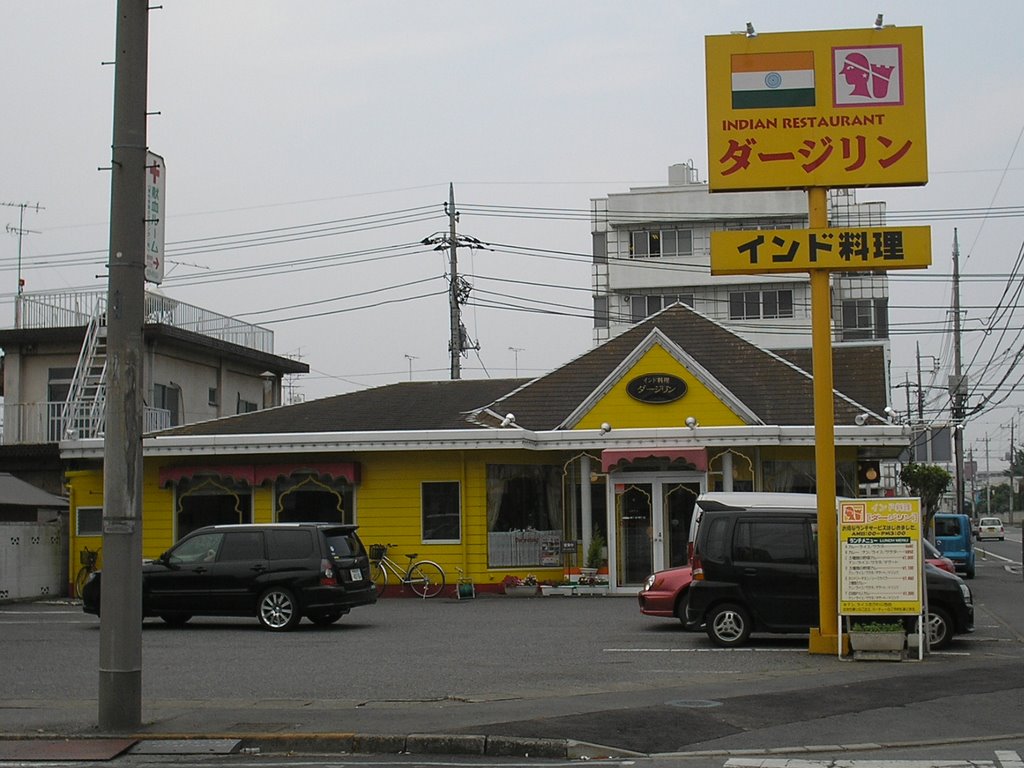
We couldn’t find a clue until a couple hours later when, after circling a few blocks north of the station, we asked at Rana, an “International, Halal” food store run by some Iranians. The only other customer was a Nepali who not only owned an Indian restaurant named Darjeeling, but offered to drive us there, and even to drive us back to the station if his place wasn’t too busy by the time we finished eating. We readily accepted, and had a wonderful meal of chicken tandoori, mutton masala, nan bread, and salad vegetables, washed down with a couple of beers unusual for Japan: Everest and Grolsch. The proprietor came to Japan ten years ago, and his restaurant has been successful enough for his elder brother to open a branch in Tokyo.

Except for a few words of English, he and I communicated entirely in Japanese, quite informally and comfortably. Neither of us had done enough formal study to command formal registers very well anyway. After dinner, we insisted on walking back to the train station, and he came out to the street to confirm his earlier directions and we parted in typical Japanese fashion, with bows and thank yous. On the way back, we passed the Civic Center, with a range of social support facilities for both citizens and foreigners, including an office that handled passports and visas.

The 1 May 2005 issue of Pakistan’s Dawn has more about unskilled foreign workers in Ota.

Kimio Matsudaira, an official at Hello Work, a public labour office in Ota city, Gumma prefecture, 60 kilometres north of Tokyo, said there is now a special programme to help and support foreigners working in the area. Ota has a population of about 200,000 people. The irony is that more than sixty per cent of its people are over 60 years of age, in a city where the economy is dependent on manufacturing. Without doubt, Ota really needs foreign workers badly. To support the city’s automobile and electronic industries, Ota is now host to more than 30,000 Japanese Latin Americans, descendants of Japanese who emigrated to South America in the early 20th century seeking a better future. In the late eighties Japan launched a policy of accepting third and fourth generation Japanese Latin Americans to support a labour shortage in its factories stemming from the bubble economy at that time. More recently, Asians, mostly from South-east Asia, have also arrived to work in factories, comprising a total of 45,000 registered workers in Ota city. Matsudaira said foreign workers are vital to the survival of Ota’s economy.

Leave a comment

Filed under Brazil, China, industry, Japan, migration

Kiryu’s Changing Industries: From Silk to Pachinko

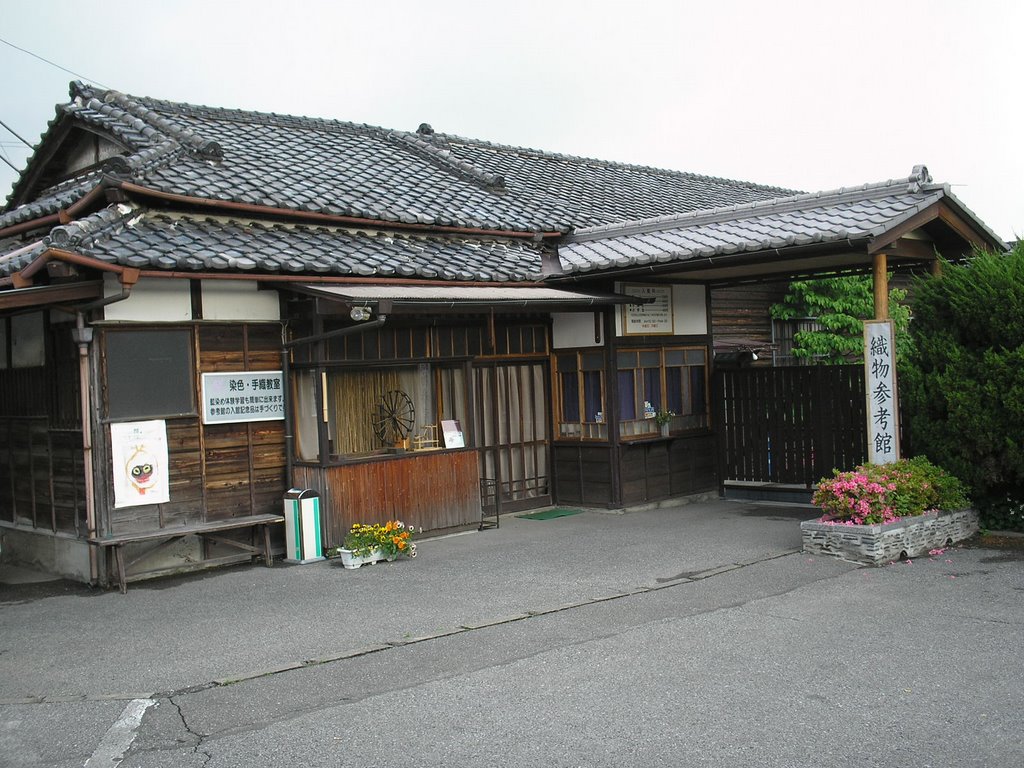
Kiryu (桐生), in Gunma Prefecture’s southeast fanhandle, was an early center of silk manufacture, a later pioneer in textile manufacturing, and now home to Gunma University’s Faculty of Engineering, which offers this glimpse at its industrial transitions.

Kiryu is often referred to as “the Eastern Kyoto”. Like Kyoto, Kiryu has over 1,000 years of history behind it and owes its wealth and tradition to the silk textile industry. Even now, Kiryu is a major centre for the manufacture of kimonos (traditional Japanese wear). The precise origins of the silk industry in Kiryu have been lost in the mists of time, but according to local legend a young man from Kiryu won the heart of a princess at the Imperial Court in Kyoto with his exquisite poetry. They eventually married and returned to Kiryu, where she taught the local inhabitants the art of weaving. There are records of silk production in Kiryu dating from the 10th century. Over the years, the silk industry grew and flourished in Kiryu. Kiryu silk was sent to the Imperial Court and was used by the Tokugawa Shogun for his army’s battle banners in 1600. Kiryu became the site for a major silk market which drew merchants from all over Japan.

However, in recent years the kimono was been largely replaced by Western-style suits and dresses. The golden age of the silk industry has now passed.

With the decline of the silk industry the people of Kiryu adapted themselves to new industries, mainly the production of automotive parts, electronics and related industries. However, Kiryu has become a major producer of another typically Japanese product–pachinko machines! (Pachinko is a type of pinball which is extremely popular in Japan.)

An article by Tomoko HASHINO entitled “Power-looms and the factory system: the relation between production systems and technology choice in the silk textile industry in Kiryu in the 1910s” has more about the early transition from hand looms to power looms. The abstract from Socio-Economic History, vol. 63, no. 4, follows.

Recent studies have clarified some special features regarding the introduction of power-looms, especially in pre-war Japan. One of the more important findings was the close relationship between particular production systems and technologies, for example the factory system and power-looms and the putting-out system and hand-looms.

The purpose of this paper is to investigate the above relationship in the silk textile industry on the basis of the hypothesis that the factors leading to the introduction of power-looms are independent from those leading to the introduction of the factory system. Kiryu is one of the oldest silk textile industry districts in Japan. In the early Meiji period (1870s-80s) it showed a positive response to the introduction of new foreign technology, such as the batten and the Jacquard machine, and helped to spread them to other areas. But Kiryu was slower than other areas in introducing power- looms. The putting-out system was widely adopted in Kiryu and had a long history. It has been assumed that this acted as an obstacle to the introduction of power-looms.

In the 1910s, there were four types of factory in Kiryu: factories with power-looms only, factories with hand-looms only, those with both, and those with none, which were often called orimoto (clothiers). Neither the production systems nor the technology dramatically changed in Kiryu in the 1910s; however, some factories began to introduce power-looms.

There were some reasons that promoted the adoption of the factory system. OJT (on-the-job-training), which played a role in maintaining the quality of goods, was an important reason in Kiryu in the 1910s. As past studies point out, institutional, technological and market factors were other reasons that promoted the introduction of power-looms there. While both electrification and the establishment of domestic and local power-loom suppliers were very important, it appears that the change in raw material from raw silk to rayon in the 1920s was the decisive factor in accelerating mechanization. The fact that hand-loom factories have often been categorized as “manufacture” has been a controversial issue among historians. But we must recognize the significance of their role in controlling workers and turning them into a skilled labor force.

Leave a comment

Filed under industry, Japan

Watching the Japanese Elections

Jonathan Dresner at Frog in a Well has a nice summary of how effective Japan’s Postal Savings system has been since it was first created back in the Meiji era.

The Postal Savings system was a fundamental institution in the Meiji modernization, enabling reliable low-cost long-distance transactions (including remittances from overseas, which is where my research comes in) and accumulating small deposits into a pool of capital that was agressively used for investment in railroads and other heavy industrial development.

I know I’ve been relying on the post office ATMs while I’ve been in Japan these past six weeks, since a lot of combini don’t give equal access to accounts overseas.

My first comment on the recent election is that it provided me a great opportunity for language-learning that kept listening and reading skills in synch. The constant repetition of restricted sets of visual and oral clues with each new set of results (enough to keep me watching) gave me time to look stuff up in my handy-dandy new Canon WordTank: 当選の当 (short for ‘elected’)、確実の確 (short for ‘called’)、比例の比 (short for ‘proportion[ally elected]’)、圧勝 (‘pressure=overwhelming victory’)、plus a lot of surnames and placenames that I’m always a little shaky on.

Two more points: (1) Koizumi seems to be creating the equivalent of Blair’s New Labour or Clinton’s DLC (which is where I feel most comfortable on the political spectrum). Can we call the current LDP the New Tories? (Please, not Neocons!) (2) The DJP really got wiped out in Greater Kanto. I’m right now in Ashikaga, on the border of Tochigi and Gunma, where all but one out of maybe 18 wards went for the LDP. You can see the economic growth (industrial parks, tract housing, strip malls, big box retailers, lots of cars and parking) all around the edges of the Kanto plain.

Leave a comment

Filed under Japan