
Category Archives: industry

Wordcatcher Tales: Gum naval, Jump-butt, Stumpage value

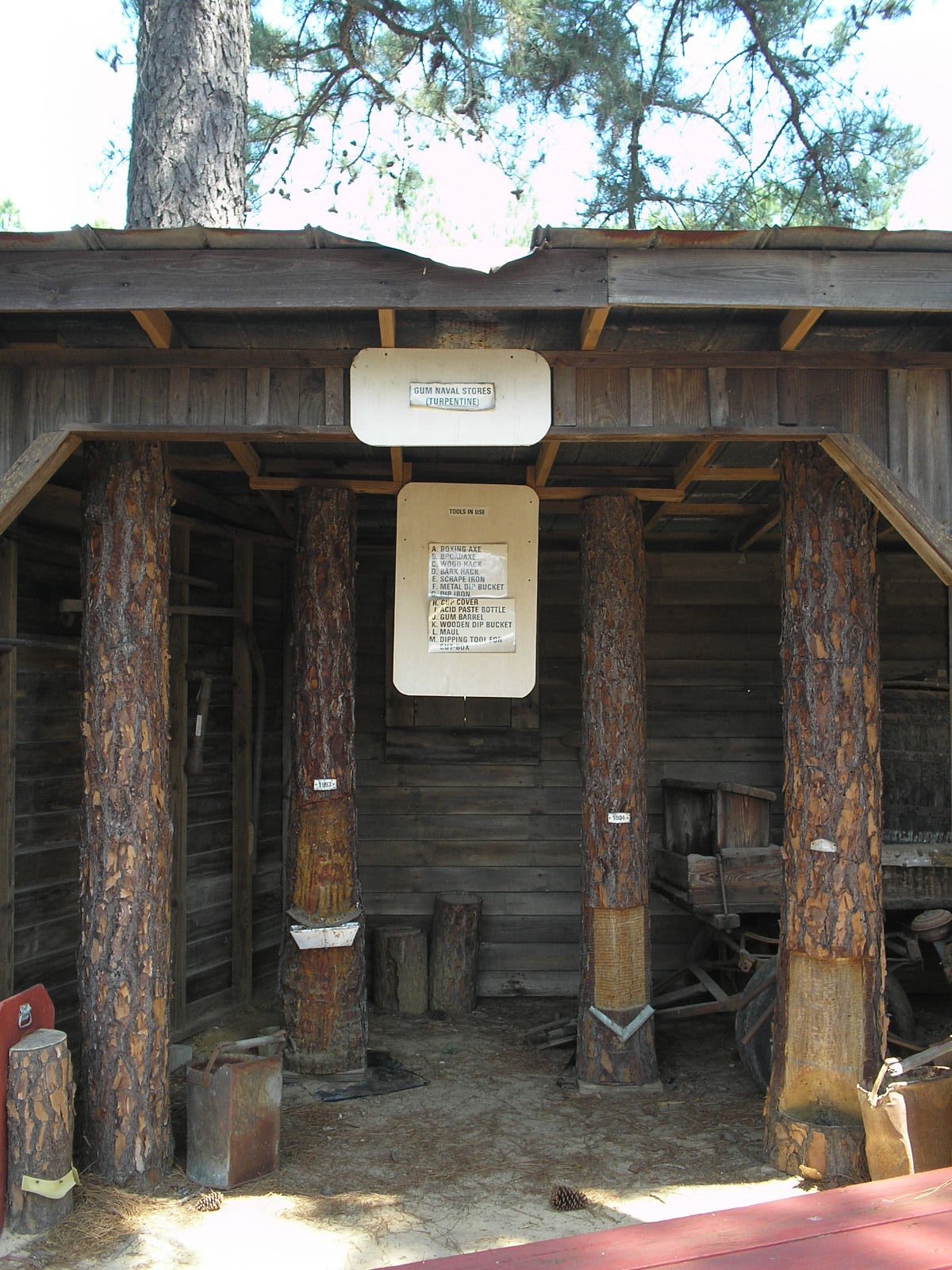
Gum naval stores and toolsOn the road from Columbus to Savannah, Georgia, during our recent Great Square Route around the eastern U.S. (MN – MS – GA – CT – MN), we stopped at the Million Pines Visitor Center off I-16 in Soperton, Georgia. The visitor center includes the Curt Barwick House, built of wood about 1845, which houses the front desk, gift shop, restrooms, and various display items; a one-room wooden house with a tin roof that served as the post office for Blackville, Georgia, from 1888 to 1904; and a wooden shed containing tools used to produce gum naval stores.

The latter term was new to me. It bears no relation to naval jelly (phosphoric acid), which is used on iron ships. Gum naval dates back to the days of wooden ships, when Georgia played an important role in the naval stores industry, as the New Georgia Encyclopedia relates:

In the late nineteenth and early twentieth centuries, Georgia was the world’s leading producer of naval stores, which are materials extracted from southern pine forests and then used in the construction and repair of sailing vessels. Typical naval stores include lumber, railroad ties, rosin, and turpentine.

The naval stores industry in North America originated in the mid-eighteenth century in North Carolina. Before 1800 the major products of the trade were raw gum, pitch, and tar. After the American Revolution (1775-83), processes were developed for distilling spirits of turpentine from gum. By 1850, 96 percent of U.S. naval stores came from North Carolina.

In the early 1870s North Carolina naval stores producers began migrating to southeast Georgia’s sandy coastal plain to take advantage of the untapped virgin pine forests in that region. They brought their equipment and black laborers and established residential villages on large turpentine farms. By the mid-1880s about seven in ten turpentine workers in southeast Georgia had been born in North Carolina.

The industry grew so rapidly that by 1890 Georgia was the national leader in naval stores production, a ranking that lasted until 1905. Florida was the leader from 1905 to 1923, after which Georgia regained its predominance and maintained it until the 1960s.

The USDA Forest Service Southern Research Station Headquarters in Asheville, North Carolina, describes some of the nitty gritty of production. Here are two photo captions from their website:

Photo caption: Improved gum naval stores extraction methods require new tools and techniques. Bark streaks 9 feet from the ground require a special long handled tool for pulling the streak and safely applying the acid. A combination bark-pulling and acid-treating tool was designed to meet this need. The laborer is shown applying 50-percent sulfuric acid to a streak 8 feet from the ground. This tool enables a laborer to stand a safe distance from the tree and reduce the hazard of acid drifting down on his head and clothes.

Photo caption: No more jump-butts and wasted timber as a result of turpentining. A turpentined tree containing both front and back faces and worked for 8 years is shown entering a German gang-saw to produce quality lumber. Developing conservative gu[m] extraction methods for the gum producer represents only half the problem, research must also prove to wood using industries that modern turpentining does not impair the stumpage value of the worked out tree.

The punctuation in the second caption sucks rather badly, but the wonderful collocations make up for it. Jump-butts in this context seems to refer to the discarded lower portion of turpentined trees. Stumpage value is the calculated value of standing timber. The butt log is the often slightly irregular log taken from the base of a tree.
Leave a comment

Filed under industry, language, travel, U.S.

The Model T’s Effect on the Amazon

Seringueiros [rubber tappers] were, by default, the true settlers of Brazil’s interior. When Henry Ford had introduced the Model T in 1908, the Amazon had been the world’s sole source of rubber. The wild popularity of these automobiles, and the seemingly insatiable demand for rubber that accompanied them, had ignited a frenzy in South America that rivaled the California gold rush. In The Sea and the Jungle, H. M. Tomlinson complained that the only thing Brazilians saw in their rich rain forests in 1910 was rubber. “It is blasphemous that in such a potentially opulent land the juice of one of its wild trees should be dwelt upon … as though it were the sole act of Providence,” he wrote. “The passengers on the river boats are rubber men, and the cargoes are rubber. All the talk is of rubber.” Two years before Roosevelt had set sail for South America, his friend the great American naturalist John Muir had been similarly astonished by the rubber lust that he had witnessed as he traveled through the Amazon. “Into this rubbery wilderness thousands of men, young and old, rush for fortunes,” he marveled, “half crazy, half merry, daring fevers, debilitating heat, and dangers of every sort.”

By the time Roosevelt reached the Amazon, the dangers were still there but the promise of riches had all but disappeared. The bottom had dropped out of the South American rubber boom in 1912, when the Amazon lost its lock on the market. Thirty-six years earlier, an Englishman named Henry Wickham had smuggled Hevea brasiliensis seeds, the most popular species of Amazonian rubber tree, out of Brazil. Those seeds had then been cultivated at Kew Gardens, and the British had eventually planted their predecessors in tropical Malaysia. There, far from their natural enemies, the trees could be planted in neat rows with no fear that a blight would destroy the entire crop, as it likely would have done in South America. Labor in Malaysia was also not only cheap but readily available, and much more easily controlled. So successful had been the transfer of rubber trees to the Far East that by 1913 Malaya and Ceylon were producing as much rubber as the Amazon.

SOURCE: The River of Doubt: Theodore Roosevelt’s Darkest Journey, by Candice Millard (Doubleday, 2005), pp. 317-318

Leave a comment

Filed under Brazil, industry, Malaysia, Sri Lanka, U.S.

Reshaping China’s Coal Industry

SURELY NO NATION ON EARTH has as many coal miners or coal mines as China. In 1996, 5 million Chinese mined coal, virtually all of them underground. At the same time in the United States, about 90,000 miners were digging about the same amount of coal. The reason for the disparity, of course, is that Chinese mines rely much more on cheap labor than on costly machines. In addition to its many large mines, China has tens of thousands of tiny mines that each employ just a handful of miners.* The small mines are vastly more deadly than the big mines, which are themselves quite dangerous. In 1991, a particularly bad year, 10,000 Chinese coal miners died in accidents. By comparison, the number of Americans killed in coal mining in 1992, a bad year for the U.S. industry, was fifty-one.

*In 1998, China had about 75,000 mines employing an average of thirteen miners each. These small mines have a death rate seven times higher than the large ones.

… As they are in the United States and other coal-producing nations, the small inefficient mines are shutting down in favor of larger ones. In China, though, the scale of the disruption is mind-boggling: Beijing claims to have closed down 30,000 small mines just since 1998. Although the true number is surely less, there are undeniably painful reforms underway that have already thrown perhaps a million Chinese coal miners out of work.* These sweeping changes reflect the fundamental shift in Beijing’s economic philosophy over the years: In a move more reminiscent of J. P. Morgan than Mao Zedong, the Communist government is now openly urging coal companies to merge into larger and larger enterprises, and to form “cartels” to limit overproduction and improve profitability.

*According to widespread reports, many communities have defied Beijing and quietly reopened their small mines; as a result, several officially “closed” mines have suffered deadly mining accidents in recent years. However, reports that miners are being laid off in huge numbers, including at large state-run mines, are more credible. Between 1992 and 1995, reportedly 883,000 coal miners (more than ten times the total U.S. coal mining workforce) were laid off, and there are plans to lay off nearly 800,000 more.

SOURCE: Coal: A Human History, by Barbara Freese (Penguin, 2003), pp. 207-208, 221-222

Leave a comment

Filed under China, industry

Reshaping the U.S. Coal Industry

THERE MAY BE NO POLLUTANT in all of history that people have worked harder to defeat than sulfur dioxide. In the United States alone the battle against it has absorbed years of effort and billions of dollars. Although it is nowhere near won, it has already utterly transformed the coal industry. It has also created deep political fissures between states and regions, as local fortunes rise and fall and as states struggle to decide how much they are willing to sacrifice to fight this invisible foe and to stop 11 killing their downwind neighbors.

Coal provides just over half the electricity for the United States, with huge and politically important regional variations. Many states, especially in the coal-producing regions, get virtually all their electricity from coal; others, especially on the West Coast and in New England, burn next to none. They rely instead on the three power sources that make up almost all the other half of the nation’s electricity—hydroelectric dams, nuclear power, and natural gas—though sometimes they also import coal-fired electricity from other states. However, the number of people a state’s coal plants actually sicken or kill (and the amount of acid rain and lost visibility they cause) depends not just on how much coal they burn bur on the kind of coal they use and how they burn it.

People who run coal-fired power plants can cut their SO2 emissions in two ways: They can scrub, or they can switch…. It’s often cheaper and a lot easier, though, just to switch to a kind of coal containing less sulfur. This option has caused some painful changes to the traditional U.S. coal industry by wrenching much of it away from the high-sulfur coal fields of the East and moving it to the low-sulfur coal fields of the West. Western coal has always been easier to dig because it lies in thick seams near the surface; but it is younger and generally packs less of an energy punch than the older eastern coals. In 1970, before environmental laws made sulfur content so important, only a tiny, share of U.S. coal came from west of the Mississippi. Today, more than half of it does, and the growing western low-sulfur coal fields are continuing to drain business away from the suffering high-sulfur eastern fields. Wyoming, with its vast surface mines, is now the nation’s top coal-producing state. One result of the shift is that the coal industry can no longer view the environmental movement solely as a threat; the western coal fields, at least, owe much of their growth to environmental laws, and could benefit even more from stricter SO2 limits.

The shift to the western United States has transformed this ancient industry in other ways, too. Even though coal fueled the rise of the machine in virtually every sector of the economy, the extraction of coal (as opposed to mine drainage or coal transportation) long depended far more on manual labor than on machines. Today, though, nearly two-thirds of American coal comes from surface mines, where it has been scooped up by some of the world’s most gargantuan machines. This mechanized mass production has helped make the direct cost of coal incredibly cheap by any measure.

The mechanization of mining has also devastated the work force. Because only the largest mines can afford to mechanize, the smaller mines that characterized the soft-coal industry for so much of the twentieth century have finally been driven out. More than three-quarters of the coal mines operating in the United States in 1976 have closed, and the current work force of 72,000 coal miners is less than a third of what it was a quarter century ago. The once mighty UMW now represents a mere 20,000 miners, who produce less than a fifth of American coal.

SOURCE: Coal: A Human History, by Barbara Freese (Penguin, 2003), pp. 177-180

Leave a comment

Filed under industry, U.S.

Anthracite Elites vs. Bituminous Boondocks

THE 1902 STRIKE [in the anthracite fields of northern Pennsylvania] served to emphasize how the nation had divided into clean anthracite cities like New York, Philadelphia, and Boston, and dirty bituminous ones, like Pittsburgh, Chicago, St. Louis, Cincinnati, and Birmingham.* In New York City, as the strike-induced shortage caused anthracite prices to rise, more and more coal users turned to bituminous, violating city laws and alarming city residents. Some plants allegedly switched to bituminous after dark when the smoke would attract less attention. In June of that year, the New York Times carried the distressing headline “Smoke Pall Hangs Over the Metropolis,” something that was true every day in the soft-coal cities. A letter to the editor, bemoaning the growing illegal use of bituminous during the strike, asked, “Are we to have fastened on us the frightful infliction which curses Pittsburg and Chicago?” Andrew Carnegie, the steel magnate whose bituminous-burning mills in Pittsburgh added greatly to that city’s “frightful infliction,” chose to live in New York City, and warned: “If New York allows bituminous coal to get a foothold, the city will lose one of her most important claims to pre-eminence among the world’s great cities, her pure atmosphere.”

Pure atmospheres were something most bituminous cities had not seen, and would not see, for a very long time. Most of the bituminous cities saw their coal smoke as the inevitable byproduct of industry, and saw industry as the source not merely of their material wealth but of modern civilization itself. And yet, this belief was not unshakeable. By the late nineteenth century, it was starting to clash with other firmly held attitudes that linked civilized life to cleanliness, beauty, health, and ultimately morality. In short, coal smoke was coming into conflict with an emerging environmental philosophy.

*In fact, nearly every city west of the Appalachians depended heavily on bituminous except the emerging cities in Texas and California, where oil and natural gas were locally available. The reason was the cost of transportation; bituminous was mined in some twenty states by 1900, anthracite only in eastern Pennsylvania. In St. Louis, for example, anthracite could cost four times more than soft coal from the mines of Illinois.

SOURCE: Coal: A Human History, by Barbara Freese (Penguin, 2003), pp. 148-149

Leave a comment

Filed under industry

Wood-burning Trains: "A Storm of Fiery Snow"

Anthracite country is often called the cradle of American railroading, and with good reason. Apart from a couple of relatively minor exceptions, the anthracite mine operators were the first Americans to use rails, and they greatly advanced the science of building railways. White and Hazard built a nine-mile rail line from their Summit mine down to the Lehigh [River] in 1827. Gravity carried the coal cars and a carload of mules (who refused to walk down once they had experienced rail travel), down to the Lehigh, and then the mules pulled the cars back up.

Rails spread quickly throughout the anthracite region, and the rest of the East, and eventually locomotives followed. Schuylkill county had more track than any other small area in the country. Companies building railroads alongside the canals drained away canal business and bought up much of the region’s coal property. The Philadelphia and Reading Railroad, one of the nation’s largest and most powerful companies, dominated the area, but there would be five railways so intermingled with th anthracite trade that coal and railroading were often considered a single industry.

Surprisingly, these trains didn’t run on coal. For the first few decades, American trains burned wood, even those that existed for the purpose of hauling coal. Anthracite did not burn well in locomotive fireboxes as they were then designed, and the bituminous fields were not yet widely exploited outside of Pittsburgh. Wood was bulky and burned fast, though, so the trains had to stop often to refuel. All along the tracks, people made money cutting wood to sell to the railroads—just one more way that trains would help turn the United States from a forested nation into an agricultural and industrial one.

The era of wood-burning trains is one that train buffs look back on with particular nostalgia. With clean-burning wood, locomotives could be much flashier: They were painted bright red and fitted with polished brass ornamentation. Engineers were flashier, too, often wearing ornate suits and vests with shiny buttons. When the switch to bituminous coal occurred later in the century, the inevitable accumulation of soot and grime meant that engines had to be painted plain black, and engineers switched to overalls. Some say that when the engineer’s uniform was toned down, his status as a workman fell, too.

One problem with the shiny, wood-burning engines proved hard to ignore: They spewed out a continuous shower of sparks and cinders wherever they went, “a storm of fiery snow,” as Charles Dickens called it when he visited the United States. It was a beautiful display at night, but it had a predictable downside. Wood-burning trains commonly set nearby fields and forests ablaze; some said the trains burned more wood outside the firebox than inside.

SOURCE: Coal: A Human History, by Barbara Freese (Penguin, 2003), pp. 121-123

Leave a comment

Filed under industry

Coal Ships as the Royal Navy’s Nursery

By the time of the industrial revolution, Britain already had a relatively sophisticated transportation network. This was partly because of its accommodating waters, but partly because of its coal. As the heaviest and bulkiest of daily necessities, coal was the nation’s cutting edge cargo, the one that kept forcing it to find new ways to move things.

It was noted in the 1600s that “it is the great quantities of Bulksome Commodities that multiplies ships and men,” and commodities didn’t get more bulksome than coal. And so, as the coal trade grew in the latter half of the 1500s and in the 1600s, so did the nation’s shipping fleet. Already in the early 1600s, more ships were used to move coal than everything else combined. England would no doubt eventually have developed its shipping industry without the impetus of the coal trade; but London’s growing dependence on coal left it no choice in the matter, and surely accelerated the nation’s maritime investment. Once they had built the ships, the ports, the sailing fleet, and the skills required for the coal trade, the English found it much easier to expand their maritime trade to other commodities and other locations. According to one historian, “the coal trade may be regarded, in short, as a magnet which helped to draw Englishmen to seek their profit and their livelihood in ocean commerce.”

The expansion of England’s private fleet would prove vital not just commercially but militarily, too. Despite being an island nation, England had not always been a maritime power. Henry VIII built its first real Royal Navy, but it was not strong, and in times of trouble, the nation had to commandeer private vessels: Elizabeth I’s navy was more powerful than her father’s, but even so, it needed the help of dozens of armed merchant ships to defeat the Spanish Armada in 1588. England’s coal ships were particularly important for national defense, and by the early 1600s it was axiomatic that the coal trade was the “chief nursery” for English seamen. Although there were more vessels involved in fishing, they were smaller and of less use to the navy. The sturdier coal ships, with their larger crews, were a vital national asset and could be called up quickly when needed. And when called upon, there was no refusing; the coal ships and their thousands of crew members were pressed into service, by force, many times in English history. In fact, in times of war, those involved in the coal trade demanded additional wages because they ran such a high risk of being forced into the navy.

Paradoxically, the coastal coal trade was another reason a navy was so important in the first place. London and the south of England had become dependent on this fragile lifeline to the north, subject to attack by pirates and foreign powers. The navy was frequently dispatched to escort the coal vessels, in convoys, down the English coast. Still, the coastal coal trade was seen not mainly as a vulnerability but as a national asset, and it came to enjoy what one historian called “an almost superstitious reverence” as the source of England’s naval strength. There were even those in the 1600s who opposed trying to find inland coal supplies closer to London because it would have choked off the precious coastal trade.

SOURCE: Coal: A Human History, by Barbara Freese (Penguin, 2003), pp. 85-87

Leave a comment

Filed under industry

Oil Barons of Baku, 1901-1905

By 1901, Baku was supplying half the world’s oil. It became an international city overnight, and the local Azeris were soon outnumbered by Russians, Georgians, Ossetians, and others from the four corners of the earth. Between 1856 and 1910, Baku’s population grew at a faster rate than that of London, Paris, or New York. The Nobel brothers, who dominated the industry in the first decades, invented the concept of the tanker to handle the demand for Baku oil in the Far East, appropriately naming their first tanker Zoroaster. They made the bulk of the family’s fortune in Azeri oil, though brother Alfred’s invention of dynamite is more famous.

The oilmen came in all stripes—Swedes and Jews and Poles and Armenians—but the dominance of big foreign groups like the Nobels and Rothschilds didn’t last long. By the turn of the century, half of the tanker business and much of the production was in local hands. So-called oil barons arose from both the peasantry and the feudal aristocracy—anyone who dug a hole in the ground and got lucky. (The Nobels tried whenever possible to buy out these new oil barons, along with smaller producers. According to documents in the Baku archives, Abraham Nussimbaum sold the Nobels most of his wells in 1913, on the eve of the Great War, a highly opportune business decision.)

The new oil millionaires became great philanthropists, determined to turn their city from a provincial backwater into the finest Islamic city in the world—a showcase of the possibilities of the positive merger of East and West. As the representative local group, the Muslim oil barons felt the most obliged to make showy public statements with their new wealth. They took grand tours of Europe and hired architects to build copies of the mansions, museums, and opera houses they had seen, all in an attempt to anchor their city in the Occidental future rather than its Oriental past. While some Azeri Muslims were outraged by the education of women or their appearance onstage or in an office building, Baku benefited from having been so long at the crossroads of East and West that people were used to new fashions and change.

Equal parts Dodge City, medieval Baghdad, industrial Pittsburgh, and nineteenth-century Paris, fin de siècle Baku was the last great city built before the First World War spoiled the dream that the West could keep expanding forever in a grand civilizing pageant. It was a place of fantastic extremes of wealth and poverty, where gas lights and telephones made a stark contrast to camel caravans and emaciated Zoroastrian monks. The city’s wild and clashing history came to ahead at the turn of the century, when it was the “Wild East” frontier of Europe, the world’s greatest oil-boom town: A British visitor at the time wrote, “One might almost fancy oneself in an American city out west. There is the same air of newness about everything, the same sanguine atmosphere. Everyone is hopeful.”

Yet by 1905, the entire Russian frontier was bathed in blood, as the empire entered the first of its revolutions. The unrest reached from the coast of Korea to St. Petersburg’s Nevsky Prospekt, and Baku was not spared. The revolution came, as many do, on the heels of a disastrous war, one of the bloodiest in history. The czar’s advisers had dreamed up the 1904–5 Russo-Japanese War in part as a means of diffusing revolutionary tension, by acquiring, via quick victory, an injection of patriotism as well as some much-needed timber concessions on the Korean coast. Instead, the Russians experienced total defeat. The catastrophe in the Far East—against a people the czar called “little, short-tailed monkeys”—made the Russian Empire look fragile and moribund. As the war’s losses sank in—in addition to the hundreds of thousands of dead soldiers, practically the entire Russian Navy was sunk by the Japanese fleet—years of left-wing terrorism and czarist oppression collided in a year of uprisings, ethnic cleansing, and generalized breakdown.

The semi-destroyed Russian military was in no position to quash the unrest. The only part of the vast czarist navy that had not been sunk by the Japanese was the famous Black Sea Fleet, and on its main battleship, the state-of-the-art Potemkin, the sailors rioted in the spring of 1905 and shot their officers. All around the Black Sea and the Caspian, public order broke down. While the staggering numbers of Russian dead, machine-gunned on the icy hills of Manchuria and the Korean peninsula, showed the new lethality of war, the revolutionary terrorism and pogroms that arrived inside Russia that year showed the new brutality of politics—and both foreshadowed what horror might be born through the mediums of modern mass violence.

SOURCE: The Orientalist: Solving the Mystery of a Strange and Dangerous Life, by Tom Reiss (Random House, 2005), pp. 11-13

One of the most intriguing photographs reproduced in the book is labelled “Muslim-Jewish Christmas party, Baku, 1913.” Days long, long gone.

Leave a comment

Filed under Caucasus, Central Asia, energy, industry, Japan, military, nationalism, religion, Russia, Turkey, war

A Visit to International Ota City

Ota City (太田) in Gunma Prefecture is just two train stops southwest from Ashikaga City on the private Tobu line. Ota English School‘s website brags that

Ota itself is quite an international town. The neighboring town [Ôizumi] has one of the largest Brazilian populations in Japan. Ota itself has one of the largest Asian communities outside of Tokyo. This means that, as well as all the usual non-Japanese restaurants (Italian, French, Chinese) there are many Indian, Pakistani and Brazilian restaurants a short walk or drive from the school.

Purdue University‘s The Exponent Online is rather more modest when it compares Ota City to Lafayette, Indiana.

The populations are almost the same, both cities were changed from agricultural centers to industrial centers, both cities are on a river, and for the most part, both are flat cities.

What moved a Purdue student reporter to compare Lafayette and Ota? Well, West Lafayette, Indiana, is home to Purdue’s main campus as well as to Subaru-Indiana Automotive, Inc. Fuji Heavy Industries and Subaru are among the largest employers in Ota, a commercial cluster development center dating back to the days of textiles and then military aircraft.

So, is Ota really as international a city as these websites suggest? The Far Outliers got a skewed impression when we set out to find a Brazilian restaurant to eat dinner at last Saturday evening. We headed south from Ota train station zigzagging between the two widest streets we could find, asking policemen, passers-by, shopkeepers, and even employees at the main post office (open on Saturdays) if they knew of any Brazilian restaurants in the city. No luck. Even those who took the trouble to look through the restaurant listings in the telephone book couldn’t find any Brazilian restaurant. A few people recommended we go instead to neighboring Ôizumi–Japan’s “Little Brazil.” (Been there. Done that. More later.)

We did find a few tiny Filipino restaurants (none yet open) scattered along one of the longest strips of seedy strip joints, hostess bars, and member clubs that I’ve seen in a while. (I’ve never been to Las Vegas.) It went on for at least a full kilometer. It was still early when we walked its length, encountering no more than a few bouncers loitering outside a few doorways. When we retraced a portion of the strip on our way back to the station later that night, there were a lot more drunken males and leggy females on the sidewalks. Judging from the streetside advertising, some portion of Ota City’s international Asian population would seem to be women from China and the Philippines. (A Japanese customer I was chatting with at a yakitori shop in Ashikaga last week demonstrated his few words of “French” by saying Magandang gabi! That’s Tagalog for ‘Good evening!’)

After the trail went cold in that direction, we headed back for the station on a main drag with more vehicle traffic. It was a much more family-oriented strip mall, with a huge shopping center, and plenty of parking, car dealers, tire shops, and the most amazing site entirely dedicated to weddings that I’ve yet seen, the Royal Chester Ota (for “The Brilliant European Wedding”). (Again, I’ve never been to Las Vegas.) We saw plenty of chain restaurants, but nothing representative of Ota City’s large foreign community.

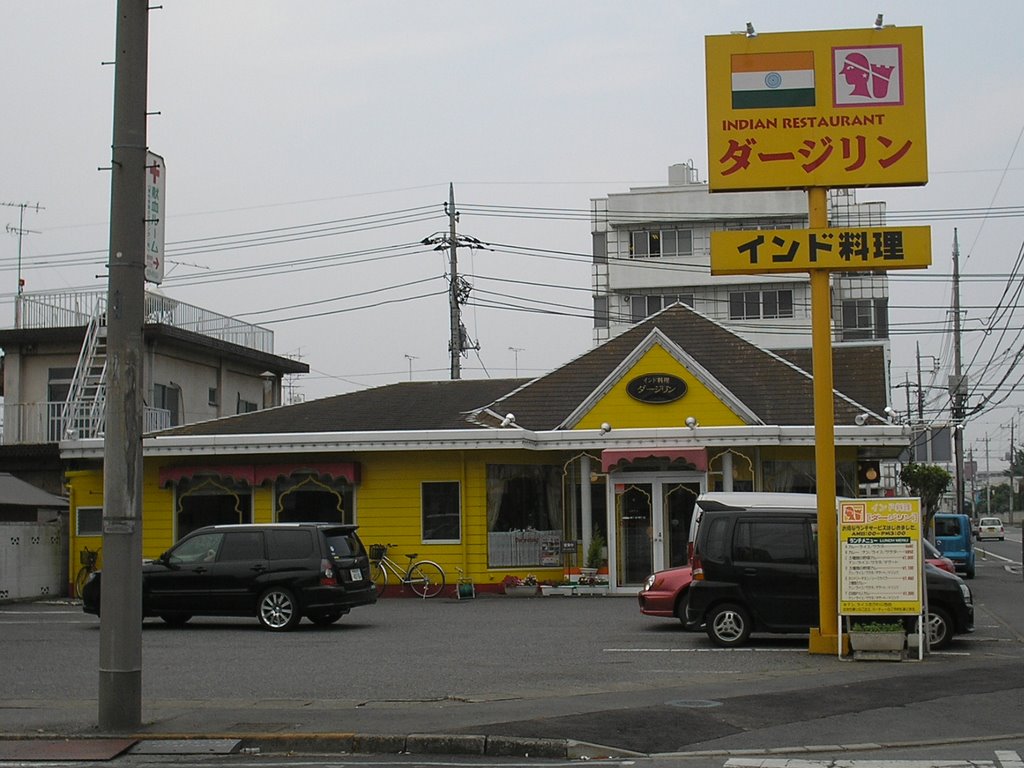
We couldn’t find a clue until a couple hours later when, after circling a few blocks north of the station, we asked at Rana, an “International, Halal” food store run by some Iranians. The only other customer was a Nepali who not only owned an Indian restaurant named Darjeeling, but offered to drive us there, and even to drive us back to the station if his place wasn’t too busy by the time we finished eating. We readily accepted, and had a wonderful meal of chicken tandoori, mutton masala, nan bread, and salad vegetables, washed down with a couple of beers unusual for Japan: Everest and Grolsch. The proprietor came to Japan ten years ago, and his restaurant has been successful enough for his elder brother to open a branch in Tokyo.

Except for a few words of English, he and I communicated entirely in Japanese, quite informally and comfortably. Neither of us had done enough formal study to command formal registers very well anyway. After dinner, we insisted on walking back to the train station, and he came out to the street to confirm his earlier directions and we parted in typical Japanese fashion, with bows and thank yous. On the way back, we passed the Civic Center, with a range of social support facilities for both citizens and foreigners, including an office that handled passports and visas.

The 1 May 2005 issue of Pakistan’s Dawn has more about unskilled foreign workers in Ota.

Kimio Matsudaira, an official at Hello Work, a public labour office in Ota city, Gumma prefecture, 60 kilometres north of Tokyo, said there is now a special programme to help and support foreigners working in the area. Ota has a population of about 200,000 people. The irony is that more than sixty per cent of its people are over 60 years of age, in a city where the economy is dependent on manufacturing. Without doubt, Ota really needs foreign workers badly. To support the city’s automobile and electronic industries, Ota is now host to more than 30,000 Japanese Latin Americans, descendants of Japanese who emigrated to South America in the early 20th century seeking a better future. In the late eighties Japan launched a policy of accepting third and fourth generation Japanese Latin Americans to support a labour shortage in its factories stemming from the bubble economy at that time. More recently, Asians, mostly from South-east Asia, have also arrived to work in factories, comprising a total of 45,000 registered workers in Ota city. Matsudaira said foreign workers are vital to the survival of Ota’s economy.

Leave a comment

Filed under Brazil, China, industry, Japan, migration

Kiryu’s Changing Industries: From Silk to Pachinko

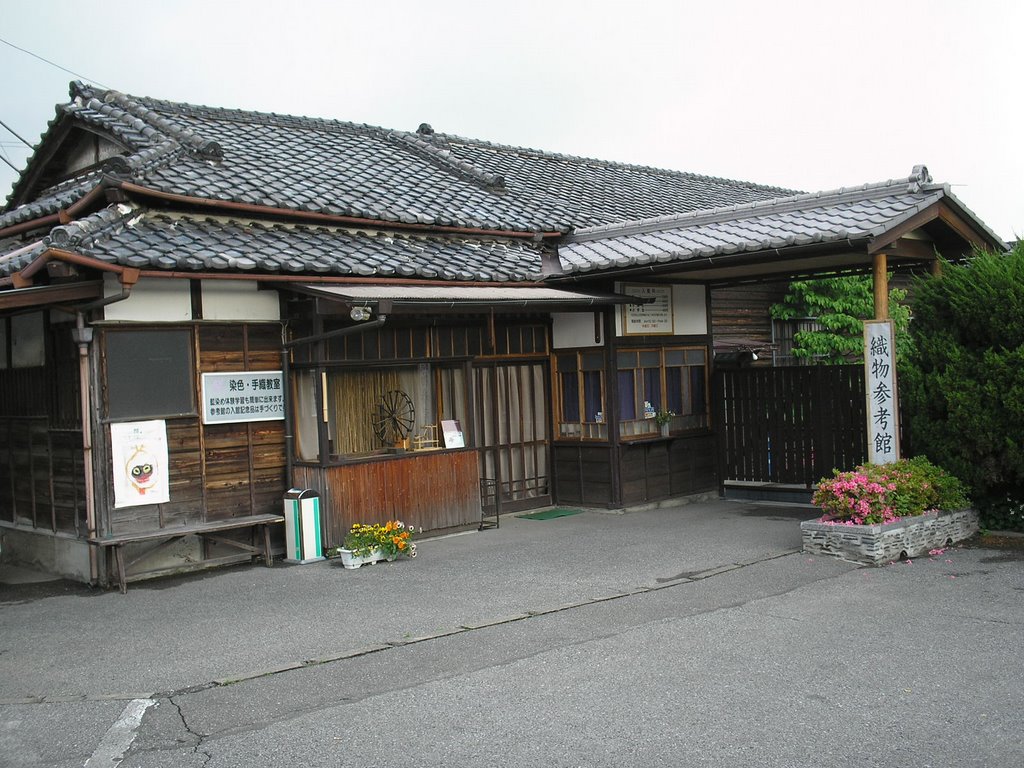
Kiryu (桐生), in Gunma Prefecture’s southeast fanhandle, was an early center of silk manufacture, a later pioneer in textile manufacturing, and now home to Gunma University’s Faculty of Engineering, which offers this glimpse at its industrial transitions.

Kiryu is often referred to as “the Eastern Kyoto”. Like Kyoto, Kiryu has over 1,000 years of history behind it and owes its wealth and tradition to the silk textile industry. Even now, Kiryu is a major centre for the manufacture of kimonos (traditional Japanese wear). The precise origins of the silk industry in Kiryu have been lost in the mists of time, but according to local legend a young man from Kiryu won the heart of a princess at the Imperial Court in Kyoto with his exquisite poetry. They eventually married and returned to Kiryu, where she taught the local inhabitants the art of weaving. There are records of silk production in Kiryu dating from the 10th century. Over the years, the silk industry grew and flourished in Kiryu. Kiryu silk was sent to the Imperial Court and was used by the Tokugawa Shogun for his army’s battle banners in 1600. Kiryu became the site for a major silk market which drew merchants from all over Japan.

However, in recent years the kimono was been largely replaced by Western-style suits and dresses. The golden age of the silk industry has now passed.

With the decline of the silk industry the people of Kiryu adapted themselves to new industries, mainly the production of automotive parts, electronics and related industries. However, Kiryu has become a major producer of another typically Japanese product–pachinko machines! (Pachinko is a type of pinball which is extremely popular in Japan.)

An article by Tomoko HASHINO entitled “Power-looms and the factory system: the relation between production systems and technology choice in the silk textile industry in Kiryu in the 1910s” has more about the early transition from hand looms to power looms. The abstract from Socio-Economic History, vol. 63, no. 4, follows.

Recent studies have clarified some special features regarding the introduction of power-looms, especially in pre-war Japan. One of the more important findings was the close relationship between particular production systems and technologies, for example the factory system and power-looms and the putting-out system and hand-looms.

The purpose of this paper is to investigate the above relationship in the silk textile industry on the basis of the hypothesis that the factors leading to the introduction of power-looms are independent from those leading to the introduction of the factory system. Kiryu is one of the oldest silk textile industry districts in Japan. In the early Meiji period (1870s-80s) it showed a positive response to the introduction of new foreign technology, such as the batten and the Jacquard machine, and helped to spread them to other areas. But Kiryu was slower than other areas in introducing power- looms. The putting-out system was widely adopted in Kiryu and had a long history. It has been assumed that this acted as an obstacle to the introduction of power-looms.

In the 1910s, there were four types of factory in Kiryu: factories with power-looms only, factories with hand-looms only, those with both, and those with none, which were often called orimoto (clothiers). Neither the production systems nor the technology dramatically changed in Kiryu in the 1910s; however, some factories began to introduce power-looms.

There were some reasons that promoted the adoption of the factory system. OJT (on-the-job-training), which played a role in maintaining the quality of goods, was an important reason in Kiryu in the 1910s. As past studies point out, institutional, technological and market factors were other reasons that promoted the introduction of power-looms there. While both electrification and the establishment of domestic and local power-loom suppliers were very important, it appears that the change in raw material from raw silk to rayon in the 1920s was the decisive factor in accelerating mechanization. The fact that hand-loom factories have often been categorized as “manufacture” has been a controversial issue among historians. But we must recognize the significance of their role in controlling workers and turning them into a skilled labor force.

Leave a comment

Filed under industry, Japan