Category Archives: family

Eating Across America: Road Trip Food Stops

On the long travel days during our Great Square Route (MN – MS – GA – CT – MN) car trip in May, we would aim to get on the road early, then stop for a late breakfast at some place with local flavor, trying to avoid national chains. We might snack a bit on the road, but would not eat another meal until the evening, again trying to avoid national chains. Here are the most memorable food stops. Like my father and brothers, when I travel I tend to remember the meals above all else.

First breakfast stop – Our first breakfast stop on I-35 South out of Minneapolis was at the Perkins restaurant in Clear Lake, IA. Despite being a national chain, it offered the big plate of biscuits and gravy that I was determined to indulge in at least once on this trip.

Greasiest omelet – After a nice visit with my stepbrother and his family in Kansas City, MO, we hit the road early on I-70 East. We didn’t see much with local flavor until we got to the Midway Auto/Truck Plaza near exit 121 between the Missouri River and Columbia. Their Southwestern Omelet needed extra tabasco to cut the grease as much as to add spice.

Most filling meal – We made good time around St. Louis, whose waterfront we had each visited before, then dawdled down I-55 South on the way into Sikeston, MO, where I was determined to subject my wife and mother-in-law to regionally famous Lambert’s Cafe, “The Only Home of Throwed Rolls.” I ordered just 4 vegetables (cole slaw, green beans, turnip greens, and white beans), but helped my mother-in-law with her (very tasty) catfish and my wife (very little) with her polish sausage and kraut. Between those ample portions and the irresistible black-eyed pea and fried okra “pass-arounds,” I came away stuffed to the gills.

Tiniest restaurant – After stopping two nights in Paducah, KY, to see two brothers, a new sister-in-law, a niece, and a nephew-in-law, grand niece, and grand nephew that I hadn’t met yet, and also to pick up my wife’s sister who flew in from Minneapolis to join us for the jaunt across the South, we headed out on I-55 South, stopping for breakfast at The Grill on Main Street in New Madrid, MO. It had only three or four tables, but served a steady stream of take-out customers and had a lot of local flavor. Above the kitchen doorway was a sign honoring a local U.S. Army lieutenant killed in action.* Every table had a well-used ashtray, emptied but not washed between customers. The restroom in the kitchen contained various cosmetics used by the staff. And the steak I ordered with my eggs—on the chef’s recommendation—was very nicely marinated, very nicely grilled, and very tender.

(*The New Madrid KIA was 1st Lt. Amos C. R. Bock, 4th Battalion, 320th Field Artillery Regiment, 4th Brigade Combat Team, 101st Airborne, killed when a roadside bomb exploded near his vehicle in Baghdad, Iraq, on 23 October 2006.)

Ameristar Casino, Vicksburg, MississippiFanciest restaurant – We found a motel in Jackson, MS, before driving over to Vicksburg. After little success finding a restaurant overlooking the Mississippi River, we ended up at Bourbon’s in the Ameristar Casino. (It was my first time in a casino.) The food and drinks were excellent and we could look out on the river when we weren’t fiddling with the wooden blinds trying to keep the glare of the sunset off the water out of the eyes of our neighbors and ourselves. I had a cup of their Seafood Gumbo (which turned out to be dirty rice, not soup) and Caribbean Steak Salad.

Emptiest restaurant – Traveling east the next day on I-20, we stopped for breakfast at a Barnhill’s restaurant in a ghost-town of a shopping center in Meridian, MS. Barnhill’s is a regional chain that mostly offers Southern-style buffets, but some branches offer breakfast buffets on the weekends. I had sausage, grits, and a good bit more. It was Sunday morning about time for Sunday school to start, so the huge dining hall was practically empty.

Strangest smell – We crossed most of Alabama on U.S. 80, passing through Selma and Montgomery on the way to visit old friends from Micronesia who now live on Ft. Benning, GA, where the father, a Sgt. 1st Class born and raised on Yap, has been teaching infantry tactics to officers ever since he returned from deployment in Afghanistan with the 10th Mountain Division (Light Infantry). During his 20+ years in the Army, he earned a B.A., and is now pursuing an M.A. in international relations.

After a long visit and a quick chew of betel nut, we repaired off-base to Country’s Barbecue in Columbus for a late supper. The food was tasty, but the dining room smelled more like a wet mop than a hot grill. When the party at the booth next to us left, I understood why. The waitresses not only cleared, wiped, and reset the table, they also pulled it out and mopped the floor beneath it. The wait help doubled as bus help and tripled as janitorial help. We left a good tip.

Best grits – It was slim pickings for breakfast the next morning along GA 96 through the heart of pecan and peach country. We got off course in the old railroad junction town of Fort Valley and ended up in Perry, where we settled on an outlet of the Krystal regional fastfood chain. I tried their breakfast “scrambler” with egg and sausage atop grits in a bowl. It was surprisingly tasty, billed as low-carb but plenty high in fat, salt, and cholesterol. The outlet we stopped at seemed exceptionally well managed.

Gang of baby gators, The Crab Shack, Tybee Island, GeorgiaSecond most gimmicky (after Lambert’s Cafe) – After an afternoon exploring a bit of historic downtown Savannah, GA, we drove out to Tybee Island on U.S. 80, which ended at a sign saying “my other end is in San Diego” (an assertion that hasn’t been true for several decades). We dined that night at The Crab Shack, at an outdoor table that had a hole in the middle to discard the shells and corncobs from our heaping platter of seafood. The baby alligator pond was the gimmick that most caught my fancy. I asked the host on the way in if I could pick which one I wanted to eat. He said, “You can pick one, but we ain’t gonna cook it for you.”

Homiest atmosphere – Driving up I-95 from Savannah, we stopped for breakfast at the Olde House Cafe in Walterboro, SC. It was the only “unchained” restaurant we could find. The food was great but the architecture was more interesting. As the name suggests, the building really was built to be someone’s home. We ate in what may once have been a bedroom, and the front porch had a rocking chair on it.

Second worst chitlins – Before we arrived at my dad’s place in South Boston, VA, I had asked him to find some place in his neck of the wood that served decent chitlins (= chitterlings). A long time ago, when he lived in Roanoke, he had taken my wife and me to a mostly black restaurant that served the only good Southern-style chitlins I’ve ever tasted. They were chopped, marinated, and sauteed with vinegar and pepper. (Since then, I’ve had pretty decent Korean-style chitlins several times, both grilled and in soup.) The worst (and first) chitlins I ever tasted was when I was a kid in Winchester, VA. My mother boiled them without enough flavor to disguise the taste and they were terrible. I couldn’t get them past my tongue (or nose). I’m sure my father made a valiant effort to eat them, but we kids all turned up our noses.

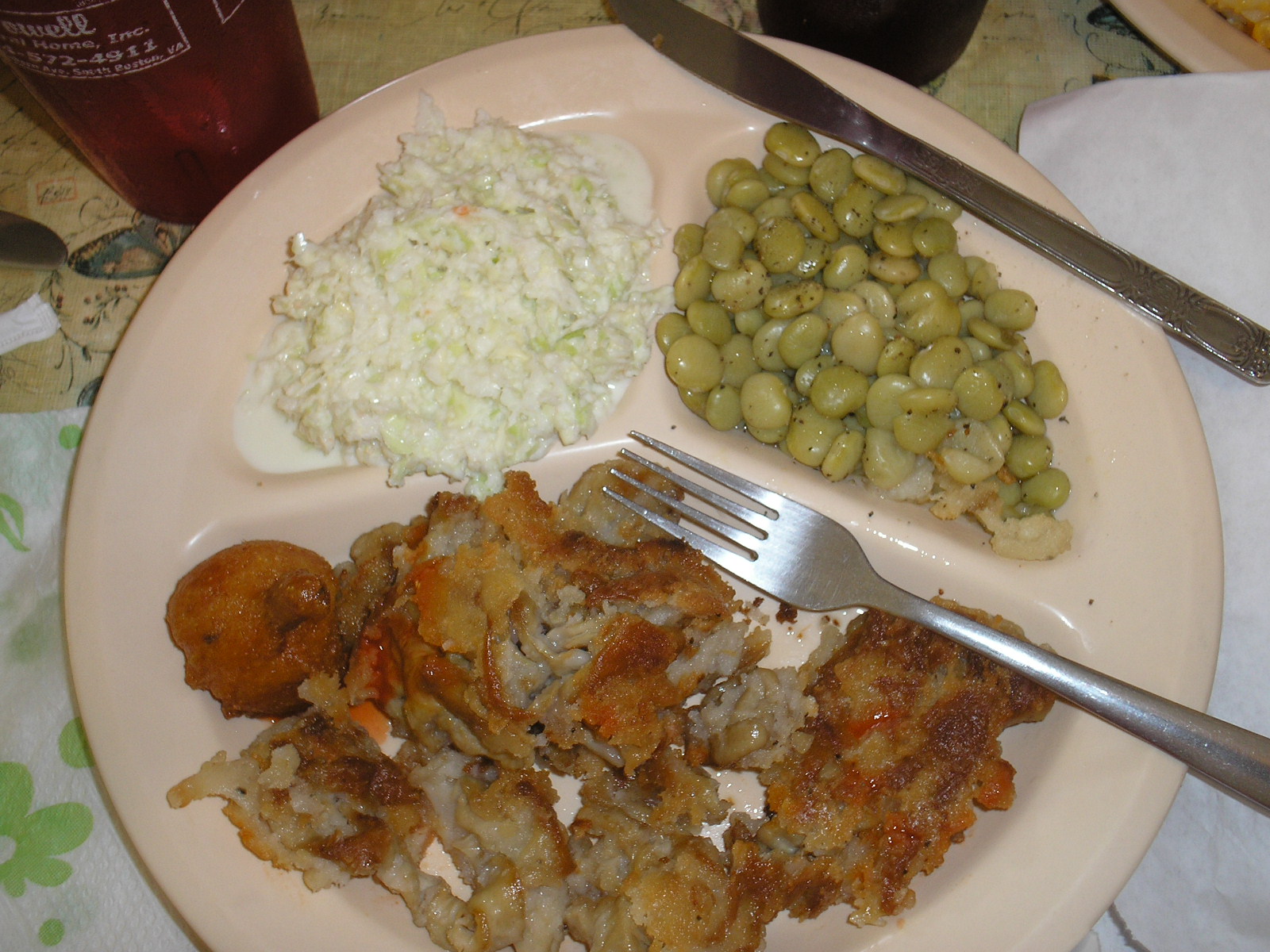
Chitlins with slaw and butterbeansWell, on this occasion, my youngest uncle and an older cousin and their respective spouses had driven over from Tidewater Virginia, so we all went out to Paulette’s Place in Halifax, which served batter-fried fish, shrimp, oysters, and chitlins. My father, my uncle, and I ordered the chitlins. Everyone else had better sense. My uncle drowned his in vinegar, and I dumped tabasco on mine, but I think my father was the only one who didn’t leave any on his plate. The rest of the menu was fine.

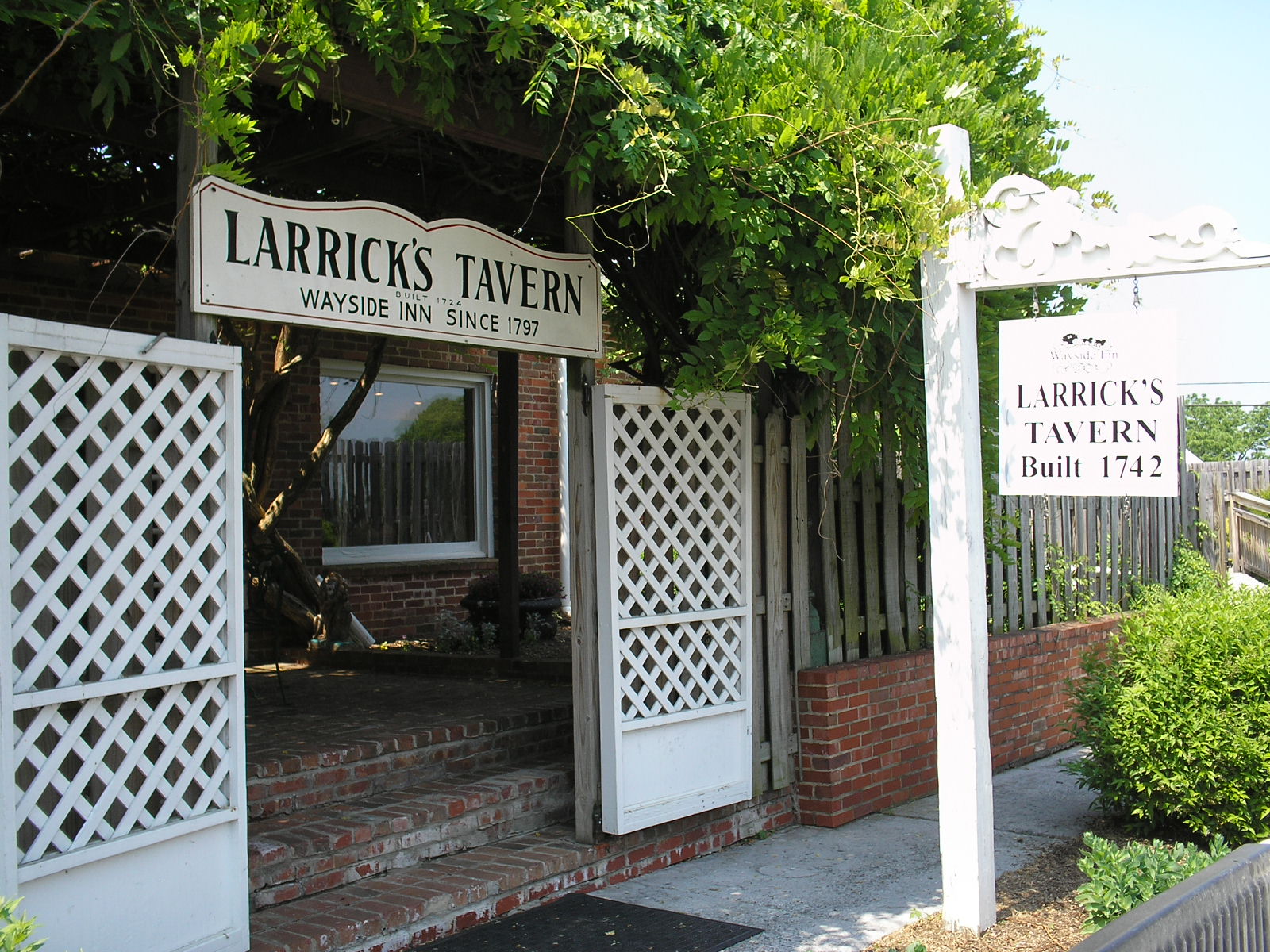
Larrick’s Tavern, Wayside Inn, Middletown, VAOldest restaurant – The next leg of our journey ran through the Blue Ridge Mountains and up the Shenandoah Valley to Middletown, VA, where we stopped for a light snack at the historic Wayside Inn, founded in 1797, before paying respects to my aunt, who lives on a farm nearby, and my cousin’s wife and mother-in-law, who live up the road a bit in a house that dates back to the 1740s. (My cousin was off hunting big game on a South African preserve.) The four of us confused the waitress by ordering three house salads and three bowls of their signature Colonial Peanut Soup, reputed to be one of George Washington’s favorites.

Most sushi – The reason we snacked so lightly in Middletown is that we were headed for another family reunion at the other end of I-66, at the Todai [= Lighthouse] Restaurant in Fairfax with: my brother, sister-in-law, and their two kids; my sister and brother-in-law from Annapolis, MD; my father, who came up from South Boston; and my mother-in-law and sister-in-law, who were flying back to Minneapolis the next day, leaving us the car for the rest of our trip. When I eat at Todai, I concentrate on the huge variety of sushi and a few cold salads. When my brother in Fairfax turned 50, I took him to Todai for lunch and we ate 50 pieces of sushi between us.

Dishes at Fiesta Atlantic, Stamford, ConnecticutBest oasis – Our worst day of driving, by far, was between Fairfax, VA, and New Haven, CT, on the Friday before Memorial Day. Even though we avoided I-95 as much as possible, we spent far too much time in bumper-to-bumper traffic until we got past Baltimore during the morning rush hour, then again after we got across the Hudson on the Tappan Zee Bridge later that afternoon. After trying a stretch of U.S. 1 between Greenwich and Stamford, we decided to break for an early supper in Stamford. After finding the food court still under construction at a brand-new downtown shopping plaza, we discovered Fiesta Atlantic, a refreshing Peruvian restaurant across Atlantic Street that was already open for dinner before 5 pm. Their Sangria had canned fruit cocktail in the bottom of the glass, but tasted quite refreshing, and the two appetizers and two side dishes we ordered were fresh, flavorful, and nicely presented. We had cebiche (ceviche) mixto, ensalada de pulpo (octopus), platano (plaintain) frito, and yuca (yucca) frita.

Most unexpected language – After a long but lovely ride through Pennsylvania on I-80, then through a rather ugly corner of Ohio, we took the North Ridgeville exit on the way to the pleasant Cleveland suburb of Avon Lake, OH, where a busy friend had invited us to stay the night. We had agreed to meet her for breakfast the next morning, so we looked for supper on our own. The Gourmé [sic] Family Restaurant (“Good Home Cooking”) on Lorain Road caught our fancy, so we sampled their fare. I had their lake perch and pierogie combination. Two things puzzled me. Why did every table have a squeeze bottle of syrup as well as ketchup on it? (If ketchup was for the fried fish, was syrup for the pierogies?) And which language was the staff speaking to each other? Their appearance and their accents were vaguely Eastern European, but I heard enough of their talk to rule out Germanic, Slavic, Romance, Hellenic, Turkic, and even Finnic and Ugric. It turned out to be Albanian. We never did solve the mystery of the syrup.

1 Comment

Filed under family, food, military, travel, U.S.

A Quaker Transition to the Talkies

On New Year’s Day, my father turned 82. His Japanese driver’s license says he was born in the 14th year of Taisho. All during my childhood in Japan, his age advanced in parallel with the Showa reign year. Here’s a short, preliminary tribute to one of his best-honed skills:

Perhaps there’s an element of truth to my teasing claim that Dad left the Quakers to become a Baptist because he just couldn’t keep his mouth shut long enough. But that cheap hypothesis fails to explain why the rest of his siblings also abandoned their Quaker roots.

Of course, Dad didn’t leave all his Quaker values behind. Not even the value of silence. During Wednesday night prayer meetings at the First Baptist Church in Winchester, Virginia (my mother’s home church), where he served as associate pastor one furlough, he made some of the Baptists uneasy enough to speak up when he allowed periods of silent prayer to go on a little longer than they were used to.

But Dad does believe in the value of talk—for preaching, for teaching, for learning, for sharing, to be sure, but most of all for healing. That must be why he chose to concentrate on pastoral counseling at seminary and to serve as an institutional chaplain, rather than a church-planting evangelist, during his first two terms as a missionary in Japan. And later to teach pastoral care at Seinan (‘Southwestern’) Seminary in Fukuoka.

He does preach a good sermon, though. He doesn’t shout, thump the Bible, or silently wait for the Spirit to move him. Nor does he read a dry lecture on comparative theology or religious history. Instead, he keeps his sermons fairly short, fairly conversational, and almost always tells a story to get his message across. He knows that great truths are best conveyed by great stories. His homilies have surely come a long way since he practiced his first sermons while plowing, preaching temperance to the back end of a mule.

Leave a comment

Filed under family, religion

Foreign Outliers in Kyoto 50 Years Ago

Fifty years ago, I was attending second grade at the U.S. Army Base on the grounds of the Kyoto Botanical Garden. I’m not sure whether it might have been called Camp Botanical Garden (Shokubutsuen, 植物園). I remember that some of my military-brat classmates had to ride a school bus from nearby Camp Otsu, which didn’t have its own school at the time.

It was my third school in as many years, and the next year I would enter my fourth. The previous year, while we were on furlough at Southern Seminary in Louisville, Kentucky, I had attended first grade at Greathouse Elementary School in St. Matthews. The year before that, I had attended the Japanese kindergarten on the grounds of Seinan Jo Gakuin, a Baptist girls school where my father served as chaplain.

After we returned from furlough in 1956, my father became chaplain of the newly established Japan Baptist Hospital in Kyoto. The military base closed down the very next year, so the local missionaries hastily organized Kyoto Christian Day School (now KIS), using Calvert School curriculum materials.

The photo above is from a KCDS field trip to the Kyoto police headquarters, maybe in 1958. Our adult chaperone was Mr. Daub, whose eldest son Philip was in my brother’s class (a year behind me). My brother is the disgusted-looking kid in the front row, with Philip to his right. I’m the angry-looking kid in the front row, with my classmate David Thurber to my left. I don’t remember much about David except that he was somehow related to the writer, James Thurber; and that he had a wide-smile contest at his birthday party, which I thought was kind of unfair because he had the widest mouth in the class (and not just because I was such an accomplished frowner).

Behind me are two more of my classmates, Danny Hesselgrave and John Hawley. I remember riding my bike to the Hesselgraves on more than a few weekends, where Danny and I would play with his sets of little plastic cowboy and Indian figures, each of us taking one side or the other. Our games would always start with the question “Peace or War?” I once experimented—only once—with the game-killing answer, “Peace!”

John Hawley was an only child with what we imagined to be a rich grandmother back in England, who used to send him much more impressive sets of little metal figurines: legions of finely crafted toy soldiers in the colors of famous British regiments. I remember only once or twice going out to visit him in a huge mansion on a large estate in Yamashina. To us, he seemed the poor little rich kid. We envied him his toys, but not what we imagined to be his solitude.

AFTERTHOUGHTS: Such, anyway, were my childish impressions at the time. In truth, we were all poor little rich kids relative to our Japanese neighbors at the time. We lived in a large American house on a lot so big that it was later subdivided to accommodate at least half a dozen Japanese houses for employees of the Baptist Hospital. We had a Japanese maid, as did most other American missionaries at the time. And we got presents of various kinds either from relatives or churches back home or from Sears or Montgomery Ward catalogs we ordered from in time for Christmas every year.

At the time, we only knew that John’s father was a writer of some kind, but I’ve just this weekend learned what an extraordinary man he was. Frank Hawley (1906-1961) was a linguist who taught at SOAS, spent the 1930s in Japan, helped found the Japanese language section of the BBC after being repatriated to England during the war, then returned to Japan where he worked as a writer and collector of well over 20,000 books, some of which were destroyed during the war, others first confiscated then purchased by Keio University in Tokyo, and others after his death now housed at the University of Hawai‘i.

It also turns out that Danny Hesselgrave’s father was a very productive author in his own right. I had thought the Hesselgraves were Evangelical Lutheran, but now I’ve found that they belonged to a pietist, congregationalist offshoot of Scandinavian Lutheranism, the Evangelical Free Church, explained further below.

There were also Finnish Lutheran missionaries in Kyoto at the time, and at least two Finnish MKs, John and Eva Kekkonen. Eva taught the kids of KCDS a game that we used to call Finnish Red Rover, where one kid in the middle tried to tag the other kids as they ran between the endzones, turning each person tagged into a tagger until all had been caught. (Eva was also the object of my first secret boyhood crush.)

Thanks to a random, mindful act of Internet archiving [PDF], I’ve discovered more about the first school teacher whose name I remember. Miss Pilcher was the first principal and first credentialed teacher of Kyoto Christian Day School.

Reflecting the keen interest of the denomination to which they belonged, the fledgling church [Evangelical Free Church of Walnut Creek, now known as NorthCreek Church] was very missionary-minded from the start, and this was further demonstrated when Shirley Pilcher left for Japan. Shirley’s folks, Carl and Ada, often had missionaries visit in their home thus exposing their children to the spiritual needs of the wider world.

After high school, Shirley went to Trinity College, the EFCA school in Chicago, and then to San Francisco State where she completed her teaching credential. After a second grade assignment for one year in Walnut Creek, she felt God’s call to overseas work under the Evangelical Free Church Overseas Missions Department, as it was then called. This opportunity had developed on very short notice, so a commissioning service was quickly arranged and held on the evening of July 31, 1958. About 200 people attended. A few days later, with about 100 well-wishers at the airport, Shirley left for Kyoto, Japan, where she spent four years teaching mostly missionary children plus some from U.S. Embassy families. Church records show that the stipend paid to her monthly was $1,287.

Because Shirley would spend her next birthday thousands of miles from home, all in the church family were encouraged to send her appropriate greetings. For those wishing to send money, envelopes were provided. A telephone call to her was initiated from the church during a Sunday school hour; it was probably very early morning in Kyoto. In 1962 she returned home to a public school teaching assignment in Alamo. Later, Shirley met Foster Donaldson and, after they were married, they served for many years in the Philippines with Overseas Crusade where they were engaged in a Bible correspondence ministry and provided literature resources for pastors. They also opened a couple of bookstores there. Shirley lost her life to cancer in January 2004; Fos continues to be active in the church. Following is a reproduction of the farewell program for Shirley’s departure for Japan.

I must confess that, until today, I had never heard of the Evangelical Free Church of America. Here’s a bit of its history, from the document I discovered online.

Scandinavians began streaming to the United States in the late nineteenth century, settling mainly in the East and Midwest. They brought with them all of the thinking, the implements, and the practices of the culture they knew abroad. One big difference was that there was no state church in America. Most Christian immigrants attended a Lutheran Church where their own languages were spoken, Swedish, Norwegian, or Danish. Following their experiences back home, especially where they did not find evangelical messages in the churches here, many began to meet privately for worship, Bible study, and fellowship. In 1884 a Norwegian-Danish Free Church was founded in Tacoma, Washington. It was the first church with “Free church” roots on the West coast. Shortly a group of seven persons formed the next Norwegian-Danish Church, this one in Boston. Those of this European background thus organized two conferences, one “eastern” and one “western.” In time these two joined to form the Evangelical Free Church Association….

Although there were a number of leaders in those early years, the research points to John. G. Princell as the “founder” of the Swedish Evangelical Free Church of America. His counterpart was R. A. Jernberg of the Norwegian-Danish Free Church. Princell attended the University of Chicago, majoring in Latin, Greek, and mathematics. Jernberg graduated from Yale University and the Chicago Theological Seminary. So both of these men were learned and well-trained in the American tradition that the best educated men were those “of the cloth.”

People feared becoming a denomination because that word was associated with Lutheranism in Europe….

In the early history of these Scandinavian free churches, all the preaching was done in the native tongues since the immigrants still spoke them here. But their children were learning English rapidly and so English gradually took over, first in the Sunday schools. And little by little it then followed in the preaching services despite some resistance by the “old timers.” In some churches it was necessary for lay people to provide the pastoral leadership owing to the absence of ordained and capable men. So efforts to unite the two regional Norwegian-Danish associations had taken a long time, and getting those two to agree, despite their long years of political union in Europe, was not accomplished without a lot of discussion. And then there were many further discussions before they united with the Swedes!

3 Comments

Filed under education, family, Japan, religion, U.S.

Uncle “Happy” Herman, R.I.P.

Last week my oldest uncle died, leaving my father the eldest surviving member of his seven siblings. (Two more died in early childhood.) As my father tells it, Uncle Herman

spent three years in the first grade and left school after the third grade. He loved to rock and one of his nicknames was Rocking Chair. He was almost always happy, and it took so little to make him happy that we nicknamed him Happy. The pastor said at his graveside, “Wouldn’t it be good if all of us would live with such an attitude that we would be nicknamed Happy?”

Uncle Herman never studied much, never traveled much, and did manual labor all his life, first as a farmhand, then as a service station attendant. He and my father were the only two brothers never to serve in the military. Uncle Herman, born in 1915, was too old for World War II, and my father had a ministerial deferment, graduating from the University of Richmond in 1945.

Like his own father, Uncle Herman spent most all his life within a small radius of the pulpmill town of Franklin, Virginia, home of Union Camp Paper (now owned by International Paper). One highlight of his retirement years was a car trip to Florida and back with my father and my youngest uncle to visit their only sister before she died. (Her brothers just called her “Sister” so she was “Aunt Sister” to us as kids.)

Aunt Bessie kept Herman on a short leash. She was a wonderful cook and a frugal housekeeper. Together they raised two fine, hard-working daughters who took good care of their dad after Bessie died. Their younger daughter, who’s my age, likes to travel when she takes vacation time.

To give an outsider’s view of what life was like in Tidewater Virginia during Herman’s youth, here’s a passage from James McBride’s The Color of Water: A Black Man’s Tribute to His White Mother (Riverhead Books, 1996), pp. 39-40.

My father was a traveling preacher. He was just like any traveling preacher except he was a rabbi…. [H]e got an offer to run a synagogue in Suffolk, Virginia…. He said, “We’re moving,” and we went to Suffolk, Virginia, around 1929. I was eight or nine at the time.

I still remember the smell of the South. It smelled like azaleas. And leaves. And peanuts. Peanuts everywhere. Planters peanuts had their headquarters in Suffolk. Mr. Obici ran it. He was a big deal in town. The big peanut man. He gave a lot of money out to people. He built a hospital. You could buy peanuts by the pound in Suffolk for nothing. There were farmers growing peanuts, hauling peanuts, making peanut oil, peanut butter, even peanut soap. They called the high school yearbook The Peanut. They even had a contest once to see who could make the best logo for Planters peanut company. Some lady won it. They gave her twenty-five dollars, which was a ton of money in those days.

Suffolk was a one-horse town back then, one big Main Street, a couple of movie theaters—one for black folks, one for white folks—a few stores, a few farms nearby, and a set of railroad tracks that divided the black and white sections of town. The biggest event Suffolk had seen in years was a traveling sideshow that came through town on the railroad tracks, with a stuffed whale in a boxcar. The folks loved that. They loved anything different, or new, or from out of town, except for Jews. In school the kids called me “Christ killer” and “Jew baby.” That name stuck with me for a long time. “Jew baby.” You know it’s so easy to hurt a child.

Tateh worked at the local synagogue, but he had his eye on this huge old barn-type building across the tracks on the so-called colored side of town with the aim of starting a grocery store there. Well, that upset some of the synagogue folks. They didn’t want their holy rabbi going into business—and doing business with niggers, no less!—but Tateh said, “We’re not moving anymore. I’m tired of moving.” He knew they’d get rid of him eventually—let’s face it, he was a lousy rabbi. He had a Jewish friend in town named Israel Levy who signed a bank note that allowed Tateh to get his hands on that old place. Tateh threw a counter and some shelves in there, an old cash register, tacked up a sign outside that said “Shilsky’s Grocery Store” or something to that effect, and we were in business. The black folks called it “Old Man Shilsky’s store.” That’s what they called him. Old Man Shilsky. They used to laugh at him and his ragtag store behind his back, but over the years they made Old Man Shilsky rich and nobody was laughing then.

Leave a comment

Filed under family

Deaths in the Family

All the news coverage surrounding the drawn-out deaths of more famous people back around the Kalends of April this year cast a macabre shadow over the much quieter deaths of two of my kinfolk, my second oldest surviving uncle and my youngest aunt.

As their deaths began to sink in, I found myself reduced to a kind of catatonic state: staring off into the distance rather than burying my nose in a book as I usually do while waiting for the bus to work; tolerating sappier shows on TV than I would normally have the patience for; damping down my verbal input and output while silently recycling old memories through my head—all subtle mourning behaviors for someone who is fairly quiet to begin with.

Although he had a Hebrew middle name like half his brothers (whose monikers included Jeptha, Joel, and Jahue), Uncle Bernard Elijah was not a recent Jewish immigrant. His (and my) ancestors arrived from England on the Atlantic shores of Virginia back in the mid 1600s, but they didn’t get very far past the Great Dismal Swamp until the mid 1900s. Most were either Baptists or Quakers, the latter being especially fond of Hebrew names, it seems.

As the middle kid of seven who survived childhood on tenant farms in Southampton County, Va., Bernard was my father’s next older brother. Although not very religious himself, he looked after his missionary kid brother’s family in Japan. We always enjoyed the Virginia ham he would send every Christmas, and looked forward to visiting him and his family every furlough.

He had retired after 33 years as a produce buyer for Colonial Stores, and had been married to my Aunt Marie for 63 years. He was a tough old bird. He was riddled with cancer, was in constant pain, and had been given six months left to live for about eight years before he finally gave up the fight. He was 84.

Aunt Becky was not blood-kin. She was married to my father’s youngest brother, whom he called Junior, so that we kids referred to him as Uncle Junior, just as we used to talk about Dad’s sister as Aunt Sister.

But Becky proved to be just the kind of kin I needed when I landed on her doorstep in tiny Ivor, Va., disoriented by rural America after a childhood in urban Japan, disillusioned with my religious heritage, and disinterested in continuing my formal education.

Uncle Junior offered me work therapy at the filling station and tire shop he managed for Becky’s Dad, who owned an oil distributorship, a couple of service stations, a furniture store, a plumbing business—a fair portion of what few commercial opportunities were available in a town of not much more than 300 souls. Work therapy was just what I needed. There’s nothing like repairing a flat tire on a mud-encrusted logging truck to bring one’s airy philosophizing back down to earth.

Meanwhile, Aunt Becky offered me talk therapy: a sympathetic ear and a genuine curiosity about the wider world. Only ten years older than me, she was as much an elder sister as an aunt and foster mother.

Being from a relatively prosperous family, she had been away to college, but she never seemed able to find a healthy compromise between her roots planted deep in the local soil and her longing to soar far beyond. She seemed to keep sacrificing one for the other. But maybe I’m just projecting my own sense of the same everlasting tensions.

With their encouragement, and financial support from a secret local benefactor, I went off to college, but dropped out in my sophomore year and had to join the Army. Becky and I eventually lost touch after she and my uncle divorced. By then, I had settled far away.

A few years ago, out of the blue, I got an email message from her. We were back in touch. I was able to pay her a visit when I went to D.C. for a meeting. Last Christmas, she sent us a Virginia ham. Last year, during my daughter’s spring break, I dragged her around to see a bunch of my Virginia uncles and aunts and cousins, and also to see the Quaker cemetery where her paternal great-grandparents, great-great grandparents, and other assorted kinfolk are buried. City kid Rachel (another Hebrew name!) thought it odd to be so attached to a patch of soil. It was a curious spring break for a Yalie. I suppose she should have been skiing in Switzerland.

It was during this year’s spring break that we first got word from a cousin by email that Aunt Becky was in Portsmouth Naval Hospital. Not just in hospital, but on life support. She had gone in because her legs were giving out on her. It turned out her kidneys were failing. And then everything seemed to give out at once. Dialysis and artificial blood hormones had to take over the work of her stalled kidneys. A respirator did the work of her emphysema-damaged lungs. An external filtering machine had to screen out a deadly organism in her blood. And heavy sedation was needed to prevent the panic attacks that made her blood pressure spike and plunge.

The doctors worked to stabilize her for weeks, but couldn’t seem to rescue one organ without endangering the others. Meanwhile, her three children made sure she always had a familiar face and voice at her bedside. At noon on 30 March 2005, she was disconnected from all the various means of artificial life support. Before sunset, she had slipped away forever.

Leave a comment

Filed under family, U.S., Virginia