Category Archives: education

How Modernism Feeds Tribalism

From The Fate of Africa: A History of Fifty Years of Independence, by Martin Meredith (PublicAffairs, 2005), pp. 154-157:

African societies of the pre-colonial era – a mosaic of lineage groups, clans, villages, chiefdoms, kingdoms and empires – were formed often with shifting and indeterminate frontiers and loose allegiances. Identities and languages shaded into one another. At the outset of colonial rule, administrators and ethnographers endeavoured to classify the peoples of Africa, sorting them out into what they called tribes, producing a whole new ethnic map to show the frontiers of each one. Colonial administrators wanted recognisable units they could control. ‘Each tribe must be considered as a distinct unit,’ a provincial commissioner in Tanganyika told his staff in 1926. ‘Each tribe must be under a chief.’ In many cases, tribal labels were imposed on hitherto undifferentiated groups. The chief of a little-known group in Zambia once ventured to remark: ‘My people were not Soli until 1937 when the Bwana D.C. [District Commissioner] told us we were.’ When local government was established under colonial rule, it was frequently aligned with existing ‘tribal areas’. Entirely new ethnic groups emerged, like the Abaluyia or Kalenjin of western Kenya, formed from two congeries of adjacent peoples. Some colonial rulers used tribal identities to divide their subjects, notably the British in southern Sudan and the French in Morocco. Chiefs, appointed by colonial authorities as their agents, became the symbol of ethnicity.

Missionary endeavour added to the trend. In the process of transcribing hitherto unwritten languages into written forms, missionaries reduced Africa’s innumerable dialects to fewer written languages, each helping to define a tribe. The effect was to establish new frontiers of linguistic groups and to strengthen the sense of solidarity within them. Yoruba, Igbo, Ewe, Shona and many others were formed in this way.

Missionaries were also active in documenting local customs and traditions and in compiling ‘tribal’ histories, all of which were incorporated into the curricula of their mission schools, spreading the notion of ethnic identity. African teachers followed suit. In southern Nigeria, young men from Ilesha and Ijebu who attended school in Ibadan or Oyo were taught to write a standard form of the Yoruba language and to identify themselves as Yoruba – a term previously reserved for subjects of the Oyo empire. As mission stations were largely responsible for providing education, educational achievement tended to depend on their locality and thus to follow ethnic lines.

Migration from rural areas to towns reinforced the process. Migrants gravitated to districts where fellow tribesmen lived, hoping through tribal connections to find housing, employment or a niche in trading markets. A host of welfare associations sprang up – ‘home-boy’ groups, burial and lending societies, cultural associations, all tending to enhance tribal identity. Certain occupations – railwaymen, soldiers, petty traders – became identified with specific groups which tried to monopolise them.

It was in towns that ethnic consciousness and tribal rivalry grew apace. The notion of a single Igbo people was formed in Lagos among the local ‘Descendants’ Union’. The Yoruba, for their part, founded the Egbe Omo Oduduwa – a ‘Society of Descendants of Oduduwa’, the mythical ancestor of the Yoruba people; its aim was ‘to unite the various clans and tribes in Yorubaland and generally create and actively foster the idea of a single nationalism throughout Yorubaland’. Ethnic groups became the basis of protest movements against colonial rule.

In the first elections in the postwar era in Africa, nationalist politicians started out proclaiming nationalist objectives, selecting party candidates regardless of ethnic origin. But as the number of elections grew, as the number of voters expanded, as the stakes grew higher with the approach of independence, the basis for campaigning changed. Ambitious politicians found they could win votes by appealing for ethnic support and by promising to improve government services and to organise development projects in their home area. The political arena became a contest for scarce resources. In a continent where class formation had hardly begun to alter loyalties, ethnicity provided the strongest political base. Politicians and voters alike came to rely on ethnic solidarity. For politicians it was the route to power. They became, in effect, ethnic entrepreneurs. For voters it was their main hope of getting a slice of government bounty. What they wanted was a local representative at the centre of power – an ethnic patron who could capture a share of the spoils and bring it back to their community. Primary loyalty remained rooted in tribal identity. Kinship, clan and ethnic considerations largely determined the way people voted. The main component of African politics became, in essence, kinship corporations.

The formation of one ethnic political party tended to cause the formation of others. In Nigeria the National Council of Nigeria and the Cameroons, the first modern political organisation in West Africa launched in 1944, started out with the aim of establishing a broad-based national movement, but after tribal dissension it became an Eastern regional party, dominated by Igbo politicians. Yoruba politicians left to form the Action Group, building it around the nucleus of Egbe Omo Oduduwa. In Northern Nigeria, the Hausa-Fulani, while disdaining the nationalist cause which Southerners espoused, nevertheless formed in 1949 the Northern People’s Congress as a political offshoot of a predominantly Hausa cultural organisation, Jam’yyar Mutanen Arewa – Association of the Peoples of the North. In a more extreme example, in the Belgian Congo rival tribal parties were launched by the score. In most countries, political leaders spent much time on ‘ethnic arithmetic’, working out alliances that would win them power and keep them there.

Few states escaped such divisions. In Tanganyika, Julius Nyerere was helped, as he himself acknowledged, by the fact that the population was divided among 120 tribal groupings, none of which was large enough or central enough to acquire a dominant position. He benefited too from the common use of the Swahili language, spread initially by Arab traders, then taken up by the Germans and the British as part of their education system. Other states had to contend with a variety of languages, sometimes numbering more than a hundred. In all, more than 2,000 languages were in use in Africa.

There was a widespread view at the time of independence that once the new states focused on nation-building and economic development, ethnic loyalties would wither away under the pressure of modernisation. ‘I am confident’, declared Nigeria’s first prime minister, Abubakar Tafawa Balewa, during a 1959 debate over the motion to ask for independence, ‘that when we have our own citizenship, our own national flag, our own national anthem, we shall find the flame of national unity will burn bright and strong.’ Ahmed Sékou Touré of Guinea spoke in similar terms in 1959. ‘In three or four years, no one will remember the tribal, ethnic or religious rivalries which, in the recent past, caused so much damage to our country and its population.’ Yet African governments were dealing not with an anachronism from the past, but a new contemporary phenomenon capable of erupting with destructive force.

It doesn’t seem all that different in kind, only in degree, from what happened in Europe with the spread of vernacular literacy, Protestantism, historical and comparative linguistics, and the scientific subclassification of everything and everyone on earth—and what continues apace in modern universities, prisons, and other political/protective patronage networks that privilege race/ethnicity over social class, religion, or other more mutable cross-cutting categories.
Leave a comment

Filed under Africa, democracy, education, Europe, language, nationalism

Age, Class, and Credulity in the Great Terror

From The Whisperers: Private Lives in Stalin’s Russia, by Orlando Figes (Metropolitan, 2007), pp. 172-174:

How did people respond to the sudden disappearance of colleagues, friends and neighbours in the Great Terror? Did they believe that they were really ‘spies’ and ‘enemies’, as claimed by the Soviet presses? Surely they could not think that of people they had known for many years?…

Nadezhda Grankina encountered many Party members in the Kazan prison in 1938. They all continued to believe in the Party line. When she told them of the famine in 1932, they said ‘it was a lie, that I was exaggerating so that I could slander our Soviet way of life’. When she told them how she had been kicked out of her home for no reason, or how the passport system had destroyed families, they would say, ‘True, but that was the best way to deal with people like you.’

They thought I had got what I deserved because I was critical of the excesses. Yet when the same happened to them, they thought it was a mistake that would be fixed – because they had never had any doubts whatsoever, and whatever instructions had come down from the top, they had always cheered and carried them out … And when they were being expelled from the Party, none of them stood up for each other; they all kept quiet or raised their hands in support of the expulsion. It was some kind of universal psychosis.

For the mass of the population there were always two realities: Party Truth and truth based on experience. But in the years of the Great Terror, when the Soviet press was full of the show trials and the nefarious deeds of ‘spies’ and ‘enemies’, few were able to see through the propaganda version of the world. It took extraordinary will-power, usually connected to a different value-system, for a person to discount the press reports and question the basic assumptions of the Terror. For some people it was religion or their nationality that allowed them to take a critical view; for others a different Party creed or ideology; and for others still it was perhaps a function of their age (they had seen too much in Russia ever to believe that innocence protected anybody from arrest). But for anyone below the age of thirty, who had only ever known the Soviet world, or had inherited no other values from his family, it was almost impossible to step outside the propaganda system and question its political principles.

The young were particularly credulous – they had been indoctrinated in this propaganda through Soviet schools. Riab Bindel remembers:

At school they said: ‘Look how they won’t let us live under Communism – look how they blow up factories, derail trams, and kill people – all this is done by enemies of the people.’ They beat this into our heads so often that we stopped thinking for ourselves. We saw ‘enemies’ everywhere. We were told that if we saw a suspicious character on the street, we should follow and report him – he might be a spy. The authorities, the Party, our teachers -everybody said the same thing. What else could we think?

After leaving school, in 1937, Bindel found a job in a factory, where the workers regularly cursed the ‘enemies of the people’.

When the factory had a breakdown, they would say: ‘Comrades, there is sabotage and treachery!’ They would look for someone who had a blemish on his record and call him an enemy. They would put him in prison, beat him up until he confessed that he had done it. At his trial they would say: ‘Look at the bastard who was working secretly among us!’

Many workers believed in the existence of ‘enemies of the people’ and called for their arrest because they associated them with the ‘bosses’ (Party leaders, managers and specialists) whom they already blamed for their economic difficulties. Indeed, this mistrust of the elites helps to explain the broad appeal of the purges among certain sections of the population, which perceived the Great Terror as a ‘quarrel among the masters’ that did not affect them. This perception is neatly illustrated by a joke that circulated widely in the years of the Terror. The NKVD bangs on the door of an apartment in the middle of the night. ‘Who’s there?’ the man inside asks. ‘The NKVD, open up!’ The man is relieved: ‘No, no,’ he tells them, ‘you’ve got the wrong apartment – the Communists live upstairs!’

Leave a comment

Filed under education, Russia, USSR

Early Days of the Polynesian Society

I recently discovered that the right venerable Polynesian Society in New Zealand has been slowly digitizing the back issues of its long-lived Journal of the Polynesian Society and mounting them on its website, working together with the University of Auckland Library. At this point, one can browse volumes 1 (1892) through 40 (1931). A perusal of the front matter in the earliest volumes transports one into another era.

Volumes 1 (1892) through 3 (1894) list the Patron of the Society as “Her Majesty Liliuokalani, Queen of Hawaii.” Her reign began in 1891, after the death of her brother, King Kalākaua. The Queen was deposed in January 1893, the rebels declared the Kingdom a Republic in July 1894, and then arrested the Queen in January 1895 after suppressing a royalist counterrebellion.

Volumes 4 (1895) through 8 (1899) accordingly list the Patron of the Society as “Liliuokalani, ex-Queen of Hawaii.” No Patron is listed in the volumes from 1900 through 1903, but the ex-Queen still heads the list of Honorary Members, with her address given as “Honolulu, Sandwich Islands.” Next on the list is the “Rev. R. H. Codrington, D.D., Wadhurst Rectory, Sussex, England.” Codrington was the author of The Melanesian Languages (Oxford, 1885).

From 1904 through 1910, the ex-Queen’s address is given as “1588, 21st Street, Washington, U.S.A.” and the Rev. Codrington’s as “Chichester, England.” In 1911, the ex-Queen is back in the “Hawaiian Isles.” Back numbers of the journal in those years cost 2s. 6d.

In 1905, the Society acquired a new Patron, “His Excellency, Lord Plunket, Governor of New Zealand.” From 1911, the Patron is listed as the “Right Hon. Baron Plunket, K.C.M.G., K.C.V.O., ex-Governor of New Zealand, Old Connaught, Bray, County Wicklow, Ireland.”

The annual report report of the governing council for the year ending in December 1911, which appears in volume 21 (1912) begins with a retrospective and ends with its customary financial report.

The Council feels in presenting its nineteenth report that there is some justification for congratulating the Society on having attained its twentieth year of existence….

Our financial position is good, though there are a few members in arrear with their subscriptions. We end the year with a balance to our credit of £28 18s. 7d.

At that point the society had 201 members. Good show, chaps.

Leave a comment

Filed under education, Polynesia, publishing

Overcompensating Kids of ‘Kulaks’

From The Whisperers: Private Lives in Stalin’s Russia, by Orlando Figes (Metropolitan, 2007), pp. 143-145:

Many ‘kulak’ children ended up as ardent Stalinists (and even made careers for themselves by joining the repressive organs of the state). For some the transformation involved a long and conscious process of ‘working on themselves’ that was not without its psychic costs. Stepan Podlubny is an example. Born in 1914 to a peasant family in the Vinnitsa region of western Ukraine, Stepan and his mother fled to Moscow in 1929, after his father had been exiled as a ‘kulak’ to Arkhangelsk. Stepan found a job as an apprentice in the factory school of the Pravda printing plant. He joined the Komsomol, headed a brigade of shock workers, edited a wall-newspaper (a form of agitprop), became a member of the factory board, and at some point it seems he was recruited as an informer by the police. All this time he carefully concealed his ‘kulak’ origins. He kept a diary which charted his own struggle to purge the ‘sick psychology’ of his peasant ancestors and reconstruct himself as a Soviet citizen. He tried to read the correct books, to adopt all the correct attitudes, to cultivate himself by dressing neatly and learning how to dance, and to develop in himself the Soviet public virtues of activity and vigilance. He drew up a ‘balance sheet’ of his ‘cultural progress’ at the end of every year (just as the state’s own planning agencies drew up annual balances of economic progress in the Five Year Plan). His ‘kulak’ background was a constant source of self-loathing and self-doubt. He saw it as an explanation for his own shortcomings, and wondered whether he was capable of ever really becoming a fully equal member of society:

13.9.1932: Several times already I have thought about my production work. Why can’t I cope with it painlessly? And in general, why is it so hard for me? … A thought that I can never seem to shake off, that saps my blood from me like sap from a birch tree – is the question of my psychology. Can it really be that I will be different from the others? This question makes my hair stand on end, and I break out in shivers. Right now, I am a person in the middle, not belonging to one side nor to the other, but who could easily slide to either.

Podlubny was constantly afraid that his origins would be exposed, that he would be denounced at work (a ‘snake pit’ filled with ‘enemies’), leading to his sacking and possible arrest. Eventually his ‘kulak’ origins were indeed discovered by OGPU, which told him it would not take action, provided he ‘continued to do good work for them’. It seems likely that Podlubny began to inform on his work colleagues. In his diary he confessed to feeling trapped – he was repulsed by his public persona and he clearly longed to ‘be himself’.

8.12.1932: My daily secretiveness, the secret of my inside – they don’t allow me to become a person with an independent character. I can’t come out openly or sharply, with any free thoughts. Instead I have to say only what everyone [else] says. I have to walk on an uneven surface, along the path of least resistance. This is very bad. Unwittingly I’m acquiring the character of a lickspittle, of a cunning dog: soft, cowardly, and always giving in.

The news that a fellow student had not been punished after he had been exposed as the son of a ‘kulak’ was greeted by Podlubny as a ‘historical moment’, suggesting as it did that he no longer needed to feel so stigmatized by his social origins. He embraced this personal liberation with joy and gratitude towards the Soviet government.

2.3.1935: The thought that I too can be a citizen of the common family of the USSR obliges me to respond with love to those who have done this. I am no longer among enemies, whom I fear all the time, at every moment, wherever I am. I no longer fear my environment. I am just like everybody else, free to be interested in various things, a master interested in his lands, not a hireling kowtowing to his master.

Six months later, Podlubny was accepted as a student at Moscow’s Second Medical Institute. He had always dreamed of studying at a higher institute, but knew his ‘kulak’ origins would be a stumbling block. The fact that the Komsomol at the Pravda plant had supported his application was for him the final affirmation of his new Soviet identity.

It sure would be nice if a lot of people who are either born into ‘class enemy’ status or educated into it could work out their feelings of guilt and entitlement outside the political realm. Let them manage hedge funds, not governments.

1 Comment

Filed under economics, education, Russia, USSR

Woolsey Hall, Memorial Walls, and Stacked Pencils

When she submitted her design for the Vietnam Veterans Memorial on the National Mall in Washington, D.C., Maya Lin was still an undergraduate at Yale, where she was no doubt partially inspired by the names on the walls of Woolsey Hall, which houses the university auditorium and the university cafeteria, and on whose interior walls one can find the names of Yale alumni killed in many wars, revolutionary (Nathan Hale), civil, and foreign. In November 1922, Yale dedicated its War Memorial, adding 225 names of Yale alumni killed in World War I.

The names on Woolsey Hall include military ranks, dates of death, and place of death, if known. The vast majority of Yalies served as officers, as befitted their elite status during most of Yale’s history. (Nowadays our elites are too good to serve in the military.) But a minority of Yalies in each war served in the enlisted ranks. When the Far Outliers attended a baccalaureate service at Woolsey Hall last May, I found a few of those names of Yalies who apparently dropped out and enlisted before they graduated, for whatever reason. Here are just two, one killed in Vietnam, one in Korea.

  • Donald Porter Ferguson, class of 1969, CPL, U.S. Army, killed on 13 January 1968 in Bienhoa, Vietnam. (One of my classmates learning Romanian at Army Language School in 1969–70 graduated from Yale in 1968.)
  • Harold Ackerman Storms Jr., class of 1953 (or 1952), PFC, Infantry, killed 10 July 1953 on Christmas Hill in Korea. (The armistice was signed on 27 July 1953.)

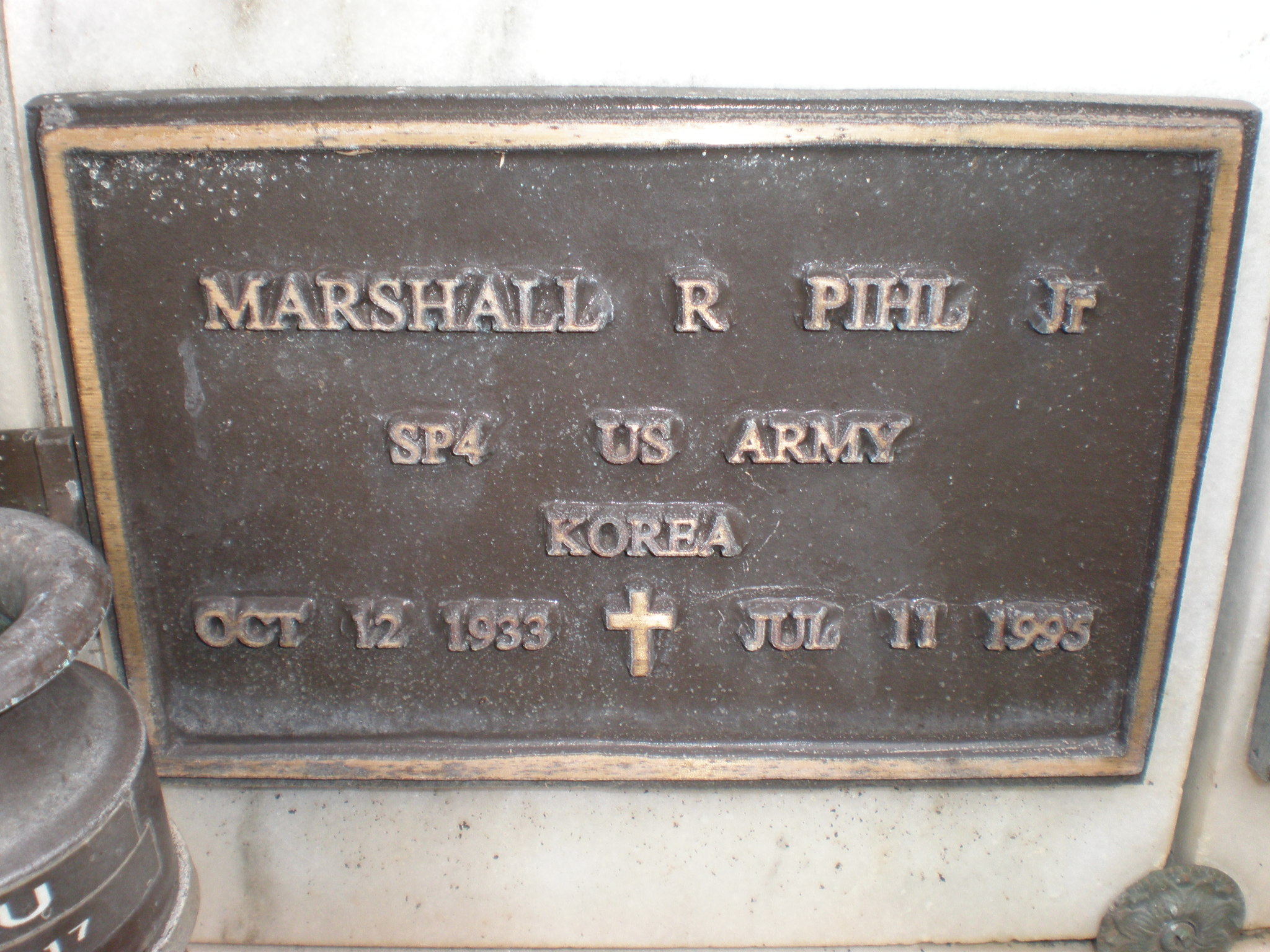
However, the Ivy League veteran I would most like to honor on this Veterans Day is Marshall R. Pihl (1933–1995), Harvard class of 1960, who learned Korean courtesy of the Army Language School and used his G.I. Bill funding to become a renowned scholar of Korean literature, especially the “performed literature” he described in his dissertation, later published as The Korean Singer of Tales (Harvard U. Press). Here’s the obituary posted to a Korean studies listserv in July 1995.

MARSHALL R. PIHL, renowned translator and leading scholar in the field of Korean literature, died at his home over the weekend of July 8. He was 61.

Since early spring his health had been deteriorating, at first gradually and then more and more rapidly. Nevertheless he diligently kept his appointments and continued his research. At least outwardly, he remained optimistic about recovery until the end.

After graduating from Harvard College in 1960, where he majored in Far Eastern languages, Marshall became the first Fulbright student grantee in Korea, receiving an M.A. in Korean language and literature from Seoul National University in 1965. He was the first Westerner to earn a graduate degree from a Korean university. He then entered the doctoral program at Harvard University, receiving his Ph.D. in 1974.

During another Fulbright year in Korea in 1970-71, Marshall was named the winner of the first annual Modern Korean Literature Translation Award, sponsored by the Korea Times. His first collection of translations, Listening to Korea, was published by Praeger in 1973. Later he produced The Good People: Korean Stories by Oh Young-su, published by Heinemann in 1985, and coedited (with Bruce and Ju-Chan Fulton) Land of Exile: Contemporary Korean Fiction, published by M. E. Sharpe/UNESCO in 1993. He also published many articles and translations in periodicals such as Korea Journal and Korean Studies and in collections such as Peter Lee’s Anthology of Korean Literature (1981) and Flowers of Fire (1986). But he was most proud of the beautifully produced work that originated as his dissertation, The Korean Singer of Tales, published by Harvard University’s Council on East Asian Studies in 1994.

Because he was a pioneer in a then-tiny field, Marshall was unable to secure a full-time academic position and was forced to combine teaching with administrative duties until he joined the Department of East Asian Languages and Literatures at the University of Hawaii in 1989. Although he was an exceptionally capable administrator, serving as associate director and then director of the Harvard University Summer School from 1977 to 1987, he was thrilled to be able to devote full-time to teaching and research in Hawaii.

His contributions were well recognized at UH, where he received tenure in 1992 and a promotion to full professor in 1995. His administrative skills were also highly valued by his colleagues on the executive committee of the Center for Korean Studies.

Marshall was not just a fine scholar, but also a dedicated teacher and an unfailingly generous, optimistic, and energetic mentor for junior colleagues everywhere. He attracted a growing number of graduate students into Korean literature, and always gave higher priority to their academic advancement than to his own projects. Even in the two months before his death he chaired one dissertation defense, two thesis defenses, and served as outside member on several more.

He had planned to devote his upcoming sabbatical to finishing several of his own projects, including translating and condensing Cho Dongil’s comprehensive history of Korean literature and coediting several textbooks in a series on Korean literature organized by the International Korean Literature Association, which he helped establish in 1992.

———-

Marshall was an extraordinarily powerful person. I never spoke with him without feeling infused with some of his energy and obvious love of life. —Jonathan Petty, University of California, Berkeley

Not only was he a fine scholar who brought an incredible amount to the field, but he was also simply an extraordinary human being—kind, helpful, and generous to those around him and blessed with a terrific sense of humor. His passing leaves not only a large vacuum in the field but a huge void in the hearts of those who knew him. —Stephen Epstein, Victoria University, Wellington

Marshall used to say that at the end of each duty day in Korea, regular soldiers might stack arms, but his fellow translator/interpreters would stack pencils. His ashes are interred in Punchbowl National Memorial Cemetery of the Pacific in Honolulu.

Marshall R. Pihl grave marker

Marshall R. Pihl grave marker

1 Comment

Filed under education, Korea, U.S., Vietnam, war

China Diary, 1988: Campus Life

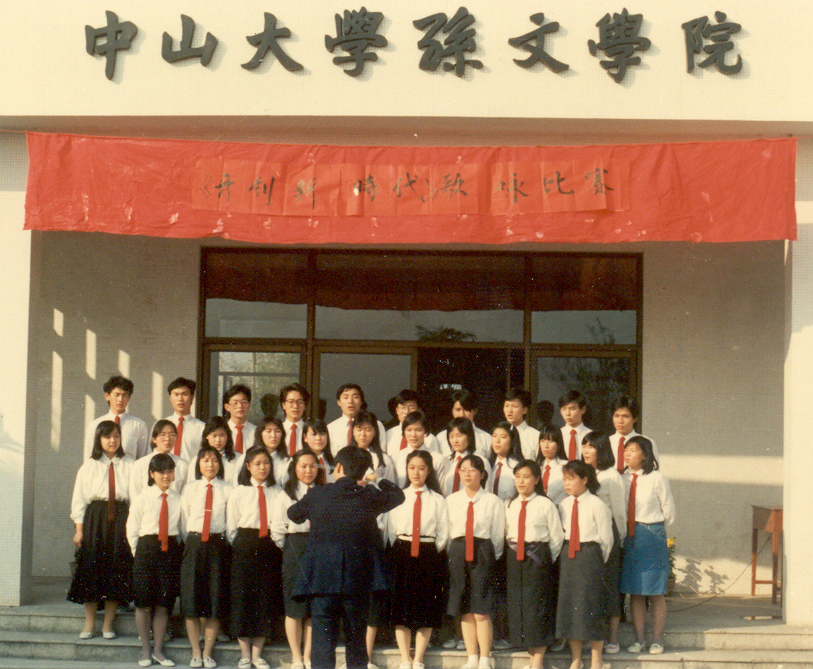
In 1987–88, the Far Outliers, with their two-year-old daughter in tow, spent a year teaching English at a new community college in Zhongshan City, Guangdong Province, China. The following is one of a series of articles I wrote in 1988. I sent them to a Honolulu newspaper, but they were not interested. So now I offer them as a retrospective on coastal China twenty years before hosting its first Olympics. At the same time, I am scanning in a lot of our old China photos and uploading them to my Flickr account or to my WordPress blog to illustrate this series.

Should students be allowed to fall in love on campus? Should students be allowed to hold part-time jobs? These subjects of student debates at Sun Wen College in Zhongshan City, Guangdong, indicate how different college life is in China and the United States. School policy answers “No” to both questions.

Sun Wen College students, Zhongshan City, China, 1988Those who argued that students should be allowed to hold part-time jobs said that students benefit by learning about the real world of work. But those who argued that students should be allowed to fall in love said only that a boyfriend or girlfriend is a good study partner. They said nothing about the real world. A few of our 18-year-old freshmen claimed not to know what “falling in love” means.

Schools and teachers play a much more parental role in China than in the U.S. Even in college, teachers may supervise students’ leisure time as well as class time. The students’ role includes running errands or doing chores for teachers.

When we moved into our apartment, some of our students were recruited to fill the planters on our balconies with dirt and plants. Our students often volunteered to help us with shopping.

High school students are even more closely supervised. From morning exercise to nightly study hall six days a week, they have hardly a free moment.

At Sun Wen College, no one who lives on campus needs an alarm clock to make sure they get up in time for class. At 6:15 every morning, the loudspeaker blares forth a wake-up medley of rousing orchestral pieces such as the Carmen Overture, Rhapsody in Blue, and Stars and Stripes Forever.

By 6:30 a.m., all dormitory students are supposed to be out on the soccer field doing morning exercises in unison. Breakfast–mostly rice soup (jook), sometimes dim sum—is served from 7 a.m. Classes begin at 7:45.

Most classes span two 50-minute periods. There are four regular periods in the morning. Everything shuts down at noon for the daily siesta, and classes resume at 2:30 p.m. Regular students attend class six days per week.

College students in China are a privileged minority and are highly motivated. They are also a serious lot, but probably less so in Zhongshan than in other parts of the country.

Sun Wen College also has a relatively high proportion of informal, fee-paying auditors who are improving their English in order to emigrate. We lost several students to emigration during the year we were there.

Basic education classes are held six nights per week from 7:30 to 9:30 p.m. for students who have not yet met formal entrance requirements. Lab sessions for informal students are held on Sunday mornings.

There are no elective courses. You choose your major when you start, and that decides all of your courses. There is little room for individual initiative, especially since free time is kept to a minimum.

Our English majors took intensive reading (for grammar), extensive reading (for vocabulary), listening comprehension, oral fluency, physical education, philosophy (political education), and Chinese language and literature.

All classes are with the same classmates. This builds a strong class camaraderie. The whole class is also required to take part in such extracurricular activities as morning exercise contests, song contests, and clean-classroom contests.

Sun Wen College graduating class, 1988The most recent song contest offered a cash prize to encourage more enthusiastic competition. At the same time, the students were required to sing at least one revolutionary song.

Each student sits at the same desk in the same room for most classes. Many study there in the evenings as well.

The dormitory at Sun Wen College is filled to bursting. There are six students to each room. Although some dorm students come from as far away as Guangzhou, others live not more than an hour’s bicycle-ride away.

While the school cafeteria was under construction, the students were fed at an overloaded, tin-roofed canteen with coal-fired woks. A typical school lunch consists of a vegetable–usually choy sum, Chinese cabbage, or daikon–two or more protein dishes–often duck eggs, pork hash, small bony fish, water-buffalo beef, or tofu—and government-ration-quality rice, some of the worst you will ever taste.

Eaters bring their own bowls and spoons. No one uses chopsticks.

Leave a comment

Filed under China, education

China Diary, 1988: The Allure of Hong Kong

In 1987–88, the Far Outliers, with their two-year-old daughter in tow, spent a year teaching English at a new community college in Zhongshan City, Guangdong Province, China. The following is one of a series of articles I wrote in 1988. I sent them to a Honolulu newspaper, but they were not interested. So now I offer them as a retrospective on coastal China twenty years before hosting its first Olympics. At the same time, I am scanning in a lot of our old China photos and uploading them to my Flickr account or to my WordPress blog to illustrate this series.

When all of China converts to daylight savings time during the summer, Zhongshan stays on Hong Kong time. To people in Zhongshan, Hong Kong and Macau seem at least as important as Guangzhou and Beijing.

It takes about two hours by hovercraft from Zhongshan Port to Hong Kong. There are two boats per day to Kowloon and two to Hong Kong. They are always full. There are also larger, slower, and cheaper ferries between Zhongshan and Shenzhen, the Special Economic Zone directly across the border from Hong Kong.

So when you buy vegetables at markets in Zhongshan, you shouldn’t be too surprised if you find “Golden Boat Gift Shop, New Territories, Hong Kong” written on the plastic bag the vendor puts the potatoes in. (The fact that the vendor supplies the plastic bags is unusual enough in China.)

Private Savings Bank, Shiqi, Zhongshan City, GuangdongBut there is even more traffic across the airwaves. Fewer than ten percent of households throughout China own TV sets, but it seems as if ninety percent do in Zhongshan. Many are tuned to Hong Kong. The special antennas and signal boosters needed to pick up Hong Kong cost extra money but are not hard to get. Televisions imported from Hong Kong have a special switch that toggles between the different audio channels used by Hong Kong and China.

Hong Kong stations present their weekly broadcast schedules on the air. So viewers who don’t read Hong Kong newspapers are still able to keep well abreast of upcoming specials. Rambo, First Blood was a big hit in Zhongshan.

Beauty shop, Shiqi, Zhongshan City, GuangdongThe commercials shown during English-language broadcasts give a strange picture of the desires of English-speaking consumers, many of whom pass through Hong Kong, few of whom live there. A great many ads are for luxury products: cigarettes, watches, furs, cars, fashions, perfumes, electronics, the sorts of things advertised in airline magazines. And the ads themselves are glitzy and expensive-looking.

But if you watch the Chinese-language programming directed at residents rather than travelers, you can witness the Hong Kong equivalents of American low-budget ads for car dealers and furniture stores.

In October 1987, the government launched a campaign to discourage viewers, especially party members, from watching Hong Kong TV. The authorities didn’t want people tuned to Hong Kong while government stations were broadcasting the 13th Party Congress from Beijing in October or the 6th National Games from Guangzhou the following month. The campaign had some success. Everybody watched the National Games. The athletes from Guangdong Province won the most prizes.

In the months before we left, the provincial government was interfering with the Hong Kong TV signals and trying to bring in more clearly the provincial and national broadcast channels from Guangzhou. Some people told us that the officials in charge of public security thought Hong Kong TV helped keep people glued to their TVs and out of trouble, while those in charge of political education thought Hong Kong TV politically unacceptable.

Dragon Tiger Phoenix Restaurant, Shiqi, Zhongshan City, GuangdongAlthough Macau TV is less attractive, the city of Macau is even easier to get to. It takes less than an hour by bus from the center of Zhongshan City to Gongbei, the border town in Zhuhai Special Economic Zone. Every day thousands of people cross the border, carrying fresh food and Chinese medicine to Macau, and returning with as many goods and cigarettes as they can hide in their bags and clothing. Empty cigarette cartons litter the floor inside and outside of the restrooms that stand between the duty-free shops and Chinese Customs.

Public health poster, Shiqi, Zhongshan City, GuangdongOfficials responsible for political education are hard put to counter the allure of these two enclaves of rampant capitalism. A recent film, Escape to Hong Kong, deals directly with the issue. It tells of four people who escaped from Shenzhen during the Cultural Revolution. The only woman among them is forced into prostitution when no one will ransom her from the gangsters who hide the four in Hong Kong. Her husband finds work as a day laborer, they sleep in shifts, and he eventually kills himself. Another escapee finds respectable work as a chauffeur, and the fourth achieves some worldly success, but at the cost of marrying his boss’s idiot daughter.

Many Zhongshan schools bought tickets to this movie for their entire student body. The accompanying short subject had a complementary political message. It was a documentary—with plenty of bare skin and bulging muscles—about New China’s first-ever body-building contest, held in Shenzhen.

Leave a comment

Filed under China, cinema, economics, education

Disgust Usually Outweighs Detached Reasoning

Via Arts & Letters Daily, I came across a very interesting essay in Edge by Jonathan Haidt, entitled Moral Psychology and the Misunderstanding of Religion. Here are a few excerpts.

In my dissertation and my other early studies, I told people short stories in which a person does something disgusting or disrespectful that was perfectly harmless (for example, a family cooks and eats its dog, after the dog was killed by a car). I was trying to pit the emotion of disgust against reasoning about harm and individual rights.

I found that disgust won in nearly all groups I studied (in Brazil, India, and the United States), except for groups of politically liberal college students, particularly Americans, who overrode their disgust and said that people have a right to do whatever they want, as long as they don’t hurt anyone else.

These findings suggested that emotion played a bigger role than the cognitive developmentalists had given it. These findings also suggested that there were important cultural differences, and that academic researchers may have inappropriately focused on reasoning about harm and rights because we primarily study people like ourselves—college students, and also children in private schools near our universities, whose morality is not representative of the United States, let alone the world….

Surveys have shown for decades that religious practice is a strong predictor of charitable giving. Arthur Brooks recently analyzed these data (in Who Really Cares) and concluded that the enormous generosity of religious believers is not just recycled to religious charities.

Religious believers give more money than secular folk to secular charities, and to their neighbors. They give more of their time, too, and of their blood. Even if you excuse secular liberals from charity because they vote for government welfare programs, it is awfully hard to explain why secular liberals give so little blood. The bottom line, Brooks concludes, is that all forms of giving go together, and all are greatly increased by religious participation and slightly increased by conservative ideology (after controlling for religiosity).

These data are complex and perhaps they can be spun the other way, but at the moment it appears that Dennett is wrong in his reading of the literature. Atheists may have many other virtues, but on one of the least controversial and most objective measures of moral behavior—giving time, money, and blood to help strangers in need—religious people appear to be morally superior to secular folk.

My conclusion is not that secular liberal societies should be made more religious and conservative in a utilitarian bid to increase happiness, charity, longevity, and social capital. Too many valuable rights would be at risk, too many people would be excluded, and societies are so complex that it’s impossible to do such social engineering and get only what you bargained for. My point is just that every longstanding ideology and way of life contains some wisdom, some insights into ways of suppressing selfishness, enhancing cooperation, and ultimately enhancing human flourishing.

But because of the four principles of moral psychology [outlined earlier in the essay] it is extremely difficult for people, even scientists, to find that wisdom once hostilities erupt. A militant form of atheism that claims the backing of science and encourages “brights” to take up arms may perhaps advance atheism. But it may also backfire, polluting the scientific study of religion with moralistic dogma and damaging the prestige of science in the process.

In my experience, secular academics are just as likely as anyone else to thoughtlessly dismiss in moralistic disgust not just behaviors, but beliefs they find repugnant, especially those emblematic of their social and moral inferiors.

6 Comments

Filed under education, philosophy, religion, scholarship

The Guilty Pride of Our Betters

From Our Kind of People: Inside America’s Black Upper Class, by Lawrence Otis Graham (Harper, 2000), pp. 8-9, 18:

One of my first encounters with an early pioneering family in the black upper class was meeting members of the aristocratic Syphax family from Virginia. I had grown up hearing my father tell me about their family history, as one of his father’s business associates had known several family members. Talking to Evelyn Reid Syphax at a Links meeting that my mother had brought me to, I learned one way in which some black families—including her own—gained wealth and a place among the upper class. “My family had owned fifteen acres of the land where the Arlington National Cemetery now sits,” Syphax explained as she recounted the history of her family, which can be traced back to Maria Custis, the mulatto child of First Lady Martha Washington’s grandson, George Washington Parke Custis, who owned the mansion that sits on the cemetery today. “Custis fathered Maria with Ariana Carter, one of his female house slaves,” explained Syphax, a well-to-do, retired real estate broker who lives in Virginia, “and when Maria asked her father, who was also still her owner, for permission to marry Charles Syphax, a black slave who worked for her father, he released both from slavery, gave her a wedding in the mansion, and offered her and her new husband fifteen acres of the Arlington estate. That mansion and the surrounding property—minus Maria Syphax’s fifteen acres—was later given by Custis to his white daughter, Mary Custis, who eventually married Confederate soldier Robert E. Lee—thus making the house a famous building in the southern state.”…

One can find both pride and guilt among the black elite. A pride in black accomplishment that is inexorably tied to a lingering resentment about our past as poor, enslaved blacks and our past and current treatment by whites. On one level, there are those of us who understand our obligation to work toward equality for all and to use our success in order to assist those blacks who are less advantaged. But on another level, there are those of us who buy into the theories of superiority, and who feel embarrassed by our less accomplished black brethren. These self-conscious individuals are resentful of any quality or characteristic that associates them with that which seems ordinary. We’ve got some of the best-educated, most accomplished, and most talented people in the black community—but at the same time, we have some of the most hidebound and smug. And adding even further to the mix are those of us who feel we need to apologize to the rest of the black world for our success and for being who we are. For me, the black upper class has always been a study of contrasts.

I think the same is true of every type of elite in these normatively egalitarian times. Among fellow members of your elite, you perform rituals of solidarity that distinguish you from your inferiors–gratuitous political swipes being among the most common solidarity rituals on college campuses (or in news rooms, apparently) where everyone who matters can be assumed to be of like mind. Those who are more sensitive take care to repress those same ritual behaviors when face to face with their inferiors–most especially when seeking votes or funding from those less like-minded.

My wife and I were witness to many impressive rituals of elite solidarity over last Memorial Day weekend when we attended graduation events at Yale–where the ritual of playing Elgar’s Pomp and Circumstance at graduations began at Woolsey Hall in 1905. We had both graduated from little no-name colleges in North Dakota and Hawai‘i, respectively, before completing graduate degrees at a cheap, run-of-the-mill state university (Hawai‘i).

Our first event that Saturday was a Phi Beta Kappa induction ceremony in Battell Chapel. Before it began, the mistress of ceremonies came down the aisle chatting up the audience of parents and friends of the inductees. When she found my wife and me with our noses in books, she exclaimed how you could be sure that Phi Beta Kappa parents were avid readers. She asked me what I was reading, and I showed her the cover of Lawrence Graham’s Our Kind of People: Inside America’s Black Upper Class. That stopped her cold, and she quickly moved on to my wife, who was evaluating Graham Salisbury’s juvenile novel Blue Skin of the Sea for possible use in an ESL class. That allowed our emcee to retreat into the comfort zone of noblesse oblige, expressing concern that Yale was not doing enough for some of its rising numbers of foreign students whose mastery of English was not up to earlier standards. Later in the ceremony, while explaining the not-so-secret Phi Beta Kappa handshake, she managed to adopt just the right tone of irony that allows one to perform required social rituals while purporting not to take them seriously. It was a tone we heard again and again from public speakers throughout that ritual-soaked weekend.

I had planned to begin reading Our Kind of People: Inside America’s Black Upper Class as we traveled through the South during our road trip in May—for which my Minnesota in-laws had prepared by reading up on plantations, slavery, and riverboat gamblers. But Yale was the better venue for it. In fact, it provided belated but valuable context for the tome I bought and read when our daughter matriculated there four years ago: The Emperor of Ocean Park, by Yale law professor Stephen Carter.

I acquired a measure of elitist pretentions during my four years at an international high school in Japan. That was where I eliminated the last southernisms I was aware of in my American accent. (Few Americans can guess my family heritage from my accent.) My ambitions at that time were more literary than academic, but my journalism professor at the University of Richmond—where I started college with little enthusiasm and later dropped out—told me that I wrote more like a scientist than a journalist. He had been a practicing journalist, not an academic, so I’m not sure it was intended to be a compliment.

Although Our Kind of People is a case study of the cultivation and preservation of America’s black upper class, much of it would also seem to apply to the care and maintenance of exclusivity among other types of elites. His final chapter on light-skinned blacks who “pass” as whites is particularly poignant, especially his tales of those who chose to abandon their relatives and engineer their own equivalent of a witness-protection program—and pray like hell their kids don’t turn out too dark.

As a “no-accent” white of expatriate southern heritage who has spent a lot of time among academics, I think I have some sense of how blacks who “pass” episodically or by accident feel when they happen to encounter demeaning or disgusting attitudes from interlocutors who aren’t aware of their hidden heritage.

When we took our daughter to visit Carleton College in Minnesota after her junior year of high school, I overheard another family doing college visits tell about how frightened they were at the prospect of driving through Virginia to Norfolk on highways (I-95 and I-64!) that they imagined to be filled with crazed pickup-driving rednecks taking potshots at cars with northern license plates. I dearly wanted to speak up and assure them, in my best Hollywood southern accent: “Why we wouldn’t shoot y’all! The most we’d do is mebbe take out a headlight or taillight, mebbe aim for one of yo’ rear tires or yo’ Yankee license plate. But we wouldn’t shoot at people, even if they was Yankees!” But, of course, I kept my trap shut, not wanting to ruin my daughter’s chances at the college that was then at the top of our list of prospects.

2 Comments

Filed under education, U.S., Virginia

Southeast Asia Marginalized in Islamic Studies

From Robert W. Hefner’s introduction to Islam in an Era of Nation-States: Politics and Religious Renewal in Muslim Southeast Asia, ed. by Robert W. Hefner and Patricia Horvatich (U. Hawai‘i Press, 1997), pp. pp. 8-9 (references omitted):

One of the most serious impediments to the development of a systematic understanding of Islam in Southeast Asia is the fact that the topic has long been marginalized in the fields of Islamic and Southeast Asian studies. In Islamic studies Western and Middle Eastern scholars alike have tended to place Southeast Asia at the intellectual periphery of the Islamic world. Still today in some overviews of Islamic history and civilization, Southeast Asian Muslims are mentioned briefly if at all. Though Southeast Asian Islam has almost two hundred million believers, it is not uncommon for observers, even learned specialists, to identify Islam with the Middle East and to regard Southeast Asia as, at best, intellectually and institutionally derivative of Middle Eastern Islam.

There is a larger and, in one sense, understandable logic to this neglect. By comparison to Persia and the Arabian heartland, in insular Southeast Asia Islam became a civilizational force relatively late in Islamic history. Though Arab-Muslim traders traveled through island Southeast Asia as early as the seventh and eighth centuries, there was little settlement until the late thirteenth, when a Muslim town, inhabited in part by Arab-speaking foreigners, was established in the Pasai region of north Sumatra, an entrepôt for the trade with Muslim India and Arabia. Shortly thereafter, a Muslim presence appears to have been established in port towns along Java’s north coast, territories still then under the control of the Hindu-Buddhist kingdom of Majapahit. Ruling elites in the Malay peninsula were converted in the fifteenth and sixteenth centuries, and those in coastal Sulawesi and much of the southern Philippines were won to the faith in the seventeenth and eighteenth centuries.

The primary impetus for this wave of conversion was not conquest or religious warfare, as had been the case in Islam’s early expansion in Arabia and North Africa, but trade and interethnic intercourse. Certainly, as Anthony Reid has noted, Muslim potentates (like their Theravada Buddhist counterparts in mainland Southeast Asia) regarded forcible conversion of neighbors as “an honourable motive for conquest,” and Muslim rulers periodically engaged in warfare with their Hindu-Buddhist, animist, or, in later times, Christian neighbors. However, as Thomas McKenna’s essay in this volume illustrates, the causes of these conflicts were as much commercial and dynastic as they were religious.

More decisively, the rapid and relatively uniform spread of Islam to the insular world’s maritime centers was related to broader historical developments, especially the growth of international commerce from the fifteenth to seventeenth centuries and the movement of large numbers of people out of localized societies into a multiethnic and interregional macrocosm. Most of the map of modern Muslim Southeast Asia was laid out during this “age of commerce,” as Anthony Reid has so aptly described it. A few remote corners of Southeast Asia have been converted to Islam in this century, some even in the last decades. In general, however, the dynamism of Islam in contemporary times has had less to do with a new wave of conversion than with the reform and rationalization of religion among established Muslim populations.

By itself, the comparatively late arrival of Islam in Southeast Asia neither explains nor justifies this region’s marginalization within the field of Islamic studies. Given the genesis of what has come to be regarded as “classical” Islamic civilization within the Arabic- and Persian-speaking world, however, there was a tendency on the part of early Western Islamicists to devote their attention to regions where the classical tradition was first composed. This emphasis was reinforced by the focus of this early scholarship on Islamic “culture,” not in the modern, social-historical or anthropological sense of this term, but in its great-traditional sense, as in written literature, philosophy, art and architecture, and law. With several notable exceptions, the Orientalist commentaries that introduced Islamic civilization to a Western readership in the late nineteenth and early twentieth centuries were concerned with high culture, not the everyday meaning of Islam for ordinary Muslims. The focus of this writing was leading thinkers and civilizationwide achievements, especially those preserved for time in the printed word.

As a result of this textual emphasis, Southeast Asia—and other areas marginalized in the Orientalist understanding of the Muslim world, such as Central Asia, Bengal, and West Africa—was accorded only a minor role in early accounts of Islamic civilization.

Leave a comment

Filed under education, Islam, South Asia