
Category Archives: education

Bornu Slave Raid on Mandara, 1851

From A Labyrinth of Kingdoms: 10,000 Miles through Islamic Africa, by Steve Kemper (W. W. Norton, 2012), Kindle pp. 175-177:

THE OFFICIAL REASON FOR THE MILITARY EXPEDITION WAS TO PUNISH the vassal state of Mandara for disobedience. The real reason was that the “coffers and slave-rooms of the great men” of Bornu were empty. The lawless Welad Sliman and the legitimate government of Bornu were both motivated by greed, but the mercenary Arabs didn’t bother to disguise or rationalize their conduct.

A Bornu military campaign moved with ponderous, gaudy pomp. The boom of a great drum signaled the break of camp. Twenty thousand men set off to the drum’s deep cadence, along with 10,000 horses and 10,000 beasts of burden. Barth described the scene:

. . . the heavy cavalry, clad in thick wadded clothing, others in their coats of mail, with their tin helmets glittering in the sun, and mounted on heavy chargers . . . the light Shuwa horsemen, clad only in a loose shirt and mounted upon their weak, unseemly nags; the self-conceited slaves, decked out gaudily in red bernuses or silken dresses of various colors; the Kanembu spearmen, almost naked, with their large wooden shields, their half-torn aprons round their loins, their barbarous head-dresses, and their bundles of spears; then, in the distance behind, the continuous train of camels and pack-oxen. . . .

The pack animals were burdened with “tents, furniture, and provisions and mounted by the wives and concubines of the different chiefs, well dressed and veiled.” The vizier and the sheikh each brought “a moderate number” of concubines—eight for Haj Beshir, twelve for Umar, all dressed in white burnooses. Four fan-bearers in multicolored attire followed the sheikh, as did shrill musicians. Everyone, wrote Barth, was “full of spirits, and in the expectation of rich booty, pressing onward to the unknown regions toward the southeast.”

The army moved over the countryside like locusts. The courtiers brought their own provisions, but the soldiers were expected to supply themselves and their horses from the fields and livestock they passed. “To the ruin of the country,” noted Barth. Cornfields were stripped, livestock seized.

He and Overweg had neither provisions nor money to buy any, but the sheikh and the vizier kept them well fed, at first: rice boiled with milk, bread and honey, sheep and sorghum. The Germans spent most evenings in intellectual tête-à-tête with the vizier, whose curiosity matched theirs. Haj Beshir’s travels to Egypt and Mecca had enlarged his perspective and excited his interest in foreign matters. “Our conversation at some of these African soirées with the vizier,” wrote Barth, “became sometimes so learned that even Ptolemy with his ‘Mandros oros’ was quoted.” On another evening, “a disputation arose of so scientific a character that it might have silenced all those who scoff at the uncivilized state of the population of these regions.”

They often discussed slavery. Barth urged Haj Beshir to abolish it in favor of agriculture, industry, and trade. The vizier agreed that slave-hunting was a sordid business, but no other commodity paid as well, and Bornu needed the money for European firearms to protect itself against enemies—firearms that were also used, noted Barth, to hunt down and enslave or massacre yet more people. The high profits from slavery also led to a taste for luxuries that could only be sustained by capturing and selling more slaves. “Such is the history of civilization!” wrote Barth acerbically. He concluded that European nations were hypocritical for condemning the slave trade while profiting from the gun trade that fueled it. The vizier offered to end slave-trading in Bornu—though not domestic slavery—if the British government would send Bornu 1,000 muskets and four cannons.

Haj Beshir was one of the two great friends Barth made on his journey (the other was Sidi Ahmed al-Bakkay, the sheikh of Timbuktu). “I repeat that, altogether, he was a most excellent, kind, liberal, and just man,” wrote Barth of Haj Beshir, “and might have done much good to the country if he had been less selfish and more active.”

Leave a comment

Filed under Africa, Britain, economics, education, labor, military, religion, slavery, war

Wordcatcher Tales from Kyoto

Last month I visited the Kyoto Railway Museum, full of many things that made me nostalgic for my many youthful train trips (and several more recent ones) in Japan. I also discovered two Japanese language usages new to me.

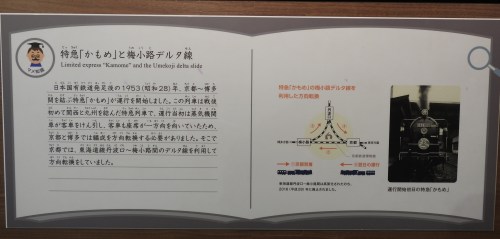
マメ知識 mame-chishiki ‘bean-knowledge’ – The very kid-friendly museum contained many small placards in front of larger exhibits with tasty tidbits of information labelled ‘bean (of) knowledge’. Almost all the kanji had furigana to show how they are pronounced, so that kids who had not yet mastered all their elementary or middle school kanji (as I haven’t) could still read them. ‘Bean’ mame (written 豆 in kanji, マメ in katakana) also means ‘small’ in compounds like 豆本 mamehon ‘miniature book’, 豆鉄砲 mameteppou ‘pea shooter’, or even 豆台風 mametaifuu ‘baby typhoon’. The mamechishiki in the photo below tells how the Kamome (Seagull) limited express from Hakata (Fukuoka) would change directions by veering off the main track at Umekoji Station (where the museum is now located) to go north to the top of a delta-shaped track, then back down the far side of the triangle into Kyoto Station so that the locomotive would be facing Hakata for the return trip.

Bean of knowledge

A bean of knowledge about the Kamome limited express train

上り下り nobori-kudari ‘ascending-descending’ in early Meiji – The railway museum also displayed blackboard tables (in kanji) of fares and departure times from the early Meiji era (from the 1880s), when the train system was just beginning, and the national capital was moving from Kyoto to Tokyo. Nowadays, all trains moving toward Tokyo are ‘ascending’ (上り nobori) while those moving away from Tokyo are ‘descending’ (下り kudari). Before the Meiji era, travelers and goods ‘ascended’ to Kyoto and ‘descended’ to Edo. But the timetable below from Kyoto Station shows different usage, perhaps reflecting the route of the earliest heavy freight traffic in the Kansai area, which ran by rail from Osaka to Otsu on Lake Biwa, then by boat north across the lake to Nagahama, then by rail to Tsuruga on the Japan Sea coast. Trains departing south from Kyoto are listed as ascending, and those to the north of Kyoto are listed as descending, perhaps because people and goods bound for Tokyo would first aim to reach a port on the Tokaido side of Honshu.

Meiji-era train

Meiji-era train timetable for Kyoto Station

2 Comments

Filed under education, Japan, language, travel

Three Famous Explorers of Africa

From Into Africa: The Epic Adventure of Stanley and Livingstone, by Martin Dugard (Broadway Books, 2003), Kindle loc. ~300:

Speke was a thin loner whose family home, Jordans, was just forty miles from Bath. He was childlike, entitled, wealthy, bland, deaf in one ear. At thirty-seven, he doted on his mother but had never courted any other woman. Critics acknowledged his prowess as a sportsman, but puzzled over his penchant for slaughter and fondness for eating the unborn fetus of a kill. They wondered about the character of a man who once gave a rifle as a gift to an African chief fond of shooting subjects for fun, and who allowed a live human child to be steamed like a lobster during a tribal ritual in his honor. Speke felt that the ends justified the means—in this case, finding the source was worth the loss of inconsequential African lives. The source, Speke claimed, was a massive rectangular body of water the size of Scotland. He named it Victoria Nyanza—Lake Victoria—for the Queen.

The dark-haired Burton claimed Lake Tanganyika as the source. That body of water lay 150 miles southwest of Victoria Nyanza, separated by mountainous, unexplored jungle. Burton did not dispute that the Nile flowed from Victoria, but he believed that another, yet undiscovered, river flowed from Tanganyika through the mountains, into Victoria.

Lake Tanganyika’s shape was slender and vertical on the map, like a womb parting to give birth to the great Nile. Its choice as Burton’s geographical talisman was apt, for his character tics veered toward the sensual. The accomplished linguist had a fondness for Arab prostitutes and would someday write the first English translation of the Kama Sutra. In 1845, as a young army officer stationed in India, he’d been ordered to investigate Karachi’s homosexual brothels. Burton’s detailed reportage implicated fellow officers and evinced suspicion about his own sexuality—both of which combined to ruin his career. So he’d become an explorer. His knowledge of languages and Islam allowed him to infiltrate cities like Mecca and Harar, which were forbidden to non-Muslims. The resulting books about those escapades were best-sellers in the mid-1850s, earning Burton a reputation for daring while introducing Oriental thoughts and words to his readers. It was Burton who made the term safari—Swahili for “journey”—familiar to the English-speaking world.

The mob packing the auditorium, so eager for spectacle and rage, knew the Burton and Speke story well. The time had come for resolution. When the eleven o’clock starting time came and passed, the crowd “gave vent to its impatience by sounds more often heard from the audience of a theater than a scientific meeting,” sniffed the Bath Chronicle. The audience gossiped loudly about Speke’s whereabouts and stared at the stage, scrutinizing Burton with that unflinching gaze reserved for the very famous. In an era when no occupation was more glamorous than African explorer, Burton’s features were already well known through photographs and sketches from his books. But for many in the audience, seeing his face up close, in person, was why they’d come. They felt the same about Speke.

There was a third explorer many hoped to glimpse, a man whose legend was arguably greater than any living explorer. “The room,” the Chronicle noted of the auditorium, “was crowded with ladies and gentlemen who were radiant with the hope of seeing Dr. Livingstone.” The British public hadn’t caught a glimpse of their beloved Livingstone since the halcyon days of 1857 when he seemed to be everywhere at once. His exploits had been a balm for the wounds of the Crimean War, the ill-fated Charge of the Light Brigade, and the bloody slaughter of British women and children during the Indian Mutiny. Livingstone reminded Victorian Britain of her potential for greatness. The fifty-one-year-old Scot was their hero archetype, an explorer brave, pious, and humble; so quick with a gun that Waterloo hero the Duke of Wellington nicknamed Livingstone “the fighting parson.” Livingstone was equally at home wandering the wilds of Africa and making small talk over tea with the Queen. The public made his books best-sellers, his speeches standing room, his name household. Livingstone was beloved in Britain, and so famous worldwide that one poll showed that only Victoria herself was better known.

Livingstone, though, wasn’t scheduled to appear at the Nile Duel [debate about the origins of the Nile]. His first public appearance since returning from an exploration of Africa’s Zambezi River six months earlier was officially supposed to take place the following Monday. He would lecture the British Association on the details of that journey. Ticket demand was so enormous that Livingstone, standing before a massive map of Africa, would give the speech live in one theater as Clements Markham of the Royal Geographical Society read it concurrently to the overflow crowd in a second auditorium. The Chronicle‘s special edition would publish the text in its entirety. Rumors, however, said Livingstone would make an appearance at the Nile Duel as moderator. His appearance would confirm the Duel’s heft and counterbalance smirks of innuendo. For celebrity gazers and scientists alike, Livingstone, Burton, and Speke on the same stage would elevate the proceedings from grudge match to intellectual field day. Those three greats hurling geographical barbs would make the long hours in the rain more than worthwhile.

Leave a comment

Filed under Africa, Britain, education, publishing, religion, science, slavery, travel

What the War on Mexico Taught Grant

From Grant, by Ron Chernow (Penguin, 2018), Kindle pp. 49-51:

THE MEXICAN WAR did more than just educate Grant in strategy and tactics, it also tutored him in the manifold ways wars are shot through with political calculations. “The Mexican war was a political war,” he would observe, “and the administration conducting it desired to make party capital out of it.” Monterrey’s fall made Zachary Taylor the darling of the Whig press. When this was followed by Whig victories in the November elections, giving the opposition party control of both houses of Congress, President Polk grew leery of Taylor as a Whig rival for president. In a Machiavellian maneuver, he decided to divest Taylor of most of his troops and replace him with Winfield Scott, a Whig lacking Taylor’s brand of popular charisma.

In high-handed fashion, Polk dispatched Scott to Texas without notifying Taylor of what was afoot. When Scott arrived in Point Isabel after Christmas, he informed Taylor by letter that he had taken over the Army of Invasion and was radically revamping the war strategy. …

Grant was with Taylor when he received the shocking news of his demotion and never forgot his hero’s befuddled reaction. … This early experience made Grant tend to view war as a hard-luck saga of talented, professional soldiers betrayed by political opportunists plotting back in Washington.

Between the founding era of the Republic and the Civil War, no figure embodied the American military more splendidly than Winfield Scott, who was promoted to brevet major general by the War of 1812. Straddling two eras, he would serve under presidents as far apart as James Madison and Abraham Lincoln. Mocked as “Old Fuss and Feathers” behind his back, he had never seen a parade ground he didn’t long to tread or a uniform he didn’t wish to wear. With his enormous height, wavy hair, and ample flesh, he loved to flash medals, flaunt plumed hats, and preen before mirrors, a vanity that made him susceptible to flattery. Grant noted how Scott sent word ahead to commanders of the precise hour he planned to arrive. “This was done so that all the army might be under arms to salute their chief as he passed. On these occasions he wore his dress uniform, cocked hat, aiguilletes, sabre and spurs.” Such vainglory was so alien to Grant that it is sometimes hard to say whether he modeled himself after Zachary Taylor or in opposition to Winfield Scott.

For all that, Grant credited Scott with a brilliantly resourceful mind and strategic daring. To travel from Veracruz to the capital, an army of twelve thousand would quit a secure supply base, traverse 250 miles of mountainous terrain, then face a much larger and well-fortified enemy in a populous capital. To do this, Scott assembled a first-rate team of bright junior officers, including Pierre G. T. Beauregard and George B. McClellan and a rising star on the engineering staff, Robert E. Lee. Throw in a host of other officers who later reappeared in the Civil War—Joseph Johnston, John Pemberton, James Longstreet, Winfield Scott Hancock, Albert Sidney Johnston, Joseph Hooker, George Thomas, Braxton Bragg, and George Gordon Meade—and the Mexican War seemed a dress rehearsal for the later conflict. With a retentive memory for faces and events, Grant accumulated a detailed inventory of knowledge about these varied men that he drew on later.

Leave a comment

Filed under education, Mexico, military, U.S., war

Yapese “See something, say something”

Public service announcements in TheBus in Honolulu typically include two Micronesian languages, Chuukese and Marshallese, in addition to several Asian languages, but I recently saw one that included Yapese, another language in Micronesia that is not closely related to any other Micronesian language, and is in many ways unique among Austronesian languages.

The Yapese text is written in a very barebones orthography, making even fewer distinctions than the Bible orthography. It makes me think someone who speaks but doesn’t write Yapese dictated it to someone who transcribed it without knowing much Yapese phonology or grammar (or even the Bible orthography), since they don’t write any glottal stops or glottalized consonants (usually marked by an apostrophe), only write 5 vowels, and misanalyze some small grammatical particles. The original spelling is in quotes.

I’ve respelled each line in something close to the new orthography, but without the controversial q for glottal stops, and also added a line with rough glosses for each word. The naag that I’ve glossed ‘TR’ makes transitive verbs out of other words, including words borrowed long ago from Japanese, like dengwa ‘telephone’ and unteng ‘drive’, as well as those borrowed more recently from English. The ea glossed ‘ART’ occurs before specific nouns that are neither indefinite (marked with ba) nor definite (marked with fa). It’s interesting that they felt it necessary to define English bus driver in a paraphrase that relies on an older Japanese loan.

“Mu ayweg nem. Mu rin.”
Mu ayweeg neem. Mu riin’.
You help you. You do [it].
= Be aware. Take action.

“Mu eg nag e nen nag be guy ni ra bucheg banen”
Mu eeg naag ea n’ean ni ga bea guy ni raa bucheeg ba n’ean
You report TR ART thing that you are seeing that will do-bad a thing
= Report anything you see that will cause harm.

“Mu dengwa nag e 911 fa mog ko bas driver”
Mu dengwa naag ea 911 faa moeg ko bas driver
You telephone TR ART 911 or you.say (it) to bus driver
= Call 911 or tell the bus driver

“(un ni be unteng nag e bas)”
(an ni bea unteng naag ea bas)
(person that is driving TR ART bus)
= (the person who is driving the bus)

Leave a comment

Filed under education, language, Micronesia, migration, U.S.

Examination Hell in Calcutta

From The Epic City: The World on the Streets of Calcutta, by Kushanava Choudhury (Bloomsbury, 2018), Kindle Loc. approx. 1635-1655:

When I was a student at Calcutta Boys’ School, our academic year was marked by three term exams. The tests would be in at least a dozen subjects. Preparations would take over a month of mugging up. During exam time, a hush settled over Calcutta’s families, as mothers fretted, cajoled and provided warm glasses of milk, while the little one prepared for his term exams. The SATs were a breeze compared to my Calcutta first-grade final exams. No test I would take in the US – not even the field exams in graduate school – ever required the amount of mindless memorisation, or produced as much competitiveness and anxiety, as those grade-school exams.

After each term exam we would be ranked among our peers. The status of the kid who topped the rankings, the ‘First Boy’, can be compared only to that of an American high-school quarterback. He was typically bespectacled, oily haired and a bit of a bore, but students revered him, teachers granted him the equivalent of diplomatic immunity, and other kids’ mothers wanted to copy notes from his ma. Perhaps I have neglected to mention that each day, mothers lined up along the schoolyards during lunchtime with hot fish curry and rice tiffins to spoon-feed their progeny. Since my mother worked as a scientist for much of my childhood, my tiffins were cold butter sandwiches carried from home, and I was spared this maternal attention.

All those years of spoon-feeding and exams led up to the standardised tests in tenth, and then twelfth grade. Six hundred thousand tenth graders took the state’s final exam in 2009. The boy who ranked first was featured on the front page of the newspaper, just under the article on the national parliamentary elections. On the inside pages each year are stories of kids hanging themselves because of a poor exam result. The preferred mode of suicide for spurned lovers is drinking acid. The preferred mode for exam victims is hanging.

The target of every Bengali family is to produce a doctor or an engineer. Both fields have rigorous entrance exams at the end of twelfth grade, known in Bengal as the joint entrance exam. By the time you reach twelfth grade, exams have provided the entire drama of your existence. These results are the measure of your self-worth. Each year, with each new report of suicide, there is talk of easing the stress, perhaps doing away with some tests altogether. Nothing much changes except that more shortcuts appear – more reference books, more coaching centres, more compilations of old exam papers – and more people pass.

Leave a comment

Filed under Britain, education, India, migration, U.S.

Tyranny of Transliteration

From The Epic City: The World on the Streets of Calcutta, by Kushanava Choudhury (Bloomsbury, 2018), Kindle Loc. approx. 1580-1590:

Bengali last names when transliterated into English often have multiple spellings. For instance, my name, Choudhury, can be Chaudhuri, Chowdhury, Chaudhry, and so on. These variations are used by aunts and cousins in my own family. Other Bengali last names even have varying pronunciations. As with Bob and Robert, so too everyone recognises that Banerjee and Bandopadhyay are the same name. Everyone, except the University of Calcutta. Each name has a prescribed university version. If your birth certificate says Choudhury when the university accepts only Chaudhuri, there will be forms you will have to fill out and get attested, clerks you will have to flatter and treat to tea while you wait to be renamed. Like Yahweh, Ellis Island and the slave masters from Roots, not only will the university play name-giver – on your certificate you will become Chaudhuri, of that there is no doubt – but whether they will recognise your life prior to your conversion is a matter left up to the fates themselves.

Leave a comment

Filed under Britain, education, India, language, migration, U.S.

Bengal’s New Bourgeoisie

From The Epic City: The World on the Streets of Calcutta, by Kushanava Choudhury (Bloomsbury, 2018), Kindle Loc. approx. 560-580:

Each summer, I had returned to Calcutta for months at a time, without a project or a purpose, just to be there. The Statesman looked worse with each passing year. Most of my Statesman friends – those who weren’t lifers like Mike – had fled to the Telegraph or one of the national papers that had opened up offices in Calcutta. The times were changing. India’s corporate boom was trickling into the city. New jobs were emerging. Some friends had left journalism altogether to work in back offices, writing content and doing design for American corporations. On the verdant eastern edge of the city, a whole planned suburb called Sector Five had sprouted to accommodate them. Next to grazing fields dotted with palms and cows, the likes of IBM, GE and Pricewaterhouse-Coopers had built glittering glass temples to global capitalism. Premodern and postmodern India headbutted each other as if waiting to deliver the punchline to a cruel joke. A peasant and a programmer walk into a bar . . .

I met a friend who had found such a position in an American firm at Sector Five. As she was showing me around her glass temple, she took me to a room full of rolled-up mats. They reminded me of the mats that some of the Muslim waiters used to spread out during prayer times at the Statesman canteen.

‘Are the mats for namaz?’ I asked.

‘No,’ she said, ‘they are for yoga.’

It was the first time I had heard anyone in Calcutta utter the word. She didn’t say joge, which is the Bengali term for the breathing exercises and body contortions that we had all been forced to practise as kids, exercises that were the realm of old geezers, much like consulting astrological charts, performing exorcisms or taking snuff. Joge to us was some grandpa forcing you to sit still for fifteen minutes and pretend to ‘meditate’. This avatar of grandpa’s joge as yuppie yoga was part of a prepackaged global lifestyle imported from America.

At six o’clock, Sector Five was lined with more coach buses than South Point School. As those glass temples emptied into the streets, throngs of twenty- and thirty-somethings all lit Filter Wills cigarettes and fired off that last text message. And new masses replaced them, for another shift would start soon enough. It may have been quitting time in Calcutta, but somewhere in New York or California, the day had just begun. Sector Five was staffed by my people, my generation of the middle class. It employed thousands of men in Moustache jeans and women in Fab India salwars, the types that in my time would idle for years, having passed their college exams, offering tutoring, writing Charminar-fuelled poetry before finally giving up or moving out of the city. Those multitudes represented something unprecedented in my lifetime. Before, I had only seen such crowds of the young middle classes at cricket matches and during student demonstrations. This was new. They were not jeering Pakistani cricketers or attacking tuition hikes. They were working. In Sector Five, on parade was Bengal’s new bourgeoisie.

Leave a comment

Filed under economics, education, India, language, migration, U.S.

China’s Constant Internal Migrations

From Yangtze: Nature, History, and the River, by Lyman P. Van Slyke (Stanford Alumni Assn., 1988), p. 53:

China generates paradox. The Chinese are renowned for their attachment to place, their deep identification with native soil. And yet whenever one looks at Chinese history one finds people everywhere on the move. Migration is part of this movement, the permanent transfer of people from one region to another, sometimes pushed out of their original homeland by overpopulation, poverty, disaster, or war, and sometimes attracted to new lands by real or presumed opportunities for betterment of their lives.

But migrants were not the only travelers across the Chinese landscape. Merchants big and small set forth on business trips; Buddhist monks and devout layfolk made pilgrimages or sought centers of learning; scholars aspiring to prestigious careers in the imperial civil service headed for provincial capitals or Peking to take the most fiendishly demanding examinations ever devised. Officials took up their posts across the far-flung realm, and some were exiled for real or alleged offenses to the most remote and dangerous corners of the empire; corvee labor gangs were sent to work on canals or defensive walls; boatmen and transport coolies moved the goods of the empire; one might even spot a rare travel buff exploring his world out of curiosity or scholarly interest. There were foreign traders, Japanese and Korean monks who had come to learn from Chinese Buddhist masters, ambassadors and their retinues, entertainers, bandits, fugitives. In wartime, armies were on the march. Rebel hordes, angry and desperate peasants headed by ambitious or megalomaniac leaders with their own dynastic dreams, followed the same routes as migrants, merchants, a11d scht1lars. In the mid-1960s, during the Cultural Revolution, urban youth went on an orgy of hitherto prohibited travel, sanctioned by Mao Tse-tung’s revolutionary dictum to “exchange revolutionary experience”; later, beginning in 1969, some fourteen million of these urban youth were sent whether they wanted to go or not to the countryside to “learn from the peasants.”

Leave a comment

Filed under China, economics, education, Japan, Korea, labor, migration, philosophy, religion

African vs. Indian Experience in Mauritius and Seychelles

From “Slavery and Indenture in Mauritius and Seychelles” by Burton Benedict, in Asian and African Systems of Slavery, ed. by James L. Watson (U. Calif. Press, 1980), pp. 154-168. Both colonies depended very heavily on imported labor for their sugar plantations. Watson attempts to explain why Indian cultural traits survived better in the two island groups than did African cultural traits. The following summaries are closely paraphrased.

1. ORIGINS: African slaves came from all over the continent and lacked common cultures or political systems. Indentured Indians came from diverse cultures that had nevertheless all coexisted within a more or less unified political and economic system ruled by the Mughals and then the British.

2. RECRUITMENT: African slaves were nearly all unwilling recruits who had usually passed through many hands in many markets. Indentured Indians were volunteers recruited by men from their own culture and often from the same village, caste, or tribe, even though they usually had no idea about their destination or working conditions, and their voyaging conditions were hardly better than that of the African slaves.

3. FAMILIES: Most Africans arrived as isolated individuals, with no guarantee that any surviving relatives would be sold to the same plantation. Indentured Indians left their wives behind during the early years, but were later assigned as family units, whose marriages were recognized by the local courts. They were better able to preserve family life.

4. YOUTH: Many African slaves were kidnapped as children, and children were favored over adults by plantation managers. They received little education and adapted to local French culture. Most Indians came as young adults, some with children, who learned Indian customs and values at home and at vernacular schools.

5. LANGUAGE: African slaves spoke many different languages, and had to communicate among themselves in Swahili, Arabic, or the languages of European traders. On the plantations, they learned the local French Creole. Most of the Indians came from three major language groups (Bhojpuri) Hindi, Tamil, and Telegu. Employers relied on bilingual overseers and the Indians preserved their home languages, in which they transmitted their home cultures. Many man but far fewer women learned Creole, even into the 1960s.

6. NAMING: African slaves were given European names, usually French or English for given names. Over time, African surnames were replaced by French or English ones. Indians retained their Indian names and gave their children Indian names, although some Christian converts took European names.

7. RELIGION: The dominant religion in Mauritius and the Seychelles was Roman Catholic, from when they were French colonies, and African slaves were heavily evangelized. Catholic and Protestant churches were controlled by Europeans. The Indians were generally Hindu or Muslim, and Europeans made little effort to convert them to Christianity. Moreover, temples, mosques, and religious ritual and education were controlled by Indians, not Europeans.

8. MUSIC AND DANCE: Africans lost not just their traditional religious rites of passage, but also music and dance connected with them. The latter became entirely secular, adapted to European and Creole cultures. Indians retained Hindu and Muslim ceremonies for rites of passage, along with their musical and dance components.

9. OVERSEAS CONNECTIONS: African slaves were completely cut off from Africa. Those who went overseas for training went to France or Britain, not Africa. Indians were also cut off from home, but many of those indentured returned to India, the Indian government took frequent interest in their welfare, and Hindu and Muslim missionaries came to preach to them. Many went to Europe for training but others went to India.

10. ECONOMIC BASE: Africans lost their kinship organizations, which had been their principal units of production and consumption. The sugar plantations produced cash crops, not subsistence crops, and individual workers purchased what they consumed. Indians came from highly stratified societies with complex, caste-based divisions of labor that produced goods and services. They were used to sharecropping and wage work (which was why indentured themselves), but the family remained the basic unit of consumption.

11. ENDOGAMY: Marriage in both European and Indian societies was very much about property; brides came with dowries. Both groups also tended to marry within their race, class, or caste. In African societies, marriage was more about building alliances; brides required bridewealth. African social stratification was much more fluid; chiefs could marry commoners.

Watson concludes “that there was a concatenation of factors which militated against the retention of African cultural traits (or conversely which fostered the adaptation of European cultural traits) and that these factors did not operate in the same fashion for Indians” (p. 167).

Leave a comment

Filed under Africa, Britain, education, France, labor, language, migration, religion, slavery, South Asia